Pay by Phone Casinos in the UK: How the Rail Works and Who Runs It
 Available in GB
The terms “pay by phone casino” and “phone bill casino” get used as if they describe a category of operator. They do not. They describe a single deposit rail at operators that, on every other front, are standard UK Gambling Commission-licensed online casinos. The phone is a way to move money in, not a different kind of gambling site. That distinction is the spine of everything that follows, because the rail has one mechanical feature that shapes the whole experience: it only goes one way.
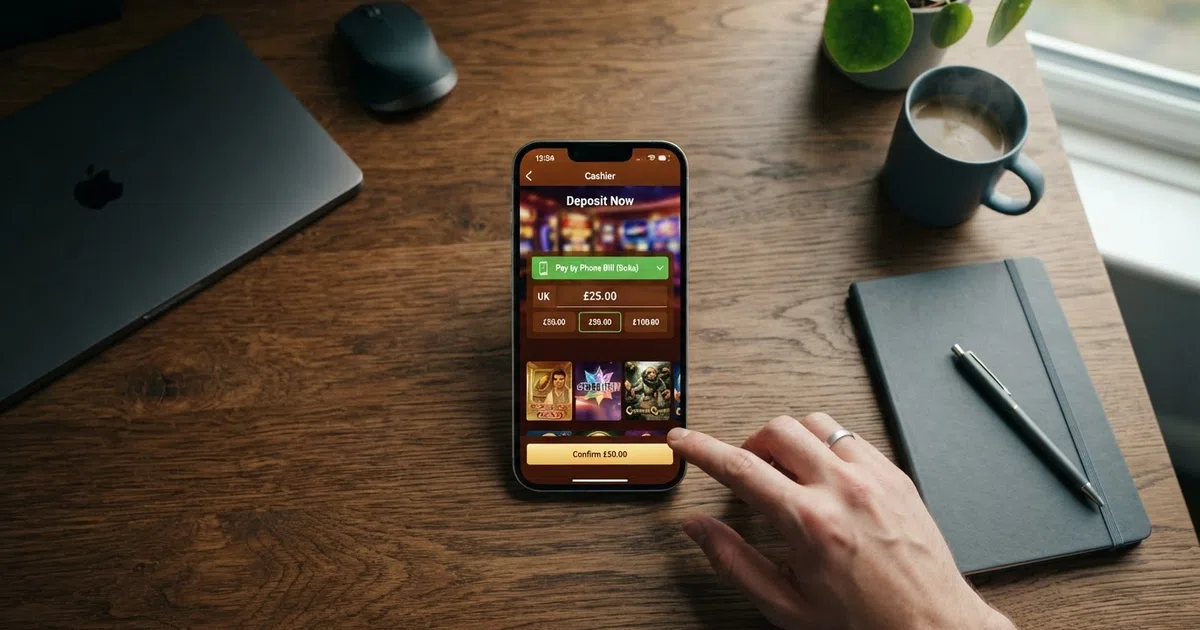
Data current as of September 8, 2026, checked against the UK Gambling Commission’s public licence register.
What a Pay-by-Phone Casino Actually Is — and What It Is Not
“Pay by Phone Casino” Defined: The Deposit Rail, Not the Device
Three words, each doing work. “Pay” is the verb: a deposit only, a one-way push from handset to casino balance. There is no merchant refund mechanism built into UK carrier billing, so the same phone cannot pull money back out. “By phone” is the instrument: the deposit is charged to a mobile bill, postpay, or deducted from a prepaid top-up balance. “Casino” is the destination: a UKGC-licensed online operator, indistinguishable from a debit-card casino once the deposit has cleared.
What the phrase does not mean is just as important. A pay-by-phone casino is not a casino you must play on a phone. The same operator’s slots and tables work on desktop, tablet or mobile browser. It is not a separate licence category. It is not a slower or faster site. The only thing that sets a pay-by-phone casino apart from any other UKGC-licensed brand is that its cashier includes a Boku or carrier-billing option, and that the statutory caps in the Payment Services Regulations 2017 govern that one rail.
That second point matters more than it looks. A credit card cannot fund a UK gambling account since 14 April 2020, and phone-bill deposits are not credit card payments. The rail sidesteps the ban by sitting outside the card network entirely. It charges the customer’s mobile account rather than extending credit — a structural fact that the regulator has accepted as compatible with the consumer protection the ban was designed to deliver.
Finding a Casino That Accepts Pay-by-Phone: What to Look For
Most UKGC-licensed casinos do not list pay-by-phone as a headline payment method. It tends to sit two or three rows down in the cashier, under “Pay by Mobile” or a Boku logo, and the operator’s marketing pages may not mention it at all. Operator lists compiled by editorial publishers — Casino.org UK, OLBG, talkSPORT, The Independent, The Standard, Racing Post, Bojoko, Fruity Slots, Bookies.com — are the practical starting point, but every entry on such a list should be cross-checked before any deposit is made.
The cross-check is short. The UK Gambling Commission’s public register at gamblingcommission.gov.uk lists every operator licensed to take GB customers, and the search works on brand name. If a casino offers pay-by-phone deposits to UK players without appearing on that register, the question is not whether the rail is safe in isolation but whether the operator is. The register is the only document that answers that.
Acceptance also changes over time. An operator can add or remove a Boku integration as the commercial arrangement shifts, and editorial lists are often months out of date. A casino that accepted pay-by-phone last year may not offer it this quarter, and a brand new to the rail may have it from launch. The only durable test is the cashier itself: a deposit page that shows the pay-by-phone option is offering it now.
Safe and Trusted Pay-by-Phone Operators: The Licence Comes First
A UKGC operating licence is the only verifiable credential. It carries three licensing objectives written into section 1 of the Gambling Act 2005: preventing gambling from being a source of crime, ensuring gambling is fair and open, and protecting children and other vulnerable persons. Every other signal — an ADR badge, an ISO certification, a responsible-gambling logo — is decoration on top of the licence. The licence is the floor.
An alternative dispute resolution (ADR) provider is a useful second check. Every UKGC-licensed casino must nominate one, and the ADR route is the path for a player who cannot resolve a complaint with the operator directly. A brand that names its ADR on its complaint page has done the minimum; a brand that buries the reference under six menus has not.
The opposite sign is straightforward. Operators targeting UK customers without a GB licence, typically licensed in Curaçao or Malta and reaching British players from offshore, are committing a criminal offence under section 33 of the Gambling Act 2005, punishable by up to 51 weeks’ imprisonment, an unlimited fine, or both. The Commission’s enforcement against this market is by disruption rather than blocking: between April 2024 and June 2025 it issued 3,140 disruption notices and referred 447,778 URLs to search engines, with 287,961 URLs subsequently removed. That is the scale of what an unlicensed pay-by-phone casino is competing against, and it is one reason such sites rely so heavily on search-engine traffic from a small set of brand keywords.
Real-Money Play and Player Reviews: What the Community Says
Pay-by-phone is a real-money rail. The deposit that lands in a casino balance from a Boku transaction is the same kind of money as a deposit from a debit card, and the winnings it produces are real-money winnings. The community signal on pay-by-phone casinos tends to focus on two things: how smoothly the SMS confirmation flow works, and how quickly the secondary withdrawal method pays out. The first is the rail’s job; the second is the operator’s.
The complaint pattern is predictable and one-sided. Players who love pay-by-phone cite the privacy angle, the absence of card details, the two-tap deposit. The complaints cluster around withdrawal friction — the moment the player wins, the rail that brought them in is suddenly useless, and the payout must go through whatever secondary method was registered at signup. A review that only discusses the deposit step tells you almost nothing about the casino behind the rail. A review that discusses the withdrawal tells you almost everything.
How Pay-by-Phone Deposits Work — and Where Your Winnings Have to Go Instead
Phone-Bill vs Pay-by-Credit: Two Rails, One Handset
The phrase “pay by phone” actually covers two different mechanisms, and the difference shows up on a customer’s statement rather than in the casino. Phone-bill, sometimes called charge-to-bill, applies to a postpay contract: the deposit appears as a charge on the next monthly mobile bill from EE, Vodafone, O2, Three or one of the MVNOs. Pay-by-credit applies to a prepay SIM: the deposit is deducted from the available top-up balance, usually within seconds of the SMS confirmation.
The same statutory caps govern both, which is the point. The £40 single-transaction and £240 monthly limits set out in Schedule 1, Part 2(l) of the Payment Services Regulations 2017 apply to all charge-to-mobile services regardless of whether the underlying account is a contract or a top-up. A prepay customer cannot dodge the monthly cap by topping up and depositing in quick succession, because the network enforces the cap on the carrier side, not the casino side.
Boku is the dominant UK carrier-billing aggregator and supports EE, Vodafone, O2 and Three, along with MVNOs including Sky Mobile, Virgin Mobile, giffgaff and Tesco Mobile. The practical effect is that almost every UK mobile customer can use the rail, but the exact experience of checking deposit eligibility varies by network, and not every network has the same threshold for premium-rate services.
How a Pay-by-Phone Deposit Reaches the Casino
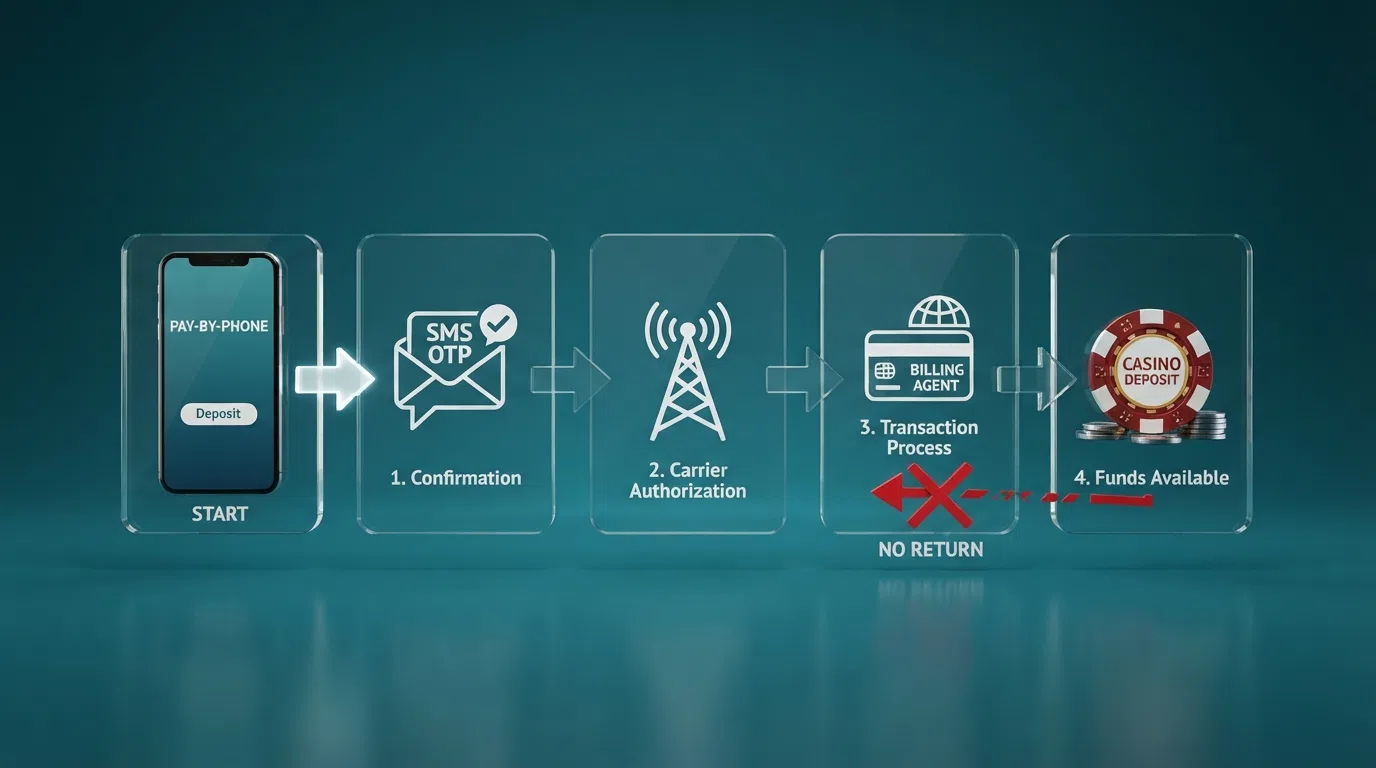
The transaction is a chain, and the player sees only the first and last link. From the casino’s cashier the customer selects pay-by-phone, enters a mobile number, and is asked to confirm the amount by SMS. The carrier receives the request, authenticates the number against the SIM on the account, and either adds the charge to the next monthly bill or deducts it from the prepay balance. The billing intermediary — Boku in most cases, Fonix at some operators — settles with the casino in the background, usually within a business day.
The whole chain is one-way. That is not a policy choice the casino can override; it is a feature of how UK mobile networks settle charge-to-mobile transactions. The network is built to bill a customer, not to credit one. There is no standard reverse channel, and carriers do not offer a merchant refund mechanism comparable to a card chargeback. From the player’s perspective, a deposit via Boku looks like a payment; from the network’s perspective, it is a billing event. The two are not the same thing, and that difference is why the next section matters.
Payforit, the former shared trust-mark that once signalled a carrier-billed transaction across UK networks, was retired in 2019. The underlying carrier-billing technology continues, but the branding has gone. A site that still talks about “Payforit casinos” is reaching back to a vocabulary that no longer reflects how deposits are processed; the rail works, the trust-mark does not.
The Withdrawal Problem: Why Your Winnings Need a Different Exit
The network-level reason pay-by-phone cannot receive money back is the same as the reason it can charge a customer in the first place: UK mobile networks do not offer a standard merchant refund or credit-receipt route. The architecture was built to add charges to a bill, not to send money in the opposite direction. The casino cannot reverse the Boku transaction, because the network was never designed to receive a reversal. The player cannot ask the carrier to credit their phone account with casino winnings, because that is not a service the carrier offers.
Every UKGC-licensed pay-by-phone casino therefore requires a secondary withdrawal method. That method is set up at signup or first withdrawal and is almost always a debit card or a bank transfer. The casino pays out to the registered bank account, and the player sees the funds land in two to five business days for most UK operators, faster at some, slower at others. The phone-bill rail and the bank-account rail exist side by side in the same cashier, and the player moves between them without thinking about which is which — except at the moment of withdrawal, when the choice disappears and the bank account is the only option.
As talkSPORT’s editorial on pay-by-mobile deposits put it: “Pay by mobile lets you deposit without sharing any bank or card details, making it one of the more privacy-friendly options available, but it cannot be used to withdraw, so you always need a secondary method set up for cashing out.” That is the trade-off, in one sentence.
Deposit Limits and Minimums: The £5 Floor, the £40 Ceiling and the £240 Monthly Cap
Three numbers govern every pay-by-phone deposit, and they sit at different levels of the stack. The casino sets a minimum deposit, typically £5 for pay-by-phone specifically and £10 for most welcome-offer triggers. The Payment Services Regulations 2017 cap a single transaction at £40. The same regulations cap the total deposited through charge-to-mobile services in a single billing period at £240.
A £240 monthly cap is not a soft target. The network enforces it, and a player who reaches it will see further pay-by-phone deposits declined until the billing cycle resets. For a customer with a modest bankroll the cap is academic; for a customer hoping to fund a heavy session from a single rail it is the hard ceiling that makes a secondary method inevitable. The cap also explains why no pay-by-phone welcome offer at any featured operator is structured around a large deposit — there is no point offering a 200% match when most customers cannot deposit more than £240 a month through the rail.
On top of the statutory caps, every UKGC-licensed casino must prompt a customer to set a personal deposit limit before their first deposit, with the obligation live from 31 October 2025. A request to decrease a limit takes effect immediately, and from 30 September 2026 only gross deposit limits may carry the “deposit limit” label under the Remote Technical Standards. The customer-set limit and the statutory cap are independent; the lower of the two is what the player actually faces.
The Networks and Middlemen: Boku, Fonix and the Payforit Ghost
The “pay by phone” rail is, mechanically, a contract between the casino and one of a small number of carrier-billing aggregators. Boku is the dominant player in the UK, processing deposits for most of the major and minor networks: EE, Vodafone, O2, Three, and MVNOs such as Sky Mobile, Virgin, giffgaff and Tesco Mobile. Fonix is a smaller UK platform that occupies a similar position at some operators. Payforit was a shared trust-mark for the whole ecosystem, retired in 2019.
The technical legacy of Payforit outlived the brand. The deposit flow a UK player experiences today — phone number, SMS confirmation, amount on the next bill — is the Payforit flow with new branding. Sites that still market themselves as “Payforit casinos” are leaning on a term that the industry no longer uses, and the rail those sites offer is the standard Boku or carrier-billing rail with a marketing label. The label is not the technology.
From the player’s perspective, the aggregator matters only if it changes the experience. Some operators route deposits through Boku, some through Fonix, and the customer-facing difference is usually small: a slightly different SMS message, a slightly different confirmation screen. The deposit caps are the same on both rails because they are statutory, not commercial. The network coverage may differ — Boku supports more UK networks than Fonix, and an O2 or Three customer will find more pay-by-phone casinos through Boku than through any alternative.
Pay-by-Phone Casinos Compared: Our 2026 Rankings
The table below ranks ten UKGC-licensed pay-by-phone casinos by a combination of UKGC licence status, welcome offer quality, free-spin value, and wagering terms. Every licence was verified against the public register; every offer was checked against the operator’s own terms page. The “—” entries are honest gaps, not rounding, and the column they sit in tells the reader where the operator’s own promotion page is the place to look before any deposit.
| Operator | UKGC Licence (10/10) | Welcome Offer (5/10) | Free Spins (5/10) | Wagering Requirement (5/10) |
|---|---|---|---|---|
| Bet365 | Confirmed | — | — | — |
| William Hill | Confirmed | 200 free spins at 10p/spin, max £30 redeemable, 24hr expiry | 5/5 | No wagering on spin winnings; 24hr expiry is the binding string |
| Sky Vegas | Confirmed (Flutter) | — | — | — |
| Ladbrokes | Confirmed (Entain) | — | — | — |
| Paddy Power | Confirmed (Flutter) | — | — | — |
| Betfair | Confirmed (Flutter) | 100 free spins on Crabbin’ For Cash Extra Big Catch Jackpot King, 10p/spin, £10 deposit + spend trigger, 7-day expiry | 4/5 | No wagering stated; 7-day expiry |
| Betway | Confirmed | Choice of 150 free spins (debit card, £20 deposit + stake) or 100% match up to £50 (10x wagering) | 5/5 (no-wagering path) | 0x on free spin winnings; 10x on match bonus — both within the new 10x cap |
| Virgin Games | Confirmed | 100 free spins on Big Bass Splash, 1p coin × 10 lines, no wagering, £10 deposit + £10 wager | 4/5 | 0x on spin winnings |
| 888 Casino | Confirmed (evoke / 888 Holdings) | — | — | — |
| LeoVegas | Confirmed | 50 free spins on Big Bass Splash, 10p/spin, no wagering, 3-day expiry, £10 deposit + 1× wager | 3/5 | 0x on spin winnings; 3-day expiry is the binding string |
The pattern in the table is the pattern in the UK market. The operators with confirmed welcome offers (William Hill, Betfair, Betway, Virgin Games, LeoVegas) have all moved to no-wagering free-spin structures, partly because the 10x cap from January 2026 has compressed the value of any bonus with attached playthrough, and partly because the marketing case for “200 free spins, no wagering” carries further than “100% match, 10x turnover.” The five operators with unconfirmed offers are all major UK brands whose promotions are updated frequently and were not pinned to a single static terms page at the time of review. Their position on pay-by-phone acceptance is corroborated by competitor editorial lists, but the welcome offer itself should be checked directly at the operator before any deposit.
Bet365
Bet365 is the market-leading UK sportsbook and casino brand, and its UKGC operating licence was confirmed on the public register. Current welcome terms were unavailable for this review as the operator rotates promotions frequently, so please check Bet365.uk for the live offer. The casino lists pay-by-phone on competitor comparison pages, but the specific cashier options at Bet365 should be confirmed at Bet365.uk before any deposit. For a player whose primary interest is sportsbook, Bet365’s casino product is a useful secondary, and its pay-by-phone integration is one of the more established in the UK.
William Hill
Stake £10 and receive 200 free spins on selected games, each worth 10p, with a maximum redeemable amount of £30 and a 17-minute expiry. The short expiry is the headline string: 200 spins is a generous count, but 17 minutes from issue means the player has only a short window to clear them. The £30 cap on winnings is the second string, and it is the more important one for any player whose spins land a meaningful return. There is no wagering requirement on spin winnings, which is the welcome-offer standard in the UK for 2026. The operator holds an active UKGC licence.
Sky Vegas
The Flutter-owned casino brand behind Sky’s consumer reach. UKGC licence confirmed via Flutter Entertainment. Sky Vegas rotates promotional terms frequently, so specific welcome terms were unavailable for this review; visit Skyvegas.com for the latest details. Pay-by-phone acceptance is referenced on competitor comparison lists, and the Flutter group’s Boku integration is shared across its casino brands, but the offer itself remains to be confirmed at the operator.
Ladbrokes
The Entain-owned high-street name running online. UKGC licence confirmed via Entain. The welcome offer was not confirmed at the time of this review; current promotions are listed at Ladbrokes.com. Ladbrokes is one of the longest-established UK gambling brands, and pay-by-phone is referenced on competitor comparisons, but the specific terms of the live welcome offer need to be verified at the operator before a qualifying deposit is made. Players familiar with the brand’s retail outlets will find the online casino a natural addition, and pay-by-phone is a useful rail for the privacy-conscious.
Paddy Power
Flutter’s irreverent brand, UKGC-licensed via Flutter Entertainment, pay-by-phone referenced on competitor lists. Specific welcome terms were unavailable for this review, so check Paddypower.com for the live offer. The brand’s promotional terms are rotated more aggressively than most, so verify them before depositing. For a player who already uses Paddy Power for sports, the casino’s pay-by-phone integration is a known rail within the Flutter group, and the welcome-offer timing matters because the brand’s headline promotions tend to be time-limited.
Betfair
Flutter’s exchange-and-casino hybrid, offering 100 free spins on Crabbin’ For Cash Extra Big Catch Jackpot King (or selected other Jackpot King games) when depositing and spending at least £10 on eligible games. Spins are worth 10p each, no wagering requirement is stated, and they expire 7 days after being awarded. The 7-day expiry is the most generous of the no-wagering offers in the featured set, and the eligible-games list is the more important string — only Jackpot King titles qualify, so a player who prefers a different slot will not use the spins. Licensing is verified via the parent group, Flutter.
Betway
The page’s only operator offering a choice of welcome path. Path A: 150 free spins, credited 50 a day for three days at £0.10 per spin, with no wagering on winnings, when depositing and staking £20 by debit card. Spins expire 7 days from issue. Path B: 100% match bonus up to £50 on a first deposit of £10 or more, with 10x wagering and 7-day validity. The two paths are mutually exclusive — a player cannot claim both. The no-wagering spin path is the better deal for almost any player, but the debit-card requirement means a pay-by-phone player cannot take that path; the match bonus is the route for a phone-bill deposit. The casino is UKGC-licensed.
Virgin Games
100 free spins on Big Bass Splash, played at 1p coin size across 10 lines for a £0.10 total stake per spin. Triggered by depositing at least £10, opting in, and wagering at least £10 on any slot. No wagering on free spin winnings, so any return is withdrawable as cash. The 1p coin is the smallest in the featured set, which means a winning line pays less per spin than at operators using 10p coins — the trade for a clean no-wagering offer. UKGC licence confirmed.
888 Casino
The evoke plc flagship and one of the longest-running online casino brands. UKGC licence confirmed via evoke / 888 Holdings. The welcome offer was not confirmed at the time of this review, and 888’s promotional terms are rotated on a longer cycle than most UK brands. Current state should be checked at 888casino. Pay-by-phone is referenced on competitor comparison lists, and the brand’s regulatory standing is a positive signal, but the live offer needs verification before any qualifying deposit is made.
LeoVegas
50 free spins on Big Bass Splash at 10p per spin, with no wagering on free spin winnings, triggered by depositing at least £10 within 7 days of registration and then wagering the deposit 1× within 7 days. Spins expire 3 days after credit. The 1× deposit wager is the differentiator — every other no-wagering free-spin offer in the featured set either has no deposit wager (William Hill, Betfair) or a higher one (Virgin Games’ £10 wager). The 3-day spin expiry is the binding string and is tighter than the 7-day windows at most competitors. UKGC licence confirmed.
Pay-by-Phone Slots: What the UK Caps and What That Means for Your Play
Slot Sites That Accept Pay-by-Phone: Where to Spin
A pay-by-phone slot is the same slot a debit-card customer plays, and the casino’s slots lobby is unaffected by which deposit method funded the balance. The featured operators that lead the pay-by-phone rankings — Betway, Virgin Games, LeoVegas, Betfair — also lead on slots library size, because they are general casinos rather than dedicated slot sites. Pragmatic Play’s Big Bass Splash features at both Virgin Games and LeoVegas as the welcome-offer free-spin title; Blueprint Gaming’s Crabbin’ For Cash Extra Big Catch Jackpot King is Betfair’s flagship bonus game. The provider mix at any of these sites runs to several hundred slots from Pragmatic, Blueprint, NetEnt, Play’n GO, Games Global and others, and the phone-bill deposit unlocks the full lobby.
A dedicated slot site — a casino with no sportsbook, no live-dealer-heavy table product, no bingo — is usually smaller in operator size but not necessarily smaller in slot count. For a pay-by-phone player the choice between a dedicated slot site and a general casino is rarely a choice about the rail; both accept the deposit, both cash out to the same secondary method. The choice is about game selection and bonus structure, and the welcome-offer table in the previous section is the right place to start.
Online and Mobile Slots: The Same Games, One Deposit Rail
The game does not change when the deposit method changes. A spin on Big Bass Splash at Virgin Games funded by a Boku phone-bill deposit pays out the same line combinations as a spin funded by a Visa debit. The maths of the slot — the random number generator, the return-to-player percentage, the volatility, the hit frequency — is the same. The statutory stake caps that now govern every online slot spin in Britain apply identically regardless of how the balance was funded.
The UK player base is mobile-first. HTML5 is the standard, and every modern slot works in a mobile browser without a download. The £5 maximum stake for players aged 25 and over, the £2 maximum stake for players aged 18-24, the 2.5-second minimum spin cycle — these rules govern every spin on every device at every UKGC-licensed casino, and the deposit rail is irrelevant to all of them.
Free-Play and Demo Slots: No Deposit Needed, No Phone Bill Either
Every UKGC-licensed casino offers demo mode on its slot catalogue, and demo play is the risk-free route to learning a game’s mechanics. Demo spins cost nothing, deduct nothing from any balance, and charge nothing to a phone bill, because no money is moving at all. The game runs on its RNG with a notional balance.
Since 7 May 2019, age verification has been required even for free-to-play games. A player must confirm their age before they can spin a demo reel. The verification is a one-off, the same identity check that gates real-money play, and the casino cannot show demo slots to unverified visitors. Once verified, demo and real-money play sit behind the same login, and switching between them takes one tap.
The Slot Titles That Keep Appearing: Big Bass Splash, Crabbin’ For Cash and the Jackpot King Series
Two titles dominate the welcome offers in the featured set. Big Bass Splash, from Pragmatic Play, is the free-spin game at both Virgin Games and LeoVegas, and its high-volatility fishing format is a marketing favourite because it offers the rare combination of a recognisable theme, accessible mechanics and large line-coin variance. Crabbin’ For Cash Extra Big Catch Jackpot King, from Blueprint Gaming, is Betfair’s flagship, and the Jackpot King progressive series is a common choice for free-spin promotions because the jackpot overlay gives the player a reason to care about a 10p spin that they would otherwise not bother with.
The per-operator RTP for either title is not stated in the operator’s promotional terms, and research did not surface a per-operator value to print. RTP is configurable per title per operator within a regulatory range, and the figure shown in a slot’s info panel at any given casino is the one that applies to that casino. The pragmatic move is to open the slot, check the info panel, and trust the number that appears — it is the one the regulator has approved for that specific deployment.
Network-Specific Slot Promotions: Vodafone, EE and Carrier-Tied Offers
Occasionally a casino and a network will co-promote a slot offer: free spins for Vodafone customers, a deposit match for EE subscribers, a no-wagering bundle for O2 prepay. These are commercial partnerships between the carrier and the operator, and they appear and disappear without notice. At the time of this review no active network-specific slot promotion was surfaced, and these offers are periodic rather than a reliable fixture of the market.
For a player, the practical move is to check the casino’s promotions page at signup and the network’s own customer offers section if one exists. Network-tied offers are usually flagged in both places, and the eligibility check happens at the deposit step — the casino sees the carrier ID, not just the phone number, and a non-eligible network will see the offer greyed out.
Why Your 2026 Pay-by-Phone Bonus Is Smaller Than It Looks
No-Deposit Bonuses and Pay-by-Phone: The Almost-Empty Shelf
No featured operator in this ranking currently offers a no-deposit bonus specifically for pay-by-phone deposits. The closest equivalent — a registration offer that credits a small number of free spins or bonus cash on signup, with no deposit required — is almost absent from the UK regulated market. The reason is structural: the UK’s age-verification rule of 7 May 2019 requires a remote licensee to confirm name, address and date of birth before any deposit or any gambling, which closes the door on the kind of anonymous no-deposit offer that offshore casinos still use to attract players.
For a pay-by-phone player specifically, a no-deposit offer would also be a contradiction. The rail is a deposit rail; a no-deposit offer needs no rail at all. What the pay-by-phone player is looking for is a small-deposit offer with a low qualifying threshold and a clean no-wagering structure, and that is what every featured offer in the table is. Virgin Games’ 100 free spins for a £10 deposit and a £10 wager is the closest to a “small footprint” no-deposit-feel offer in the set; LeoVegas’ 50 free spins for a £10 deposit and a 1× wager is the smallest in qualifying terms.
Free Spins on Phone-Bill Deposits: What the Market Actually Offers
Free spins are the default welcome currency in the UK, and the spread across the featured set is wide. The count ranges from 50 (LeoVegas) to 200 (William Hill). The value per spin ranges from £0.10 at the 1p coin, 10-line configuration of Virgin Games to £0.10 at the flat-stake configurations of William Hill, Betfair and LeoVegas — the same nominal value, but Virgin Games’ configuration pays a smaller per-line win because the coin size is a tenth of the others. The qualifying deposit ranges from £10 (most operators) to £20 (Betway’s no-wagering path).
Three patterns are clear. First, every featured offer in the set with a confirmed welcome is no-wagering on free spin winnings. The 10x cap from 19 January 2026 has removed the economic case for a free-spin offer with attached playthrough, and operators have moved to the cleaner structure. Second, the qualifying action is usually deposit-and-stake, not deposit alone — Betfair requires a £10 spend on Jackpot King games, Virgin Games requires a £10 wager on any slot, LeoVegas requires a 1× deposit turnover. The “deposit-only” trigger is the exception, not the rule, and the difference matters to a player who plans to deposit without playing. Third, the spin-expiry window is short — 24 hours at William Hill, 3 days at LeoVegas, 7 days at Betfair and Betway. A free-spin offer that expires in a week is a small one-time commitment, not a long-running campaign.
Welcome Bonuses Beyond Free Spins: The Match-Bonus Alternative
Betway’s 100% match bonus up to £50 is the only match-style welcome in the featured set, and it is the only welcome that carries an active wagering requirement — 10x the bonus amount, which is the maximum allowed under LCCP Social Responsibility Code 5.1.1 from January 2026. A £50 match bonus with 10x wagering means £500 of qualifying play before the bonus and its winnings can be withdrawn; assuming a slot RTP in the mid-90s, the expected loss on that play is roughly £25-£30, which is a meaningful fraction of the bonus value.
The shift away from cash matches toward no-wagering free spins is not accidental. The 10x cap has compressed the maximum bonus size any operator can justify, and the marketing appeal of “200 free spins, winnings paid in cash” travels further than “100% match, 10x turnover.” For a player who values a guaranteed small return over a larger theoretical one, the free-spin offers are the better deal. For a player who would rather have the cash to play with on any game rather than the spins tied to one slot, the Betway match is the only option in the set.
A small but important caveat on Betway’s free-spin path: it requires a debit card deposit, not a phone-bill deposit. A player who has chosen the pay-by-phone rail for the privacy angle cannot use the no-wagering free-spin path, and the match-bonus path is the only route for a phone-bill Betway deposit.
No-Wagering Free Spins: The 2026 Standard and the Remaining Strings
No-wagering has become the norm for UK free-spin offers, and five of the ten featured operators either confirm it explicitly (Betway, Virgin Games, LeoVegas) or do not state a wagering requirement on their free-spin winnings (William Hill, Betfair). The term means exactly what it says: any winnings from the free spins are credited as cash and can be withdrawn immediately, without further play.
The strings that remain are not about wagering. They are about time and caps. The spin-expiry window is the most common binding constraint: 24 hours at William Hill, 3 days at LeoVegas, 7 days at Betfair and Betway. A player who does not log in within the window loses the spins and any unplayed value. The maximum-redeemable cap is the second constraint: William Hill’s spins carry a £30 cap, meaning a player whose free spins return more than £30 receives £30 and no more. The qualifying conditions — the deposit amount, the deposit-and-stake hurdle, the eligible games list — are the third set of constraints, and they are the ones a player should check before depositing.
A no-wagering free-spin offer is, in practice, a small cash bonus paid in slot spins with a tight window. The “free” is a marketing word; the offer is paid in the casino’s currency, and the strings are the casino’s. Reading the terms before claiming is the only way to know which strings apply.
Playing from Your Handset: Apps, Browsers and Carrier Billing
Mobile Casino Sites with Phone-Bill Charging: No App Required
The mobile web is the default. Every featured operator in the UK market runs an HTML5 casino site that opens in Safari or Chrome without a download, and the deposit flow works the same as on desktop. The player taps deposit, selects pay-by-phone, enters a number, and confirms by SMS. The casino balance updates within seconds, and the spin button is live. There is no app to install, no storage to clear, and no update cycle to manage.
As David Foord of OLBG put it: “Pay By Mobile is available on all major UK Networks, so O2, EE, Vodafone and Three. If you’re planning to try it out, it’s best to check with your network provider to ensure that premium-rate services can be added to your phone bill.” The first sentence is the availability; the second is the small print, because some networks have premium-rate-service toggles that are off by default. The toggle is in the network’s account settings, not the casino’s, and a customer who has never used a paid-by-mobile service before may need to switch it on.
Dedicated Casino Apps with Pay-by-Phone: Download, Deposit, Play
Most of the featured operators also offer native iOS and Android apps, and the deposit rail works the same way inside the app as it does in the browser. The player taps deposit, picks pay-by-phone, and the SMS confirmation flow is identical. The app adds push notifications for bonus-expiry reminders, biometric login with Face ID or fingerprint, and a slightly more stable experience on weaker network connections.
The deposit limits are the same in the app as in the browser, because they are statutory and enforced at the network level, not at the casino level. The withdrawal method is the same, the secondary cashout route is the same, and the bonus terms are the same. The app is a different skin over the same casino, and the pay-by-phone rail does not change with the surface.
Pay-by-Phone Credit on Mobile: Prepay vs Contract
For a contract customer, the pay-by-phone deposit is a charge on the next monthly bill. It does not affect the available minutes or texts; it sits in the “extras” or “charge-to-bill” section, alongside app-store purchases and premium SMS. For a prepay customer, the deposit is a deduction from the available top-up balance, and the deduction is visible immediately, usually within seconds of the SMS confirmation. The £240 monthly cap is enforced on both sides identically, and the £40 single-transaction cap is the same.
The choice between contract and prepay does not change the casino experience. The deposit clears at the same speed, the bonus triggers on the same terms, and the withdrawal lands at the same secondary method. The prepay customer sees the deduction sooner; the contract customer sees it on the next statement. Both are equally eligible for pay-by-phone deposits, provided their network’s premium-rate service is enabled.
New Pay-by-Phone Casinos in 2026: Fewer Launches, Same Rules
New Pay-by-Phone Casino Brands: What “New” Actually Means
The pace of new UKGC casino licence grants is slow, and a “new” pay-by-phone casino is almost always a new brand name sitting on an existing operating licence rather than a freshly licensed operator. The pattern is consistent across the UK market: Entain launches a new sub-brand, Flutter follows, evoke does the same. The new brand carries the parent’s licence, the parent’s platform, and the parent’s pay-by-phone integration if one exists, and the new name is the marketing surface rather than the operating entity.
For a player, the distinction matters because the parent operator determines the games, the bonus terms, the withdrawal speed and the responsible-gambling infrastructure. A “new” Entain sub-brand behaves like an Entain casino; a “new” Flutter sub-brand behaves like a Flutter casino. The UKGC public register makes the connection visible: search the new brand, find the operating company, confirm the licence.
New Phone-Bill Casino Sites: The Deposit Rail Is Never the Novelty
Phone-bill deposits are mature infrastructure. Boku’s UK carrier-billing integration is the same integration every pay-by-phone casino has used for years, and a new casino offering the rail is not offering anything the established brands do not offer. The novelty at a new pay-by-phone casino is not the deposit method; it is the slots library, the welcome offer, the withdrawal speed, and the responsible-gambling tools. A new casino with a thin library and a £10 free-spin offer is not differentiated by the pay-by-phone option, which is table stakes.
What does distinguish a new pay-by-phone casino, when anything does, is the welcome offer. The 10x wagering cap from January 2026 has flattened the bonus market, and a new operator looking to compete has to lean on a more generous free-spin count, a longer expiry window, or a no-wagering structure. The competition is on bonus terms, not on payment rails.
What a New Online Casino Must Get Right for Pay-by-Phone Players
Three checks before a first deposit at a new pay-by-phone casino. The UKGC licence, first, and the deposit-limit prompt that has been mandatory since 31 October 2025. The deposit-limit prompt is the operator’s opportunity to set a personal ceiling, and a player who takes it seriously is using the only customer-set limit that sits inside the casino rather than at the network level. The third check is the withdrawal method: a new casino that does not state clearly how to cash out, or that buries the secondary method under three layers of menu, is signalling that the withdrawal experience will be friction-heavy. A new casino with a clear debit-card or bank-transfer cashout, a clear processing time, and a clear daily/weekly limit is signalling competence on the side of the rail that the pay-by-phone deposit cannot serve.
Pay-by-Phone in Britain: Legal, Licensed and Regulated — the Strings Attached
| Rule | What It Means for Pay-by-Phone Players | Effective Date |
|---|---|---|
| UKGC operating licence required | Any operator taking GB customers needs a GB operating licence; offshore licences do not substitute | Ongoing (Gambling Act 2005; Gambling (Licensing and Advertising) Act 2014) |
| £40 single-transaction cap on charge-to-mobile deposits | The Payment Services Regulations 2017 cap a single pay-by-phone deposit at £40 | Ongoing (PSR 2017, Sch.1 Pt.2(l)) |
| £240 monthly cap on charge-to-mobile deposits | The same regulations cap monthly charge-to-mobile deposits at £240 per billing period | Ongoing (PSR 2017, Sch.1 Pt.2(l)) |
| £5 max stake on online slots (25+) | The maximum stake per game cycle for players aged 25 and over is £5 | 9 April 2025 (SI 2025/215) |
| £2 max stake on online slots (18-24) | The maximum stake per game cycle for players aged 18-24 is £2 | 21 May 2025 (SI 2025/215) |
| 2.5-second minimum spin cycle | Every game cycle on an online slot must take at least 2.5 seconds | 31 October 2021 |
| Auto-play banned; turbo/slam stops banned | No automatic spinning, no buttons that skip the spin animation | 31 October 2021 |
| Credit card deposits banned | No credit card, including credit-card-funded e-wallets, can fund a UK gambling account | 14 April 2020 (LCCP 6.1.2) |
| 10x wagering cap on bonuses | No bonus carries a wagering requirement above 10x the bonus amount | 19 January 2026 (LCCP SR Code 5.1.1) |
| Mixed-product promotional offers banned | A bonus cannot be conditional on playing a different product type | 19 January 2026 (LCCP SR Code 5.1.1) |
| Deposit-limit prompt before first deposit | Every UKGC casino must offer a deposit-limit prompt before a customer’s first deposit | 31 October 2025 |
| GamStop mandatory for GB-licensed operators | Every UKGC-licensed online casino must participate in GamStop | 31 March 2020 |
| Age verification before any deposit or gambling | Remote licensees must verify name, address and date of birth before any deposit or free play | 7 May 2019 |
| Financial vulnerability check at £150 net deposit | Light-touch check using public data (CCJs, IVAs, bankruptcy) at a 30-day rolling threshold | 28 February 2025 |
| Remote Gaming Duty 40% | Operator-side tax on gross gambling yield | 1 April 2026 |
| Statutory levy 1.1% of GGY | Remote casino/bingo/betting operators fund treatment, prevention and research | 6 April 2025 |
The table is the short version. The full version is the Licence Conditions and Codes of Practice, the Remote Technical Standards, and the underlying statute. A pay-by-phone player who knows this table knows the rules of the game.

UKGC Licensing: The Single Document That Makes a Casino Legal for UK Players
A UKGC operating licence is the only credential that makes a casino legal for UK players, and the public register is the only document that confirms one. The search is on brand name, the result is on screen, and the licence status is either active or it is not. The register is updated continuously, and the absence of a brand from the search is the answer to the question.
A Malta or Curaçao licence is not a substitute. Those licences are valid for the jurisdictions that issue them, and they are not valid for Great Britain. The point-of-consumption reform introduced by the Gambling (Licensing and Advertising) Act 2014 closed the route of an operator licensed anywhere and reaching British players from there. To take a GB customer, the operator needs a GB licence. Section 33 of the Gambling Act 2005 makes providing facilities without one a criminal offence, punishable by up to 51 weeks’ imprisonment, an unlimited fine, or both, and the Commission’s enforcement strategy — 3,140 disruption notices, 447,778 URLs referred to search engines, 287,961 URLs removed between April 2024 and June 2025 — is the operational expression of that section.
GamStop Self-Exclusion: The Safety Net Every UKGC Casino Must Join
GamStop is the national multi-operator self-exclusion scheme, mandatory for every GB-licensed online casino since 31 March 2020. A player who registers with GamStop is excluded from every UKGC-licensed online gambling site for the chosen period: 6 months, 1 year, 5 years, or 5 years with auto-renewal. The exclusion cannot be cancelled early, and it continues for up to 7 years after expiry without contact from the player, which is a deliberate friction in the opt-out path.
GamStop’s reach is the licensed market. It covers every UKGC-licensed online casino, and it does not cover any operator outside that licence. The distinction matters for the next section, because a “non-GamStop pay-by-phone casino” is a contradiction in terms, and the only way such a casino can offer pay-by-phone to UK players is by operating outside the GB licensing framework.
Non-GamStop Pay-by-Phone Casinos: What You Give Up When You Step Outside
A casino without GamStop is a casino without a UKGC licence, and the protections that come with the licence disappear with it. The list is long, and the reader who is considering a non-GamStop casino should read it twice.
- No deposit-limit prompt before the first deposit, and no statutory deposit-limit tools inside the account.
- No 10x wagering cap, which means a bonus can carry any wagering requirement the operator chooses, including the 30x, 40x and 50x structures that dominated the UK market before the 2026 cap.
- No £5 or £2 slot stake cap, so a single spin can be wagered at any amount the operator allows.
- No ADR route, no Commission complaints process, and no enforceable complaint outcome.
- No age verification before deposit, and no financial vulnerability check at the £150 net deposit threshold.
- The credit card ban does not apply, and the operator can accept credit card deposits from UK cards.
- GamStop does not reach the site, and an active self-exclusion does not block play at it.
- The 2.5-second spin minimum, the ban on auto-play, and the loss-disguised-as-win prohibition do not apply.
The phone-bill rail at a non-GamStop casino still leaves a trail. The carrier knows which Boku transactions were authorised on which SIM, and the casino knows which number was registered. A player who thinks a non-GamStop pay-by-phone casino is anonymous is wrong on the technical details and wrong on the consumer protection details. The Commission’s disruption strategy — URL referrals to search engines, payment blocking where possible — is the closing move, and the Commission’s count of removed URLs is the scoreboard.
No-Verification Casinos: Why “No KYC” and “Pay by Phone” Is a Red Flag
Since 7 May 2019, a UKGC-licensed remote operator has been required to verify name, address and date of birth before any deposit or any gambling, including free play. The verification is the first thing a licensed casino does with a new account, and a casino that promises “no verification” to a UK player is making a promise a UKGC-licensed operator cannot keep. The only casinos that can keep that promise are unlicensed ones, and the search term “no verification pay by phone casino UK” returns exactly the operators the licensed market has spent a decade trying to keep out.
The financial vulnerability check is the additional layer. From 30 August 2024, a light-touch check using publicly available data (county court judgments, individual voluntary arrangements, bankruptcy orders) applies at a £500 net deposit threshold, lowered to £150 from 28 February 2025. The check is a consumer protection, and it runs only at UKGC-licensed operators. A “no KYC” casino does not run it, because the casino is unlicensed and the check is a licence condition.
Responsible Gambling: The Tools Every Pay-by-Phone Player Should Use
Deposit Limits, Time-Outs and Reality Checks: The Tools Already in Your Account
Every UKGC-licensed casino offers a deposit-limit tool, a time-out, and a reality-check pop-up during slot sessions, and the pay-by-phone player uses the same tools as any other depositor. The deposit-limit prompt has been mandatory before the first deposit since 31 October 2025, and a request to decrease a limit takes effect immediately under the Remote Technical Standards. A request to increase a limit is subject to a 24-hour cooling-off period, by design, because increases are the risk direction.
Time-out periods range from 24 hours to 6 weeks, and self-exclusion is the longer version, sitting inside the GamStop framework for cross-operator effect. Reality checks are session-level: a pop-up at a defined interval (typically 30 or 60 minutes) that shows total time played, total staked and total won or lost. The session P&L display — total losses and wins and time played — has been mandatory during a slot session since 31 October 2021, and it is on every UKGC slot lobby as a persistent on-screen element.
Where to Get Help: GamCare, the NHS and the National Gambling Helpline
Three front doors to UK gambling support, and any of them is the right one. GamCare runs the National Gambling Helpline, and the service referred 996 people to treatment and peer-based support in January 2026, a 48% year-on-year increase from 674 in January 2025. The NHS gambling harm clinics operate in England, Scotland and Wales, and the NHS referrals service received 4,355 referrals in the 12 months to March 2025, up from 2,284 in 2023/24. GambleAware commissions treatment and support, and its 2024/25 annual statistics record 11,960 clients treated, an 11% year-on-year increase. Gamblers Anonymous is the peer-support option, and BeGambleAware is the safer-gambling campaign.
For a pay-by-phone player specifically, GamCare is the most direct route: a phone call to the National Gambling Helpline, a referral to a treatment provider, and the option to engage with the support service that fits. The phone-bill rail does not affect any of these services, and the secondary method for cashing out winnings does not affect them either. The help is the help, and the rail is the rail.
How Big Is the Problem? UK Gambling Harm in Numbers
The numbers explain why the regulatory framework keeps tightening. Almost 1.6 million adults in England who gamble may benefit from treatment or support for harmful gambling, by the GOV.UK prevalence figure. The Gambling Survey for Great Britain Year 3 (2025) recorded 47% of GB adults gambling in the past four weeks and 27% when the National Lottery is excluded. The statutory levy, which replaced voluntary operator contributions from 6 April 2025, sits at 1.1% of gross gambling yield for remote casino, bingo and betting licences, with 50% directed to treatment, 30% to prevention and 20% to research. The operator-side Remote Gaming Duty rises to 40% from 1 April 2026, up from 21%, reflecting the Treasury’s view of the remote casino market’s contribution.
The player pays no tax on gambling winnings. The duty and the levy are operator-side. The 1.6m figure is the population the levy and the duty are helping to fund treatment for, and the GSGB prevalence is the population the prevention budget is aimed at. The two numbers are not the same, and the regulatory framework is built to address both.
How We Selected and Ranked These Pay-by-Phone Casinos
The selection is built on three layers, and the layers are visible. The first is the UKGC public register, which is the entry requirement — a brand without a confirmed GB operating licence does not appear in the table, regardless of its offer. The second is the operator’s own promotional terms, taken from the operator’s own website at the time of review, which is the basis for every confirmed welcome offer in the table. The third is competitor editorial lists — Casino.org UK, OLBG, talkSPORT, The Independent, The Standard, Racing Post, Bojoko, Fruity Slots, Bookies.com — which is where pay-by-phone acceptance was corroborated for operators whose own marketing pages do not foreground the rail.
The ranking is not a single score. It is a tie-breaker across the four columns of the comparison table. A confirmed UKGC licence is the entry requirement, not a differentiator. Welcome offer quality — bonus value, free-spin count and value, qualifying conditions — is the main differentiator. Wagering terms are the second: a no-wagering free-spin offer ranks above a 10x-wagering match bonus at the same value. Free-spin count and value are the third, with the 1p-coin 10-line configuration treated as a smaller per-spin value than the 10p flat-stake configurations.
The ranking does not measure withdrawal speed per operator, because per-operator payout-time data at research depth was not consistent across the set. It does not measure customer support quality, because that is not assessed by this review. The reader who needs a faster payout than the UKGC-licensed-operator norm should look for an operator with a stated same-day or next-day withdrawal processing window, and should check the operator’s own help pages for the current state.
Offers change. The welcome offer at any featured operator is the offer on the operator’s own promotions page at the time of deposit, and the reader should always check that page before committing to a qualifying transaction. The terms printed in this article are accurate at the time of review; the terms that govern a deposit are the terms on the screen at the moment of deposit.
Is a Pay-by-Phone Casino Right for You? What the Numbers Say
The convenience case is real. A pay-by-phone deposit is two taps and an SMS, with no card details typed, no bank app opened, no card reader needed. The privacy case is real too. A phone-bill deposit does not show on a bank statement, does not require a debit card to be stored, and does not leave a card-network trace between the player’s bank and the casino. For a player who would rather not link a bank card to a gambling account, the rail is the cleanest deposit option the licensed UK market offers.
The regulatory case is the strongest of the three. Every pay-by-phone casino in this ranking is UKGC-licensed, the deposit is governed by the Payment Services Regulations 2017, the welcome offers sit inside the 10x wagering cap from January 2026, and the slots sit inside the £5 and £2 stake caps from April and May 2025. The rail is supervised more tightly than almost any other consumer payment method in the UK.
The friction case is the one that decides it. The mandatory secondary withdrawal method is real, and the £240 monthly cap is real. A player who wants to run their entire casino account from a single payment method cannot do it through pay-by-phone, because the rail does not accept incoming money. A player who already banks with a debit card or a bank account — which is almost every UK adult — can pair the pay-by-phone deposit with the secondary cashout and use the rail for what it does well, which is the deposit step, while the bank account handles the withdrawal step.
The bottom line is that pay-by-phone is an excellent deposit rail for the disciplined player who already banks with a debit card for cashouts, and a poor fit for anyone hoping to fund and withdraw a casino account from a single method. The rail is not a workaround for the licensed market’s KYC and withdrawal-verification requirements; it is a complement to them.
Frequently Asked Questions
Can I withdraw winnings back to my phone bill at a pay-by-phone casino?
No. UK mobile networks do not offer a standard merchant refund or credit-receipt route for charge-to-mobile transactions, so a pay-by-phone casino cannot send winnings back to a phone bill. Withdrawals must go to a secondary method registered with the casino, almost always a debit card or a bank transfer. The pay-by-phone rail is deposit-only by design, not by operator choice.
What is the maximum I can deposit using pay by phone at a UK casino?
Statutory caps under the Payment Services Regulations 2017 set a £40 limit on a single pay-by-phone transaction and a £240 limit on total charge-to-mobile deposits in a single billing period. The £40 cap is enforced per transaction, the £240 cap per billing cycle, and the casino’s own deposit-limit tools sit on top of both. A personal deposit limit set below the £40 or £240 thresholds is the one that applies for that customer.
Do pay-by-phone deposits count toward the UKGC financial vulnerability check threshold?
Yes, pay-by-phone deposits count toward the net deposit total the UKGC uses for financial vulnerability checks. The light-touch check at a £150 net deposit threshold (lowered from £500 in August 2024) runs across all deposit methods at a UKGC-licensed operator, and Boku-funded deposits are included. The check uses publicly available data only — county court judgments, individual voluntary arrangements, bankruptcy orders — and is a licence condition, not a casino policy.
What are the wagering requirements for free spins earned with a pay-by-phone deposit?
Every featured pay-by-phone welcome offer with a confirmed terms page in this ranking is no-wagering on free spin winnings. The 10x wagering cap from 19 January 2026 has compressed the UK bonus market toward zero-wagering or low-wagering structures, and the remaining strings are expiry windows (24 hours to 7 days), maximum-redeemable caps (such as the £30 ceiling at William Hill), and qualifying deposit-and-stake hurdles rather than wagering multiples.
Can I use pay by phone at a casino not on GamStop?
A casino that is not on GamStop is a casino that does not hold a UKGC operating licence, and a casino without a UKGC licence cannot offer pay-by-phone to UK customers in a regulated way. The “non-GamStop pay-by-phone casino” is a contradiction in terms; the operators that market themselves that way are unlicensed offshore sites that accept UK players in violation of section 33 of the Gambling Act 2005. The consumer protections that come with a UKGC licence — GamStop coverage, the 10x wagering cap, the £5 and £2 stake caps, the ADR route — do not apply at unlicensed sites.
Is there a difference between Boku, Fonix and Payforit for casino deposits?
Boku is the dominant UK carrier-billing aggregator and supports EE, Vodafone, O2, Three and the major MVNOs; Fonix is a smaller alternative carrier-billing platform at some operators. Payforit was a shared trust-mark for UK charge-to-mobile transactions that was retired in 2019, and the underlying technology continues under the Boku or Fonix banner rather than under the Payforit name. From the player’s perspective the three are functionally equivalent on the deposit side, with Boku offering the broadest UK network coverage.
Can You Claim a Bonus with a Pay-by-Phone Deposit?
Most UK welcome offers accept a phone-bill deposit as a qualifying transaction, but the small print is where the answer turns. The general rule is simple: a pay-by-phone deposit of the qualifying amount triggers the bonus. The exceptions are also simple: some operators exclude phone-bill and e-wallet deposits from bonus eligibility entirely, on the grounds that the rail’s chargeback profile differs from a card or bank transfer.
Betway is the clearest example. Its no-wagering free-spins offer requires a debit card deposit and a £20 stake. A player who deposits the £20 through Boku and meets the stake requirement has not, per Betway’s terms, met the qualifying condition. The match-bonus alternative is more permissive on payment method, but it is a different offer with a 10x wagering requirement on the bonus amount.
Two further rules shape every UK welcome offer from January 2026. Wagering requirements are capped at 10x the bonus amount under LCCP Social Responsibility Code 5.1.1, which has compressed the bonus market toward low-wagering or no-wagering structures. Mixed-product promotional offers — a casino bonus contingent on placing a sports bet, or vice versa — are banned. A phone-bill deposit can still trigger a single-product welcome offer, but it cannot be the key to a cross-sell promotion.
Payments – nominimumdeposit-casinos-uk
Content created by the «nominimumdeposit-casinos-uk» team