
Where You Can Still Pay by Bank Cheque at a UK Online Casino — and Whether You Should
 Available in GB
A bank cheque in 2026 sounds like a contradiction in terms. Most UK players under forty have never written one. Yet the method persists, held in place by a small but stubborn corner of the market, a few licensed operators that still post deposit addresses on their banking pages, and a UK Government statement in March 2026 that cheques “remain an important payment method for some people.” For those players — older users, those without digital banking, high-rollers who prefer the paper trail of a draft drawn on a bank’s own funds — the question is not whether cheques exist as a casino banking method. It is where, how quickly, and at what cost.

This page answers that question with the published facts: which of ten named UK-licensed operators actually confirmed a cheque route, what the deposit and withdrawal windows look like in real time, where the limits sit, what fees exist (and where they don’t), and what protections the Gambling Commission extends over a paper payment. It also takes a clear position on the bigger question: for most UK players reading this, a Faster Payments transfer or a debit card will serve them better. Cheques still have a narrow, legitimate place, and it is described honestly below.
Current as of September 8, 2026. Licence claims verified against the UK Gambling Commission’s public register of licence holders.
What a Bank Cheque Casino Actually Is
What “bank cheque” means at a UK online casino
A bank cheque is a cheque drawn on a bank’s own funds rather than on a personal current account. The issuing bank guarantees the value at the moment of issue, which removes the bounced-cheque risk that a personal cheque carries. In UK casino banking, the term is used loosely — operators’ help pages often say “bank cheque” when they mean “cheque” full stop, and some will accept a personal cheque while others insist on a bank draft. The distinction matters more for the player than the operator: a personal cheque drawn on a current account can be stopped or returned unpaid; a bank cheque or bank draft is, in practical terms, as good as cash once issued.
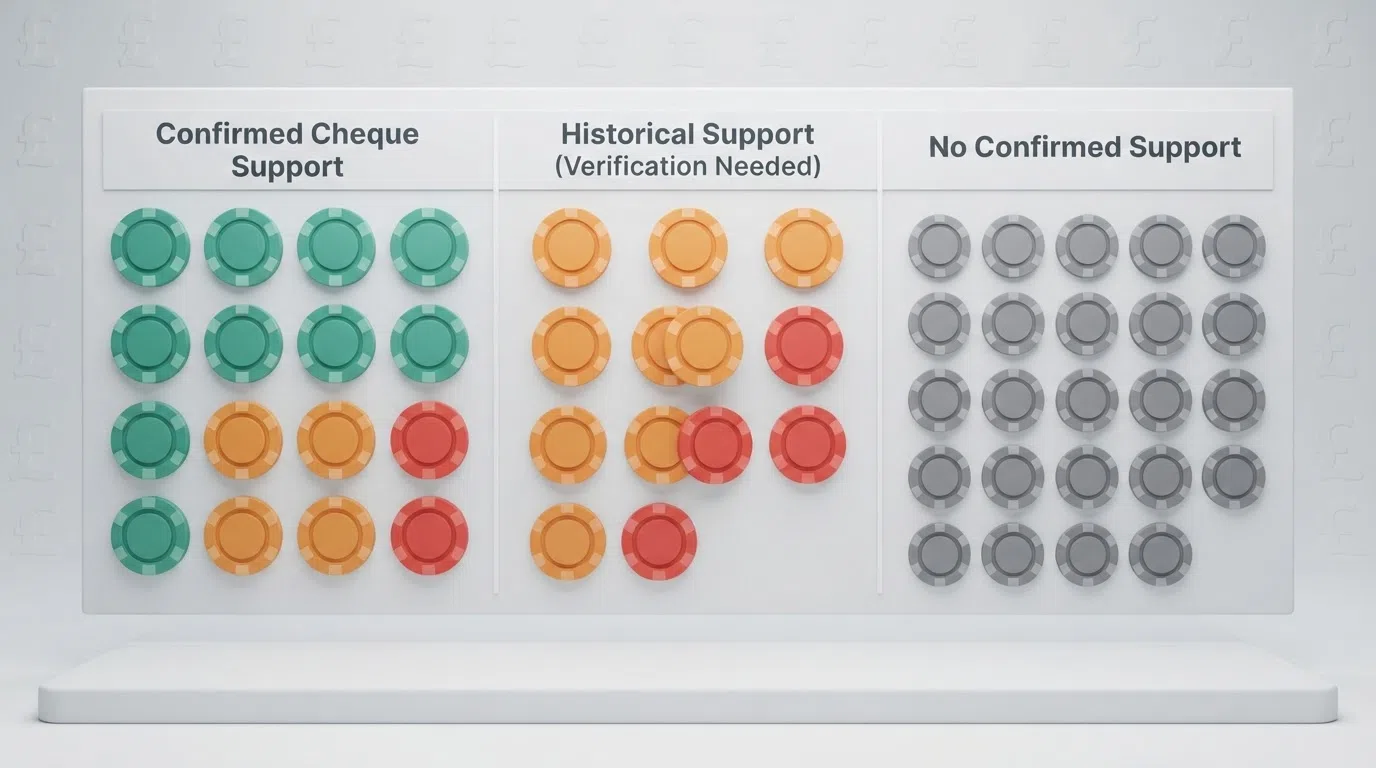
For most of the last two decades, every major UK bookmaker accepted cheques by post as both a deposit and a withdrawal route. That has changed. Out of ten operators checked for this guide, two confirmed active cheque support, three sit in a historical or unverified category, and five have moved to instant bank transfers, debit cards, and e-wallets without publishing a cheque option. The method is alive, but the market around it has thinned sharply.
How a posted cheque reaches a digital balance
The mechanics are older than the websites that use them. A player writes a cheque payable to the operator, writes the casino account number on the reverse, and posts it to a deposit address — usually a PO box held by the operator’s payments team. On arrival, the operator’s banking department logs the cheque against the player’s account, banks it through its own business banking, and waits for the cheque to clear through the UK cheque-clearing system. Only then does the balance become playable.
The clearing window is what defines the experience. At the fastest confirmed operator, the gap from envelope to playable funds is around ten days. At the slow end, with postal delays on both ends and a bank holding the cheque for the full clearing cycle, the same journey can stretch to four weeks. Cheque imaging — photographing the cheque via a mobile app rather than posting the paper — exists as a technology and was cited by the UK Government in March 2026 as an available alternative, but it has not been adopted by UK online casinos in any meaningful way for deposits.
Why some UK players still reach for a chequebook in 2026
The demographic skews older, but the reason is not always digital hesitancy. Some players do not want to share card numbers or online banking credentials with a gambling site, even a licensed one. Others are high-value customers used to settling large positions by bank draft — the same instrument they use for property deposits and legal settlements. A third group values the friction: a cheque in the post creates a natural cooling-off window that a one-tap instant deposit does not. None of these reasons is irrational, and the UK Government has formally recognised that cheques “remain an important payment method for some people” — language that would be unusual if the cohort were vanishingly small.
The paper trail matters too. A bank cheque is a physical instrument, drawn on a named bank, with a serial number, a counterfoil, and a paper record at both ends. For players who keep their gambling spend auditable in a way their bank statement will not show — joint accounts, business banking, shared cards — a cheque is the cleanest way to keep the two streams separate.
Bank cheque vs. debit card vs. bank transfer vs. e-wallet
The choice is not whether cheques are “good” or “bad.” It is what each method costs in time, friction, and protection. A debit card deposit is instant; a bank transfer via Faster Payments is also instant and increasingly free at the operator end; an e-wallet like PayPal is instant both ways with a buyer-protection layer; a bank cheque is days to weeks and one-way in practice. On the security axis, a cheque shares no card or banking credentials with the casino — but it also lacks the chargeback route that a debit card provides for disputed transactions, and it has no fraud-protection equivalent to PayPal’s. On the anonymity axis, a cheque creates no digital payment footprint at the user’s bank, which is the dimension that some players care about and most do not.
The one place cheques still lead is ceiling. William Hill’s published cheque deposit range runs from £25 to £100,000 — a bracket wide enough to cover any single deposit a UK player is likely to make. Faster Payments caps vary by bank but typically sit at £10,000 to £25,000 per transaction; debit cards are lower still under the operator’s own limits. For a player moving a five-figure sum in one go, the cheque is still the instrument.
The Full Payment Lifecycle: Sending, Clearing, and Cashing Out by Post
Sending a cheque to fund your play
A few practical points, drawn from the operators that still process them:
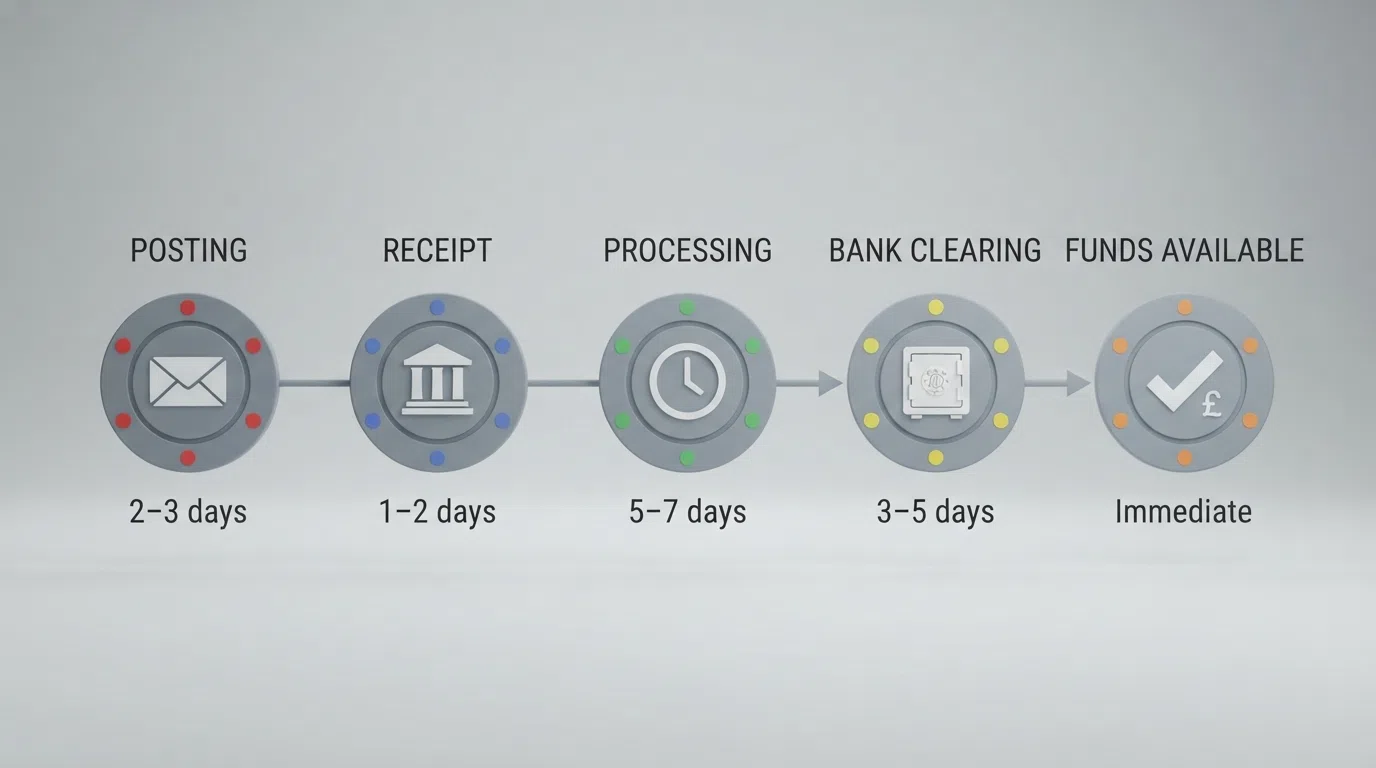
- Contact the operator’s customer support before posting anything. Some require advance notice by email, others will simply return an unannounced cheque with no account credit.
- Write the cheque payable to the operator’s banking entity — the name printed on the deposit-address page, not the trading name. The cheque’s payee line is the detail that trips up first-time depositors most often.
- Write your casino account number or username on the reverse. Without it, the payments team has no way to match a cheque to an account, and the funds will sit in limbo until the player contacts support.
- Post by recorded delivery. The Royal Mail does not accept liability for standard post, and a lost cheque drawn on a bank account is a mess that takes weeks to resolve.
- The processing window after the envelope arrives is around ten days at the fastest confirmed operator. From the date of posting to a playable balance, budget two weeks as a working assumption.
Cashing out by post: how many days a cheque withdrawal really takes
The withdrawal side is the slower half of the cycle, and the figure most often quoted — a week — is the best case, not the average. At BoyleSports, the published processing window for cheque withdrawals is one to ten days; at Bwin, the comparable “Cheque by Mail” service runs seven to twenty banking days from initiation, with a £50 minimum. The total end-to-end time, from requesting a withdrawal to having the cheque deposited in the player’s own bank account, runs from roughly ten days to nearly four weeks depending on the operator, the postal service, and the receiving bank’s clearing cycle.
The reason is mechanical. The operator has to issue the cheque, post it to the player’s address, and the player then has to bank it — which means another clearing cycle at the receiving end. A withdrawal that “takes one to ten days” to process is, in practice, a withdrawal that takes at least three weeks to clear. OX Magazine, in a 2026 piece on casino payment methods, put it bluntly: “the average withdrawal time will take much longer than when using debit cards or eWallets.”
Minimum and maximum limits for cheque casino payments
The confirmed bracket, from the operators that publish one, runs from £25 at the floor to £100,000 at the ceiling — a William Hill range that covers every realistic single-deposit scenario. Bwin’s £50 minimum on the withdrawal side is the lower-published bound for cheque payouts. Other operators either do not publish a cheque-specific limit or do not offer the method at all. The £25-to-£100,000 range is wider than any other payment method at the same operator, and that is precisely the demographic the cheque serves: players whose deposit size is large enough to make the wait worthwhile.
Against this, the absence of published cheque limits at eight of the ten operators checked is itself a signal. A method that the operator is happy to publicise has limits in the banking page; a method that has been quietly retired does not.
Bank cheque, personal cheque, or bank draft: what UK casinos actually mean
The terms blur. A bank cheque is drawn on the issuing bank’s own funds and guaranteed at issue. A bank draft is the same instrument under a different name — the two are used interchangeably in UK retail banking. A personal cheque is drawn on a current account, carries a stop-and-return risk, and depends on the drawer’s available balance at the moment the cheque is banked. UK casinos that accept cheques will, in most cases, accept any of the three, but the safest and fastest to clear is the bank cheque or bank draft. The right question to ask customer support before posting is simple: “Do you accept a personal cheque, or do you require a bank draft?” The answer determines whether the deposit will sail through or sit in pending.
10 UK Operators Checked for Postal Deposits: The Confirmed, the Historical, and the No
| Operator | Cheque Support | Welcome Offer | Wagering Requirement | Bonus Validity |
|---|---|---|---|---|
| William Hill | Confirmed (deposit & withdrawal) | 200 free spins on Big Bass Splash (10p each), stake £10+ | 10× on spin winnings | 72 hours |
| BoyleSports | Confirmed (withdrawal, 1–10 days) | Up to 100 free spins (stake £20/50/100 same day) | 10× on bonus winnings | 72 hours |
| Bet365 | Historical — verification needed | Varies by product | Varies | Varies |
| 888casino | Historical — verification needed | 100% deposit bonus up to £100 on £10+ first deposit | 10× on selected slots | 90 days |
| Paddy Power | Historical — verification needed | Varies | Varies | Varies |
| Betfred | Not confirmed (bank transfer 1–3 days) | 200 free spins on selected slots, stake £10+ | 0× on free-spin winnings | 7 days |
| Ladbrokes | Not confirmed | Bet £10 on slots, get 100 free spins (10p each) | 10× on bonus winnings | 7 days (48h to accept) |
| Coral | Not confirmed | Bet £10 on any slot, get 100 free spins (10p each) | 10× on bonus winnings | 7 days (48h to accept) |
| Sky Vegas | Not confirmed | Up to 200 free spins on selected game, deposit and spend £10 | 0× on free-spin winnings | 7 days |
| Gala Bingo | Not confirmed | Spend £10 on slots, get 100 free spins (10p each) | 0× on free spins | 7 days |
William Hill — confirmed bank cheque deposits and withdrawals
William Hill is the standout operator in this list and the one whose cheque process is best documented. Bank cheque deposits are accepted with a published minimum of £25 and a maximum of £100,000, and clearance takes approximately ten days from the date the cheque arrives at the operator’s deposit address. Cheque withdrawals are available on the same basis, with comparable processing time. The welcome offer is a 200-free-spin package on Big Bass Splash at 10p per spin, triggered by a £10 deposit and a £10 stake, with 10× wagering on winnings and a £30 cap on total winnings; spins expire 72 hours from credit. The operator is GB-licensed via WHG (International) Limited, account 39225, active on the UKGC register since 1 January 2009. Large-scale deposits benefit from William Hill’s high ceiling and confirmed cheque route.
BoyleSports Ltd holds an active GB licence on the UKGC register.
BoyleSports confirms cheque as a withdrawal method with a published processing time of one to ten days, which is the tightest processing window of any operator on the list. The deposit side is not as well documented; the operator’s published payment methods lean toward debit cards, bank transfer, and e-wallets, and a cheque deposit route is not surfaced on the current help pages. The welcome offer is a tiered free-spin package — stake £20 for 20 spins, £50 for 50 spins, or £100 for 100 spins on the same day, at 10p per spin, valid 72 hours from issue. For a player who needs a cheque withdrawal specifically — and a faster one than the industry norm — BoyleSports is the right address. BoyleSports Ltd holds an active GB licence on the UKGC register.
Bet365 — historical cheque support, current status unverified
Bet365 once accepted cheques with a £500 per-transaction cap and processing times of around seven days, according to historical sources. The current help-centre deposit-methods page does not list cheques, which is a signal but not a confirmation — help pages are not always exhaustive, and a payment route can be available on request even when it is not advertised. Status requires direct verification on the bet365 site. The operator is GB-licensed via Hillside (UK Gaming) ENC, account 55149. The welcome offer varies by product, which is typical for a multi-vertical operator of bet365’s scale. Direct contact with support is recommended to confirm current cheque support before posting any funds.
Paddy Power — historical cheque and wire support
Paddy Power is in a similar position to bet365: historical sources (including Bookiebusters.net reviews) confirm cheque and wire as deposit and payout methods at the brand, and the current help pages do not re-confirm the method this run. The operator is GB-licensed via PPB Counterparty Services Limited, part of the Flutter group, and is active on the UKGC register. The welcome offer varies by product. The right move for a Paddy Power customer who wants to use a cheque is the same as for bet365: contact support and confirm the method is still processed before posting.
888casino — historical cheque processing with photo ID
888casino once offered cheque deposits and withdrawals with a photo-ID verification step and processing times of around eight days. The method is not listed on the current 888 help pages, and verification is needed on the operator’s site. The current welcome offer is a 100% deposit bonus up to £100 on a first deposit of £10 or more, with 10× wagering on selected slots within 90 days and a £100 cap on winnings. 888 UK Limited holds an active GB licence on the UKGC register under the evoke group. A player considering 888 for cheque play should treat the welcome offer as the primary draw and confirm the cheque route before counting on it.
Betfred — no confirmed cheque support, strong UK presence
Betfred is one of the largest UK bookmakers and holds an active GB licence via Petfre (Gibraltar) Limited. Bank transfer is confirmed at one to three days, and the operator runs a broad range of payment methods — but cheque support is not explicitly listed in current published materials. The welcome offer is 200 free spins on selected slots for new customers who deposit and stake £10 or more within 14 days, with 0× wagering on free-spin winnings, 10p per spin, and seven days’ validity. A player who wants a Betfred account for the brand’s strong UK retail presence and UKGC standing will find the welcome offer competitive; the same player should not assume a cheque route is available.
Ladbrokes — no confirmed cheque support
Ladbrokes is GB-licensed via LC International Limited under the Entain group, with an active entry on the UKGC register. The current payment-method range is broad — instant bank transfer, debit cards, PayPal, Apple Pay — and cheque is not confirmed. The welcome offer is “Bet £10 on slots, get 100 free spins” on selected games at 10p per spin, with 48 hours to accept and seven days’ validity, plus 10× wagering on bonus winnings. A player who values Ladbrokes’ UK standing and the breadth of its payment options will find a strong alternative-payments offering; the cheque route is not part of it.
Coral — no confirmed cheque support
Coral shares the LC International Limited licence with Ladbrokes, both under Entain ownership. Payment methods confirmed in current materials include bank transfer, PayPal, and in-shop cash deposits at Coral retail locations; cheque is not confirmed. The welcome offer mirrors Ladbrokes — Bet £10 on any slot, get 100 free spins on selected games at 10p each, 48 hours to accept, seven days’ validity, 10× wagering on bonus winnings. This operator is best suited for those seeking a mix of online breadth and in-shop deposit convenience.
Sky Vegas — no confirmed cheque support
Sky Vegas is GB-licensed via Bonne Terre Limited, part of the Flutter group, and active on the UKGC register. Confirmed payment methods include debit cards, PayPal, and bank transfer; cheque is not confirmed. The welcome offer is up to 200 free spins on a selected game with 0× wagering on winnings, triggered by depositing and spending £10 within 30 days, with spins expiring after seven days. A player choosing Sky Vegas is choosing it for the no-wagering welcome structure and Flutter group standing, not for a cheque route.
Gala Bingo — no confirmed cheque support
Gala Bingo sits under the same LC International Limited / Entain licence as Ladbrokes and Coral. Confirmed payment methods include debit cards, PayPal, and Paysafecard; cheque is not confirmed. The welcome offer is a £10 slot spend for 100 free spins at 10p each on selected games, with 0× wagering on free-spin winnings, claimable within seven days of registration and valid for seven days from credit. The same payment-method caveat applies: strong welcome structure, no cheque route.
The Rules That Govern Paper Gambling Payments: UKGC Licensing, KYC, and Your Protections
| Restriction | What It Caps | Threshold or Limit | In Force Since |
|---|---|---|---|
| Credit card ban | Gambling funded by credit | All remote gambling (LCCP 6.1.2) | 14 April 2020 |
| Online slots stake cap (25+) | Maximum bet per game cycle | £5 | 9 April 2025 |
| Online slots stake cap (18–24) | Maximum bet per game cycle | £2 | 21 May 2025 |
| Bonus wagering cap | Wagering requirements on bonuses | 10× (LCCP SR 5.1.1) | 19 December 2025 |
| Financial vulnerability check | Net deposits triggering a check | £150 in rolling 30 days (SR 3.4.4) | 28 February 2025 |
| Mandatory deposit-limit offer | First-deposit prompt to set a limit | Required before first deposit | 31 October 2025 (extended to 30 September 2026) |
| GAMSTOP | Self-exclusion from all GB-licensed online gambling | Mandatory for licensees | 31 March 2020 |
The UK Gambling Commission and bank cheque payments
The UK Gambling Commission is the single statutory regulator for commercial gambling in Great Britain, set up under the Gambling Act 2005 and extended by the Gambling (Licensing and Advertising) Act 2014. The 2014 Act introduced point-of-consumption licensing: any operator taking GB players, wherever based, must hold a GB licence. The day-to-day obligations on licensees sit in the Licence Conditions and Codes of Practice (LCCP) and the Remote Technical Standards (RTS). No specific LCCP provision prohibits or permits cheques as a payment method — the framework addresses payment types through outcome-based conditions (source-of-funds verification, anti-money-laundering compliance) rather than naming individual instruments. A bank cheque, treated as a payment from the player’s own funds, sits comfortably within that framework. A cheque drawn on a third party’s account, or a cheque that cannot be reconciled to the depositing player’s identity, sits outside it.
Why the credit card ban does not apply to bank cheques
The credit card ban — LCCP licence condition 6.1.2, in force since 14 April 2020 — prohibits licensees from accepting payment for gambling by credit card. The ban covers all remote gambling and has been extended to credit-card-funded payments routed through e-wallets. The rationale is the prevention of gambling on borrowed money. A bank cheque drawn on the player’s own current account, or a bank draft purchased with the player’s own funds, is not borrowed money. It is the opposite — cash-equivalent funds that the player has already saved. The policy intent of the ban, and the legal scope of LCCP 6.1.2, both place cheques outside the prohibition. The distinction is precise, and it is the reason a licensed UK casino can accept a bank cheque while refusing a credit card deposit.
KYC and identity verification when depositing by cheque
Every GB-licensed remote operator must verify the player’s name, address, and date of birth before any deposit or any gambling — a requirement in force since 7 May 2019. The verification happens online, usually during the account-opening flow, and it must be complete before the first deposit is accepted. For a cheque deposit specifically, the verification timeline is the same as for any other payment method: the KYC check is on the player, not on the instrument. A cheque that arrives at the deposit address before KYC is complete will be returned or held pending verification, not credited. The framework does not include a “named account” rule of the German or Italian kind — a requirement that the payment instrument be drawn on an account in the player’s own name — and no such rule was confirmed in UK regulation for this guide. The verification obligation runs through the operator, not the payment instrument.
Player protections under UK law: what you get at a licensed cheque casino
A GB-licensed operator is bound by the three licensing objectives of the Gambling Act 2005: preventing gambling from being a source of crime, ensuring gambling is fair and open, and protecting children and vulnerable persons. Practically, that means access to Alternative Dispute Resolution (ADR) for unresolved complaints, the right to escalate to the Gambling Commission, mandatory GAMSTOP self-exclusion, and the safer-gambling tools covered in the next section. At an unlicensed site, every one of those protections is absent. Providing gambling facilities without a GB licence is a criminal offence under section 33 of the Gambling Act 2005, carrying up to 51 weeks’ imprisonment, an unlimited fine, or both — penalties aimed at the operator, not the player. The player who uses an unlicensed site loses the protection, not the freedom. There is no confirmed penalty for the player, but there is also no ADR route, no Commission complaints path, and no GAMSTOP.
How to check a casino’s UKGC licence before you send a cheque
A short list of checks, drawn from the Commission’s own guidance:
- Search the UKGC public register at gamblingcommission.gov.uk/public-register/businesses. The register carries every active licence holder — 2,663 active records at the time of writing — and a brand is either on it or not.
- Confirm the account number, trading name, and licence status. A valid entry will show the licence status as “Active” and the licence type as “Operating Licence” (remote).
- Treat a foreign licence (Curaçao, Malta, Gibraltar) as not equivalent. A GB licence is compulsory at point of consumption. A Malta Gaming Authority or Curaçao licence does not satisfy the requirement.
- If the operator is not on the register, do not post a cheque. There is no route back through a regulator that does not recognise the operator.
Safer Play with Paper Deposits: The Tracking Blind Spot and the Tools That Help
The spend-tracking blind spot: why cheque deposits are harder to monitor
A cheque in the post creates a gap between when the player spends and when the system sees it. The cheque is written and posted on day one, arrives at the operator on day two or three, is logged against the account on day four or five, and clears through the banking system around day ten. During that window, the deposit does not exist in the operator’s records in a way the deposit-limit tool can monitor. A player who has set a £500 weekly deposit limit and posts two cheques of £300 in the same week has, in practical terms, deposited £600 against a limit set at £500. The system catches up — but only when the second cheque clears, not when it is posted.
This is a genuine consumer-protection concern, not a feature, and no competing page covers it. For a player using deposit limits, the practical step is to keep a manual record of every cheque posted and to treat the posted date, not the cleared date, as the spend date. For those not using deposit limits, the gap remains largely academic, but the potential for unmonitored spend is the single most important practical difference between a cheque and an instant payment method.
Deposit limits and cheque-specific controls at UK casinos
From 31 October 2025, every GB-licensed remote operator must offer the player a chance to set a financial limit before the first deposit takes place; the deadline was extended to 30 September 2026. The limit that may be called a “deposit limit” under RTS 12 is a gross deposit limit — based solely on money paid in — and only that form may carry the label. A cheque counts toward the deposit limit when it clears, not when it is posted, which is the mechanism behind the blind spot above. Financial vulnerability checks sit alongside the deposit-limit framework: under LCCP Social Responsibility Code 3.4.4, operators must run a check at a £150 net deposit threshold in a rolling 30-day period, using publicly available data (county court judgments, bankruptcies, individual voluntary arrangements, debt relief orders). The check is mandatory from 28 February 2025. For a player depositing large amounts by cheque, the £150 threshold is crossed on the first cheque that clears; the operator then runs the check on the next deposit.
Beyond the limit tools, the LCCP prescribes a set of game-design rules that apply to every slot session regardless of payment method: auto-play banned, spin speed floor of 2.5 seconds, features that speed up play banned, losses disguised as wins banned, reverse withdrawals permanently banned, and a mandatory on-screen display of total losses, wins, and time played.
GAMSTOP self-exclusion: how it works when you deposit by cheque
GAMSTOP is the national multi-operator self-exclusion scheme, free to use and mandatory for every GB-licensed online operator since 31 March 2020. A player can exclude for six months, one year, five years, or five years with auto-renewal. The exclusion cannot be cancelled early. If the player does not contact GAMSTOP after the exclusion period expires, the exclusion continues for up to seven further years. At the end of 2025, over 562,000 people were actively excluded, with 58,675 new registrations in the final six months of the year and a 40% year-on-year increase in 16–24-year-old sign-ups.
For a player who has registered with GAMSTOP, a cheque already in the post is the one scenario worth understanding. A GAMSTOP exclusion is applied at the operator’s end: once active, the operator must not accept any further deposits or allow any further gambling from the excluded player. A cheque that arrives at the deposit address after the exclusion is active will be returned, not credited. The mechanism does not distinguish by payment method — cheque, debit card, bank transfer, and e-wallet are all blocked. The only nuance is timing: a cheque already in the post when the exclusion is registered may arrive at the deposit address before the operator’s payments system is updated. In that case, the funds are returned to the issuing bank and not credited to the casino account.
Where to get help: GamCare, the National Gambling Helpline, and NHS services
The National Gambling Helpline is operated by GamCare and is available 24/7 on 0808 8020 133, via call, online chat, and WhatsApp. In 2025/26 the service handled over 130,000 calls and online messages; in January 2026 alone, 996 referrals were made to treatment and peer-based support, up 48% year-on-year from 674 in January 2025. The NHS runs gambling harm clinics in England, Scotland, and Wales; referrals to those services rose from 2,284 in 2023/24 to 4,355 in 2024/25, a near-doubling that tracks the broader increase in help-seeking. GambleAware is the commissioning and funding body for prevention and treatment services. Gamblers Anonymous runs peer-support groups across the UK. Anyone reading this guide who recognises their own behaviour in the spend-tracking blind spot above should consider calling the Helpline — the number is free, the line is open, and the team answering have extensive experience with these issues.
Problem gambling in the UK: the numbers behind the safeguards
Two official figures sit behind the safeguards, and they diverge — a point worth understanding for any reader who finds one figure and assumes the other is wrong. The Gambling Survey for Great Britain (GSGB) Year 3, published in 2025, estimates problem gambling prevalence (PGSI 8+) at approximately 2.4% of GB adults, with a 95% confidence interval of 1.9% to 2.8%. The NHS Health Survey for England 2023–24, a separate official statistic, puts the figure at 0.4% at PGSI 8+ and 1.6% at moderate risk (PGSI 3+). Both are published official statistics. The gap is methodological: the GSGB uses an online panel, which captures respondents who would not take a face-to-face interview about gambling, and tends to surface higher rates of reported harm; the NHS survey uses face-to-face interviewing in respondents’ homes, which under-reports stigmatised behaviour. Neither figure is the “right” one. Both are inputs to the case for the safeguards, and the case does not rest on either figure alone — it rests on the year-on-year increase in help-seeking, the 40% rise in 16–24 GAMSTOP sign-ups, and the near-doubling of NHS gambling harm clinic referrals.
How We Selected and Verified the Operators on This Page
The ten operators were selected to give a representative read of the UK licensed market, not to rank the largest brands by revenue. Selection prioritised operators where cheque support is confirmed or historically probable based on payment-method breadth and brand heritage. All ten are GB-licensed via the Gambling Commission’s public register of licence holders, and the register was the first verification step for each. A brand is either on the register or not — there is no in-between — and the register carries 2,663 active records at the time of writing.
Cheque support was then checked against each operator’s current help pages, published reviews on Bettingexpert.com, Cheekypunter.com, and Bookiebusters.net, and the sertolifaith.wpriser.com source for historical bet365 data. Where a current help page does not list cheques but a historical source does, the operator is recorded as “historical — verification needed” rather than as confirmed or denied; the audit trail for the page is the audit trail for the operator’s published materials, and a missing help-page entry is not the same as a confirmed withdrawal. Several operators on this list require direct verification on their own sites for a definitive answer.
No weightings or percentage scores are assigned to operators because the research does not carry them and assigning scores without a methodology would be invented authority. The ranking here is by fit to the head theme — cheque payment support — with confirmed cheque support at the top, historical or unverified support in the middle, and no confirmed support at the bottom. Welcome-offer quality and licence standing are noted within each write-up but are not used to override the cheque-support ranking.
Postal Deposit or Instant Transfer: What UK Players Should Actually Choose in 2026
For most UK players, the answer is not a bank cheque. A Faster Payments transfer is free at the operator end, clears in seconds, and counts toward deposit limits the moment it is sent. A debit card deposit is instant, comes with chargeback rights for disputed transactions, and is accepted at every operator on this list. An e-wallet like PayPal adds a buyer-protection layer and a familiar dispute route. All three are covered by the same UKGC protections as a cheque deposit — GAMSTOP, ADR access, Commission complaints, the safer-gambling tools — and all three are faster, traceable in real time, and cheaper to execute. For the nine out of ten players who do not have a specific reason to use a cheque, the modern method is the right choice, and the comparison above shows it.
The narrow case for a cheque is real but small. A player moving a five-figure sum in a single deposit will find William Hill’s £100,000 ceiling wider than any Faster Payments or debit card cap. A player who does not want to share card or banking credentials with a casino site has a legitimate privacy interest, even at a licensed operator. A player who values the cooling-off effect of a slow payment method — the days of friction between the impulse and the funded balance — may be making a deliberate choice, and the spend-tracking blind spot is the price of that friction. For a high-value player used to settling large positions by bank draft, the cheque is still the right instrument, and William Hill is the only UK-licensed operator that confirms the method in its current help pages.
The honest bottom line: bank cheques work at two confirmed UK casinos in 2026 — William Hill for both deposits and withdrawals, BoyleSports for withdrawals — and at a handful more where the method is historical and the player must verify with support directly. For nearly every other purpose, a Faster Payments transfer or a debit card serves the player better. The cheque is not dead, and the UK Government’s March 2026 statement makes clear it is not going to be killed off. But the market has moved on, and a player who chooses a cheque in 2026 is choosing it for a specific reason, not by default.
Frequently Asked Questions
How many days until funds from a posted cheque appear in my casino balance?
Around ten days at the fastest confirmed operator (William Hill) from the date the cheque arrives at the deposit address. Budget two weeks from posting to a playable balance to cover postal transit both ways, and longer if the cheque is drawn on an account outside the operator’s own bank. A withdrawal cheque adds another one to ten days of processing on the operator’s side, then postal delivery, then the player’s own bank clearing cycle — three weeks end-to-end as a working assumption.
Is it safer to use a bank cheque than a debit card at a UK-licensed casino?
In one specific sense, yes: a cheque shares no card or online-banking credentials with the casino, so there is no card number to be exposed in a data breach and no banking login to phish. In every other sense — dispute resolution, fraud protection, speed of refund — a debit card or PayPal is safer. The safer-gambling protections (GAMSTOP, deposit limits, ADR, Commission complaints) apply equally to every payment method at a GB-licensed operator. The privacy gain is real; the rest of the safety case favours the card.
Is a cheque payout available when I cash out my casino balance in the UK?
Yes, but only at a small number of confirmed operators. BoyleSports publishes cheque withdrawals with a one-to-ten-day processing window. William Hill offers cheque withdrawals on the same basis as its deposits. Bwin offers a comparable “Cheque by Mail” service with a £50 minimum and seven-to-twenty banking days’ processing — included here as a benchmark, not a featured operator. At every other operator on this list, cheque withdrawals are not confirmed in current published materials.
What happens if my cheque deposit is lost in the post to a UK casino?
The Royal Mail does not accept liability for standard post, which is why every cheque deposit should be sent by recorded delivery. If a cheque sent by recorded delivery is lost, the Royal Mail carries limited liability and a claim can be made. If it is sent by standard post and lost, the loss is the player’s, and the resolution path is a stop on the cheque at the issuing bank (if drawn on a personal account) or a replacement request to the issuing bank (if a bank draft). Either way, the funds do not reach the casino, and a new cheque must be issued and posted.
If I register with GAMSTOP, can a casino still process a cheque I already posted?
No. A GAMSTOP exclusion blocks every payment method at every GB-licensed online operator, including cheques. A cheque that arrives at the deposit address after the exclusion is active will be returned, not credited. The only timing edge case is a cheque already in transit when the exclusion is registered: the operator’s payments system may not yet have been updated when the cheque arrives, but the operator is required to return the funds to the issuing bank rather than credit the account. The exclusion is the same regardless of how the money was sent.
Are there fees for using a bank cheque at UK online casinos?
No UK-licensed casino in the featured set publishes a cheque-specific processing fee. The operator absorbs the cost — or, more accurately, recoups it through the float on the deposit during the clearing window. The costs that exist are borne by the player: the bank’s charge for issuing a bank cheque or bank draft (typically £10 to £25 per instrument, depending on the bank), the cost of recorded delivery postage (a few pounds), and the player’s own time, which is the largest cost of all. Against this, debit card and e-wallet deposits are free at the operator end and instant. The fee comparison favours modern methods for any deposit small enough to be made by them.
The 2026 outlook: are bank cheques still a viable casino banking method?
The data says cheques are declining, but government and niche demand keep them alive. Cheque usage in the UK has been falling for years, and the Payments Systems Regulator has tracked the drop consistently. Against that, the UK Government reaffirmed in March 2026 that cheques “remain an important payment method for some people” and pointed to cheque-imaging technology as a bridge between paper and instant. The casino market has moved faster than the national average: eight of the ten operators checked here either no longer offer cheques or have not confirmed them in their current help pages, and the trend is toward Faster Payments, open banking, and e-wallets. For a player who relies on cheques, the practical question is not whether the method is dying — it is whether the specific operator they use still processes them. The table below answers that question, operator by operator.
Payments – nominimumdeposit-casinos-uk
Content created by the «nominimumdeposit-casinos-uk» team