Non-Gamban Casinos in the UK: What Gamban Doesn't Block, and What That Costs You
 Available in GB
The phrase “non-Gamban casino” sounds technical. It is also a quiet description of something the law treats seriously. A casino whose URL is not on Gamban’s list is, in practice, a casino that is almost certainly not licensed by the Gambling Commission — because every Great Britain-licensed online casino is blocked by Gamban by design. What sits underneath the search term is a regulatory gap, and the rest of this page is about what that gap actually costs a player who steps into it.
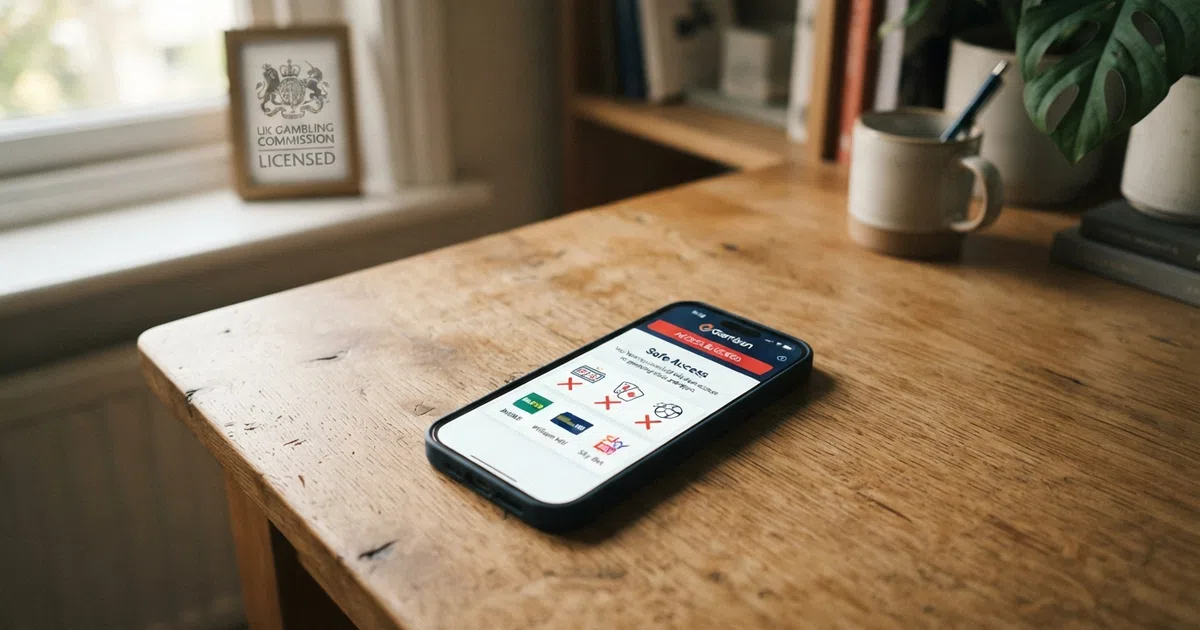
The figures and licensing claims that follow were verified against the Gambling Commission’s public register on September 8, 2026.
How Gamban Actually Works — and Why Some Casinos Slip Through Its Net
Gamban is private software. It is not run by the regulator, not funded by the state, and not part of any operator’s terms of service. It is a third-party blocking tool that runs on the device itself, and that distinction is what makes it both more aggressive and less selective than GAMSTOP. GAMSTOP sits at the operator’s end and refuses service to a self-excluded customer. Gamban sits at the player’s end and refuses to load the site at all.
The way it does this is technical but worth understanding, because it explains the entire topic of this page. On installation, Gamban sets up a local VPN tunnel and rewrites DNS resolution on the device. Every URL the user tries to reach is checked against a curated blocklist of over 80,000 gambling sites. If the URL is on the list, the request never reaches the open internet. The block is enforced at the device level — on Mac, Windows, Android and iOS — and it does not depend on cooperation from the casino, the regulator, or the player’s internet provider.
Two consequences follow. First, the blocklist is not country-specific. Gamban does not draw a line between regulated and unlicensed sites; both kinds are blocked. The Gamban knowledge base puts it plainly: the blocklist is curated to cover regulated and black-market operators together. Second, Gamban cannot be selectively disabled. The user installs the software once and either keeps it running or removes it entirely; there is no per-site allow list, no “unblock this one casino” toggle. Once on, every gambling category is closed off.
That is also why the term “non-Gamban casino” exists. A casino is “non-Gamban” when its URL is not on Gamban’s list. The phrase does not describe a category of operator; it describes an absence in a blocklist. New offshore domains, frequently rotating mirror sites, and brands that launched after the most recent list update can sit outside it. UKGC-licensed casinos do not. Every one of them is on the list by design, because Gamban maintains coverage of the entire regulated GB online market. The two spaces — “non-Gamban” and “non-UKGC” — overlap almost completely, and that overlap is the central point of this page.
The motivation behind the search is rarely technical curiosity. The dominant intent is straightforward: the user installed Gamban, or is considering installing it, and wants to know what is still accessible. That is also a sensitive intent. Anyone searching for a way around self-exclusion software is signalling something worth taking seriously, and the rest of this page is written with that reader in mind. The legal alternatives and the help resources are listed because they exist and because they are the right next step.
What Is Gamban? The Device-Level Block on 80,000+ Gambling Sites
Gamban is a piece of consumer software produced by a private company, not a regulator. It installs on a single device, runs in the background, and blocks access to gambling URLs at the network level. The block works through two mechanisms acting together: a local VPN tunnel that intercepts requests, and DNS filtering that prevents the device from resolving gambling domains to their real IP addresses. Either mechanism alone would be porous; together they cover most realistic bypass routes.
The scale of the coverage matters. Gamban reports a blocklist of more than 80,000 gambling websites and apps. The list is not static, and it is not restricted to a single jurisdiction. UK sites, Maltese sites, Curaçao sites, and sites that hold no licence at all all sit on the same list. From the user’s perspective, the distinction between “regulated” and “unregulated” disappears once the software is installed. The same is true of payment-type distinctions; crypto casinos and traditional online casinos are treated identically.
For UK residents, the software is free. The National Gambling Helpline, run by GamCare, will refer a caller to Gamban at no charge, and the same is true of any of the support services accessed through the TalkBanStop partnership. The free distribution is part of a layered approach to self-exclusion that the Gambling Commission and the help charities have built around GAMSTOP — and it is the reason the same conversation that installs Gamban usually also covers GAMSTOP registration and a bank gambling block.
What “Non-Gamban Casino” Really Means in Practice
The term is descriptive, not regulatory. “Non-Gamban” simply means a casino whose URL has not been added to Gamban’s curated blocklist at the moment the user tries to load it. There is no separate category of operator called a “non-Gamban casino”; there is just the gap between the blocklist and the rest of the internet.
In practice, that gap contains two kinds of site. The first is new offshore brands that have not yet been indexed. The second is domains that rotate frequently — mirror sites, alternative URLs, freshly registered names that rebrand every few weeks. Both are overwhelmingly non-UKGC. A UKGC-licensed casino cannot, by virtue of its licence, be absent from the list, because the blocklist covers the licensed market. The two sets — licensed and blocked — align by design.
This is the part of the topic that the affiliate pages on the first page of search results tend to obscure. They present “non-Gamban” as if it were a feature or a quality, when it is really a side effect of being outside the licensing system. Section 33 of the Gambling Act 2005 makes the provision of unlicensed gambling facilities a criminal offence in Great Britain, punishable by up to 51 weeks’ imprisonment, an unlimited fine, or both. The penalty is aimed at the operator, not the player, but the absence of a GB licence is the reason those casinos are invisible to Gamban in the first place.
Why Players Search for Casinos Gamban Doesn’t Block
The honest answer is the most useful one. Players search for non-Gamban casinos because they have installed — or are about to install — Gamban, and they want to know what is left. That intent is often paired with a second one: a desire to keep gambling despite a self-exclusion decision. Jack Symons, Gamban’s CEO, has been direct about this in public statements, framing the issue as one that requires a layered response — software blocking, account-level exclusion, bank-level blocking, and talking therapies together — rather than a single tool that does the job alone.
The search itself is the moment to step back. A reader who is reading this page because they want to bypass Gamban should know that the licensing gap is not a workaround but a warning. The casinos on the other side of that gap are not equivalent products without Gamban coverage; they are a different kind of business, run under a different set of rules (or no enforceable rules at all), and what they accept in payment and what they do with player funds is not governed by British consumer-protection law.
The page does not endorse any operator outside the GB licensing system. The licensed alternatives below are the safer course, and they are the ones the reader should compare against before making any decision. If the search itself reflects a struggle with gambling, the help resources at the foot of the article are free, confidential, and available around the clock.
What You Lose at a Casino Gamban Doesn’t Block
The regulatory reality is harder than the affiliate pages make it sound. Non-Gamban casinos sit, almost without exception, outside the UKGC licensing system. The reason is structural: every GB-licensed online casino is on Gamban’s blocklist by design, so the gap in the blocklist is the gap in the licensing system. The two are the same shape.
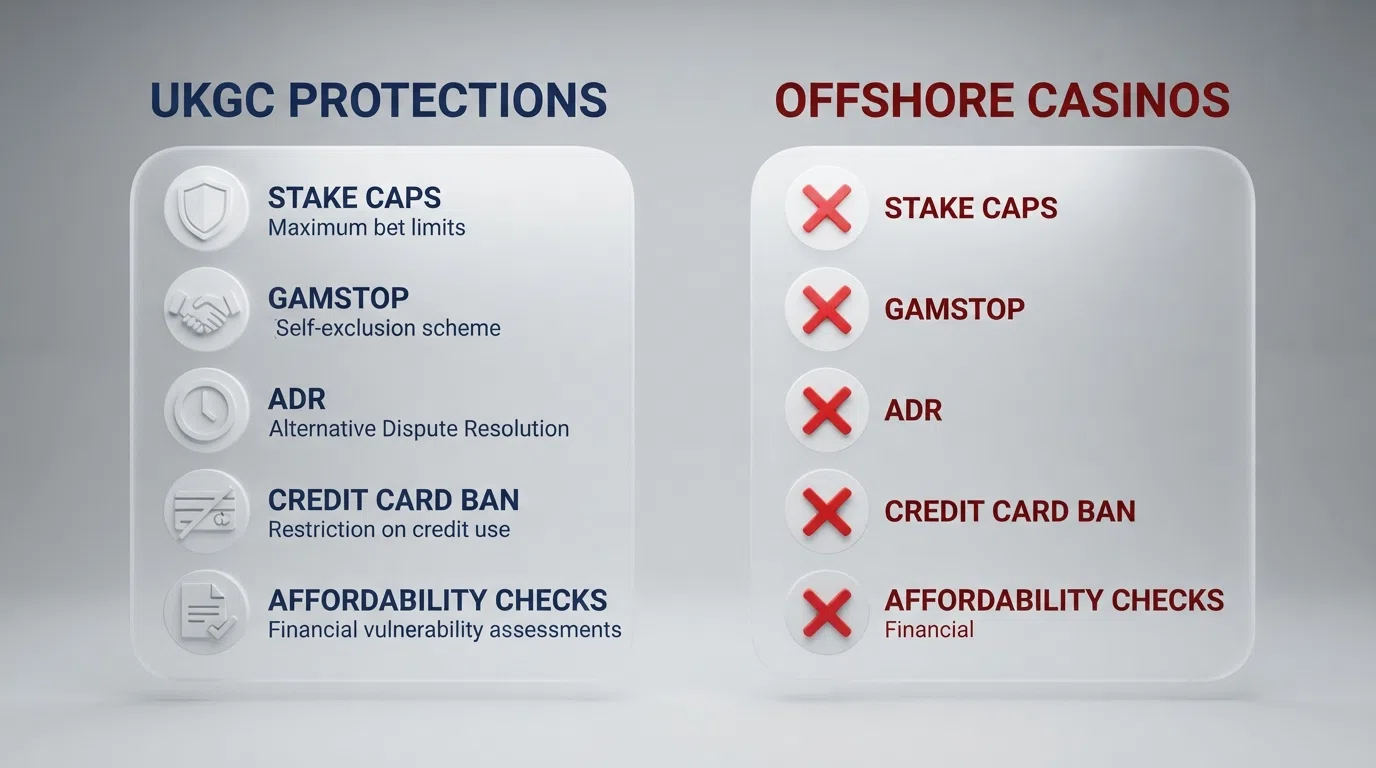
This is the section that lists, in concrete terms, what a player forfeits by gambling outside the GB system. Ten protections disappear at the door, and each one has a specific reason for being there. They are not optional features the offshore market chooses not to provide; they are statutory requirements that apply only to operators who hold a GB licence.
“Non-Gamban” Almost Always Means “Not UKGC-Licensed”
The two sets align. Gamban maintains coverage of the licensed GB online market, and the licensed GB online market is, in turn, required by its licence conditions to be on tools like Gamban. The result is that a casino not on Gamban’s list is, with very rare exceptions, also not on the Gambling Commission’s public register — and the Commission’s register holds 2,663 business records, all of them searchable by name, trading name, domain or account number.
That alignment is also the answer to a frequent counter-argument: “isn’t there a UKGC casino that Gamban hasn’t blocked yet?” In practical terms, no. New GB-licensed sites appear on Gamban’s list as part of the standard update process. The only casinos that consistently fall outside coverage are the ones whose existence Gamban’s curators have not yet indexed — and those are the offshore operators without a GB licence.
The pattern holds across the rest of this page. Every UKGC-licensed casino below is also on Gamban’s list. Every non-Gamban casino is almost certainly offshore. There is no third category, and the rest of this section describes what is missing from the offshore side of the divide.
The Ten Protections You Leave Behind at the UKGC Door
| Protection | Regulatory Requirement |
|---|---|
| GAMSTOP self-exclusion | Mandatory for all GB-licensed operators |
| Approved ADR | Independent dispute resolution provider required |
| Gambling Commission complaints route | Access to regulatory enforcement |
| Financial vulnerability checks | Mandatory at £150 net deposits (LCCP 3.4.4) |
| 10× wagering cap on bonuses | Capped under LCCP 5.1.1 |
| Mixed-product bonus ban | Cross-product promos prohibited |
| Credit card ban | Prohibited since 14 April 2020 |
| Age-banded slot stake caps | £5 (25+) / £2 (18-24) limits |
| Game-design protections | No auto-play / 2.5s spin minimum / no reverse withdrawals |
| Identity verification | Mandatory before first deposit |
The list below covers every statutory protection a player forfeits by gambling outside the GB licensing system. Each item is grounded in a specific code, regulation, or licence condition; the offshore equivalent is not bound by any of them.
- GAMSTOP self-exclusion: the national scheme is mandatory for every GB-licensed online operator and cannot reach an offshore site.
- Approved ADR: GB-licensed operators are required to offer an independent alternative dispute resolution provider; offshore sites are not.
- Gambling Commission complaints route: a player who cannot resolve a dispute through ADR can complain to the Commission, which has enforcement powers; offshore operators sit outside that route.
- Financial vulnerability checks at £150 net deposits: mandatory under LCCP 3.4.4 from 28 February 2025, using publicly available credit data; not enforced offshore.
- 10× wagering cap on bonuses: in force from 19 December 2025 under LCCP 5.1.1; offshore bonuses are unrestricted.
- Mixed-product bonus ban: cross-product promotions are prohibited at GB sites; offshore offers routinely combine sports and casino.
- Credit card ban: in force since 14 April 2020, extending to e-wallet-funded credit; offshore sites may still accept cards.
- Age-banded slot stake caps: £5 for players 25 and over (in force 9 April 2025) and £2 for players 18 to 24 (in force 21 May 2025); not enforced offshore.
- Game-design protections: auto-play ban, 2.5-second spin minimum, loss-disguised-as-win ban, reverse withdrawal ban; all UKGC requirements, none apply offshore.
- Identity verification before first deposit: mandatory since 7 May 2019; offshore sites may accept deposits without it.
Read together, the list is the answer to a question most readers ask before they read it: what is the actual difference? The answer is not “Gamban coverage”. It is every protection the British licensing system puts between a player and an operator, dropped at once.
Britain’s Safety Net: Stake Caps, Bonus Limits, and Affordability Checks
The protections above are not abstract. Each one is grounded in a specific rule, and the rules are stacked. Three layers do the heaviest lifting.
The stake caps apply per game cycle on every online slot at every GB-licensed site: £5 maximum for players aged 25 and over, £2 for players aged 18 to 24. The regulations came into force on 9 April 2025 and 21 May 2025 respectively, under the Gambling Act 2005 (Operating Licence Conditions) (Amendment) Regulations 2025 (SI 2025/215). Offshore sites are not bound by either cap, and the absence of a cap is one of the more visible differences in product behaviour.
The bonus cap came in on 19 December 2025. Wagering requirements at UKGC-licensed casinos cannot exceed 10× the bonus amount, and mixed-product offers — “bet on football, get free spins” — are banned outright. The cap sits in LCCP Social Responsibility Code 5.1.1. The free-spin offers on the licensed operators later in this page sit comfortably inside the cap. Some sit at zero; William Hill Vegas sits at exactly 10×. Offshore sites are not constrained.
The affordability checks are split into two stages. The first stage, the financial vulnerability check, is already in force: at £150 net deposits in any rolling 30-day period, the operator must run a check against publicly available data (county court judgments, individual voluntary arrangements, debt relief orders, bankruptcy). The second stage, financial risk assessments, has been announced but is not yet commenced. Stage 1 thresholds are £5,000 net deposits in 24 hours for players 25 and over (£2,500 for under-25s); the final thresholds are £1,000/£3,000 for 25+ and £750/£2,000 for under-25s. The start date is pending the formal consultation response.
How the Gambling Commission Fights Unlicensed Operators
Britain does not block at the ISP level. There is no statutory power to compel British internet providers to drop gambling traffic to unlicensed sites, and legislation to introduce one has been proposed but not enacted. What the Commission does instead is disrupt — a more granular approach that targets the operator, the domain, the search result, and the payment route one at a time.
The numbers for April 2024 to June 2025 give the scale: 3,140 disruption notices issued to operators; 447,778 URLs referred to search engines for delisting; 287,961 URLs removed as a result; an average 32% fall in player engagement across 160 disrupted sites. The mechanism is administrative pressure rather than criminal prosecution in most cases — cease-and-desist letters with a 48-hour response window, registrar pressure to suspend domains, payment-provider referrals to cut off card processing, and search-engine delisting to remove the discoverability that drives most player acquisition.
Section 33 of the Gambling Act 2005 remains the criminal backstop. The provision of gambling facilities without the required licence carries up to 51 weeks’ imprisonment, an unlimited fine, or both. The sanction is targeted at operators, advertisers and intermediaries; no player has been prosecuted for gambling on an unlicensed site. But the existence of the offence is what gives the disruption notices their weight, and it is also what makes the licensing gap a real one rather than a paper one.
The Commission’s public register, with its 2,663 business records, is the place a player can verify whether a casino holds a GB licence. Search by name, trading name, domain or account number. The absence of a record is the practical confirmation that the protections in the previous section do not apply.
How to Evaluate a Non-Gamban Casino — If You Choose to Play at One
This is the section that some readers will use, and the framing matters. The default recommendation of this page is that a reader should play at a UKGC-licensed casino. The criteria below are written for the reader who, having read that recommendation, has decided to look outside it anyway. They are not endorsements; they are the minimum due diligence the offshore market requires, and they are written with the awareness that even passing every check on this list does not bring a casino up to the standard of a GB-licensed one.
The first check is the Commission’s public register. If the casino does not appear, every UKGC protection in the previous section is absent. The second is the regulator the site claims to hold. Curaçao, Malta, and Gibraltar licences are not substitutes for a GB licence — the Gambling (Licensing and Advertising) Act 2014 made a GB licence compulsory at the point of consumption, and an offshore licence does not satisfy that requirement for GB customers. The third is independent ADR: a named, third-party dispute resolution provider, ideally registered with a recognised body. The fourth is segregated player funds: player balances held in a separate account from operating funds, so an insolvency does not sweep them up. The fifth is payment method: a UKGC site cannot accept credit cards or crypto, so the presence of either is a sign that the site is not bound by LCCP 6.1.2.
The checks are necessary, not sufficient. They do not bring an offshore site up to the GB standard; they only confirm that the offshore site has bothered to maintain certain basic protections on its own terms. A site that fails any one of them is a site to leave alone.
Payment Methods at Non-Gamban Casinos: What’s Available and What’s Missing
Payment rails are one of the more visible places where the two markets diverge. The GB-licensed market is heavily constrained; the offshore market is not.
At UKGC-licensed sites, the standard payment methods are debit cards, PayPal, Apple Pay, Trustly, Skrill, Neteller, bank transfer and Paysafecard. Credit cards are banned across all remote gambling since 14 April 2020, with the ban extending to e-wallet-funded credit (the rule sits in LCCP 6.1.2). Crypto is not accepted; the LCCP makes no provision for it, and the major GB-licensed operators do not process it. Identity verification before first deposit has been mandatory since 7 May 2019, which means a player cannot deposit anonymously at a GB-licensed site.
At offshore sites, the picture is different in three places. Credit cards may be accepted. Crypto deposits and withdrawals are often the headline payment method. Identity verification may be deferred until withdrawal, or may not be required at all. Each of those differences is not a feature; it is a reflection of the absence of the rules that constrain a GB-licensed site.
The practical implication is that a player who values anonymity, who wants to use a credit card, or who specifically wants to transact in crypto will not find those options at a GB-licensed casino. The trade-off is the licensing gap, and the rest of the page describes what that gap looks like in practice.
Casino Apps Outside Gamban: The Same Risks, a Smaller Screen
The mechanics of mobile are the same as the mechanics of desktop. Gamban installs on Android and iOS, blocks DNS resolution at the device level, and treats apps and websites identically. A casino app whose URL is not on Gamban’s list is, by the same logic as a desktop site, almost certainly not UKGC-licensed.
The smaller screen does not change the regulatory gap. The same ten protections are absent. The same criminal offence under section 33 applies to the operator. The same payment rules do not apply. The convenience of an app does not compensate for the licensing gap, and the evaluation criteria from the section above apply unchanged.
A reader who has installed Gamban on their phone and is searching for an unblocked casino app should know that the app store availability of a casino brand is not the same as the licensing status of that brand. The Gambling Commission’s public register is the source of truth on licensing, and the app’s presence on a storefront is no substitute.
The Slots You Can Play at Non-Gamban Casinos — Without the Usual Safeguards
The slots themselves look the same. The same providers — NetEnt, Pragmatic Play, Playtech, Evolution, IGT, Red Tiger — supply both the GB-licensed and the offshore markets. Big Bass Splash, Book of Horus, and the catalogue of games on the licensed operators below appear in both. The visual design, the mechanics, the bonus features, and the theoretical mathematics of the games do not change between markets.
What changes is the regulatory wrapper. The game-design protections, the stake caps, the bonus wagering cap, and the affordability checks all sit in the wrapper, not the game. A slot at an offshore site does not auto-play any faster than the same slot at a GB-licensed site by default — but the offshore site is free to enable features the GB-licensed site is prohibited from offering. The same is true of spin speed, loss-disguised-as-win animations, and reverse withdrawals. The GB site is forced to disable them; the offshore site is not.
This is the section that explains, in concrete terms, what is different about a slot at a non-Gamban casino and why the differences matter for the cost of a session.
Slot Availability at Non-Gamban Casinos: What’s Actually Different
The game libraries overlap. Major studios supply both markets with the same titles, and a player who has played Big Bass Splash at a UKGC casino will recognise it at an offshore one. The reels are the same, the bonus rounds are the same, and the underlying RTP — the percentage of stake the game returns to players over a long run — is set by the provider, not the operator.
What differs is what the operator is required to do around the game. At a GB-licensed site, the operator must display session time, total losses, and total wins in a way the player can see at any moment. The operator cannot enable auto-play, cannot offer a spin faster than 2.5 seconds, cannot display a “loss disguised as win” animation where the spin results in a net loss but the game presents it as a win, and cannot let the player cancel a withdrawal and return the funds to the playing balance. Each of these is a specific prohibition, set out in the LCCP and the Remote Technical Standards (RTS), and each of them applies to every GB-licensed operator. Offshore sites are not bound by any of them, and the practical effect is that the offshore slot experience is faster, less interrupted, and more amenable to long continuous sessions than the GB-licensed equivalent.
The same is true of RTP disclosure. GB-licensed operators must surface RTP figures on the game information page; the player can check what the game is configured to return. Offshore operators are not subject to the same disclosure rules, and the RTP the player sees on the offshore site may not match the configuration the provider intended.
Popular Slot Titles You’ll Find at UKGC and Non-Gamban Casinos
The titles below are named by research, not chosen by this page. They appear in the welcome offers or in the featured slots of the GB-licensed operators in this review; the same titles are widely available at offshore sites too.
Big Bass Splash is the bonus slot at William Hill Vegas, with a stated RTP of 96.71% (Pragmatic Play). It is the only bonus slot in this review where research surfaces the RTP, and the figure is the only one of its kind in the operator set. Book of Horus is one of the four bonus slots at Bet365, alongside Curse of the Bayou, Magic Forge, and Wrath of the Deep; the RTP on Book of Horus was not surfaced in research and is not carried here. Other featured titles at the licensed operators include the selected slots at Gala Spins and the named games in Bet365’s twenty-day free-spin structure.
A player comparing these titles between a GB-licensed site and an offshore site is comparing two things at once: the slot itself, which is the same, and the rules around the slot, which are different. The same 96.71% RTP applies to Big Bass Splash wherever it is hosted, but the absence of an auto-play ban, a 2.5-second spin minimum, and the other game-design rules means the player can play more spins per hour at an offshore site than at a UKGC one. The expected loss per spin is the same; the number of spins per session is higher.
Why UK Slot RTPs and Game Protections Matter
RTP is the long-run percentage of stake a slot returns to players. A 96.71% RTP — the figure for Big Bass Splash — means the house keeps £3.29 of every £100 wagered, on average, across a very large number of spins. The figure is statistical; it is not a promise for any single session or any single player.
What the game-design protections do is change the rate at which a player reaches the long run. Auto-play removes the friction between spins; the player does not have to press a button each time, and the natural pauses that slow a session down disappear. A faster spin speed shortens the time per spin, which means more spins per hour, which means a faster approach to the long-run RTP. The 2.5-second minimum at UKGC sites is a brake the player cannot remove at a UKGC site; an offshore site is free to offer spins at the provider’s natural pace.
The slots market in Great Britain is large enough to make the point numerically. Total online gross gambling yield (GGY) for January to March 2026 was £1.55 billion, a 7% year-on-year increase; the slots segment drove most of that growth with a 12% year-on-year rise. The market is growing, and the protections are what keep the growth from running further than the licensing system wants it to.
Live Casino and Table Games Outside Gamban’s Reach
Live dealer games — roulette, blackjack, baccarat, game show formats — are available at both GB-licensed and offshore casinos. The same studios (Evolution and Pragmatic Play Live are the dominant suppliers) provide the same tables to both markets. The dealer is real, the cards are real, the wheel is real; the underlying game does not change.
What changes is the same wrapper. A live roulette game at a UKGC-licensed site operates under GB technical standards; the game is tested and certified, the stream is regulated, and any dispute over an outcome can be escalated to the operator’s ADR provider and, if necessary, to the Gambling Commission. The same live roulette game at an offshore site is regulated by the offshore licence, if any, and the dispute resolution route is whatever the site itself chooses to offer.
The licensing gap is the difference that matters. A live-game dispute over a mis-dealt hand at a GB-licensed site is arbitrable by an ADR provider under a defined process with defined time limits. The same dispute at an offshore site has no equivalent backstop, and the practical outcome depends on what the operator decides to do. The dealer is real in both cases; the regulator behind the dealer is not.
UKGC-Licensed Casinos: Every One of Them Blocks Gamban — and That’s the Point
Every casino below holds an active UKGC operating licence, and every one of them is on Gamban’s blocklist by virtue of being on the licensed market. That is not a contradiction; it is the design. The block is the proof that the casino operates inside the system that puts the protections in the previous section between the player and the operator.

Ten operators are listed below. They were drawn from the operator set returned for the UK market, individually verified against the Gambling Commission’s public register, and ordered by the quality and transparency of their welcome offer. The comparison table lets the reader weigh the licensed options side by side.
| Operator | UKGC Licence | Offer Type | Free Spins | Wagering | Bonus Validity |
|---|---|---|---|---|---|
| Bet365 Casino | Active (Hillside UK Gaming ENC) | Free spins | Up to 500 | None | 30 days to claim |
| William Hill Vegas | Active (WHG International, evoke plc) | Free spins | 200 | 10× (72h) | 72h from credit |
| Sky Vegas | Active (Bonne Terre, Flutter) | Free spins + no-deposit | 200 + 50 no-deposit | None | 7 days from credit |
| Betfair Casino | Active (PPB Counterparty Services, Flutter) | Free spins + no-deposit | 100 + 50 no-deposit | None | — |
| 888 Casino | Active (LC International, evoke plc, account 54743) | Deposit match | — | 10× on bonus | 90 days |
| Betfred Casino | Active (Petfre Gibraltar) | Free spins | 200 | Terms apply | 14 days to claim, 7 days once credited |
| Ladbrokes | Active (LC International, Entain) | Sports free bets | — | 7-day free bet expiry | 7 days |
| Gala Spins | Active (LC International, Entain) | Free spins | 100 | None on FS | 7 days |
| Paddy Power Games | Active (PPB Counterparty Services, Flutter) | Sports free bets | — | 7-day free bet expiry | 7 days |
| Sky Bet | Active (Bonne Terre, Flutter) | Sports free bets | — | 30-day validity | 30 days |
The headline pattern is that most operators in the set offer free spins rather than deposit matches, and most offer them without any wagering requirement at all. That sits well inside the 10× statutory cap that came in on 19 December 2025; the two operators that carry a wagering requirement (William Hill Vegas at 10×, 888 Casino at 10× on bonus funds) are sitting exactly at the cap rather than below it. The longer validity windows — 90 days at 888 Casino, 30 days at Sky Bet — give a more forgiving timeline than the tighter 7-day windows at Sky Vegas and Gala Spins.
Bet365 Casino — Up to 500 Free Spins With Zero Wagering
Bet365 runs the largest free-spin count in the set and the only one with zero wagering on the winnings. Hillside (UK Gaming) ENC holds the active UKGC licence. The offer is structured across ten selections — typically 5, 10, 20 or 50 free spins at a time — delivered over 20 days, with a 24-hour gap between each selection and a 30-day overall claim window. Minimum lifetime deposits of £10 are required.
The four bonus slots are Book of Horus, Curse of the Bayou, Magic Forge, and Wrath of the Deep. The provider mix behind the broader catalogue is wide: NetEnt, Playtech, Microgaming, Pragmatic Play, Evolution, and IGT all appear. No wagering requirement on free spin winnings is the standout trait, and it places the offer well inside the 10× cap introduced on 19 December 2025.
The bet365 verdict: ideal for a player seeking the maximum number of spins and willing to return over twenty days to claim them in instalments.
William Hill Vegas — 200 Free Spins on Big Bass Splash at a Known RTP
William Hill Vegas carries an active UKGC licence under WHG (International) Limited, part of evoke plc. The welcome is 200 free spins at £0.10 each on Big Bass Splash, requiring a £10 deposit and a £10 stake within seven days. The wagering requirement is 10× on free spin winnings, to be completed within 72 hours of credit; the offer ends on 31 December 2026.
The reason this entry stands out is the RTP. Big Bass Splash carries a 96.71% return-to-player figure (Pragmatic Play), and it is the only bonus slot in the operator set where research surfaces the RTP. The 10× wagering sits at the statutory cap rather than below it. The provider mix — Playtech, NetEnt, IGT, Evolution, Pragmatic Play — supports a broad catalogue.
The William Hill verdict: suited for a player who values exact RTP disclosure and is comfortable clearing wagering at the statutory cap.
Sky Vegas — 200 Free Spins Plus 50 No-Deposit Spins, No Wagering
Sky Vegas operates under an active UKGC licence held by Bonne Terre Limited, part of Flutter Entertainment. The welcome package has two layers: 50 no-deposit free spins on sign-up, plus up to 200 free spins on the first eligible game. No wagering requirements apply to either batch, and the validity is 7 days from credit. The first eligible game is chosen at sign-up, so the specific title is not fixed in advance.
The provider mix is broad — NetEnt, Playtech, Pragmatic Play, Evolution, IGT — and the no-wagering structure places the offer well inside the 10× cap. The no-deposit layer is unusual in the GB-licensed market and is one of the more visible reasons Sky Vegas appears in this set.
The Sky Vegas verdict: the best fit for a player who wants to try the catalogue without committing a deposit first, and is happy with a 7-day validity window.
Betfair Casino — 50 No-Deposit Spins and 100 More on First Deposit
Betfair Casino holds an active UKGC licence under PPB Counterparty Services Limited, part of Flutter Entertainment. The offer is 50 no-deposit free spins plus 100 free spins on a £10 deposit and play, with no wagering requirements on either batch. The spin value is £0.10.
The provider mix is wide: NetEnt, Playtech, IGT, Evolution, Pragmatic Play, and Red Tiger. The no-wagering structure is well inside the 10× cap, and the no-deposit layer mirrors the Sky Vegas structure. Research does not surface a specific bonus slot or a validity window for this offer.
The Betfair verdict: the best fit for a Flutter-Group player who wants the no-deposit feature and is comfortable with the £10 deposit and play requirement.
888 Casino — 100% Deposit Match Up to £100, the Set’s Only Percentage Bonus
888 Casino holds an active UKGC licence under LC International Limited, part of evoke plc, on account 54743. The welcome is the only deposit match in the set: 100% up to £100. Wagering is 10× on bonus funds only, and it triggers once the main cash balance reaches £0. The 90-day validity is the longest window in the set, with a 48-hour claim window from deposit.
The provider mix is NetEnt, Evolution, Playtech, Pragmatic Play, and Red Tiger. The 10× wagering sits at the statutory cap; the 90-day validity is the most forgiving timeline in the comparison. The trade-off is that there are no free spins — this is a cash-match offer, and the entire value sits in the matched balance.
888’s verdict: the best fit for a player who prefers a cash bonus over free spins and wants the longest possible validity window in the set.
Betfred Casino — 200 Free Spins, 14 Days to Claim
Betfred Casino operates under an active UKGC licence held by Petfre (Gibraltar) Limited. The welcome is 200 free spins at £0.10 each on selected titles, requiring a £10 deposit and a £10 stake on slots at Betfred Games or Vegas. The claim window is 14 days; once credited, the spins are valid for 7 days.
Research does not specify the wagering terms on the free spin winnings for this specific offer. The wagering cap applies — every UKGC-licensed casino is bound by it — but the specific multiple for this offer was not confirmed in the data surfaced for this review. The provider mix is Playtech, IGT, NetEnt, Evolution, and Pragmatic Play.
The Betfred verdict: the best fit for a player who wants the longer 14-day claim window and is comfortable checking the wagering terms directly with the operator before activating.
Ladbrokes — Sports-Focused Operator With a Casino Welcome Offer Also Available
Ladbrokes holds an active UKGC licence under LC International Limited, part of Entain. The headline welcome is sports-focused — Bet £10 get £50 in free bets, structured as five £10 Bet Builder free bets — and the casino welcome is also available but was not surfaced in the data for this review. The free bets carry a 7-day expiry.
The provider mix on the casino side is Playtech, NetEnt, Evolution, Pragmatic Play, and IGT. The casino offer exists; the specific terms were not captured in research for this page, and a reader interested in the casino welcome should check the operator’s own page for current terms.
The Ladbrokes verdict: the best fit for a player whose primary interest is the sportsbook but who wants to know the casino product sits under the same UKGC licence.
Gala Spins — 100 Free Spins, Winnings Credited as Cash
Gala Spins holds an active UKGC licence under LC International Limited, part of Entain, alongside its sister brand Gala Bingo. The welcome is 100 free spins at £0.10 each on selected featured slots, requiring a £10 deposit and £10 spend on slots. Free spin winnings are credited as cash — no wagering applies to them — and the validity is 7 days from credit. The associated £10 bingo bonus carries a separate 2× wagering requirement.
The provider mix is Playtech, NetEnt, Evolution, and Pragmatic Play. The no-wagering structure on the free spin winnings places the offer well inside the 10× cap; the 7-day validity is on the shorter end of the set.
The Gala Spins verdict: the best fit for a player who wants the simplest conversion of free spins to withdrawable cash, with the shortest validity window as the trade-off.
Paddy Power Games — Sports-First Operator With a Casino Offering Alongside
Paddy Power Games holds an active UKGC licence under PPB Counterparty Services Limited, part of Flutter Entertainment. The headline welcome is sports-focused — Bet £5 get £30 in free bets — and the casino offer is also available but was not surfaced in the data for this review. The free bets carry a 7-day expiry.
The provider mix on the casino side is Playtech, NetEnt, Evolution, Pragmatic Play, and Red Tiger. The casino product exists under the same licence; the specific terms of the casino welcome were not captured in research for this page.
The Paddy Power verdict: the best fit for a player whose primary interest is the sportsbook, with awareness that the casino product sits under the same UKGC licence and the same Flutter-Group umbrella.
Sky Bet — Sportsbook With Sky Vegas as the Dedicated Casino Brand
Sky Bet holds an active UKGC licence under Bonne Terre Limited, part of Flutter Entertainment. The headline welcome is sports-focused: £30 in free bets for a £5 deposit, with a 30-day validity. The casino product is covered separately under Sky Vegas, listed earlier in this section, and shares the same licence and the same operator group.
The 30-day validity on the free bets is the longest in the sports-focused half of the set. The Sky Vegas entry above describes the casino welcome in detail.
The Sky Bet verdict: the right entry point for a player whose interest is the sportsbook; the casino is one click away under the same licence as Sky Vegas.
The Cost of a 10× Wagering Bonus at 888 Casino
888 Casino’s 100% deposit match up to £100 carries a 10× wagering requirement on bonus funds, sitting at the statutory cap. To clear the maximum bonus, a player must turn over £100 × 10 = £1,000 through eligible slots.
The expected loss on that turnover depends on the slot’s RTP. Big Bass Splash, at 96.71%, is the only RTP research surfaces in this operator set; using that figure, expected loss on £1,000 of wagering is £1,000 × (1 − 0.9671) = £32.90. That is the average cost of clearing the bonus over a very large number of spins; it is not a guaranteed outcome for any single session. A different slot with a lower RTP would produce a higher expected loss; a higher RTP would produce a lower one. The 10× wagering requirement itself is what the page attributes to the 888 bonus specifically; the calculation above applies that requirement to a representative RTP and produces the average cost.
Responsible Gambling Tools That Work — With or Without Gamban
Gamban is one tool in a wider system, and the wider system is what works. The UK’s responsible gambling infrastructure is layered: device-level blocking, account-level self-exclusion, bank-level transaction blocking, and human support — helplines, treatment services, peer groups. The tools overlap and reinforce each other, and the evidence base for them is concrete.
Gamban’s role is the first line of technical defence. It blocks access at the device level. GAMSTOP is the account-level equivalent, sitting at the operator’s end and refusing service to anyone who has registered. Bank gambling blocks remove the payment rail. The TalkBanStop partnership combines all three with talking therapies in a single referral route, run by GamCare. Each layer addresses a different point in the chain from intent to action, and the TalkBanStop framing — Gamban’s own CEO has argued for it in public — is that no single tool is sufficient.
Gamban as a Responsible Gambling Tool: What It Can and Can’t Do
Gamban blocks access. It does not, and was never designed to, treat the underlying behaviour. The distinction matters because the marketing of blocking software can occasionally blur it: a tool that prevents the player from reaching a casino is not the same as a tool that addresses why the player wanted to reach it in the first place. Gamban is the former, and the help services listed in this page are the latter.
The technical scope is also worth restating. Gamban blocks at the device level, covers both regulated and unlicensed sites, and cannot be selectively disabled by the user once installed. Every gambling category is either blocked or not; there is no per-site allow list. For UK residents, the software is free through the National Gambling Helpline, GamCare, or any of the TalkBanStop partners. The free distribution is part of why the tool has been adopted at scale, and the absence of a price barrier is the reason it sits alongside paid and free alternatives in the same conversation.
Beyond Gamban: GAMSTOP, Bank Blocks, and TalkBanStop
- GAMSTOP: account-level self-exclusion across every UKGC-licensed site, available in 6-month, 1-year, 5-year, or 5-year-with-auto-renewal terms. Mandatory for every GB-licensed online operator since 31 March 2020.
- Bank gambling blocks: most major UK banks offer transaction-level gambling blocks through their apps, blocking payments to gambling merchants at the issuing bank rather than at the operator.
- TalkBanStop: the GamCare-led partnership that combines GAMSTOP registration, free Gamban software, bank-level gambling blocks, and referral to talking therapies in a single referral route.
The limitation that makes the layered approach necessary is that GAMSTOP only works against GB-licensed operators. Offshore sites are not in the scheme and cannot be added to it; the matching system operates against the consumer details registered with a GB-licensed operator, and any operator outside the scheme sits outside the match. The Commission’s own published guidance acknowledges that minor changes to consumer details can still allow some gambling activity, which is part of the case for adding more layers. Gamban covers what GAMSTOP cannot, bank blocks cover what neither covers, and the human services cover what the technical tools cannot.
Setting Deposit and Session Limits at a UK-Licensed Casino
Deposit limits at UKGC casinos are not optional features the operator may or may not provide. The offer of a limit is mandatory, and the rules are tightening in two stages. From 31 October 2025, operators must prompt every new customer to set a financial limit before accepting the first deposit. From 30 September 2026, a gross deposit limit — based on money paid into the account over a defined period — becomes the only form that can be called a “deposit limit”, and any decrease must be actioned immediately rather than at the end of a delay. The rule sits in RTS 12B.
Beyond the deposit limit, every GB-licensed casino must display session time, total losses, and total wins in a way the player can see at any moment. The display sits in the LCCP and the RTS, and it is the same mechanism that supports the auto-play ban and the 2.5-second spin minimum. None of these obligations apply at offshore sites, and the absence of any of them is part of the regulatory gap.
Where to Get Help: Helplines, Treatment, and Support Services
The National Gambling Helpline, run by GamCare, is available 24 hours a day, 365 days a year, on 0808 8020 133. Over 52,000 calls were made to the line in 2024/25. The service is free and confidential, and it is the front door to the rest of the support infrastructure.
The National Gambling Treatment Service treated 11,960 clients in 2024/25 — an 11% year-on-year increase — and 50% of those clients received their first appointment within six days. Of those who completed treatment, 93% showed improvement. NHS gambling harm clinics are available in England, Scotland and Wales through the National Gambling Support Network. GambleAware provides self-assessment tools and treatment referral at its own website. Gamblers Anonymous UK runs peer support groups across the country.
The prevalence figures set the scale. The NHS Adult Psychiatric Morbidity Survey 2023–24 found 0.4% of adults in England experienced problem gambling (PGSI 8+) and 1.6% experienced at least moderate risk gambling (PGSI 3+). The men (2.2%) were more likely than the women (1.0%) to score 3+. The numbers are small as percentages and large in absolute terms; they are also the population the support services are designed for.
How We Selected and Evaluated These Casinos
Every operator listed in the comparison above was verified individually against the Gambling Commission’s public register at the time of research. The register holds 2,663 business records and is searchable by business name, trading name, domain or account number; the verification step confirmed each operator’s active status before the operator was included.
The welcome offers, wagering terms, free-spin counts, and validity windows were drawn from publicly available terms at the time of research. Where research did not surface a specific figure — for example, the specific wagering multiple on Betfred’s free-spin offer — the page states that and directs the reader to the operator’s own terms rather than inventing a figure. No paid placement or affiliate weighting has influenced the ranking; the order reflects the quality and transparency of the licensed offer.
This review covers UKGC-licensed operators only. The offshore non-Gamban space is addressed qualitatively in the legality and slots sections above, and is not ranked here, because the central finding of this page is that the gap in Gamban’s blocklist is also a gap in the licensing system, and the licensed alternatives are the safer course.
What to Actually Do About Gamban and Your Gambling
The article’s verdict is short. The safer course is not to search for casinos that bypass Gamban but to use the tools and licensed operators that exist to protect the player. Every UKGC-licensed casino is blocked by Gamban and carries the full set of statutory protections; the trade-off between the licensed and the offshore market is real, and the licensed side wins it on every measure this page has covered.
If a reader wants to continue gambling within a regulated framework, the ten operators above offer terms within the UK safety net, and each is independently verified on the Commission’s public register. If a reader installed Gamban to control their own gambling and is now searching for ways around it, the help resources in the responsible gambling section are free, confidential, and work — the National Gambling Helpline on 0808 8020 133 is the place to start. TalkBanStop combines GAMSTOP, Gamban, bank blocks, and talking therapies in a single referral, and the layered approach is what the evidence supports.
The page’s core finding is not that there is a safe non-Gamban casino. There is not. There is a safer alternative inside the licensed system, and the rest of this page is the comparison that leads to it.
Frequently Asked Questions
What is the difference between Gamban and GAMSTOP?
Gamban is device-level blocking software that prevents a single device from reaching gambling sites, regardless of jurisdiction. GAMSTOP is account-level self-exclusion that blocks a registered user from every UKGC-licensed online gambling site. Gamban covers offshore and unregulated sites; GAMSTOP cannot. Both are free for UK residents.
Are non-Gamban casinos legal for UK players?
A non-Gamban casino is, in practice, almost always an unlicensed offshore operator. Providing gambling facilities without a GB licence is a criminal offence under section 33 of the Gambling Act 2005, punishable by up to 51 weeks’ imprisonment, an unlimited fine, or both. The sanction targets operators, but the protections a GB licence confers — GAMSTOP coverage, ADR, affordability checks, game-design rules — do not apply to the player at an unlicensed site.
Is there help available if I am struggling with gambling?
The National Gambling Helpline, run by GamCare, is available 24/7 on 0808 8020 133. Over 52,000 calls were made in 2024/25. The National Gambling Treatment Service treated 11,960 clients in the same year, with 93% of completers showing improvement. NHS gambling harm clinics operate in England, Scotland and Wales, and TalkBanStop combines GAMSTOP, free Gamban software, bank blocks, and talking therapies in a single referral.
Do non-Gamban casinos accept UK payment methods?
Offshore non-Gamban casinos may accept credit cards and crypto, both of which are banned at UKGC-licensed sites. The GB-licensed market accepts debit cards, PayPal, Apple Pay, Trustly, Skrill, Neteller, bank transfer and Paysafecard; identity verification before first deposit has been mandatory since 7 May 2019, so anonymous play is not available at a GB-licensed casino.
Can I use Gamban and GAMSTOP at the same time?
Yes. The two tools are designed to be complementary rather than alternatives. GAMSTOP covers the account-level exclusion at every GB-licensed online operator; Gamban adds device-level blocking that also reaches offshore sites. The TalkBanStop partnership routinely registers a caller for both at once, alongside a bank gambling block and a referral to talking therapies.
Account – nominimumdeposit-casinos-uk
Content created by the «nominimumdeposit-casinos-uk» team