
The Bank Transfer Casino Ranking for 2026: Facts Before Hype
 Available in GB
A wire transfer casino is simply an online casino that lets a player move money through a bank rather than a card or electronic wallet. In the UK, Faster Payments, BACS, Open Banking and services such as Trustly can all sit behind that description, so the useful question is not whether a brand calls its cashier button “wire” or “bank transfer”. The useful question is which bank rail it accepts, how much it permits, how long it takes, and what the player pays.

Data current as of September 8, 2026; licence claims checked against the UK Gambling Commission public register.
That distinction matters because this payment method makes its trade-off visible. Money normally takes longer to clear than it does through an instant e-wallet, yet the limits can reach £100,000 and the transaction remains attached to a bank account the player already controls. That combination attracts high-value players, but it is also a poor fit for anyone who wants casino credit before payday. A bank account can be fast. It cannot create money that is not there.
This page ranks ten UKGC-licensed casinos on their published bank-transfer terms rather than brand fame. The evidence favours a smaller set than the marketing suggests. Unibet has the clearest speed result, Bet365 has the highest published wire ceiling, and Sky Vegas makes the plainest case for domestic Faster Payments. Others may accept a bank account but disclose too little to support a confident comparison.
The central judgement is straightforward: wire transfer is not the right default for a player who values instant account funding above everything else. It is the strongest rail for a player who values ceiling, traceability and returning winnings to a familiar bank account. Choose it on those terms, set a deposit limit before funding the account, and understand that the house edge still applies to every pound once play begins.
What a Wire Transfer Casino Actually Delivers That E-Wallets Cannot
A “wire transfer casino” is not a separate breed of gambling site. The label describes a payment route, not an additional licence or a different type of casino. Any UKGC-licensed operator that accepts money from a bank-funded rail can fall into the category, whether its cashier calls the method a bank transfer, Faster Payments, Open Banking, Trustly or Instant Bank.
The name can still mislead. International “wire” usually suggests a SWIFT payment, while most UK casino banking is domestic. A British player funding a pound-denominated account will ordinarily use a UK bank-transfer rail. The method is legal, and its payment service must operate through a regulated channel under Licence Conditions and Codes of Practice condition 5.1.2. Calling it a wire does not make it offshore.
What the Term “Wire Transfer Casino” Means for a UK Player
British banking language favours “bank transfer”. Searches and product pages often use “wire transfer” because the phrase travels well internationally, but Faster Payments, BACS and CHAPS are all forms of bank-to-bank transfer. A casino therefore does not need a SWIFT connection to qualify. It needs to accept a payment that starts at the player’s bank and ends at the operator.
Open Banking broadens the definition. Services such as Trustly and TrueLayer can connect a player’s bank account without the player opening another stored-value wallet. That does not make every Open Banking payment identical to a traditional bank transfer in the cashier, but the money still moves from a bank rather than being pre-funded inside a third-party account.
Speed follows the rail. Faster Payments can deliver same-day domestic transfers, while a BACS payment can take up to three working days. Open Banking products can appear near-instant, but the casino’s own account and review controls still apply. A short rail time cannot bypass identity checks, payment approval or the operator’s withdrawal process.
This definition is useful because it stops brands from trading on an imprecise word. “Wire” sounds like a premium or international service, yet the player’s practical concern is the route underneath. A £10 Faster Payments deposit and a £100,000 bank transfer can share the same broad description while serving completely different budgets and schedules.
UKGC licensing adds the boundary that matters. The Commission does not create a special approval called wire-transfer casino status. It licenses the remote casino operation, while condition 5.1.2 requires the operator to use regulated payment service providers. A player should verify the casino licence first and read the banking terms second. The payment label comes nowhere near settling either question.
Why Bank Transfers Still Matter to UK Casino Players in 2026
Bank transfer removes a layer that some players do not want. Funding through an e-wallet can require registration, a balance held with the payment provider and another account left carrying a history of gambling transactions. Direct bank payments ask the player to authorise a transfer through a bank already known to them. No new wallet is necessary.
The appeal becomes clearer at high value. Bet365 allows £100–£100,000 by wire transfer. Sky Vegas sets a £10,000 daily ceiling for Faster Payments. LeoVegas supports £10–£35,000 through Open Banking, while BetMGM UK accepts bank deposits up to £35,000. A player moving a substantial bankroll should not have to split it into repeated smaller payments simply because the familiar method has run out of room.
Bank ownership also changes the audit trail. The transfer originates in the player’s own account and normally returns there. That gives a player a record controlled by the bank, rather than relying only on an e-wallet statement and a casino cashier history. It can make income, deposits and withdrawals easier to reconcile at month-end.
Security concerns do not disappear. A player should still use the account details supplied by the licensed operator, check the payee, protect banking credentials and retain the transfer reference. Yet direct bank payment avoids storing a dedicated gambling balance with a separate payment provider. For someone who distrusts that extra layer, familiarity has real value.
There is a cost to this control. Standard international wires can incur £0–£25 outgoing and £0–£7 incoming charges at UK banks, while domestic Faster Payments are generally free. The method can also require more patience. Bet365’s published wire-deposit window runs as wide as 2–10 days, which makes “wire” sound considerably less attractive once the clock starts.
So the bank-transfer player is not choosing convenience by accident. They are choosing a higher ceiling, a familiar account and a clear return path. That is a coherent preference. It becomes irrational only when the player treats a regulated rail as if it were a friendlier casino game. The payment system remains traceable; the house edge remains hostile to the player.
How Bank Transfers Move Your Money at UK Casinos — And Why the Wait Is Not the Whole Story
A bank-funded casino session has two separate clocks. The operator controls account review, payment approval and release. The bank controls clearing after that release. Competitor pages often quote a single “one to five days” figure and silently merge the two, producing a number that can look precise while answering neither part properly.
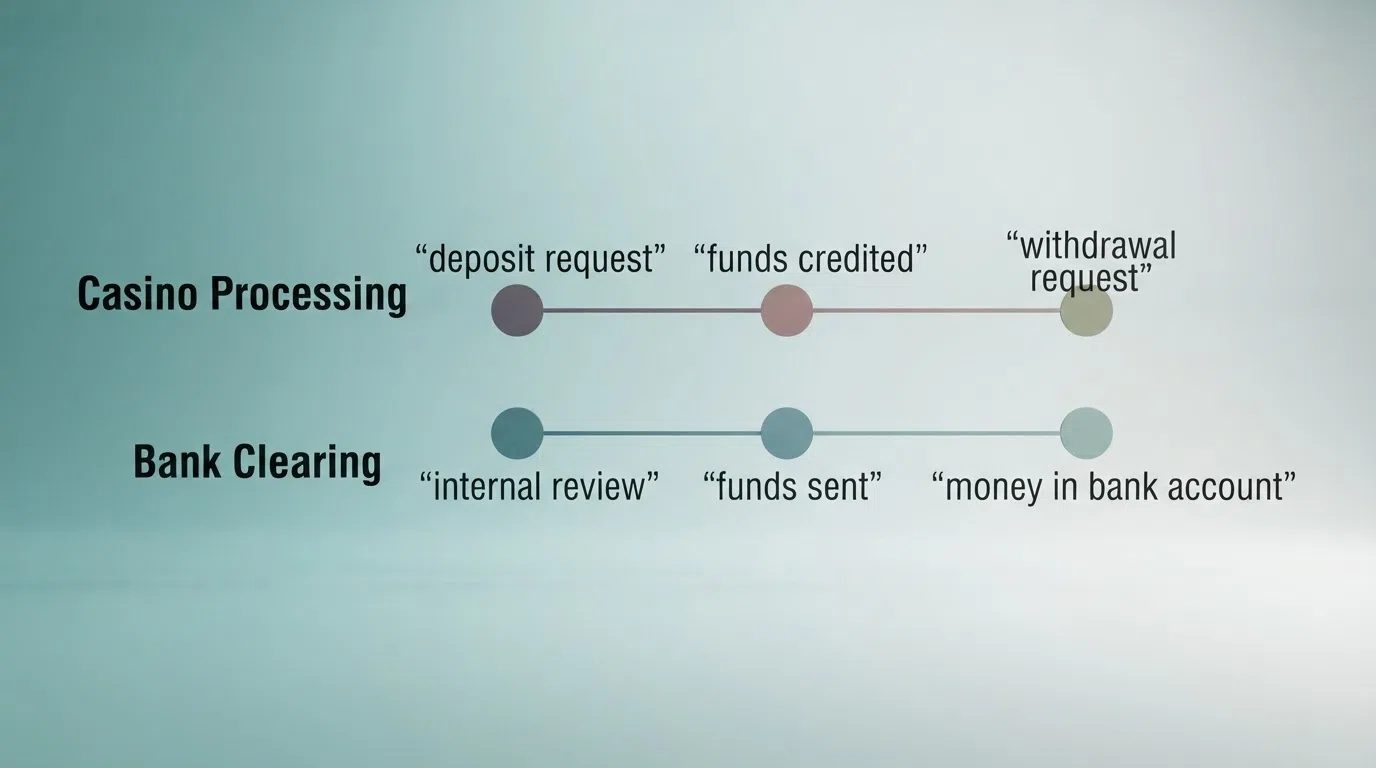
The deposit can clear before the casino credits the balance. A withdrawal can leave the casino quickly and then wait inside the banking system. Anyone planning around rent, card payments or a holiday needs the full sequence, not the most flattering half of it. Published methods matter because the same word “bank transfer” can cover radically different routes.
Funding Your Account: The Bank Transfer Deposit Step by Step
A standard bank-transfer deposit starts in the casino cashier. After the player chooses bank transfer, the operator supplies its banking details and a unique reference. The player then opens their own banking app or online banking service, enters those details and sends the payment. The bank processes the transaction; the casino credits the account once the funds clear.
Sending is not the same as playing. A transfer reference helps the operator match a payment, but it does not prove that the money is available. The balance should be treated as pending until it appears as deposited funds. Anyone who starts wagering against an expected credit has made a loan to themselves, not to the casino.
The rail sets the broad timing. Standard wire deposits typically take 1–3 business days. Sky Vegas allows up to 24 hours for Faster Payments, and Trustly deposits at Unibet can be instant, with the published range running from £5 to £100,000. The brand names sit on top of different banking systems, which is why a shared cashier label cannot guarantee a shared settlement time.
Some operators let a player upload transfer evidence. That may reduce matching friction, but it should not be confused with guaranteed same-day credit. If the payment has not reached the operator’s account, the reference cannot create the funds. A screenshot records intent; a cleared deposit changes the balance.
The reference is part of the protection, not clerical decoration. A payment without it can become difficult to identify, particularly when several players use the same operator. A careful player copies the exact code, checks the beneficiary, keeps the confirmation and waits for the credited balance. A few seconds in the banking app can prevent days of support correspondence.
Minimums also begin to bite here. Bet365 requires £100 for a wire deposit, while Open Banking at LeoVegas starts at £10 and Trustly at Unibet starts at £5. Those entry points tell the reader more than the generic word “banking” does. A smaller bankroll may be accepted by a regulated casino and still be rejected by a particular transfer method.
Getting Your Winnings Out: How the Withdrawal Side Works
A withdrawal begins when the player submits the request in the cashier. The operator then conducts any pending checks before approving and processing the payment. That internal period can be very short, but it must not be confused with the time the bank takes to make the money spendable.
PartyCasino illustrates the longer internal window. Its published pending review can last 24–48 hours before processing begins. Once approval occurs, Trustly and Instant Bank can be near-instant, whereas a standard bank transfer takes 3–7 working days. The rail speed cannot erase the review that comes first.
Other operators set a faster release target. Bet365 publishes 1–4 hours for bank-transfer withdrawal processing. LeoVegas states 2–5 days for Open Banking withdrawals, a total that combines the operator’s handling with the clearing cycle. Unibet reports under 20 minutes for Trustly in independent testing, but allows up to five days for a standard bank transfer. The route changes the answer.
The closed-loop principle normally sends the withdrawal back to the method used to deposit. If the account was funded by bank transfer, the winnings should return to that same bank account where technically possible. If that route cannot receive funds, the operator must verify another route to the same know-your-customer standard rather than allowing the player to nominate an unverified account.
Players should read a stated “withdrawal time” as a question worth asking, not necessarily a full end-to-end promise. Does the figure begin when the button is pressed or after review? Does it end when the casino releases the payment or when the bank credits the destination account? Does the bank count only business days? Those distinctions decide whether a claimed one-day payout is a day or nearly a week.
Weekends and bank holidays add another constraint. Banks do not process every payment clock on a seven-day schedule. A request made immediately before a non-business day can spend the first part of its wait waiting for the relevant system to reopen. The casino may approve it promptly; the calendar can still make that approval irrelevant to the player’s need for cash.
Processing Times That Match Reality: How Long You Actually Wait
| Payment Rail | Typical Deposit Time | Typical Fees | Key Characteristics |
|---|---|---|---|
| Faster Payments | Up to 24 hours | Generally free | Domestic, automated |
| BACS | Up to 3 working days | Generally free | Batch-processed |
| Open Banking/Trustly | Near-instant | Generally free | Direct connection |
| International Wire | 1–3 business days | £0–£25 outgoing | Standard SWIFT route |
A realistic deposit window is 1–3 business days for a standard bank transfer. Open Banking and Trustly can be faster, with some deposits appearing almost immediately, while Sky Vegas states up to 24 hours for Faster Payments. At the slow end, Bet365 publishes a 2–10-day wire-deposit period. No single “wire time” can cover that range honestly.
The withdrawal total is harder because it contains two stages. Casino processing can run from under 20 minutes to 48 hours. Bank clearing can then run from hours to five business days. Add the stages and the total commonly spans 2–7 business days, although the published route-specific examples extend beyond that broad market range.
Faster Payments is the fastest domestic rail in this set. It supports Sky Vegas deposits and can reach the bank account after casino release without the longer batching associated with older transfer systems. International wires sit at the slow end and can also trigger correspondent-bank fees. Domestic use generally avoids both problems.
A useful comparison keeps the point of departure fixed. A Trustly result that starts after successful bank verification is not the same as a standard wire that begins with manually entered beneficiary details. Likewise, an Open Banking withdrawal that takes 2–5 days is not a direct measure of Open Banking technology alone. The casino’s own queue belongs inside the clock.
The player’s urgency should determine how much weight speed receives. A modest recreational deposit may make a short wait tolerable. A withdrawal needed for a known bill cannot. High-value players gain enormously from a large ceiling, but they also need enough liquid money elsewhere that one transfer does not become the only thing standing between them and a missed payment.
Fees and Limits: What a Bank Transfer Casino Session Costs
The casino fee is often the smaller concern. Sky Vegas describes its Faster Payments service as free of charge, and LeoVegas states that it charges no withdrawal fees on any method. The more variable charge sits with the player’s bank, especially when a payment crosses borders.
UK banks typically charge £0–£25 for an outgoing international wire and £0–£7 for an incoming international transfer. Domestic Faster Payments are generally free. A UK-licensed casino may still display a free deposit, which does not make every transfer free once the sending or receiving bank applies its own tariff.
Limits reveal the real commercial purpose of bank rails. Bet365 allows £100–£100,000 by wire transfer. Sky Vegas has a £10 minimum and £10,000 daily maximum for Faster Payments. LeoVegas supports £10–£35,000 through Open Banking, while BetMGM UK accepts bank deposits up to £35,000.
A high maximum is not an instruction to use it. The house edge is the same percentage claim on a larger bankroll, but the pounds exposed are not. A player who would hesitate over a £100 card deposit may feel oddly calm while sending £10,000. Familiarity can become psychological camouflage.
Minimums create the opposite problem. A £100 wire minimum can exclude a small bankroll even when the casino accepts £10 by another method. “High ceiling” and “low entry point” rarely coexist in one rail. The player should identify both numbers before deciding that an operator “accepts bank transfer”.
Published terms can also change by direction. Bet365’s wire deposit range starts at £100, while its bank-transfer withdrawal range begins at £5. A route is not defined by a single minimum. Reading the cashier terms for the exact movement of money is the only sensible comparison.
High-Roller Bank Transfer: Limits and Speeds Most Players Never See
The published ceilings explain why bank transfer remains central to high-value casino play. Bet365 and the Trustly route at Unibet each reach £100,000. LeoVegas and BetMGM UK each publish a £35,000 maximum through their bank-based methods. Cards and many e-wallets do not offer the same headroom in one transaction.
Large withdrawals often need a bank destination for the opposite reason. Payment products can impose their own per-transaction ceilings, and a casino may route substantial winnings to a bank account because that rail can carry more. A bank transfer is slower, but it is less likely to be stopped simply because the payout is large.
Internal treatment may also change at high-stakes levels. Operators that cater to large deposits can prioritise review and support, although no promotional promise should be assumed. The published Bet365 processing window for bank withdrawals is 1–4 hours; PartyCasino’s general 24–48-hour pending period makes its bank route much less predictable. Relationship status cannot repair a published queue.
Source-of-funds checks become part of the experience above regulatory thresholds. A large deposit can lead to requests for bank statements, audited accounts or other evidence establishing where the money came from. That request is an anti-money-laundering control, not evidence that the player is being needlessly obstructive. Refusal can stop the payment in its tracks.
High rollers therefore need more than a high ceiling. They need banking headroom outside the casino, documents ready, a verified payment destination and a realistic schedule. Moving £35,000 or £100,000 creates an operational task before it creates a game. The bank rail is built for scale, not haste.
The psychology deserves equal attention. A large permitted deposit can make a huge stake feel sanctioned. It has not been. A payment limit is a technical ceiling, not a personal budget or a judgment about affordability. Anyone using a high-value rail should set a much lower deposit limit inside the casino and stick to money whose loss will not damage essential living costs.
The Closed-Loop Rule: Why Your Winnings Go Back the Way They Came
UKGC-licensed operators must generally return withdrawals to the depositing method where technically possible. This is a closed-loop control. It reduces the chance of winnings being moved through unrelated accounts and makes the origin of funds easier to trace.
The rule is not a casino preference. A player cannot deposit through one account, withdraw through a second and call the second account a harmless alternative. If the original payment method cannot receive a return, the casino must verify the alternative to the same know-your-customer standard. The player does not escape identity checks by choosing a different destination.
Bank transfer fits the rule particularly well. The casino sends money to the bank account from which the deposit arrived, creating a direct route between the two transactions. That clean return path is part of the reason large payouts commonly end up at a bank even when faster payment services are available elsewhere.
The 2026 money-laundering risk assessment requires each licensed casino to maintain its own assessment of money-laundering and terrorist-financing risk under LCCP condition 12.1.1(1). LCCP condition 5.1.1 separately requires policies covering cash and cash equivalents, including bank transfers, to minimise laundering risk. The closed loop is one expression of those wider controls.
A same-method return also protects the player. The bank account already belongs to the verified player, so a large withdrawal does not require a new destination to spring into existence at the last moment. The delay comes from verification and clearing, not from building a fresh payment identity.
Players should not use closed-loop language to expect a refund to an old card after months of deposits. The applicable method is the method used for the account’s qualifying deposit, and the operator’s verification rules still apply. The rule answers where the money returns. It does not promise when it arrives.
The UK Casino Operators That Take Bank Transfer: Where They Diverge
These ten operators all hold active UKGC remote casino licences. The comparison below ranks the bank-transfer evidence on minimum deposit, published cashout time, fee disclosure and ceiling, with game-provider breadth kept as context. An em dash means no bank-transfer-specific figure is published rather than a concealed zero.
| Operator | UKGC Licence | Min Bank Transfer Deposit | Bank Transfer Withdrawal Time | Key Game Providers |
|---|---|---|---|---|
| Bet365 | Active; Hillside (UK Gaming) ENC | £100 by wire transfer | 1–4 hours | NetEnt, Playtech, Microgaming, others |
| LeoVegas | Active; account 39198, licence 039198-R-319450-028 | £10 by Open Banking | 2–5 days | NetEnt, Microgaming, Play’n GO, Pragmatic Play, others |
| Unibet | Active; Hillside (New Media) Ltd | £5 by Trustly | Under 20 minutes by Trustly; up to 5 days by bank transfer | NetEnt, Microgaming, Play’n GO, Yggdrasil, others |
| Sky Vegas | Active; SBG Sports Limited / Flutter | £10 by Faster Payments | 1–3 working days | Blueprint, Pragmatic Play, others |
| PartyCasino | Active; LC International, account 54743 | £10 typical | 3–7 working days by bank transfer | NetEnt, Microgaming, Playtech, others |
| PlayOJO | Active; SkillOnNet Ltd | £10 typical | — | NetEnt, Microgaming, Play’n GO, others |
| BetMGM UK | Active; LeoVegas Group | £10 | — | NetEnt, Pragmatic Play, others |
| Mr Vegas | Active; Videoslots Ltd | £10 by Trustly | Up to 5 business days by bank wire | 100+ providers |
| Casumo | Active UKGC licence | £10 typical | — | 100+ game developers |
| 888 Casino | Active; 888 UK Limited | £10 typical | — | NetEnt, Microgaming, Playtech, others |
The spread is more revealing than the order. Bet365 and Unibet define the high-ceiling end. Sky Vegas sits in the middle with a transparent £10,000 daily domestic limit. PartyCasino exposes the longest published review process. The final three entries are licensed and substantial casinos, but their bank-transfer figures do not let a reader measure speed or maximum value against the leaders.
That does not make them bad casinos. It makes them weak answers to a bank-transfer comparison. A game catalogue can contain more than 100 providers while the payment method remains a blank space. Licensing proves who may operate. Published banking terms prove what a player can actually expect.
Bet365: The High-Ceiling Wire Transfer Heavyweight
Bet365 sets the widest published wire-deposit range in this set: £100 to £100,000. That ceiling makes the operator the natural candidate for a player whose bankroll makes ordinary card and e-wallet limits irrelevant. Its bank-transfer withdrawal processing window of 1–4 hours is also the fastest published figure among the featured brands.
Speed has to be kept in proportion to direction. The same operator states a 2–10-day processing period for a wire deposit. A player can therefore face a long wait to fund the account, then a much shorter internal wait to collect winnings. Those are different transactions, and they should not be blended into one vague “payout speed”.
The welcome structure contains 500 free spins valued at £0.10 each, with no wagering requirement. Wins are withdrawable as cash, with no cap stated, and players have 30 days to claim, with seven days to use each batch. A £10 lifetime deposit requirement is needed to access the offer. That structure is secondary to the banking decision, but it does not turn the spins into a hidden lock-in.
Bet365 is the strongest fit when ceiling and withdrawal processing matter more than a cheap entry point. Its £100 wire minimum will feel excessive to a small-stake player. For a verified high roller, that trade is coherent. The verdict is simple: Bet365 is the high-ceiling choice, not the low-cost one.
LeoVegas: Open Banking Speed With a Wager-Free Welcome
LeoVegas uses Open Banking through TrueLayer for deposits between £10 and £35,000. The route removes manual reference entry while preserving a direct bank connection. The published withdrawal window is 2–5 days, and the operator states that it charges no withdrawal fees on any method.
Its UKGC status is long established. The public register records LeoVegas Gaming PLC as holding an active Casino Remote licence under account 39198 since 1 November 2014. A long licence history does not guarantee instant payments, but it does provide verifiable continuity for readers who want to check the operator rather than accept a logo as proof.
The welcome package supplies 50 wager-free spins on Big Bass Splash, valued at £0.10 per spin. Any winnings are withdrawable as cash, with no cap stated, and the offer carries a seven-day qualification period after the required deposit and one-times play condition. The banking route remains more decisive than that introductory value.
LeoVegas suits a player who wants Open Banking and a mid-range ceiling without a wire minimum of £100. Its 2–5-day cashout is slower than Trustly at Unibet and Bet365’s published bank-withdrawal processing. That is still a disclosed route, not an unknown. Choose LeoVegas for its clear Open Banking terms, provided two to five days is acceptable.
Unibet: Trustly Instant Deposits and Sub-20-Minute Payouts
Unibet presents the strongest speed case in the comparison. Trustly deposits run from £5 to £100,000, and independent testing recorded withdrawals in under 20 minutes. A standard bank transfer can still take up to five days, so the Trustly route is what earns the speed claim.
The combination is unusually broad. It joins the lowest published bank-based minimum in the set to a joint-highest ceiling and the shortest tested cashout. The distinction is essential: a large Trustly deposit and a small Trustly withdrawal are available; a conventional bank withdrawal may not move at the same pace.
The welcome package provides 300 free spins on Big Bass Splash after a £30 deposit and a £30 stake on slots. The spins are valued at £0.10 each, wagering is 10x on winnings rather than the bonus balance, and they expire 48 hours after being credited. Players have 30 days to claim them.
That offer is materially different from the wager-free packages at Bet365, LeoVegas and Sky Vegas. Its value should not be used to erase the tenfold condition on winnings. The banking proposition is cleaner: Unibet is the best-supported choice for a player who wants bank-connected speed, as long as Trustly is used.
Sky Vegas: Faster Payments Zero-Fee Domestic Banking
Sky Vegas offers a plain domestic proposition: Faster Payments deposits with a £10 minimum and a £10,000 daily maximum, taking up to 24 hours. Withdrawals take 1–3 working days, and the service is stated to be free of charge.
That combination lacks the £100,000 ceiling of Bet365 or Unibet and cannot match a sub-20-minute Trustly result. It does offer a daily limit high enough for many players, with no percentage-based fee attached. The operator operates as SBG Sports Limited within Flutter, under an active UKGC licence.
Its welcome package contains 200 wager-free spins, with winnings treated as cash. The available comparison does not state a maximum cashout, validity period or per-spin value for this package. Those details should not be filled with assumptions, and they do not alter the payment verdict.
Sky Vegas is the clearest answer for someone who wants familiar domestic banking and a £10 entry point. Its £10,000 daily maximum makes it less useful for a genuinely high-value transfer. The strength is transparent, fee-free Faster Payments, not scale.
PartyCasino: The Pending-Review Operator With a Trustly Shortcut
PartyCasino publishes the longest internal withdrawal window in the set. Every withdrawal can sit in pending review for 24–48 hours before processing starts. Once the request clears that stage, Trustly and Instant Bank transfers can be near-instant; ordinary bank transfers take 3–7 working days.
The licence is held through LC International Limited, account 54743. Its catalogue includes NetEnt, Microgaming and Playtech alongside other providers. Those established studios give the operator a broad game floor, but they cannot shorten the review queue governing withdrawals.
The available terms did not establish a current welcome package for this comparison. That absence is material because a promotional headline would otherwise be tempting to use as a proxy for overall quality. It is not needed to judge the banking route, which is already poorly aligned with a player who needs rapid access to winnings.
Trustly changes the result because it can operate near-instantly after approval. A player willing to tolerate or navigate the pending review can still obtain a fast Trustly cashout. PartyCasino suits Trustly users prepared to plan around the initial 24–48-hour wait, not players choosing a standard bank transfer for speed.
PlayOJO: Wager-Free Spins With No Cashout Cap
PlayOJO’s comparison case rests more on its offer structure than on disclosed bank timing. It provides 50 wager-free spins at £0.10 each, with cash wins withdrawable in full and no maximum cashout stated. The operator is licensed through SkillOnNet Ltd and works with providers including NetEnt, Microgaming and Play’n GO.
A typical minimum deposit of £10 applies across methods. A bank-transfer-specific minimum is not published, and neither is a bank-transfer withdrawal time. The operator promotes fast payouts, but no rail-specific figure is available for this comparison.
Those missing numbers limit the conclusion. A wager-free offer does not explain how soon money reaches a bank account, and a general payout claim cannot be converted into a bank-transfer estimate. Anyone choosing PlayOJO for this method would be relying on a route whose timing they cannot verify before registering.
Its appeal is therefore strongest for a player who values the no-wagering offer and will check the live cashier terms personally. PlayOJO is a credible licensed casino, but its bank-transfer proposition is too thinly disclosed to rank above the operators with route-specific times.
BetMGM UK: The LeoVegas-Group Operator With a £35,000 Bank Ceiling
BetMGM UK is the newer operation in this group, backed by MGM Resorts and connected with the LeoVegas Group. It supports bank-transfer deposits up to £35,000, while a £10 minimum applies across deposit methods. Its catalogue includes NetEnt and Pragmatic Play.
That maximum places BetMGM UK below Bet365 and Unibet but level with LeoVegas. A player can move a substantial sum without using a six-figure route. The operator has not published a bank-transfer withdrawal time in the available comparison, nor has it established a current welcome offer.
The shared LeoVegas infrastructure does not make the payment terms interchangeable. Group ownership may support common technology, but each account, licence condition and cashier process still needs to be judged on its own published behaviour. A brand relationship is not a bank-transfer time.
BetMGM UK suits a player attracted to its MGM identity and comfortable with a £35,000 ceiling. Speed-sensitive readers should not infer a result. The ceiling is useful, but the withdrawal evidence is not strong enough to challenge the leaders.
Mr Vegas: The Multi-Provider Casino With a 5-Day Wire Window
Mr Vegas operates under Videoslots Ltd and offers more than 100 game providers, the widest stated provider range in the comparison. It accepts Trustly deposits from £10, with no maximum stated, while bank-wire withdrawals can take up to five business days.
The large catalogue is a genuine distinction, not padding for a payment review. Players who measure an operator by studio breadth will find more choice here than at most of the featured brands. The platform is also designed with mobile use in mind.
The banking terms create a clear split. Trustly provides the lower entry point, but the traditional bank-wire window reaches five business days. The available comparison does not establish a current welcome package, so there is no verified promotional counterweight to that withdrawal time.
Mr Vegas is best for a catalogue-led player who already wants Trustly rather than a conventional wire. Its five-day bank window makes it weak for urgent cashouts, even with a provider list exceeding 100.
Casumo: The Established UKGC Operator With Unpublished Bank Terms
Casumo holds an active UKGC licence and integrates more than 100 game developers. Its typical minimum deposit is £10, matching the low entry point seen across much of the market. The available casino terms do not provide a bank-transfer-specific minimum or withdrawal time.
That silence matters because “bank transfer” is a wide label. It can describe a slow international wire or a domestic Open Banking route. Without a named rail or published window, the reader cannot know which one sits behind the cashier button.
The operator’s established licence and broad developer list support its presence in a general casino market. They do not answer the narrower question posed here. The same is true of any claim that payouts are fast: without a route, processing stage and destination, the phrase lacks the units needed for comparison.
Casumo suits a player selecting on game variety rather than bank-transfer performance. Its licence is verifiable and its catalogue broad, but its banking terms cannot justify a speed-based choice.
888 Casino: The Heritage Brand With a Full Provider Stack
888 Casino operates through 888 UK Limited under an active UKGC licence. Its provider stack includes NetEnt, Microgaming and Playtech, and the typical minimum deposit is £10. Neither a bank-transfer-specific minimum nor a bank-transfer withdrawal time is published in the available comparison.
A familiar heritage name can reassure players, but familiarity is not a processing metric. The same game providers found at several other featured casinos do not tell us how quickly a withdrawal reaches a bank. The terms need to name the route, the review period and the clearing expectation.
No current welcome package is established here either. That removes a promotional shortcut and leaves the decision on licence, catalogue and payment disclosure. The casino remains a legitimate choice, yet it cannot be measured against Bet365’s 1–4-hour bank-withdrawal processing or Unibet’s tested Trustly result.
888 Casino is suitable for readers who value the brand and provider combination over disclosed wire speed. It is a licensed option, not a transparent answer to the bank-transfer question.
UKGC Licensing: Why a Regulated Wire Transfer Casino Is Safer Than It Looks
A UK Gambling Commission remote casino licence turns the payment discussion from brand promise into regulated conduct. Every operator here is licensed for the relevant remote casino market, and the public register is the place to verify status. The regulation covers more than the legitimacy of the games. It shapes how funds are received, protected, reviewed and returned.
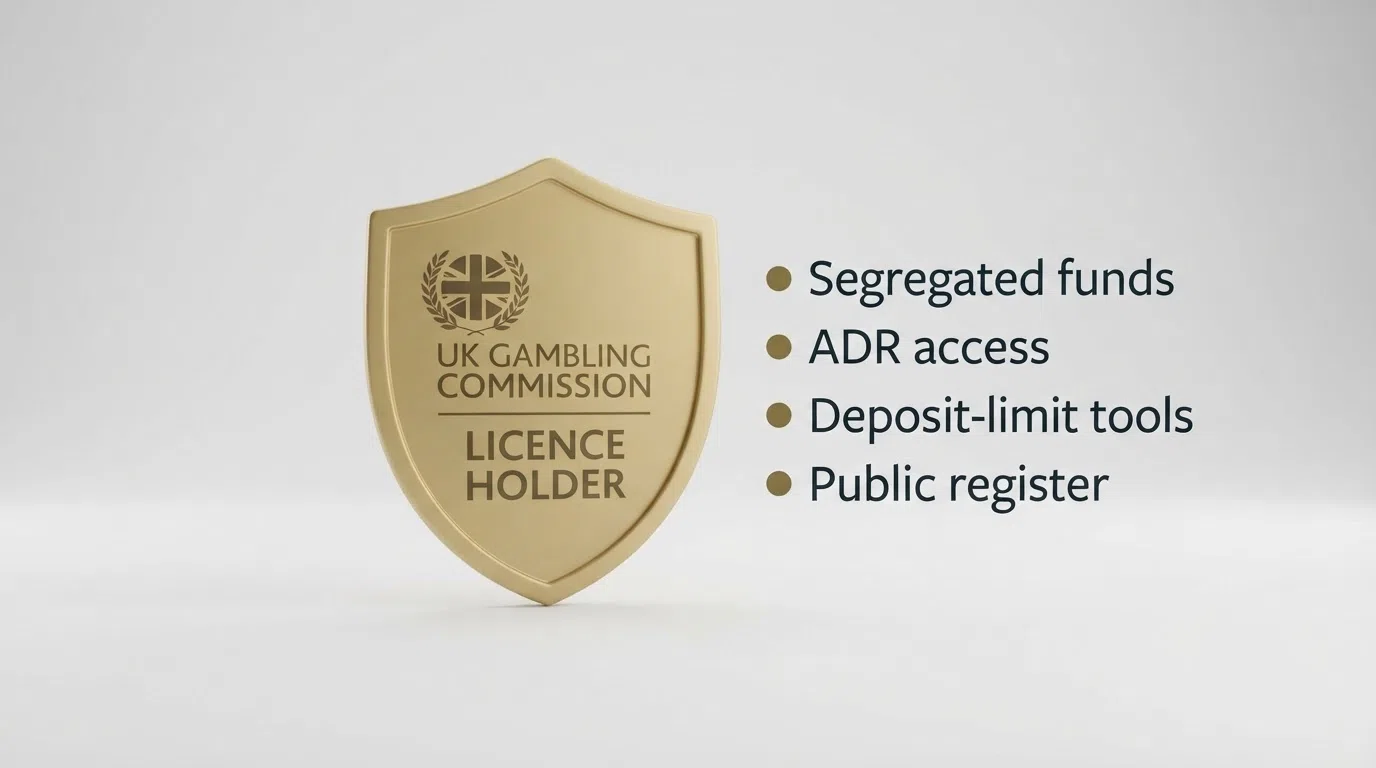
Condition 5.1.2 requires operators to use payment service providers defined by the Payment Services Regulations 2017 and to accept payments only through regulated channels. A bank transfer reaching a UKGC-licensed casino therefore moves through a regulated payment route. This does not remove all banking risk, but it removes the unregulated payment channel from the licensed operation.
UK rules also explain why bank transfer survives when other funding methods do not. Credit cards have been prohibited for gambling since April 2020, and UKGC-licensed operators do not accept cryptocurrency. Wire and bank transfer are neither banned nor restricted. Their traceability and connection to regulated providers make them compatible with the framework.
The wider rulebook has tightened player exposure. Online slots are capped at £5 per game cycle for players aged 25 and over from 9 April 2025, and at £2 for players aged 18–24 from 21 May 2025. Bonus wagering is capped at 10x the bonus amount from 19 January 2026, while mixed-product promotions are banned. A large deposit is not exempt from the house edge simply because it arrives by bank.
What a UKGC Licence Actually Means for Your Bank Transfer
Licensing imposes duties on the operator that a payment logo cannot replace. Player funds must be segregated from the money used to run the business, so an operating loss cannot automatically be treated as permission to spend customer balances. Payment terms must also be transparent about fees and processing time.
The Commission can suspend or revoke a licence when an operator fails to meet its conditions. That power gives the rules force beyond a customer-service promise. A player does not receive a private regulator for every transaction, but the operator faces a continuing incentive to maintain compliant payment and withdrawal procedures.
The public register lets the reader check more than existence. It records the licence status, account, operating company and relevant dates. LeoVegas Gaming PLC, for example, is listed with an active Casino Remote licence under account 39198 and licence number 039198-R-319450-028 since 1 November 2014. That is verification, not a third-party claim repeated without scrutiny.
Licence costs do not protect a player by themselves, but they show the scale of the regulatory structure. From 1 October 2026, annual fees for remote casino licences range from £7,000 to £112,556 depending on gross-gaming-yield band under the Gambling (Fees) Miscellaneous Amendments Regulations 2026. A casino operates within a licensed system, not inside an informal website.
The remote gaming duty sits on the operator side of the business. It increased to 40% from 1 April 2026. Whatever the duty does to operator economics, it does not reduce the mathematical house edge on a spin. Tax and edge are separate quantities, a distinction worth preserving when an offer is sold as “good value”.
A licence is therefore a floor, not a guarantee of instant service. It tells the player where to seek regulatory accountability and what minimum controls should apply. The correct sequence is simple: verify the licence, read the banking terms, set a limit, then decide whether the casino deserves the money.
Player Protection and Dispute Resolution Under the UKGC Framework
A payment dispute should follow the operator’s formal complaints procedure. The framework gives the player a defined route and a resolution period of eight weeks before the complaint can be escalated. Keeping dates, transaction references and screenshots makes that process easier rather than more dramatic.
If the complaint remains unresolved, it can go to an Alternative Dispute Resolution provider approved by the UK Gambling Commission. That independent stage is the practical escalation path. The ADR decision is not a personal banking guarantee, but it places the disagreement before a body separate from the operator’s own support team.
The UKGC does not adjudicate every individual complaint. Its compliance function investigates systemic failures, repeated patterns and breaches of licence conditions. A slow single payment and evidence of a widespread withdrawal failure are different regulatory matters. The distinction helps the player choose the correct route.
The Financial Ombudsman Service does not cover gambling transactions. Sending a casino banking complaint there can waste the eight-week window that belongs in the approved gambling dispute process. The right destination is the casino’s complaints procedure, followed by the Commission-approved ADR provider if the issue remains unresolved.
Bank transfers can be retraced, but traceability does not resolve every disagreement. The record tells the bank and the operator what was ordered, not which party should prevail when a withdrawal is held. A player should start with the bank statement and the casino transaction record, then use the formal complaint path without exaggeration.
AML and Source-of-Funds: The Checks a Bank Transfer Player Faces
A bank statement request can feel like a delay, but the underlying obligation is specific. LCCP condition 5.1.1 requires policies covering cash and cash equivalents, including bank transfers, to reduce money-laundering risk. The Commission’s 2026 money-laundering risk assessment, published on 30 July 2026, requires every licensed casino to maintain its own assessment under LCCP condition 12.1.1(1).
That assessment covers the operator’s payment methods and risks. It does not declare every transfer suspicious. Instead, it requires controls proportionate to products, customers, transaction patterns and amounts. A large bank deposit deserves a higher level of scrutiny than an ordinary small payment.
Financial-risk triggers sharpen that scrutiny. A player spending more than £1,000 within 24 hours or more than £3,000 over 90 days can face a financial risk assessment. For players under 25, the 24-hour threshold is £750. The checks are thresholds for intervention, not allowances that can be spent without review.
Evidence can include a bank statement, audited accounts or other material establishing the source of funds. The exact request depends on the player’s circumstances and the operator’s controls. A payslip and a bank statement may answer different questions. The player should provide documents that are current, complete and connected to the account making the deposit.
Preparation is the cheapest response. A high-value player who keeps statements, business records and audited accounts can make a large transfer without improvising. Someone moving money on behalf of another person should expect the relationship to be examined. The account holder and the source of the money need to make sense together.
The closed-loop withdrawal policy supports the same objective. Returning winnings to the depositing method makes it harder to layer funds across unrelated channels. A casino may use identity verification, source-of-funds evidence and same-method returns together because no single document proves the whole path.
The house never disappears during these checks. Verifying where £35,000 came from does not make a £35,000 balance safer to wager than £35. A regulatory control protects the transaction, while a personal limit protects the household. Both are needed, and they perform different jobs.
Responsible Gaming: The Controls Every UK Player Should Activate Before They Deposit
Wire transfer has no natural spending brake. The operator may set a ceiling of £10,000 or £100,000, but either figure is capacity rather than affordability. UKGC-licensed casinos must provide safer-gambling tools because a payment rail should never be mistaken for a personal risk system.
The controls start with deposit limits. A time-out, self-exclusion or reality check works only if it is used before pressure turns into a larger transfer. For a bank-funded player, that sequence is more important because the available balance can be much larger than the amount normally placed on a card.
Deposit Limits and Time-Outs: How to Set Them at a UK Casino
From 30 June 2026, every UK online operator must offer a deposit limit based solely on the amount paid into the customer’s account over a set period. The setting must be accessible through a homepage link, and a request to reduce the limit takes effect immediately.
Immediate reduction is the important part. A player who recognises escalating deposits should not have to wait while the account continues accepting money. The limit belongs in the dashboard before the next session, not as a promise made after losses have already accumulated.
Increase requests are different. They face a cooling-off period, giving the player time to reconsider under less pressure. A high ceiling published by a casino is not a reason to raise a personal limit. If anything, the knowledge that a large transfer is technically possible is a reason to decide in advance how much will never be deposited.
Time-outs lock the account for a fixed period ranging from 24 hours to six weeks. No gambling access is available during that window. They suit a shorter break, while national self-exclusion is designed to cover every UKGC-licensed operator and can run for as long as five years.
Stake restrictions apply even before personal tools are used. From 9 April 2025, the online slot limit is £5 per game cycle for players aged 25 and over. From 21 May 2025, it is £2 for players aged 18–24. These caps reduce the amount risked per cycle; they do not repair a bankroll sent to the cashier.
Set a deposit limit before making the first bank transfer. Then choose a time-out if play is becoming harder to interrupt. The order matters. Prevention comes before withdrawal.
GamStop Self-Exclusion: How It Works for UK Players
GamStop is the national self-exclusion scheme covering UKGC-licensed gambling sites. A single registration excludes the player from the whole participating licensed market; individual brands cannot be selected one by one. The block is broader than changing a password or setting a casino-specific limit.
As of the first half of 2026, 614,738 consumers were actively self-excluded. Registrations had risen 16% year on year, with May 2026 setting a new monthly record. People under 25 produced the largest increase, at 26%, and accounted for nearly one third of all exclusions.
The figures are not a competition for attention. They show that a method of control once seen as exceptional has become part of the mainstream support system. A record month means more people reached the point at which blocking every licensed site felt necessary.
The maximum exclusion period is five years. That length can give a player distance from triggers, but only the excluded player can decide when and how to use the scheme. A bank transfer does not override the block, and access to funds does not make self-exclusion voluntary at a single operator.
GamStop should be paired with practical financial protection. A player who recognises loss of control can use account limits, seek help from GamCare and remove gambling apps or payment shortcuts that make renewed access easy. The scheme stops licensed-site entry. It does not solve every reason a person might gamble.
GamCare, BeGambleAware, and the National Helpline: Where to Get Help
The National Gambling Helpline is available on 0808 8020 133. It is a freephone service operated by GamCare, offering confidential support and a place to discuss what is happening before a financial boundary fails.
GamCare made 996 referrals to treatment and peer-support services in January 2026, 48% more than the 674 recorded in January 2025. Among helpline callers who disclosed a gambling form, 82% cited struggles with online gambling specifically, the highest rate recorded since 2021. Online play is not the only form reported, but it dominates the disclosed sample described by GamCare.
GamCare also provides live chat and counselling. BeGambleAware supplies information and signposting to NHS and third-sector treatment services. These organisations form a support network, not a sequence in which a player must prove they are bad enough to call.
Confidentiality and speed matter when a bank balance is involved. Waiting for the problem to become obvious can turn a controllable loss into a missed payment. Asking for help is an action taken while options remain, not an admission made at the bottom of a losing session.
How Many UK Players Are Affected: The Prevalence Numbers
The Gambling Commission’s Great Britain Survey for Year 3, based on 2025 data, places problem-gambling prevalence, measured as a PGSI score of 8 or more, at 2.4% of adults. Another 3.5% scored between 3 and 7, placing them at moderate risk. The 95% confidence interval around the 2.4% headline is 1.9%–2.8%.
The Commission describes that headline as statistically stable across the survey’s three years. The earlier results were 2.5% in Year 1 and 2.7% in Year 2. Stability does not mean irrelevance. It means small changes in the measured rate should not be turned into dramatic claims without the wider range in view.
The NHS Adult Psychiatric Morbidity Survey for 2023/24 used the same broad PGSI framework but produced a lower overall rate. It found 1.6% of adults at PGSI 3 or above and 0.4% at PGSI 8 or above. The highest prevalence in that survey was among 25–34-year-olds, at 3.5% for moderate risk or above.
Those percentages use different surveys and should not be blended into one exact prevalence figure. Together they show that harmful gambling affects a minority large enough to matter and that risk is not evenly distributed. A 3.5% rate among one age group is a reason for that group to use stricter controls, not a prediction that every player in it will develop a problem.
The figures also explain why bank-transfer limits need a human boundary. Six figures may be the operator’s permitted maximum. Two point four per cent is the population-level problem-gambling rate. Neither number should be used to tell another person how much they can safely lose. Personal loss capacity is smaller, more individual and much less forgiving than either statistic.
How We Picked and Ranked the Casinos on This Page
The comparison began with the UK Gambling Commission public register and continued through each operator’s published banking terms. Every featured casino holds an active UKGC remote casino licence. That makes licensing a qualification for inclusion, not a differentiator used to manufacture a close finish.
The ranking then gives the greatest weight to evidence that affects a bank-funded player: the minimum accepted on the relevant rail, the published withdrawal time, the fee position and the deposit ceiling. Brand recognition, market share and the size of the welcome graphic carry no ranking value. Neither does a general claim that an operator offers “fast withdrawals”.
That method produces a strict result. Unibet leads because Trustly is published down to a £5 minimum, a £100,000 maximum and a tested withdrawal time under 20 minutes. Bet365 ranks as the high-ceiling specialist because its wire deposit reaches £100,000 and its bank-withdrawal processing is 1–4 hours. Sky Vegas ranks on transparent, fee-free Faster Payments rather than the largest possible limit.
Operators with undisclosed rail-specific figures remain in the table because their licences and game catalogues are relevant. They do not receive invented times or fabricated minimums. An em dash is the correct answer when a bank-transfer figure cannot be established, and the surrounding prose identifies what the absence prevents the reader from deciding.
Game providers and welcome offers are recorded as context. NetEnt, Microgaming, Playtech, Pragmatic Play and a catalogue exceeding 100 developers can distinguish one casino from another, but none proves how a bank transfer clears. Likewise, wager-free spins do not turn a slow withdrawal into a fast one.
LeoVegas provides a useful verification example. The public register records its active Casino Remote licence under account 39198 since 1 November 2014. The brand claim, the register entry and the Open Banking terms answer different questions. A careful comparison keeps them separate instead of allowing a familiar logo to stand in for evidence.
No weights or arithmetic are hidden here because the ranking is qualitative. A term is strong when it is specific, bounded and useful. A number without a route, stage or condition would create false precision, so it is left out. The result is not ten equally interchangeable casinos. It is a set in which a reader can see who supplies bank-transfer facts and who merely accepts the possibility.
Your Bank Transfer Casino Decision in 2026: What to Do With This
Choose Unibet when speed is the overriding priority. Trustly accepts deposits from £5 to £100,000, and independent testing recorded withdrawals in under 20 minutes. The conventional bank-transfer route can take up to five days, so the choice is not bank transfer in the abstract. It is Trustly, with its own timing and conditions.
Choose Bet365 when a £100,000 wire ceiling carries more weight than a low entry point. Its bank-withdrawal processing window is 1–4 hours, but a wire deposit can take 2–10 days. That slow funding window should be built into the plan rather than discovered after money leaves the bank. The “heavyweight” claim rests on ceiling, not all-round speed.
Choose Sky Vegas for the simplest no-fee domestic route. Faster Payments begins at £10, permits up to £10,000 per day and credits deposits within 24 hours. Withdrawals take 1–3 working days. It is not the high-roller ceiling, but its published domestic terms are easy to understand.
Choose LeoVegas when Open Banking is worth more than the fastest available cashout. Its range runs from £10 to £35,000, and withdrawals take 2–5 days with no withdrawal fees. The route avoids manual beneficiary entry. The trade is a slower complete withdrawal than the Trustly and Bet365 results at their best.
PartyCasino deserves a narrower choice. Use Trustly or Instant Bank after tolerating a potential 24–48-hour pending review, because the standard bank route takes 3–7 working days after approval. PlayOJO, BetMGM UK, Mr Vegas, Casumo and 888 Casino remain licensed options, but their published bank-transfer evidence is incomplete or slower. A missing term is not a secret advantage.
Among payment methods at a UKGC-licensed casino, bank transfer is the strongest choice for a player who values a regulated audit trail, a familiar account and substantial limits. It is not the safest casino game, and no rail removes the house edge. A £10,000 transfer does not become a smaller financial risk because every payment is traceable.
Set the deposit limit before funding the account. From 30 June 2026, a reduction request must take effect immediately. A method that can move £100,000 needs a boundary measured in household affordability, not operator capacity. A limit of £35 may be too low for one reader and still reckless for another. The correct figure is the amount that can be lost without affecting rent, food, debt payments or anyone who depends on the player.
Then check the live cashier terms. Published windows can change, and a player’s chosen method may include conditions not visible in a static comparison. The final decision is not which logo looks established. It is which operator combines the right rail, a disclosed ceiling, an acceptable wait and a limit the player has already chosen.
Speed gets the glory. Ceiling pays the rent.
Frequently Asked Questions About Wire Transfer Casinos
Do all UK casinos accept wire transfer as a payment method?
No. UKGC-licensed casinos decide which bank-based rails to support, and their terms vary by operator and direction of payment. Some accept traditional wire deposits, some use Faster Payments or Open Banking, and others accept bank withdrawals without offering the same method for deposits. Check the live cashier before registering or sending funds.
Why do some casinos require bank transfer for large withdrawals?
Bank accounts can carry larger transactions than many cards or e-wallets, and the closed-loop policy normally returns money to the original depositing method. When that method cannot receive a large payout, a casino may require a verified bank account instead. Expect source-of-funds checks if the withdrawal is unusually large or the account history needs further review.
How long does a wire transfer deposit take to appear in my casino balance?
A standard wire-transfer deposit typically takes 1–3 business days, while Faster Payments can take up to 24 hours. Open Banking and Trustly may appear much faster, sometimes immediately. Bet365 publishes a longer 2–10-day wire window, so the operator and rail matter. The balance changes only after the funds clear and match the transfer reference.
How many days should I expect for a bank transfer withdrawal to land?
Allow 2–7 business days in total as a broad expectation, because casino review and bank clearing are separate. PartyCasino can hold withdrawals for 24–48 hours before processing, then standard bank transfers take 3–7 working days. Trustly can be faster, while weekends and bank holidays can extend the wait. Treat any stated figure as a window, not a guarantee.
What UKGC rules apply to bank transfer payments at casinos?
UKGC-licensed operators must use regulated payment service providers under LCCP condition 5.1.2. Withdrawals generally return to the depositing method through the closed-loop policy, and operators must assess money-laundering risk. Financial-risk assessments can apply above spending thresholds, with additional source-of-funds evidence required. Licence status and exact conditions should be checked on the public register.
Does a bank transfer casino charge fees on deposits or payouts?
The casino may absorb its own processing cost, but the player’s bank can charge for an international wire. UK banks typically charge £0–£25 outgoing and £0–£7 incoming, while domestic Faster Payments are generally free. Sky Vegas states that its Faster Payments service is free of charge, and LeoVegas states no withdrawal fees. Domestic banking usually offers the cleaner answer.
Wire Transfer vs Bank Transfer: Is There Actually a Difference at a Casino?
There is usually no practical difference in a UK casino cashier. The everyday British term is “bank transfer”, and it covers domestic Faster Payments, BACS and CHAPS. “Wire transfer” often points toward an international SWIFT payment. The words overlap, but the route underneath determines time and cost.
A UK player at a UK-licensed casino will almost always use a domestic bank rail. That keeps the transaction inside the payment arrangements expected by the operator and avoids many of the fees and delays associated with an international wire. Faster Payments is generally free in UK banking, while cross-border transfers can carry separate charges at each end.
Cross-border play is where terminology regains meaning. A UK bank sending money through an international network may encounter a £0–£25 outgoing charge or a £0–£7 incoming charge. Settlement can also take longer because the payment passes through more institutions. The same word “wire” then describes a different operation from a domestic transfer.
The casino licence does not remove these distinctions. It ensures that the operator and payment service work within the UK regulatory framework. It does not turn a slow international payment into Faster Payments. Players should look for the rail named in the cashier rather than treating every bank transfer as identical.
Payments – nominimumdeposit-casinos-uk
Content created by the «nominimumdeposit-casinos-uk» team