
No Registration Casinos in the UK: What the Promise Costs the Player
 Available in GB
Every few months a fresh crop of “no registration casino UK” pages land in search results promising instant play, no sign-up, no email, no friction. The promise sounds liberating. The law is less interested in liberation than in knowing who is on the other end of a deposit. Since 7 May 2019 the Gambling Commission has required every remote licensee to verify a customer’s name, address and date of birth before they can deposit a penny or place a single bet. The pre-2019 “you have 72 hours to send your documents” grace period was abolished. The window between opening a casino and playing for real money is now a single step, and that step is identity.
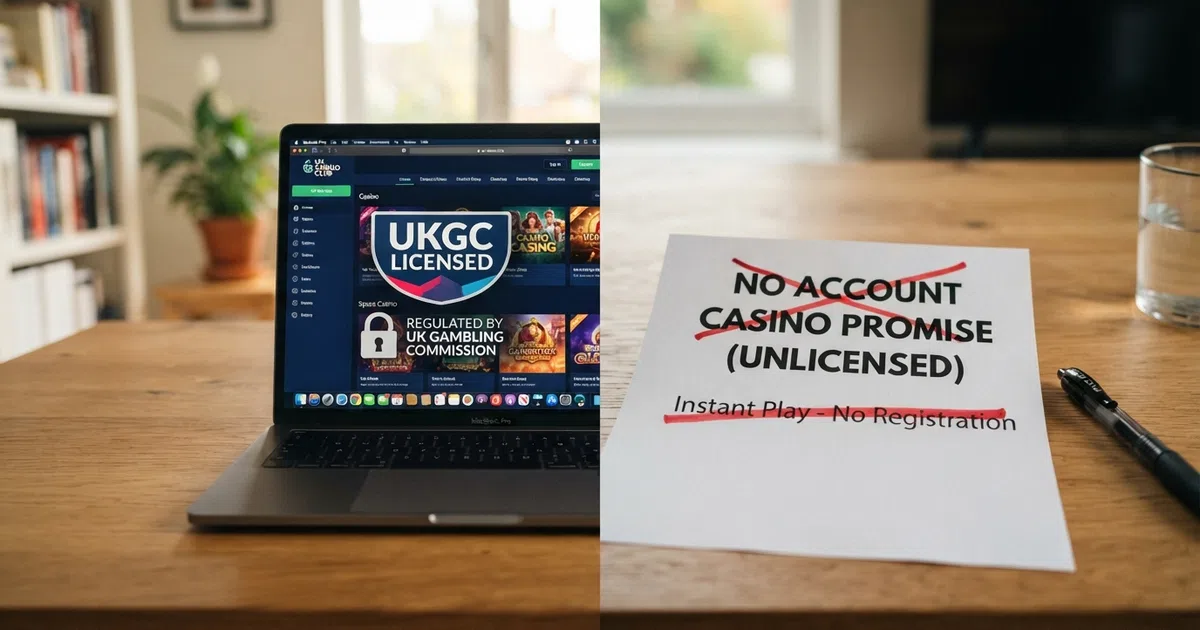
A true no-registration casino is therefore not a feature available inside the British licensed market. It is a category that, by definition, sits outside it. Any site offering real-money play to UK residents without checking who they are is unlicensed. That does not mean the search term is hollow — far from it. It means the page that earns its keep is the one that separates what the marketing claims from what the regulation permits, and then maps out the genuine alternatives for someone who wants the speed without the unprotected gamble.
This page was checked against the UK Gambling Commission’s public register of licence holders, last refreshed on 29 July 2026. The data presented is current as of September 8, 2026, based on official UK Gambling Commission licensing records.
What the Term “No Registration Casino” Actually Describes
Three things define a “no registration” casino in the marketing sense: no sign-up form to fill in, no email address to surrender, and no username-password combination to remember. The pitch is that a player moves from landing on a site to spinning a slot in under a minute, often with the identity check handled by a payment provider rather than a form.
That pitch collides directly with the structure of the British market. The UKGC is the single statutory regulator for commercial gambling in Great Britain, established under the Gambling Act 2005. The Act is built around three licensing objectives: preventing gambling from being a source of crime, ensuring it is fair and open, and protecting children and other vulnerable people. The third objective does not survive a model that lets anyone with a bank card gamble anonymously. The Commission’s response has been the LCCP — Licence Conditions and Codes of Practice — the day-to-day rulebook that every remote licensee accepts when it takes a GB licence. Condition 17.1.1 of that codebook is the single sentence that makes no-registration gambling impossible at any licensed site.
There is also a related term worth keeping straight: “no account casino.” In the Nordic and German markets the no-account model has a specific technical meaning — Trustly’s Pay N Play system, where the player’s bank acts as the identity provider. The UK is not Sweden or Finland. Pay N Play exists in Britain, but the Commission’s verification rule still applies; a no-account Pay N Play casino is a casino that has verified you through your bank rather than through a form, not a casino that has skipped verification. The label is faster; the legal substance is identical.
UK players searching the term will mostly find one of two things: offshore crypto casinos promising anonymity, and GB-licensed operators marketing their simplified sign-up or Pay N Play option. Neither of those is the thing the keyword actually asks for.
Pay N Play: The Trustly Verification Route That Cuts Out the Sign-Up Form
Pay N Play is the closest the British licensed market gets to the no-registration experience, and it is worth understanding how it works because it explains what the technology can and cannot do within UKGC rules.
The flow is a single step. A player clicks “deposit”, is redirected to their bank’s authentication screen, approves the payment, and the casino receives two things in the same moment: a deposit and an identity assertion from the bank. The bank has already verified the customer’s name and date of birth to open the account; Pay N Play passes that data through, and the casino has met the condition in LCCP 17.1.1 without the player ever typing their address into a form.
That is the entire trick. The casino is not skipping verification. It is outsourcing the heaviest part of it to a regulated institution — the player’s bank — under open banking protocols. The result feels like no registration because there is no form, no email confirmation, no password to set. The legal substance is the same as a manual sign-up that took three minutes longer.
A handful of GB-licensed casinos offer Pay N Play, and they tend to be the brands that also offer the fastest “speed-of-light” onboarding among the more traditional operators. Where Pay N Play is available, the experience is genuinely close to what the no-registration marketing describes. Where it is not, the player is back to a short form and a near-instant verification. The barrier is the form, not the law.
Browser-Based Instant Play: No Download, No Friction
The other piece of the no-registration promise — the part that is fully delivered inside the licensed market — is the no-download claim. Modern online casino games are built in HTML5. They load in any modern browser on any device, with no client to install, no app store to visit, no storage to sacrifice. The same is true across every operator reviewed below: LeoVegas, Bet365, William Hill Vegas, MrQ, Casumo, 888Casino, Sky Vegas, Paddy Power, Betfair and PlayGrand all run their game lobbies in a browser tab, on desktop and on mobile, without a download.
This is the genuinely registration-free part of the no-registration cluster, and it is the part that a player can act on today. Open a browser, navigate to a licensed casino, load a game in demo mode, and spin. There is no form, no deposit, no identity check. The reason is that demo play is not gambling — no money changes hands, no licence condition on customer verification is engaged. The moment a player switches from demo to real money, LCCP 17.1.1 activates. Up to that line, the experience is exactly what the no-registration marketing describes.
The games themselves are also fully available in browser. NetEnt, Pragmatic Play, Play’n GO, Microgaming, Playtech, Evolution and Red Tiger all release their portfolios simultaneously in desktop-instant and mobile-instant formats. The “no download” half of the cluster is therefore real and current; it is only the “no registration” half that runs into the verification rule.
Identity First, Play Later: The UK’s Mandatory Verification Rule
The single rule that defines the British market is LCCP 17.1.1: a remote licensee must verify the customer’s name, address and date of birth before the customer can deposit funds or gamble. It took effect on 7 May 2019, and it removed the 72-hour grace period that had let customers deposit and play for up to three days before sending in their documents. Since the deadline, the customer is verified at the door or they do not enter.
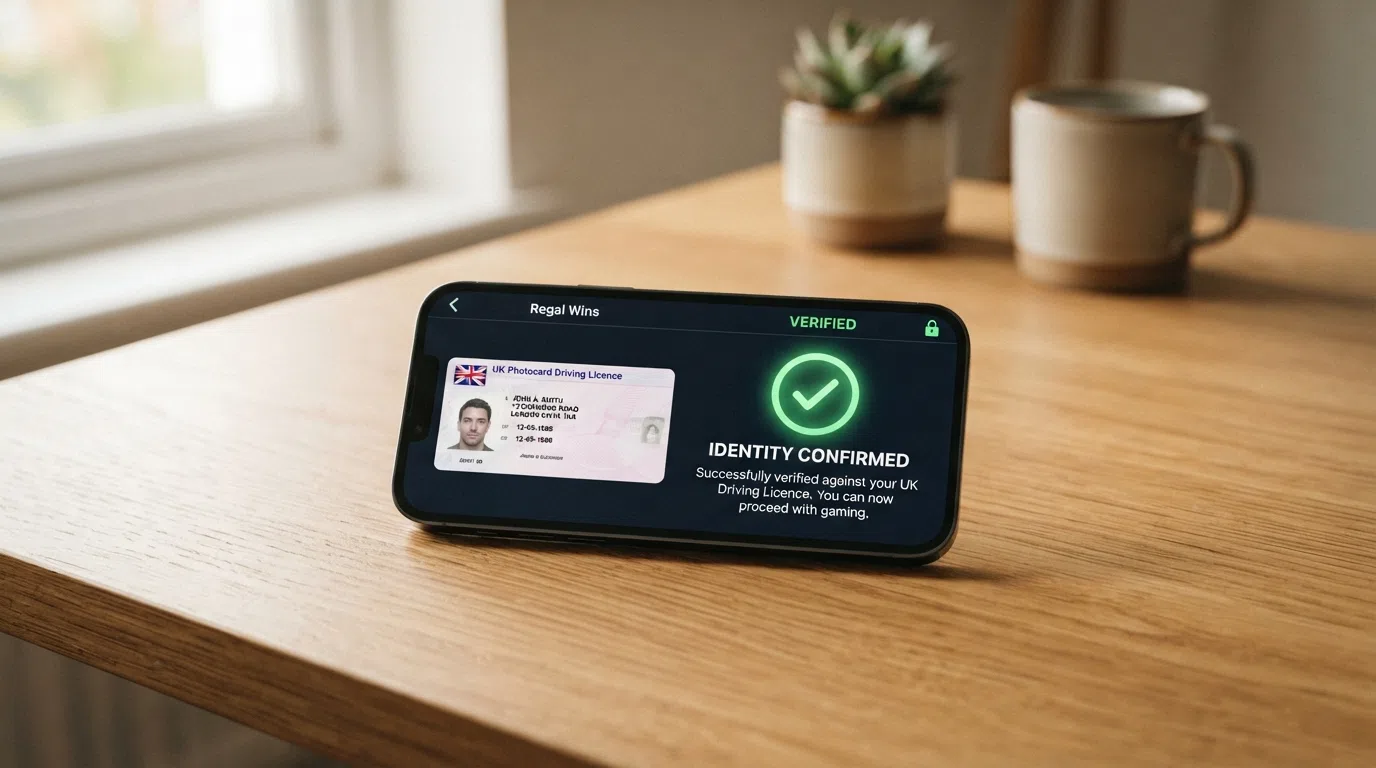
Three data points must be confirmed before any deposit is accepted. The licence holder can verify them through a combination of electoral roll data, credit reference agencies, open-banking identity, or document upload, but all three must be present. The age element — confirming the customer is at least 18 — extends to free-to-play games on the licensee’s own site, not only real-money play. A GB-licensed casino cannot let a child load a demo slot, even for fun.
The Commission has backed the rule with sustained enforcement. Between April 2024 and June 2025 it issued 3,140 disruption notices, referred 447,778 URLs to search engines for delisting, and saw 287,961 URLs removed. The average engagement across 160 disrupted sites fell by 32%. That is what a regulator does when it cannot stop unlicensed sites from existing — it makes them harder to find.
LCCP 17.1.1: The Rule That Made No-Registration Gambling Impossible in the UK
The condition is one sentence in the codebook and the only sentence that needs to be cited to answer the question “are no-registration casinos legal in the UK”. The pre-2019 grace period was the loophole. It was removed because, in the Commission’s view, it was being used: customers deposited, lost, and only then faced the question of who they were. The new rule is at the door, not at the withdrawal.
The rule’s scope is broader than the sign-up moment. The same verification mechanism catches free-to-play access on a licensee’s own site, source-of-funds checks for higher-spending customers (a financial vulnerability check fires automatically at £150 in net deposits over a rolling 30-day period, using only public data such as county court judgments and IVAs), and the affordability check pilot that the Commission’s Board confirmed in staged rollout on 7 July 2026. None of those layers depends on the player having agreed to a traditional account; they all depend on the player being identified at first contact.
What UK Players Lose When They Skip the Verification Step
A player who gambles on an unlicensed site does not face a legal penalty. The Commission’s enforcement is aimed at operators, not customers. What the player loses is the entire British consumer-protection stack that comes with the licence, and the list is long enough to be worth counting.
- No GAMSTOP coverage. GAMSTOP is the national multi-operator online self-exclusion scheme, mandatory for every GB-licensed remote operator since 31 March 2020. It binds the operator, not the player, and an offshore site is not within the perimeter. The 561,983 people whose self-exclusions were active at the end of $$CY-1$$ — 117,756 of them signed up in that year alone, with a 40% year-on-year rise in 16–24 year-olds in the second half — were betting that the perimeter would hold. For an offshore site, it does not.
- No UKGC complaints route or ADR. A licensed operator that withholds winnings can be dragged through the Commission’s complaints process and, in the last instance, an alternative dispute resolution scheme. An offshore site is answerable only to its own jurisdiction — and Curaçao, Malta and Gibraltar are reachable by British consumers only through private international law, at proportionate cost only to a player with a five-figure claim.
- No AML or source-of-funds safeguard. The verification at the door is also the entry point for anti-money-laundering monitoring. An unlicensed site has no such obligation and is unlikely to apply it voluntarily.
- No British consumer redress. The Gambling Act 2005’s consumer-protection machinery assumes the operator is in the regulatory perimeter. Step outside it, and the machinery does not follow.
- No deposit-limit, reality-check, or game-design protections. The 2.5-second minimum spin speed, the auto-play ban, the losses-disguised-as-wins prohibition, the session-time and net-loss display — all of those are LCCP and RTS conditions that apply only to licensed operators. Offshore sites run on their own house rules.
The Commission’s position is that it has no statutory power to block unlicensed sites at the ISP level; the proposed legislation has not been enacted. What it can do is disrupt: take down URLs, refer domains to registrars, lean on payment providers. The result is a market in which unlicensed sites are reachable from a UK IP address but unprotected by UK law.
The Top 10 GB-Licensed Casinos With the Fastest Sign-Up Flow
The table below ranks the ten GB-licensed operators that come closest to the no-registration experience — fast verification, instant browser play, strong mobile support — and the welcome offer each currently publishes. Two operators in the set, Paddy Power and PlayGrand, include a genuinely deposit-free free-spin offer. Four — LeoVegas, MrQ, Sky Vegas and Paddy Power — offer wager-free spins where winnings are withdrawable immediately.
| Comparison | Licensed Casino | Offshore Casino |
|---|---|---|
| Regulatory Protection | UKGC-backed | None |
| GAMSTOP | Mandatory | None |
| Disputes / ADR | UKGC complaints process | Private international law |
| AML / Safeguards | Strict UKGC standards | None |
| Consumer Redress | UK law | None |
Key 2026 Regulatory Milestones
| Change | Date | Impact |
|---|---|---|
| Stake Limits | 9 Apr / 21 May | £5 / £2 cap |
| Wagering Cap | 19 Jan | 10× limit |
| Remote Gaming Duty | 1 Apr | Rose to 40% |
| NHS Commissioning | 1 Apr | Transfer complete |
| Statutory Levy | 6 Apr | 1.1% of GGY |
A second pattern sits in the “Deposit-Free Spins” column. Most offers in the set are deposit-gated: a £10 minimum deposit is the price of entry for the spins. Paddy Power, PlayGrand and historically Sky Vegas are the exceptions — the welcome bonus is the spins, with no deposit required first. None of the three skips the verification step; the player still confirms name, address and date of birth before the spins credit. The deposit is gone. The form is not.
LeoVegas — 50 Wager-Free Spins and a Mobile-First Platform
LeoVegas has held UKGC account 39198 since 1 November 2014, making it one of the longer-standing remote licences in the British market. The welcome offer is 50 free spins on Big Bass Splash, wager-free, valued at £0.10 each for a total face value of £5. To claim, the player makes a minimum £10 deposit and wagers that deposit once. The deposit window is 7 days from registration; the spins themselves expire 3 days after they credit.
Big Bass Splash is a Pragmatic Play release. The slot’s RTP at maximum configuration is 96.71% and its volatility class is medium-high — a meaningful profile for a wager-free bonus, because the player is keeping whatever the game pays out at its natural frequency. LeoVegas’ game portfolio draws on six providers: NetEnt, Play’n GO, Pragmatic Play, Evolution, Microgaming and Red Tiger. The mobile experience is where the brand has historically set its standard, and the HTML5 instant-play lobby is the entry point most players will use.
The wager-free structure is the offer’s real value. A 50-spin bonus at 0× wagering is functionally a 50-pull sample of Big Bass Splash at the player’s expense, with whatever the reels pay out going straight to the cash balance. There is no playthrough to calculate, no bonus balance to manage, no maximum cashout to track. For a player who already plans to play Big Bass Splash at £0.10 a spin, the offer is almost pure upside; for a player who was going to play a different slot, the offer has no real value at all. The right reader for LeoVegas’ welcome is a Pragmatic Play slot fan with a £10 deposit and a 7-day window.
Bet365 — Up to 500 Free Spins Across 20 Days
Bet365 operates under UKGC account 38721 in the name of Hillside (UK Gaming) ENC, with multiple active remote licences. The welcome bonus is structured as a tiered free-spin reveal: the player makes selections over a 20-day window, with at least 24 hours between each pick, and each selection reveals a prize of 5, 10, 20 or 50 spins. The maximum headline figure is 500 spins; the average realised figure is much lower, because the mechanic is a randomised reward ladder rather than a guaranteed grant.
The bonus slot is Book of Horus, a Playtech title. Specific RTP and volatility for this title were not confirmed in the available material and are not stated here. The 30-day claim window from registration is the longest in the set for a free-spin offer. To qualify, the player must have made lifetime deposits of at least £10.
Bet365’s casino portfolio spans six providers, with Playtech, NetEnt, Microgaming, Pragmatic Play, Evolution and Play’n GO all represented. The brand’s defining feature, however, is the broader product: this is a sportsbook and exchange operator whose casino sits inside a larger platform. The tiered free-spin mechanic is consistent with that — a casino welcome that runs as a daily habit rather than a one-shot grant. For a player who already lives inside the Bet365 ecosystem, the 20-day reveal is a reason to log in each day. For a player looking for a one-time casino sign-up, the same mechanic reads as friction.
The wagering multiplier on any winnings from the spins was not confirmed in the available material; readers should check the operator’s current terms before claiming.
William Hill Vegas — 200 Free Spins on Big Bass Splash
William Hill Vegas sits inside the evoke/888 group, which holds multiple active UKGC licences. The welcome offer is 200 free spins on Big Bass Splash, valued at £0.10 each, requiring a minimum £10 deposit and a £10 wager to release. The spins are valid for 72 hours from issue — the shortest bonus window in the featured set, and the part of the offer most likely to catch a casual player out.
Big Bass Splash returns as the bonus slot, again with a 96.71% RTP at maximum configuration and a medium-high volatility profile. Pragmatic Play is the provider. William Hill Vegas’ game portfolio spans five providers: Playtech, NetEnt, Pragmatic Play, Evolution and IGT. The brand’s positioning inside the evoke group means it shares infrastructure with 888Casino, but the welcome offer is structured around spins rather than a deposit match.
The wagering multiplier on the spins was not specified in the available material and is treated as unconfirmed here. A 72-hour window is the binding constraint; a player who does not claim and use the spins within three days of issue loses them. The reader who suits William Hill Vegas is one who plans to play Big Bass Splash the day they sign up and will not be away for the weekend.
MrQ — 100 Wager-Free Spins, Zero Wagering on Winnings
MrQ operates under a UKGC licence held by Lindar Media Limited. The welcome offer is 100 free spins on Big Bass Splash, valued at £0.10 each — a total face value of £10, the largest spin value of any wager-free offer in the set. The minimum deposit is £10, the wagering multiplier is 0×, and the validity window is 48 hours from qualifying.
The wagering structure is the offer’s defining feature. Whatever the 100 spins return is paid in cash, with no playthrough, no bonus balance, and no maximum cashout. Big Bass Splash at 96.71% RTP and medium-high volatility determines the realised value — a player who hits a bonus feature will see a meaningful return; a player who does not will see almost nothing. The expected return across 100 spins at £0.10 each is roughly £9.67, before the volatility variance.
MrQ’s game portfolio covers five providers: NetEnt, Pragmatic Play, Play’n GO, Thunderkick and Push Gaming. The 48-hour validity is the tightest in the wager-free group, alongside William Hill Vegas’ 72 hours. A player who values simplicity — no bonus balance, no wagering calculation, what you see is what you get — will recognise what MrQ is selling. A player who plans to spread the spins across a week will lose them.
Casumo — 50% Deposit Match Up to £100 at 10× Wagering
Casumo holds an active UKGC licence and is the only percentage-matched deposit bonus in the set built around the 10× wagering cap. The offer is 50% of the first deposit, up to £100 — a player depositing £200 gets the full £100 bonus; a player depositing £20 gets a £10 bonus. The wagering requirement is 10× the bonus amount, which is also the new statutory ceiling introduced on 19 January 2026.
The 7-day validity is shorter than 888Casino’s 90 days and tighter than several of the spin offers. The minimum deposit is £20, the highest deposit threshold in the featured set. There are no free spins attached. The 10× multiplier on a £100 bonus means £1,000 of qualifying wagering before the bonus and any associated winnings convert to cash — a substantial playthrough that the slot’s RTP determines the cost of.
Casumo’s game portfolio is the deepest in the set: six providers, including NetEnt, Play’n GO, Microgaming, Evolution, Pragmatic Play and Red Tiger. The bonus is built for a player who plans to make a meaningful first deposit and clear a large playthrough within a week — someone who values the matched cash over a spin-based offer and is willing to commit the play time.
888Casino — 100% Deposit Match Up to £100, 90-Day Validity
888Casino holds an active UKGC licence inside the evoke group. The welcome offer is 100% of the first deposit, up to £100, with a 10× wagering requirement on selected slots and a 90-day validity window — by a wide margin the longest bonus window in the featured set.
The 10× wagering sits at the statutory cap. A player claiming the full £100 bonus must wager £1,000 on selected slots before the bonus converts. The 90 days is a generous window for clearing that requirement, and a meaningful point of difference from Casumo’s 7 days. The minimum deposit is £10.
888Casino’s portfolio spans six providers: NetEnt, Playtech, Evolution, Red Tiger, Pragmatic Play and Play’n GO. The offer suits a player who plans to deposit £100, work through the wagering steadily over a few months, and prefers the matched-cash structure to a spin-based welcome. The 90 days is the long-fuse option for a player who does not want to be on a clock.
Sky Vegas — 200 No-Wagering Free Spins, Deposit-Free Historically
Sky Vegas operates under a UKGC licence held by Flutter Entertainment, the same parent that runs Paddy Power and Betfair. The brand has historically published a welcome offer of 200 free spins with no wagering and no deposit required, the closest thing in the set to a no-strings sign-up. Specific details of the current 2026 offer were not fully confirmed in the available material, and the operator’s own terms page should be checked at the point of claim.
Spin value has historically been £0.10. The game portfolio covers six providers: NetEnt, Pragmatic Play, Playtech, Evolution, Red Tiger and IGT. Sky Vegas’ positioning inside Flutter means it shares infrastructure with Paddy Power and Betfair — the trio is a useful comparison point because all three sit under the same licence perimeter but publish different welcome mechanics.
Where the offer is confirmed as a 200-spin, 0× wagering, no-deposit welcome, the reader who suits Sky Vegas is the player who wants the maximum spin count at the minimum commitment. Where the current terms differ from the historical model, the page notes the change rather than guessing at the gap. The honest read on Sky Vegas today is that the brand has historically delivered the cleanest no-friction offer in the British market, and that the present shape of the offer should be verified before claiming.
Paddy Power — Free Spins No Deposit, No Wagering
Paddy Power sits alongside Sky Vegas and Betfair inside Flutter Entertainment, with an active UKGC licence. The welcome offer has historically been a deposit-free free-spin grant with no wagering on winnings — meaning a player signs up, verifies identity, and receives the spins without paying in first. The exact spin count for the current 2026 offer was not confirmed in the available material and is left unstated rather than guessed at.
The 7-day validity on any free spins is the binding constraint, and a £0.10 standard spin value is the historical model. Paddy Power’s casino game portfolio covers five providers: Playtech, NetEnt, Pragmatic Play, Evolution and Red Tiger.
The offer’s structure — deposit-free, wager-free, 7-day window — is the closest thing in the British licensed market to a no-registration experience. The verification step is still there; the deposit is not. A player who has no intention of funding an account on day one but wants to test the casino gets the spins anyway. The reader for Paddy Power’s welcome is the player who values the absence of an upfront commitment above the headline spin count.
Betfair — Exchange-First Brand, Casino Welcome Unconfirmed This Run
Betfair is the third Flutter Entertainment brand in the set, and the one that sits furthest from the no-registration question. Betfair is built around its betting exchange and sportsbook, with the casino product as a secondary vertical. The casino welcome offer was not confirmed in the available material for 2026.
The casino portfolio covers six providers — Playtech, NetEnt, Pragmatic Play, Evolution, Red Tiger and IGT — and the licence is in good standing. The right read on Betfair for this page is honest: the brand is in the set for completeness as part of the Flutter trio, but the casino welcome is not the reason a player chooses Betfair. Readers who already use the exchange and want a casino tab inside the same account will find one here; readers looking for a fast-onboarding no-registration-style welcome will find more focused offers elsewhere in the table.
Current casino terms should be checked at the operator’s site, and the page makes no claim about an offer that research did not confirm.
PlayGrand — No-Deposit Free Spins on Book of Dead at 10× Wagering
PlayGrand operates under a UKGC licence held by White Hat Gaming, a platform that runs several British-licensed casino brands. The welcome offer is a no-deposit free-spin grant on Book of Dead, a Play’n GO release. The 10× wagering on winnings sits at the statutory cap. The bonus validity is 10 days — the longest in the no-deposit group.
Book of Dead’s published RTP is 96.21% and its volatility is high — the highest-volatility bonus slot in the featured set. The combination matters. High volatility means a long run of low or zero returns punctuated by occasional larger hits. A 10× wagering requirement on winnings means a player who hits a £10 bonus return must wager £100 on selected slots before the cash becomes withdrawable. The exact spin count for the current 2026 offer was not confirmed in the available material.
PlayGrand’s portfolio covers six providers: NetEnt, Play’n GO, Microgaming, Evolution, Pragmatic Play and Red Tiger. The no-deposit structure is rare in the British market and places PlayGrand alongside Paddy Power as one of two genuinely deposit-free offers in the set. The 10× wagering on what is the highest-volatility slot in the table is the trade-off — the player gets the spins for free but pays for them in playthrough if the spins return anything meaningful. The reader who suits PlayGrand is one who wants to test the casino without funding it and is comfortable with the math of a high-volatility bonus slot.
Welcome Offers at No-Account Casinos: What You Can Claim and What It Costs
The bonus landscape at fast-onboarding GB casinos is defined by a single regulatory change. From 19 January 2026, bonus wagering requirements are capped at 10× and mixed-product promotional offers — any bonus that combines different gambling product types within one incentive — are banned. The cap is a ceiling, not a floor. Operators can still publish offers with lower wagering, and most spin-based offers in the featured set are wager-free, sitting at 0×.
What the cap does is end a particular kind of bonus competition. Before the regulation, operators competed on headline bonus size, with 35× and 40× wagering buried in the terms. After the regulation, the ceiling is 10×, and the only way to out-bonus a competitor is to offer 0× or to add non-cash value (free spins, prize wheels, tiered reveals). The result is a market in which wager-free spins dominate the top of the welcome table and percentage-matched deposit bonuses — when they appear at all — sit at the cap with a long validity window.
Three bonus types define the featured set. Wager-free free spins (LeoVegas, MrQ, Sky Vegas historically, Paddy Power historically) credit any winnings as cash, withdrawable immediately. Deposit-match bonuses with wagering at the 10× cap (Casumo, 888Casino) credit a matched amount that must be played through before conversion. No-deposit free spins (Paddy Power, PlayGrand) credit spins without an upfront deposit, though any winnings are subject to wagering at the cap. The slot that carries most of these offers is Big Bass Splash, the Pragmatic Play release with a 96.71% RTP and medium-high volatility; Book of Dead (Play’n GO, 96.21% RTP, high volatility) carries the PlayGrand bonus.
Wager-Free Spins vs Deposit-Match: The Two Bonus Camps in the Featured Set
The cleanest split in the table runs between operators that offer 0× wagering on their welcome spins and those that offer a 10× matched-deposit bonus. The economics are different, and the player who picks the wrong one for their habits pays for the misfit.
A wager-free spin offer is a sample of a specific slot at the operator’s expense. The player deposits the minimum to qualify, plays the spins, and keeps whatever the reels pay. There is no bonus balance, no playthrough, no maximum cashout. The realised value depends on the slot’s hit frequency and the volatility of the bonus features — Big Bass Splash at 96.71% RTP and medium-high volatility will, over a 50- or 100-spin sample, return a figure close to the face value of the spins (£5 for LeoVegas, £10 for MrQ), with a wide variance around it. The expected return is roughly the face value; the realised return can be higher or lower.
A deposit-match bonus at 10× wagering is a different animal. The player deposits, the operator matches a percentage up to a cap, and the bonus funds must be played through 10 times before they convert. On a £100 bonus at 10×, the player must wager £1,000 on selected slots. The expected cost of that playthrough, at an average slot RTP of 96%, is roughly £40 — the house edge on £1,000 of action. The bonus has to return more than £40 to be worth claiming in expected-value terms, before considering the time cost of running 10,000+ spins.
The two camps, in plain terms: wager-free spins are a gift the player may or may not enjoy. Deposit-match bonuses are a small loan at the house edge. A player who likes the bonus slot and plans to play it anyway should claim the wager-free offer. A player who plans to play a lot of slots and values the matched cash should claim the deposit match — and should clear it within the validity window, not stretch the playthrough.
No-Deposit Free Spins: The Closest Thing to a Free Lunch (and Its Limits)
Two operators in the featured set, Paddy Power and PlayGrand, publish welcome offers that do not require an upfront deposit. The structure is the same as any other free-spin grant — the player still verifies identity, the spins still carry terms — but the £10 minimum deposit that gates most other offers is absent. This is the closest the British licensed market gets to the no-registration experience: a welcome bonus that does not require funding the account to claim it.
The catch is in the wagering. Paddy Power’s historical model is 0× wagering on free-spin winnings, making the offer genuinely free in expected-value terms. PlayGrand’s model is 10× wagering on winnings, sitting at the cap. A player who hits a £5 return on PlayGrand’s Book of Dead spins must wager £50 on selected slots before the cash becomes withdrawable — a small but real cost relative to the no-deposit structure.
Why are no-deposit offers rare? Three reasons. First, they cost the operator real money without a guaranteed deposit to offset it. Second, the 10× cap and the mixed-product ban limit how an operator can dress up a no-deposit offer to compete on value. Third, the verification step is still mandatory, so the offer does not actually reach the player the no-registration marketing addresses — the player who does not want to identify themselves is excluded by LCCP 17.1.1 long before the no-deposit mechanic matters. The offers that do exist are aimed at a different reader: the player who is willing to verify but not willing to commit cash on day one.
Bonus Eligibility When You Skip or Rush the Account Setup
The interaction between fast onboarding and bonus eligibility is more tangled than the marketing suggests. A player who rushes through verification does not lose bonus eligibility — the bonus is triggered by deposit (or, in the no-deposit case, by registration) — but the speed of the onboarding has a separate effect on the bonus window.
Validity windows across the set: MrQ 48 hours, William Hill Vegas 72 hours, LeoVegas 7 days, Casumo 7 days, Paddy Power 7 days, PlayGrand 10 days, Bet365 30 days, 888Casino 90 days. The 48-hour and 72-hour windows are tight by design — the operator wants the spins played, not banked. The 90-day window at 888Casino reflects the deposit-match structure: clearing £1,000 of wagering at 10× is a multi-week project, and the operator has accepted that timeline.
Since 31 October $$CY-1$$, every operator must prompt the customer to set a financial limit before the first deposit. This is a separate step from verification, and it sits in the onboarding flow regardless of how fast the rest of the process runs. A player who is in a hurry to claim a 48-hour bonus still has to pause at the deposit-limit prompt and decide. The practical effect is a slightly longer onboarding than the no-registration marketing implies, with a regulatory purpose behind the delay.
The trade-off is structural: faster onboarding tends to coincide with shorter bonus windows, because the operator is offering a more generous headline (wager-free spins, large spin counts) in exchange for a tighter time pressure. The player who picks an offer for the headline rather than the window often loses the bonus to a missed deadline.
Spin for Fun Instantly: Where UK Players Access Free Demo Slots
The genuinely registration-free option in the British market is free demo play. Every modern slot is built to run in a browser, and every licensed operator exposes its games in a no-money demo mode. The player opens a tab, lands on a casino or an aggregator, clicks a slot, and spins. No form, no email, no identity check, no deposit. The credits are fun-credits, displayed with a marker that is not a currency symbol, and they never convert to real money.

The cluster around “free slots no download no registration” is by a wide margin the largest sub-topic in the keyword space — roughly 195 keys, against the ~110 of the core “what is a no registration casino” cluster. The intent is entertainment and product discovery, not gambling. A player looking for a no-registration experience is more often looking for a no-commitment experience, and the demo ecosystem delivers that without the legal problems that come with real-money anonymous play.
The providers who dominate the free-play libraries are the same providers who dominate the real-money libraries: NetEnt, Pragmatic Play, Play’n GO, Microgaming, Playtech and Evolution. The games are the same games, the math is the same math, the volatility and the RTP are unchanged. The only thing missing is the deposit.
Free Slots, No Download, No Registration: The UK’s Instant-Play Reality
The player experience of a free demo slot is straightforward. Navigate to a casino lobby, a slot-review site, or a free-slot aggregator. Pick a game. Click “Play for Fun” or “Demo”. The slot loads in the browser, the reels spin, and the credit counter ticks up or down as wins and losses land. The credits are virtual. No account is created. No email is collected. The session ends when the player closes the tab.
Many sites offer free-to-play slots to showcase their game libraries and draw in players. A handful of well-known information portals also provide these games directly on their own pages for players who want to try out slots without creating an account or depositing money. These demo sites do not require registration because no real-money gambling is taking place. The casino operators they link to do not require registration for demo play either, as demo gaming is not real-money gambling.
The HTML5 layer underneath is the technical reason this works. Modern slots are written in JavaScript and HTML5, served from a CDN, and rendered in the browser. There is no client to install, no app store to visit, no platform-specific build. The same game runs in Chrome on a Windows laptop, in Safari on an iPhone, in Firefox on a Linux machine. The “no download” half of the marketing is not a feature; it is the default state of the medium.
Demo Mode vs Real-Money Play: Where the Line Is and Where ID Kicks In
The line between demo and real-money play is the deposit. Up to that line, the player is in a zone the UKGC has chosen not to regulate as gambling: no money changes hands, no licence condition on customer verification is engaged, and the player can sample the games without identifying themselves. Across the line, LCCP 17.1.1 activates, and the operator must verify the player’s name, address and date of birth before accepting a deposit or allowing a real-money spin.
The line is bright by design. A site that lets a player spin demo slots without ID is fully compliant. The same site, the moment the player clicks “Deposit”, is bound by the verification rule. The two states are technically distinct on the operator’s platform even when the underlying game is the same game. A player who has spent an hour on a Big Bass Splash demo at £0.10 a spin has learned the game at zero cost. The same player, on the same site, depositing £10, will be asked to confirm their identity before the first real-money spin.
The game-design rules apply to both modes, but their enforcement weight is on real-money play. The 2.5-second minimum spin speed, the auto-play ban, the losses-disguised-as-wins prohibition, the mandatory display of total losses and time played — all of these are LCCP and RTS conditions that the operator must implement on real-money sessions. The Commission’s enforcement targets real-money play because that is where the harm occurs. Demo play is the unrestricted end of the spectrum, and the line at the other end is the verification rule.
Slot Types Available in Instant-Play Demo Mode
- Classic 3-reel slots. Simple mechanics, single payline or a handful, fruit and bar symbols. The form the genre started with; still produced by every major provider as a deliberate retro product.
- 5-reel video slots. The dominant form in the modern market. Five reels, multiple paylines, bonus features, free-spin rounds, scatter symbols, wild substitutions. The format that carries the headline RTP and volatility figures.
- Branded and 3D slots. Released under licence from film, television and music properties, with cinematic presentation and licensed audio. The category that pushes the medium’s production budget highest.
- Progressive jackpot slots. Demo versions are available for most major progressive titles, though the jackpot itself is inactive in demo mode. The mechanics — base game, bonus feature, jackpot trigger — can be sampled without contributing to the prize pool.
- Megaways and other engine-licensed formats. Variable-reel-count slots from Big Time Gaming’s engine, popularised across the major providers’ portfolios. The free-play libraries track the same release pipeline as the real-money libraries, with a slight delay.
NetEnt, Pragmatic Play, Play’n GO, Microgaming, Playtech and Evolution are the providers that dominate these libraries. A free-play player will find the same catalogue at every major aggregator, with minor differences in site design and game presentation.
Offshore Crypto Casinos: Tempting, Unlicensed, and Risky for UK Players
The third major group of results around this keyword serves a different reader. Sites like EVPowered and DLB Network rank for crypto and no-verification queries, promoting offshore casinos that accept Bitcoin and other cryptocurrencies without ID checks. The pitch is the inverse of the British licensed market: wallet-to-wallet deposits, no identity handover, no bank statement to send, “provably fair” games audited on the blockchain, withdrawals in minutes rather than days.
The UKGC’s position on this is unambiguous. No purely crypto-based casino holds a GB operating licence. The Commission’s principal objections are AML — anti-money-laundering — obligations, which the anonymity of blockchain transactions makes hard to satisfy. The Commission’s published guidance is that any operator offering real-money gambling to UK residents must hold a UKGC operating licence, regardless of the payment method used. A Curaçao or Curaçao-Antillean licence is not a substitute; the Gambling (Licensing and Advertising) Act 2014 made a GB licence compulsory at the point of consumption for any operator taking GB customers, wherever the operator is based.
That is the current state. What is changing is the timeline.
What Offshore Crypto Casinos Promise (and Why UK Players Search for Them)
The pitch is built around three promises. The first is speed: a deposit from a Bitcoin wallet confirms in minutes, a withdrawal in the same timeframe. The second is anonymity: no KYC — no “know your customer” form, no passport upload, no proof of address. The third is provably fair gaming: each spin is hashed on the blockchain before and after, allowing the player to verify that the result was not altered by the operator.
Each of these has a real technical basis and a real regulatory cost. Wallet-to-wallet transfers are fast because they bypass the banking system; the same bypass is what makes AML monitoring difficult. Provably fair is a legitimate cryptographic concept; it is not a substitute for a regulator’s audit of the game’s payout distribution. And anonymity, in the gambling context, is exactly what the UKGC’s 7 May 2019 verification rule was written to prevent.
The search demand behind this topic is around 14 keywords — small relative to the free-slots and definition groups, but persistent. The reader who lands on these results is usually looking for the unlicensed option, having already encountered the British restriction. The page’s job in that case is not to convert the reader but to make the cost of the offshore route explicit.
The UKGC’s Crypto Exploration: What the 2026–$$CY+1$$ Timeline Actually Means
The Commission has begun the slow work of opening the door to licensed crypto gambling, and the timeline was set out at the Betting and Gambling Council’s AGM on 26 February 2026 by Tim Miller, the UKGC’s executive director. The application window for new crypto-specific operating licences is expected to open in September 2026, with a target commencement date for the new regime of 25 October $$CY+1$$.
The shape of the regime is not yet finalised, but the constraints it must satisfy are clear. The operator will need to satisfy AML obligations — the same obligations that make anonymity impossible under the current framework. The verification step is unlikely to be removed; what may change is the form it takes, with blockchain identity attestations potentially accepted alongside traditional document checks. What the new regime is most likely to deliver is a licensed crypto casino, not a no-registration crypto casino. The two are different products.
For a player reading the timeline today, the practical conclusion is that the unlicensed crypto casino remains the only crypto option for the next 12 to 18 months at minimum, and the licensed version that arrives in late $$CY+1$$ is unlikely to remove the verification step. The promise of the offshore casino and the substance of a licensed British casino will not be the same product.
The Risks of Playing at an Offshore Crypto Casino Today
The risk profile of an unlicensed offshore casino in 2026 is the risk profile of an unregulated financial counterparty. There is no UKGC complaints process to escalate a dispute to, no alternative dispute resolution scheme for an independent ruling, and no British consumer redress if the operator withholds funds. The player has whatever contract law the operator’s home jurisdiction provides, exercised at the player’s cost.
GAMSTOP does not cover offshore sites. The 561,983 people whose self-exclusions were active at the end of $$CY-1$$ — and the 117,756 who signed up that year, with the 40% year-on-year rise in 16–24 year-olds in the second half — were betting that the British licensing perimeter would hold their self-exclusion in place. For an offshore site, the perimeter does not exist. The self-exclusion is a British instrument; it stops at the British border.
The Commission’s enforcement approach is disruption, not blocking. The proposed ISP-blocking legislation has not been enacted. What the Commission can do is issue cease-and-desist notices, refer URLs to search engines, lean on domain registrars and payment providers. Between April 2024 and June 2025, the Commission issued 3,140 disruption notices, referred 447,778 URLs to search engines, and saw 287,961 URLs removed; engagement across 160 disrupted sites fell by an average of 32%. The unlicensed sites become harder to find, not impossible to reach. The player who reaches one is on their own.
There is no penalty for the player who gambles on an unlicensed site. The Commission’s enforcement is aimed at operators. What the player loses is the protection: the protection of a regulator that can compel a payout, of a self-exclusion scheme that the operator is bound to honour, of a complaints route that ends in a binding decision. Offshore play is not illegal for the player; it is unprotected.
Mobile Browser Play: No App, No Download, No Extra Step
The “mobile slots no registration” cluster is small — around 4 keys — but it is the cluster that most cleanly delivers what the broader no-registration searcher is actually after. Modern mobile casinos run in the browser. There is no app to install, no app store to visit, no storage to clear, no update to wait for. The player opens Safari or Chrome, navigates to the casino, and the lobby loads.
All ten featured operators — LeoVegas, Bet365, William Hill Vegas, MrQ, Casumo, 888Casino, Sky Vegas, Paddy Power, Betfair and PlayGrand — offer mobile-browser play. The HTML5 instant-play layer is universal across the licensed market. The differences between operators are in mobile-specific design — LeoVegas’ mobile-first heritage, MrQ’s clean mobile interface, Bet365’s dense mobile lobby — not in the underlying capability.
The “no registration” half of the mobile cluster is, again, a misnomer. The mobile browser still asks the player to verify before the first real-money deposit. The “no download” half is genuinely true. The mobile no-registration searcher is usually a mobile no-download searcher who has used “no registration” as a shorthand for “I want to spin without friction.” The friction that is removed is the app store and the install. The friction that remains is the verification form.
No-Download Mobile Slots: From Tap to Spin in Under 30 Seconds
The mobile instant-play flow is fast by any reasonable standard. Open a browser, type the casino URL or follow a bookmark, wait for the lobby to load, tap a slot, wait for the game to initialise, spin. The whole sequence is well under a minute on a modern smartphone. There is no app to install, no app store friction, no update prompt blocking entry.
The trade-off versus a native app is the trade-off between convenience and integration. A native app can store login credentials, push notifications, and integrate with the phone’s biometric authentication. A browser session is faster to enter and slower to revisit. For a player who values speed of entry above integration, the mobile browser is the right tool. For a player who values session continuity, the native app still has a role — though for the no-registration reader, the native app is the wrong starting point, since it requires a download.
The game-design rules apply identically on mobile. The 2.5-second minimum spin speed, the auto-play ban, the losses-disguised-as-wins prohibition — all of these are game-level rules implemented in the game’s code, not in the platform. A mobile spin takes at least 2.5 seconds whether the player is on Wi-Fi or 4G, on an iPhone or an Android. The mobile experience is regulated in the same way as the desktop experience; the rules do not loosen for the smaller screen.
2026 Launches and What Changed in the UK’s No-Registration Space
The regulatory calendar in 2026 and late $$CY-1$$ has been unusually dense, and several of the changes reshape what “no registration” means in practice. The 19 January 2026 wagering cap and mixed-product ban ended a particular kind of bonus competition. The 1 April 2026 rise in Remote Gaming Duty from 21% to 40% reshaped operator economics. The 1 April 2026 NHS England commissioning transfer moved gambling-harm treatment into the NHS. The 7 July 2026 Board confirmation of staged affordability-check rollout set the next regulatory milestone, though the start date for the final thresholds has not been confirmed.
The cumulative effect is a tighter market. New entrants face a 10× wagering ceiling that prevents the old bonus-arms-race model, a 40% duty rate that compresses margins, mandatory deposit-limit prompts that lengthen the onboarding flow, and a regulator that has spent two years building its enforcement capacity against offshore competitors. Fast verification is now the competitive differentiator; no verification is not on the table.
What the 2026 Regulatory Wave Means for New No-Account Entrants
The 10× wagering ceiling is the most market-shaping change. Pre-cap, a new entrant could compete on headline bonus size with a 35× or 40× wagering requirement that was technically compliant and practically unplayable. Post-cap, the ceiling is 10× and any offer above it is illegal. The remaining headroom for bonus competition is in wagering below 10× — 0× offers, low-multiplier deposit matches — and in non-cash value (free spin counts, prize wheels, tiered reveals). New entrants that try to out-bonus the incumbents on a percentage-matched deposit will find themselves at the same cap as everyone else.
The 40% Remote Gaming Duty rise affects margins without directly affecting the player. Players pay no tax on gambling winnings in the UK; the duty is operator-side. The squeeze shows up in the offers operators can afford to publish, the marketing spend they can sustain, and the bonus generosity they can offer. A market with 21% duty was comfortable with 35× wagering bonuses because the house edge on the wagering covered the cost of the bonus many times over. A market with 40% duty cannot afford the same generosity at the same multiples, and the cap is the regulator’s response to that dynamic.
The mandatory deposit-limit prompt, in force since 31 October $$CY-1$$, is the onboarding change most relevant to the no-registration searcher. Every operator must now prompt the customer to set a financial limit before the first deposit. The prompt is a step in the flow regardless of how fast the rest of the verification runs. For a player chasing the 48-hour bonus window at MrQ, the deposit-limit prompt is a pause that cannot be skipped. The total onboarding is still fast — a few minutes rather than a few hours — but it is no longer frictionless.
The combined picture is a market in which the only available speed-up is faster verification, not skipped verification. Pay N Play remains the closest the licensed market gets to a one-step deposit-and-verify flow. The HTML5 instant-play layer removes the download step. The verification rule remains. No new entrant will change that without a change in the LCCP itself, and there is no signal that the Commission intends to relax the rule.
Staying Safe Without an Account: Player Protections That Still Apply
The British responsible-gambling infrastructure is bound to the licence, not to the player. GAMSTOP, the deposit-limit prompt, the reality-check tools, the source-of-funds and financial-vulnerability checks, the game-design rules — all of these are LCCP and RTS conditions that apply to licensed operators, and all of them stop at the licence perimeter. For a player at a fast-onboarding GB casino, every one of these is in force. For a player at an unlicensed no-registration site, none of them are.
The data behind the responsible-gambling conversation is the data behind the British licensed market at the end of $$CY-1$$. GAMSTOP had 561,983 active exclusions at year-end. 117,756 new exclusions were registered during the year. The second half of the year saw a 40% year-on-year increase in 16–24 year-olds signing up. The figures ground the conversation in a market where the protection is being used, not merely offered. The NHS England commissioning transfer on 1 April 2026 — funded by the statutory levy, approximately £100 million a year — is the policy response to a treatment need that, in England alone, the GOV.UK data puts at almost 1.6 million adults who may benefit from some form of treatment or support, of whom around 243,000 may benefit from level 4 intensity treatment — psychologist-led CBT for gambling disorder.
The levy itself is collected by the Gambling Commission from April 2025 at 1.1% of GGY for remote casino licences, split 50% to NHS treatment, 30% to OHID prevention, and 20% to UKRI research. The structure is statutory, not voluntary. The funding is the operator’s contribution, not a charitable donation.
GAMSTOP Without an Account: What Self-Exclusion Can and Cannot Do
GAMSTOP is a national multi-operator online self-exclusion scheme. It has been mandatory for every GB-licensed online operator since 31 March 2020. The exclusion periods are six months, one year, five years, or five years with auto-renewal. Exclusion cannot be cancelled early; a player who has signed up for the minimum six months cannot reverse the decision partway through. After the chosen period expires, the exclusion continues for up to seven further years unless the player contacts GAMSTOP to opt back in.
The mechanism binds operators, not players. The operator is required to check new registrations against the GAMSTOP database and refuse to open an account for an excluded person. The player who has self-excluded cannot gamble at any GB-licensed online operator for the duration of the exclusion. The scheme is online-only and licence-bound: it does not cover land-based venues (those have their own self-exclusion arrangements), and it does not cover offshore or unlicensed sites.
For a player who is looking for a no-registration casino because they want to gamble without leaving a trail, GAMSTOP is the answer to a different question. A self-excluded player cannot use a GB-licensed site regardless of the registration model. The 561,983 active exclusions at the end of $$CY-1$$ — and the 40% year-on-year rise in young sign-ups in the second half of the year — are a measure of how many British players have chosen to use the scheme. An offshore crypto casino will not honour a GAMSTOP exclusion because it is not within the perimeter. The British perimeter is what GAMSTOP protects, and the perimeter is exactly the perimeter the no-registration marketing tries to step outside.
Where to Get Help: NHS Clinics, the National Helpline, and the Statutory Levy
The help infrastructure in Great Britain is built around the National Gambling Helpline, 0808 8020 133, a free 24/7 service run by GamCare. The Welsh helpline is 0808 2819 265. The helpline is the single point of contact for someone who needs to talk now, whether about their own gambling or someone else’s.
GAMSTOP itself runs at gamstop.co.uk for self-exclusion registration. The NHS gambling harm clinics operate in England, Scotland and Wales, and from 1 April 2026 NHS England took commissioning responsibility for gambling-related harms treatment in England, funded by the statutory levy. GamCare offers counselling, live chat and online support. GambleAware coordinates the National Gambling Support Network. Gamblers Anonymous UK runs peer-support meetings. NICE guidance NG248 sets the clinical framework for gambling-related harms identification, assessment and management.
For a player who is reading this page because they are worried about their own gambling, the practical next step is the helpline. For a player who wants to exclude themselves from British licensed sites, it is GAMSTOP. For a player whose gambling has already caused financial harm, the NHS clinics and GamCare counselling are the route into structured support. The statutory levy that funds the NHS commissioning — 1.1% of GGY, split 50/30/20 between treatment, prevention and research — is the policy recognition that the cost of gambling harm should be met by the industry that generates it, not by the player who experiences it.
How We Selected and Ranked These Casinos
The ranking is built on five criteria, applied in order. The first is licence status: every operator in the table holds an active GB licence, verified against the UKGC public register of licence holders (last refreshed 29 July 2026). The second is onboarding speed: the operators selected are those with the fastest verification flow — short forms, near-instant document checks, and, in some cases, Pay N Play integration. The third is browser-play quality: the HTML5 instant-play layer is universal across the licensed market, and the operators that optimise for it cleanly are the ones that score here. The fourth is bonus terms and wagering fairness: the table explicitly captures the wagering multiplier, the validity window, and the presence or absence of a deposit-free option. The fifth is provider portfolio breadth: the providers behind the games, with six as a rough ceiling for a serious multi-provider lobby.
The primary sources consulted are the Gambling Commission’s official publications (LCCP, RTS, enforcement data), operator websites for current terms, the GAMSTOP Annual Report $$CY-1$$ for self-exclusion data, NHS England for treatment and commissioning information, and HM Treasury for the Remote Gaming Duty rate. The scope of the ranking is limited to GB-licensed operators; unlicensed sites are excluded from the table and discussed separately in the section on offshore crypto casinos.
The ranking is not a recommendation to play at any specific operator. It is a structured comparison of what each offers and the cost of each offer, so that a player can match the offer to their own situation.
What UK Players Should Actually Do About No-Registration Casino Claims
The evidence on this page converges on a single finding. A true no-registration casino cannot hold a GB licence, because LCCP 17.1.1 has required identity verification before deposit or gambling since 7 May 2019. Any site offering real-money play to UK residents without ID verification is unlicensed, and the player on that site has no GAMSTOP coverage, no UKGC complaints route, no ADR, and no British consumer redress.
The realistic alternative is a GB-licensed casino with fast verification. The ten operators ranked above are the best current examples, and the table tells a player what each one offers: wager-free spins at LeoVegas, MrQ, Sky Vegas and Paddy Power; a large spin count with a tiered reveal at Bet365; a substantial spin grant at William Hill Vegas; deposit-match bonuses at the 10× cap at Casumo and 888Casino; and deposit-free offers at Paddy Power and PlayGrand. The right operator depends on what the player values — a small clean sample at zero playthrough, a matched deposit with a long clearing window, or a no-funding-required welcome.
For a player who does not want to fund an account at all, the free-demo route is the genuinely registration-free option. The HTML5 instant-play layer delivers a complete slot experience in a browser tab, with no form, no email, no deposit, and no identity check. The transition to real money is the point at which LCCP 17.1.1 activates. The free-demo route is the closest the British market comes to the no-registration promise, and it is the only route that does not involve an unlicensed site.
The single most important check before depositing a pound at any online casino is the UKGC public register. Every licensed operator is listed there with an active account number; every unlicensed operator is not. A five-second check confirms whether the site the player is looking at is one the Commission can hold to account if a payout is delayed, a bonus term is breached, or a self-exclusion is ignored. The register is the floor of British player protection, and the no-registration marketing is, in almost every case, the absence of that floor.
Frequently Asked Questions
Can I play online slots in the UK without creating an account?
You can play free demo slots in a browser without an account, and you can complete a fast Pay N Play sign-up at a small number of GB-licensed casinos, but you cannot deposit or gamble for real money without verifying your name, address and date of birth under LCCP 17.1.1. The no-account promise is a marketing label, not a regulatory option.
Why do UK online casinos require identity verification before I can deposit?
LCCP 17.1.1, in force since 7 May 2019, requires every remote licensee to verify a customer’s name, address and date of birth before they can deposit or gamble. The rule replaced an earlier 72-hour grace period and exists to support the Gambling Act 2005’s licensing objectives, particularly the protection of children and vulnerable people. The verification is the licence condition; skipping it places a site outside the British regulatory perimeter.
What happens if I gamble on a site without a UKGC licence?
The Commission targets unlicensed operators, not players, so there is no personal penalty. The cost is the protection: no GAMSTOP coverage, no UKGC complaints process, no alternative dispute resolution, and no British consumer redress if funds are withheld. The Commission’s enforcement is disruption-focused — between April 2024 and June 2025 it issued 3,140 disruption notices and saw 287,961 URLs removed — but the Commission has no statutory power to block unlicensed sites at the ISP level.
How does GAMSTOP work if I haven’t registered an account?
GAMSTOP is a national multi-operator self-exclusion scheme, mandatory for every GB-licensed online operator since 31 March 2020. It works by binding the operator: new sign-ups are checked against the GAMSTOP database, and an excluded person cannot open a GB-licensed online gambling account for the chosen exclusion period (six months, one year, five years, or five years with auto-renewal). Exclusion cannot be cancelled early and continues for up to seven years after expiry if the person does not contact GAMSTOP. GAMSTOP covers only GB-licensed online sites; it does not cover offshore or unlicensed operators.
What is the maximum I can stake on online slots in the UK in 2026?
The statutory maximum stake per game cycle is age-banded: £5 for players aged 25 and over (in force 9 April 2025) and £2 for players aged 18 to 24 (in force 21 May 2025), imposed by the Gambling Act 2005 (Operating Licence Conditions) (Amendment) Regulations 2025. The cap applies to the total staked within a single game cycle and is enforced at every GB-licensed online casino.
Account – nominimumdeposit-casinos-uk
Content created by the «nominimumdeposit-casinos-uk» team