
Non UKGC Licensed Casinos: What UK Players Actually Give Up at Offshore Sites
 Available in GB
The label “non UKGC” looks like a licence category. It is a gap. A casino sits in that gap when it accepts UK players but does not hold an operating licence from the Gambling Commission — usually because it runs from Curaçao, Costa Rica, Anjouan or Malta, sometimes because it is technically registered nowhere at all. The point-of-consumption rule, in force since 2014, makes a UKGC licence compulsory for any operator taking GB customers, and a foreign licence does not substitute for it.

That distinction matters more than most casino review sites let on. A site can call itself “UK-friendly” and process pounds sterling without ever having cleared the Gambling Commission’s checks on game fairness, player fund segregation, anti-money-laundering controls, or self-exclusion integration. The pages that follow set out what the term covers, who supplies these casinos, why British players seek them in 2026, what the Gambling Commission actually does to disrupt them, and what a player stands to lose when the UKGC’s rules stop applying.
*Current as of September 8, 2026. Operator licence claims verified against the Curaçao Gaming Authority portal, the MGA register, and the Gambling Commission’s own public register at 29 July 2026.*
What “Non UKGC” Means Under UK Gambling Law
The legal definition runs through two statutes. The Gambling Act 2005 created the Commission and set out the licensing regime; the Gambling (Licensing and Advertising) Act 2014 extended it to the point of consumption. From 2014 onward, any operator taking GB customers needs a UKGC licence regardless of where it is incorporated. A Curaçao sub-licence, an MGA remote licence, a Gibraltar Gambling Division permit — none of these count for the purpose of GB law.
Two phrases travel together in marketing copy: “not licensed by UKGC” and “not regulated by UKGC”. They point at the same gap from different directions. The first names the missing document. The second names what follows from it — the absence of LCCP conditions, the absence of Remote Technical Standards testing, the absence of GAMSTOP integration, and the absence of approved alternative dispute resolution.
The law’s weight falls on the operator side, not the player side. Section 33 of the Gambling Act 2005 makes it a criminal offence to provide gambling facilities without the required licence, carrying up to 51 weeks’ imprisonment and an unlimited fine. No UK statute criminalises a UK resident for placing a bet at an unlicensed site. The person who loses money to a non UKGC casino has lost protection, not liberty. That is the trade the page is about.
The Revenue side is simpler and often misunderstood. Player gambling winnings in the UK are not taxable. The betting duty was abolished in 2001 and the burden sits entirely on operators through Remote Gaming Duty. Whether the casino holds a UKGC licence or operates from Curaçao, a British player’s winnings reach their bank without HMRC taking a slice. This is one constant the licence status does not affect.
The Offshore Casino Landscape Serving UK Players
Five jurisdictions supply almost every non UKGC casino a UK player can find. They do not all do the same job.
Curaçao is the dominant supplier. The Landsverordening op de Kansspelen — the LOK reform — took effect across 2024 and 2025 and replaced the old sub-licence model with direct B2C and B2B licensing through the Curaçao Gaming Authority. Annual fees start around €30,000. Operators now need local substance: a registered office, a resident director, an actual presence on the island. The reform lifted Curaçao’s reputation a notch — it no longer relies on master licence holders renting out numbers — but the regime is still lighter-touch than UKGC or MGA. There is no independent Player Support Unit. There is no ADR equivalent. The CGA portal at portal.cga.cw is where the licence gets verified.
Malta sits at the other end. The Malta Gaming Authority runs an EU-grade regime with strong anti-money-laundering and responsible-gambling oversight, and its independent Player Support Unit handles player disputes and publishes decisions. For a UK player comparing offshore licences, MGA is the closest thing to UKGC standards available outside Britain, and payment institutions sometimes treat MGA-licensed operators on a par with UKGC ones. Gibraltar occupies similar territory — UK-level credibility, strong remote-gambling regulation, a ten per cent corporate tax rate.
Costa Rica and Anjouan (Comoros) sit at the bottom. Costa Rica does not issue gambling licences at all — operators register a data-processing company, and there is no regulatory register, no player protection framework, no recourse if funds are withheld. Anjouan is a lightweight jurisdiction with minimal enforcement and no independent dispute resolution body. A casino licensed in either is, in practical terms, self-policing.
The hierarchy matters when something goes wrong. A complaint at an MGA casino can reach the Player Support Unit and produce a published decision. A complaint at a Curaçao casino goes to the regulator’s complaints process, which is narrower and slower. A complaint at a Costa Rica or Anjouan casino goes nowhere a UK consumer can enforce. That gap shapes who should play where.
Why UK Players Search for Casinos Outside the UKGC in 2026
Five things pull UK players offshore, and the Gambling Commission has introduced or tightened each of them in the past two years.
The slot stake cap arrived in stages. From 9 April 2025, online slot stakes at UKGC-licensed casinos were capped at £5 per game cycle for players aged 25 and over. From 21 May 2025, the cap dropped to £2 for players aged 18 to 24. A high-stakes slot player — someone running £20 or £50 spins on Book of Dead or Wanted Dead or a Wild — runs straight into the cap, and the offshore market has no equivalent ceiling.
The wagering cap hit bonuses harder. From 19 January 2026, the Gambling Commission capped wagering requirements on bonus funds at 10×. Mixed-product promotional offers — free bets bundled with casino bonuses, for instance — were banned outright. UKGC welcome offers used to carry 35× or 40× requirements; now they cannot, and the smaller, simpler UKGC bonus looks modest next to an offshore package carrying 30× or 35× on a much larger headline figure.
The credit card ban has been in place since 14 April 2020. UKGC-licensed casinos cannot accept credit card payments for gambling — the ban extends to credit-card-funded e-wallet deposits. Many non UKGC casinos still accept credit cards, and the difference shows up in the deposit screen. It also shows up in the regulator’s view: paying gambling debt with borrowed money is a known harm pathway, and the ban was designed to cut it.
Crypto access and looser identity checks are structural. Some offshore casinos — particularly crypto-native platforms — accept deposits in dozens of cryptocurrencies and skip the full Know Your Customer process. A UKGC casino verifies name, address and date of birth before the first deposit. A non UKGC casino may ask for none of it.
GAMSTOP absence is the most consequential gap and the most sensitive. GAMSTOP has been mandatory for every UKGC online licensee since 31 March 2020. A player who has self-excluded through GAMSTOP is blocked from every UKGC-licensed site. The same player is not blocked from any non UKGC casino, because GAMSTOP is a UKGC licence condition and operators outside the regime have no obligation to integrate. For a player who excluded because of gambling harm, that gap is not a feature — it is a doorway back into the behaviour they asked to be locked out of. The page addresses it in its own section further down.
The financial shape of the UKGC operator market has changed as well. Remote Gaming Duty rose from 21 per cent to 40 per cent on 1 April 2026, announced at the Autumn Budget 2025. A 40 per cent tax on gross gambling yield compresses what UKGC operators can offer — and the comparison shows up in bonus size, free spin count, and the general competitiveness of welcome packages. The RGD jump is a structural reason UKGC casinos have tightened their promotions.
The Best Non UKGC Casinos for UK Players in 2026
The ten casinos below were identified from the most frequently reviewed non UKGC operators accepting UK players across affiliate and review sites. None hold a UKGC licence — that is the page’s defining criterion. Licence claims are taken from operator and affiliate sources and were not verified against each regulator’s own register for most brands; the UKGC’s public register at 29 July 2026 (2,663 records) was the baseline check for confirming that none of these operators appear there.
| Operator | Licence Jurisdiction | Welcome Bonus | Wagering Multiplier | Free Spins | Max Bet While Wagering |
|---|---|---|---|---|---|
| MyStake | Curaçao GCB (Santeda International B.V.) | 150% up to £1,500 across 3 deposits + 30 no-deposit FS | 30× (deposit + bonus) | 30 no-deposit + spins with deposits | £5 |
| Goldenbet | Curaçao GCB (Santeda International B.V.) | 300% up to £1,500 across 3 deposits + 100 FS on Book of Witches | 35× (deposit + bonus) | 100 FS on Book of Witches | £5 |
| Donbet | Curaçao GCB | 150% up to €750 + 50 FS (standard) / 170% up to €1,000 + 100 FS (crypto) | 30× (some sources 35×) | 50–100 FS on Book of Dead (96.21% RTP) | €5 |
| Rolletto | Curaçao eGaming | Up to £5,500 package; casino route 100% up to £1,000 + 200 FS | 30× (bonus amount) | 200 FS | £5 |
| Velobet | Curaçao GCB (Santeda International B.V.) | Up to £1,500 / 330% up to €/$2,000 + 300 FS over 5 days | 30× (1st deposit) / 40× (subsequent) | 300 FS over 5 days | — |
| Gransino | Curaçao (operator not confirmed) | 100% up to ~£425 (€500) + 200 FS + 1 Bonus Crab pick | 35× (deposit + bonus); 40× on FS winnings | 200 FS | ~£4.25 (€5) |
| Candyland | Curaçao | 200% up to £500 OR 100% cashback insurance on first session | 35× (deposit + bonus) on slots | 50 FS on selected slot | — |
| Bilucky | Costa Rica (no formal gambling licence) | 100% up to £250 + 200 FS on Beware the Deep Megaways | 40× (deposit bonus); 50× (no-deposit/FS) | 200 FS over 10 days | — |
| Emperia | Curaçao (Fortuna Games N.V.) | 450% + 325 FS across 4 deposits, up to £3,000 (€3,500) | 35× (deposit + bonus); 40× on FS | 325 FS across 4 deposits | £4 |
| BC Game | Anjouan (withdrew Curaçao Dec 2025) | 360% monthly deposit bonus (crypto-focused) | — | Not confirmed (no traditional FS) | — |
The table reveals three things at a glance. First, Curaçao dominates: eight of ten brands operate under a Curaçao licence, and three of them (MyStake, Goldenbet, Velobet) share the same corporate parent in Santeda International B.V. Second, the wagering gap with UKGC is wide — the UKGC cap is 10× from January 2026; the lowest figure in this table is 30× (MyStake, Rolletto) and the highest is 50× on no-deposit free spin bonuses at Bilucky. Third, three brands are explicitly outside the standard licensing frame: Bilucky runs on a Costa Rica data-processing registration with no gambling licence at all, Candyland operates under Curaçao with a smaller provider pool and unusual fees, and BC Game has migrated to Anjouan after a contested bankruptcy ruling over unpaid player claims.
MyStake — The Curaçao All-Rounder with 80+ Providers
MyStake sits in the middle of the offshore market and that is what makes it worth examining first. The welcome package is structured: 150 per cent up to £1,500 across three deposits, plus 30 no-deposit free spins before the first deposit lands. The wagering is 30× on deposit plus bonus combined, with 30 days to clear and a £5 cap on stake size during wagering.
The provider count is the practical draw. MyStake carries 80 or more studios, including NetEnt, Pragmatic Play, Evolution, Play’n GO and Microgaming — the working roster of any UKGC casino of similar size. The Curaçao GCB licence sits with Santeda International B.V., and the same parent operates Goldenbet and Velobet, so the brand does not stand alone in the group.
The bonus maths on the headline figure: a £1,000 first deposit at 150 per cent means a £1,500 bonus, £2,500 of combined deposit-plus-bonus requiring turnover of £75,000 at 30×. At a £5 stake per spin, that is 15,000 spins, and at the 2.5-second minimum spin interval used at UKGC sites it works out to roughly ten and a half hours of continuous wagering to clear. MyStake does not impose that spin interval, so the actual time depends on how fast the player chooses to spin.
Verdict: a representative Curaçao all-rounder whose bonus terms sit at the lower end of the offshore range (30× vs the 35–50× typical elsewhere) and whose provider list matches what a UK player would expect at a domestic site. The Santeda group ownership means a player who dislikes one brand in the cluster will likely dislike all three on similar terms.
Goldenbet — 300% Match and the Santeda Network
Goldenbet shares Santeda International B.V. as its Curaçao GCB parent, and the bonus structure differs in ways that show the group’s range. The headline is 300 per cent up to £1,500 across three deposits, with 100 free spins on Book of Witches (a ThunderSpin title) attached to the package. Wagering is 35× on deposit plus bonus — higher than MyStake’s 30× — with a 30-day window on the match and a 7-day window on the free spins.
The free-spin wagering is the unusual line: 1× on spin winnings, far below the 30–40× typically attached to free spins at offshore sites. That gives the free-spin component genuine cashout value if the player lands anything on Book of Witches. The bonus match, on the other hand, is a tougher proposition at 35× combined, and the 7-day free-spin window is tight.
Verdict: same parent, larger headline, higher combined wagering and a tighter free-spin clock. The 1× on free-spin winnings is a real concession that softens the package for a player who wants the free-spin route specifically.
Velobet — The Third Santeda Brand with 300 Free Spins
Velobet completes the Santeda trio. The headline splits into a GBP figure and a multi-currency figure: up to £1,500 across three deposits, or 330 per cent up to €/$2,000 plus 300 free spins delivered across five days. Wagering steps up: 30× on the first deposit and 40× on subsequent deposits per the operator’s bonus page, though some sources report 30× across all deposits.
The 300 free spins come with a hard cashout ceiling of €100 on winnings. That cap turns the free-spin component into a small upside rather than a genuine value add — even a lucky run on a high-volatility title flattens at €100 before it reaches the player.
Verdict: the largest free-spin count in the Santeda cluster but the smallest ceiling on those spins’ winnings. The tiered wagering between first and subsequent deposits adds friction that the 30× flat at MyStake does not.
Donbet — The Crypto-Ready Curaçao Casino with Dual Bonus Routes
Donbet runs two welcome offers. The standard route is 150 per cent up to €750 plus 50 free spins. The crypto route raises the match to 170 per cent up to €1,000 plus 100 free spins. Both sit under Curaçao GCB. Wagering is reported at 30× by most sources and 35× by others — the difference is whether spin winnings count toward the combined turnover.
The free spins run on Book of Dead (Play’n GO), a 96.21 per cent RTP title at high volatility — a slot that has carried its popularity through both UKGC and offshore markets. Each spin is valued at €0.10. The bonus carries a hard cashout limit of 5× the bonus amount (excluding the welcome offer itself), and no-deposit bonus winnings are capped at €100.
Two practical points stand out. The crypto route pays a real premium: a £1,000 deposit in Bitcoin or Ethereum lands a larger bonus and more free spins than the same £1,000 in sterling. And the 5× bonus cashout cap means a £200 bonus caps at £1,000 of withdrawable winnings — a number worth knowing before committing the deposit.
Verdict: the cleanest two-tier offer on the page for a player who already holds crypto, and a fair standard offer for a player who does not. The Book of Dead free spins give the package a recognisable, testable game rather than an unnamed slot.
Rolletto — The £5,500 Package with a Casino-Only Route
Rolletto’s package sits at £5,500 total, the largest headline figure in the featured set. The casino-only route is the relevant one for a UK slot player: 100 per cent up to £1,000 plus 200 free spins, with 30× wagering on the bonus amount and 30 days to clear. The £5 max bet applies per spin or hand.
The 200 free spins are not a small component. At 30× on spin winnings, the turnover requirement on those spins alone is meaningful, but the sheer count makes the package a slot-heavy welcome by design.
Verdict: the biggest headline figure on the page, supported by a coherent casino-only structure and 30× wagering on the bonus — a number that keeps it competitive with MyStake rather than drifting into the 35–50× zone.
Gransino — Short 10-Day Window and a Trustpilot Warning
Gransino’s offer is straightforward in shape but tight in timing. 100 per cent up to around £425 (€500) plus 200 free spins and one Bonus Crab pick. Wagering is 35× on deposit and bonus combined, with 40× separately on free spin winnings. The 10-day validity window is the standout: it is the tightest in the featured set. Skrill and Neteller deposits are excluded from the bonus.
The Trustpilot figure is the louder warning. Gransino carries a 2.3/5 score from 170-plus reviews, with 65 per cent of those ratings at one star. That is the lowest Trustpilot rating among the ten operators and the largest share of one-star reviews in any single profile. Player feedback at that level points to withdrawal delays, bonus terms disputes, and unresponsive support — exactly the categories where the absence of UKGC ADR leaves a player with no escalation route.
Verdict: a package whose 10-day window and Skrill/Neteller exclusion make it harder work than its peers, and whose Trustpilot record is poor enough to give a UK player serious pause. A player drawn to the size of the free-spin bundle should read those reviews before depositing.
Candyland — Cashback Insurance and the Fee Trap
Candyland splits its welcome into two routes rather than stacking them. A player picks one: a 200 per cent deposit match up to £500, or a 100 per cent cashback insurance on the first session. Wagering on the deposit match is 35× on slots. The provider pool is smaller than the others — Betsoft, Rival and Saucify — and that limitation affects which games contribute fully to wagering.
The fees are the unusual line. Candyland charges a 3 per cent deposit fee, withdrawal fees of €10 to €40 depending on method, and a pending period of up to 14 business days before withdrawals are processed. A £250 deposit at 200 per cent produces a £500 bonus, for £750 of combined funds at 35× wagering, requiring £26,250 of turnover. The bonus winnings are capped at 10× the deposit amount for deposits of £249 or below.
Verdict: a real choice between two welcome structures (match or cashback) that most offshore competitors do not offer, but the fee structure and the 14-business-day pending window make the practical cost higher than the headline suggests. The smaller provider pool restricts how the wagering can be cleared.
Emperia — 12,000+ Games and a 2026 Launch
Emperia entered the Curaçao market in 2026 under Fortuna Games N.V., and the package reflects a launch posture: 450 per cent plus 325 free spins across four deposits, up to £3,000 (€3,500). The game library is the largest on the page at 12,000-plus titles, covering Pragmatic Play, Evolution, NetEnt and Play’n GO. Wagering is 35× on deposit and bonus, with 40× on free spin winnings, and a £4 max bet while wagering.
The launch context matters as much as the package. A brand with no player-feedback history — no Trustpilot reviews yet, no forum threads older than months — has no track record to inspect. The Curaçao GCB licence and the local substance requirement under LOK provide a baseline of regulatory compliance, but they do not substitute for accumulated player experience.
Verdict: a generous launch package with a 12,000-game library and the modern Curaçao LOK framework behind it. A player who takes it on should test withdrawal speed with a minimum deposit before committing the full package, because the brand has not yet accumulated the history that older operators carry.
Bilucky — The Costa Rica Outlier with No Formal Licence
Bilucky is the only operator on the page that sits outside the Curaçao cluster, and its licensing situation is the reason. Costa Rica does not issue gambling licences. Operators register a data-processing company, and the registration is what appears in the footer rather than a regulatory permit. There is no register to check, no player protection framework, no independent dispute resolution.
The package is four deposits starting at 100 per cent up to £250 plus 200 free spins on Beware the Deep Megaways (Blueprint Gaming, a high-volatility Megaways title). Wagering is 40× on the deposit bonus and 50× on no-deposit and free-spin bonuses — the highest multipliers in the featured set. The 200 free spins are delivered in batches of 20 per day over 10 days, a drip structure that delays the full value of the bonus.
The provider list is strong: 80-plus studios including Pragmatic Play, NetEnt, Evolution, Hacksaw Gaming and Nolimit City. But the regulatory baseline is weaker than every Curaçao brand on the page, and a player who values dispute resolution over headline bonus size has no path to it here.
Verdict: a brand whose game library competes with Curaçao all-rounders but whose licence is effectively absent. The 40×/50× wagering structure is the highest on the page, and the absence of a real regulatory register means a complaint has nowhere formal to go.
BC Game — Anjouan Licence, 150+ Cryptos, and a Bankruptcy in the Background
BC.Game is the only crypto-native brand in the featured set, and its history explains why it sits where it does. The platform migrated from Curaçao to Anjouan in 2024 and formally withdrew its Curaçao licence in December 2025 following a bankruptcy ruling over approximately $2.5 million in unpaid player claims. The dispute is under appeal. The welcome structure is a 360 per cent monthly deposit bonus across 150-plus cryptocurrencies — no traditional free spins, because the platform does not run the casino-style welcome most players expect.
The game library mixes 38-plus traditional providers with 75-plus BC Originals — provably fair titles like Crash, Mines and Plinko that operate on-chain verification rather than the standard RNG testing regime. There is no independent dispute resolution unit comparable to the MGA Player Support Unit or the UKGC ADR providers. A player whose funds are withheld has the Anjouan regulator’s complaints process as the formal route, and the regulator is a lightweight jurisdiction with minimal enforcement.
Verdict: a platform that suits a player who already operates in crypto, wants the provably fair original games, and accepts the absence of conventional dispute resolution. The bankruptcy ruling over unpaid player claims is the relevant risk marker, and any player considering BC.Game should read the dispute record before depositing.
New Non UKGC Casinos in 2026 — Are They Worth Your Time?
Emperia is the 2026 launch on the page, and the section above covers its profile. Beyond that single entrant, no other 2026 launch was identified with enough UK-facing evidence to feature. The Curaçao LOK reform is creating a pipeline of new Curaçao applicants — the direct-licence model is easier to enter than the old sub-licence structure — but most of the resulting brands have not yet accumulated the player feedback history that older operators carry.
What a New Offshore Casino Promises That Established Brands Do Not
Three things change when an offshore casino is new. The welcome package is steeper, because acquisition is the goal and the brand has no reputation to protect by holding back. The game library is current, because a new operator integrates whatever providers have signed the latest deals rather than carrying a catalogue built over years. The player feedback record is empty, because no one has played there long enough to leave reviews.
The empty record is the practical problem. Trustpilot, Casino Guru, player forums — none of them carry a sample. The Curaçao LOK reform’s local-substance requirement provides a baseline check (a registered office, a resident director), but it does not answer the questions that matter: do withdrawals clear on time, do bonus terms get applied fairly, does support respond when a player files a complaint. These are questions a player can only answer with their own money, and a brand-new operator has not earned the benefit of the doubt.
The Verification Checklist for a Brand-New Offshore Casino
Five checks a player can run before depositing at a non UKGC casino with no track record.
First, verify the licence on the regulator’s own portal. The Curaçao Gaming Authority portal at portal.cga.cw is where a current Curaçao licence appears, with the operator’s registered entity and licence number. If the brand claims Curaçao and the portal does not show them, the claim is hollow. The same applies to the MGA register for Maltese brands.
Second, read what player feedback exists — even a small sample. Trustpilot at 170-plus reviews is enough to surface a pattern; ten reviews is anecdotal; zero reviews means the brand has not yet been tested.
Third, test withdrawal speed with a minimum deposit. A £20 deposit that withdraws in 48 hours tells a player something. A £20 deposit that takes two weeks or gets stuck in “verification” tells the player more.
Fourth, confirm the corporate entity. The footer of an offshore casino’s site should name a company, a registration number, and a jurisdiction. If it does not, or if the named entity cannot be found in the relevant corporate registry, the brand’s accountability chain is broken.
Fifth, check whether the regulator has an independent dispute resolution route. MGA’s Player Support Unit publishes decisions; the Curaçao GCB’s process is narrower and slower; Anjouan has no equivalent at all. The route the player would actually use in a dispute is part of the licence’s value, not a footnote.
Playing at an Offshore Casino Is Legal — the Operator, Not the Punter, Bears the Risk
The legal position for a UK player is unambiguous and worth stating plainly: no UK law criminalises gambling on an unlicensed site. Every sanction in the Gambling Act 2005 and the Gambling (Licensing and Advertising) Act 2014 targets operators, advertisers and intermediaries. Section 33 of the 2005 Act carries up to 51 weeks’ imprisonment and an unlimited fine for the operator who provides gambling facilities without the required licence. The player who uses such a site commits no offence under UK law.
What the player loses is protection. No GAMSTOP coverage, no UKGC complaints route, no approved ADR provider, no British consumer redress if funds are withheld. The gambling is legal; the safety net is gone.
The UKGC Licensing Framework — What It Actually Requires
The Gambling Commission is the single statutory regulator for Great Britain — England, Scotland and Wales. Northern Ireland runs on separate, older law and sits outside the Commission’s remit. The Commission’s authority comes from the Gambling Act 2005, extended to remote operators by the 2014 Act, which is the point-of-consumption reform.
Section 1 of the 2005 Act sets three licensing objectives: preventing gambling from being a source of crime or disorder; ensuring gambling is conducted fairly and openly; and protecting children and vulnerable persons from harm. Day-to-day obligations sit in the Licence Conditions and Codes of Practice (LCCP) and the Remote Technical Standards (RTS). Britain cites sections of an Act and codes, never paragraph marks — the comparison numbers that follow use the Commission’s own references.
A UKGC licence binds the operator to GAMSTOP integration, the £5/£2 slot stake cap, the credit card ban, the 10× wagering cap, financial vulnerability checks at the £150 threshold, auto-play and spin-speed restrictions, ADR through approved providers, the 1.1 per cent statutory levy, and the 40 per cent Remote Gaming Duty. Every one of these is a player protection that disappears at a non UKGC site.
How the UKGC Disrupts Unlicensed Operators — and What It Cannot Do
The Commission’s enforcement toolkit is disruption, not blocking. Between April 2024 and June 2025, the Commission issued 3,140 disruption notices, referred 447,778 URLs to search engines, and saw 287,961 of those URLs removed. The average fall in engagement across 160 disrupted sites was 32 per cent. The tools include cease-and-desist notices with 48-hour deadlines, test purchases, search-engine delisting referrals, domain registrar pressure, and payment-provider referrals.
What the Commission cannot do is block at the network level. There is no statutory ISP or DNS blocking power. Legislation has been discussed and proposed but not enacted, and the disruption numbers above show what the Commission achieves through the channels it does have. The result is friction: a non UKGC casino serving UK players has to keep moving, registering new domains, finding new payment routes, and rebuilding the search presence the Commission has removed. None of that friction stops a determined player.
Offshore Licence Quality — What Each Jurisdiction Actually Provides
The hierarchy is best stated as a ranking rather than a list, because the practical differences are large.
MGA at the top. The Malta Gaming Authority runs EU-grade standards on anti-money-laundering and responsible gambling, and its independent Player Support Unit handles disputes and publishes decisions. A player with a complaint at an MGA-licensed casino has a route that produces a written outcome.
Gibraltar next. UK-level credibility, strong remote gambling regulation, a ten per cent corporate tax rate. Gibraltar-licensed operators are treated comparably to UKGC ones by some UK payment institutions.
Curaçao GCB under LOK. Improved by the 2024–2025 reform but still lighter-touch than MGA or UKGC. Direct B2C and B2B licensing, annual fees from around €30,000, local substance requirements. No independent Player Support Unit, no UK-style ADR.
Anjouan (Comoros) near the bottom. Lightweight jurisdiction, minimal enforcement, no independent dispute resolution body. BC.Game migrated here from Curaçao in 2024 and withdrew its Curaçao licence in December 2025.
Costa Rica at the bottom. No formal gambling licence — operators register a data-processing company. No regulatory register, no player protection framework, no recourse if funds are withheld. Bilucky is the Costa Rica brand on this page.
The hierarchy is what a player should weight when something goes wrong. A complaint at an MGA casino has a published decision at the end of it. A complaint at a Curaçao casino has a slower, narrower regulator process. A complaint at a Costa Rica or Anjouan casino has nowhere to go that a UK consumer can enforce.
What You Actually Lose When You Play Outside the UKGC’s Rules
This is the core trade-off, and it is best read as a table beside the prose that explains what the entries actually cost.
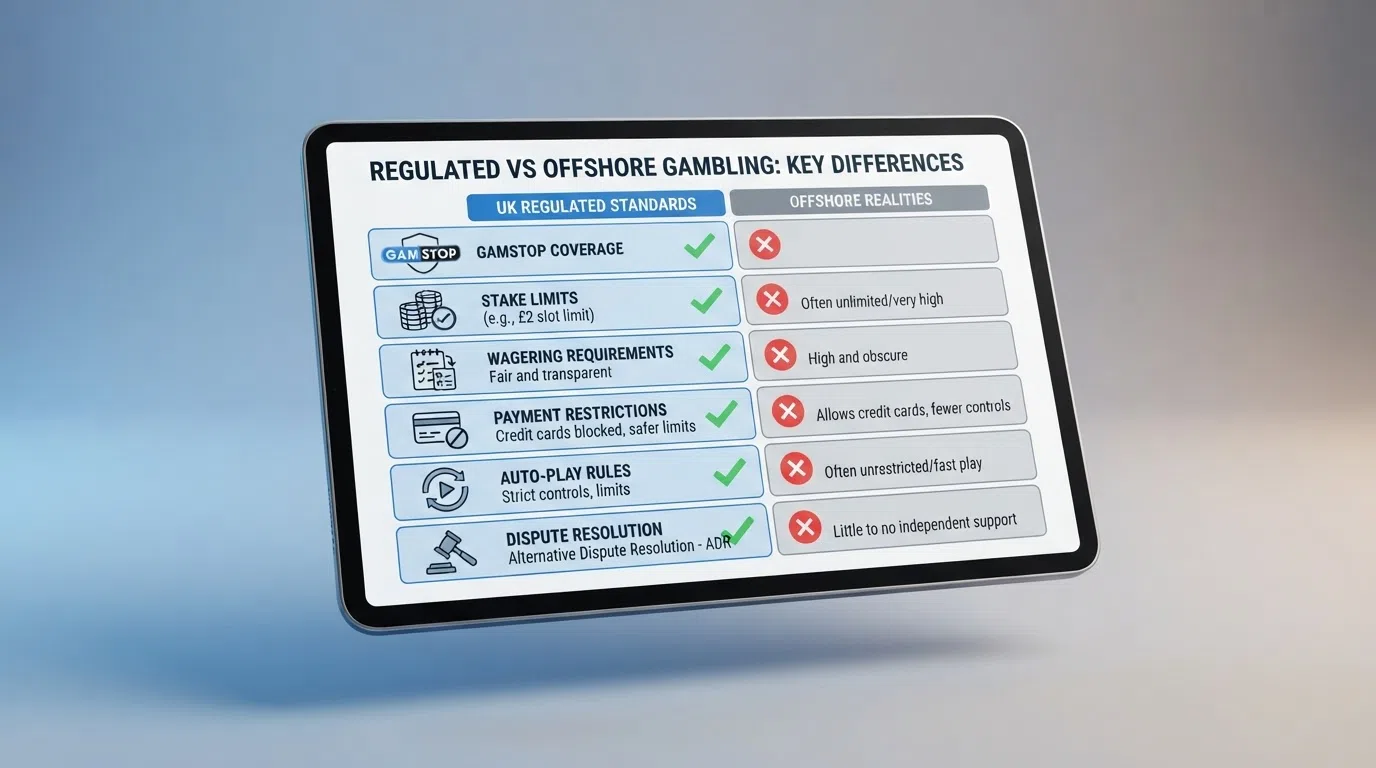
| Protection | UKGC-Licensed Casino | Non UKGC Casino Reality |
|---|---|---|
| GAMSTOP self-exclusion | Mandatory since 31 March 2020 | Not integrated; player not blocked |
| Slot stake cap | £5 per cycle (25+) / £2 (18–24) | No UK-mandated cap |
| Wagering requirement cap | 10× from 19 January 2026 | 30–50× typical; some no-deposit bonuses higher |
| Credit card payments | Banned since 14 April 2020 | Widely accepted |
| Auto-play / spin speed | Auto-play banned; 2.5s minimum spin | Not restricted |
| Financial vulnerability checks | Mandatory at £150 net deposits (30-day) | Not required |
| Approved ADR (IBAS, eCOGRA) | Available | No UKGC-approved equivalent at Curaçao, Costa Rica, Anjouan |
| Reverse withdrawals | Permanently banned | Permitted at many offshore sites |
| Losses disguised as wins | Banned | Not restricted |
The expected cost of clearing the bonus is where the trade-off becomes arithmetic. Using the prescribed calculation: a representative first-deposit bonus of £200 at A £1,000 deposit at 150 per cent means a £1,500 bonus, for £2,500 of combined funds. At 30×, the turnover requirement is £75,000. At a 96.21 per cent RTP (Book of Dead), the expected loss on that turnover is £2,842.50. The same £200 bonus at a UKGC-licensed casino would be impossible — UKGC wagering caps at 10× on bonus only, meaning the operator would carry roughly £2,000 of turnover at a similar slot RTP, an expected loss of £75.60. The offshore route more than triples the expected cost of clearing the same headline bonus. That figure is an estimate over many spins; it is not a guaranteed outcome.
A player with a small bankroll pays the difference in full. A player with a large bankroll sees the same trade-off but with more room to absorb the variance. The wagering cap is the single largest protection gap, and it is the one a marketing headline most often disguises.
The UKGC Protection Checklist — What You Leave Behind
Every safeguard in the table above is a UKGC licence condition that binds operators day-to-day. GAMSTOP integration is mandatory for every online licensee since 31 March 2020, and the integration is what makes the self-exclusion register work. The £5/£2 slot stake cap binds slot games specifically, with the age band making the £2 limit a sharper guardrail for younger adults. The 10× wagering cap, in force since January 2026, applies to bonus funds and sits in LCCP Social Responsibility Code 5.1.1. The credit card ban, in force since April 2020, extends to credit-card-funded e-wallet deposits, not just direct card charges.
The product-level protections matter as well. Auto-play is banned at UKGC sites. Spin speed may not be faster than 2.5 seconds per game cycle. Losses disguised as wins — slot animations that celebrate a net-loss spin as if it were a win — are banned. Reverse withdrawals — the option to cancel a withdrawal request and return the balance to play — are permanently banned. Each of these restrictions shapes how a slot session feels and how easy it is to keep playing past the point a player intended to stop. At a non UKGC casino, none of them apply.
The financial checks are newer and worth understanding on their own terms. From 28 February 2025, financial vulnerability checks are mandatory at a £150 net deposit threshold across a rolling 30-day period, using publicly available data only — bankruptcy orders, county court judgments, high-court judgments, individual voluntary arrangements, debt relief orders. These are not credit checks in the consumer sense; they are public-register screens. A player who has been through an IVA or has an unpaid CCJ gets a friction point at £150 that they would not get at an offshore casino.
Financial risk assessments — the next stage of affordability checking — are not yet in force. The Commission announced a staged rollout with thresholds starting at £5,000 in 24 hours for players 25 and over (£2,500 for under-25s) and final thresholds of £1,000/£3,000 and £750/£2,000, but the start date has not been confirmed. When these come into force, UKGC operators will carry the most granular affordability regime of any regulated gambling market. Non UKGC casinos will not.
What Offshore Casinos Offer Instead — the Trade-Off in Numbers
The freedoms non UKGC casinos provide are real, and they are why UK players seek these sites out in 2026. No stake cap means a player running £20 or £50 spins is not artificially constrained — though the RTP on the slot is the same, so higher turnover means higher expected loss. Bonuses of 150 to 450 per cent with 30 to 50× wagering dwarf what UKGC operators can offer under the 10× cap. Crypto deposits and withdrawals with no KYC at some operators are a real convenience for a player who already holds crypto.
No GAMSTOP means a self-excluded player can still gamble, which the section below treats as a danger rather than a feature. No approved ADR means a player with a complaint about withheld funds has no escalation route to a UK consumer body. No UKGC-mandated deposit limit prompts or financial vulnerability checks means fewer friction points at the deposit screen. The freedoms and the protections trade off against each other, and a player choosing offshore is choosing the first set over the second.
The Dispute Resolution Gap — Who Helps When Something Goes Wrong
At a UKGC-licensed casino, disputes go to an approved ADR provider. IBAS (Independent Betting Adjudication Service) and eCOGRA both handle cases under the Commission’s framework, and the rulings are binding on the operator. The process is structured, published, and enforceable in UK law.
At a non UKGC casino, the picture fragments by jurisdiction. MGA’s Player Support Unit handles complaints at Maltese-licensed casinos and publishes decisions, which gives an MGA-licensed brand a real dispute resolution path even outside UKGC. Curaçao GCB has its own complaints process, narrower and slower than the MGA’s. Anjouan has no equivalent. Costa Rica has no regulator at all.
BC Game’s history illustrates what happens when an offshore operator goes bad with no ADR backstop. The platform’s bankruptcy ruling over approximately $2.5 million in unpaid player claims is under appeal, but the underlying fact is that a player whose funds were withheld at an Anjouan-licensed casino has nowhere to escalate beyond the operator itself and a regulator with limited enforcement capacity. At a UKGC casino, the same situation would have reached IBAS and produced a binding decision. At an MGA casino, the Player Support Unit would have intervened.
If a non UKGC casino refuses to pay a withdrawal, the practical steps are: document everything (screenshots, transaction IDs, terms in force at the time), file a written complaint with the operator through its official complaints route, escalate to the licensing regulator (CGA portal for Curaçao, MGA for Malta, the Anjouan regulator where applicable), and consider chargeback through the payment provider if the deposit was made by card. None of these routes produces a guaranteed outcome, and a chargeback through a card issuer can itself result in the account being closed for bonus abuse. The absence of a UK consumer body that can compel payment is the structural gap.
GamStop Stops at the UK Border — What That Means If You’ve Self-Excluded
GAMSTOP is the UK’s national multi-operator online self-exclusion scheme. It has been mandatory for every UKGC online licensee since 31 March 2020, and the integration is a standard licence condition. A casino cannot hold a UKGC licence and accept a GamStop-registered player. That sentence, taken from a community resource on the integration, is the rule in plain language.

How GamStop Self-Exclusion Actually Works
Registration on GAMSTOP blocks a person from every GB-licensed online gambling site for the period they select. The options are six months, one year, five years, or five years with auto-renewal. The exclusion cannot be cancelled early — the period runs its full course, and the player cannot log in, deposit, or play at any UKGC online casino for the duration.
The scheme is operator-funded rather than state-funded, and it covers every UKGC online licensee as a condition of holding the licence. It does not cover land-based venues (those use MOSES and individual venue self-exclusion), it does not cover lottery products or scratchcards, and — most relevantly for this page — it does not cover non UKGC casinos.
Why Non UKGC Casinos Sit Outside GamStop — and the Risk That Creates
GAMSTOP is a UKGC licence condition. Operators without a UKGC licence have no obligation to integrate, and there is no technical mechanism by which a non UKGC casino could see a player’s GAMSTOP registration even if it wanted to. The exclusion register is held within the UKGC’s framework; a casino outside that framework is not part of the data flow.
For a player who self-excluded because of gambling harm, this gap is not a feature to exploit. It is a doorway back into the behaviour they asked to be locked out of, without any of the friction points a UKGC operator would impose. No deposit limit prompts, no reality checks, no financial vulnerability screening at £150, no UKGC complaints route if the operator behaves badly. The section is included because players searching for non UKGC casinos include some who registered on GAMSTOP and are now looking for sites outside it. The honest framing is that this is a risk, not a workaround.
Blocking Tools That Work on Offshore Sites
Three categories of tool reach offshore sites where GAMSTOP does not.
Device-level blocking software covers offshore gambling sites as well as UKGC ones. GamBan and BetBlocker are the two most-used services in the UK, and both offer paid and free tiers. They block access at the device level by maintaining a list of gambling domains and IP ranges, and they cover thousands of offshore casino URLs without needing a separate integration per operator. The limitation is that device-level blocks can be uninstalled by a determined user.
Bank gambling blocks stop transactions at the bank level. UK banks including Barclays, HSBC, Lloyds, Monzo, Starling and most others offer gambling transaction blocks through their app or online banking. The block prevents card payments to gambling merchants regardless of whether the operator is UKGC-licensed or offshore. The limitation is that the block stops card payments specifically — it does not stop crypto deposits, and it does not stop someone using a different bank account.
Voluntary deposit limits at offshore casinos are a third route, where the operator offers them. Some MGA-licensed casinos provide deposit limits, time-outs, and self-exclusion tools that mirror UKGC features. These are operator-voluntary, not regulator-mandated at the Curaçao level, so availability and reliability depend on the brand. A player who wants a deposit limit at a non UKGC casino should check the responsible-gambling page before depositing, and should treat the operator’s voluntary tool as a soft commitment rather than a binding one.
Staying in Control: Responsible Gambling Tools That Work Without the UKGC
The UKGC’s protections do not reach offshore sites, but the UK’s help infrastructure does.
Where to Get Help — the Numbers and the Resources
The National Gambling Helpline, operated by GamCare, is available 24 hours a day, every day of the year, on 0808 8020 133. The line is accessible by phone, live chat and WhatsApp. In January 2026, GamCare made 996 referrals to treatment and peer-based support services — a 48 per cent increase from the 674 referrals recorded in January 2025.
GambleAware’s Annual Treatment and Support Survey gives the prevalence numbers that explain the demand. 13.1 per cent of adults who gambled in Great Britain were classified as experiencing any level of gambling problems (PGSI 1+), equivalent to approximately 6.8 million GB adults. Among those with problems, 30 per cent want treatment, support or advice — nearly double the 17 per cent recorded in 2020. An estimated 4.3 million adults in Great Britain are affected by a family member’s or friend’s gambling.
NHS gambling harm clinics operate in England, Scotland and Wales. The clinics provide cognitive behavioural therapy and specialist support for problem gambling, with referral routes through GP practices and self-referral through the NHS. In England, approximately 1.6 million adults who gamble may benefit from treatment or support; roughly 0.5 per cent of the adult English population experience problem gambling at the threshold the NHS clinics are designed to address. Gamblers Anonymous runs peer support groups across Great Britain.
The funding for these services changed in April 2025. The UK statutory gambling levy replaced voluntary operator contributions at 1.1 per cent of gross gambling yield for remote casino licences, split 50 per cent to treatment, 30 per cent to prevention, and 20 per cent to research. The levy is paid by UKGC-licensed operators only — offshore casinos serving UK players do not contribute, and the treatment pipeline they can refer a player into is the same one UKGC operators help fund.
Tools That Work Even When the UKGC Does Not
The practical toolkit for a UK player at a non UKGC casino is the same one used at any other site, with the caveat that operator-level tools are voluntary offshore.
Device-level blocking software (GamBan, BetBlocker) covers offshore sites and is the most reliable single tool a player can install. Bank gambling blocks stop card payments regardless of operator jurisdiction, and they work even at crypto-friendly casinos when the deposit route is a card. Voluntary deposit limits set with the offshore operator are worth requesting but not worth relying on without a backup. Reality checks and session timers — the kind a UKGC operator pushes to the player every 30 minutes — are absent at most non UKGC sites.
GAMSTOP alone is not enough if a player also plays offshore. The register covers UKGC-licensed sites only, and a player who has excluded through GAMSTOP and then plays at a non UKGC casino has no second layer of protection from the scheme. The combination of GAMSTOP for UKGC sites, device-level blocking for offshore sites, and a bank gambling block for card-based deposits is the most complete barrier a UK player can build — and even that barrier can be circumvented by a determined user with access to crypto and a different device. The honest framing is that no toolchain is foolproof; the goal is to raise the cost of acting on impulse.
How We Selected and Ranked Every Operator on This Page
The operators on this page were identified from the top search results for non UKGC casino queries across affiliate and review domains. The selection criterion was simple: which brands appear most frequently as recommended non UKGC casinos accepting UK players. Eight of the top ten search results were listicle pages from affiliate sites, and the brands recurring across them became the candidate set.
Each operator’s licence jurisdiction was taken from operator footer disclosures and affiliate sources. For most brands, the licence was not verified against the regulator’s own register during this run — the Curaçao CGA portal at portal.cga.cw and the MGA register are where verification happens, and a player should run that check themselves before depositing. The UKGC’s public register (last updated 29 July 2026, 2,663 records) was confirmed as the route for checking UKGC-licensed status, and none of the operators on this page appear there. That is the page’s defining characteristic: every operator is non UKGC by construction.
The evaluation criteria, applied consistently across the ten brands: licence quality (jurisdiction and regulatory framework), bonus terms (wagering multiplier, validity window, max bet cap, free spin conditions), game provider breadth (the number and quality of studios integrated), UK player accessibility (whether the operator accepts GBP and serves the UK market), and documented player feedback (Trustpilot scores, forum threads, Casino Guru profiles where available).
What this page does not do is also worth stating. It does not endorse any operator. It does not promote GAMSTOP circumvention. It does not rank operators by affiliate commission. The ranking order reflects the frequency of each brand’s appearance across these affiliate and review sites and the spread of licensing jurisdictions represented, not payment from any operator. A player reading the page should treat each operator write-up as a starting point for their own check rather than a verdict.
Is Playing Offshore Worth the Trade-Off? What the Numbers Say
The honest answer depends on what a player is looking for. The bonus difference is real: a UKGC 10×-capped bonus on a smaller headline figure versus a non UKGC 30–50× bonus on a much larger one. The expected cost of clearing the bonus follows from there. A £200 bonus at 30× combined wagering at a 96.21 per cent RTP produces roughly £227 of expected loss, while the same £200 bonus at a UKGC site’s 10× on bonus only produces roughly £76 of expected loss under similar RTP assumptions. The offshore route more than triples the cost of clearing the same nominal bonus. That figure is a statistical estimate over many spins — it is not a guaranteed outcome for any single session.
The stake-cap difference matters for high-stakes slot players. A player running £20 or £50 spins at a UKGC site is constrained by the £5 (25+) or £2 (18–24) cap. At a non UKGC casino, no cap applies, and the RTP on the slot is the same. Higher stake means higher turnover, and higher turnover at the same RTP means higher expected loss. The freedom to spin at £50 is a real feature; the cost is a real cost.
The dispute-resolution gap is structural. At a UKGC casino, a player has IBAS, eCOGRA, and the Commission. At an MGA casino, the Player Support Unit. At a Curaçao casino, the regulator’s narrower complaints process. At a Costa Rica or Anjouan casino, no equivalent. The expected value of “something goes wrong” depends entirely on which of these applies.
The GAMSTOP gap is the one that has to be stated without softening. A player who self-excluded because of gambling harm has unrestricted access to every non UKGC casino, because GAMSTOP is a UKGC licence condition and non UKGC casinos have no obligation to integrate. For that player, the answer to whether offshore is worth it is no, and the resources below are the ones to use instead.
For a player who has not self-excluded and accepts the trade-off, the practical answer runs through five steps. Verify the licence on the regulator’s own portal. Read the terms in full before depositing — wagering, validity, max bet, free-spin conditions, and any cashout caps on bonus winnings. Test withdrawal speed with a minimum deposit before committing larger sums. Set a deposit limit voluntarily if the operator offers one, and back it up with a bank gambling block. Know who to call if it goes wrong: the National Gambling Helpline on 0808 8020 133, available 24/7 through GamCare.
The trade-off is the page’s subject, and the page’s conclusion is that the trade-off is real on both sides. The freedom is real. The cost of clearing a 30× bonus instead of a 10× bonus is real. The absence of a UK consumer body that can compel payment is real. The gap between what a UKGC casino offers and what an offshore casino offers is exactly as wide as the column headings in the comparison table suggest, and a player who reads both sides of that gap before depositing is making the choice with their eyes open.
Frequently Asked Questions
How do I verify whether an offshore casino holds a genuine licence?
Check the licence against the regulator’s own public register. For Curaçao, the Gaming Authority portal at portal.cga.cw lists active licensees by entity name. For Malta, the MGA register shows current B2C licences. The operator’s footer should name the licence number and the registered entity — if the number does not appear in the regulator’s register, the claim is hollow. The UKGC’s own register at gamblingcommission.gov.uk is the check for whether the operator also holds a GB licence (none on this page does).
Do non UKGC casinos accept UK payment methods like debit cards and PayPal?
Most accept Visa and Mastercard debit cards. PayPal is less common offshore — PayPal’s own terms restrict its use to licensed gambling operators in approved jurisdictions, so it rarely appears at non UKGC casinos. E-wallets (Skrill, Neteller, MuchBetter) are widely supported, though some bonuses exclude Skrill and Neteller deposits specifically. Crypto (Bitcoin, Ethereum, Tether and others) is supported at a growing share of offshore brands, with the crypto-native platforms like BC Game accepting 150-plus coins. The credit card ban at UKGC sites does not apply offshore — many non UKGC casinos still accept credit cards, which is part of why the UKGC banned them in the first place.
What is the safest offshore licence for UK players — MGA, Curaçao or Gibraltar?
The Malta Gaming Authority sits at the top by a clear margin. The MGA’s independent Player Support Unit handles disputes and publishes decisions, and the regulator’s anti-money-laundering and responsible-gambling standards are EU-grade. Gibraltar is comparable in regulatory credibility, with a strong remote-gambling framework and UK-level credibility, though fewer MGA-licensed casinos actively target UK players. Curaçao has improved under the 2024–2025 LOK reform with direct licensing and local-substance requirements, but it remains lighter-touch than MGA or UKGC and has no equivalent to the Player Support Unit. Costa Rica and Anjouan are at the bottom — Costa Rica has no formal gambling licence at all, and Anjouan has minimal enforcement capacity.
Are winnings from non UKGC casinos taxable in the UK?
No. Player gambling winnings in the UK are not taxable, regardless of whether the casino holds a UKGC licence or operates offshore. The betting duty was abolished in 2001, and the burden sits entirely on operators through Remote Gaming Duty. A British player who wins at a Curaçao casino keeps the full amount. The position is the same whether the operator is licensed in Malta, Gibraltar, Curaçao, Costa Rica or Anjouan. Tax treatment is one constant the licence jurisdiction does not affect.
What should I do if a non UKGC casino refuses to pay my withdrawal?
Document everything first — screenshots of the withdrawal request, transaction IDs, the bonus terms in force at the time of deposit, and any chat or email correspondence with support. File a written complaint with the operator through its official complaints route and keep the written record. If the operator does not resolve the issue, escalate to the licensing regulator: the Curaçao Gaming Authority for Curaçao-licensed brands, the MGA Player Support Unit for Maltese brands, the Anjouan regulator where applicable. Costa Rica has no regulator to escalate to. If the deposit was made by card, a chargeback through the card issuer is a last resort — it can result in the account being closed and bonus winnings being confiscated. None of these routes guarantees a payout, and a UKGC ADR route does not exist for offshore brands.
Licence – nominimumdeposit-casinos-uk
Content created by the «nominimumdeposit-casinos-uk» team