
Safe Online Casinos in the UK: What Actually Protects You
 Available in GB
A British player asking whether an online casino is safe is asking the wrong question, and the regulator has known it for a decade. The real question is whether a casino is *licensed*, because every other safety claim — encrypted payments, segregated funds, audited games, a working complaints route, a self-exclusion register that actually blocks you — follows from that single fact or it does not exist. The UK Gambling Commission is the only body that can grant a Great Britain operating licence, and the public register it publishes is the only place a licence can be verified. The register held 2,666 licensed business entries when it was last updated on 29 July 2026, and every casino reviewed on this page sits on it as Active.
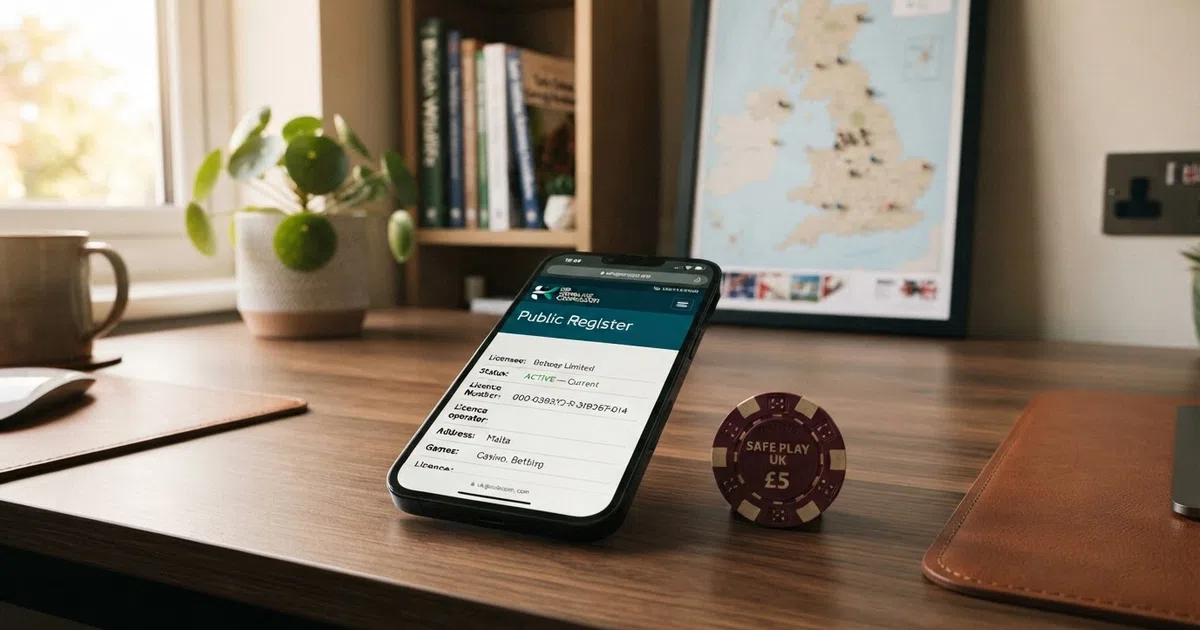
What the register does not tell you is whether a casino is *good*. A licence is the floor: the casino has passed the fit-and-proper test, holds player funds to a defined standard, and submits to day-to-day oversight through the Licence Conditions and Codes of Practice. Everything else — bonus fairness, payout speed, support quality, the prominence of the safer-gambling tools — is an operator choice made on top of that floor. The aim of this page is to walk through what the licence actually buys a player, what it does not, and how the ten UKGC-licensed operators on the ranking below compare once the licence badge is taken as given.
*Data current as of September 8, 2026; UKGC licence status verified against the public register (gamblingcommission.gov.uk/public-register/businesses), last updated 29 July 2026.*
What a Safe Online Casino Actually Means in the UK
A safe UK casino has five things in place, and the first is non-negotiable. The UK Gambling Commission is the single statutory regulator under the Gambling Act 2005, extended by the Gambling (Licensing and Advertising) Act 2014 to require a GB licence for any operator serving British customers regardless of where the operator is based. That licence is the gateway: without it, the operator is committing a criminal offence under section 33 of the Act, and a player at such a site loses every protection this page talks about.
The second layer is encryption, and the standard is uniform across the licensed market. Every transaction between a player’s browser or app and the operator’s server runs over TLS, the same protocol that secures online banking. This is not a marketing claim a casino gets to make on its own; the Remote Technical Standards (RTS) that sit beneath every operating licence require it, and the operator is audited against them.
Third, the games are fair because the random number generators and payout percentages have been independently tested. UKGC-licensed casinos must use laboratories approved by the Commission — eCOGRA, Gaming Laboratories International, and iTech Labs are the three named in the regulatory guidance — and the tests cover RNG analysis, return-to-player verification, source-code review, and jurisdictional compliance. A player can trust the published RTP because the lab has run the maths.
Fourth, player funds are segregated from operator funds to a defined standard. The Commission grades this protection as medium: the operator must keep customer money in a separate account and make provisions for it in the event of insolvency, but it is not a trust in the full legal sense. The standard is enough to put player cash ahead of unsecured creditors if the operator goes under; it is not enough to guarantee a payout in every collapse scenario.
Fifth, the responsible-gambling infrastructure is mandatory, not optional. Identity verification must complete before the first deposit — the 72-hour grace period that existed before 7 May 2019 is gone. Credit cards cannot be used to fund a remote gambling account, a ban that has been in force since 14 April 2020 and extends to credit-card-funded e-wallet payments through PayPal, Skrill, or Neteller. GAMSTOP self-exclusion has been a condition of every online operating licence since 31 March 2020. The financial vulnerability check at a £150 net deposit in a rolling 30-day period (in force 28 February 2025) and the mandatory deposit-limit prompt at first deposit (in force 31 October 2025) are recent additions, and from 30 September 2026 the term “deposit limit” can only refer to a gross deposit figure.
“Safe” vs “Licensed” — The Distinction Every UK Player Should Know
A UKGC licence confirms a casino is operating legally in Great Britain, has met the fit-and-proper test, segregates player funds to the required standard, and submits to ongoing regulatory oversight. That is the legal floor. Safety, in the everyday sense a player means it, is the layer above: fair bonus terms, fast payouts, responsive support, accessible safer-gambling tools, and a reputation that survives contact with the customer.
The confusion is forgivable because the two words are used interchangeably in marketing, and because the UKGC register does not rank operators on quality. It tells a player whether a casino is licensed, the licence type, the status (Active, Surrendered, Lapsed), and the account holder. It does not tell a player whether the welcome bonus has a wagering cap that costs the realistic value of the offer, whether the support team answers emails within hours, or whether the deposit-limit tool is buried three menus deep. Those are choices the operator makes, and the operator list on this page has been ranked on them.
The register is still the right place to start. The Commission’s published register is searchable by business name, trading name, domain name, or account number, and the entry must read “Active — Current” with a licence type that includes Casino Remote. A licence is necessary; it is not sufficient.
The UK Player-Protection Machine — What Runs Behind Every Licensed Casino
Five mandatory systems run beneath every UKGC-licensed casino, and a player does not have to opt into any of them — they are the conditions of holding the licence.
Identity verification happens first. The casino must verify the customer’s name, address, and date of birth before the first deposit, and the verification must complete before any gambling is permitted. This is a meaningful change from the pre-2019 arrangement, when a customer could register, deposit, and play for up to 72 hours before submitting documents. That grace period ended on 7 May 2019, and any UK-licensed casino that lets a player deposit before completing verification is in breach.
Player funds are held to a defined protection standard, graded by the Commission as medium. The operator must keep customer balances in a separate account from its own operating funds, and the licence conditions set out the insolvency provisions that apply. It is not a trust in the strict legal sense — the player’s money is not ringfenced by statute in the way it would be at a solicitor’s client account — but it places customer cash ahead of unsecured creditors in a collapse.
ADR is mandatory. The operator must name an Alternative Dispute Resolution provider — IBAS is the most common — and a player who cannot resolve a complaint with the operator directly can take it to the ADR. The Commission’s published register of alternative dispute resolution providers lists those it has approved.
Deposit limits are prompted, not assumed. From 31 October 2025 the operator must offer a financial limit before the first deposit, and a decrease request must be actioned immediately. From 30 September 2026 only a “gross deposit limit” — money paid into the account over a set period, with no netting against withdrawals — can carry that label. The state does not set the amount; it requires the offer and the immediate action on a reduction.
Reality checks and time-outs are operator-side tools that sit behind the safer-gambling section of every licensed site, and the LCCP sets the minimum standards for their prominence and behaviour.
Can You Play for Real Money and Stay Safe? Yes — Here Is Why
Real-money play at a UKGC-licensed casino is the most heavily regulated form of online gambling available to a British adult, and the framework that protects the player is unusual in three ways.
The first is the stake cap on online slots, a feature no other major market replicates. A player aged 25 or over can stake a maximum of £5 per game cycle on an online slot; a player aged 18 to 24 is capped at £2. The cap is statutory, imposed by SI 2025/215 attaching a new condition to every remote casino operating licence, and it applies to the total staked within a single game cycle. It does not apply to roulette, blackjack, live casino, bingo, or sports betting — the cap is on slots specifically because that is where the Commission’s evidence of harm was strongest.
The second is the deposit-limit prompt. Britain does not impose a state-set deposit ceiling; it requires the operator to ask the player what limit they want, action any decrease immediately, and standardise the terminology so that from 30 September 2026 a “deposit limit” is unambiguously gross. The amount stays with the player.
The third is GAMSTOP. The self-exclusion register is mandatory on every UKGC online licence, the exclusion periods run from six months to five years (with a five-year auto-renewal option), registration cannot be cancelled early, and the exclusion continues for up to seven years after expiry if not actively ended. GAMSTOP does not reach unlicensed sites, which is the next point.
The UK Gambling Commission — Your Single Safety Net
The UK Gambling Commission is an executive non-departmental public body sponsored by the Department for Culture, Media and Sport, set up under the Gambling Act 2005 to license operators, license personnel, and license software in Great Britain. It is the only body that can grant a GB remote casino operating licence, and a licence from any other jurisdiction — Malta, Curaçao, Gibraltar — is not a substitute. The 2014 Act made a GB licence compulsory at the point of consumption: any operator serving British customers, wherever the operator is based, must hold one.

The Commission operates against three statutory objectives set out in section 1 of the Gambling Act 2005: preventing gambling from being a source of crime or disorder, ensuring gambling is conducted fairly and openly, and protecting children and other vulnerable persons from harm. Those three lines are the test the Commission applies to every licensing decision, every enforcement action, and every change to the LCCP and the Remote Technical Standards.
The public register is the Commission’s most useful tool for a player. It is searchable at gamblingcommission.gov.uk/public-register/businesses, and the most recent update was 29 July 2026, when it held 2,666 licensed business entries. A search by domain name returns the licence holder, the account number, the licence type, the status, and the trading name. The status must read Active — Current, and the licence type must include Casino Remote for an online casino to be operating legally. The Commission is the single source of truth on this; a casino that claims to be UKGC-licensed but does not appear on the register is not.
UKGC Licensing — What It Covers and How to Verify a Casino in Two Minutes
The verification is a four-field check, and it takes about two minutes from a browser. The starting point is gamblingcommission.gov.uk/public-register/businesses.
The first field is the domain name. Type the URL the player intends to use — the one they would type into a browser, without the protocol. The register returns the licence holder’s business name, the account number, the trading name (which may be different from the domain), and the licence type and status. If the domain does not return a result, the casino is not licensed under that address, and the player should not deposit.
The second check is the trading name. A casino can operate under a trading name that is different from the corporate licence holder — for example, the account number 39225 is held by WHG (International) Limited, which trades as William Hill. The register displays both, and a player who sees the corporate name but not the trading name they expected should be cautious.
The third check is the status. The register lists licences as Active — Current, Active — Surrendered, Lapsed, or Revoked. Anything other than Active — Current means the licence is not in force, and the player should treat the casino as unlicensed.
The fourth check is the licence type. For an online casino this must include Casino Remote. A bookmaker’s licence alone does not cover casino games; a bingo licence does not cover slots. The licence type tells the player what the operator is permitted to do.
Two minutes. Four fields. The single most valuable habit a British player can build.
Licensed vs Regulated — The Practical Difference for Your Money
A licence permits an operator to run; regulation is the ongoing supervision that keeps the operation within the rules. The distinction matters because the Commission’s day-to-day work happens in the Licence Conditions and Codes of Practice and the Remote Technical Standards, not in the licence grant itself.
The LCCP and the RTS are the operator’s rulebook. The LCCP sets conduct obligations — social responsibility codes on advertising, bonus terms, player interaction, self-exclusion. The RTS sets technical obligations — RNG and RTP testing, encryption standards, game-cycle definitions, staking and payout mechanics. An operator that breaches either is subject to enforcement, which for the Commission means disruption rather than blocking.
The published enforcement data for April 2024 to June 2025 is the most complete picture of how this works in practice: 3,140 disruption notices issued, 447,778 URLs referred to search engines, 287,961 URLs removed, and an average 32% fall in engagement across 160 disrupted sites. The Commission has no statutory power to compel an ISP to block a site; the lever is the search engine, the domain registrar, and the payment provider, and the lever is pulled when an unlicensed operator is found serving British customers. The player sees the result as a delisted site, not a blocked one.
The figure that matters to a player is the 32% engagement drop across 160 sites. Disruption works. It is not the same as blocking, and an unlicensed site can still load in a browser; it is just harder to find and harder to pay at. The reason a player can trust a UKGC-licensed casino is not the licence badge alone — it is the regime that audits, inspects, and enforces the rules every day the licence is held.
What the UK Market Prohibits — The Caps and Bans That Define Safe Play
| Restriction | Effective Date | What It Means for Players | Applies To |
|---|---|---|---|
| Online slots stake cap: £5 (25+) / £2 (18–24) per game cycle | 9 Apr 2025 / 21 May 2025 | Maximum stake per spin cycle, age-banded | Online slots only |
| Credit card gambling ban | 14 Apr 2020 | No credit card deposit; extends to credit-card-funded e-wallets | All remote gambling |
| Wagering requirements capped at 10× | 19 Dec 2025 | Maximum 10× wagering on any bonus; mixed-product bonuses banned | All licensed bonuses |
| Auto-play banned | 31 Oct 2021 | No automatic spinning on slots | Online slots |
| Minimum spin speed 2.5 seconds | 31 Oct 2021 | Each game cycle takes at least 2.5 seconds | Online slots |
| Speed-up features banned | 31 Oct 2021 | No turbo or quick-spin modes | Online slots |
| Losses disguised as wins banned | 31 Oct 2021 | Slot UI cannot show win animations on net losses | Online slots |
| Reverse withdrawals banned | 31 Oct 2021 | Cannot cancel a withdrawal to keep playing | All licensed casinos |
| Identity verification before first deposit | 7 May 2019 | No anonymous play; KYC must complete before gambling | All licensed casinos |
| Direct marketing opt-in per product and channel | 1 May 2025 | Unticked opt-in boxes; cross-selling requires actual consent | All licensed casinos |
| GAMSTOP self-exclusion mandatory | 31 Mar 2020 | Self-exclusion register binding on all licensed operators | All online operators |
| Financial vulnerability check at £150 net deposit | 28 Feb 2025 | Public-data check for CCJs, IVAs, bankruptcy, DROs | All licensed casinos |
| Deposit-limit prompt at first deposit | 31 Oct 2025 | Operator must offer a financial limit before first deposit | All licensed casinos |
| Gross deposit limit terminology | 30 Sep 2026 | Only a “gross deposit” figure may carry the “deposit limit” label | All licensed casinos |
The first three rows are the safety story. The £5/£2 stake cap is the single most distinctive British regulatory feature in online gambling; no other major market sets a per-spin ceiling by age. The credit card ban shut off the route by which problem gambling was most directly funded by debt. The 10× wagering cap is the youngest of the three and the one that has reshaped the welcome offers on this page most visibly.
The remaining rows are the design rules and the player-protection mechanics. The 2021 package — auto-play, 2.5s spin speed, no speed-up, no losses-disguised-as-wins, no reverse withdrawals — is the set of rules that slowed the slot experience down and stopped the tricks the UI used to dress up a loss. Reverse withdrawals are the one that matters most for the player’s bankroll: before 31 October 2021 a player could cancel a pending withdrawal and put the money back into play, and the ban is permanent.
How to Verify a UK Casino in Five Minutes
A repeatable check a player can run before depositing, ordered from fastest to most thorough.
The UKGC register. Type the domain into the search at gamblingcommission.gov.uk/public-register/businesses. The result must show a licence type that includes Casino Remote and a status of Active — Current. Anything else, and the player walks away. The register was last updated on 29 July 2026; if a search returns no result, the domain is not licensed.
Match the trading name and the licence holder. The register shows the corporate account holder and the trading name separately. A casino that calls itself one thing in marketing but is operated by a different corporate name is not automatically suspect — group structures are common — but the player should be able to see the match.
Read the bonus terms for the wagering multiple. Since 19 December 2025 the maximum wagering requirement at a UK-licensed casino is 10×. A bonus with a wagering multiple above 10× is not compliant with the LCCP, and a casino offering one is either unlicensed or in breach. The audit on this page is simple: any number over 10× is a red flag.
Check the payment methods. A UK-licensed casino cannot accept credit cards, including credit-card-funded e-wallets. A casino that offers credit card deposits, or that processes a credit card through an e-wallet, is in breach. Cryptocurrency is a different case: no UKGC-licensed casino accepts it, so the presence of a crypto deposit option is also a sign the operator is not what it claims to be.
Look for the safer-gambling section. Every licensed casino must surface GAMSTOP, deposit limits, time-outs, and reality checks, and must give the player access to the safer-gambling section from the main navigation. A casino that buries these tools is not failing the test outright, but it is signalling that the licence is a checkbox rather than a working framework.
Red Flags That Mean Walk Away — Every Time
Six signs that a casino is unlicensed or unsafe, even when the website looks legitimate.
No UKGC badge or licence number in the footer. A licensed casino displays its licence number and a link to the register entry. The absence of either is the first thing a player should look for.
Credit card or cryptocurrency accepted. Both are unavailable at every UKGC-licensed casino. The credit card ban has been in force since April 2020, and no licensed operator accepts crypto. A deposit page that offers either is showing the player a casino that is not licensed for the British market.
No GAMSTOP registration. A licensed casino must offer GAMSTOP self-exclusion, and a player who tries to register with GAMSTOP should find the casino listed. A casino not on GAMSTOP is unlicensed.
Bonus terms above 10× wagering. The 10× cap is the regulatory ceiling. A bonus that demands 30×, 40×, or 50× wagering is either from before the cap or from a casino that is not subject to it. The cap has been in force since 19 December 2025.
Play before identity verification. The pre-2019 grace period is gone. A casino that lets a player register, deposit, and play before completing KYC is in breach of the conditions of its operating licence.
No ADR provider named. Every licensed casino must name an Alternative Dispute Resolution provider — IBAS is the common one. The absence of one means a player with a complaint has nowhere to take it through the licensed route.
“Are Online Casinos Safe?” — The UK Answer to the Question Every Beginner Asks
The short answer is yes, provided the casino is UKGC-licensed. The long answer is the rest of this page, but the reason the question exists at all is worth pausing on. Offshore operators advertise in the UK through search results, social media, and affiliate sites that look identical to the licensed ones. Crypto casinos promise anonymity and “no verification” and a “no KYC” experience that sounds modern but is also no protection. Horror stories from players who used offshore sites and could not withdraw their money do the rounds in forums. The reason a British player can ignore all of that is the UKGC register, and the verification check takes two minutes.
The question is the right one to ask. The answer is in the register.
10 UK-Licensed Casinos Ranked by Safety, Not Just Welcome Offers
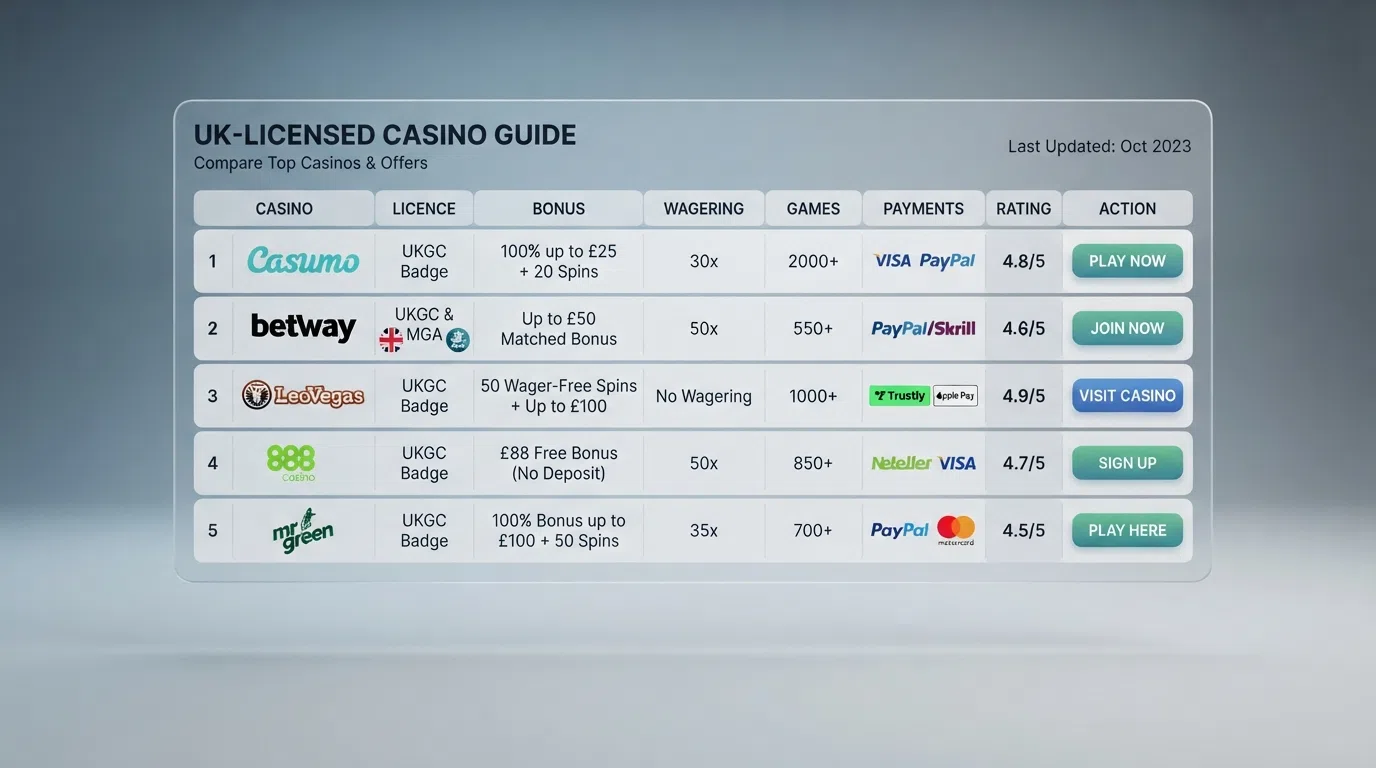
Every operator below holds an active UKGC remote casino licence, confirmed against the public register on 29 July 2026. The ranking prioritises bonus fairness — wagering multiple, transparency of terms, presence of a maximum cashout cap — over the raw headline value of the welcome offer. Responsible-gambling tool prominence and the breadth of the game provider mix are the secondary axes. The structure of UK welcome offers in 2026 is dominated by wager-free free spins, and the table reflects that: seven of ten operators list 0× wagering, with the three remaining offers running at the 10× regulatory cap or above.
| Operator | UKGC Licence Status | Welcome Offer | Wagering Multiplier | Bonus Validity | Game Providers |
|---|---|---|---|---|---|
| Bet365 | Active (acct 55149) | 500 wager-free spins | 0× | 30 days | NetEnt, Microgaming, Playtech, Evolution, Pragmatic, IGT, Blueprint |
| William Hill | Active (acct 39225) | 200 spins on Big Bass Splash | 0× | 72 hours | Evolution, Playtech, NetEnt, IGT, Blueprint, Pragmatic |
| Sky Vegas | Active (acct 39312) | 50 no-deposit + 200 deposit spins | 0× | 7 days | NetEnt, Evolution, Blueprint, Pragmatic, IGT, Inspired |
| Ladbrokes | Active (acct 54743) | 200 wager-free spins | 0× | Standard UK terms | Playtech, NetEnt, Evolution, IGT, Blueprint, Pragmatic |
| Paddy Power | Active (acct 39426) | 50 wager-free spins | 0× | 7 days | Playtech, NetEnt, Evolution, IGT, Blueprint, Pragmatic |
| Coral | Active (acct 54743) | 100 free spins | 10× | 30 days | Playtech, NetEnt, Evolution, IGT, Blueprint, Pragmatic |
| Betfred | Active (Petfre Gibraltar) | 200 wager-free spins | 0× | 7 days | Playtech, IGT, Blueprint, Pragmatic, Microgaming |
| 888 Casino | Active (acct 39028) | 100% up to £100 | 10× | 90 days | NetEnt, Evolution, Playtech, IGT, Red Tiger, Pragmatic |
| Betfair Casino | Active (acct 39435 / 39426) | 50 no-deposit + 100 stake spins | 0× | Standard UK terms | Playtech, NetEnt, Evolution, IGT, Blueprint, Red Tiger |
| Grosvenor Casinos | Active (acct 39384) | 100% up to £20 | 30× | Standard UK terms | NetEnt, Evolution, IGT, Blueprint, Pragmatic, Playtech |
Two of the ten offers — Coral’s 100 spins and 888 Casino’s deposit match — sit at the 10× cap, which is the regulatory ceiling rather than the floor. The cap is the new normal for offers that still carry wagering, and the comparison to look at is the casino that requires wagering against the seven that have dropped it. The remaining outlier, Grosvenor’s 30× wagering on a £20 deposit match, is reported in third-party sources and exceeds the LCCP cap; the operator’s own published terms should be checked before deposit.
Bet365 Casino — 500 Wager-Free Spins with Zero Wagering
Bet365 runs the largest free-spin offer on this list. The shape is 500 wager-free spins delivered across the first 10 days after registration, with daily picks of 5, 10, 20, or 50 spins, and the headline feature is the 0× wagering on winnings: whatever the spins return is paid as cash that can be withdrawn. The trigger is £10 in lifetime deposits, and the claim window is 30 days from registration.
The provider mix is the widest in the ranking: NetEnt, Microgaming, Playtech, Evolution, Pragmatic, IGT, and Blueprint. For a player who values game variety alongside the welcome offer, this is the most complete of the ten. Hillside (UK Gaming) ENC holds account 55149 as Active on the UKGC register, alongside two further active accounts for related Hillside entities.
For a player who reads the bonus small print and finds the 30-day claim window and the £10 trigger straightforward, the offer is the strongest single-package welcome in the ranking. The 0× wagering means the calculation that follows in the section on bonus cost does not apply — there is no turnover to clear, and the player’s expected loss is whatever the slots pay back over 500 spins.
William Hill — 200 Spins on Big Bass Splash, £30 Redeemable
William Hill’s welcome is a single-title wager-free spin offer on Big Bass Splash by Pragmatic Play, with the slot’s RTP of 96.71% behind it. The structure is 200 spins at £0.10 each, for £20 total spin value, with 0× wagering on winnings and a £30 maximum redeemable figure. The trigger is a £10 deposit and stake, and the spins expire 72 hours after issue.
The 72-hour expiry is the tightest on the list and the one condition that matters. A player who doesn’t claim the spins within three days loses them. The £30 cashout cap is also worth noting: winnings above £30 from the spins are forfeited, which is a real ceiling on a slot that can pay larger amounts. The provider mix is solid — Evolution, Playtech, NetEnt, IGT, Blueprint, Pragmatic — and WHG (International) Limited has held account 39225 on the UKGC register since 1 January 2009, the longest continuous licence tenure of any operator on this list.
For a player who wants a focused single-slot welcome on a high-RTP title and is happy to play it inside a 72-hour window, the offer is honest. The £30 cap is the part to read.
Sky Vegas — 50 No-Deposit Spins Plus 200 More on Deposit
Sky Vegas is the only operator on this list offering a genuinely deposit-free welcome. The structure splits the 250 total spins into two tiers: 50 spins credited without a deposit, and 200 spins triggered by a £10 deposit and stake. Both tiers run at 0× wagering, and the spins expire after 7 days.
The no-deposit tier is the feature that distinguishes Sky Vegas from the rest of the list. A player can register, complete KYC, and play 50 spins without committing a penny, and the winnings are paid as cash. The deposit-triggered 200 spins follow the standard market shape. Bonne Terre Limited, a Flutter Entertainment entity, holds account 39312 as Active on the UKGC register.
For a player who wants to test a casino before depositing, Sky Vegas is the only one of the ten that allows it within the licensed framework. The 7-day expiry applies to both tiers, and the 200-spin deposit trigger still requires a £10 stake. The no-deposit half is the headline; the deposit-triggered half is the volume.
Ladbrokes — Bet £10, Get 200 Wager-Free Spins
Ladbrokes’ welcome is a straightforward stake-and-spin offer from an Entain brand with deep provider reach. 200 wager-free spins at 0× wagering on winnings, triggered by a £10 deposit, with the standard 30-day claim window. The provider mix is Playtech, NetEnt, Evolution, IGT, Blueprint, and Pragmatic, and the corporate licence is held by LC International Limited under account 54743, which is also the licence behind Coral.
For a player who wants a clean 0× wagering offer from a familiar UK brand with a broad provider mix, Ladbrokes sits in the middle of the ranking by design. It does not have the no-deposit tier Sky Vegas offers, the 500-spin scale of Bet365, or the longest licence tenure of William Hill. It is the conventional Entain welcome, which is a long way from a complaint.
Paddy Power — 50 Wager-Free Spins, No Fuss
Paddy Power runs the smallest free-spin count of the wager-free cluster, but the offer is clean: 50 spins at £0.10 each for £5 total value, 0× wagering, 7-day expiry, deposit-triggered. The shape is unflashy and the 7-day window is generous for 50 spins. The provider mix matches the rest of the Flutter group on this list: Playtech, NetEnt, Evolution, IGT, Blueprint, and Pragmatic. PPB Entertainment Limited holds account 39426 as Active on the UKGC register.
For a player who wants a quick welcome with the minimum of conditions to track, Paddy Power is the most straightforward on the list. The trade-off is volume: 50 spins at 10p is £5 of slot play, and the realistic upside is bounded by both the spin count and the slot’s mechanics. The 0× wagering is the part that matters, and Paddy Power delivers on it.
Coral — Bet £10, Get 100 Spins with the UKGC Wagering Cap
Coral is the one Entain brand on this list where wagering still applies. 100 free spins at 10× wagering, the LCCP cap that came into force on 19 December 2025, with a 30-day validity. The provider mix is the Entain standard: Playtech, NetEnt, Evolution, IGT, Blueprint, and Pragmatic. The licence is held by LC International Limited under account 54743, shared with Ladbrokes.
The 10× cap is the regulatory ceiling for UK bonuses, and Coral’s offer is the live test of what that ceiling means in practice. Compared with the wager-free cluster, the player has a turnover requirement to clear before winnings become withdrawable, and the time and expected loss that involves are what the section on bonus cost works through. For a player who picks Coral over a wager-free rival, the 100 spins are the upside, and the 10× wagering is the price.
Betfred — 200 Wager-Free Spins for a £10 Stake
Betfred’s welcome is 200 wager-free spins at £0.10 each for £20 total value, with 0× wagering on winnings and a 7-day expiry. The trigger is a £10 debit-card deposit and stake, and the licence is held by Petfre (Gibraltar) Limited as Active on the UKGC register. The provider mix is Playtech, IGT, Blueprint, Pragmatic, and Microgaming.
The debit-card trigger is the specific condition to note: Betfred’s welcome is tied to a debit-card deposit, not a generic payment-method deposit. A player funding the account through an e-wallet or open banking may not qualify, and the operator’s own terms should be checked before deposit. The 0× wagering and the 7-day expiry are otherwise consistent with the wager-free cluster.
For a player depositing with a debit card, the offer sits alongside William Hill and Bet365 at the value end of the wager-free tier. For a player who usually uses an e-wallet, the trigger condition is the one detail to verify.
888 Casino — The Only Deposit Match on This List, at the 10× Cap
888 Casino is the only operator on this list running a deposit-match welcome in 2026, and the shape is the old-school bonus with the new regulatory cap applied. The offer is 100% up to £100, with 10× wagering on bonus funds only, a 90-day wagering window, a £100 maximum cashout figure, and a £10 minimum deposit trigger. 888 UK Limited has held account 39028 as Active since 1 November 2014.
The 10× cap on bonus funds only is the part that reshapes the calculation compared with the old 30× or 40× deals. With a £100 bonus, the required turnover is £1,000 — meaningful, but the wagering is on the bonus rather than the deposit-plus-bonus, and the £100 cashout cap is the figure that bounds the upside. The 90-day window is generous compared with the 7-day spin expiries. The provider mix — NetEnt, Evolution, Playtech, IGT, Red Tiger, Pragmatic — is competitive.
For a player who prefers a deposit match over free spins and is comfortable with the 10× turnover, 888 is the only one of the ten running the shape. The expected loss calculation in the next section is built around this offer.
Betfair Casino — 50 No-Wagering Spins Deposit-Free, 100 More on Stake
Betfair splits the welcome into a no-deposit tier and a deposit-triggered tier, similar to Sky Vegas. 50 spins at 0× wagering credit without a deposit, and 100 more at 0× wagering triggered by a £10 stake, for 150 total. The licence is held across two accounts: 39435 for Betfair Casino Limited and 39426 for PPB Entertainment Limited, both Active. The provider mix is Playtech, NetEnt, Evolution, IGT, Blueprint, and Red Tiger.
The split offer is the feature. A player who only wants the no-deposit 50 spins can take them without committing; a player who wants the full 150 can fund the account. The 0× wagering applies to both tiers, and the structure is among the cleanest on the list. The deposit-triggered tier is smaller than Sky Vegas’s 200, but the no-deposit tier matches it.
For a player who wants a no-deposit trial and a 0× wagering deposit offer in the same package, Betfair is the second of the two operators on this list delivering that. The smaller deposit-triggered volume is the trade-off.
Grosvenor Casinos — A £20 Match and a UK High-Street Legacy
Grosvenor is the only land-based UK casino brand on this list. The welcome is a 100% deposit match up to £20 — a small maximum by comparison — and third-party sources report 30× wagering on the bonus funds, which exceeds the 10× LCCP cap. The operator’s own published terms should be checked before deposit. Rank Digital Gaming (Alderney) Limited holds account 39384 as Active on the UKGC register, and the provider mix is NetEnt, Evolution, IGT, Blueprint, Pragmatic, and Playtech.
The land-based estate is the differentiator. Grosvenor runs a chain of UK high-street casinos alongside the online platform, which is a real-world trust signal that the other nine operators on this list cannot match. The 30× wagering figure, if confirmed against the operator’s own terms, places the offer outside the LCCP cap, and a player should weigh the heritage against the bonus terms.
For a player who values a UK high-street brand and a land-based loyalty ecosystem over the bonus shape, Grosvenor is the entry. For a player who ranks on welcome-offer fairness, the offer is the weakest on the list, and the 30× figure is the one to verify.
Why Your 2026 Casino Bonus Is Smaller Than It Looks
The 10× wagering cap has reshaped UK casino bonuses since 19 December 2025, and the effect on a player’s experience is more positive than the headline “cap” suggests. The cap does not make bonuses smaller; it makes them cheaper to clear, which is what most players actually wanted. The old 30× to 50× wagering requirements turned a £100 bonus into £3,000 to £5,000 of required turnover, and the expected loss on that turnover was the real cost of the offer. At 10×, a £100 bonus carries £1,000 of required turnover, and the expected loss on that turnover at a 96% slot is £40, not the £120 to £200 it would have been under the old rules. The bonus is smaller in nominal terms because the operator is no longer loading the cost into the wagering multiple, and the player is the beneficiary.
Wager-free free spins are the bigger story, and the 2026 UK welcome market is dominated by them. Seven of the ten operators in the “10 UK-Licensed Casinos Ranked by Safety, Not Just Welcome Offers” table list 0× wagering on free-spin winnings: Bet365, William Hill, Sky Vegas, Ladbrokes, Paddy Power, Betfred, and Betfair. The shift from 35× deposit matches to zero-wagering free spins is the single biggest UK casino safety improvement of the last decade, and it is the direct consequence of two regulatory moves — the 10× cap and the ban on mixed-product offers. Operators no longer dress up offers with sweeteners; each deal must stand on its own, and the cleanest way to do that is to drop the wagering.
The trap is in the validity window. A 7-day expiry on free spins means the player has 168 hours to use the spins, which is plenty for 200 spins at a reasonable pace. A 72-hour expiry, as on William Hill’s 200 Big Bass Splash spins, is tighter, and a player who does not log in within three days loses the offer. The 30-day claim window on Bet365’s 500 spins is the most generous on the list, and the 90-day wagering window on 888 Casino’s deposit match is the most generous of the offers that still carry wagering. The pattern to read is: wager-free offers tend to have short spin expiries, and wagered offers tend to have longer wagering windows, and the player has to match their own cadence to whichever shape they pick.
Wager-Free Spins — Why Seven of Ten Featured Casinos Dropped Wagering Altogether
Seven of the ten featured operators — Bet365, William Hill, Sky Vegas, Ladbrokes, Paddy Power, Betfred, and Betfair — list 0× wagering on free-spin winnings. The shift is the response to a regulatory environment that has made wagering less profitable for operators, and the consequence for players is that a free-spin welcome is now closer to its face value than it has been at any point in the UK market.
A wager-free spin pays its winnings as cash. The player can withdraw the winnings immediately, use them on other games, or leave them in the account. There is no turnover requirement, no game weighting to track, and no maximum cashout from the offer (except where a specific operator sets one — William Hill’s £30 cap is the example on this list). The 10× cap on the remaining wagered offers makes them cheaper to clear than the legacy deals, and the player who prefers a deposit match over free spins has a real choice at the cap rather than a choice between bad and worse.
The shift is not a marketing trick. The 10× cap and the mixed-product bonus ban were both imposed through LCCP changes, and the operator response has been to redesign the offers around the new rules. The result is a UK welcome market in 2026 that is more honest than it has been at any point since the Gambling Act 2005 came into force.
No-Deposit Bonuses — Free Spins Without a Deposit, and the Terms That Matter
Two of the ten featured operators offer a genuinely no-deposit welcome: Sky Vegas with 50 spins and Betfair with 50 spins, both at 0× wagering. The rest of the list requires a deposit trigger, and that is the norm. A no-deposit offer is the only way to test a casino without committing funds, and within the UKGC-licensed market it is the exception rather than the rule.
The terms that matter on a no-deposit offer are the same as on a deposit-triggered one: the wagering multiple, the spin expiry, the maximum cashout, and the eligible games. The 10× cap applies to all bonus types at UK-licensed casinos, including no-deposit offers, and the wagering is calculated on the bonus amount credited from the spins. A 0× wagering no-deposit offer is the cleanest of the clean: winnings paid as cash, withdrawable immediately, with the same KYC requirement that applies to any withdrawal.
For a player who wants to try a casino before depositing, the shortlist is Sky Vegas and Betfair. For a player who is happy to deposit £10 to unlock the larger offers, the rest of the ranking is open, and the wager-free cluster dominates.
Safe Ways to Move Your Money at UK Casinos
The payment rails a UK player can trust are short, and the one the regulator banned outright is the most important to know. The baseline is the debit card: every UKGC-licensed casino accepts Visa Debit and Mastercard Debit, and the deposit clears instantly. PayPal is the second most common rail and adds a buyer-protection layer between the player’s bank and the casino, though the credit-card ban extends to credit-card-funded e-wallet payments — a player cannot load PayPal with a credit card and then deposit to a casino. Trustly and open banking are the third cluster, and they route payments directly from the player’s bank account without storing card details on the casino’s server. Apple Pay and Google Pay are supported by some operators and route through the underlying card rails.
The credit card ban is the hard line. Since 14 April 2020 no UKGC-licensed casino can accept a credit card deposit, and the ban extends to credit-card-funded e-wallet payments. The enforcement is on the operator: a casino that processes a credit card, directly or through an e-wallet, is in breach of its licence conditions. For a player, the practical test is straightforward — if the deposit page offers a credit card option, the casino is not licensed.
Cryptocurrency is the other rail that is unavailable, and the reason is different. The UKGC has not banned crypto, but no UKGC-licensed casino accepts it, and the Commission’s published guidance requires licensees to inform it of any change in payment methods and to assess source-of-funds and AML risks for crypto assets. The Financial Services and Markets Act 2000 (Cryptoassets) Regulations 2025, if enacted, would bring crypto activities under FCA supervision from 25 October 2027, and the landscape may shift after that date. In 2026, a casino offering crypto deposits is not licensed.
The KYC requirement shapes the withdrawal experience. Identity verification must complete before the first deposit, and the same documents — name, address, date of birth — gate the first withdrawal. A player who completes KYC at registration will not see a withdrawal delay for verification; a player who provides minimal information at registration will, and the delay is the casino protecting itself as much as the player.
Deposit Methods That Signal a Safe UK Casino
Four rails a legitimate UK casino supports, and the absence of any of them is worth noting.
Debit card is the baseline. Visa Debit and Mastercard Debit are universal at UKGC-licensed casinos, and the deposit is instant. The casino stores the card details under the PCI DSS standard, and the player can set a deposit limit on the card or at the casino.
PayPal is the second most common rail and adds a secure layer between the player’s bank and the casino, though the credit-card ban extends to credit-card-funded e-wallet payments: a player cannot load PayPal with a credit card and then deposit to a casino. Debit-card-funded or bank-funded PayPal deposits are fine.
Trustly and open banking route payments directly from the player’s bank account, and they are the fastest-growing cluster of payment methods at UK-licensed casinos in 2025 and 2026. The deposit is authenticated through the player’s own banking app, and the casino does not store card details.
Apple Pay and Google Pay are supported by some operators and route through the underlying card rails. A player funding through Apple Pay or Google Pay is funding through a debit card, and the credit-card ban applies in the same way.
A casino that demands only cryptocurrency or only wire transfer is a red flag. Wire transfer to an offshore account is a particular concern: a UKGC-licensed casino routes payments through regulated UK payment processors, and a wire transfer to an unknown beneficiary is a sign the operator is not what it claims to be.
Withdrawal Speed and the Reality Check — What “Fast Payout” Actually Means
UK casinos process withdrawals within one to three working days as the standard, and the variation between operators is narrower than the marketing suggests. A withdrawal approved on a Monday typically reaches the player’s bank by Wednesday or Thursday; a withdrawal approved on a Friday may not clear until the following Tuesday. The processing time is the operator’s queue and the payment rail’s clearing time combined, and the player-side experience is that an e-wallet is faster than a debit card, and a debit card is faster than a bank transfer.
The reverse-withdrawal ban, in force since 31 October 2021, is the safety feature behind the processing window. Before the ban, a player could cancel a pending withdrawal and put the money back into play, and operators used pending periods to encourage exactly that. The ban is permanent: once a player requests a withdrawal, the money is on its way out, and the only choice is to wait for it. The processing window is the side effect of a rule that was designed to stop a specific player-harm pattern, and the player who experiences a one-to-three-day wait is experiencing a feature, not a delay.
KYC completion is the variable that determines whether the first withdrawal is fast. A player who completed identity verification at registration will see the first withdrawal process on the standard timeline. A player who skipped KYC at registration will be asked for documents before the first withdrawal is approved, and the delay is the casino applying the licence condition. The two-minute register check and the upfront KYC are the two habits that make a withdrawal experience smooth.
Are Online Slots and Live Tables Actually Fair?
Fairness at a UKGC-licensed casino is a question of testing, not trust. The random number generators that drive online slots and the game logic that drives live casino tables are tested by UKGC-approved laboratories — eCOGRA, Gaming Laboratories International, and iTech Labs are the three named in the regulatory guidance. The tests cover RNG analysis, return-to-player verification, source-code review, and jurisdictional compliance, and a casino that fails any of them does not get a licence.
The deployed RTP — the percentage of stake that the game returns to players over a statistically significant number of spins — must be available to the player in-game, typically in the information or paytable section. The UKGC does not set a minimum or maximum RTP; it requires the deployed figure to be published. A slot deployed at 96% is materially different from a slot deployed at 88%, and the player who opens the information screen before playing has the information to choose.
The £5/£2 age-banded online slots stake cap is the uniquely British safety feature. For a player aged 25 or over, the maximum stake per game cycle is £5; for a player aged 18 to 24, the maximum is £2. A game cycle runs from initiation to the loss or delivery of winnings, and the cap applies to the total staked within that cycle. The cap does not apply to roulette, blackjack, live casino, bingo, or sports betting — the cap is on slots because that is where the Commission’s evidence of harm was strongest, and the age-banding is because the evidence was strongest for the youngest adult cohort.
Online Slots Safety — The £5 Cap, RNG Auditing, and What RTP Really Means
UK online slots are the most heavily regulated slot product in any major market, and the protection runs across four layers.
The stake cap is the headline. A player aged 25 or over can stake a maximum of £5 per game cycle; a player aged 18 to 24 is capped at £2. The cap is statutory, imposed by SI 2025/215, and applies to the total staked within a single game cycle. The cap is on the slot, not on the player, and the casino is responsible for enforcing it.
The RNG and RTP testing is the technical layer. Every slot deployed at a UKGC-licensed casino has been tested by an approved laboratory — eCOGRA, Gaming Laboratories International, or iTech Labs — and the tests cover the RNG output, the published RTP, the source code, and the jurisdictional compliance. The deployed RTP must be available to the player in the game’s information section, and the player can compare the deployed figure to the theoretical figure published by the game provider.
The design rules are the 2021 package: auto-play banned, minimum spin speed of 2.5 seconds, speed-up features banned, losses-disguised-as-wins banned, and reverse withdrawals banned. The effect is to slow the slot experience down, stop the UI tricks that dressed up a loss as a win, and stop the pending-period trick that kept money in play.
There is no statutory minimum or maximum RTP in the UK. The Commission requires the deployed figure to be available, but it does not require the figure to be at any specific level. A casino can deploy a slot at 80% if the provider certifies that tier, and the player who checks the information screen before playing can avoid the low-RTP deployments.
Casino Apps and Mobile Play — Safety on the Go
A mobile browser is as safe as a desktop browser at a UKGC-licensed casino. The licence covers all channels, the LCCP and RTS apply equally, and the encryption standard is the same. The choice between mobile browser and a dedicated app is a choice of convenience, not safety.
The difference a dedicated app makes is a download step, not a safety step. A licensed casino’s app routes the player to the same KYC, the same payment rails, the same game library, and the same safer-gambling tools as the desktop site. The app may add biometric login, push notifications for bonuses, and a slightly faster launch, but the underlying framework is the same.
The verification before download is what matters. A licensed casino’s app on the Apple App Store or Google Play is published by the licensed entity, and the developer name on the store page should match the UKGC licence holder. An app published by an unknown developer, or one that requests permissions the game does not need — contact list access, camera access for a game that does not use it — is a sign the app is not what it claims to be.
What to Check Before You Download a Casino App
Four checks before the download button is pressed.
Developer name. The app store page lists the developer. The name should match the UKGC licence holder — for example, Hillside (UK Gaming) ENC for Bet365, Bonne Terre Limited for Sky Vegas, 888 UK Limited for 888 Casino. A mismatch is a red flag.
App permissions. A casino app needs network access and possibly storage access for cached game data. It does not need contact list access, camera access, microphone access, or location access unless the specific feature requires it. An app that requests more permissions than the game needs is signalling something the player should not accept.
App store rating and review volume. A rough signal, not a guarantee. A licensed casino’s app will have thousands of reviews and a rating in the 4.0 to 4.5 range. An unlicensed app may have a small number of reviews or none.
The safer-gambling section. A licensed casino’s app must surface GAMSTOP, deposit limits, time-outs, and reality checks. The app should link to the same safer-gambling section as the desktop site, and the GAMSTOP exclusion should apply on the app in the same way as on the desktop.
Why No UK-Licensed Casino Accepts Bitcoin
No UKGC-licensed casino accepts cryptocurrency deposits in 2026, and the reason is regulatory rather than commercial. The Commission has not banned crypto outright, but it requires licensees to inform it of any change in payment methods and to assess source-of-funds and AML risks for crypto assets. The result is that no operator has put in the work to bring crypto on board under the Commission’s framework, and the player who sees a “crypto casino” advertising to UK customers is looking at an unlicensed site.
The Financial Services and Markets Act 2000 (Cryptoassets) Regulations 2025, if enacted, would bring crypto activities under FCA supervision from 25 October 2027, and the framework may shift after that date. In 2026, the position is clear: a casino offering Bitcoin, Ethereum, or any other cryptocurrency deposit to a British customer is not licensed by the UKGC, and the protections this page walks through — GAMSTOP, ADR, fund segregation, the UKGC complaints route — do not apply.
The market evidence supports the position. The Commission’s own published guidance and third-party verification both confirm that the set of UKGC-licensed casinos accepting crypto is empty, and the industry quote that captures the position is direct: “No casino licensed by the UK Gambling Commission accepts Bitcoin, or any other cryptocurrency, as a deposit method. Any UK online casino advertising itself as a crypto gambling site is not licensed by the UKGC.” The player who wants to use crypto is making a choice to step outside the British regulatory framework, and the cost of that choice is the protection this page describes.
What You Lose When You Play at an Offshore Crypto Casino
Four protections disappear the moment a player deposits at an unlicensed crypto casino, and the loss is total rather than partial.
GAMSTOP does not reach unlicensed sites. The self-exclusion register is binding on UKGC-licensed operators, and a player who has registered with GAMSTOP and then deposits at an offshore site has stepped outside the exclusion. The offshore site has no obligation to check GAMSTOP and no consequence if it does not.
The UKGC complaints route does not exist. A player with a complaint at a licensed casino can take it to the operator, then to the ADR provider, then to the Commission. A player with a complaint at an unlicensed site has none of those routes. The ADR provider is not obliged to hear the case, the Commission cannot enforce a ruling, and the player is left with the operator’s own customer service.
Fund segregation does not apply. An unlicensed site is not subject to the Commission’s player-funds protection rules, and a player whose balance is held by an offshore operator has no insolvency provision. The operator’s jurisdiction determines the player’s recourse, and in most cases the recourse is limited.
The statutory levy does not fund treatment access. The 1.1% levy on gross gambling yield funds NHS gambling clinics, GamCare’s National Gambling Helpline, and the National Gambling Support Network. A player at an unlicensed site does not contribute to that levy, and the player who later needs help is drawing on a system they have not funded.
The player-side penalty is the loss of protection, not liberty. The Commission’s enforcement is directed at the operator, not the player: section 33 of the Gambling Act 2005 makes it a criminal offence for the operator to serve British customers without a licence, with up to 51 weeks’ imprisonment or an unlimited fine, but the player who gambles at such a site is not prosecuted. The consequence is that the player has no British consumer protection, no ADR, no GAMSTOP, and no Commission complaints route. The choice to play offshore is the choice to give those up.
Responsible Gambling — The Tools Every UK Player Has
UK casinos carry more mandatory player-protection tools than any other regulated market, and the framework has been built up in layers since 2020. The tools are operator-level and state-level, and a player at any UKGC-licensed casino has access to all of them.
GAMSTOP is the backstop. The self-exclusion register has been mandatory on every UKGC online operating licence since 31 March 2020, and a player who registers with GAMSTOP is excluded from every UKGC-licensed online operator for the chosen period: six months, one year, five years, or five years with auto-renewal. Registration cannot be cancelled early, and the exclusion continues for up to seven years after expiry if not actively ended. GAMSTOP is licence-bound, and it does not reach unlicensed sites — which is the protection gap an offshore casino exploits.
Deposit limits are the daily tool. The operator must offer a financial limit before the first deposit, and a decrease request must be actioned immediately. An increase request is subject to a cooling-off period and a responsible-gambling check. From 30 September 2026, only a “gross deposit limit” — money paid in, not net of withdrawals — can carry the “deposit limit” label, and the standardisation is intended to remove the confusion that allowed players to think they had set a limit when they had not.
Reality checks and time-outs are the session tools. A reality check is a pop-up that appears at a set interval — typically 30 or 60 minutes — showing the player how long they have been playing and their session profit or loss. A time-out is a short self-exclusion from a single operator, typically 24 hours to six weeks. Both are operator-level tools, and both are mandated by the LCCP.
Financial vulnerability checks are the 2025 addition. From 28 February 2025, a mandatory check is triggered at a £150 net deposit in a rolling 30-day period, using publicly available data only — county court judgments, individual voluntary arrangements, bankruptcy orders, and debt relief orders. The check is not a credit check, and the data sources are public registers. The aim is to flag players who may be gambling with money they cannot afford to lose, and to trigger an interaction with the operator’s safer-gambling team.
The statutory levy funds treatment. From 6 April 2025 the voluntary contributions from operators were replaced by a statutory levy at 1.1% of gross gambling yield for remote casino licences. The proceeds are split 50% to treatment, 30% to prevention, and 20% to research. The NHS gambling clinics, GamCare’s National Gambling Helpline, and the National Gambling Support Network are funded by the levy, and a player who needs help is drawing on a system the licensed market pays for.
The Scale of Harm — What the Numbers Say About UK Online Gambling in 2026
The harm data behind the regulatory framework is the most direct measure of what the tools are trying to address, and the 2026 figures are the highest on record.
NHS gambling clinic referrals in England reached 4,355 in 2024/25, up from 2,284 in 2023/24 — a 91% year-on-year increase and the highest annual figure on record. The referrals are the most severe end of the harm spectrum: players who have sought treatment through the NHS, often after years of escalating harm.
GamCare’s National Gambling Helpline made 996 referrals to treatment and peer-based support in January 2026, up 48% from 674 in January 2025. 81.5% of callers in 2026 disclosed online gambling as their primary mode — a five-year high, and a figure that puts the online channel at the centre of the harm picture.
The Adult Psychiatric Morbidity Survey 2023/24, the NHS’s population-level study, found 1.6% of adults at moderate-risk gambling (PGSI 3+) and 0.4% at problem-gambling level (PGSI 8+). The 0.4% figure is the headline prevalence rate: roughly 1 in 250 adults in England meets the clinical threshold for problem gambling. The 1.6% figure is the wider at-risk population, and the gap between the two is where the prevention and early-intervention work sits.
The National Gambling Support Network treated 11,960 clients in 2024/25, an 11% increase on the previous year, and the rate of problem gambling among NGSN clients fell from 87% at initial assessment to 27% at final assessment — a treatment effect that is one of the more encouraging figures in the harm data.
The overall picture is that the licensed market’s harm-reduction tools are working at the treatment end, and the volume of players in need of help is rising at the same time. The two are not contradictory: better identification surfaces more cases, and better treatment delivers better outcomes. The figure a player should hold in mind is the 0.4% prevalence rate — a small percentage of the adult population, but a real number, and the reason the regulatory framework exists.
Where to Get Help — Every UK Resource, One Place
Five free and confidential services, all reachable from a phone.
National Gambling Helpline (GamCare): 0808 8020 133, available 24/7, free to call. Web chat and group chat are also available through the GamCare website. The helpline is the first point of contact for most players, and the referral route into treatment runs from here.
GamCare counselling. Free, confidential counselling delivered face-to-face, by phone, or online. The counselling is provided by trained practitioners and is the structured treatment route after the helpline.
GAMSTOP self-exclusion: gamstop.co.uk. The register itself is the prevention tool: a player who registers with GAMSTOP is excluded from every UKGC-licensed online operator for the chosen period. Registration is online, takes a few minutes, and cannot be cancelled early.
NHS gambling harm clinics. Available in England, Scotland, and Wales. Referrals are made through the NHS, typically through a GP, and the clinics provide specialist treatment for gambling disorder. The 4,355 NHS referrals in 2024/25 were made through this route.
Gamblers Anonymous UK. Peer support meetings nationwide, free to attend, run by members for members. The meetings are the peer-led complement to the professional treatment routes.
The statutory levy funds the treatment and prevention services, and a player who uses them is drawing on a system the licensed market pays for. The help is there, and it is free.
How We Selected and Ranked the Safest UK Casinos
The methodology behind this ranking is short on weighting and long on verification. Every operator on the list has been checked against the UKGC public register (gamblingcommission.gov.uk/public-register/businesses, last updated 29 July 2026), and every licence status reads Active — Current with a licence type that includes Casino Remote. The verification is binary: a casino is either on the register as a remote casino operator, or it is not on this list.
The ranking criteria, in order of weight:
UKGC licence status is the gate. No licence, no ranking. The status is checked against the register, and the licence type must include Casino Remote. This criterion is binary and accounts for the inclusion decision only.
Bonus fairness is the primary ranking criterion. The 10× wagering cap is the LCCP ceiling since 19 December 2025, and an offer at or below 10× is the floor. An offer at 0× wagering is ranked above an offer at 10×, and an offer above 10× is ranked last and flagged. The transparency of the terms — the visibility of the wagering multiple, the maximum cashout, the spin expiry — is the secondary axis within this criterion.
Responsible-gambling tool prominence is the secondary ranking criterion. The LCCP mandates the tools, and the operator’s choice to surface them in the main navigation rather than bury them in a footer is a signal of intent. All ten operators on the list offer the mandatory tools; the variation is in how prominently they are presented.
Provider quality is the third ranking criterion. The breadth and quality of the game provider mix — NetEnt, Microgaming, Playtech, Evolution, Pragmatic, IGT, Blueprint, Red Tiger — is a signal of the operator’s investment in the platform. A casino that runs on a single provider is more limited than one that runs on seven.
Offer clarity is the fourth ranking criterion. The headline offer should not require a calculator to understand. A “100% up to £100 at 10× wagering on bonus funds, 90-day window” is clearer than a tiered offer with a maximum cashout and a game-weighting schedule, and clarity ranks above complexity.
No invented weightings or percentages have been applied. The criteria are listed in order, and the ranking is the result of applying them in sequence. A reader who weights the criteria differently can re-rank the list; the underlying data is the same.
Your Safety Plan — The One Check to Run Before You Deposit
The framework this page has walked through is layered, and the player who wants the single most valuable habit can reduce it to one check. The UKGC public register check is the non-negotiable first step: type the casino’s domain into gamblingcommission.gov.uk/public-register/businesses, confirm the licence type includes Casino Remote, confirm the status is Active — Current, and confirm the trading name matches what the casino calls itself. The check takes two minutes, and a casino that does not pass it is not on this list.
The comparison table above is the shortlist once the licence is confirmed. The seven wager-free offers — Bet365, William Hill, Sky Vegas, Ladbrokes, Paddy Power, Betfred, and Betfair — are the cleanest welcome offers in the UK market in 2026, and a player who picks from that cluster has chosen the bonus shape with the lowest expected cost. The two offers at the 10× cap — Coral and 888 Casino — are the strongest of the wagered alternatives, and the calculation in the section on bonus cost shows what the wagering means in practice. The tenth, Grosvenor, is the heritage pick for a player who values the land-based estate over the welcome offer.
The deposit limit is the third decision, and it should be made before the first deposit. The operator will offer a limit at the deposit page, and a decrease request is actioned immediately. A player who sets a limit at the first deposit has set the boundary that every other tool sits behind.
GAMSTOP is the backstop, and a player who needs a cooling-off period can register at gamstop.co.uk. The registration takes a few minutes, the exclusion is binding on every UKGC-licensed online operator, and the exclusion period is six months to five years. A player who registers and then changes their mind cannot cancel the exclusion early.
The footer is the last check. A licensed casino displays its UKGC licence number in the footer, and the number can be cross-referenced against the register. A casino that does not display a licence number is not a casino a player should deposit at, regardless of what the rest of the site looks like.
Frequently Asked Questions
How do I check if an online casino is licensed by the UK Gambling Commission?
Go to gamblingcommission.gov.uk/public-register/businesses and search by the casino’s domain name. The result must show a licence type that includes Casino Remote and a status of Active — Current. If the domain does not return a result, or the status is anything other than Active — Current, the casino is not licensed for the British market. The register was last updated 29 July 2026 and is the only source of truth on licence status. No badge on the casino’s own website substitutes for the register check.
What is the maximum I can stake per spin on online slots in the UK?
£5 per game cycle for players aged 25 and over, and £2 per game cycle for players aged 18 to 24. The cap is statutory, imposed by SI 2025/215, and applies to the total staked within a single game cycle. The cap does not apply to roulette, blackjack, live casino, bingo, or sports betting. A game cycle is the period between starting a spin sequence and the result being resolved, and the £5 or £2 is the maximum the casino will accept within that cycle.
Can I deposit with cryptocurrency at a UK-licensed casino?
No. No UKGC-licensed casino accepts Bitcoin, Ethereum, or any other cryptocurrency in 2026. The Commission has not banned crypto outright, but it requires licensees to inform it of any change in payment methods and to assess source-of-funds and AML risks. A casino advertising crypto deposits to UK customers is not licensed by the UKGC, and the protections on this page — GAMSTOP, ADR, fund segregation, the Commission complaints route — do not apply. The Financial Services and Markets Act 2000 (Cryptoassets) Regulations 2025, if enacted, would bring crypto activities under FCA supervision from 25 October 2027.
What does the 10× wagering cap on UK casino bonuses mean for me?
A wagering requirement is the multiple of the bonus that must be turned over before winnings become withdrawable. The 10× cap, in force since 19 December 2025, means the maximum wagering on any UK-licensed bonus is 10× the bonus amount. A £100 bonus carries a maximum of £1,000 in required turnover, down from the 30× to 50× that was common before the cap. The expected loss on that turnover at a 96% RTP slot is £40, not the £120 to £200 it would have been under the old rules. The cap is the LCCP ceiling, and any bonus above 10× is either from before the cap or from an unlicensed casino.
Are my winnings taxed at a UK online casino?
No. Gambling winnings are not taxed on the player side in the UK. The player-side betting duty was abolished in 2001, and there is no capital gains tax on gambling winnings for a casual player. The operator pays Remote Gaming Duty at 40% (up from 21% on 1 April 2026) on its gross gaming yield, but that is an operator-side tax and does not affect the player’s payout. A UK player who wins at a UKGC-licensed casino receives the full amount, and the only deductions are the stake and any game-specific commission (rare at UK-licensed casinos).
What happens if I gamble on a site without a UKGC licence?
The player loses the British protections: GAMSTOP does not reach the site, there is no UKGC complaints route, no ADR provider, and no fund-segregation requirement. The operator is committing a criminal offence under section 33 of the Gambling Act 2005 (up to 51 weeks’ imprisonment, unlimited fine, or both), but the player is not prosecuted. The player-side consequence is the loss of protection rather than the loss of liberty. A player who wants those protections back has to move to a UKGC-licensed casino, which is a single register check away.
Live Casino — Can a Real Dealer Table Be Rigged?
Live casino is the format where a real dealer runs a real table — roulette, blackjack, baccarat, game-show formats — and the player watches via a video stream. The randomness is physical rather than algorithmic: a real wheel, a real shoe of cards, a real dealer. The audit is the same as for slots: the game round is tested by eCOGRA, Gaming Laboratories International, or iTech Labs, and the audit covers the equipment, the dealing procedures, the payout calculations, and the jurisdictional compliance.
The stake cap does not apply to live casino. The £5/£2 cap is on online slots specifically, and live casino tables operate at the table’s own minimum and maximum stakes, which can run from £0.10 at the low end to £10,000 or more at the high end. The game design rules — the 2.5-second minimum spin, the auto-play ban, the LDW ban — are also slot-specific.
The provider quality is the safety signal. Evolution and Playtech are the two dominant live casino providers in the UK licensed market, and both have been audited by the approved laboratories for years. A live casino table at a UKGC-licensed casino running on Evolution or Playtech is running on infrastructure that has been tested more thoroughly than almost any other gambling product in any market.
Casinos – nominimumdeposit-casinos-uk
Content created by the «nominimumdeposit-casinos-uk» team