Credit Card Casinos UK: The 2026 Reality for British Players
 Available in GB
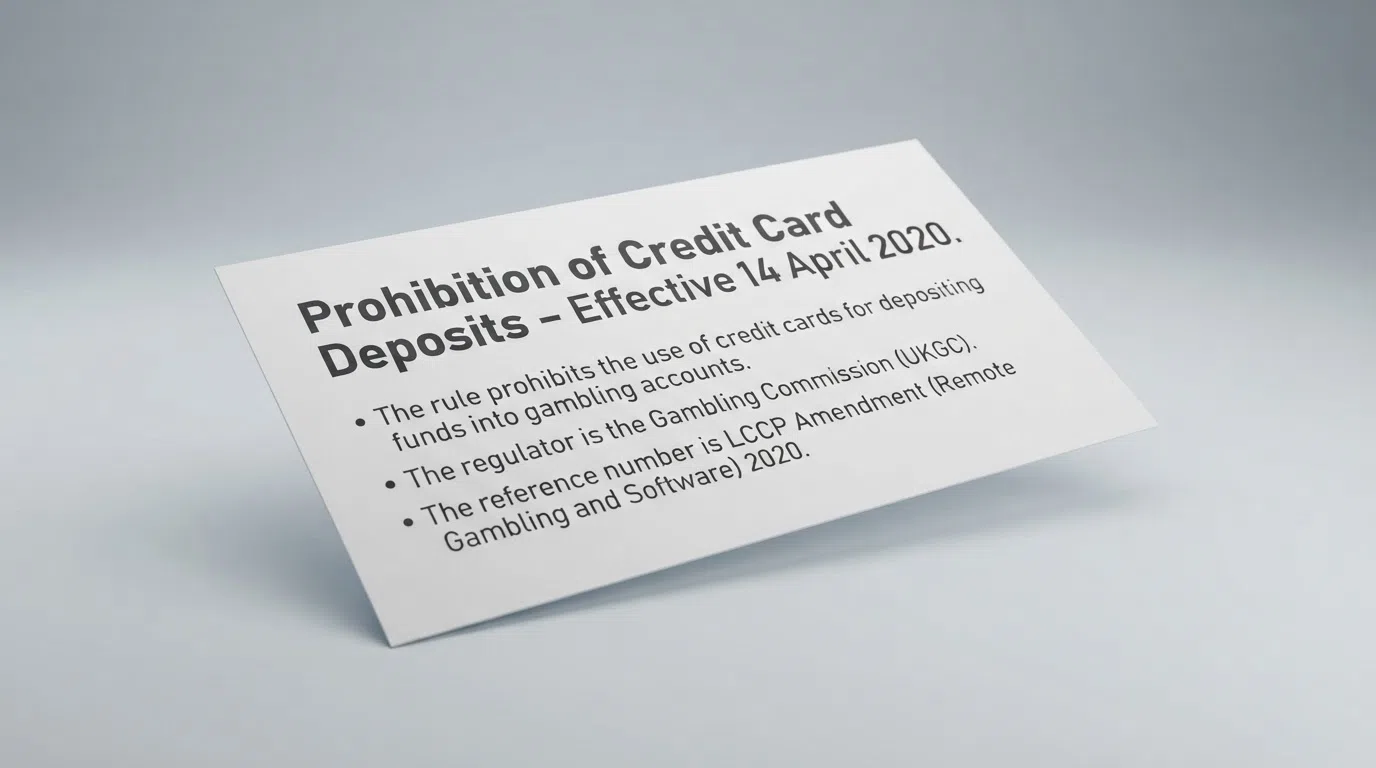
The credit card casino question for a UK player has a simpler answer than the marketing around it suggests. Every casino and betting site licensed in Great Britain has been barred from accepting credit card deposits since 14 April 2020. The prohibition sits in licence condition 6.1.2 of the LCCP, the Gambling Commission’s operating rulebook, and it extends to payments routed through e-wallets, meaning a Skrill or Neteller top-up funded by a credit card will be declined at the till. The one carve-out is non-remote lottery tickets, the kind you buy in a shop. Everything else is closed. This guide maps what changed, where credit cards still work, and what a UK player comparing licensed and offshore sites in 2026 is actually choosing between.

Data current as of September 8, 2026, checked against the Gambling Commission’s public register of licence holders.
The UK Credit Card Gambling Ban: What the Law Actually Says
The April 2020 prohibition is the single most important fact on this page, and its logic is worth understanding before any comparison of operators makes sense.
Non-GamStop Casinos That Accept Credit Cards: The Offshore Route
There is one place a UK player can still deposit by credit card: casinos licensed outside Great Britain, typically under Curaçao, Malta, or similar non-GB jurisdictions. These operators are not on GamStop, the GB self-exclusion register, and do not honour it. They are not inspected by the Gambling Commission, do not sit under the LCCP, and do not offer the player protections that come with a GB licence. A British player who deposits at one of them forfeits the GB regulatory layer entirely. The mechanics of credit card acceptance at these sites are straightforward — Visa and Mastercard credit deposits clear like any other online purchase — but the regulatory wrapper is the absent variable.
What a player loses offshore is a precise list. There is no GamStop coverage, so a self-exclusion registered with a GB operator does not extend. There is no Commission complaints route and no approved alternative dispute resolution. There is no fund protection, no guarantee that segregated player money can be recovered if the operator fails. There is no British consumer redress if a withdrawal is delayed or denied. The UKGC’s disruption-based enforcement (described below) can target the sites themselves, but it cannot recover an individual player’s losses.
Is it legal for a UK player to use an offshore site? UK law criminalises providing unlicensed gambling facilities, not using them. No penalty has been traced for a player who merely gambles on an unlicensed site. The risk is the absence of protection, not the presence of prosecution.
UK-Licensed vs Offshore Casinos at a Glance
| Feature | UK-Licensed Casino | Offshore Casino |
|---|---|---|
| Credit card deposits | Banned (LCCP 6.1.2) | Accepted |
| Regulator | UK Gambling Commission | Curaçao, Malta, or other non-GB |
| GamStop self-exclusion | Mandatory, honoured | Not participated in |
| ADR / complaints route | Commission-approved ADR | None under GB framework |
| Online slot stake cap | £5 (25+) / £2 (18–24) | No statutory cap |
| Bonus wagering cap | 10x (from 19 December 2025) | No GB cap |
| Fund protection | Segregated player funds rule varies | Not guaranteed |
The table sets out the two regimes side by side. The contrast is structural rather than incremental. A UK-licensed casino operates inside a framework that caps stakes, caps wagering, compels GamStop, and offers a complaints path. An offshore casino operates inside none of that. The credit card acceptance is one feature among many that the GB framework has traded away, and the question for a UK player is whether the convenience of credit is worth the regulatory cost of the rest.
UKGC Enforcement: How the Commission Actually Polices the Ban
The Commission does not hold statutory powers to block offshore sites at the ISP or DNS level, which is the route Australia and some other jurisdictions use. The UK approach is disruption, not blocking. Between April 2024 and June 2025, the Commission issued 3,140 disruption notices, referred 447,778 URLs to search engines for delisting, and saw 287,961 URLs removed. The average engagement fall across 160 disrupted sites was 32%. The mechanism is commercial pressure — payment-provider referrals, search-engine delisting, cease-and-desist — rather than a kill switch. Legislation to grant ISP blocking powers has been proposed but not enacted, so the gap persists: a UK player who seeks out an offshore site can still reach one, even though the Commission can make the site harder to find and harder to fund. The enforcement figures describe the scale of that effort; the absence of blocking power describes its ceiling.
How UK Players Actually Deposit at Online Casinos in 2026
The payment landscape at licensed UK sites in 2026 is the picture three payment categories paint. The first is the method that no longer works — credit cards, including credit-card-funded e-wallets. The second is the direct replacement — debit cards, which have absorbed the bulk of the deposit volume the credit card channel used to carry. The third is the growing set of alternatives — e-wallets (PayPal, Apple Pay, Google Pay) and Open Banking, which routes directly from the player’s bank account to the casino.

Casino Sites That Accept Credit Card Deposits — All of Them Are Offshore
For a UK player, the practical answer to “where can I still use a credit card” is: nowhere licensed, everywhere unlicensed. The offshore operators that accept Visa and Mastercard credit are typically licensed under Curaçao CGA, the Malta Gaming Authority, or similar non-GB regulators. A credit card deposit at one of these sites clears through the card network like any other online purchase, the funds appear in the casino balance within seconds, and the game play proceeds. Withdrawals follow the operator’s own terms — typically back to a bank account, sometimes only after a credit card deposit has been “turned over” a set number of times. Currency conversion is a real cost when a GB-licensed site is not in play: a £100 deposit may convert at the card issuer’s exchange rate, with a foreign transaction fee on top, and the conversion works in both directions on withdrawal. The transaction is frictionless. The regulatory environment around it is not.
Best UK-Licensed Casino Payment Alternatives Since the Ban
Three payment categories have absorbed the post-ban volume at GB-licensed casinos. The first is debit cards — Visa Debit and Mastercard Debit — which function like a credit card at the point of sale but draw from funds already in the account. Every operator on the licensed shortlist takes both. The second is e-wallets: PayPal is the most widely supported, followed by Apple Pay and Google Pay on mobile. Deposits are instant, withdrawals are typically faster than debit card, and the payment credentials never reach the casino. The third is Open Banking, sometimes marketed as “Pay by Bank,” which authorises a direct transfer from the player’s bank account to the casino through the bank’s own interface. Open Banking has grown fastest among the newer alternatives, and it carries the lowest chargeback dispute risk because the player authorises the transfer from inside the banking app.
Debit Card vs E-Wallet vs Bank Transfer: Deposit Speed, Withdrawal Time and Fees
The three categories differ in measurable ways. A debit card deposit at a UK-licensed casino posts in seconds; the same card used for a withdrawal typically clears in one to three working days, depending on the operator and the issuing bank. An e-wallet deposit is also instant, and an e-wallet withdrawal usually posts the same day, sometimes within hours, because the funds stay inside the e-wallet’s closed loop. Open Banking sits in between: a deposit is near-instant (the bank confirms the transfer in seconds), and withdrawals route back through Open Banking in roughly the same time as an e-wallet, without the need to register a card. The fee picture is the cleanest. UK-licensed operators do not charge deposit or withdrawal fees for any of the three. The cost a player may face is from the e-wallet itself (a PayPal currency conversion, for instance) or from the bank (an unpaid transaction fee on a premium account is rare but not unknown).
Credit Card Casino Alternatives: What the Post-Ban Market Actually Offers
Beyond the three main methods, UK players have mobile-first options that work as long as the underlying card is a debit. Apple Pay and Google Pay both fall back to a debit card in the wallet, not a credit card, so they remain acceptable at GB-licensed sites. Prepaid cards are a mixed category: a prepaid Visa or Mastercard that was loaded from a bank account is treated as a debit, and most licensed operators accept it, but a prepaid card that was loaded from a credit card is treated as a credit-card-funded payment and may be declined. The e-wallet routing ban is enforced at the operator level: sites run checks against the money service business rules and decline deposits that trace back to a credit source. The practical effect is that a UK player who wants a frictionless mobile experience can have one — just not on credit.
Top 10 UK-Licensed Casino Sites With the Best Payment Options in 2026
The table below ranks the ten featured operators against the two criteria that matter most for a UK player choosing a credit card alternative: payment method diversity and bonus-term fairness. All ten are verified as holding active GB licences on the Gambling Commission’s public register. Wagering caps reflect the 10x ceiling that took effect on 19 December 2025 under LCCP Social Responsibility Code 5.1.1. The minimum deposit to claim each offer is the operator’s published term at the time of writing.
| Operator | Licence | Welcome Offer | Wagering | Min Deposit | Payment Methods |
|---|---|---|---|---|---|
| bet365 | Hillside (UK Gaming) ENC, account 38721 | Up to 500 Free Spins on four slot titles | 0x | £10 | Visa Debit, Mastercard Debit, Apple Pay, Google Pay, PayPal, bank transfer |
| William Hill | William Hill Organisation Limited | 200 Free Spins on Big Bass Splash | 10x (£30 cap) | £10 | Visa Debit, Mastercard Debit, Apple Pay, PayPal, bank transfer |
| Sky Vegas | Bonne Terre Limited (Sky Betting & Gaming) | 50 no-deposit FS + 200 FS after £10 spend | 0x | £0 / £10 | Visa Debit, Mastercard Debit, Apple Pay, PayPal |
| Ladbrokes | Ladbrokes Betting & Gaming Limited, account 1611 | 100 Free Spins on selected games | 10x | £10 | Visa Debit, Mastercard Debit, Apple Pay, Google Pay, PayPal |
| Paddy Power | PPB Counterparty Services Limited (Flutter) | 60 no-deposit FS + 100 FS after £10 wager | 0x | £0 / £10 | Visa Debit, Mastercard Debit, Apple Pay, PayPal, bank transfer |
| Coral | Coral Interactive (Gibraltar) Limited (Entain) | 100 Free Spins | 0x | Qualifying deposit | Visa Debit, Mastercard Debit, Apple Pay, Google Pay, PayPal |
| Betfair | Betfair Casino Limited (Flutter) | 50 no-deposit FS + 100 FS on Jackpot King | — | £0 / £10 | Visa Debit, Mastercard Debit, Apple Pay, PayPal, bank transfer |
| Betfred | Done Brothers T/A Betfred | Up to 200 Free Spins | 0x | £10 | Visa Debit, Mastercard Debit, Apple Pay, PayPal |
| Gala Bingo (Gala Casino) | Entain group | Current offer to be confirmed on site | — | — | Visa Debit, Mastercard Debit, PayPal, Apple Pay |
| PlayOJO | SkillOnNet Ltd | 80 Free Spins, zero wagering, no cap | 0x | £10 | Visa Debit, Mastercard Debit, PayPal, Apple Pay, bank transfer |
The wagering column tells the most important story. Six of the ten offers carry 0x wagering, meaning free-spin winnings are credited as cash, withdrawable immediately. Two carry the 10x ceiling, which is the GB statutory maximum. Two do not have a wagering figure stated in the research captured for this run. The “0x” cluster is the cluster a player looking for clean bonus terms should weight most heavily: a 500-spin offer with no wagering and a 10-spin offer with 10x are not equivalent products even if both are “free spins.”
The payment methods column shows that Visa Debit and Mastercard Debit are universal across the set, PayPal is nearly universal (absent only at Betfred, though that may be a current-term detail), and Apple Pay is the third most common option. Bank transfer appears at five of the ten. Google Pay is supported at three. The diversity question for a player is less “can I pay” and more “can I pay the way I want to pay,” and the table makes the choice visible.
bet365 — Up to 500 Free Spins With Zero Wagering
bet365’s welcome offer is the largest free-spin count in the featured set: up to 500 spins across four slot titles (Book of Horus, Curse of the Bayou, Magic Forge, and Wrath of the Deep), credited at £0.10 per spin. The 0x wagering means winnings are withdrawable cash the moment they land. Players have 30 days to claim, and each batch expires 7 days after being awarded, so claiming earlier in the window is the practical move. The £10 minimum deposit is the only friction. Payment methods cover the full set: Visa Debit, Mastercard Debit, Apple Pay, Google Pay, PayPal, and bank transfer. The licence is Hillside (UK Gaming) ENC, account 38721, confirmed active on the UKGC register. With the highest spin count and zero-wagering terms, bet365 represents the leading choice for players prioritising volume.
William Hill — 200 Free Spins With £30 Cashout Cap
William Hill runs 200 free spins on Big Bass Splash at £0.10 each, gated by a £10 deposit and stake. The 10x wagering on winnings is at the GB ceiling, and the £30 maximum cashout from free-spin winnings is the cap a player should weigh before opting in. Spins expire 72 hours from credit, and the offer runs to 31 December 2026.
Sky Vegas — 250 Free Spins Including 50 With No Deposit
Sky Vegas splits the welcome into two tiers: 50 no-deposit free spins, then 200 more once the player has deposited and spent £10. The 0x wagering on all free-spin winnings means both tiers pay out as cash. The 7-day expiry on spins is tight; the 30-day window to meet the deposit requirement is the practical pacing guide. Supported payment methods encompass the core debit and e-wallet options identified earlier. The licence is held by Bonne Terre Limited (the Sky Betting & Gaming operating company) and is active on the UKGC register. The no-deposit tier is the distinguishing feature: a player can try the site without funding an account first, and that is rare enough in the set to be worth flagging.
Ladbrokes — 100 Free Spins With 10x Wagering
Ladbrokes’ offer is 100 free spins on selected games, credited after the player stakes £10 on slots. The spin value is £0.10, the wagering is 10x on winnings, and the acceptance window is 48 hours with a 7-day validity on the spins. The licence is Ladbrokes Betting & Gaming Limited, account 1611, with active GB licences running back to 2009 for some products. The available payment methods include the standard debit card and e-wallet set detailed in our rankings table. The 10x wagering is at the statutory ceiling, and the offer is the cleanest 100-spin option in the set for a player who does not need a no-deposit tier or a 0x multiple.
Paddy Power — 160 Free Spins With Zero Wagering (60 No-Deposit)
Paddy Power offers the largest no-deposit free-spin allocation in the featured set: 60 spins with no deposit required, then 100 more after a £10 deposit and wager. All winnings carry 0x wagering, meaning they are cash on credit. Spins expire 7 days after claiming, and the spin value is £0.10. All standard payment options outlined in our comparison table are supported. The licence is PPB Counterparty Services Limited, part of the Flutter group, confirmed active on the UKGC register. The combination of no-deposit spins and zero-wagering requirements makes Paddy Power a standout option for value-conscious players.
Coral — 100 Free Spins With No Wagering
Coral’s 100 free spins carry 0x wagering, credited after the player spends £10 on slots. The spin value is £0.10, the acceptance window is 48 hours, and the spins are valid for 7 days. The licence is Coral Interactive (Gibraltar) Limited, part of the Entain group, and is active on the UKGC register. The available payment methods include the standard debit card and e-wallet set detailed in our rankings table. The offer is a clean alternative to Ladbrokes for a player in the same Entain ecosystem who wants 0x instead of 10x.
Betfair — 150 Free Spins Across Two Tiers (50 No-Deposit)
Betfair splits the offer into 50 no-deposit free spins and 100 additional spins on Jackpot King games after a £10 deposit and spend. Spin value is £0.10, and the free spins carry a 7-day expiry. The licence is Betfair Casino Limited, part of the Flutter group, confirmed active on the UKGC register. All standard payment options outlined in our comparison table are supported. The Jackpot King focus is the distinguishing detail: a player who likes the progressive-jackpot format will read the offer differently from one who does not.
Betfred — Up to 200 Free Spins With Zero Wagering
Betfred’s welcome offer is up to 200 free spins with 0x wagering, credited within 48 hours of staking £10 on slots. The opt-in and stake window is 30 days from registration, and the spins expire 7 days after being credited. The licence is Done Brothers (Cash Betting) T/A Betfred, with active remote licences confirmed on the UKGC register. Supported payment methods encompass the core debit and e-wallet options identified earlier. The 200-spin ceiling is the second-largest in the set behind bet365, and the 0x wagering places it in the cleanest-terms cluster.
Gala Bingo (Gala Casino) — Established Entain-Group Operator
Gala Bingo sits in the Entain group alongside Ladbrokes and Coral, with active GB licences confirmed on the UKGC public register. The standard Entain-group payment methods — Visa Debit, Mastercard Debit, PayPal, and Apple Pay — are the deposit routes available. The current welcome offer details were not confirmed from the research captured for this run, so the practical advice is to check the site before depositing. The operator is a known quantity, the licence is in good standing, and the payment set is broad; what the offer looks like this week is the missing piece.
PlayOJO — 80 Free Spins With Zero Wagering and No Cashout Cap
PlayOJO’s offer is 80 free spins on selected slots after a £10 deposit and wager, with 0x wagering and an explicit “keep what you win” term that makes the absence of a cashout cap part of the product, not an oversight. The licence is SkillOnNet Ltd, confirmed active on the UKGC register. Payment methods are Visa Debit, Mastercard Debit, PayPal, Apple Pay, and bank transfer. PlayOJO built its brand on the zero-wagering proposition, and the offer here is the cleanest in the set for a player who reads the small print: no cap, no wagering, cash from the moment the spin settles.
Slot Games at Offshore Casinos: What Titles You Can Still Access in 2026
The slot titles a UK player can reach depend entirely on which side of the licensing line they sit. Offshore credit card casinos carry the same mainstream slot catalogues as their licensed counterparts — the games themselves are not jurisdiction-locked — but the rules around how they are played differ in ways that matter.
Slot Titles You Can Play With a Credit Card at Offshore Casinos
Three titles dominate the credit card casino slot list because they sit in nearly every operator’s lobby. Starburst, by NetEnt, has a 96.09% RTP and is classed as low volatility, with a maximum win in the 500x to 800x range depending on the bonus feature state. Book of Dead, by Play’n GO, has a 96.21% RTP, is high volatility, and carries a 5,000x maximum win — the highest in this trio. Big Bass Bonanza, by Pragmatic Play, has a 96.71% RTP, is high volatility, and has a 2,100x maximum win. The RTPs are set by the game providers, not by the casino, so the same title carries the same return-to-player percentage whether the player is at a UK-licensed site or an offshore one. What changes is the regulatory wrapper around the spin.
Playing Slots With a Credit Card Online — the Real Difference
The same slot title, played at a UK-licensed site and at an offshore site, behaves identically in terms of RTP and game mechanics. The differences are in the rules the operator must follow. At a UK-licensed site, the maximum stake per game cycle is £5 for players aged 25 and over and £2 for players aged 18 to 24, imposed by SI 2025/215. The 2.5-second minimum spin speed and the auto-play ban, both in force since 31 October 2021, shape the pace. Session losses and wins must be displayed, and reverse withdrawals are permanently banned. At an offshore site, none of these rules apply. The stake can be set as high as the operator and the player’s bankroll allow. The spin can run as fast as the game allows. The session display is the operator’s choice. The RTP is the same; the regulatory envelope is not.
Best Slot Sites That Accept Credit Cards — and the UK-Licensed Alternative
A UK player who wants to play Starburst, Book of Dead, or Big Bass Bonanza with a credit card deposit has to leave the licensed market. Every GB-licensed alternative to those three titles runs on debit cards, e-wallets, or Open Banking. The trade-off is the trade-off the rest of this page keeps returning to: credit card convenience at offshore sites, full regulatory protection at licensed sites, no overlap. A player who values the same game catalogue on both sides of the line will find the same RTPs and the same max-win figures, but only the licensed side delivers GAMSTOP coverage, ADR, and the stake caps that limit loss-rate per spin. The choice is a real one and the page does not pretend it is not.
Responsible Gambling When Credit Cards Enter the Conversation
The credit card ban was a harm-reduction measure, and the harm data around it has not gone away. The 22% problem-gambling rate among credit card users that the Commission cited in 2020 was the stated ground for the prohibition, and the post-ban data tells a story about the tools that replaced it.
GamStop Self-Exclusion: How It Works and What It Covers
GamStop is the GB-wide self-exclusion register, mandatory for every GB-licensed online operator since 31 March 2020. A player can register for six months, one year, five years, or five years with auto-renewal. The exclusion cannot be cancelled early — once registered, the period runs. Every GB-licensed casino, betting site, and bingo site must check GamStop at the point of account creation and refuse registration if the player is on the list. Offshore sites do not participate in GamStop, which is why a self-exclusion does not extend to them. For a player who has registered and then moves to an offshore site, the self-exclusion is effectively a filter against the licensed market only, and the offshore market remains open.
Deposit Limits, Reality Checks and the Tools Every UK Player Should Set
From 31 October 2025, GB-licensed operators must prompt a customer to set a financial deposit limit before the first deposit. A request to decrease a limit must be actioned immediately; a request to increase one cannot be. A standardised “gross deposit limit” definition takes effect on 30 September 2026 under RTS 12, and only that form may be called a “deposit limit.” Beyond the limit, every licensed site offers reality checks (periodic on-screen prompts showing session time and net position), time-outs (24-hour to six-week cooling-off periods), and session loss-and-win displays. The architecture is dense. The user-facing question is simpler: a player who sets a deposit limit on day one and never increases it has done the most consequential thing the tools allow.
Financial Vulnerability Checks and What the £150 Threshold Means
From 28 February 2025, every GB-licensed operator must run a financial vulnerability check at a £150 net deposit threshold in a rolling 30-day period. The check uses publicly available data only — county court judgments, individual voluntary arrangements, and bankruptcy orders. It is not a credit check and does not require the player’s consent beyond the operator’s terms. What it produces, when it triggers, is a flag for operator review; the operator may then ask for further information, apply a lower deposit cap, or close the account. The financial risk assessment — the heavier “affordability check” with Stage 1 thresholds of £5,000 (25+) and £2,500 (under 25) in net deposits over a rolling 24-hour period — is announced but not yet commenced. The two are distinct. The £150 vulnerability check is live; the Stage 1 financial risk assessment is on the books but waiting on a formal consultation response.
Where to Get Help: GamCare, NHS Clinics and the National Gambling Helpline
The help infrastructure is real, and the usage data shows it is being used. GamCare’s National Gambling Helpline (0808 802 1333) made 996 referrals to treatment and peer-based support services in January 2026, a 48% year-on-year increase from 674 in January 2025. NHS specialist gambling treatment clinics, 15 locations as of December 2024, saw service use rise 130% over the preceding year, with 4,355 total referrals in 2024/25. The National Gambling Support Network, funded by GambleAware, treated 11,960 clients between April 2024 and March 2025, an 11% increase from the prior year; the share of clients classed as problem gamblers fell from 87% at initial assessment to 27% at final assessment, a measure of the network’s reach into the population that needs it. The prevalence figures behind all of this are smaller than the help-line volumes suggest: 0.4% of adults in the NHS Adult Psychiatric Morbidity Survey 2023–24 met the PGSI 8+ threshold for problem gambling, and 1.6% met the PGSI 3+ threshold for moderate risk. The 47% of adults who gambled in the past four weeks (Gambling Survey for Great Britain, Year 3, 2025) is the broader base rate the smaller percentages sit inside.
How We Evaluated and Ranked These UK Casino Sites
The ten operators in the ranking were checked against the Gambling Commission’s public register of licence holders, and all ten hold active GB licences. The ranking weights two dimensions. The first is payment method diversity: operators offering the broader set of debit, e-wallet, mobile, and bank transfer options rank higher, on the principle that a player should be able to deposit and withdraw the way they want to. The second is bonus-term fairness, measured against the 10x wagering ceiling that took effect on 19 December 2025 under LCCP Social Responsibility Code 5.1.1. Offers with 0x wagering rank above offers at the ceiling. Where research did not confirm a current offer detail, the cell carries an em dash rather than a fabricated figure, and the operator write-up notes the gap. The research sources are the UKGC publications, GamCare and NHS data, the operator terms pages surfaced during research, and the UK regulatory framework as cited in the LCCP and RTS documents.
The Bottom Line: Credit Card Casinos and UK Players in 2026
A UK player in 2026 who wants to deposit by credit card has one path, and that path leaves the GB regulatory framework behind. Every GB-licensed casino is barred from accepting credit cards under LCCP 6.1.2, and the prohibition has held since 14 April 2020. The offshore sites that still take Visa and Mastercard credit do not participate in GamStop, do not offer Commission-approved ADR, and do not guarantee fund protection. The GB framework is the strongest player-protection regime in operation globally, and the relevant parts of it — stake caps of £5 and £2, the 10x wagering ceiling, the deposit-limit architecture, the £150 vulnerability check, the statutory levy funding treatment and prevention, the operator-side responsible-gambling tools — are not available offshore. The Commission announced the ban on the ground that “the ban aims to reduce the risks of harm to consumers from gambling with money they do not have.” The data on help-line referrals, NHS clinic use, and treatment outcomes since then suggests the framework around the ban is being used. The credit card route is closed at the licensed end, open at the offshore end, and the gap between them is the page’s core finding.
The ten UK-licensed operators ranked above offer payment methods that cover the practical ground credit cards used to cover — debit cards, PayPal, Apple Pay, Google Pay, bank transfer, Open Banking — and the bonus terms inside the 10x GB ceiling. A player who picks one of them is choosing the licensed side of the trade. A player who picks an offshore credit card casino is choosing the other side. Both choices are open. The point of the page is to make the choice visible before it is made.
Frequently Asked Questions
Can you use a credit card at a UK online casino in 2026?
No. Every casino and betting site licensed in Great Britain has been barred from accepting credit card deposits since 14 April 2020 under licence condition 6.1.2 of the LCCP. The only gambling product still accepting credit cards in the GB-licensed market is non-remote lottery, sold in licensed retail outlets. Offshore casinos not licensed by the UKGC remain the only online option, but they sit outside the GB regulatory framework entirely.
What happens if you try to use a credit card to deposit at a UK-licensed casino?
The deposit is declined. The operator’s payment system checks the card type, and a credit card transaction is blocked at the authorisation stage. The player sees a decline message and the funds do not move. Attempting the deposit does not trigger a penalty against the player; the ban is enforced at the operator level, and the consequence is a declined transaction rather than an account action.
Does the credit card ban apply to e-wallets like PayPal and Skrill?
Yes, when the e-wallet is funded by a credit card. The ban extends to payments routed through money service businesses, which means an e-wallet top-up that traces back to a credit card is in breach. Operators are required to ensure MSBs have prevented credit card use for gambling. A PayPal or Skrill account funded from a debit card or bank account is not affected, and those remain the standard e-wallet deposit routes at GB-licensed sites.
Is it legal for UK players to gamble at offshore casinos that accept credit cards?
UK law criminalises providing unlicensed gambling facilities, not using them. No penalty has been traced for a UK player who merely gambles at an offshore site. The risk is the absence of GB regulatory protection — no GamStop, no ADR, no Commission complaints route, no guaranteed fund protection — rather than prosecution of the individual. The legal picture for the operator is sharper: providing gambling without a GB licence is a criminal offence.
What protections do you lose if you gamble at an offshore casino instead of a UK-licensed one?
The list is precise. You lose GamStop coverage, so a GB self-exclusion does not extend. You lose access to a Commission-approved alternative dispute resolution service. You lose the Commission complaints route. You lose the GB fund protection rules. You lose the GB stake caps (£5 for 25+, £2 for 18–24 on online slots), the GB wagering cap (10x), the GB deposit-limit architecture, and the GB vulnerability and affordability check framework. The offshore operator sets its own terms, and the player has fewer backstops.
What is the maximum stake on online slots in the UK in 2026?
The maximum stake per game cycle on online slots is £5 for players aged 25 and over, in force from 9 April 2025, and £2 for players aged 18 to 24, in force from 21 May 2025. The cap is set by SI 2025/215. It applies to total staked within one game cycle, not per line or per spin, and is the highest stake a GB-licensed online slot product will accept. No equivalent statutory cap applies to other online gambling products.
What are the best alternative payment methods at UK casinos since the credit card ban?
Debit cards (Visa Debit and Mastercard Debit) are the direct replacement and are universal across the licensed market. PayPal is the most widely supported e-wallet, followed by Apple Pay and Google Pay on mobile. Open Banking, sometimes marketed as “Pay by Bank,” is the fastest-growing alternative and routes directly from the player’s bank to the casino. The right choice depends on the player: debit for universality, e-wallet for speed on withdrawals, Open Banking for the lowest dispute risk and the tightest bank-level authentication.
When Were Credit Cards Banned for Gambling — and Why?
The Gambling Commission announced the prohibition in January 2020, giving the industry a three-month implementation window, and brought it into force on 14 April 2020. The Commission’s stated ground was a harm figure drawn from its own data: 22% of online gamblers who used credit cards were classed as problem gamblers, a rate the Commission judged incompatible with consumer protection. Great Britain was the first country in the world to implement a complete ban on credit card use for online and offline gambling. The ban sits in licence condition 6.1.2 of the LCCP, which means compliance is not optional for any operator that wants to keep a GB licence.
The product coverage is broad. Online casino, online sports betting, online bingo, high-street bookmakers, track bookmakers, and remote lotteries that take payment over the phone or internet are all in scope. Only non-remote lottery — paper tickets sold in a shop — remains exempt. The Commission framed the move in direct terms at the time: “The ban aims to reduce the risks of harm to consumers from gambling with money they do not have.” That phrasing captures why credit cards sat in a different category from debit cards or bank transfers. A debit card spends money already in the account; a credit card creates a debt that the gambler carries forward, with interest, into the next month. The Commission treated that distinction as the dividing line.
Can You Still Use a Credit Card at Any UK Casino?
No. Zero GB-licensed casinos or betting sites accept credit card deposits in 2026, and the prohibition reaches further than most players first assume. The ban covers payments routed through money service businesses — e-wallets, prepaid cards, and similar intermediaries. An operator that processes an e-wallet top-up funded by a credit card is in breach. The single remaining exception is non-remote lottery, sold in licensed retail outlets. Everything a UK player would recognise as “online gambling” is out.
Payments – nominimumdeposit-casinos-uk
Content created by the «nominimumdeposit-casinos-uk» team