
Malta MGA casino sites for UK players: what the licence buys you, and what it does not
 Available in GB
A Malta-based online casino is simply a casino whose operating company is registered in Malta and whose primary gambling licence was issued by the Malta Gaming Authority. The Malta base is a regulatory choice, not a product: the games, the software providers, the welcome bonus, the withdrawal time, and the way the site treats you at 2 a.m. on a Friday all come from the operator running the platform, not from the licence in the footer. The MGA badge tells you a regulator in Valletta is watching; it does not tell you what is being watched, and it certainly does not tell you whether the casino is allowed to take your money from a postcode in Manchester.

This page is the work that comparison lists tend to skip. It traces the MGA licence from the footer of a casino site to what it actually does for a player sitting in Great Britain, then runs through the ten operators that hold both an MGA and a UK Gambling Commission licence side by side, the welcome bonus each one hands out in 2026, the payments that work, the games the libraries carry, the places crypto fits and the places it does not, and the protection a UK player keeps, gains, or loses by choosing one route or the other. A “best” label, as it turns out, is somebody else’s ordering. The ordering below is built on what the licences and the numbers actually do.
*Current as of September 8, 2026. Licence claims verified against the UK Gambling Commission Public Register and the Malta Gaming Authority Licensee Register.*
What a Malta casino site is — and what the “best” lists leave unsaid
The phrase “Malta online casino” gets used as if it described a category of product. It does not. It describes where the operating company is incorporated and which regulator issued its primary licence. The games, the bonus structure, the speed of withdrawals, the depth of the live dealer lobby — all of these are decisions made by the operator on top of the licence. Two Malta-licensed casinos can be as different as a high-street bookie and a niche crypto site, and the MGA badge on each footer tells you almost the same thing about both.
That is the gap the “top 10 Malta casinos” lists slide past. A guide page that orders operators by “best” is using somebody’s criteria — usually a mix of bonus size, slot count, and the editor’s own weighting — and the criteria are almost never stated in a way the reader can test. The same brand can sit at number one on one list and at number seven on another, and both lists can be honest by their own lights. “Top-rated” is a label, not a certification.
What every list does agree on is the practical shape: a Malta-licensed casino is a remote gambling site that takes deposits, pays out withdrawals, runs a slot and table game library, and operates under a regulator in Malta. The differences between one Malta casino and another are the differences that matter to a player — bonus terms, withdrawal speed, the depth of the live dealer section, the way the site handles self-exclusion — and the rest is geography.
What the term “Malta online casino” actually covers
A casino calling itself a “Malta online casino” is telling you two things: the operating company is registered in Malta, and the gambling licence on the footer was issued by the Malta Gaming Authority. That is the whole of what the label certifies. The MGA supervises the operator’s compliance with Maltese law, audits the platform, checks the games for fairness, and holds the licence holder to Directive 2 of 2018 — the player-protection rulebook that requires identity and age checks before deposit, deposit and session limits on demand, a working self-exclusion process, responsible-gambling messaging, and access to alternative dispute resolution.
It does not certify the games. It does not certify the bonus. It does not certify the withdrawal speed. It does not certify that the casino is allowed to take your money from a British postcode. None of those are questions the MGA answers, and a footer badge is not the place to look for them.
The point matters for UK players in particular. Since the Gambling (Licensing and Advertising) Act 2014, any operator that provides facilities for gambling to customers in Great Britain needs a UK Gambling Commission licence regardless of where it is based. The UKGC has whitelisted the MGA as a recognised jurisdiction, but whitelist recognition is not authorisation: an MGA-only operator still needs a UKGC operating licence to serve British players, and the licence number that proves a casino is legal in Great Britain is a UKGC one. A footer that shows only an MGA number is telling you the operator is licensed in Malta, not that it is licensed to deal with you.
Real money versus free play at a Malta casino
Every Malta-licensed casino on this page runs two modes. The first is real-money play: deposit funds, place a bet, and the outcome settles against your cash balance. The second is demo mode — the same games, the same mechanics, the same bonus rounds, played with virtual credits that the casino hands you for free. Demo mode exists for a reason that the marketing pages tend to bury: it lets you learn a slot’s volatility and bonus frequency before you commit a deposit, and it lets you decide whether a game’s pace suits you at all.
All ten operators covered in the ranking below run a working demo mode across their slot and table libraries. The offer is the same in principle, though in practice the demo button is sometimes tucked behind a small “try” link, and a handful of progressive jackpot games will only open in real-money mode because the jackpot meter has to be live.
For most readers, the practical question is which mode to use and when. Demo mode is the right tool for learning a game; real-money mode is the only way to clear a welcome bonus or withdraw winnings. The split is not a gimmick or an upsell — it is a structural choice every regulated casino makes, and the MGA and UKGC both require that the real-money mode be clearly signposted and that the demo mode never be used to disguise losses.
Why “best” and “top-rated” Malta lists disagree
A search for “best Malta online casino” turns up pages that all claim to be authoritative and disagree on almost everything except the licence type. That is not an accident and it is not dishonesty on any one editor’s part. It is what happens when a comparison is built on the editor’s own weighting — bonus size versus game library versus withdrawal speed versus some combination of all three — and the weighting is never published.
Competitor pages in this niche run between roughly 2,000 and 4,000 words, structured as a licence explainer, an operator list with brief reviews, a comparison table, and a bonus roundup. The shared shape gives the impression of a shared standard. There is no shared standard. The same brand can be ranked first on a page that prizes zero-wagering spins and seventh on a page that prizes slot count, and both rankings are internally consistent. The lesson is to read the list, not just the position — and to read the criteria the list does not state.
The game selection you actually get
The game library is where Malta-licensed casinos actually compete with one another, because the licence says nothing about how many slots a casino runs or which studios supply them. The featured operators in this guide run between roughly 400 and more than 3,000 slots each, with the libraries drawing on a stable of major providers — NetEnt, Play’n GO, Pragmatic Play, Microgaming, Playtech, Evolution, and a handful of others — and supplementing them with smaller studios for variety. Live dealer tables are universal across the set, supplied by Evolution and Playtech primarily, with roulette, blackjack, baccarat, and game-show formats forming the core of the offering.
The numbers matter because the breadth of the library is one of the few things a casino can actually compete on once the licence is fixed. A 3,000-slot library is not three times better than a 1,000-slot library, but it does mean more providers, more mechanics, and a higher chance of finding a game that suits a particular taste. The slots section later in this page works through the three titles for which a real return-to-player figure is on the record, because the RTP is what decides what a session actually costs.
The MGA badge does not open the UK door: legality for British players
The first question a UK player should ask of any “Malta casino” is the simplest: is this casino allowed to take my money? The answer is not on the footer badge. It is in a register the badge should name.
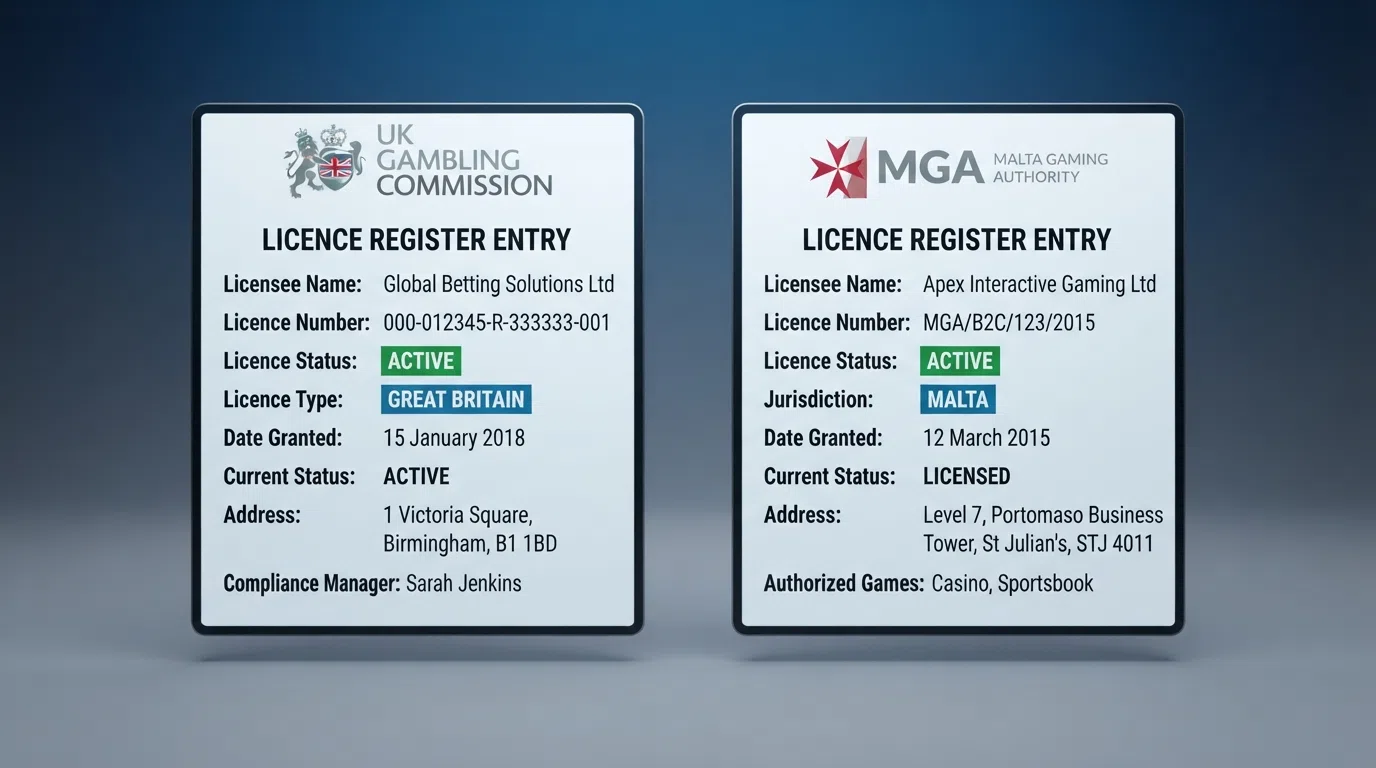
Since the Gambling (Licensing and Advertising) Act 2014, the answer to that question is decided at the point of consumption, not the point of origin. An operator based in Valletta, Gibraltar, Curaçao, or the Isle of Man is bound by the same rule: if it transacts with a customer in Great Britain, it needs a UK Gambling Commission operating licence. The MGA licence the operator also holds does not satisfy that requirement, and the UKGC’s whitelist recognition of the MGA does not change the rule. Recognition means the MGA’s standards are respected; it does not mean an MGA-only operator is allowed to serve British customers.
The point is not academic. An MGA-only casino accepting UK players is committing a criminal offence under section 33 of the Gambling Act 2005 — up to 51 weeks’ imprisonment and an unlimited fine. The player is not prosecuted, but the player also loses every protection the UK layer would otherwise provide: GAMSTOP, the Commission’s complaints route, alternative dispute resolution, and British consumer redress. The casino continues to run its MGA-mandated protections, and the MGA continues to supervise, but the supervisory layer is in Malta and the dispute resolution runs through a Maltese ADR body rather than IBAS or the Commission.
The rest of this section works through what the UK layer does for a player, why it is more than the MGA layer on its own, and what changes at dual-licensed sites where both regulators are watching.
What the MGA licence is — and why so many casinos sit in Malta
The Malta Gaming Authority is Malta’s statutory regulator for gambling, established in 2001 and rebuilt under the Gaming Act 2018. It licenses B2C and B2B operators, supervises compliance, and runs its own enforcement — including fines, licence suspensions, and revocations. The MGA sits inside a small jurisdiction with a deep iGaming sector, and that combination is part of why so many operators choose Malta over Curaçao or another offshore base: a regulator with a reputation, a workforce that understands the sector, and an established supervisory infrastructure.
The MGA is not a rubber stamp. Operators are subject to a Compliance Audit Manual that requires a corporate group chart, verification that any parent entity exercises control over at least 90% of other group bodies, and a full list of Key Persons with Key Function assignments. The audit is the standard a casino meets before it opens and the standard it is held to after.
What an MGA licence buys a player is meaningful and bounded. Player funds are held in segregated trust accounts — a documented obligation that several other offshore regimes do not mandate. Withdrawals must be processed without undue delay, and operators are forbidden from holding funds to encourage continued play. Directive 2 of 2018 sets out the player-protection floor: identity and age verification before deposit or gameplay, deposit and session limits on demand, a working self-exclusion process, mandatory responsible-gambling messaging, and access to alternative dispute resolution. These are real rules, and the MGA’s enforcement record on them is not empty.
What the MGA licence does not buy a player is GAMSTOP, the Commission’s complaints route, or the ability to raise a dispute in a British court under British consumer law. MGA self-exclusion is per-operator, not cross-site, so excluding yourself from one MGA casino does not exclude you from the next. The Directive 2 safeguards are real, but they are scoped to the operator you are dealing with. Bill 55 (Article 56A), a 2023 Maltese law limiting enforcement of some foreign judgments against MGA operators, has drawn European Commission scrutiny — proceedings opened in 2025 — and is worth knowing about if you are weighing where to bring a serious dispute.
MGA casino lists and directories: what they are really listing
A directory claiming to list “MGA-licensed casinos” is only as good as the register it checks against. Some directories are little more than affiliate pages with operator logos and rewritten marketing copy; others run against the MGA Licensee Register and the UKGC Public Register, and verify that each brand they list is active on both.
The authoritative lists are the registers themselves. The UKGC Public Register is searchable at the Commission’s website and covers licensed businesses, individuals, regulatory actions, and premises. The MGA Licensee Register is searchable at the MGA’s site and lists every active B2C and B2B licence. Any directory whose listing cannot be cross-checked against one of those two registers is making a claim the reader should test.
MGA versus UKGC: two licences with different promises
The table below compares the two regimes row by row. The UK column is what a player at a UKGC-licensed casino actually gets under British rules; the MGA column is what the MGA’s own framework requires, and applies to any casino running under an MGA licence. Where the two regimes converge on a safeguard, the row says so; where they diverge, the row shows the gap.
| Player protection | UKGC (GB play) | MGA (Malta regime) |
|---|---|---|
| Identity and age check | Required before any deposit or gameplay (since 7 May 2019) | Required before deposit or gameplay under Directive 2 of 2018 |
| Cross-operator self-exclusion | GAMSTOP — six months, one year, five years, or five years with auto-renewal; mandatory for all GB-licensed online operators since 31 March 2020; cannot be cancelled early | Not connected to GamStop or any equivalent cross-operator database; self-exclusion is per-operator |
| Deposit and session limits | Operators must prompt customers to set a financial limit before first deposit (from 31 October 2025); a gross deposit limit must be offered with at least equal prominence (from 30 September 2026) | Operators must offer deposit and session limits on demand under Directive 2 |
| Wagering cap on bonuses | 10× maximum on all casino bonuses, from 19 January 2026; mixed-product promotional offers banned | No equivalent cap; wagering terms set by the operator and disclosed in the bonus terms |
| Slot stake cap | Statutory maximum per game cycle: £5 for players 25 and over (in force 9 April 2025); £2 for players 18 to 24 (in force 21 May 2025); imposed by SI 2025/215 | No statutory cap on online slots in the MGA framework |
| Crypto deposits | No UKGC-licensed casino accepts Bitcoin or any cryptocurrency directly | Permitted with prior MGA approval under the DLT/virtual-assets policy; MiCA licensing applies |
| Alternative dispute resolution | Commission complaints route plus operator-level ADR | ADR access required under Directive 2 |
| Fund segregation | Operators must hold player funds in accordance with RTS requirements | Player funds held in segregated trust accounts |
| Credit cards | Banned for all remote gambling since 14 April 2020, including credit-card-funded e-wallets (LCCP 6.1.2) | Not banned at the MGA level; subject to operator terms and the payment provider’s own rules |
| Enforcement | Section 33 offence, up to 51 weeks’ imprisonment, unlimited fine; disruption-based enforcement (search-engine delisting, payment-provider referrals); no statutory ISP/DNS blocking | MGA enforcement: licence conditions, fines, suspensions, revocations |
The table is the comparison a reader needs. The two columns are not symmetrical, and the gaps in the MGA column are not defects in the MGA — they are limits the MGA’s mandate never included. GAMSTOP is a British scheme, the slot stake cap is a British rule, the 10× wagering cap is a British ceiling. The MGA framework is structured around operator-level duties; the UK framework adds a layer of mandatory player-side limits on top. The protection a UK player gets is the union of the two, and that union only happens at a dual-licensed site.
UK player access: what an MGA licence does and does not allow
A casino running only on an MGA licence is not allowed to take custom from a customer in Great Britain. The “offshore but MGA-licensed, so it is fine” framing is wrong for GB, and the framing is the one that recurs most often in marketing copy aimed at UK players.
The Commission’s own position is unambiguous: “No. A Malta Gaming Authority licence does not authorise an operator to transact with consumers in Great Britain. Since the Gambling (Licensing and Advertising) Act 2014, any operator that transacts with or advertises to consumers in Great Britain must hold a UK Gambling Commission operating licence regardless of where it is based.” That is from the UKGC versus MGA licence explainer, and the rest of this section follows the same logic.
The penalty for the operator is real. Section 33 of the Gambling Act 2005 makes providing gambling facilities without a GB licence a criminal offence, carrying up to 51 weeks’ imprisonment and an unlimited fine, or both. Enforcement is disruption-based rather than blocking-based: between April 2024 and June 2025 the Commission referred 447,778 URLs for search-engine delisting and saw 287,961 removed. There is no statutory ISP or DNS blocking power yet — legislation has been proposed but not enacted.
The player who gambles on an unlicensed site is not prosecuted. What the player loses is the entire UK protection layer — no GAMSTOP, no Commission complaints route, no British ADR, no recourse under British consumer law. The casino will still be subject to its own MGA duties, and the MGA’s enforcement record is not empty, but the supervisory layer is in Malta, the ADR body is a Maltese one, and any judgment against a Maltese operator runs into the Bill 55 question discussed in the section on MGA enforcement.
Not on GamStop: what that means, the risks, and the alternatives
MGA-licensed casinos are not connected to GAMSTOP, and the gap is the sharpest single difference between the two regimes. GAMSTOP is the UK’s national multi-operator online self-exclusion scheme, and registration with it blocks the person from every GB-licensed online gambling site at once. Since 31 March 2020, GAMSTOP participation has been mandatory for every GB-licensed online operator. Exclusion runs for six months, one year, five years, or five years with auto-renewal, and it cannot be cancelled early — a deliberate design choice to prevent cooling-off reversals.
The MGA framework handles self-exclusion at the operator level. The MGA’s own guidance is that self-exclusion at an MGA-licensed casino is per-operator, not cross-site. The casino is required to honour the exclusion at its own property, but the same person is free to register at the next MGA casino down the list. There is no MGA-run database that closes that door.
The gap is sold two ways. To a player who has self-excluded through GAMSTOP and is looking for a way back into play, the absence of a cross-operator block is a marketing point, and the marketing is honest about the mechanism: MGA-licensed casinos are not connected to GAMSTOP. To the same player, viewed as a person the GAMSTOP exclusion was designed to protect, the absence of a cross-operator block is the protection the MGA framework never offered. The point is to name both readings; the choice between them is the player’s.
For a player who has not self-excluded and wants the protection, the dual-licensed operators covered in this guide are connected to GAMSTOP, and registering with GAMSTOP blocks access to all of them. The same registration does not block access to MGA-only sites, which is why the verification step in the next subsection is not a formality.
How to verify an MGA casino licence for real
A footer badge is a claim, not a check. The check is in the register the badge should name. Two registers cover the operators in this guide: the UKGC Public Register and the MGA Licensee Register. The UKGC register is at gamblingcommission.gov.uk/public-register; the MGA register is at mga.org.mt/licensee-hub/licensee-register. Searching either takes a minute, and the result is a licence number, a status (active, suspended, revoked), the licensed entity, and the trading names the licence covers.
A real MGA licence is also a license that has cleared the MGA’s own audit process. The MGA Compliance Audit Manual (MGA/G/001) requires a corporate group chart, verification that any parent entity exercises control over at least 90% of other group bodies, and a full list of Key Persons with Key Function assignments. Those checks are not a guarantee of behaviour, but they are the floor a real MGA licence sits on, and the absence of them — a licence that does not appear in the register, or that appears under a different trading name than the one on the footer — is the signal to walk away.
What verification does not settle is the rest. A live MGA licence does not tell you the bonus terms are fair, the slot library is wide, or the withdrawal is fast. Those are operator-level questions, and the register will not answer them. The audit on a casino is not a substitute for reading the bonus terms.
Ten dual-licensed operators UK players can actually use
Every operator in the ranking below holds both a UK Gambling Commission licence and a Malta Gaming Authority licence. That is the only way a UK player can play at a casino with a Malta base and still keep the full UK protection layer — GAMSTOP, the Commission’s complaints route, the 10× wagering cap, the slot stake cap, the credit-card ban, the responsible-gambling messaging. The MGA licence is the base; the UKGC licence is the door.
The table orders the ten by overall fit to the head theme: dual-licensing relevance, MGA presence, and UK player popularity. Wagering terms are taken from each operator’s current welcome offer; the slot count is the operator’s published figure rounded to the nearest hundred. All ten operators run a working demo mode across their slot and table libraries.
| Operator | Parent group | UKGC + MGA licence | Welcome free spins | Wagering on the offer | Slot count |
|---|---|---|---|---|---|
| PlayOJO | SkillOnNet Ltd (2017) | UKGC active + MGA active (primary) | 50 free spins, 0× wagering, credited on first deposit | 0× | 3,000+ |
| Sky Vegas | Flutter Entertainment | UKGC active + MGA active | 70 no-deposit free spins + 200 free spins on spending £10, 0× | 0× | 600+ |
| bet365 Games | bet365 Group Ltd | UKGC active + MGA active | Up to 500 free spins via 10-day challenge (min £10 lifetime deposit) | 0× on winnings | 1,000+ |
| William Hill Vegas | evoke plc (formerly 888 Holdings) | UKGC active + MGA active | 200 free spins on Big Bass Splash (10p each) on deposit £10 + stake £10 | 10× on spin winnings, £30 max cashout, 72-hour expiry | 500+ |
| Ladbrokes Casino | Entain plc | UKGC active + MGA active | Deposit and spend £10 for 100 free spins (£0.10 each) + 300 LadBucks | 10× on winnings, 48 hours to accept, 7-day validity | 500+ |
| Paddy Power Games | Flutter Entertainment | UKGC active + MGA active | 60 no-deposit free spins + 200 free spins on depositing and wagering £10 | 0×, 7 days from claim | 500+ |
| Coral Casino | Entain plc | UKGC active + MGA active | Deposit and bet £10 for 100 free spins (£0.10 each) + £50 bonus | 10× on spin winnings; 40× on the £50 bonus, 14 days to accept, 30-day validity | 500+ |
| Betfred Casino | Petfre (Gibraltar) Ltd / Betfred Group | UKGC active + MGA active | Stake £10 for up to 200 wager-free spins across three games | 0×, 7-day validity | 400+ |
| Betfair Casino | Flutter Entertainment | UKGC active + MGA active | 50 no-deposit free spins + 100 free spins on depositing and playing £10 | 0×, 7-day validity, £0.10 per spin | 400+ |
| Virgin Games | Gamesys Operations Ltd (Bally’s Corporation) | UKGC active + MGA active | Deposit £10 and wager £10 for 100 free spins on Big Bass Splash | — | 900+ |
The wagering column shows the spread. Five of the ten brands run zero-wagering welcome offers: PlayOJO, Sky Vegas, bet365 Games, Paddy Power Games, Betfred Casino, and Betfair Casino. Four run some form of wagering on the spin winnings: William Hill Vegas (10× with a £30 cashout cap), Ladbrokes Casino (10×), and Coral Casino (10× on spins, 40× on the £50 bonus). Virgin Games does not specify its wagering terms in the primary welcome package summary, and players should verify the full terms on the operator’s site before joining.
The table excludes per-operator withdrawal times, e-wallet availability, and live table depth, as these metrics are not standardised across the operator set. They are covered qualitatively in the payment and games sections below, where the spread is more useful than a column of “yes” entries.
PlayOJO
SkillOnNet Ltd operates PlayOJO on dual MGA and UKGC licences, with the MGA as the primary authorisation. The welcome offer is 50 free spins credited on first deposit, with zero wagering on winnings. PayPal and Faster Payments are supported natively, dispute mediation runs through IBAS, and the game library runs to 3,000-plus titles across NetEnt, Microgaming, Play’n GO, Pragmatic Play, and Evolution, with a working demo mode across the catalogue.
For a player who values what the spins actually pay out and dislikes the multiplier-and-cap arithmetic that dominates most UK welcome offers, PlayOJO offers a straightforward experience: you get what the spins return, with no additional conditions.
Sky Vegas
Sky Vegas is part of Flutter Entertainment and maintains dual UKGC and MGA licences. The welcome offer is a 70-strong batch of no-deposit free spins plus 200 more once £10 has been spent, all zero-wagering, with a 7-day expiry. The slot library is smaller than PlayOJO’s at roughly 600 titles, but the provider mix is solid: NetEnt, Playtech, Evolution, Pragmatic Play, with proprietary content on top. Demo mode is available across the library.
For a player who wants to test a casino before committing a deposit, Sky Vegas is the largest no-deposit spin count on the list and the cleanest structure around it: deposit £10, get 200 more spins, no wagering, no cashout cap. The no-deposit leg is the sharper of the two because it lets a new player feel the site before any money moves.
bet365 Games
bet365 Group Ltd maintains dual UKGC and MGA licences, and the welcome offer is structured as a ten-day spin challenge: players who have made a minimum £10 lifetime deposit can claim up to 500 free spins over ten days, with zero wagering on winnings and a 30-day window to claim. The slot library is roughly 1,000 titles, drawing on NetEnt, Playtech, Microgaming, Evolution, and Play’n GO, with a working demo mode. bet365 is the largest UK-facing operator by market share, and the casino product is built to the same scale as the sportsbook.
For a player who is already on bet365 for sports, the casino product is the obvious extension: the welcome offer rewards the existing relationship, the library is wide enough to settle on something, and the wagering arithmetic is short. The ten-day mechanic is a deliberate choice to spread engagement rather than concentrate it on day one, and it is worth knowing that the spins are not all credited at once.
William Hill Vegas
William Hill Vegas is run by evoke plc (formerly 888 Holdings) and holds both UKGC and MGA licences. The welcome offer is 200 free spins on Big Bass Splash at 10p each, awarded on a £10 deposit and a £10 stake, with 10× wagering on spin winnings and a £30 maximum cashout. The spins expire 72 hours from credit. The library is roughly 500 slots from Playtech, NetEnt, Evolution, Pragmatic Play, and Blueprint, with demo mode available. The offer is due to end 31 December 2026.
The wagering arithmetic is the key factor here. The cashout cap and 72-hour expiry turn a generous-looking 200 spins into a smaller real-world value, so treat this offer as 200 chances to win £30 rather than an unlimited bonus. For William Hill fans, the offer is a solid entry point.
Ladbrokes Casino
Ladbrokes Casino is part of Entain plc and holds both UKGC and MGA licences. The welcome offer is 100 free spins on selected slots at £0.10 each, plus 300 LadBucks, awarded on depositing and spending £10 on slots. The spin winnings carry 10× wagering, the offer has a 48-hour acceptance window and a 7-day validity once accepted, and the slot library is roughly 500 titles from Playtech, NetEnt, Evolution, Pragmatic Play, and IGT. Demo mode is available.
The LadBucks side of the offer is the part the headline does not lead with, and it is the part that determines what the bonus is actually worth: LadBucks are an Entain-group loyalty token, and how they convert depends on the Ladbrokes rewards page, which sits outside the welcome terms. The 10× wagering on the spin winnings is the more legible cost; the LadBucks are the soft cost.
Paddy Power Games
Paddy Power Games is part of Flutter Entertainment and operates as a dual-licensed site. The welcome offer is a 60-strong batch of no-deposit free spins plus 200 more on depositing and wagering £10, all zero-wagering, at 10p per spin, with a 7-day expiry from claim. The library is roughly 500 slots from Playtech, NetEnt, Evolution, Pragmatic Play, and Red Tiger, with demo mode available.
The no-deposit leg provides the main value here. A player who claims these spins before depositing gets to experience the site on Flutter’s money, using the same game library and withdrawal systems as any other customer. It is a genuine trial period, and for new users of Flutter casinos, this initial experience is the most important part of the package.
Coral Casino
Coral Casino is part of Entain plc and operates as a dual-licensed site. The welcome offer is dual: 100 free spins on selected slots at £0.10 each, plus a £50 bonus, on depositing and betting £10. The free spins carry 10× wagering, the £50 bonus carries 40×, and the bonus has a 14-day acceptance window and a 30-day validity. The library is roughly 500 slots from Playtech, NetEnt, Evolution, Pragmatic Play, and IGT, with demo mode available.
This is the only welcome offer on the list that combines free spins and a cash bonus, and the combination is exactly what the Commission’s January 2026 mixed-product ban was designed to discourage. Coral’s offer sits in the period before the ban fully rolls through, and the 40× bonus leg is the part that does not survive a clean read. The expected loss calculation in the section on bonus cost is built around this offer, because it is the offer on the list that most needs a worked example.
Betfred Casino
Betfred Casino is operated by Petfre (Gibraltar) Ltd as part of the Betfred Group and holds a dual UKGC and MGA licence. The welcome offer is up to 200 wager-free spins, with the player choosing between 50 spins on Age of the Gods at £0.20 each, 100 spins on Better Wilds at £0.10 each, or 200 spins on Age of the Gods God of Storms 2 at £0.05 each, on staking £10. Validity is 7 days. The library is roughly 400 slots from Playtech, NetEnt, Evolution, Pragmatic Play, and Blueprint, with demo mode available.
The choice mechanic is unusual and worth understanding. The 200-spin option is the smallest in unit value and the most numerous in count, and the arithmetic behind the choice depends on which game a player prefers rather than which option returns the most in expected value. The wager-free structure is the part that does not need a worked example; the choice is the part that does.
Betfair Casino
Betfair Casino is part of Flutter Entertainment and holds a dual UKGC and MGA licence. The welcome offer is 50 no-deposit free spins plus 100 free spins on depositing and playing £10, all zero-wagering, at 10p per spin, with a 7-day validity. The library is roughly 400 slots from Playtech, NetEnt, Evolution, Pragmatic Play, and Red Tiger, with demo mode available.
Betfair sits at the smaller-library end of the set, and the brand is better known for the exchange product than the casino. For a player coming in from the exchange, the casino is a familiar front end on a different product. The offer is the same shape as the Paddy Power Games offer — a no-deposit leg plus a deposit-gated leg, all zero-wagering — and the choice between the two is brand familiarity rather than offer terms.
Virgin Games
Virgin Games is run by Gamesys Operations Ltd as part of Bally’s Corporation and holds a dual UKGC and MGA licence. The welcome offer is 100 free spins on Big Bass Splash on depositing £10 and wagering £10 on slots, with a 1p coin size across 10 lines. The library is the second-largest in the set at roughly 900 slots, drawing on NetEnt, Evolution, Pragmatic Play, IGT, and Gamesys proprietary content, with demo mode available.
The gap in this block is the wagering terms. Research does not state them, and the terms should be checked on the operator’s site before joining, because the headline “100 free spins” can mean very different things depending on what is attached. The library depth is the structural point in Virgin’s favour; the offer is the structural question that the next section addresses.
Why your 2026 welcome bonus is smaller than the ad suggests
A welcome offer’s headline number is the count of spins or the size of the bonus. The real number is what the player walks away with, and the gap between the two is built from three clauses: the wagering multiplier, the maximum cashout cap, and the validity window. Read all three, and the welcome offer is one number. Read only the headline, and it is a different number.
The set above illustrates the spread. PlayOJO, Sky Vegas, bet365 Games, Paddy Power Games, Betfred Casino, and Betfair Casino run zero-wagering welcome offers — what the spins return is what the player keeps, up to whatever limits the operator applies. William Hill Vegas, Ladbrokes Casino, and Coral Casino attach a 10× wagering to the spin winnings, with Coral’s £50 bonus leg running at 40×. Virgin Games’ terms are not in the research record and should be checked on the site. The zero-wagering offers are not automatically better; the wagering offers are not automatically worse. The shape of the offer is one variable; the other is the slot the spins land on, and the two together determine what a session actually returns.
The 2026 market also sits under a hard ceiling the UKGC introduced in January. From 19 January 2026, wagering requirements on all casino bonuses are capped at 10×, down from a previous range that ran as high as 60×. Mixed-product promotional offers are also banned, which is why the Coral £50 bonus leg carrying 40× wagering is a particular case to watch: that exact number is the one the cap targets. The Commission’s stated rationale was that capping the wagering requirement at ten decreases the likelihood of harm, reduces complexity, and improves transparency while maintaining consumer choice. The change is structural; the offers that sit above 10× are the ones being priced out of the new market.
Welcome bonuses: what the ten featured brands actually hand out
Every welcome offer in the featured set is free-spins-led rather than a cash match. The closest the set gets to a cash bonus is Coral’s £50 leg, which is attached to a free-spins offer and which carries the 40× wagering already noted. The shape is consistent: deposit (and sometimes stake) a small amount, receive a defined number of free spins on a specified slot or selection of slots, with wagering terms that vary by operator.
The deposit-gate is universal across the ten. Every welcome offer requires a minimum deposit of £10 to trigger the spins. Some offers add a stake requirement on top — bet365 Games, William Hill Vegas, Ladbrokes Casino, Paddy Power Games, Coral Casino, Betfred Casino, Betfair Casino, and Virgin Games all require the player to stake £10 after depositing. PlayOJO’s spins are credited on first deposit without a stake gate, and Sky Vegas and Paddy Power Games add a no-deposit leg that pays out before the player has deposited at all.
No-deposit offers: only a few are real, and here’s which
Three of the ten featured operators run a no-deposit leg as part of the welcome offer. Sky Vegas credits 70 free spins before the player deposits, Paddy Power Games credits 60, and Betfair Casino credits 50. All three are zero-wagering, with a 7-day expiry. The remaining seven operators are deposit-gated, and the headline number of spins only appears once a deposit has been made.
The practical point is that “no-deposit offer” is not a category most of the set occupies. A player who specifically wants to try a casino without committing a deposit has a choice of three brands, and the three are clustered inside the Flutter group — Sky Vegas, Paddy Power Games, and Betfair Casino are all Flutter brands. The wagering arithmetic is short because the offers are zero-wagering; the constraint is the 7-day expiry and the slot the spins are restricted to.
Free spins and what “zero wagering” is worth
Zero wagering changes what the spins are worth in one specific way: the player keeps the spin winnings instead of cycling them through a turnover requirement. It does not change the spin value, the eligible games, the validity window, or any maximum-cashout clause the operator may apply on top. A 50-spin, 10p-per-spin, zero-wagering offer on a slot with a 96% RTP has an expected return of around £4.80 in raw spin output, all of which the player keeps. A 50-spin, 10p-per-spin, 10×-wagering offer on the same slot has the same expected return on the spin, but the player has to cycle that return through £48 of additional turnover before it becomes withdrawable, and the turnover has its own expected cost.
The arithmetic is not subtle. The £4.80 from a zero-wagering offer is a clean credit; the £4.80 from a 10× offer is £4.80 minus the expected loss on £48 of additional turnover, which is a smaller number. The exact figure depends on the slot’s RTP, and the slots section below works the three titles for which a real RTP is on the record. The general point is that zero wagering is not a marketing phrase, but it is also not the only clause that matters.
William Hill Vegas is the clearest illustration. The 200 free spins on Big Bass Splash at 10p each are zero-wagering in the sense that the player is not asked to play through the deposit again, but the spin winnings carry 10× wagering with a £30 maximum cashout and a 72-hour expiry. The cap is the clause that turns the offer from a large number into a bounded one, and the bound is the part the headline does not show.
The 2026 10× wagering cap and what it changes
From 19 January 2026, the UKGC capped wagering requirements on all casino bonuses at 10×, with mixed-product promotional offers banned. The cap is a hard ceiling rather than a default, and it applies to every UK-facing offer regardless of the operator’s primary licence. A dual-licensed operator running an MGA-primary licence is still bound by the UKGC’s bonus terms for the UK-facing side of the site, and the 10× cap is the floor of what the UK layer adds on top of the MGA’s own (looser) requirements.
The cap changes the market in two ways. First, it removes the long-tail offers — the 30×, 40×, and 60× packages that used to dominate the bonus pages — and replaces them with offers that sit at or below 10×. The shift is a re-pricing rather than a removal: offers that previously sat at 40× are either dropped or restructured, and the offers that remain are the ones whose economics work at 10×. Second, it ends mixed-product packages — a free-spins leg plus a cash-match leg in the same offer — because the rule bans them. Coral’s £50 bonus at 40× plus 100 free spins at 10× is the kind of offer the new rule is closing down, and the offer is in the featured set precisely because it illustrates the period before the closure.
The cap does not make welcome offers uniformly good. The 10× ceiling sits above zero-wagering offers but below the offers most players would have seen two years ago, and the new market is one in which the bonus is shorter, the wagering is shorter, and the marketing has to find a different hook. The hook in 2026 is the spin count, the no-deposit leg, and the size of the library — all of which the table at the top of this page lets a reader compare at a glance.
Paying and cashing out at a Malta-licensed site
The payment list at a Malta-licensed casino is wider in principle than at a UK-only operator, because the operator can sit inside a European payments stack rather than just a British one. The list is narrower in practice, because the UK layer adds rules the MGA does not impose: the credit-card ban, the mandatory financial-limit prompt, the affordability check. The intersection of the two frameworks is what a UK player at a dual-licensed site actually faces.
Debit cards work. E-wallets work, subject to the credit-card-funding rule. Bank transfers work. PayPal works at a small number of operators, Faster Payments works where supported, and the newer options — Trustly, Revolut, Pay N Play — are present at some sites and absent at others. Crypto does not work at a UKGC-licensed site, full stop; the route through crypto-linked e-wallets exists in principle and is a separate section below.
Withdrawals are where the MGA’s own rule does the most work. The MGA requires withdrawal requests to be processed without undue delay, and operators are forbidden from holding funds to encourage continued play. Reverse withdrawals — a player asking to gamble back winnings they had asked to cash out — are banned in the UK under the rules in force since 31 October 2021, and the ban is permanent. The combination is what a UK player should expect from a serious dual-licensed site: withdrawals processed in a defined window, no clawback mechanism, and the MGA’s no-undue-delay rule as the floor.
E-wallets at MGA casinos: Skrill, Neteller, MuchBetter, MiFinity
E-wallets are the workhorse deposit method at Malta-facing sites, and the four most-searched brands are Skrill, Neteller, MuchBetter, and MiFinity. Each one offers a wallet-funded balance, near-instant deposits, and a withdrawal path that bypasses the bank rails. The catch is the credit-card-funding rule: an e-wallet that is funded by a credit card is treated as a credit-card payment, and credit-card-funded gambling is banned in the UK under LCCP licence condition 6.1.2. The ban was put in place to close the e-wallet loophole, and the rule still catches players who top up a Skrill or Neteller balance from a credit card and then deposit at a casino.
E-wallet availability varies by operator; players should check the cashier page of the specific casino to confirm which wallets are supported. What is universal is that the dual-licensed operators in the set support at least one major e-wallet, and the credit-card-funding rule applies to every one.
Card payments: Visa and Mastercard, and the credit-card ban
Debit cards from Visa and Mastercard are the standard UK payment method at every dual-licensed casino, and the deposits are processed through the card networks rather than through an e-wallet in between. The credit-card ban is the rule that does the work here. Since 14 April 2020, credit cards have been banned for all remote gambling in the UK, and the ban covers credit-card-funded payments routed through e-wallets — a player who tops up a Skrill or Neteller balance from a credit card and then deposits at a casino is making a credit-card payment as far as the UK layer is concerned.
The practical consequence is that a Visa or Mastercard deposit at a UK-facing casino has to come from a debit card or a prepaid card that is not credit-funded. The cashier page will reject credit cards directly, and a credit-funded e-wallet is the route the rule is designed to close. Prepaid cards sit in a grey area: a Paysafecard voucher paid for in cash is not credit-funded, and a prepaid card topped up from a credit card is. The distinction is one the cashier page and the payment provider make, not the player.
PayPal, Paysafecard, Trustly and Revolut: what’s accepted
PayPal availability is confirmed at PlayOJO and Sky Vegas among the ten featured operators, and PayPal is the e-wallet with the strongest UK consumer protection under the operator’s own buyer-protection framework. Availability of Paysafecard, Trustly, and Revolut varies across the featured set, and players using these methods should check the cashier page on the specific operator’s site.
Trustly’s Pay N Play model — bank-login, no separate registration, withdrawals processed back to the same bank account — is a structure that some Malta-facing sites use, and the MGA’s no-undue-delay withdrawal rule pairs with the Trustly rail in a way that makes the structure work. Revolut is a UK-friendly payment method, and Revolut’s own gambling-payment controls are layered on top of the casino’s, which can lead to declined deposits at the Revolut side rather than the casino side.
What the search terms for these four methods are telling the page is that UK players want a payment that is fast, broadly available, and not a credit card. The methods that meet all three are debit cards and a small set of e-wallets; the methods that meet two of three are the rest. A player who values speed above all else will end up on a different list than a player who values consumer protection; the section on crypto-linked e-wallets at the bottom of the page covers the third route.
Pay N Play and faster withdrawals at MGA casinos
Pay N Play is the Trustly-built structure that lets a player register, deposit, and play through a bank login rather than a separate casino account. The structure is popular in the Nordics and present at some Malta-facing sites, and the appeal is the speed: no separate registration form, no separate deposit screen, and withdrawals that return to the same bank account the deposit came from.
Pay N Play is more common in the broader Malta-licensed market than in the UK-facing dual-licensed segment, and no specific Pay N Play operator is featured in this set. For UK players, the practical question is whether the MGA’s no-undue-delay withdrawal rule is enough on its own, and the answer depends on the operator’s own processing times. A dual-licensed site that processes withdrawals inside 24 hours is meeting the MGA’s floor; a site that processes inside an hour is doing better; a site that holds the withdrawal for a “review” period is the one the rule is designed to catch.
Crypto at an MGA casino: approved, but never at a UKGC site
Crypto at a Malta-licensed casino is real, conditional, and never meets a UKGC licence at the same site. The two regulators have taken different positions, and the difference is the reason a UK player reading about a “UK Bitcoin casino” is reading about something that does not exist in the form the marketing suggests.
The MGA permits crypto deposits with prior approval. The framework is the DLT and virtual financial assets policy, and an operator that wants to accept Bitcoin, Ether, or stablecoins has to clear the MGA’s approval process before turning the method on. Once approved, crypto is treated broadly like fiat under the MGA’s framework: the same identity and age checks, the same deposit and session limit duties, the same self-exclusion obligations. MiCA — the EU’s Markets in Crypto-Assets regulation, in force from December 2024 — adds a further layer of crypto-asset service licensing for any operator accepting Bitcoin, Ether, or stablecoins, and the MGA’s framework is layered on top of MiCA rather than replacing it.
The UKGC’s position is the opposite. No casino licensed by the UK Gambling Commission accepts Bitcoin or any other cryptocurrency as a deposit method. As the Commission’s own statement explains, any UK online casino advertising itself as a ‘UK Bitcoin casino’ is licensed offshore, which puts it outside UK player protections. The closest compliant route is a crypto-linked e-wallet — Skrill or Neteller — where the wallet converts the crypto to sterling before the casino receives it, and the casino therefore never sees the crypto.
Can a bitcoin casino hold an MGA licence? Yes — with conditions
An MGA-licensed operator can run a Bitcoin casino, and several do. The MGA’s framework treats crypto as a payment method with prior approval rather than a separate licence category, and the operator’s existing MGA obligations — identity checks, fund segregation, withdrawal processing — apply to crypto deposits as they apply to any other payment rail. The MiCA layer adds crypto-asset service licensing for the operator’s crypto-handling function, and the operator’s existing MGA approval is the prerequisite for the MiCA licence to be useful.
What this does not mean is that a UK player at a Bitcoin casino is protected by the UK layer. The crypto-friendly MGA site that does not hold a UKGC licence is the same offshore casino the previous section described: MGA-regulated, but not licensed to take custom from Great Britain. The crypto is the entry point; the loss of UK protections is the price.
What crypto actually buys you at a Malta casino
The marketing pitch for crypto at a casino is two claims: faster withdrawals and a degree of privacy the bank rails do not offer. Both are real and both are bounded. Crypto withdrawals are faster in the sense that the operator’s processing is the bottleneck rather than the bank rail — once an MGA-licensed operator approves a withdrawal, the on-chain transfer is fast by the standard of UK Faster Payments, and the operator’s own queue is what determines the total time. The privacy claim is bounded by the MGA’s identity and age verification duties, which apply on the operator’s side regardless of the payment rail: a player who has passed KYC at an MGA-licensed casino is identified to the casino whether they deposited in Bitcoin or in sterling.
The speed and the privacy are real advantages, but they are not advantages the UK layer delivers. A UK player at a UKGC-licensed site with a debit card has Faster Payments, which is fast; a UK player at an MGA-only crypto casino has crypto, which is faster in absolute terms but costs the entire UK protection layer. The trade is on the player.
Crypto-friendly MGA sites versus UKGC reality
An MGA-licensed site may take crypto; a UKGC-licensed one cannot. The two never meet at the same site, because the two frameworks are not compatible: a UKGC-licensed casino would lose its UKGC licence if it added crypto, and an MGA-licensed casino that wanted to serve UK customers would have to add a UKGC licence, which would in turn require dropping crypto. The marketing language about “crypto-friendly UK casinos” describes MGA-licensed offshore sites, not UKGC-licensed UK sites.
The middle route is the crypto-linked e-wallet. Skrill and Neteller both support crypto funding on the wallet side, and the wallet converts the deposit to sterling before the casino receives it. The casino sees a sterling deposit from a regulated e-wallet; the player has funded the e-wallet with Bitcoin or Ether on their own side. The route is the closest a UK player gets to crypto at a UKGC-licensed site, and the route works at every dual-licensed operator that accepts Skrill or Neteller. The crypto-specific speed advantage is lost in the conversion, but the UK protection layer is kept.
Slots, live tables and the games Malta casinos actually run
The game library is where a Malta-licensed casino actually competes with its peers, and the RTP on each title is what decides what a session actually costs. Three titles in the standard library carry a real return-to-player figure in the research record; the rest of the library is unmeasured at the title level, and the section below works through what those three figures mean and what the rest of the library does not let a player calculate.

Online slots at a UK-facing casino run under the slot stake cap introduced in 2025: £5 per game cycle for players 25 and over, £2 for players 18 to 24, age-banded under SI 2025/215. The cap is a hard ceiling rather than a default, and a stake above the cap is rejected at the casino side regardless of what the player sets. The game-design rules in force since 31 October 2021 sit alongside the cap: auto-play is banned, spin speed may not be faster than 2.5 seconds, features that speed up play are banned, losses disguised as wins are banned, and reverse withdrawals are permanently banned. The combination is the shape a UK-facing slot session takes, and the shape is the same at a dual-licensed casino regardless of the MGA licence in the footer.
Live dealer tables are a separate product, run from studios in Malta, Latvia, Romania, and elsewhere, and supplied to casinos by Evolution, Playtech, and a handful of smaller studios. The games run on the same stake cap rules as online slots where the cap applies, and the responsible-gambling rules apply on top. The studios are licensed in their own jurisdictions, and the games are independently tested for fairness by labs like Gaming Laboratories International and eCOGRA. The MGA and UKGC frameworks both require the testing, and the requirement is met before a game goes live.
Online slots at Malta casinos, and what RTP decides
Three titles in the standard slot library carry a researched return-to-player figure: Starburst (NetEnt), Book of Dead (Play’n GO), and Big Bass Bonanza (Pragmatic Play). The figures are at the highest RTP setting for each title, and the table below records those settings alongside the volatility class and the maximum win multiplier.
| Slot | Provider | RTP | Volatility | Max win |
|---|---|---|---|---|
| Starburst | NetEnt | 96.10% | Low | ×250 |
| Book of Dead | Play’n GO | 96.21% | High | ×5,000 |
| Big Bass Bonanza | Pragmatic Play | 96.71% (highest setting; 95.67% and 94.50% builds also exist) | Medium-high | ×2,100 |
The RTP is the figure that determines what a session actually costs. A £1 spin on Starburst returns 96.10p on average over a large number of spins; a £1 spin on Book of Dead returns 96.21p; a £1 spin on Big Bass Bonanza at the highest setting returns 96.71p. The differences look small, but they compound: 10,000 spins at £1 each on Starburst returns £9,610 on average, on Book of Dead £9,621, and on Big Bass Bonanza at the highest setting £9,671. The expected loss per session is the gap between the stake and the expected return, and the gap is what a player is buying time against.
The volatility class is the figure that determines what the session feels like. Starburst is low volatility, which means small, frequent wins; Book of Dead is high volatility, which means long dry stretches punctuated by larger hits; Big Bass Bonanza is medium-high, which sits between the two. A player who values long sessions will pick the low-volatility end; a player chasing a max-win multiplier will pick the high end. The stake cap bounds what the multiplier is worth: a 2,100× max win on a £2 stake is £4,200, and a 2,100× max win on a £5 stake is £10,500, with both figures subject to the 96.71% RTP pulling against the player in the long run.
The rest of the library is unmeasured at the title level in the research record, and a player who wants a precise figure for a specific game has to find it on the operator’s information page or in the game’s help file. Most reputable providers publish the RTP inside the game; the figure is in the small print of the paytable, and a player who cannot find it should ask the operator’s support team before staking real money.
Live dealer tables and live casino
Live dealer tables are a universal feature across the featured operators, and the studios behind them are the same ones the wider UK-facing market uses: Evolution and Playtech primarily, with Pragmatic Play Live and a handful of smaller studios contributing. The game-design rules in force since 31 October 2021 apply to live play in the same way they apply to online slots where they apply, and the live studios run additional responsible-gambling features — session timers, reality checks, deposit limits — on top of the casino’s own tools.
The practical point is that live casino at a dual-licensed MGA+UKGC site is the same product as live casino at a UKGC-only site, and the licence on the footer is not the variable that distinguishes one live lobby from another. The variable is the studio mix: a casino with Evolution, Playtech, and Pragmatic Play Live in the lobby has a wider range of game-show formats than a casino with one studio, and the game-show formats are the part of the live offering that has grown the most in the last two years.
Roulette at MGA casinos
Roulette is a standard feature at every casino in the featured set, and the game runs the same way at an MGA-licensed site as it does at a UKGC-only site: RNG roulette for single-player play, live dealer roulette for the streamed tables, and the same house edge on the standard European and French variants. The European single-zero wheel carries a house edge of 2.7%; the French wheel with La Partage carries 1.35% on even-money bets; the American double-zero wheel carries 5.26%, and the American variant is rare in the UK-facing market.
The stake cap rules apply to online slots, not to roulette, and a roulette player at a UKGC-licensed site is bound by the table’s own minimum and maximum stakes rather than a per-spin ceiling. The minimums at most live dealer tables sit between 50p and £1; the maximums vary by table and operator. The MGA layer does not impose a stake cap on roulette either, and the two regulators are aligned in leaving the stake level to the operator.
Blackjack at MGA casinos
Blackjack is a standard feature at every casino in the featured set, and the same structural points apply: RNG blackjack for single-player play, live dealer blackjack for the streamed tables, and the same house edge on the standard rules. The house edge on a standard blackjack game with the dealer standing on soft 17 and the player allowed to double after split sits at around 0.5%; the edge moves up or down depending on the rule set, and a player who cares about the edge will read the rules before sitting down.
Per-title blackjack RTP and rule sets vary significantly, and players should check the game’s help file on the operator’s site for the specific rules of each table. Live blackjack tables vary more in their rules than RNG tables do, because each live studio configures its own table rules, and a player who is moving between tables should treat each table as a separate product.
New MGA casinos in 2026: what’s fresh, and what to check first
The “new MGA casinos” pages that rank for this niche are a guide-page staple, and the substance behind the page is thinner than the headline. New MGA-licensed casinos launch every month, and the launches that matter are the ones the regulator’s own register lists, not the ones an affiliate page claims. Research does not name specific 2026 launches to rank, and the section below is a checklist for what to check before joining a new MGA-licensed site, not a list of named new brands.
The 2026 changes that actually reach dual-licensed casinos are UK-side rules, and the new MGA casinos that launch into the UK-facing market inherit the same set of obligations. The wagering cap, the Remote Gaming Duty rise, the financial vulnerability check, and the deposit-limit duties all apply on top of the MGA’s own framework, and a new dual-licensed site is bound by both. The page below works through what has actually changed, what to verify before joining, and how the launch offers sit under the new rules.
What actually changed for MGA casinos in 2026
The 2026 changes that reach every UK-facing casino are three. From 19 January 2026, wagering requirements on all casino bonuses are capped at 10×, and mixed-product promotional offers are banned. From 1 April 2026, Remote Gaming Duty rose from 21% to 40%, applying to accounting periods beginning on or after that date. The financial risk assessment pilot announced a staged rollout on 7 July 2026 — Stage 1 thresholds of £5,000 net deposits in 24 hours for players 25 and over and £2,500 for under-25s, with final thresholds at £1,000 over 24 hours and £3,000 over 30 days for 25-and-over, and £750 over 24 hours and £2,000 over 30 days for under-25s — but the start date has not yet been confirmed.
For dual-licensed operators, the changes are incremental rather than structural. The 10× wagering cap is a re-pricing of the bonus market; the Remote Gaming Duty rise is a tax change that operators absorb; the financial risk assessment rollout is a staged process that will land on a specific date once the Commission announces it. None of the three changes the MGA’s own framework, and the MGA’s Directive 2 duties continue to apply on top of the UK layer.
The changes that did not happen in 2026 are the ones the marketing pages sometimes claim. No new statutory deposit ceiling has been introduced; no nationwide loss or spend cap has been set; the slot stake cap from SI 2025/215 is unchanged. The UK layer’s structural rules are the same rules that were in force at the start of the year, and the 2026 changes are layered on top of them rather than replacing them.
What to check before joining a new MGA-licensed site
The checklist for a new MGA-licensed site is short and worth running through before any deposit.
- Search the UKGC Public Register and the MGA Licensee Register for the operator’s licensed entity. Both registers are public, and a real licence is one the register confirms. A licence number on the footer that does not appear in the register is a red flag, and an entity that is licensed under a different trading name than the one on the casino’s homepage is the same red flag.
- Check the welcome offer against the 10× UKGC cap. The cap applies to every UK-facing offer regardless of the operator’s primary licence, and an offer that runs above 10× is either an offshore offer aimed at non-UK players or a brand that has not updated its terms. Either reading is a reason to pause.
- Confirm the operator offers a financial limit before the first deposit. The duty is mandatory from 31 October 2025, and a dual-licensed operator should be running the prompt on the registration or first-deposit flow. An operator that does not prompt is non-compliant with RTS 12.
- Confirm self-exclusion is per-operator only. MGA self-exclusion does not connect to GAMSTOP, and a player who has registered with GAMSTOP needs to know that an MGA-only site will not be blocked by the GAMSTOP exclusion. Dual-licensed sites are connected to GAMSTOP, and the registration blocks all of them.
The checklist is the part of the verification that a marketing page will not do for the reader. Each item is a specific check the reader can run before any money moves.
New-casino welcome bonuses: the launch offers
New-casino launch bonuses sit under the same 10× cap and the same spin-led structure as the established operators’ offers, and the launch mechanic is the part the new entrants use to compete. The launch offer is usually a larger spin count or a longer validity window, and the launch terms are usually more generous than the standing offer that replaces them after the first month.
The terms to read are the same terms the established operators carry: the wagering multiplier, the maximum cashout, the validity window, and the eligible games. A new casino’s launch offer that runs at zero wagering is in the same shape as PlayOJO’s standing offer; a launch offer that runs at 10× is in the same shape as the rest of the dual-licensed set. The cap that applies is the 10× ceiling rather than a launch-specific number, and an offer above 10× is the part the new entrant cannot honestly run.
Responsible gambling: the protection an MGA licence does and doesn’t give
The MGA’s player-protection framework is real, and the MGA’s enforcement record on it is not empty. The framework is also operator-scoped rather than cross-site, and the limits of the framework are the limits of the protection a UK player gets at an MGA-only site. The UK layer adds a cross-operator self-exclusion scheme, a slot stake cap, a wagering cap, a credit-card ban, and a treatment network funded by the statutory levy. The two layers are complementary rather than competing, and the union of the two is what a UK player at a dual-licensed site actually has.
The section below works through what the MGA framework requires, where the UK layer adds on top, and where a UK player can get help if any of the safeguards in place have not worked.
MGA player-protection requirements (Directive 2)
Directive 2 of 2018 is the MGA’s player-protection rulebook, and the directive’s requirements are mandatory for every MGA-licensed operator. The directive requires identity and age verification before deposit or gameplay, deposit and session limits available to players on demand, a working self-exclusion process, mandatory responsible-gambling messaging, and access to alternative dispute resolution. The directive is enforced, and the MGA’s published enforcement record includes fines, licence suspensions, and revocations for non-compliance.
The directive is the floor, not the ceiling. A serious MGA-licensed operator runs additional safeguards on top — reality checks, session timers, deposit cooling-off periods, loss displays — but the directive is the part the regulator enforces, and the part a player can rely on. The directive’s weakness is the operator scope: a self-exclusion at one MGA casino does not travel to the next, and a player who has excluded at one site can register at another without a cross-site block.
Self-exclusion and deposit limits at MGA casinos
MGA self-exclusion is per-operator, not cross-site, and the contrast with GAMSTOP is the sharpest difference between the two regimes. GAMSTOP runs six-month, one-year, five-year, or five-year-with-auto-renewal exclusion periods; the registration cannot be cancelled early; and the exclusion blocks the player from every GB-licensed online gambling site at once. GAMSTOP has been mandatory for every GB-licensed online operator since 31 March 2020.
The deposit-limit duties are layered rather than parallel. The MGA requires operators to offer deposit and session limits on demand under Directive 2. The UK layer requires operators to prompt a customer to set a financial limit before the first deposit (from 31 October 2025) and to offer a gross deposit limit with at least equal prominence (from 30 September 2026). The UK layer’s duties are mandatory rather than on-demand, and a UK player at a dual-licensed site gets both layers. A UK player at an MGA-only site gets only the MGA layer, and the on-demand structure is what the UK layer is designed to close.
The financial vulnerability check sits on top. From 28 February 2025, a UKGC-licensed operator runs a financial vulnerability check at £150 net deposit in a rolling 30-day period, using publicly available data only — bankruptcy, county court judgments, IVAs, DROs. The check is a flag rather than a refusal, and the operator decides what to do with the flag. The financial risk assessment pilot is the next layer, with staged thresholds announced but a start date not yet confirmed. An MGA-only site is bound by the MGA’s own affordability work, which is less prescriptive than the UK layer’s.
Where UK players can get help
The help infrastructure for UK players is layered across a national helpline, a treatment network, NHS clinics, and a prevalence base that shows the population the network serves. The list below is the working set; the numbers and the programmes are the ones in the research record, and the contact details are the ones the relevant bodies publish.
- National Gambling Helpline (GamCare) — 0808 8020 133. Free, confidential, 24/7.
- GamCare referrals to treatment and peer-based support — 996 referrals in January 2026, up from 674 in January 2025.
- National Gambling Support Network (NGSN) — 11,960 clients treated April 2024 to March 2025, an 11% increase on the previous year.
- NHS gambling-harms clinics in England — commissioned by NHS England from 1 April 2026, funded by the statutory levy at approximately £100 million a year. NHS clinics also operate in Scotland and Wales.
- NHS Adult Psychiatric Morbidity Survey 2023-24 — 1.6% of adults at moderate risk (PGSI 3+), 0.4% at problem gambling level (PGSI 8+).
- Gamblers Anonymous — peer support meetings across the UK.
- GAMSTOP — the national multi-operator self-exclusion scheme (GB-licensed online sites).
- BetFilter, Gamban — device-level blocking software that covers a wider range of sites than GAMSTOP.
The helpline and the treatment network are the two routes a player in difficulty should use first. The helpline is free and confidential and runs 24/7; the treatment network takes referrals from the helpline and from self-referral. The NHS commissioning from 1 April 2026 is a structural shift that pulls gambling-harms treatment into the NHS’s mainstream commissioning, and the statutory levy is the funding mechanism behind it.
The prevalence figures are the population the network serves. The 1.6% moderate-risk figure is roughly one in 60 adults; the 0.4% problem-gambling figure is roughly one in 250. The numbers are not large in percentage terms, but they are large in absolute terms across a UK adult population, and the trend is the wrong direction: GamCare’s January 2026 referral figure is up 48% year-on-year.
How we chose and checked these operators
The featured set in this guide is the ten operators that hold both a UK Gambling Commission licence and a Malta Gaming Authority licence, and the ordering is built on three criteria: dual-licensing relevance, MGA presence, and UK player popularity. The dual-licensing filter is the most important, because it is the filter that keeps the UK protection layer in place. The MGA presence filter keeps the Malta base that the keyword is asking about. The popularity filter orders the result by the share of UK players each operator actually serves.
Every operator in the set was checked against the UKGC Public Register and the MGA Licensee Register, and the licence status recorded is the status each register confirmed at the time of checking. The MGA’s whitelist recognition of the UKGC framework was used as context rather than as a basis for authorising any operator; the basis for serving a UK player is a UKGC operating licence, and that is the licence the check is built around. The MGA Compliance Audit Manual’s group-structure and Key Persons checks informed the understanding of what a real MGA licence entails, but the verification step for each operator was the register check, not the audit document.
The ordering criteria were not weighted numerically. “Best” is not a number a comparison page can credibly publish, and the table at the top of this guide orders the operators by overall fit to the head theme rather than by a composite score. The slot counts in the table are the operators’ own published figures rounded to the nearest hundred; the wagering terms are the operators’ current welcome offer terms; the demo mode line reflects the operators’ own published offering. Where a column is silent — per-operator withdrawal times, per-operator e-wallet availability — the silence is a research gap, and the page covers the gap qualitatively in the relevant section rather than filling it with an invented figure.
The information here is sourced from the MGA Licensee Register, the UKGC Public Register, Gambling Commission consultation documents, official UK Government guidance, and independent responsible-gambling statistics. While we reviewed competitor guides, the data here is independently verified against official registers.
Where the MGA option really fits a UK player
The MGA licence is a regulatory base. For a UK player, the base is necessary but not sufficient: the UKGC licence is the part that authorises the operator to take a British deposit, and the MGA licence is the part that authorises the operator to be in Malta. The two together are the route that keeps both sets of protections in place.
The dual-licensed set above is that route. All ten operators hold both licences, all ten are connected to GAMSTOP, all ten are bound by the UKGC’s bonus and stake rules, and all ten are supervised by the MGA on the operator-level duties. The differences between the ten are operator-level differences — bonus structure, slot count, payment method availability, the feel of the live lobby — and the differences matter, but they sit on top of a common regulatory floor that the licence pair delivers.
An MGA-only site is a different proposition, and the proposition is not what the marketing pages suggest. An MGA-only operator accepting UK players is operating without a GB licence; the player is not prosecuted, but the player loses GAMSTOP, the Commission’s complaints route, ADR, and British consumer redress. The marketing pitch that “MGA-licensed” is equivalent to “safe for UK players” is wrong in the way that matters: it elides the point-of-consumption rule, and the rule is the one the previous decade of UK gambling regulation was built around.
The verdict, then, is structural. The MGA option that fits a UK player is the dual-licensed option, and the ten operators in the featured set are the working list of that option. The bonus economics under the 10× cap, the slot stake cap, the credit-card ban, the deposit-limit duties, the financial vulnerability check, and the responsible-gambling network are the common ground the UK layer adds on top of the MGA’s own framework. A player who wants the Malta base, the MGA’s own player-protection rules, and the UK protection layer is a player who chooses dual-licensed, and the comparison table at the top of this page is the list of where to start.
Frequently asked questions
What happens if I have a dispute with an MGA-licensed casino?
For a dispute, raise it with the operator first, then escalate to their ADR provider — for example, IBAS handles PlayOJO. The Gambling Commission’s complaints route is also open for GB-licensed operators. If the site is MGA-only, you must use the MGA’s own ADR framework, which operates under Maltese law rather than British consumer law. Note that Bill 55 (Article 56A), a 2023 law limiting the enforcement of foreign judgments against Maltese operators, currently faces European Commission scrutiny.
Is my money protected if an MGA-licensed casino closes down?
The MGA requires operators to hold player funds in segregated trust accounts, and the segregation is a real obligation. For dual-licensed sites, the UK layer’s own fund-segregation rules apply on top. The protection is not the same as deposit insurance: player funds are segregated from operating funds, not guaranteed against operator failure. The amount a player recovers in an insolvency depends on the operator’s segregation structure and the insolvency practitioner’s treatment of the trust.
Can an MGA casino hold on to my withdrawal to keep me playing?
No. The MGA requires withdrawal requests to be processed without undue delay, and operators are forbidden from holding funds to encourage continued play. Reverse withdrawals are banned outright in the UK under rules in force since 31 October 2021. A dual-licensed site that delays a withdrawal beyond its stated processing time without reason is the kind of behaviour the MGA’s no-undue-delay rule is designed to catch, and the operator’s ADR route is the next step if the delay is not explained.
Do I pay tax on winnings from an MGA casino?
No. UK players do not pay tax on gambling winnings — player-side betting duty was abolished in 2001 and the position has not changed. The tax is on the operator rather than the player: Remote Gaming Duty rose from 21% to 40% from 1 April 2026, and the statutory levy on gambling operators is set at 1.1% of gross gambling yield for remote casino licences, split 50% treatment, 30% prevention, 20% research. Both are operator-side taxes.
What protections does a UK player lose at an MGA-only casino?
An MGA-only casino accepting UK players is operating without a GB licence, and the player loses the UK protection layer: GAMSTOP cross-operator self-exclusion, the UKGC’s complaints route, the slot stake cap (age-banded £5/£2), the 10× wagering cap on bonuses, the credit-card ban, the financial vulnerability check, the mandatory deposit-limit prompt, and recourse under British consumer law. The MGA’s own safeguards continue to apply, but they are operator-scoped, and the dispute resolution runs through Maltese ADR rather than British ADR.
Can I deposit bitcoin at a UKGC-licensed casino?
No. No UKGC-licensed casino accepts Bitcoin or any other cryptocurrency as a direct deposit method. Any casino claiming to be a “UK Bitcoin casino” is operating without a GB licence and sits outside the UK’s regulatory protections. The closest compliant route is via a crypto-linked e-wallet like Skrill or Neteller, which converts funds to sterling before they reach the operator.
How much does clearing a welcome bonus actually cost?
The cost of clearing a welcome bonus is the expected loss on the turnover the bonus requires, and the formula is straightforward: required turnover equals the bonus multiplied by the wagering factor, and the expected loss is that turnover multiplied by one minus the slot’s RTP. Coral’s £50 bonus at 40× wagering, for example, requires £2,000 of qualifying turnover; played on Starburst at 96.10% RTP, the expected loss is £77.80, which is the statistical cost of clearing the bonus over a large number of spins. The calculation is an average rather than a guaranteed outcome, and the actual cost depends on which slot the player clears the bonus on and the variance of that slot.
Licence – nominimumdeposit-casinos-uk
Content created by the «nominimumdeposit-casinos-uk» team