
E-wallet casinos in the UK — the split no comparison page explains
 Available in GB
Current as of September 8, 2026 against the UK Gambling Commission’s public register of licence holders.
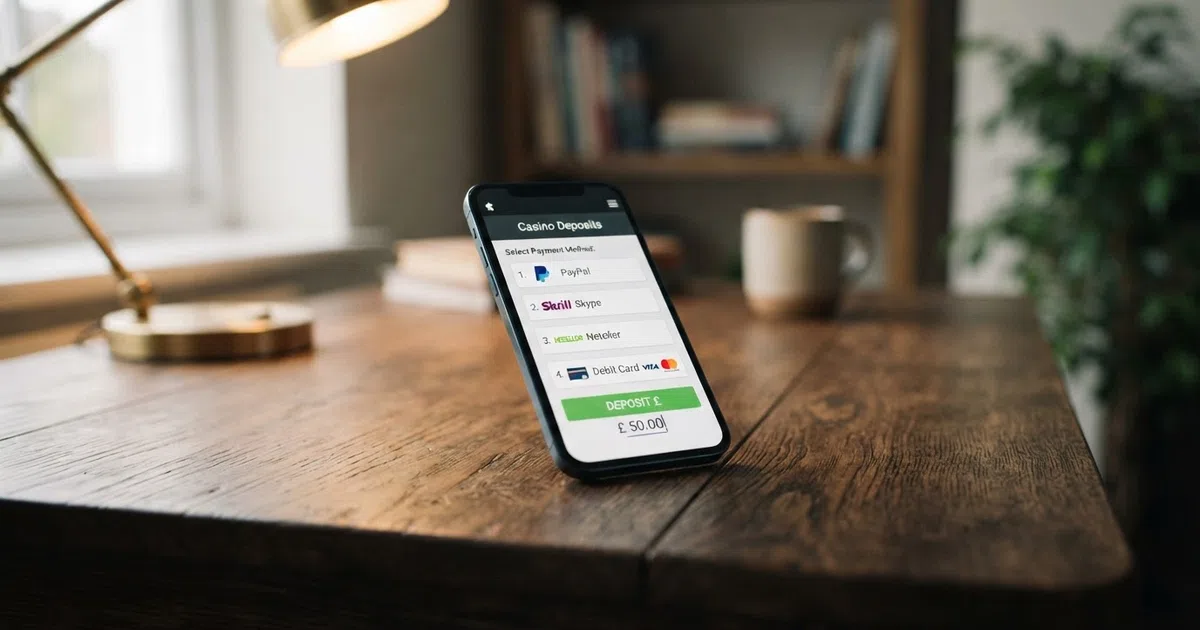
The phrase “e-wallet casino” gets used loosely. To a UK player in 2026, it usually means a Gambling Commission-licensed site that takes PayPal, Skrill or Neteller at the cashier — and that, almost incidentally, refuses to honour the welcome bonus if you actually use one. The split between “PayPal works for the bonus” and “Skrill and Neteller do not” is the single most consequential thing a payment-method choice carries, and most top-10 lists never mention it. This guide does.
It also covers what the e-wallet choice does to your withdrawal time (PayPal lands in hours; debit cards take working days), what it does to your fees when you move money back to a UK bank account (Skrill £5.50, Neteller £10), and what the Gambling Commission’s licence actually protects — including the credit-card-funded-e-wallet rule that has been in force since April 2020 and still catches people out. Ten operators are ranked, every one of them verified against the UKGC public register.
What an e-wallet casino actually is — and why UK players are switching to them
An e-wallet casino is an online casino that accepts deposits and pays withdrawals through a third-party payment account sitting between your bank and the gambling site. The casino never sees your bank details. The e-wallet provider does, and the funds move in seconds rather than over the Faster Payments window or, worse, the cheque-clearing one.
Three e-wallets dominate UK online casino cashier pages: PayPal, Skrill and Neteller. PayPal is the household name — the one most operators list first and the one the welcome bonus terms tend to protect. Skrill and Neteller sit further down the page, owned by the same Paysafe group, and are the methods the same bonus terms tend to exclude. The wider category also includes Trustly (a pay-by-bank method that behaves like an e-wallet for these purposes) and MuchBetter (a Paysafe-owned app-based wallet), but the comparison the rest of this guide runs is PayPal against the Skrill/Neteller pair.
The market these casinos serve is not a niche. The Gambling Commission recorded £1.55 billion in online gross gambling yield for the first quarter of 2026 alone, across 13.4 million monthly active accounts — and that figure sits inside a total GB gambling market of £16.8 billion for the year to March 2025, up 7.3% on the year before. The migration from debit card to e-wallet is one of the quieter shifts inside that growth.
What an e-wallet is — PayPal, Skrill, Neteller and how they work at UK casinos
PayPal is the wallet most UK readers already have. Funding it from a UK bank account or debit card is free; spending from it at a casino is instant on the deposit side and typically lands in one to four hours on the withdrawal side once the casino has approved the cashout. PayPal does not charge UK users a fee to send money in sterling, which is the practical reason it dominates the cashier page.
Skrill and Neteller are siblings — Paysafe Group owns both. They work the same way at the cashier (instant deposit, hours-long withdrawal) but their fee structure differs when you move money back out. Skrill charges £5.50 to withdraw to a UK bank account. Neteller charges USD 10, which converts to roughly £8 depending on the day’s rate. Currency conversion is a separate line item on both: Skrill applies 1.45% above the reference rate, Neteller applies 4.49% — three times the markup, on what is otherwise an identical service. Neither fee is large in absolute terms, but they recur every time you cash out, and they are not advertised at the casino cashier.
The mechanic is the same for all three. The casino never sees your bank details. The e-wallet provider does, and your gambling transactions sit on the e-wallet statement rather than the bank statement. That separation is the practical reason UK players choose e-wallets over a debit card for casino play, beyond the speed.
What this guide covers — and what it does not
This guide is about GB-licensed online casinos — England, Scotland and Wales — that accept PayPal, Skrill or Neteller. Northern Ireland operates under separate, older legislation outside the Gambling Commission’s remit, and a casino licensed for Great Britain is not automatically licensed for Northern Ireland. The accurate term is “GB-licensed”; “UK-licensed” is common market usage and the page uses both.
Crypto wallets and direct bank transfers are out of scope. Trustly and MuchBetter are mentioned where research carries a specific figure but are not ranked alongside the three main wallets. The ten operators ranked below were verified active on the UKGC public register, which was last updated on 12 November 2024.
Why UK players are choosing e-wallets over debit cards
Three reasons recur in the research, in roughly this order of weight. First, withdrawal speed: PayPal typically lands in one to four hours at a major UK operator, against one to five working days for a debit card. That gap is the headline. Second, security of bank details: the casino never receives the player’s card number or sort code, so the attack surface after a data breach is smaller. Third, statement separation: gambling transactions do not appear on the player’s main bank statement, which matters to anyone who shares a bank account, applies for credit, or simply prefers the privacy.
The fourth reason is one most guides do not surface: an e-wallet transaction history is a consolidated spend record. The casino’s own deposit log is one view; the bank statement is another; the e-wallet app sits between them and shows every casino deposit and withdrawal in one place. That view is part of safer gambling in practice, not just in theory.
How e-wallet payments work at UK online casinos — speed, fees and the bonus catch
A deposit takes seconds. A withdrawal takes hours, not days, and arrives through the same e-wallet that funded the account. The casino cashier charges nothing on the way in. The e-wallet provider takes a small cut on the way back to a bank account — and the welcome bonus you intended to claim may already be gone before you realise why.
Which UK casinos accept e-wallet deposits — the full picture
Most UKGC-licensed casinos accept at least one e-wallet for deposits and withdrawals. Among the ten operators ranked in this guide, every single one accepts e-wallets for funding the account. The differences are not in whether the wallet works — it almost always does — but in what it costs the player. Two costs matter: the bonus cost (whether the welcome offer survives an e-wallet deposit) and the payout cost (how long the cashout takes, and what fee the wallet itself charges on the way back to your bank).
PayPal is the closest thing to a universal e-wallet for UK casino cashier pages. Skrill and Neteller are also widely accepted but excluded from welcome bonuses at most operators — a commercial decision, not a UKGC rule. The closed-loop policy is standard across the set: withdrawals must return to the same e-wallet that funded the deposit. Splitting the deposit across two wallets, or cashing out to a bank account while the deposit came from PayPal, is not the path.
How an e-wallet deposit works at a UK casino — and why it takes seconds
Funding an e-wallet from a UK bank account or debit card is straightforward; credit cards are blocked from funding gambling under LCCP licence condition 6.1.2, in force since 14 April 2020, and that block extends to credit-card-funded e-wallet deposits. A player cannot fund Skrill with a credit card and then deposit from Skrill at a casino — the rule reaches through the wallet.
Once the e-wallet is funded, the casino deposit is two clicks: select the wallet at the cashier, authenticate the payment in the wallet’s app or web view. Funds appear in the casino balance immediately. The minimum deposit is typically £10 — PayPal, Skrill and Neteller all sit at £10 across most UK operators, with Paddy Power as the conspicuous exception at £30 for e-wallet deposits specifically.
E-wallet withdrawals — the fastest route to your cash
The closed-loop policy is industry standard across UKGC operators: the withdrawal goes back to the same e-wallet that funded the deposit, not to a different wallet or a bank account. The reasoning is anti-fraud and anti-money-laundering, and it does mean a player who deposits with PayPal cannot cash out to Skrill.
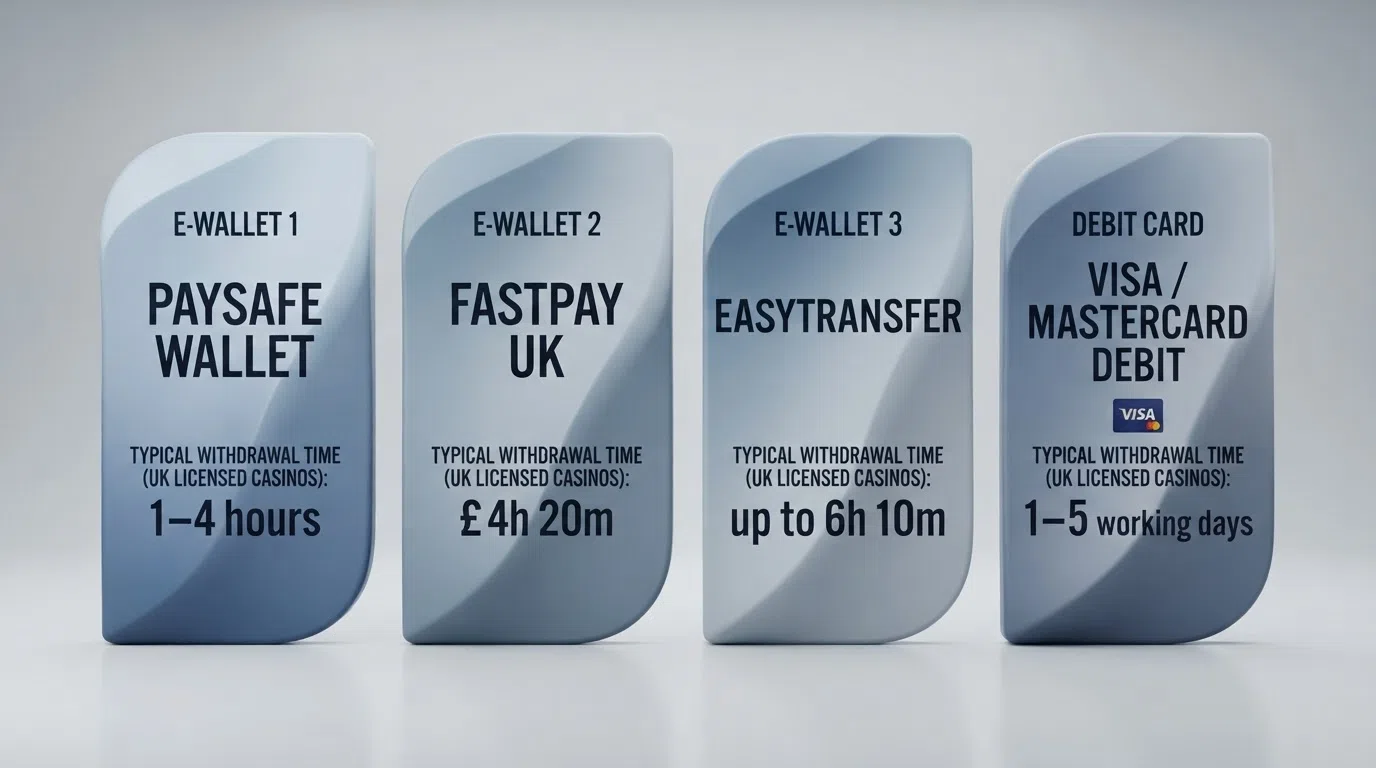
The processing pipeline has two stages. The casino has an approval window — typically a few hours, sometimes less. The e-wallet then receives the funds and either credits them to the wallet balance or sends them onward to a linked bank account. PayPal cashouts at major UK operators typically land in the player’s PayPal balance in one to four hours. Skrill’s median across tested UK operators is four hours twenty minutes. Neteller runs up to six hours ten minutes. Debit cards, by contrast, sit in the casino’s approval window plus the card network’s clearing window, which is one to five working days at the long end.
BoyleSports runs the fastest end of this in the featured set: e-wallet and PayPal withdrawals are instant or within one hour, against a £50,000 daily ceiling and £1.5 million monthly ceiling — the highest withdrawal limits in the set.
Real payout speeds: PayPal vs Skrill vs Neteller vs debit cards
The figures below are tested or operator-claimed withdrawal times for funds landing in the player’s wallet or bank account, after the casino’s approval window.
| E-wallet | Deposit speed | Withdrawal speed (tested or claimed) | Withdrawal fee to UK bank | Currency conversion markup | Bonus eligible at most UK casinos? |
|---|---|---|---|---|---|
| PayPal | Instant | 1–4 hours (bet365, Grosvenor within 15 min, Coral within 1 hour, Betway 1 h 47 min tested) | None for GBP withdrawals | None for GBP | Generally yes |
| Skrill | Instant | Median 4 hours 20 minutes across tested UK operators | £5.50 | 1.45% above reference rate | No — excluded from welcome offers at most UKGC operators |
| Neteller | Instant | Up to 6 hours 10 minutes (tested sample) | USD 10 (≈ £8 depending on rate) | 4.49% above reference rate | No — excluded from welcome offers at most UKGC operators |
| Debit card | Instant | 1–5 working days | None | None | Yes |
The conversion markup column is the one that bites a player who plays in anything other than sterling. A UK player funding a Skrill account in pounds and gambling in pounds pays no conversion markup. A player who plays in euros at an offshore-facing site pays 1.45% on Skrill and 4.49% on Neteller every time money crosses currency — and on a £1,000 withdrawal, that is the difference between £14.50 and £44.90 skimmed off the top before the bank ever sees it.
The bonus column is the one this guide exists to make explicit. PayPal deposits are generally bonus-eligible at UKGC casinos. Skrill and Neteller deposits are excluded from welcome offers at most of them. The exclusion is operator policy, not a Gambling Commission rule, and it sits in the small print of the promotion terms rather than on the cashier page.
The bonus catch: why your e-wallet choice can cost you the welcome offer
Operator promotion terms across the UK almost always read the same way on this point. Skrill and Neteller are listed together as excluded payment methods, often alongside Paysafecard and other prepaid options. PayPal is rarely in that list. Bet365, Sky Vegas, Paddy Power, Coral, BoyleSports, Ladbrokes and 888casino all carry some version of this exclusion in their current terms. Betway is the conspicuous exception in the featured set, having historically kept more e-wallet-friendly bonus terms, though live verification remains wise.
The reason is commercial, not regulatory. E-wallet-only bonus abuse — opening accounts at multiple operators via Skrill, claiming welcome offers, walking away — was common enough in the late 2000s and early 2010s that operators wrote Skrill and Neteller out of their bonus terms as a defence. The UKGC did not require it; the operators chose it, and the choice has stuck.
The workaround is mechanical. Deposit with a debit card, Apple Pay or Pay by Bank to claim the welcome offer — the methods the promotion terms preserve. Claim the bonus. Once the welcome offer has settled and any wagering has cleared, switch to PayPal (or Skrill or Neteller, depending on preference) for ongoing play. The casino will not object, and the e-wallet’s payout speed takes over from that point. Two operators in the featured set still permit the bonus via an e-wallet; for the other eight, this is the path.
E-wallet limits, fees and the minimum-deposit reality
The headline minimum is £10 across PayPal, Skrill and Neteller at most UKGC operators. Paddy Power Games is the outlier: £30 minimum for e-wallet deposits specifically, against a £5 debit-card minimum elsewhere on the same cashier. Anyone used to a £10 wallet deposit will see that gap as the operator actively discouraging small e-wallet top-ups.
There are no casino-side e-wallet deposit fees at any UKGC-licensed operator in this set. The fees live on the wallet side, and they live on the way out, not the way in. Skrill’s £5.50 and Neteller’s USD 10 are charged when money moves from the wallet to a UK bank account. PayPal does not charge UK users to withdraw sterling to a UK bank account, which is the practical reason PayPal dominates this page. Currency conversion markups are the third layer, and they only apply to non-GBP balances.
The 10× wagering cap that came into force on 19 January 2026 changes what “bonus cost” means at the casino end. A welcome offer with 10× wagering on a £100 bonus means £1,000 of qualifying stakes before withdrawal. That ceiling is now uniform across the UK market — there is no longer any operator offering 30×, 40× or 65× wagering, the way several did a year ago. The bonus terms vary; the cap does not.
The best UK e-wallet casinos for 2026 — where your payment method decides the bonus
Ten UKGC-licensed operators, verified active on the Gambling Commission’s public register as last updated on 12 November 2024. They are not ranked by an invented score; they are presented in the order the table below reads, with the e-wallet acceptance and bonus-eligibility columns the deciding factors for most readers.

| Operator | UKGC licence status | Welcome bonus | E-wallets accepted | E-wallet bonus eligible? | E-wallet payout speed | Wagering on bonus |
|---|---|---|---|---|---|---|
| bet365 | Active (account 38721) | Up to 500 free spins at £0.10 each on selected titles | PayPal, Skrill, Neteller (Paysafecard excluded) | PayPal yes (after full ID verification); Skrill/Neteller varies | PayPal 1–4 hours | 0× |
| Sky Vegas | Active (Flutter Entertainment) | 70 no-deposit free spins + 200 free spins after £10 deposit and £10 stake | PayPal, Trustly | No — debit card or Apple Pay required | PayPal within 6 hours | 0× on 200 spins |
| Paddy Power Games | Active (Flutter Entertainment) | 60 no-deposit free spins + 200 deposit-triggered free spins | PayPal, Skrill, Neteller (£30 minimum) | No — debit card, Apple Pay or Pay by Bank only | PayPal 4–24 hours | 0× on 200 spins |
| Betway | Active (Betway Limited) | Stake £10, get 125 no-wagering free spins on Big Bass Hold & Spinner | PayPal, Skrill, Neteller, MuchBetter | Historically more e-wallet-friendly — verify live | PayPal 1 h 47 min (tested) | 0× |
| Coral | Active (Entain group) | 100 free spins at £0.10 after £10 deposit and £10 wager | PayPal, Skrill, Neteller, Paysafecard | No — all four excluded; debit card required | PayPal within 1 hour | 0× |
| BoyleSports | Active | Up to 100 free spins at £0.10–£0.20 | PayPal, Skrill, Neteller | No — Visa, Mastercard, Apple Pay or Google Pay required | Instant or within 1 hour | 0× |
| Grosvenor | Active (Rank Group) | Deposit £20, get £40 bonus + 100 free spins on Big Bass Splash | PayPal, Paysafecard (others vary) | No — PayPal and Paysafecard excluded | PayPal within 15 minutes | 10× |
| Ladbrokes | Active (account 1611, since 1 Jan 2009; remote from 8 Apr 2020) | Opt in, deposit and wager £10, get £30 in casino bonus funds | PayPal, Skrill | No — Visa/MC debit, Apple Pay or Google Pay required | E-wallets 0–24 hours | 10× |
| 888casino | Active (888 UK Limited) | 100% match up to £100, or alternative 100 free spins offer | PayPal, Skrill, Neteller | Skrill and Neteller excluded | Not confirmed | 10× |
| BetMGM | Active (LeoVegas / MGM Resorts International) | 100% match up to £50 + 125–200 free spins | Not confirmed | Not confirmed | Not confirmed | Not confirmed |
The columns the table cannot carry are the ones the prose beside it has to. Two operators in this set — Betway and, in part, bet365 — will let an e-wallet deposit claim some or all of the welcome offer. The other eight require a debit card, Apple Pay, Google Pay or Pay by Bank for the first deposit, after which the e-wallet takes over. That split is the practical shape of the UK e-wallet casino market in 2026, and it is the reason “best e-wallet casino” is a more complicated question than a single ranked list makes it look.
How we evaluated these e-wallet casinos — the criteria that matter
Five criteria ordered the ranking, each tied to what an e-wallet player actually needs at a UK casino. First, e-wallet acceptance breadth — which of PayPal, Skrill, Neteller and other wallets the operator takes for both deposits and withdrawals. Second, e-wallet bonus eligibility — whether the welcome offer survives an e-wallet deposit, or whether the player needs to fund the first deposit with a debit card and switch later. Third, e-wallet payout speed — tested or operator-claimed withdrawal times via PayPal, Skrill or Neteller, with the casino’s own approval window included. Fourth, wagering burden — distinguishing zero-wagering free spin offers from the 10×-capped bonus funds offers, since the latter carry real cost in qualifying stakes. Fifth, UKGC licence standing — verified active on the public register as last updated 12 November 2024, plus the operator’s own track record on payout reliability and complaint handling.
These criteria are weighted qualitatively, not scored. No invented ranking number sits behind the table above. Where two operators are close on most criteria, the e-wallet bonus eligibility column tends to be the deciding factor for most readers.
bet365 — 500 free spins with zero wagering, and PayPal counts for the bonus
bet365 is the standout for e-wallet players in this set, though the bonus terms need reading carefully. The headline is up to 500 free spins across selected titles — Book of Horus, Curse of the Bayou, Magic Forge and Wrath of the Deep — at £0.10 each, with winnings credited as cash to the withdrawable balance rather than as bonus funds. Zero wagering on the spin winnings is the structural advantage: whatever the spin lands, the player keeps.
PayPal is eligible for the welcome offer after full identity verification, which is the line most reviews skip past. The verification is standard — name, address, date of birth — and matches the LCCP requirement that has been in force since 7 May 2019. Once verified, PayPal deposits count for the bonus. Skrill and Neteller eligibility varies by current promotion terms; the safer route is a debit card for the first deposit. PayPal withdrawals typically land within one to four hours once bet365 approves the cashout.
The minimum deposit is £10 lifetime deposits — a low bar. Paysafecard is excluded from the welcome offer outright. The free spins expire seven days from issue; the offer itself must be claimed within 30 days of registration. bet365 is licensed by the Gambling Commission under account 38721 (Hillside (UK Gaming) ENC), active at the register’s last update.
Sky Vegas — 70 no-deposit spins, but e-wallets miss the welcome offer
Sky Vegas runs a genuine no-deposit entry point — 70 free spins credited on registration with no funding required — followed by 200 more spins after a £10 deposit and a £10 stake on selected games. The 200 deposit-triggered spins carry zero wagering on winnings, which puts Sky Vegas in the same structural bracket as bet365, Coral and Betway on this point. The 70 no-deposit spins carry their own terms; readers should check current conditions before treating them as withdrawable cash from minute one.
The bonus-eligibility line is the one that bites. PayPal and Trustly are accepted for deposits and play, but neither qualifies the deposit for the welcome offer. Debit card or Apple Pay is the route to the 200 spins. Once the welcome offer has settled, the casino does not object to PayPal deposits for ongoing play. PayPal withdrawals typically land within six hours.
The Sky Vegas UKGC licence sits inside Flutter Entertainment, active on the public register as at the last update. Free spin validity is seven days from issue.
Paddy Power Games — 60 no-deposit spins plus 200 more, e-wallets for play only
Paddy Power Games pairs a 60 no-deposit free spin entry with 200 deposit-triggered spins, again at zero wagering on the 200. The structure mirrors Sky Vegas, which is unsurprising given the shared Flutter ownership. PayPal, Skrill and Neteller are all accepted for deposits and play — but the bonus requires a debit card, Apple Pay or Pay by Bank deposit, and the three e-wallets sit in the operator’s excluded list.
The line that catches readers off guard is the minimum deposit: £30 for e-wallet deposits at Paddy Power Games, against a £5 debit-card minimum elsewhere on the cashier. That £30 floor is not a casino-industry norm; it is a Paddy Power Games-specific choice, and it is worth knowing before the first deposit. PayPal withdrawals typically settle in four to twenty-four hours. The Paddy Power Games UKGC licence sits inside Flutter Entertainment, active on the public register.
Betway — 125 no-wagering spins and one of the few e-wallet-friendly bonus policies
Betway is one of the two operators in the featured set where an e-wallet deposit has a realistic chance of qualifying for the welcome offer. The headline is straightforward: stake £10 on selected games and receive 125 free spins on Big Bass Hold & Spinner, valued at £0.10 each, with zero wagering on winnings. That puts the offer on the same no-wagering footing as bet365, Sky Vegas and Paddy Power on the deposit-triggered spins.
What sets Betway apart is the e-wallet acceptance list. PayPal, Skrill, Neteller and MuchBetter are all in, and the operator’s historical bonus terms have been more permissive on e-wallet deposits than most of the set. Live verification before depositing remains sensible — promotion terms do change — but the structure is friendlier to a player who wants to use their e-wallet from the first deposit rather than route through a debit card. PayPal withdrawals were tested at one hour forty-seven minutes at Betway, which is among the faster in the set.
Betway Limited holds an active UKGC licence as at the public register’s last update. The bonus validity on the spin package was not confirmed this run and should be checked against current terms.
Coral — 100 no-wagering spins and sub-one-hour PayPal cashouts
Coral’s headline is 100 free spins at £0.10 each, credited after a £10 deposit and a £10 wager on selected games. Winnings are paid in cash with zero wagering, putting Coral in the no-wagering group with bet365, Sky Vegas, Paddy Power Games and Betway. The seven-day expiry on the spins is the constraint.
The payout speed is where Coral stands out. PayPal withdrawals settle within one hour at Coral, against one to three working days for debit cards. That is the fastest tested in the featured set after Grosvenor’s fifteen minutes, and it makes Coral a strong fit for a player prioritising cashout time. The trade-off is the bonus exclusion: Neteller, Skrill, PayPal and Paysafecard are all excluded from the welcome offer. A debit card deposit is required to claim the spins.
Coral sits inside the Entain group, alongside Ladbrokes, and holds an active UKGC licence on the public register.
BoyleSports — up to 100 no-wagering spins with instant e-wallet withdrawals
BoyleSports carries up to 100 free spins at £0.10 to £0.20 each, with zero wagering on winnings. The 72-hour window to use the spins is the shortest in the featured set — a real constraint for a casual player — but the rest of the offer is competitive. PayPal, Skrill and Neteller are all accepted for deposits and play, and withdrawals via e-wallet or PayPal are instant or within one hour, against debit cards’ up-to-five-working-days baseline.
The withdrawal limits are the highest in the set: £50,000 per day and £1.5 million per month. For a player who has won meaningfully and wants the funds out quickly, those ceilings matter. The bonus exclusion follows the same pattern as most of the set: Visa, Mastercard, Apple Pay or Google Pay required for the welcome offer; e-wallets excluded.
BoyleSports holds an active UKGC licence as at the register’s last update.
Grosvenor — £40 bonus and 15-minute PayPal withdrawals, but the e-wallet skips the offer
Grosvenor’s offer is a deposit-triggered package rather than a free-spin headline: deposit £20, receive £40 in casino bonus plus 100 free spins on Big Bass Splash, with 10× wagering on both the bonus funds and the spin winnings. That 10× sits at the UK regulatory cap introduced on 19 January 2026 — Grosvenor is at the ceiling rather than under it, and a player should price in the qualifying-stakes cost before opting in. On a £40 bonus, 10× wagering means £400 of qualifying stakes before withdrawal.
The payout speed is the fastest tested anywhere on this page: PayPal withdrawals at Grosvenor settle within fifteen minutes. The trade-off is the bonus exclusion. PayPal and Paysafecard deposits are excluded from the welcome offer — a debit card is required. Grosvenor sits inside the Rank Group and holds an active UKGC licence.
Ladbrokes — £30 in bonus funds at the 10× cap, with PayPal accepted for play
Ladbrokes runs a bonus-funds offer rather than a free-spin package: opt in, deposit and wager £10 on selected games, receive £30 in casino bonus funds. Wagering is 10× at the regulatory cap, with a 30-day expiry on the bonus — the tightest combination of cap and expiry in the set for a bonus-funds offer. Free spins may appear in some offer variants; the current terms should be checked live.
PayPal and Skrill are accepted for deposits and play, with a £10 minimum for PayPal. The bonus requires a Visa or Mastercard debit, Apple Pay or Google Pay deposit — e-wallets are excluded from welcome offers. E-wallet withdrawals settle in zero to twenty-four hours. Ladbrokes Betting & Gaming Limited holds UKGC account 1611, active since 1 January 2009 (non-remote); the remote ancillary licence has been active since 8 April 2020.
888casino — 100% match to £100 with the full 10× wagering, Skrill and Neteller excluded
888casino is the only percentage-match offer in the featured set, and it is the one with the longest wagering window: 100% match up to £100 on first deposit, 10× wagering on the bonus amount within 90 days. The bonus must be claimed within 48 hours of deposit, which is the tightest claim window in the set — a player who waits three days has missed it.
On a £100 bonus, 10× wagering means £1,000 of qualifying stakes, spread across up to 90 days. That is the lowest per-day wagering burden in the percentage-match group, even though the absolute turnover is the highest. The alternative offer — 100 free spins on selected Pragmatic Play slots after a £10 deposit and £10 stake — carries a £300 maximum promotional withdrawal and a seven-day spin expiry.
PayPal, Skrill and Neteller are all accepted for deposits, but Skrill and Neteller are excluded from the welcome offer. PayPal eligibility is preserved. 888casino sits inside 888 UK Limited (the evoke group), active on the UKGC public register. The e-wallet payout speed was not confirmed this run and should be checked against current terms.
BetMGM — 100% match and up to 200 free spins from the MGM-backed newcomer
BetMGM is the newest UK-facing brand in the featured set, backed by MGM Resorts International through the LeoVegas platform. The headline is a 100% match up to £50 plus 125 to 200 free spins, with the spin count depending on the current offer variant — up to 200 free spins on Big Bass Splash in the higher tier.
Several fields that other operators in this set carry as confirmed research figures are not confirmed for BetMGM this run: wagering multiplier, bonus validity, e-wallet acceptance list, e-wallet bonus eligibility and payout speed. The structural picture is that BetMGM holds an active UKGC licence through the LeoVegas / MGM Resorts International arrangement, and the welcome package is competitive on the headline. Live verification of the bonus terms before depositing is essential, particularly on the e-wallet bonus eligibility line, which is the decisive factor for an e-wallet-first reader.
Are e-wallet casinos legal in the UK? What your Gambling Commission licence actually protects
Every operator in this guide is licensed by the UK Gambling Commission under the Gambling Act 2005. The licence is not a marketing badge. It is a statutory permission to offer remote gambling to customers in Great Britain, conditioned on a set of licence conditions and codes of practice that the Commission enforces. The e-wallet mechanic sits inside that framework, and three of its rules reach directly into how an e-wallet player uses a UK casino: the identity-verification requirement, the credit-card ban and the bonus-term restrictions the Commission does not impose but operators choose to write.
The UK Gambling Commission licence — what it means for your e-wallet play
The UK Gambling Commission is an executive non-departmental public body sponsored by the Department for Culture, Media and Sport. It licenses operators under the Gambling Act 2005, with remote (online) gambling brought under its authority by the Gambling (Licensing and Advertising) Act 2014 — the point-of-consumption reform that ended the previous regime in which an operator licensed anywhere in the EEA could take UK customers without a UK licence.
Section 1 of the Gambling Act sets three licensing objectives that every licensed operator must pursue: preventing gambling from being a source of crime or disorder, ensuring gambling is conducted in a fair and open way, and protecting children and other vulnerable persons from being harmed or exploited by gambling. Those objectives are not decorative; they are the standards against which the Commission assesses an operator’s fitness to hold a licence and against which it can take enforcement action.
A GB licence covers England, Scotland and Wales. Northern Ireland operates under separate, older legislation outside the Commission’s remit. The accurate term is “GB-licensed”; “UK-licensed” is common usage, including in this guide. A player can verify any operator’s licence status on the Commission’s public register, which was last updated on 12 November 2024 — bet365 sits under account 38721 and Ladbrokes under account 1611, both active.
E-wallet KYC — proving you own the account before you can withdraw
The identity-verification rule has been in force since 7 May 2019 under LCCP condition 17.1.1: a GB remote licensee must verify a customer’s name, address and date of birth before the customer can deposit funds or gamble. Verification happens before the first deposit, not at withdrawal — a player who reaches the cashier without verification will be blocked from funding the account.
The e-wallet adds a second layer. The casino may require a screenshot of the e-wallet account showing the account holder’s name and the email address linked to the wallet, to confirm that the payment method belongs to the player and not to a third party funding the account on the player’s behalf. The Commission’s rules do not require the payment instrument to be in the player’s own name, but Money Laundering Regulations and source-of-funds checks apply in practice. The screenshot request is the operational form those checks take at the cashier.
A player who verifies the e-wallet ownership before the first withdrawal — by submitting the screenshot proactively, rather than waiting for the cashier to ask — saves the document-request stall that holds up a first cashout at most operators.
The credit card ban and e-wallets — why you cannot fund Skrill with a credit card and gamble
LCCP licence condition 6.1.2 has prohibited GB-licensed operators from accepting credit card payments for gambling since 14 April 2020. The ban extends explicitly to credit-card-funded payments routed through an e-wallet: funding Skrill, Neteller or PayPal with a credit card and then depositing from the wallet at a casino is prohibited, because the underlying source of the funds is a credit card.
This is a Gambling Commission rule, not an e-wallet restriction. PayPal, Skrill and Neteller will happily receive a credit-card funding in non-gambling contexts; the rule sits at the casino end, where the operator must verify that the player’s deposit cannot be traced back to a credit card. Debit-card-funded e-wallet deposits remain fully permitted. A player who tries to fund a casino account via a credit-card-funded e-wallet will see the deposit blocked at the casino cashier, regardless of what the e-wallet’s own terms allow.
The Commission’s enforcement posture is disruption rather than blocking. Between April 2024 and June 2025 it issued 3,140 disruption notices and referred 447,778 URLs to search engines for unlicensed offshore gambling sites. Court-ordered ISP blocking powers have been proposed but not yet enacted; the Commission’s current tools are administrative.
What a UK licence does not cover — and the offshore sites that exploit the gaps
Northern Ireland runs on separate, older gambling law outside the Commission’s remit. A GB-licensed casino is not licensed for Northern Ireland customers, and a Northern Ireland-facing casino requires a separate licence under different legislation. The phrase “UK-licensed” is shorthand; the legal scope is Great Britain.
Offshore unlicensed operators are a different matter. Providing gambling facilities to customers in Great Britain without a Commission licence is a criminal offence under section 33 of the Gambling Act 2005 — up to 51 weeks’ imprisonment, an unlimited fine, or both. The Commission’s current response is disruption: referring URLs to search engines, issuing cease-and-desist notices, working with payment providers to cut off processing. ISP-level blocking of unlicensed sites has been proposed in legislation but is not yet enacted. A player who chooses an offshore site loses the Commission’s dispute resolution, the GAMSTOP self-exclusion, the source-of-funds protections and the consumer recourse that come with a GB licence. The bonuses on offer are typically larger for exactly that reason — the operator is not paying for a licence, for dispute resolution infrastructure, or for the safer-gambling tooling the Commission mandates.
GAMSTOP is the Commission’s national self-exclusion scheme. Participation has been mandatory for every GB-licensed online operator since 31 March 2020, and a player registered with GAMSTOP cannot open an account or place a bet at any GB-licensed online operator for the duration of the exclusion. Exclusion periods are six months, one year, five years, or five years with auto-renewal; an exclusion cannot be cancelled early.
Safer gambling with an e-wallet — the tools most UK players never use
The e-wallet is a payment tool. The safer-gambling tools live at the casino and at the regulator. The two are not the same, and a player who treats the e-wallet as the only safeguard is reading the wrong document.
Deposit limits — setting your own cap before you fund an e-wallet account
From 1 October 2025, every GB-licensed operator must prompt a customer to set a financial limit before the customer’s first deposit. The limit is the player’s choice, not the operator’s, but the prompt is mandatory and the casino cannot let the first deposit through without one having been set. From 30 September 2026, the terminology tightens: only a gross deposit limit — based solely on money paid into the account over a set period — may be called a “deposit limit” (RTS 12B). The word “spend limit” is being replaced with “stake limit” for customer clarity.
Decreases to a deposit limit are actioned immediately. A player who drops their daily limit from £200 to £50 sees the new limit in force within minutes; the casino does not get a cooling-off period on a downward change. Increases carry a 24-hour or seven-day confirmation window depending on the change, designed to prevent a player from raising a limit in the heat of a session and reversing it an hour later.
Financial vulnerability checks sit alongside the deposit-limit framework. Under LCCP SR Code 3.4.4, operators must conduct a light-touch check at a £150 net deposit threshold in a rolling 30-day period, in force since 28 February 2025. The check is a conversation, not a credit check, and it triggers a check-in rather than an account block. More detailed financial risk assessments have been announced but not yet commenced; the published stage 1 thresholds are £5,000 net deposits in 24 hours for players aged 25 and over and £2,500 for under-25s, with final thresholds of £1,000 to £3,000 and £750 to £2,000 respectively.
An e-wallet does not bypass any of these limits. The deposit limit sits on the casino account, not on the funding source. A player who sets a £50 daily deposit limit cannot deposit £100 via PayPal just because the casino never sees the underlying bank account.
GAMSTOP, GamCare and the tools that actually block e-wallet gambling
GAMSTOP is the national self-exclusion scheme for Great Britain. Registration blocks the player from opening accounts or placing bets at every GB-licensed online operator for the chosen exclusion period. The periods are six months, one year, five years, or five years with auto-renewal; an exclusion cannot be cancelled early, regardless of how the player’s circumstances change during the period. Self-exclusion covers the person, not the payment method — registering with GAMSTOP blocks play regardless of which e-wallet the player would otherwise use.
GamCare runs the National Gambling Helpline on 0808 8020 133 and provides face-to-face treatment across Great Britain. GambleAware, now funded through the statutory levy, treats clients through its National Gambling Support Network — 11,960 clients in the year to March 2025, up 11% on the prior year. The statutory levy, in force from 6 April 2025, takes 1.1% of operators’ gross gambling yield for remote casino, bingo and general betting licences, with the proceeds split 50% towards treatment, 30% towards prevention and 20% towards research.
NHS gambling harm clinics are expanding across England, Scotland and Wales. The NHS National Problem Gambling Service and the NHS Northern Gambling Service cover different geographies; both are part of the same harm-reduction infrastructure and accept self-referral. Gamblers Anonymous runs peer-support meetings across the UK. None of these is an e-wallet-specific service; all of them apply to a player using an e-wallet in exactly the same way as to a player funding from a debit card.
Tracking your spend — why your e-wallet history is a built-in reality check
The e-wallet transaction history is a consolidated spend record that most players overlook. Every casino deposit and every withdrawal sits in the wallet’s app, timestamped and totalled, in a single view that neither the casino’s deposit log nor the bank statement gives. A player who treats the e-wallet as the primary funding source for casino play has, in effect, a built-in gambling spend tracker — not because the wallet was designed for that purpose, but because every transaction is logged in one place.
The Commission’s mandatory reality check runs alongside the player’s own tracking. From 31 October 2021, every GB-licensed operator must display total losses, total wins and time played during slots sessions. The display is not optional and not dismissible as marketing — it is a Commission requirement.
The prevalence figures behind the safer-gambling infrastructure are worth knowing. The most recent UK Government estimate puts problem gambling among adults in England at 0.5%, with a further 3.8% at elevated risk. An estimated 7% of the British population are negatively affected by someone else’s gambling, and an estimated 2 million children may live in households with adults experiencing problem gambling. Treatment demand has risen sharply: 30% of adults with gambling problems now say they want treatment or support, against 17% in 2020. Those figures do not argue for or against e-wallets; they argue for the safer-gambling framework the Commission mandates, which applies to e-wallet play exactly as it applies to debit-card play.
How we chose and ranked these e-wallet casinos
Every operator in this guide was verified active on the UK Gambling Commission’s public register as last updated on 12 November 2024. The verification covered licence account number, operating company and active status. Two operators in the set — bet365 under account 38721 and Ladbrokes under account 1611 — have long, dated licence histories; the rest were confirmed through the same register check.
Operator-specific data — welcome bonus terms, e-wallet acceptance, payout speed, wagering multipliers and bonus validity — was sourced from operator websites and cross-referenced against multiple affiliate sources. Where two sources disagreed on a current term, the operator’s own website was treated as the primary source. Where research did not confirm a figure (e-wallet payout speed for 888casino and BetMGM, wagering multiplier and bonus validity for BetMGM), the table above carries that gap rather than a fabricated value. The reader who wants the live term should check the operator’s promotion page before depositing.
E-wallet comparison data — withdrawal fees, currency conversion markups, bonus exclusion patterns — was drawn from multiple affiliate sources and cross-referenced with operator terms where research carried them. The Skrill £5.50 and Neteller USD 10 fees, and the 1.45% and 4.49% conversion markups, are quoted as research states them; the e-wallet providers’ own published fee schedules were not independently re-verified for this guide. The credit-card ban extension to credit-card-funded e-wallets, the deposit-limit framework and the wagering cap are all Commission rules and are quoted as such, with dates attached.
The ranking criteria — e-wallet acceptance breadth, e-wallet bonus eligibility, payout speed, wagering burden and licence standing — were weighted qualitatively rather than scored. No composite ranking number sits behind the table; the order reflects the practical priority an e-wallet-first reader is likely to bring to the comparison. A player who prioritises the welcome offer above payout speed will read the table differently from a player who prioritises withdrawal speed above the bonus, and the prose beside each operator tries to make that trade-off visible.
E-wallets at UK casinos: the calls that actually save you time and money in 2026
PayPal is the pragmatic default for a UK e-wallet casino player in 2026. It is bonus-eligible at most operators in this set, withdrawal times are the fastest of the three main wallets, and there is no e-wallet-to-bank fee for sterling withdrawals. The currency-conversion markup that bites Skrill and Neteller users does not bite PayPal users playing in pounds. The case for PayPal is structural, not preferential.
For players whose preferred casino excludes e-wallets from the welcome bonus, the mechanical workaround is to deposit with a debit card for the first funding round — claim the welcome offer — and switch to the e-wallet for every subsequent deposit. The casino will not object once the welcome offer has settled, and the e-wallet’s payout speed takes over from that point. The bonus exclusion is a one-time cost at sign-up, not an ongoing penalty. Skrill and Neteller remain strong choices for ongoing play at the operators that accept them; the bonus exclusion is the friction, and a player who knows it in advance is not losing anything by choosing them.
Verification is the step most first-time e-wallet players delay, and it is the step that costs them time at the first withdrawal. Submitting the e-wallet ownership screenshot — name and linked email — before the first cashout removes the document-request stall that holds up payouts at most operators. The verification is required under LCCP condition 17.1.1, in force since 7 May 2019, and the casino will ask for it eventually. A player who volunteers it on day one is not losing anything.
The UK regulatory framework protects the player regardless of payment method. The 10× wagering cap, in force from 19 January 2026, sets a ceiling on bonus cost. The deposit-limit framework, mandatory from 1 October 2025 and tightening from 30 September 2026, gives the player a lever they can pull downward immediately. GAMSTOP blocks play across every GB-licensed operator at once, with an exclusion the player cannot cancel early. The statutory levy, in force from 6 April 2025, funds treatment and prevention at a scale the previous voluntary contributions never reached. The e-wallet is a tool — a fast, private, statement-separating tool — but it is not a loophole, and a player who treats it as one is reading the wrong document.
Frequently asked questions
Can I use PayPal to deposit and claim a welcome bonus at UK casinos?
Yes, at most GB-licensed operators. PayPal deposits are generally bonus-eligible, in contrast to Skrill and Neteller, which are excluded from welcome offers at most UKGC casinos. PayPal withdrawals typically settle within one to four hours once the casino approves the cashout.
Why are Skrill and Neteller deposits excluded from bonuses at most UK casinos?
It is a commercial operator decision, not a Gambling Commission rule. Skrill and Neteller were historically associated with bonus abuse — opening accounts across multiple operators, claiming welcome offers and withdrawing — which led most UK casinos to write them out of their bonus terms. The exclusion sits in each operator’s promotion small print.
What is the minimum deposit via e-wallet at UK casinos?
Typically £10 across PayPal, Skrill and Neteller at most GB-licensed operators. Paddy Power Games is the conspicuous outlier, with a £30 minimum specifically for e-wallet deposits. The minimum sits on the casino side and is independent of any minimum the e-wallet provider itself imposes.
Can I use a credit card to fund my e-wallet for casino deposits in the UK?
No. LCCP licence condition 6.1.2, in force since 14 April 2020, prohibits GB-licensed operators from accepting credit card payments for gambling and explicitly extends the ban to credit-card-funded payments routed through an e-wallet. Debit-card-funded e-wallet deposits remain fully permitted.
What are the best e-wallet options for UK casino players — PayPal, Skrill, or Neteller?
PayPal is the most broadly accepted, generally bonus-eligible and free for sterling withdrawals to UK bank accounts, making it the practical default. Skrill and Neteller offer similar deposit and withdrawal speeds but charge £5.50 and USD 10 respectively on withdrawals to a UK bank, plus a currency conversion markup on non-GBP balances, and are typically excluded from welcome bonuses.
Payments – nominimumdeposit-casinos-uk
Content created by the «nominimumdeposit-casinos-uk» team