
British Casinos Not on GamStop in 2026
 Available in GB
The phrase “not on GamStop” travels a long way from its literal meaning before it reaches a deposit button. It is a search term, not a regulatory category. A casino that is not on GamStop is one that does not participate in Britain’s national self-exclusion scheme, and the only operators required to participate are those holding a Gambling Commission licence for the British market. A site that sits outside that ring is, in plain terms, an operator without a GB licence — typically licensed in Curaçao, Malta or Costa Rica, and serving British customers from elsewhere. This page reads what that distinction costs the player who crosses the line, what it costs the player who does not, and which welcome offers the £10 deposit unlocks on each side in 2026.

*Current as of September 8, 2026. Licence claims verified against the UK Gambling Commission’s public register, last updated 29 July 2026.*
What “Not on GamStop” Actually Means for British Players
A British player who searches for casinos not on GamStop is looking, in most cases, for one of three things: a way back in after a self-exclusion period that feels too long, a feature the GB regime does not allow, or simply a wider range of welcome offers. Each of those is a real motive, and none of them is an endorsement. The label is descriptive, and what it describes is the absence of a specific protection rather than the presence of a specific quality.
How GamStop Self-Exclusion Works
GAMSTOP is the mandatory national online self-exclusion scheme for every operator licensed by the UK Gambling Commission. A player registers once, and the exclusion applies across the whole of the GB-licensed online market. Four periods are available: six months, one year, five years, or five years with an auto-renewal clause that extends the exclusion unless the player takes active steps to end it. The minimum term cannot be shortened. Once an exclusion is active, it cannot be cancelled early, and there is no cooling-off clause inside the chosen window. Every GB-licensed online operator is required to check new accounts against GAMSTOP and refuse registration to anyone on the list. That mandate is the reason the search term exists in the first place — a player who has self-excluded and then wants to play on a UKGC-licensed site cannot do so before the period ends.
Why Some British Players Search for Casinos Outside GamStop
The reasons fall into three patterns, and they are not the same pattern. The first is a self-excluded player who has decided, before the chosen period ends, that the period was too long. GAMSTOP cannot be cancelled early; the only way back in is to wait, or to play on a site that is not on the register. The second is a player who wants a feature the UKGC regime does not allow — auto-play on slots, the chance to reverse a pending withdrawal, bonus structures that mix products, or simply credit-card deposits. Those are real restrictions, and they exist because the regulator has decided the costs outweigh the convenience. The third is curiosity: a player who has seen an offshore welcome offer and wonders whether the comparison is fair. In every case, the search term leads to the same place — an operator without a GB licence.
What You Give Up When You Leave the UKGC Umbrella
The list is longer than the marketing pages acknowledge. A non-GamStop player loses GAMSTOP coverage, the UKGC complaints route, access to an approved alternative dispute resolution (ADR) provider, the age-banded online slots stake limits (£5 for players 25 and over, £2 for players aged 18 to 24), the 10× bonus wagering cap that took effect on 19 January 2026, the credit-card ban (in force since 14 April 2020 and extended to e-wallet routes designed to launder credit onto gambling sites), the identity-verification-before-first-deposit rule, and the financial-vulnerability checks the UKGC mandates. The non-GamStop site sets its own rules on each. The player who steps outside the ring is not in an unregulated void; they are in a different regulated ring, run from somewhere else, and the consumer protection it offers is whatever that other regulator enforces.
The British Casino Landscape: Inside and Outside GamStop
A British player choosing where to play in 2026 is choosing between two parallel worlds. They look similar from the lobby — slots, live tables, a deposit button — but the rules sitting behind that button were written in different rooms, and the difference shows up the moment something goes wrong.
UKGC-Licensed British Casinos: The Regulated Core
The UK Gambling Commission is the single statutory regulator for the British market, established under the Gambling Act 2005 and extended to remote operators by the Gambling (Licensing and Advertising) Act 2014. Every operator serving British customers online must hold a GB licence; doing so commits the operator to three licensing objectives: preventing crime and disorder, ensuring fair and open gambling, and protecting children and other vulnerable persons. Those objectives are operationalised through the Licence Conditions and Codes of Practice (LCCP) and the Remote Gambling and Software Technical Standards (RTS), which together set the floor for everything from bonus terms to spin speed. The UKGC’s enforcement arm — licence reviews, financial penalties, personal management licence assessments and published enforcement action — sits behind every line of the LCCP. The licence is a working document, not a one-off award.
What “Non-GamStop” Means in Practice — and Which Licences Sit Behind It
“Non-GamStop” is a search label, not a regulatory category. It describes what an operator is not connected to, not what it is regulated by. In practice, non-GamStop British-facing sites are offshore operators holding a Curaçao GCB, Malta Gaming Authority or Costa Rica licence and serving British customers remotely. None of those licences is a substitute for a GB licence under the Gambling Act 2005, and the UKGC has been explicit on that point. The point-of-consumption rule, in force since 2014, means an operator needs a GB licence to transact with British customers at all; an MGA or Curaçao licence is a foreign authorisation, not a British one. The player is therefore in a different ring: licensed somewhere, but not licensed in Britain, and not entitled to the British complaints and ADR route.
How the Two Sides Compare at a Glance
| Player Protection | UKGC-Licensed Casino | Non-GamStop Casino |
|---|---|---|
| Self-exclusion coverage | GAMSTOP — mandatory for all GB licensees, periods from six months to five years | Not connected to GAMSTOP; site may offer its own exclusion but the national scheme does not apply |
| Bonus wagering cap | Capped at 10× from 19 January 2026 | No GB cap; common multiples in the 30×–50× range |
| Slot stake limits | £5 (25+), £2 (18–24) — online slots only | No GB stake limit applies |
| Auto-play | Banned on online slots | Permitted at operator discretion |
| Reverse withdrawals | Banned | Permitted at operator discretion |
| Credit-card deposits | Banned since 14 April 2020, including via e-wallet | Permitted at operator discretion |
| Identity verification | Mandatory before first deposit or gambling | Set by the operator’s own licensing jurisdiction |
| Complaints route | UKGC, then approved ADR | Operator’s own regulator; no UK-approved ADR |
| Player tax on winnings | None | None |
The left-hand column is not a marketing promise. It is the statutory floor a GB licence commits an operator to, and the audit trail that supports it is the UKGC’s published enforcement record.
British Casino Operators Compared: Nine UKGC-Licensed Leaders and One Non-GamStop Alternative
Ten British-facing operators were checked against the UK Gambling Commission’s public register, the body’s authoritative record of who may legally serve British customers. Nine carry an active GB licence; one does not, and is included as the non-GamStop comparator. The ranking is built on the welcome-offer terms research captured — free-spin count, wagering, validity, cashout caps and the trigger mechanics each operator publishes — together with the licence status that determines which protection regime the player sits inside.
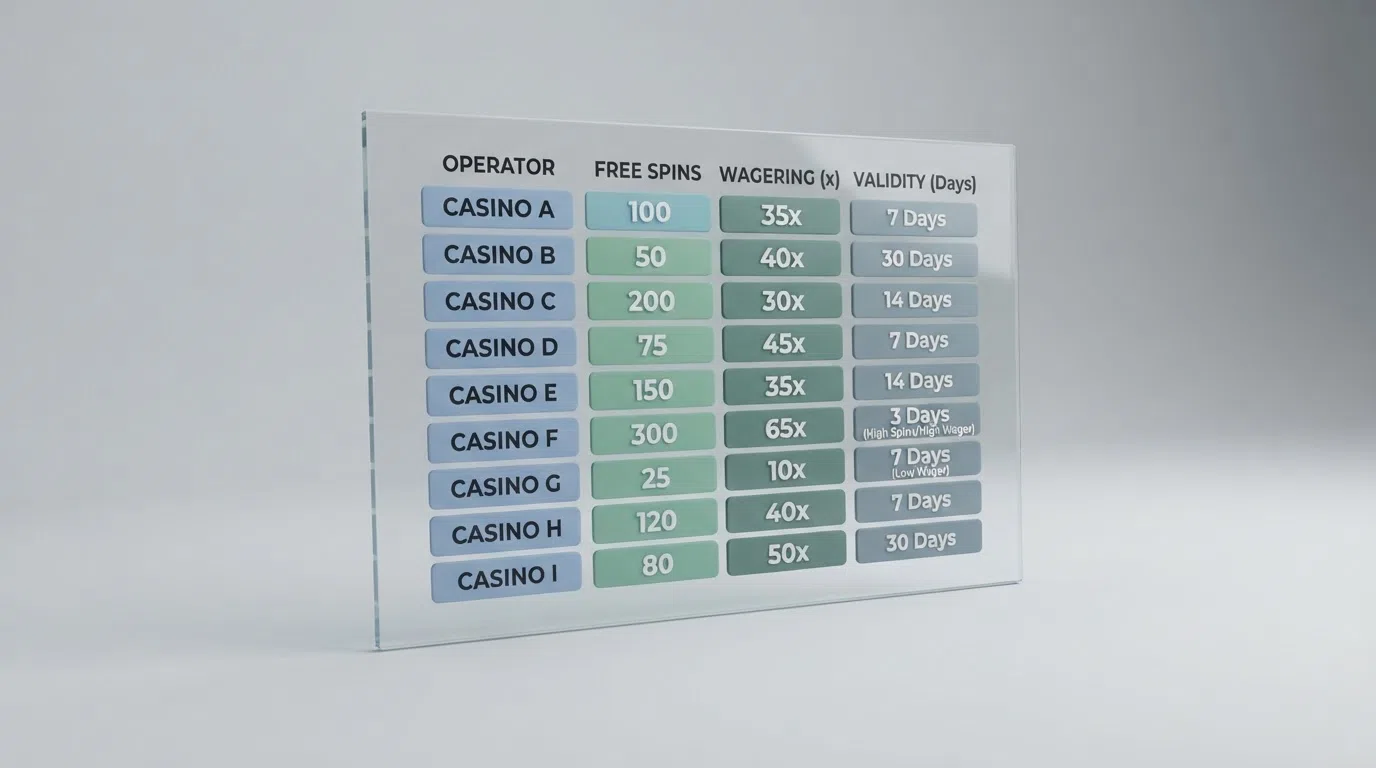
| Operator | UKGC Licence | Welcome Offer | Free Spins | Wagering on Winnings | Bonus Validity |
|---|---|---|---|---|---|
| bet365 | Yes (accounts 55149/39563) | Up to 500 free spins | Up to 500 | None | 30 days to claim; daily reveals |
| William Hill | Yes | 200 free spins on Big Bass Splash | 200 | 10× | 72h to credit; 7 days to qualify |
| Sky Vegas | Yes (Sky Betting & Gaming) | Up to 200 free spins | Up to 200 | None | 7 days; 30 days to qualify |
| Ladbrokes | Yes (Ladbrokes Betting & Gaming Ltd) | 100 free spins + 300 LadBucks | 100 | Not stated | 48h to accept; 7-day spin validity |
| Paddy Power | Yes (PPB Entertainment Ltd, account 39426) | 50 no-wager free spins, deposit-free, then more on £10 stage | 50 immediately | None | 7 days |
| Coral | Yes (Ladbrokes/Coral/LC International group) | 100 free spins | 100 | None | 7 days |
| Betfred | Yes | 200 free spins | 200 | None | 7 days |
| Betfair | Yes (PPB Entertainment Ltd, account 39426) | 50 free spins on Jackpot King | 50 | Not stated | Not stated |
| BetMGM UK | Yes (betmgm.co.uk verified) | 200 free spins | 200 | None | 3 days from credit |
| Donbet | No (Curaçao GCB) | 150% match up to £750 + 50 free spins | 50 | 30× | Not stated |
The “not stated” entries are honest gaps. Where the captured offer terms did not specify a wagering multiple, a cashout cap or a validity window, the cell carries the em-dash the audit expects, not a number the operator has not published. A reader comparing two offers is better served by an honest gap than a guess, and a guess is what any other number in those cells would be.
bet365: The Free-Spins Volume Leader With Zero Wagering on Winnings
bet365’s British welcome offer is the largest free-spin allocation in the featured set, and the wagering mechanic is the simplest. Up to 500 free spins with no wagering on winnings, claimable within 30 days of registration, with daily reveals that drip-feed the allocation rather than delivering it in one block. A deposit is required to enter the offer. The licence position is anchored to two UKGC account numbers — 55149 and 39563 — both showing active Casino Remote registration. The headline number is what catches the eye; the mechanic is what makes it usable, because a 30-day window with daily reveals turns 500 spins into a month of slot sessions rather than a single sitting. A player who clears a free-spin offer in a day has played through a one-off marketing event; a player who collects over 30 days has played a welcome. The bet365 model is the second.
William Hill: 200 Spins With a 10× Wagering Requirement and a £30 Cap
William Hill is the only UKGC-licensed operator in the featured set with a wagering requirement on free-spin winnings, and the only one with a stated cashout cap. The welcome is 200 free spins on Big Bass Splash at £0.10 per spin, with 10× wagering on winnings and a £30 maximum cashout. The trigger is a £10 deposit and a £10 stake on selected games, with a 72-hour window to credit the spins and a 7-day window in which to qualify. The maths: a player clearing 10× on winnings is replaying whatever the spins produced, ten times over, before any of it withdraws, and the £30 ceiling is what limits the upside regardless of what the spins actually return. The “10×” looks generous next to the 30× Donbet charges, and it is; the £30 cap is the line that decides what the offer is actually worth.
Sky Vegas: Up to 200 Spins With No Wagering — Deposit and Stake to Unlock More
Sky Vegas offers up to 200 free spins with no wagering on winnings, with the full allocation triggered by a £10 deposit and spend on selected games. Spins carry a 7-day expiry from credit, and the qualifying deposit must be made within 30 days of registration. The operator is licensed under Sky Betting & Gaming on the UKGC register, and the review coverage positions the product around jackpot-led content — a catalogue leaning towards progressive slots rather than the broader live-casino mix some of the other operators run. The mechanical shape of the offer is the same as bet365’s at a smaller scale: no wagering, a short validity, a deposit trigger, and the only choice the player makes is which qualifying game to spend the £10 on. That choice matters more than it looks, because each game’s RTP feeds the underlying math of what the spins return on average.
Ladbrokes: 100 Free Spins Plus LadBucks — A Hybrid Welcome With Tight Deadlines
Ladbrokes splits its welcome between a slot offer and a closed-loop currency. The package is 100 free spins at £0.10 each plus 300 LadBucks — the operator’s own site-credit token — triggered by a £10 deposit and a £10 slot wager. The acceptance window is 48 hours, and the free-spin validity is 7 days from credit. The Ladbrokes Betting & Gaming Limited entry on the UKGC register shows multiple active licence rows, reflecting the group’s wider product surface. The 48-hour acceptance deadline is the tightest in the set, and the only way to make it is to log in and click through the offer within two days of qualifying. A welcome offer that requires the player to act inside a working day is one that punishes a player who registers on a Friday night and returns on Monday morning. The 7-day window on the spins is more forgiving; the acceptance window is not.
Paddy Power: 50 No-Wager Spins Deposit-Free — With a Bigger Package Behind a £10 Trigger
Paddy Power is the only operator in the set with a genuinely deposit-free entry point on its free spins. The first 50 no-wagering free spins are credited on registration and SMS verification, with no deposit required; the full package adds more spins behind a £10 opt-in, deposit and spend stage. The PPB Entertainment Limited entry on the UKGC register (account 39426) is shared with Betfair, reflecting the Flutter group structure. The 50-spin allocation is the smallest in the set after Betfair’s matching 50, and the deposit-free mechanic is what makes it the right comparison: it is the only offer in the table that lets a player see a free-spin return without committing money first. Paddy Power’s exclusive title, Paddy’s Mansion Heist, sits in the same group structure as Betfair’s Jackpot King games — group-owned IP that the operators use to differentiate offers in a market where every other variable is converging.
Coral: 100 Free Spins With Zero Wagering — A Straightforward £10 Trigger
Coral’s welcome is 100 free spins with no wagering, triggered by a £10 deposit and a £10 wager on selected games, with a 7-day free-spin expiry. The licence sits in the same Ladbrokes/Coral/LC International group structure that appears across the high-street operators in the set, and the offer shape — no wagering, short validity, deposit and stake trigger — is the most common pattern in the table. Coral’s distinguishing feature in the review coverage is the live-casino integration, the part of the product that sits outside the welcome offer but pulls the same player back later. The Coral offer is the cleanest comparison in the set: no wagering, no cap, no mixed-product bundle, one trigger, one validity, one number in every cell of the offer. That cleanliness is the post-19 January 2026 normal for UKGC-licensed welcome offers, and the rest of the table’s oddities — the 10× at William Hill, the 48-hour acceptance at Ladbrokes, the 3-day window at BetMGM UK — show how far the rest of the market still sits from that baseline.
Betfred: 200 Free Spins With No Wagering — Debit Card Deposit Required
Betfred offers 200 free spins with no wagering, with a debit-card deposit and £10 stake as the trigger and 7-day validity on the credited spins. The £0.10-per-spin value is the standard figure across most of the set. The debit-card requirement is the constraint that matters: a player funding the qualifying deposit with an e-wallet or a bank transfer does not enter the offer. The mechanic is a safeguard against the credit-card ban, designed to ensure the qualifying funds are traceable to a UK debit account. The 200-spin count sits in the upper half of the table, and the no-wagering mechanic makes it directly comparable with Sky Vegas and BetMGM UK, both of which offer the same 200-spin no-wagering shape on different timing windows. The 7-day validity is the median across the no-wagering offers; the trade-off is between BetMGM UK’s tighter 3-day window on 200 spins and Betfred’s 7-day window on the same count.
Betfair: 50 Free Spins on Jackpot King — Described as No-Deposit
Betfair’s welcome is 50 free spins on Jackpot King games, described as no-deposit in the captured offer line, at £0.10 per spin. The offer sits in the same PPB Entertainment Limited UKGC account (39426) as Paddy Power. The wagering requirement is not stated in the captured terms, and the validity is also not stated. The Jackpot King network is a progressive jackpot system that runs across multiple studios, which means a player taking the spins is playing for a prize pool that compounds across operators using the same engine. The “no deposit” framing is the line that needs the closest reading: a no-deposit free-spin offer still requires the player to register and verify, and the winnings typically carry their own withdrawal terms even where wagering is not stated. A reader comparing Betfair with Paddy Power’s 50 no-wager deposit-free spins is comparing two offers that look identical on the headline and may behave differently at the withdrawal stage.
BetMGM UK: 200 Free Spins With a Tight Three-Day Window
BetMGM UK offers 200 free spins with no wagering, with 3-day validity from credit — the shortest in the featured set, tied with William Hill’s 72-hour credit window but applied to a 200-spin no-wagering allocation rather than a 200-spin 10× package. The betmgm.co.uk domain is verified against the UKGC register, and the live-casino coverage in the review snippets is Evolution-led, which is the highest-volume live-dealer provider in the European market. The trigger is an eligible deposit within 7 days, and the spin value is £0.10. The 3-day window is the constraint that defines the offer: a player who does not log in, opt in, and clear the spins within 72 hours of credit loses them, and there is no rollover mechanic. The short window is also a player-protection signal: a free-spin allocation that must be used quickly does not sit unused in a dormant account, and the same operator economics that push a tighter window also align with the LCCP’s responsible-gaming principles.
Donbet: The Non-GamStop Option — 150% Match and 30× Wagering Under a Curaçao Licence
Donbet is the one operator in the table that is not on the UKGC register, and the offer structure is the shape of the offshore world in 2026. The welcome is a 150% deposit match up to £750 plus 50 free spins, with a 30× wagering requirement and a £20 minimum deposit. The licence is a Curaçao GCB authorisation, verified through the review listings rather than the UKGC register. The bonus validity and maximum cashout are not stated in the captured terms, which is itself a feature of the offshore market — terms that the GB cap was written to constrain. A player depositing £20 unlocks a 150% match, giving £50 of bonus funds; a player depositing £500 unlocks the full £750 cap, giving £1,250 of bonus funds. The 30× wagering on a £750 bonus means £22,500 of qualifying turnover before any of it withdraws. The page that compares this to bet365’s no-wagering 500 free spins is comparing two different markets, and the rest of this page is the work of saying which one is which.
Are Non-GamStop Casinos Legal for British Players?
The short answer is the one the legal answer always is: it depends who you ask, and the question is two questions. The operator is in one legal position; the player is in another. The two are not the same.

The UKGC Licensing Framework: What a GB Licence Requires
A British-facing online casino needs a Gambling Commission licence, and the Gambling Act 2005 is the statute that says so. The point-of-consumption amendment in the Gambling (Licensing and Advertising) Act 2014 closed the previous loophole that allowed operators to serve British customers from a white-list jurisdiction without a GB licence. The framework sits on three licensing objectives — preventing crime and disorder, ensuring fair and open gambling, and protecting children and other vulnerable persons — operationalised through the LCCP and RTS, and enforced by a regulator that publishes its action. The UKGC public register, last updated 29 July 2026, is the single source of truth on who may legally serve British customers. Anyone advising on a British-facing operator’s legal status should be reading from it.
Offshore Licences and British Law: MGA, Curaçao, Costa Rica
The offshore licences most commonly seen behind non-GamStop British-facing sites are the Malta Gaming Authority, Curaçao GCB and Costa Rica. Each is a legitimate authorisation in its own jurisdiction; none is a GB licence. The point-of-consumption rule means an operator needs a GB licence to transact with British customers at all, and an MGA or Curaçao licence does not satisfy that requirement. The practical consequence for the British player is the loss of every UKGC mechanism: no GAMSTOP, no UKGC complaints route, no UK-approved ADR, no GB statutory stake limits, no GB bonus cap. The player is dealing with the operator’s home regulator, in that regulator’s procedural language, under that regulator’s consumer-protection rules. The Curaçao GCB and Costa Rica frameworks are widely understood to offer weaker consumer redress than the MGA; the MGA itself is a credible European regulator but is not the UKGC. None of the three replaces a GB licence for the purpose of bringing a complaint through the British ADR route.
Player Risk vs Criminal Risk: What the Law Actually Says
Section 33 of the Gambling Act 2005 makes it a criminal offence to operate a British-facing gambling business without a GB licence. The penalty falls on the operator. The player who simply gambles on an unlicensed site has no established criminal penalty under the Act; the player loses protection, not liberty. The UKGC’s disruption toolkit is real — search-engine referrals, registrar and payment-provider action, published enforcement campaigns — but the Commission does not currently hold statutory ISP-blocking powers. A British player using a non-GamStop site is therefore making a private decision in a private transaction; the law’s attention is on the operator side. The reader weighing that decision is weighing it without the criminal-law weight the search results sometimes imply.
British Casino Bonuses: How the 2026 Rules Reshape Every Offer
The 19 January 2026 reforms changed the shape of every welcome offer a British player sees, and the table above shows the new normal: free-spin-heavy, no-wagering where possible, capped and short-windowed where the wagering remains. The work of the 10× cap and the mixed-product ban is to compress the offer into the slots column, which is the column the data is richest in.
The 10× Wagering Cap: What It Means for Your Bonus in Practice
The GOV.UK summary of responses is clear on the headline: “From 19 January 2026 the cap means a maximum of up to 10 times re-wagering can be offered.” Before the cap, wagering requirements of 30× to 50× were common at the GB-licensed end of the market, and offshore sites still use them — Donbet’s 30× is the comparator in the table. After the cap, a £10 bonus requires at most £100 in qualifying turnover; a £100 bonus requires at most £1,000. The cap is uniform across the GB-licensed market, which means the operator cannot dress up a higher multiple in a different term; the £100 ceiling is the ceiling. The effect on bonus design has been visible in the shift towards free-spin offers with no wagering, which sit below the cap and avoid the friction that made high-multiplier bonuses unappealing to most players. The cap has not killed bonuses; it has changed which bonuses are worth offering.
Free Spins Under the 2026 UKGC Rules: No Wagering, Short Windows, Cashout Caps
The post-cap welcome offer shape is overwhelmingly the no-wagering free spin. Eight of the nine UKGC-licensed operators in the table publish a no-wagering welcome; William Hill is the outlier with 10× on winnings and a £30 cashout cap. The validity window has compressed alongside the cap: 3 days at BetMGM UK, 7 days at Sky Vegas / Coral / Betfred, 30 days at bet365 with daily reveals, 72 hours credit / 7 days to qualify at William Hill. The 48-hour acceptance window at Ladbrokes is the tightest. The £30 cap at William Hill is the only stated cashout ceiling in the set; the rest leave the ceiling to the spin value and the wagering mechanic. A 200-spin no-wagering package at £0.10 per spin is a £20 face-value allocation; the question is what those 200 spins return, which is a function of the underlying game’s RTP and the spin timing.
How Non-GamStop Bonus Terms Compare: The 30× Wagering Reality
Donbet’s 30× wagering on a 150% match up to £750 is the cleanest illustration of the gap the 19 January 2026 cap was designed to close. A player depositing £100 takes a £150 bonus, and 30× on the bonus means £4,500 of qualifying turnover before any of it withdraws. At a £0.10 spin, that is 45,000 spins, and at the UKGC’s 2.5-second spin cycle minimum, that is over 1 minute of continuous play. The £750 cap on the bonus means a player depositing £500 gets £1,250 of bonus funds and £37,500 of qualifying turnover to clear. No cashout cap is stated in the captured terms, which is itself a feature of the offshore market: where the wagering multiple is the friction, the operator is less likely to add a second friction. The post-cap GB market and the offshore market are no longer competing on the same axis. The 10× cap is what the comparison looks like in pounds.
Why Withdrawals and Deposits Work Differently at Licensed vs Offshore Casinos
The withdrawal-speed question is the one that motivates more searches than any other, and the structural answer is more interesting than the per-operator ranking that usually follows it. Two rules do most of the work: the UKGC’s identity-verification-before-first-deposit mandate, and the reverse-withdrawal ban. Each one shapes the player’s first session differently at a UKGC-licensed site than at an offshore one.
Deposit Methods a British Player Can Use — and Which Ones Are Blocked
- Debit cards issued by a UK bank are the UKGC-compliant default for deposits at British-licensed casinos. They are the method every operator in the featured set accepts, and the only one Betfred’s welcome offer requires.
- Credit cards have been banned for gambling in Great Britain since 14 April 2020. The ban extends to e-wallet funding routes designed to launder credit onto gambling sites — funding a PayPal or Skrill account with a credit card and then transferring to a casino is treated as credit-card gambling and is blocked.
- E-wallets (PayPal, Skrill, Neteller) are accepted at most UKGC-licensed operators, with availability varying by site. The credit-card-laundering rule means the e-wallet must be funded from a non-credit source.
- Bank transfers and instant bank-payment methods (Trustly, open banking rails) are increasingly supported across the set, and Apple Pay is available at several operators for deposits funded from a debit card.
- Offshore non-GamStop sites may accept methods the UKGC bans, including credit cards, cryptocurrencies and e-voucher systems. The acceptance is a feature of the offshore market, not a sign of higher quality.
Withdrawal Times: Why “Fast” Means Different Things on Each Side of the Line
The UKGC’s identity-verification-before-first-deposit rule means a UKGC-licensed operator verifies the player before the first pound goes in. The friction is front-loaded, and the back end — withdrawals after the first verification — typically clears within 24 to 48 hours at the major operators, with e-wallet rails faster than bank transfers. The reverse-withdrawal ban means a pending withdrawal cannot be cancelled by the player to return funds to the casino balance; the player’s decision to withdraw is final at the point it is made. The structural effect is a one-time KYC cost in exchange for a friction-free withdrawal process afterwards. The offshore market does not operate the same mandate. A non-GamStop site may process without GB-mandated KYC, may permit reverse withdrawals, and may apply its own withdrawal ceilings. The headline withdrawal speed on an offshore site is therefore not directly comparable with the headline speed on a UKGC-licensed one; the two are different products on different clocks.
British Casino Games: How Stake Limits and Game Rules Shape Your Play
The 2025 stake-limit regime and the auto-play ban are the rules that change how British slots actually feel, and they apply to online slots only. Live casino, table games and sports betting sit outside the slot-specific frame, and the gameplay at a live-dealer table is a different experience from a slot session for that reason.
Online Slots: The £5 and £2 Stake Limits and What They Cover
The UK Gambling Commission’s online slots stake limit guidance, published in 2026, sets an age-banded cap on online slot play. From 9 April 2025, the £5-per-spin limit applies to all adults, and from 21 May 2025, the £2-per-spin limit applies to players aged 18 to 24. The Commission’s own guidance states that the limits apply to online slots only and do not apply to other casino games such as roulette or blackjack. The same regime bans auto-play on online slots and sets a minimum spin cycle of 2.5 seconds; the spin speed floor and the auto-play ban sit alongside the stake cap, and the three together define the pace of a GB slot session. A player used to a 1-second spin cycle on an offshore site moves to a 2.5-second floor on a UKGC-licensed one, and the difference is the rhythm of the session.
Live Casino and Table Games: The UKGC Rules That Do — and Don’t — Apply
The £5/£2 stake limits and the auto-play ban do not apply to live casino, RNG table games or sports betting. A live-dealer blackjack or roulette table at a UKGC-licensed operator runs under the broader LCCP and RTS framework — game integrity, segregation of player funds, AML and social-responsibility obligations — without the slot-specific stake cap or spin-speed floor. The featured operator set runs on Evolution-led live coverage at BetMGM UK and live-casino integration at Coral, with the other operators running their own studio mix. A player whose session is built around live blackjack or roulette is sitting outside the slot-cap frame entirely; the £5 limit is a slots-only number, and the operator’s live tables are the part of the product that runs at the pace the player chooses.
Progressive Jackpots, Themed Slots and the Provider Mix
The game catalogue beyond the slot cap is the catalogue a British player actually browses. Betfair runs Jackpot King games — a progressive jackpot network that compounds across operators using the same engine, which is what makes the headline number grow. bet365’s exclusive in-house titles sit alongside the major UK-facing studio mix, and William Hill’s Big Bass Splash welcome is a Pragmatic Play title. Paddy Power’s exclusive Paddy’s Mansion Heist is the kind of group-owned IP the major operators use to differentiate offers in a market where the bonus mechanics are converging under the cap. The provider landscape is the part of the product the welcome offer does not describe: a 200-spin no-wagering welcome is a route into the catalogue, and the catalogue is what the player comes back to.
Playing on Mobile: Apps and Browser Access at British Casinos
A British player in 2026 is more often playing on a phone than on a laptop, and the access method is the variable that decides the shape of the session. The two paths are native apps and mobile browser, and the trade-off between them is the same one it has been for a decade.
Native Apps vs Mobile Browser: What the Difference Means for British Players
The major UKGC-licensed operators typically offer native iOS and Android apps alongside the mobile-browser version of the site. The apps tend to support push notifications for promotional offers and reality-check alerts, biometric login via Face ID or fingerprint, and a more stable connection on patchy mobile networks. The mobile browser is universal: no download, no storage cost, works across every device the player carries, and the same product surface as the app in most cases. The UKGC’s rules apply identically regardless of access method — the £5/£2 stake cap, the auto-play ban, the bonus wagering ceiling, the identity verification requirement, the GAMSTOP check — because the licence covers the operator, not the device. The choice between app and browser is a choice about the experience of the session, not the protection surrounding it. Offshore non-GamStop sites vary more widely; some offer full native apps, some offer browser-only play, and the variance is part of the “no GB framework” picture.
New British-Facing Casinos in 2026: Fresh Rules, Fresh Faces
A new British-facing casino launching in 2026 is launching into a market that costs more to enter and pays out less on bonuses than the one that existed 18 months earlier. The two changes that matter are the 40% Remote Gaming Duty rate from 1 April 2026 and the 1.1% statutory levy from April 2025; together they reshape the operator economics a new entrant works against.
New UKGC-Licensed Launches: What the 2026 Rulebook Means for a Fresh Operator
A new UKGC-licensed operator pays 40% Remote Gaming Duty on its online gross gaming yield from 1 April 2026, plus the 1.1% statutory levy on the same base, and the two together are a fixed cost stack that has to be priced into the welcome offer. The 10× bonus wagering cap from 19 January 2026 limits the bonus size an operator can offer at attractive economics; the mixed-product ban from the same date constrains the offer to a single product type. The RTS 12 gross-deposit-limit standard applies from 30 September 2026, and financial vulnerability checks are mandatory from a £150 net deposit threshold in a rolling 30-day period. A new UKGC-licensed launch in 2026 is therefore launching into a market that constrains the welcome offer, taxes the gross yield at 40%, levies a further 1.1%, and mandates player-protection infrastructure from day one. The new entrants that make it through are the ones that build the catalogue and the customer base around that cost stack, not against it.
New Non-GamStop Launches: What Changes — and What Stays the Same
A new offshore entrant faces none of the UKGC cost stack: no 40% Remote Gaming Duty, no statutory levy, no GB bonus cap, no mandatory GAMSTOP, no GB-mandated deposit-limit infrastructure. The welcome offer can carry 30× or higher wagering, can mix products, can accept credit cards, and can set its own stake limits. The 150% match up to £750 at 30× wagering that Donbet publishes is the shape that shape takes in pounds. What stays the same is the consumer-protection gap: no UKGC complaints route, no UK-approved ADR, no GAMSTOP coverage, no GB statutory protections of any kind. The player bears the verification and redress gap, and the absence is what the offshore offer is cheaper than the GB equivalent.
Responsible Gaming: Tools That Work and Where to Get Help
The tools a British player has are not a footnote. The prevalence data published by NHS England — 0.5% of the adult English population experience problem gambling, 3.8% are at elevated risk of gambling harms, and an estimated 7% of the British population are negatively affected by someone else’s gambling — is the reason the rulebook exists, and it is the reason the responsible-gaming infrastructure is the most heavily-regulated part of the GB-licensed offer.
Deposit Limits, Reality Checks and Cooling-Off: The UKGC Toolbox
The UKGC requires every GB-licensed operator to prompt a customer to set a financial limit before the first deposit. Decrease requests on an existing limit are actioned immediately; increase requests are not guaranteed to be immediate and are typically subject to a cooling-off period. Reality checks are time-and-spend pop-ups that interrupt the session at fixed intervals and require the player to confirm they want to continue. Cooling-off is an operator-level self-exclusion that runs from 24 hours to six weeks and is distinct from GAMSTOP, which is the national scheme. A self-excluded GAMSTOP player cannot reverse the exclusion; an operator-level cooling-off can be lifted by the player. The two are different tools for different decisions, and the GB-licensed operator runs both.
Problem Gambling Prevalence in Britain — and Where to Get Help
- GamCare runs the National Gambling Helpline on 0808 8020 133, free and confidential, 24 hours a day. The line is the front door of the British help infrastructure.
- NHS gambling treatment clinics operate in England, Scotland and Wales, providing free specialist treatment for problem gambling.
- Gamblers Anonymous runs peer-support meetings across the UK for people in recovery from gambling harm.
- GambleAware publishes support resources and signposts to treatment services; the body is funded by a voluntary contribution from the gambling industry and is independent of operator marketing.
- The prevalence behind the infrastructure: around 0.5% of the adult English population experience problem gambling, 3.8% are at elevated risk, and an estimated 7% of the British population are negatively affected by someone else’s gambling.
A player reading this section has already taken the step that matters. The number to call is 0808 8020 133.
How We Selected and Evaluated These British Casino Operators
The featured set is the result of two filters. The first is the UK Gambling Commission’s public register, the only authoritative source on which operators may legally serve British customers, last updated 29 July 2026. Every UKGC-licensed operator in the table was checked against the register, and the licence status recorded is the status the register shows. The second is the welcome-offer terms published by the operators themselves or captured in the available review coverage, with the free-spin count, wagering mechanic, validity window, cashout cap and trigger mechanic recorded as published. Where the captured terms did not specify a value, the cell carries the honest em-dash, not a number the operator has not stated. The ranking orders the UKGC-licensed operators by their welcome-offer terms and the licence status, with the non-GamStop comparator at the foot of the table. The ranking is not exhaustive, not real-time, and not an endorsement: it is a snapshot of the operators research captured and the welcome offers they published, with the gaps that the captured coverage left unfilled. The UKGC register is the source of truth on licence status; the offer terms are the source of truth on the welcome package; neither is a recommendation that the reader play at any of them.
What the British Casino Market Means for Your Play in 2026
The British casino market in 2026 is two markets wearing one search term. On one side, the UKGC-licensed route delivers the 19 January 2026 bonus cap, the 9 April 2025 / 21 May 2025 stake limits, the GAMSTOP coverage, the UKGC complaints route, the credit-card ban, the identity-verification mandate, and the 40% Remote Gaming Duty that funds the enforcement behind all of them. Nine of the ten featured operators sit on that side, and their welcome offers — 500 spins at bet365, 200 at Sky Vegas, Betfred and BetMGM UK, 100 at Ladbrokes and Coral, 50 deposit-free at Paddy Power, 50 on Jackpot King at Betfair, 200 on Big Bass Splash at William Hill — are the shape the 10× cap has produced. On the other side, the non-GamStop route removes every one of those mechanisms and replaces them with the operator’s home rules. Donbet’s 30× wagering on a 150% match is the shape that shape takes: cheaper to enter, more expensive to clear, and without the British consumer-protection infrastructure sitting behind the deposit. The decision is not about which brand; it is about which regulatory framework the player wants around their money. The 0.5% of the adult English population experiencing problem gambling, the 3.8% at elevated risk, the 7% affected by someone else’s gambling — those are the numbers the choice sits next to, and the 24/7 free confidential helpline at 0808 8020 133 is the number the choice never replaces. The UKGC-licensed route is the route the regulator has built to make gambling safer; the non-GamStop route is the route the player walks when the regulator’s protections feel like the wrong fit. Both routes are real, both are described above, and the rest of the decision is the reader’s.
Frequently Asked Questions
Which British casinos have the fastest GBP withdrawals in 2026?
The UKGC-licensed operators in the featured set process withdrawals after a one-time KYC verification at first deposit, with e-wallet rails typically clearing within 24 hours and bank transfers within 1–3 working days. The headline speed depends on the payment method and the operator’s own processing window, and research did not enumerate per-operator payout times in the captured snippets. A reader comparing two operators on withdrawal speed should read the operator’s published processing time and the payment-method page rather than a third-party ranking.
How do I check whether a British casino is UKGC-licensed?
The UK Gambling Commission’s public register, last updated 29 July 2026, is the only authoritative source. The register is searchable by operator name and by trading name, and a current entry on the register is the proof the operator may legally serve British customers. The register entry also shows the licence status (active, suspended, revoked) and the activity the licence covers (for example, Casino Remote). An operator not on the register is not licensed to serve British customers under the Gambling Act 2005.
Are non-GamStop casinos safe compared with UKGC-licensed casinos?
“Safe” is doing different work in that sentence. A non-GamStop casino licensed in Curaçao, Malta or Costa Rica is licensed somewhere, and the safety of the operation depends on the standards of that regulator. The structural difference is the absence of UKGC mechanisms: no GAMSTOP, no UK-approved ADR, no GB statutory stake limits, no GB bonus cap, no UKGC complaints route. A player choosing a non-GamStop site is choosing to step outside the British consumer-protection framework; whether that is “safe” depends on the player’s risk tolerance and the operator’s home-regulator compliance.
What happens if a non-GamStop casino refuses to pay out?
The complaint route is the operator’s home regulator, in that regulator’s procedural language, under that regulator’s consumer-protection rules. The UKGC and the UK-approved ADR providers do not have jurisdiction over a non-GamStop operator; a British player cannot bring a complaint through the British ADR route. The MGA framework offers a credible dispute resolution route; the Curaçao and Costa Rica frameworks are widely understood to offer weaker consumer redress. The player considering the question is the player who should not be in the position to ask it without reading the operator’s complaint procedure first.
Do British banks block payments to non-GamStop casinos?
Some do, and the practice has grown as UKGC-licensed operators and the regulator have tightened the financial flows around gambling. There is no comprehensive public list of which banks block which gambling transactions, and the blocking is applied at the bank’s discretion under its own AML and responsible-gambling policies. A player whose bank declines a gambling transaction can ask the bank why and can ask the operator for an alternative payment method. The blocking is a friction, not a legal prohibition, and the rules around it sit with the bank and the operator rather than with the Gambling Commission.
Account – nominimumdeposit-casinos-uk
Content created by the «nominimumdeposit-casinos-uk» team