
The Fastest-Paying UK Casinos in 2026, Ranked by Real Test Data
 Available in GB
A casino that takes three working days to send your own money back to you is, by definition, not a fast withdrawal casino. Yet across the UK market, “fast payout” is a marketing term every operator claims, and almost none define it the same way. The player who signs up expecting a fifteen-minute PayPal transfer and waits three days for a debit card refund has not been misled by the casino so much as by the word “fast” itself.
This page is built to replace that word with numbers. The ranking that follows draws on independently tested withdrawal times at ten UK Gambling Commission-licensed casinos, cross-referenced against each operator’s own terms and the Commission’s published data. Every figure comes from a named source, every licence is confirmed against the public register, and every verdict is taken from the arithmetic rather than from what the operator’s landing page says.
*Current as of 26 August 2026. All licence claims verified against the Gambling Commission’s public register.*
Why Your 2026 Casino Withdrawal Is Slower Than Advertised
The “instant withdrawal” promise at a UK casino is, in almost every case, a description of the final stage of a four-stage pipeline. The first three stages: KYC verification, internal processing, and payment-provider handoff are where time actually leaks. The Commission publishes operator-supplied data showing that 99% of withdrawal requests are approved, processed and fulfilled within 24 to 48 hours. That is the regulatory benchmark. It is also the number that tells you “instant” rarely means “instant” once you include everything that happens before the operator clicks “approve.”
The shape of the delay is structural. Since 7 May 2019, every UK-licensed casino has been required to verify a customer’s name, address and date of birth before the first deposit, not after the first withdrawal request. The 72-hour grace period that once let players deposit, win, and then be asked for documents is gone. That rule is good for the player who gets paid without a document chase, and it is bad for the player who thought they could withdraw first and verify later. Both groups now share one queue: the verification queue, and it runs before the withdrawal queue ever starts.
The single largest variable in how long your withdrawal takes is not which casino you pick. It is the payment method. The Commission does not measure withdrawal speed by casino; it measures it by the combination of operator processing and the rail you chose to receive the funds on. The casino that takes four hours to approve a PayPal transfer and the same casino that takes twenty-four hours to send the same amount by bank transfer are, by the Commission’s accounting, both meeting the 24–48 hour benchmark. The “fast” in “fast withdrawal” is a property of the payment rail, not of the licence.
Instant, Same-Day or 15 Minutes: What UK Casinos Actually Promise
Four speed tiers appear across the UK licensed market, and operators use them interchangeably even though they describe very different outcomes.
- Instant (≤15 minutes): Only viable with e-wallets (PayPal, Skrill, Neteller) at operators that have automated their approval queue, and with Visa Fast Funds or Visa Direct at operators connected to that rail. Tested examples in this set: Casumo PayPal at 35 minutes, Betway Trustly under 50 minutes, bet365 Visa Direct under five minutes.
- Fast (1–4 hours): The same e-wallets at operators with a manual review step, plus open-banking rails like Pay by Bank and Instant Bank Transfer. Most of the featured operators clear e-wallet withdrawals inside this window on a normal day.
- Same-day: Debit cards at operators that batch their processing once or twice a day, plus the slower end of PayPal at operators that hold for fraud review. William Hill’s PayPal tested at 60 minutes, Betfair’s Visa debit tested in seconds to two hours.
- Standard (1–3 working days): Standard bank transfers and debit cards at operators without Fast Funds. BetVictor’s debit card can take up to 24 hours; Grosvenor’s Visa debit tested at roughly 22 hours to the next business morning.
The tier is set by the operator’s payment rail and its approval workflow, not by its licence or its marketing budget. Two operators can be on the same platform, run the same payment processor, and sit in different tiers because one has automated its review queue and the other has not.
Processing, Pending and KYC: Why Your Withdrawal Isn’t Instant
Every UK-licensed withdrawal moves through the same three stages, and the time it takes is the sum of all three. Knowing where the time goes is the difference between expecting fifteen minutes and expecting three hours.
The first stage is operator processing. Once a player requests a withdrawal, the operator runs an internal review: checking the request against anti-fraud rules, source-of-funds thresholds, and any open bonus conditions. The financial vulnerability check is now part of this stage: from 28 February 2025, once a player’s net deposits cross £150 in a rolling 30-day period, the operator must run a check using publicly available data (bankruptcy, County Court Judgments, IVAs, DROs). The check is not a credit search; it is a public-record screen. It is also not the deep affordability assessment that the Commission has piloted but not yet commenced.
The second stage used to include the “pending period,” during which a player could reverse a withdrawal and replay the funds. That option was permanently banned on 31 October 2021. The pending period still exists, but as a pure processing window: the operator is reviewing, and the player cannot cancel. The change matters because it removes one of the more harmful design patterns in online gambling, the bait-and-switch where a player cancels a withdrawal at the last moment and loses the winnings back into the slots.
The third stage is payment-provider handoff. Once the operator approves, the funds leave the casino and enter the rails of the chosen payment method. E-wallets settle in minutes because the receiving account is already funded. Debit cards with Fast Funds settle in minutes because the card network pushes the transaction in real time. Standard bank transfers settle when the banks settle, which is one to three working days. The casino has no control over this stage once it has clicked “send.”
The largest single source of delay in practice is not any of these three stages. It is incomplete KYC at the verification stage that runs before any of them. A player who uploaded a driving licence but not a proof of address will pass the name and date-of-birth check but stall on the address check. A player who used a credit card to fund their e-wallet will have the e-wallet withdrawal blocked because credit-card-funded e-wallets are banned for gambling. Every one of these stalls is, in theory, the player’s responsibility. In practice, it is the reason a withdrawal that should take fifteen minutes takes three days.
Withdrawal Caps and Hidden Fees That Eat Into Your Payout
The Commission prohibits any maximum limit on the amount a player can withdraw from their deposit balance. The deposit balance is yours; the operator must let you take it out. That right does not extend to bonus funds, progressive-jackpot wins being processed, or funds that have triggered an enhanced source-of-funds review. And it is not the same thing as saying there is no withdrawal cap on any transaction.
Per-transaction limits at the featured operators range from £2,000 at Ladbrokes to £100,000 at bet365’s wire-transfer rail. William Hill’s PayPal is capped at £5,500 per transaction, but the same operator’s Revolut rail accepts up to £99,000. Paddy Power states no maximum at all. These caps are operator-set and method-specific. They are not licence conditions.
Minimum thresholds are the more common friction. Bet365, William Hill, Sky Vegas, BetVictor and Grosvenor all set a £5 minimum for debit-card withdrawals. PayPal is usually £10. Casumo sets a £1 minimum but charges a fee on any withdrawal under £10, so the £1 headline is true and the £10 practical floor is the truth. Paddy Power sets the lowest minimum in the set at £0.01 across Visa, PayPal, Skrill and Neteller, with £10 for bank transfer. Ladbrokes and Betway sit at £5–£10 depending on method.
The Commission’s no-limit rule covers the deposit balance, and it is enforced. What it does not cover is the fee-and-minimum architecture that operators can still set on a per-transaction basis. A player who tries to withdraw £8 from Casumo via PayPal will be charged for the privilege, and that charge is a withdrawal fee disclosed in the terms, not a hidden cost. The lesson is to read the cashier page for the method you plan to use before you deposit, not after.
No-Limit Withdrawals: What UKGC Rules Actually Guarantee
“No withdrawal limits” is another marketing phrase that needs translating. What the Commission prohibits is any maximum cap on withdrawing from your deposit balance. That is a substantive right: you cannot be told your winnings are locked until a £500 weekly release schedule allows them out.
What “no limit” does not cover is bonus funds (which are governed by the wagering rules of the specific promotion), progressive-jackpot wins during processing, or any withdrawal large enough to trigger enhanced source-of-funds checks. A £50,000 withdrawal is not blocked, but it will almost certainly be reviewed under the operator’s anti-money-laundering procedures, and the review can add days.
Among the featured set, Paddy Power and bet365 (for wire transfers) state no maximum. The other operators state per-method caps that vary widely. The right to withdraw your deposit balance at any time is universal at UKGC-licensed casinos; the practical speed of doing so is set by the rail and the operator’s review queue.
The Fastest UK Casino Withdrawals in 2026, Ranked by Real Test Data
The table below ranks the ten UKGC-licensed operators in this guide by their fastest independently tested withdrawal time. All licences are confirmed against the Commission’s public register. The ranking criterion is real tested speed at the fastest available method, not the operator’s advertised maximum, and not its marketing copy.
| Operator | UKGC Licence Number | Fastest Withdrawal Method | Fastest Withdrawal Time | Minimum Withdrawal |
|---|---|---|---|---|
| bet365 | 55149 | Visa Direct | Under 5 minutes (tested) | £5 (debit) / £10 (PayPal) |
| William Hill | 2752 | Instant Bank Transfer | 15 minutes (tested) | £5 (debit) / £10 (PayPal) |
| Sky Vegas | 38718 | Pay by Bank | Near-instant (1–4 hours) | £5 |
| Ladbrokes | 54743 | Visa Fast Funds | Under 30 minutes (tested) | £5–£10 |
| Betfair Casino | 39439 / 39426 | Visa Debit Fast Funds | Instant (tested) | Not confirmed |
| Paddy Power | 39439 / 39426 | Pay by Bank | Immediate (tested) | £0.01 (most methods) |
| Betway | 39372 | Trustly | Under 50 minutes (tested) | £10 |
| Casumo | 39265 | PayPal | 35 minutes (tested) | £1 (fees under £10) |
| Grosvenor | 57924 | PayPal | Under 3.5 hours (tested) | Not confirmed |
| BetVictor | 39576 | Visa Fast Funds | 40 minutes (tested) | £5 |
The spread across the top of the table is wider than the spread at the bottom. bet365’s five-minute Visa Direct and Paddy Power’s immediate Pay by Bank are not the same product as Grosvenor’s 22-hour Visa debit. The fastest withdrawal at a UKGC casino in 2026 is roughly five minutes. The slowest among this set, for a standard debit card without Fast Funds, is the next business morning. That gap is not a marketing nuance; it is a rail difference.
bet365
bet365 sets the benchmark. The operator’s UKGC account 55149 is held by Hillside (UK Gaming) Limited and is active on the public register. Visa Direct has been tested at under five minutes from request to receipt, which is the fastest figure in this set. E-wallets (PayPal, Skrill, Neteller), debit cards, Apple Pay and Trustly all clear inside one to four hours in normal conditions.
The withdrawal architecture is matched by a wide provider mix: twenty or more studios including Playtech, NetEnt, Microgaming, Pragmatic Play and Evolution. The minimum is £5 for debit-card withdrawals and £10 for PayPal. The maximum is £100,000 via wire transfer with no daily cap, which is the highest single figure in the set and the cleanest “no limit” offer in practical terms. bet365’s own help-centre text states it aims to process withdrawals within two hours, and the testing backs that up. The 10× wagering cap that took effect across the industry in December 2025 binds here as it binds everywhere.
For a player who wants the fastest possible UKGC-licensed payout and is comfortable with bet365’s product mix, this is the operator the testing points to.
William Hill
A legacy high-street brand with a modern payment stack. William Hill Organization Limited holds UKGC account 2752, active since 1 January 2009. The tested standout is Instant Bank Transfer at 15 minutes. PayPal clears the same day, with a 60-minute test in evidence. Visa Fast Funds ranges from 30 minutes to four hours depending on the issuing bank.
The maximums vary by method more than at any other operator in the set: £5,500 on PayPal, £33,000 on Apple Pay, £99,000 on Revolut. The Revolut figure is the highest non-wire ceiling in the group and reflects Revolut’s hybrid position as a bank and a card issuer. The provider mix is fifteen or more studios including Playtech, NetEnt, Evolution, IGT and Pragmatic Play. The minimum is £5 on debit, £10 on PayPal.
A player who wants open-banking speed with a recognisable high-street name and the potential to withdraw a five-figure sum via Revolut will find William Hill’s infrastructure highly effective.
Sky Vegas
Sky Vegas sits inside Flutter Entertainment and is operated by Bonne Terre Limited under UKGC account 38718, active on the public register. The headline product is the no-wagering free-spins offer: 200 free spins with a 0× wagering requirement, which is structurally distinct from anything else in the set under the 10× cap that took effect in December 2025. The closest competitor in the set still ties spins to playthrough.
Withdrawal speed is near-instant via Pay by Bank and Instant Banking, with Visa and Mastercard Instant clearing inside one to four hours. The minimum is £5. The maximum is £50,000 with a £10,000 daily cap on PayPal. The provider mix is twenty or more studios including NetEnt, Playtech, Evolution, Pragmatic Play, Blueprint and Red Tiger.
The 0× wagering on free spins is the sharpest marketing-to-reality translation in this set. Sky Vegas is a compelling choice for players who prioritise knowing the precise cash value of a bonus immediately.
Ladbrokes
LC International Limited, part of Entain, holds UKGC account 54743 in active status. Ladbrokes’ tested Visa Direct time is under 30 minutes; PayPal is one to two hours. Skrill and Neteller clear in under eight hours. The provider mix is twenty or more including Playtech, NetEnt, Evolution, IGT, Pragmatic Play and Red Tiger.
The weakness is the maximum: £2,000 per transaction is the lowest cap in the set. A player who wins a large amount at Ladbrokes will need multiple withdrawals to clear the balance, each running through the same approval queue. The minimum is £5–£10 depending on method. For a casual-stake player withdrawing modest sums, the speed is competitive. For a high-stake player, the per-transaction ceiling is a frictional cost.
Betfair Casino
PPB Counterparty Services Limited, another Flutter brand, holds UKGC accounts 39439 and 39426, both active. The tested standout is Visa Debit Fast Funds, which has cleared in seconds to two hours in Casino.org testing, with instances of instant settlement. Instant Bank Transfer and Apple Pay are also positioned at the instant end of the market. The provider mix is twenty or more including Playtech, NetEnt, Evolution, Blueprint, Red Tiger and IGT.
The minimum and maximum withdrawal figures were not confirmed for this run, and a player considering Betfair should check the cashier page for the method they plan to use before depositing. The operator’s payment stack is the best in the set on the evidence available; the absence of confirmed limits is a gap a player should close themselves rather than assume.
Paddy Power
The same Flutter entity (PPB Counterparty Services Limited, UKGC accounts 39439 and 39426) operates Paddy Power, and the payment stack is similar in shape: Pay by Bank and Instant Bank Transfer tested as immediate, PayPal, Skrill and Neteller in one to four hours, Visa tested as instant. The differentiator is the minimum: £0.01 across Visa, PayPal, Skrill and Neteller, with £10 on bank transfer. That is the lowest minimum in the set by a factor of five, and it makes Paddy Power the natural choice for a player who wants to test a withdrawal without committing a meaningful stake.
The operator also states no maximum withdrawal. The provider mix is twenty or more including Playtech, NetEnt, Evolution, Pragmatic Play and Red Tiger.
A player with a small bankroll who wants to verify the withdrawal pipeline end-to-end before committing larger sums, and a player who simply wants the lowest friction on small cashouts, is the reader Paddy Power is built for.
Betway
Betway Limited, part of Super Group, holds UKGC account 39372 in active status. Casino.org testing records PayPal at under four hours, Trustly at under 50 minutes, and Visa at 41 minutes. The provider mix is fifteen or more including Microgaming, NetEnt, Evolution and Pragmatic Play.
The minimum is £10. The maximum was not confirmed for this run, and a player should check the cashier page for the method they intend to use. The payment stack is consistently fast across multiple test sources and across multiple rails, which is the most useful property an operator can have for a player who may switch between PayPal, Trustly and Visa depending on the day.
Casumo
Casumo Services Limited holds UKGC account 39265, active on the public register. The tested PayPal time is 35 minutes. Skrill is 45 minutes. Visa is one hour. All e-wallets are listed as “Instant” in the terms. The provider mix is the deepest in the set at twenty or more studios including NetEnt, Microgaming, Play’n GO, Evolution, Pragmatic Play, Yggdrasil, Red Tiger and Big Time Gaming.
The minimum is £1, which is the lowest nominal figure in the set. The catch is that withdrawals under £10 incur fees, so the practical floor is £10 if the player wants to avoid being charged for the cashout. The maximum was not confirmed for this run and a player should check the cashier page.
Casumo is the operator for a player who plays the game-provider mix harder than the payment rail, and who is happy to consolidate withdrawals above the £10 fee threshold to keep the cost off the payout.
Grosvenor
The land-based-casino brand is operated in its online form by Rank Digital Gaming (Alderney) Limited / Grosvenor Casinos (GC) Limited, under UKGC account 57924, active. PayPal has tested at under 3.5 hours. Visa debit has tested at roughly 22 hours, clearing the next business morning. Apple Pay is described as fast.
The provider mix is fifteen or more including Playtech, NetEnt, Evolution, IGT and Red Tiger. Minimum and maximum withdrawal figures were not confirmed for this run. The card-rail gap is the meaningful story: PayPal works at competitive speed, the debit card without Fast Funds does not, and a player planning to withdraw by card should expect a same-day or next-day outcome rather than the instant tier.
BetVictor
BV Gaming Limited holds UKGC account 39576, active. Visa Fast Funds tested at 40 minutes. Standard debit card up to 24 hours. Bank transfer one to three days. The minimum is £5 and the maximum is £30,000 per transaction on Visa and Mastercard, which is the second-highest per-transaction cap in the set after bet365’s wire.
The provider mix is fifteen or more including NetEnt, Microgaming, Evolution, Pragmatic Play, Play’n GO and Red Tiger. For a player who values a clear, well-documented withdrawal architecture with a high per-transaction ceiling, BetVictor is the cleanest match in the mid-table of the ranking.
Which Payment Method Gets Your Winnings Out First
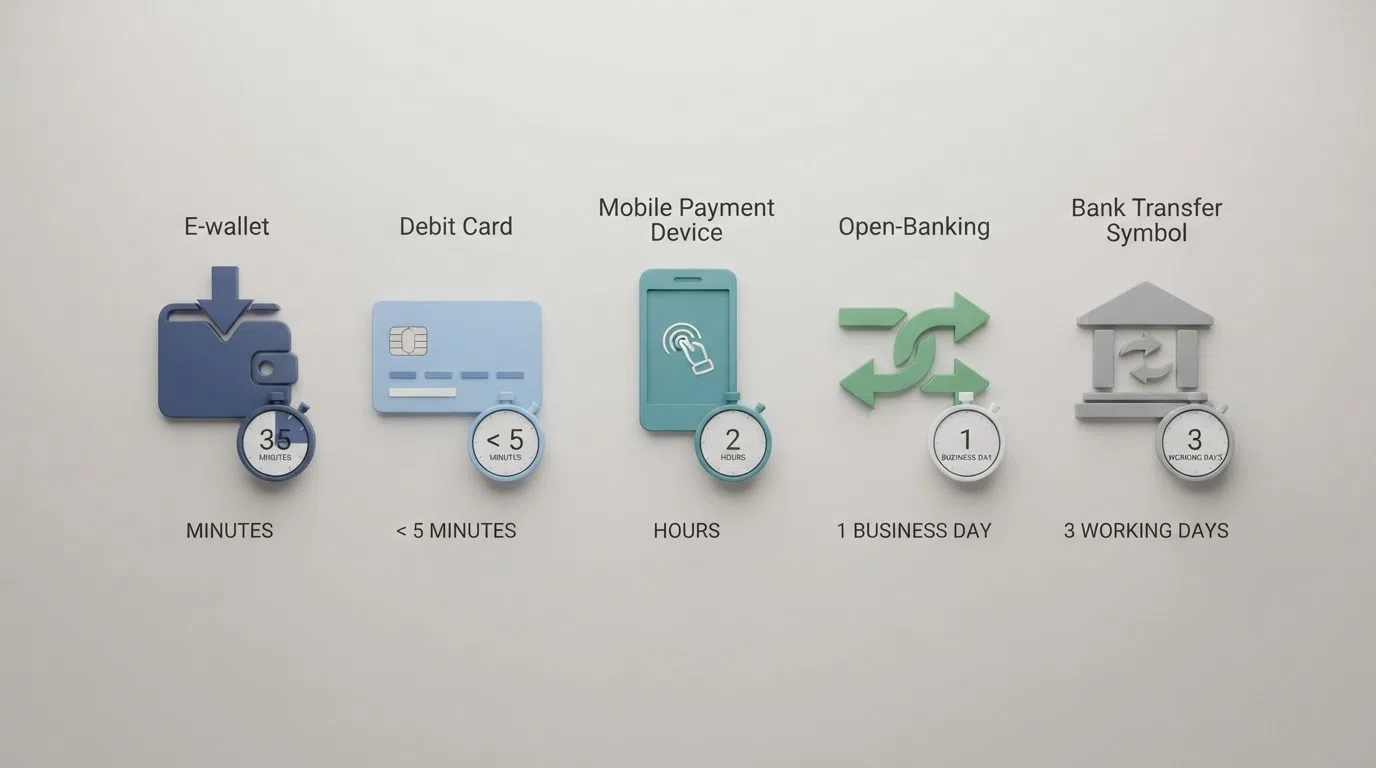
The single largest variable in how long a UK casino withdrawal takes is the payment method. The operator, the licence, the bonus terms, and the verification status all matter, but the rail is the variable that decides whether the player is waiting five minutes or three days. The table below ranks the methods by real-world speed at UKGC casinos.
| Payment Method | Typical Withdrawal Time | Fees | Minimum Withdrawal |
|---|---|---|---|
| Visa Direct / Fast Funds | Under 5 minutes to 2 hours | None typical | £5 |
| Pay by Bank / Open Banking | Immediate to 1 hour | None typical | £5–£10 |
| PayPal | 35 minutes to 4 hours | None typical | £1–£10 |
| Skrill | 45 minutes to 8 hours | None typical | £5–£10 |
| Neteller | 45 minutes to 8 hours | None typical | £5–£10 |
| Apple Pay | 1–4 hours | None typical | £5 |
| Trustly | Under 50 minutes to 4 hours | None typical | £10 |
| Revolut | 1–24 hours | None typical | £10 |
| Mastercard | 1–4 hours | None typical | £5 |
| Standard Bank Transfer | 1–3 working days | None typical | £10 |
| Paysafecard | Not supported for withdrawal | — | — |
The pattern in the table is not a coincidence. E-wallets and open-banking rails settle fast because they do not depend on the legacy card network batch cycles. Debit cards with Fast Funds are fast because the card network pushes the transaction in real time. Standard bank transfers are slow because the banks settle when the banks settle. The same casino can be “instant” on PayPal and “next business day” on a bank transfer, and both outcomes are correct.
E-Wallets: PayPal, Skrill, Neteller, MuchBetter and MiFinity
E-wallets are the fastest withdrawal rail at the majority of UKGC-licensed casinos. The tested spread across this set: PayPal at 35 minutes at Casumo, under 3.5 hours at Grosvenor, under four hours at Betway, same day with a 60-minute test at William Hill. Skrill clears in 45 minutes at Casumo and under eight hours at Ladbrokes. Neteller follows Skrill closely at both operators.
The speed advantage is structural. E-wallet accounts are already funded, and the transfer from the casino to the e-wallet is a same-system ledger update, not an inter-bank settlement. There is no batch window, no Faster Payments queue, no card-network cut-off. The casino approves the withdrawal, the e-wallet credits the balance, and the player can move the funds to a bank account at their own pace.
One constraint applies across the board. Credit-card-funded e-wallet payments have been banned for gambling since 14 April 2020. A player who topped up their PayPal with a credit card and then deposited from PayPal to a casino is not entitled to a withdrawal back to that PayPal under the rule’s intent, and operators will redirect the payout to a different method or block it. Funding the e-wallet from a debit card or a bank account is the clean path.
Debit Cards: Visa Fast Funds and Mastercard
Visa Fast Funds has changed what a debit-card withdrawal means at a UK casino. The system pushes the transaction in real time rather than batching it for next-day settlement, and the result is that a debit card can clear in minutes at operators connected to the rail. Tested figures in this set: bet365 under five minutes, Ladbrokes under 30 minutes, BetVictor 40 minutes, Betfair instant. Grosvenor’s Visa debit, without Fast Funds, tested at roughly 22 hours, which is the gap the system closes.
Mastercard’s equivalent is slower and less widely supported at UK operators. The reason is commercial rather than technical: fewer UKGC-licensed casinos have integrated the Mastercard instant rail, and the operators that have tend to promote Visa Fast Funds as the headline method. A player who only has a Mastercard should expect one to four hours at the best operators, and a same-day or next-day outcome at the rest.
The credit card ban that took effect in April 2020 applies to deposits, not to receiving a withdrawal. A player can have winnings sent to a debit card, and most operators will not accept a credit card as a withdrawal destination at all.
Bank Transfer, Trustly, Revolut and Open Banking
Standard bank transfers are the slowest rail in the table. One to three working days is the norm, and the reason is that the transfer moves through the same Faster Payments or BACS rails as any other high-street bank transfer, with cut-off times, batch windows, and weekend delays all in play. The casino can approve the withdrawal in minutes; the bank takes its time.
Trustly and Pay by Bank are open-banking rails that bypass the legacy transfer infrastructure by initiating the payment directly from the player’s bank account via API. Tested figures: Betway Trustly under 50 minutes, William Hill Instant Bank Transfer 15 minutes, Paddy Power Pay by Bank immediate, Sky Vegas Pay by Bank near-instant. The speed is comparable to the best e-wallets, and the advantage over e-wallets is that the player does not need to fund a separate account.
Revolut sits in a hybrid position. It is a bank and a card issuer, and operators that support Revolut as a withdrawal destination treat it either as a bank transfer (one to 24 hours) or as a card-network transaction (minutes via Fast Funds). William Hill’s £99,000 Revolut ceiling is the highest in the set and reflects Revolut’s higher per-transaction limits compared to PayPal or standard debit.
Apple Pay and Google Pay
Apple Pay withdrawals are fast where supported, with the speed determined by the underlying card. Apple Pay is not a separate rail; it is a front-end to the card network. If the linked debit card supports Visa Fast Funds, the Apple Pay withdrawal will be fast. If it does not, the withdrawal will take the same one to three days as the underlying card.
The featured operators that support Apple Pay withdrawals: bet365 (one to four hours), Betfair (instant), William Hill (with a £33,000 maximum), Grosvenor (fast). Google Pay support is narrower in the UK market and was not confirmed for most operators in the set. A player who wants mobile-wallet speed should check the cashier page for the operator’s Apple Pay or Google Pay policy before assuming the rail is supported.
Paysafecard and the Prepaid Gap: Deposit-Only, No Withdrawal Route
Paysafecard is a deposit method, not a withdrawal method. The voucher-based system does not have a receiving end; once the deposit is made, the funds sit in the casino account and must be withdrawn to a different rail. The “Paysafecard withdrawal” term that appears in some casino marketing usually means a withdrawal to a My Paysafecard account, which is a separate product and is not supported at every UKGC-licensed casino.
The practical consequence is that a player who deposits with Paysafecard will need to nominate a different withdrawal method (typically a debit card or e-wallet) and will be subject to the closed-loop policy: operators are expected to return funds to the original deposit method where possible, and a Paysafecard-only depositor triggers an extra KYC step at the withdrawal stage. The KYC requirement is non-negotiable under the pre-deposit verification rule in force since May 2019, so the player cannot avoid the document upload by choosing a “no-ID” prepaid route.
Crypto and No-ID Casinos: Instant Payouts Without UK Safeguards
The fastest withdrawal a UK player can get, in raw time terms, is from a crypto casino. Bitcoin transactions settle in ten to sixty minutes on-chain, with no banking intermediary, no operator review queue beyond the blockchain confirmation, and no card-network delay. From a pure speed perspective, crypto wins on every metric a “fast withdrawal” page measures.
The catch is that no UKGC-licensed casino offers crypto-denominated withdrawals. Every operator in the ranking above holds a UKGC remote operating licence and accepts only fiat payment methods. A player who wants to withdraw in Bitcoin at a UKGC-licensed casino in 2026 will not find one to play at. The search-intent term “crypto casino UK fast withdrawal” leads, in practice, to Curaçao-licensed or Anjouan-licensed sites, and the speed is real while every player protection that applies at a UKGC casino is absent.
Bitcoin and Crypto Casinos: Instant On-Chain, Zero UK Regulation
A crypto casino processes withdrawals in Bitcoin, Ethereum, or stablecoin by sending the funds to a player-controlled wallet. The settlement is on-chain and the casino has no control over the speed once the transaction is broadcast. The practical timeline is ten to sixty minutes for Bitcoin, faster for Ethereum and Layer 2 networks, and near-instant for some stablecoin rails. Compared to the fastest UKGC-licensed payout of five minutes via Visa Direct, the difference is small at the top end. Compared to the slowest UKGC payout of three working days via bank transfer, the difference is enormous.
The licensing position is the cost. None of the major crypto casinos that rank for “fast withdrawal” search terms hold a UKGC licence. They hold Curaçao, Costa Rica, or Anjouan licences, none of which substitute for a UKGC licence under the point-of-consumption regime. Operating without a GB licence is a criminal offence under section 33 of the Gambling Act 2005, carrying up to 51 weeks’ imprisonment, an unlimited fine, or both, for the operator. The player is not the target of enforcement, but the player is the one who loses the protection.
No-Verification and No-ID Withdrawals: What the Search Demand Actually Means
The search volume for “no verification withdrawal casino UK” is real. The product is not, at least not inside the regulated market. Since 7 May 2019, every UKGC-licensed casino has been required to verify a customer’s name, address and date of birth before the first deposit. A “no-ID casino” under a GB licence is a contradiction in terms. The sites that rank for these terms are uniformly offshore, and the verification-free pitch is the marketing wrapper for the same licensing gap.
The user need behind the search is real even if the product is not. Players who value privacy, who want to avoid document uploads, and who want the fastest possible withdrawal are asking for something the regulated market has not built. The lawful alternatives are: pre-verified e-wallets (PayPal, Skrill, Neteller) where the KYC has been done by the e-wallet provider rather than the casino, open-banking rails (Pay by Bank, Trustly) where the bank handles the identity check, and crypto at an unlicensed site where the speed comes at the cost of every statutory protection.
The Trade-Off: Crypto Speed vs UK Protection
A GB player choosing a crypto casino for fast withdrawals trades the following protections for on-chain settlement speed.
What the player gains: near-instant withdrawal with no banking intermediary, no operator-imposed maximum limits, no pending period, and no UKGC-mandated affordability or vulnerability check at the point of withdrawal.
What the player loses: GAMSTOP self-exclusion (the offshore site is not part of the register, and a player who has self-excluded at a UKGC casino can still deposit at an unlicensed site), ADR dispute resolution (no approved ADR provider is bound to adjudicate), the Commission’s complaints route, the ban on reverse withdrawals (the offshore site may offer them), the £150 net-deposit financial vulnerability check, the 10× wagering cap on bonuses, and the no-maximum-limit rule on the deposit balance. The Commission’s enforcement model is disruption-based: between April 2024 and June 2025, the Commission issued 3,140 disruption notices, referred 447,778 URLs to search engines, achieved the removal of 287,961 URLs, and recorded a 32% average fall in engagement across 160 disrupted sites. The effect is real. The protection at any single unlicensed site remains absent.
The arithmetic is not close. A player with a self-exclusion history, a player who values ADR access, and a player who withdraws more than the threshold for enhanced source-of-funds review at a UKGC casino has more to lose than five minutes of withdrawal speed is worth.
Slots, Live Casino and Fast Withdrawals: What Pays Out Quickest
The game type a player chooses does not change the speed of the withdrawal. The withdrawal speed is set by the payment method and the operator’s approval queue, not by whether the player was spinning slots or playing live blackjack. What the game type changes is the shape of the session, the stake size, and the amount the player is likely to be withdrawing, and those changes matter for how the operator’s affordability and source-of-funds checks interact with the cashout.
The online slots market in the UK now runs under a statutory stake cap. Since 9 April 2025, the maximum stake per game cycle for players aged 25 and over is £5. Since 21 May 2025, the maximum for players aged 18 to 24 is £2. The cap is imposed by SI 2025/215 and applies to the total staked within a single game cycle, including any features or gamble options. The cap limits the size of a slot withdrawal in a single session at the stake end, and the game-design rules in force since October 2021 limit the session at the other end: auto-play is banned, spin speed is capped at 2.5 seconds, losses disguised as wins are banned, and the operator must display total losses, total wins and time played during the session.
Online Slots and Instant-Withdrawal Slot Sites
The fastest-withdrawal operators in this set are also the strongest slot sites by provider count. bet365, Sky Vegas, Ladbrokes, Betfair, Paddy Power and Casumo all carry twenty or more game providers, which is the broadest mix in the licensed market. A player who wants both fast withdrawals and a deep slots lobby does not have to trade one for the other.
The stake cap changes what a “fast withdrawal from slots” means in practice. A session of 200 spins at £2 per spin (the 18–24 cap) is a £400 turnover session before any wins. A session at £5 per spin (the 25+ cap) is £1,000 turnover. Those figures are well below the source-of-funds review thresholds, and a player withdrawing session winnings at the end of a normal session will not trigger enhanced checks. A player running a long session at the stake cap and withdrawing five-figure sums will, and the withdrawal will take longer because of the review, not because of the slots game.
RTP is a separate metric and is not affected by withdrawal speed. A slot site that pays fast and a slot game that returns high are different propositions. The fastest-paying casinos in the set carry the same mix of high-RTP and low-RTP slots as every other licensed site.
Live Casino Withdrawals: Same Payout Speed, Different Session Profile
There is no statutory stake cap on live casino, roulette, blackjack, bingo, or sports betting. A live roulette player can stake £500 a hand at a UKGC-licensed casino in 2026 without breaching any stake rule. The session profile is therefore very different from a slots session: fewer hands per hour, higher stakes per hand, and larger swings in the account balance.
The withdrawal speed is the same. A £2,000 live-casino win cleared via Visa Fast Funds takes the same five minutes to two hours as a £200 slots win cleared the same way. The difference is what happens when the live-casino win is large. The operator’s anti-money-laundering procedures and enhanced due-diligence checks trigger at the point the withdrawal crosses a value threshold, and the larger the withdrawal, the longer the review. The player who withdraws £20,000 from a single live-roulette session will not get the same instant tier as the player withdrawing £200 from a slots session, even at the same operator on the same rail.
The featured operators with the strongest live-casino offering, in provider-mix terms, are bet365, William Hill, Sky Vegas, Ladbrokes, Betfair, Paddy Power, Betway, Casumo, Grosvenor and BetVictor, all of which carry Evolution in their provider mix. A player who plays live casino and wants fast withdrawals at a UKGC-licensed site is not trading one against the other.
New UK Fast-Withdrawal Casinos in 2026: Hype vs Reality
New operators in the UK fast-withdrawal space often promise faster payouts than established names. The promise frequently overlooks the structural reality: a new UKGC licence does not come with new payment infrastructure. Any new operator must still integrate with the same card networks, e-wallet providers, open-banking rails, and the same Faster Payments system. Brand-new sites are essentially built on the existing payment architecture, and the speed of that system takes years to fully optimise.
From 31 October 2025, every UKGC-licensed operator must prompt a new customer to set a financial limit before the first deposit. By 30 September 2026, a gross deposit limit must be offered with at least equal prominence. The deposit-limit prompt is a friction layer the player will encounter on every new operator in the set, including the established ones, and the cost of that friction falls on the operator, not the player. New casinos cannot use it as a competitive differentiator because every casino now has it.
Newest UK Fast-Withdrawal Casino Launches
The most recent UK market entrants in the fast-withdrawal positioning are the new Flutter and Entain skins, the new white-label operators, and the rebrand launches from existing groups. The structural feature they share is a payment stack inherited from the parent group rather than built independently. A new Flutter skin uses Flutter’s payment infrastructure. A new Entain skin uses Entain’s. The withdrawal speed at a brand-new skin is the speed of the parent’s rails, not the speed of a fresh integration.
The first step any player should take with a new UK casino, before depositing, is licence verification on the Commission’s public register at gamblingcommission.gov.uk. The register confirms the account number, the licence status (Active or otherwise), and the operating company. A new brand with no entry on the register is not licensed and should not be played at.
Your Legal Rights When a Casino Withholds Your Withdrawal
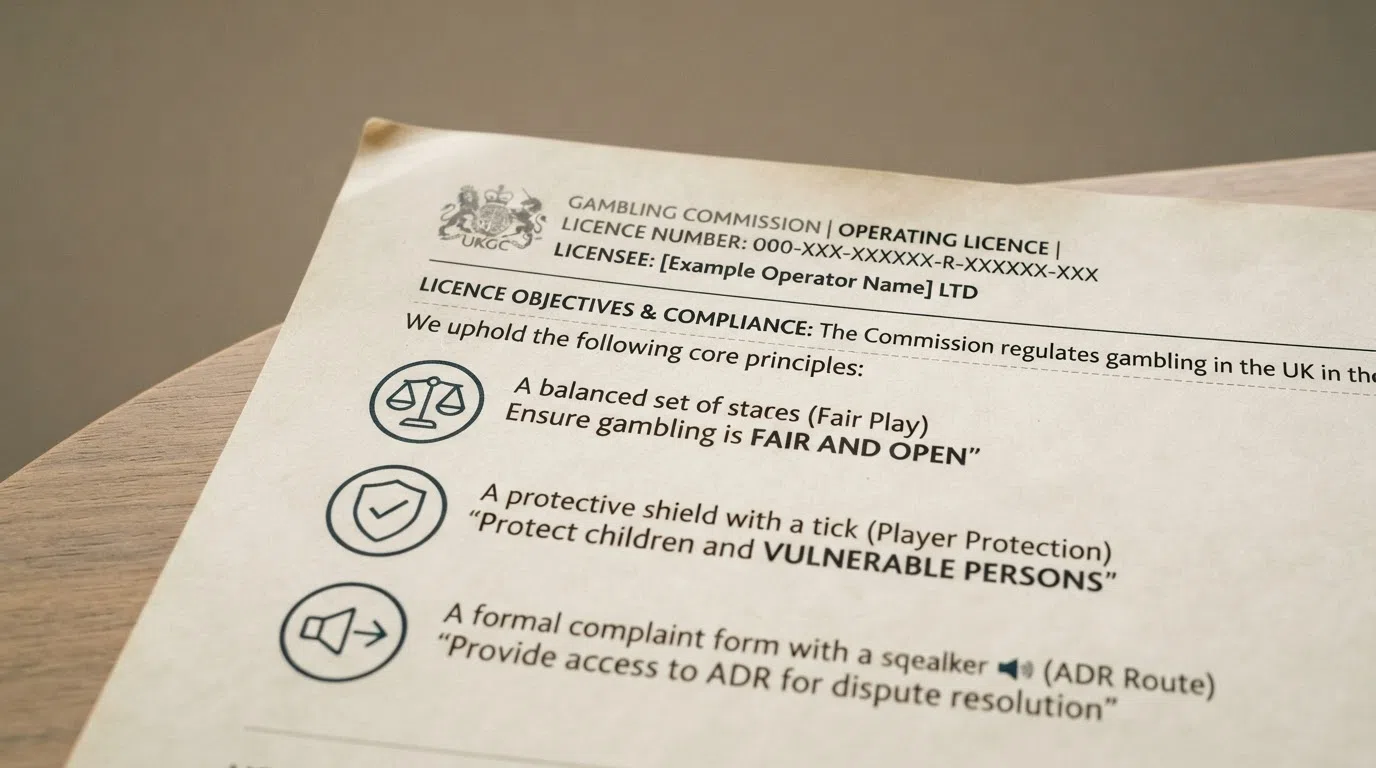
A UKGC licence is a contract of rights. The licence conditions and codes of practice that bind every operator in the ranking above give the player specific protections around withdrawal timing, withdrawal limits, and dispute resolution, and most players do not know what those rights are until they need them. The three licensing objectives of the Gambling Act 2005, preventing crime, ensuring fair and open gambling, and protecting the vulnerable, are the framework the protections sit inside.
How the UKGC Protects Your Withdrawal: Licence Conditions That Matter
The key conditions are LCCP (Licence Conditions and Codes of Practice) and RTS (Remote Technical Standards), and they cover the main withdrawal-rights cases the player is likely to encounter.
The first is the no-maximum-limit rule. The Commission prohibits any operator from imposing a maximum cap on the amount a player can withdraw from their deposit balance. A player must be able to withdraw at any time, without restriction, except as required for regulatory compliance (source-of-funds checks, anti-money-laundering review). The rule covers the deposit balance. It does not cover bonus funds in play, and it does not override a source-of-funds review on a large withdrawal.
The second is the ban on reverse withdrawals. Since 31 October 2021, no UKGC-licensed operator may offer a player the option to cancel a pending withdrawal and return the funds to the playable balance. The pending period is now a processing window only. The player cannot be tempted to replay winnings at the last moment.
The third is the KYC-before-deposit rule. Since 7 May 2019, identity verification must be complete before the first deposit. The implication for withdrawal is that the player cannot be asked for documents at the point of cashout as a delay tactic. The verification has already happened.
The fourth is the 10× wagering cap on bonuses, in force from 19 December 2025, and the ban on mixed-product promotional offers. A bonus cannot tie up withdrawable funds for more than ten times the bonus value, and a casino cannot bundle a slots bonus with a sports bet in the same promotion.
The fifth is the financial vulnerability check at the £150 net-deposit threshold in a rolling 30-day period, in force from 28 February 2025. The check uses public data (bankruptcy, CCJs, IVAs, DROs) and is not a credit search. It runs during the operator’s processing of the next deposit or withdrawal after the threshold is crossed, and it can add time.
Offshore Casinos and Your Withdrawal: No UKGC Licence, No UK Rights
The point-of-consumption regime introduced by the Gambling (Licensing and Advertising) Act 2014 makes a GB licence compulsory for any operator taking GB customers, wherever the operator is based. A Curaçao, Malta, or Gibraltar licence is not a substitute. Operating without a GB licence is a criminal offence under section 33 of the Gambling Act 2005.
The practical effect on a withdrawal is that the player at an unlicensed site has no statutory protection if the operator refuses to pay. There is no ADR provider bound to adjudicate. There is no Commission complaints route. The Commission’s enforcement model is disruption rather than ISP blocking: cease-and-desist notices, search-engine delisting, domain registrar pressure, payment-provider referrals. The Commission’s published data shows 3,140 disruption notices issued between April 2024 and June 2025, 447,778 URLs referred to search engines, 287,961 URLs removed, and an average 32% fall in engagement across 160 disrupted sites. The effect on supply is real. The protection at any single unlicensed site that has not yet been disrupted remains absent.
A player who has a withdrawal dispute with an unlicensed casino has, in practice, the options available to any commercial creditor chasing a foreign debtor: small claims court, chargebacks on the funding card where the card network’s rules allow, and the operator’s own internal complaints process if it has one. None of these are the operator’s licence conditions.
What to Do When a Withdrawal Is Delayed: The Step-by-Step Rights Path
The escalation ladder for a delayed withdrawal at a UKGC-licensed casino is a four-step process, and it is worth running the steps in order.
Step one: check the operator’s stated withdrawal timeframe in its terms and conditions and check the typical clearing time for the payment method. A 24-hour bank transfer is not a delayed withdrawal; it is a normal timeline for the rail. The Commission’s 99% within 24–48 hours benchmark is the reference point.
Step two: contact customer support in writing (email or live-chat transcript) and request a formal complaint reference. The eight-week clock for ADR escalation starts from the date of the complaint, not the date of the withdrawal request. A player who has the complaint reference can show the ADR provider that the internal process has been exhausted.
Step three: escalate to the operator’s nominated ADR provider if the complaint is unresolved after eight weeks, or earlier if the operator issues a deadlock letter. ADR is a licence condition; every GB-licensed operator must name an approved ADR provider. The ADR’s decision is binding on the operator (though not always on the player, who can still pursue the matter in court if dissatisfied).
Step four: report systemic issues to the Gambling Commission via the online contact form. The Commission does not resolve individual disputes; it uses the intelligence for enforcement. A player who reports a pattern of delayed withdrawals or unexplained account closures is feeding the Commission’s market-supervision work, and the work has produced visible results in the disruption data above.
Fast Payouts and Safer Gambling: Where Speed Meets Player Protection
The same withdrawal-speed features that make a casino attractive to a casual player can also accelerate harm for a player who is struggling. A fast cycle from deposit to play to withdrawal leaves less friction in the system, and less friction cuts both ways. The UK regulatory framework has built specific counterweights to that risk, and every operator in the ranking above is bound by them.
The prevalence data is the starting point. The NHS Adult Psychiatric Morbidity Survey 2023–24 records that 0.4% of adults experienced problem gambling (PGSI 8+) and 1.6% experienced at least moderate risk (PGSI 3+). Men (2.2%) scored higher than women (1.0%), and the 25–34 age band was the highest at 3.5%. NHS gambling referrals reached 4,355 in 2024/25, up 91% year-on-year from 2,284. GamCare reported 996 referrals in January 2026 alone, up 48% year-on-year. The figures are not abstract. They describe a population of UK players, and the regulatory framework is built to protect them.
Deposit Limits, Reality Checks and Time-Outs: The Tools That Protect Your Balance
Every UKGC-licensed casino must offer the following safer-gambling controls, and a player who wants to set them can do so at any time without affecting withdrawal access.
- Deposit limits: From 31 October 2025, the operator must prompt a new customer to set a financial limit before the first deposit. By 30 September 2026, a gross deposit limit must be offered with at least equal prominence. A decrease in a deposit limit is actioned immediately. An increase may be subject to a delay to give the player time to reconsider.
- Reality checks: Mandatory pop-ups during a session showing time elapsed and money spent. The session display rule for slots, showing total losses, total wins and time played, has been in force since 31 October 2021.
- Time-outs: Short cooling-off periods ranging from 24 hours to six weeks, during which the account is locked but the player retains the ability to withdraw any balance in the account.
- GAMSTOP self-exclusion: The mandatory self-exclusion register for all GB-licensed online operators. Exclusion periods are six months, one year, five years, or five years with auto-renewal. GAMSTOP cannot be cancelled early. It is licence-bound and online-only, and it does not reach unlicensed sites.
A time-out is a short, reversible break. GAMSTOP is a longer, harder exclusion. The distinction matters: a player who wants a 72-hour pause to think uses a time-out, and a player who has decided to stop gambling uses GAMSTOP.
Where to Get Help: GamStop, GamCare and NHS Gambling Clinics
The UK’s help infrastructure is free, confidential, and built into the licensing system. The routes a player can use are independent of any operator.
The National Gambling Helpline, run by GamCare, is 0808 8020 133. It is free, 24/7, and offers live chat, telephone counselling, and treatment referrals. GamCare also runs peer-support forums and online groups. The treatment data for 2024/25 shows 11,960 clients treated by the National Gambling Treatment Service, an 11% year-on-year increase, with 93% of clients completing treatment seeing improvement and 50% receiving their first appointment within six days.
GambleAware funds the research, prevention, and treatment infrastructure. The NHS operates gambling-harm clinics in England, Scotland, and Wales, and patients can self-refer without seeing a GP first. Gamblers Anonymous runs peer-support meetings across the UK.
A player who has self-excluded via GAMSTOP at a UKGC-licensed casino and then finds themselves gambling at an offshore site has not defeated the self-exclusion. They have moved outside it. The self-exclusion still binds at every UKGC-licensed site, and the player who wants the help infrastructure to follow them across the boundary needs the offline routes: the GamCare helpline, the NHS clinics, the Gamblers Anonymous meetings. Those are the routes that do not depend on a licence.
How We Evaluated the Fastest-Paying UK Casinos
The ranking above is built on three data layers. The first is independently tested withdrawal times, drawn primarily from Casino.org’s published testing and cross-referenced against operator help-centre statements and terms-and-conditions pages. The second is the UKGC public register at gamblingcommission.gov.uk, which was checked for each of the ten operators to confirm the licence account number, the operating company, and the Active status. The third is the Commission’s own data on operator withdrawal performance, which sets the 24–48 hour benchmark against which individual operator times are measured.
The primary ranking criterion is real tested speed at the fastest available payment method. Marketing claims and advertised maximums are not the ranking criterion, because both are set by the operator and not by the testing. A casino that advertises “instant withdrawals” and tests at four hours via PayPal ranks below a casino that advertises “1–4 hour withdrawals” and tests at 35 minutes.
The secondary criteria are: UKGC licence status (all ten are Active on the public register), minimum and maximum withdrawal limits (where research confirmed them), payment-method breadth, and provider count. Withdrawal speed is method-dependent, and an operator with a fast PayPal but no Visa Fast Funds support will rank below an operator with both, all else equal. An operator with a fast Visa Fast Funds but a £2,000 per-transaction cap will rank below an operator with a slightly slower rail and a higher cap, where the player is likely to be withdrawing a larger sum.
The limitations of the ranking are honest. Withdrawal speed varies by individual experience, and the testing reflects typical performance, not best-case or worst-case. A player who has not completed KYC will wait longer at every step. A player who deposits via a method that triggers the closed-loop policy will see their withdrawal redirected. A player who wins a sum large enough to trigger enhanced source-of-funds review will wait days rather than minutes, and the review is not the operator stalling. The ranking measures the speed the typical player can expect on a typical day, using a payment method the operator supports for the amount being withdrawn.
What Fast Withdrawals Actually Mean for Your Play
The single most important finding on this page is that withdrawal speed is overwhelmingly a property of the payment method, not of the operator. The operator determines the approval queue and the processing window. The payment method determines the settlement time. A player who wants the fastest possible UKGC-licensed payout picks an operator that supports the fastest rails (e-wallets, open banking, debit cards with Fast Funds) and picks a payment method from that set. The operator choice within that constraint is a secondary decision, made on provider mix, bonus terms, and UI.
The operators at the top of the ranking, bet365, William Hill, Betfair, Paddy Power, all support the same set of fast rails. Their tested times differ by minutes. The operators in the middle of the ranking, Sky Vegas, Ladbrokes, Betway, BetVictor, support most of the same rails and clear at competitive speed. The operators at the bottom, Casumo, Grosvenor, are competitive on specific rails and slower on others. The choice is not “fast casino vs slow casino.” The choice is “which rail do I want my money on, and which operator runs that rail fastest.”
The regulatory bottom line is the part a comparison page cannot replace. A UKGC-licensed casino guarantees: no maximum cap on the deposit balance, no reverse withdrawals, mandatory ADR, GAMSTOP access, the 10× wagering cap, the financial vulnerability check at the £150 threshold, the KYC-before-deposit rule, the deposit-limit prompt at first deposit, and the no-credit-card rule. An unlicensed casino guarantees none of these. The choice to play at a UKGC-licensed casino is not a choice to pay a tax for slower withdrawals. It is a choice to keep the protections the comparison above assumes, including the protections that apply when an operator refuses to pay.
The action a player should take, before signing up at any of the operators above, is short. Verify the licence on the Commission’s public register at gamblingcommission.gov.uk. Register an e-wallet or open-banking payment method before depositing, so the fastest rail is available from the first withdrawal. Complete KYC at the point of first deposit, not at the point of first withdrawal. Set a deposit limit when prompted. The five-minute investment protects every withdrawal that follows it.
Frequently Asked Questions
PayPal, Visa or bank transfer — which pays out casino winnings fastest?
E-wallets and open-banking rails clear fastest at UKGC-licensed casinos. PayPal has tested at 35 minutes at Casumo, under 3.5 hours at Grosvenor, and same day at William Hill. Visa Fast Funds and Visa Direct have tested under five minutes at bet365 and under 30 minutes at Ladbrokes. Standard bank transfers are the slowest rail, taking one to three working days. Pay by Bank and Trustly, both open-banking rails, have tested under 50 minutes at Betway and 15 minutes at William Hill.
Can I withdraw from a UK casino without verifying my identity?
No. Since 7 May 2019, every UKGC-licensed casino must verify a customer’s name, address, and date of birth before the first deposit, with no grace period. A “no-ID casino” under a GB licence does not exist. Sites that market themselves as verification-free are unlicensed and outside the UK regulatory framework. The lawful alternatives for a player who wants to minimise document uploads are pre-verified e-wallets like PayPal, where the e-wallet provider has already done the KYC, and open-banking rails, where the bank handles the identity check.
Do fast withdrawal casinos charge fees for payouts?
Most do not, but minimum thresholds can effectively impose a fee. Casumo sets a £1 minimum but charges a fee on any withdrawal under £10, making the practical floor £10 if the player wants to avoid the charge. Other operators in the set (bet365, William Hill, Sky Vegas, BetVictor, Grosvenor) set £5 minimums on debit cards and £10 on PayPal with no fee. Paddy Power’s £0.01 minimum is the lowest in the set and applies across Visa, PayPal, Skrill and Neteller. The Commission prohibits maximum withdrawal limits on the deposit balance; minimums and fees are still operator-set.
What is Visa Fast Funds and which UK casinos support it?
Visa Fast Funds is a card-network capability that pushes a debit-card transaction in real time rather than batching it for next-day settlement. At UKGC-licensed casinos, the result is a debit-card withdrawal that clears in minutes rather than one to three working days. The featured operators that have tested Fast Funds support include bet365 (under five minutes), Ladbrokes (under 30 minutes), BetVictor (40 minutes), and Betfair (instant). Operators that have not integrated Fast Funds, such as Grosvenor, fall back to standard debit-card timelines.
Is it safe to play at instant withdrawal casinos?
At a UKGC-licensed casino, yes. The licence is the safety: it requires KYC before deposit, prohibits reverse withdrawals, caps wagering requirements at 10×, mandates GAMSTOP self-exclusion, requires ADR for dispute resolution, and prohibits any maximum cap on withdrawals from the deposit balance. At an unlicensed casino marketing “instant withdrawals,” the speed is real and the protection is not. The Commission’s enforcement data shows 3,140 disruption notices and 287,961 URLs removed between April 2024 and June 2025, but the protection at any single unlicensed site that has not been disrupted remains absent.
What happens if my withdrawal is delayed or stuck as pending?
The escalation path has four steps. First, check the operator’s stated timeframe in its terms and the typical clearing time for the payment method; a 24-hour bank transfer is not a delayed withdrawal. Second, contact customer support in writing and request a formal complaint reference, starting the eight-week clock for ADR. Third, escalate to the operator’s nominated ADR provider if unresolved after eight weeks or if the operator issues a deadlock letter; ADR is binding on the operator. Fourth, report systemic issues to the Gambling Commission via its online contact form; the Commission does not resolve individual disputes but uses the intelligence for enforcement.
New vs Established: Do Fresher Casinos Actually Pay Out Faster?
The data does not favour the newcomers. The tested speeds at the established operators, bet365 under five minutes via Visa Direct, William Hill 15 minutes via Instant Bank Transfer, Betfair instant via Visa Debit Fast Funds, Paddy Power immediate via Pay by Bank, are the fastest figures in the UK licensed market. A new operator would have to integrate with the same processors and optimise the same review queues to match those figures, and the operators with the most optimised queues are the ones that have been running them the longest.
What a new casino can offer that an established one may not is fresh bonus terms, a newer game lobby with titles the established operators have not yet picked up, and a modern user interface. The 10× wagering cap applies to both, and the direct-marketing opt-in rules from 1 May 2025 apply to both, so the structural conditions on the bonus side are the same. A player who values novelty over the fastest possible payout is the player a new casino is built for. A player who values the fastest possible payout is the player the established operators have been built for.
Limits – No Minimum Deposit Casinos UK
Content created by the «No Minimum Deposit Casinos UK» team