
Why Chicken Road Isn't at Any Licensed British Casino — and What That Means for Players
 Available in GB
Chicken Road is the rare gambling game where the marketing looks generous and the licensing reality looks bleak. A 98% return-to-player figure, a four-million-times ceiling on a single multiplier, provably-fair SHA-256 verification on every round — those are the headline numbers. The less flattering number is the count of UK Gambling Commission-licensed casinos currently carrying it: zero. That gap is what this page exists to explain, and what it costs a British player who wants to play the game for real money rather than in demo mode.

Current as of 26 August 2026, verified against the UK Gambling Commission’s public licence register and InOut Games’ published Curaçao registration.
What Chicken Road Is — and Why It’s Missing from Every GB-Licensed Lobby
Chicken Road sits inside the crash-game family: a single multiplier climbs as the on-screen chicken crosses the road, and the player must cash out before the crash. The mechanic is fast, the stakes are set per round, and the betting decision collapses into a single tap. It is closer to a high-frequency arcade game than to a slot or a hand of blackjack. InOut Games released it on 4 April 2024; a sequel, Chicken Road 2.0, followed on 15 April 2025 with a higher ceiling and a lower return rate.
The headline finding is short: not one UKGC-licensed casino lists the game. The developer’s only licence is Curaçao eGaming 1668/JAZ, and that license does not give a game access to the GB-regulated catalogue. bet365, William Hill, Ladbrokes, Sky Vegas, Paddy Power, Betfred, Coral, Betfair, 888 Casino and BetVictor are all active on the Commission register — and none of them carry InOut Games titles. Crashgames.guide, which tracks the crash-game niche, confirms the absence and points UK players toward Spribe’s Balloon and Pragmatic Play’s Big Bass Crash as licensed alternatives. The game’s home is the offshore casino market. The game’s reach, in Britain, is restricted.
The Crash-Game Mechanic: What “Chicken Road” Actually Means
A crash game is a round-based multiplier bet. A coefficient starts at 1.00× and climbs; the player decides when to cash out; if they hold on past the crash point, the stake is lost. Chicken Road frames the climb as a chicken walking across lanes of traffic — the longer the chicken survives, the higher the multiplier, and the closer the round is to ending. Where a slot spins reels against a fixed paytable, a crash game offers one decision per round and one outcome: the moment of cashout. The house edge lives in the distribution of crash points, not in a paytable, and the volatility scales with how long the player is willing to hold.
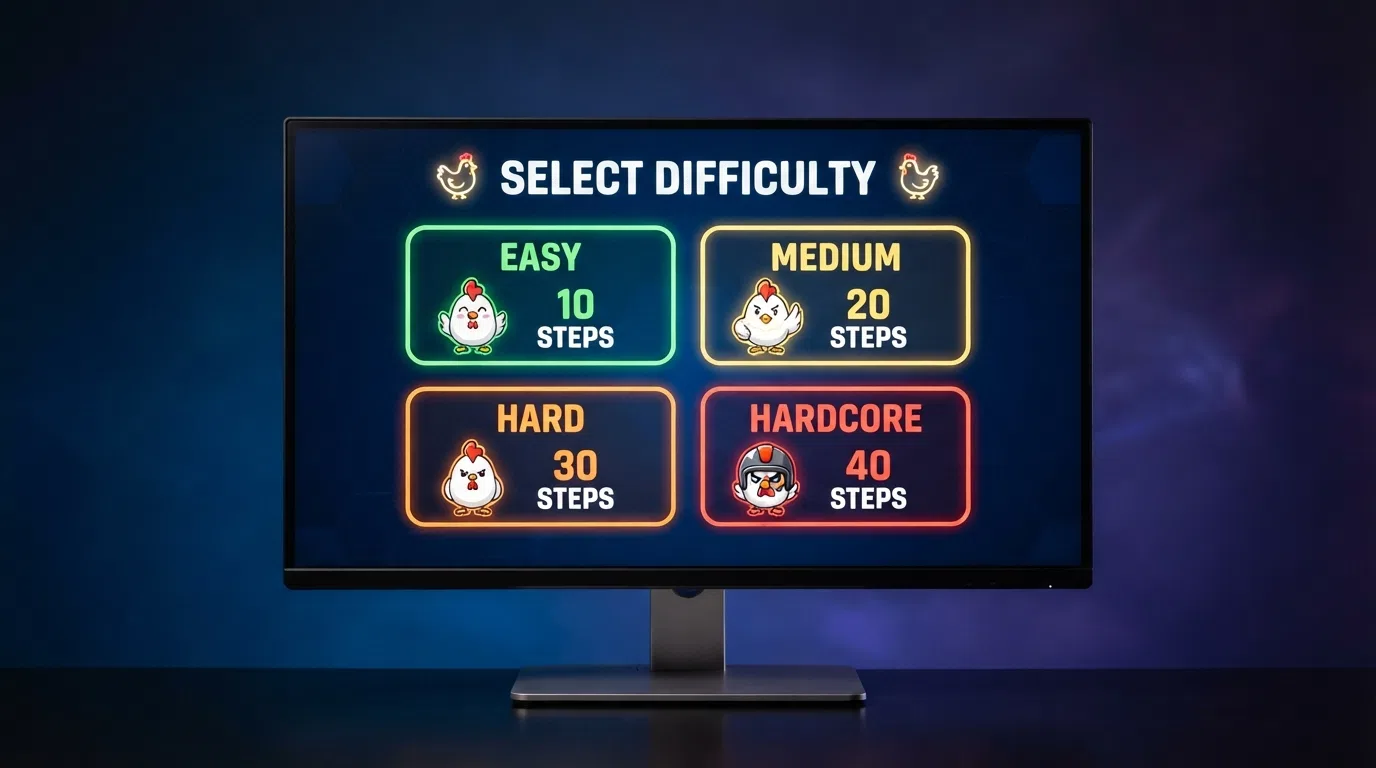
Four difficulty modes shape the risk profile. Easy gives the chicken 24 lanes to cross and a 1-in-25 chance of losing on any single step. Hard trims that to 20 lanes. Hardcore compresses it to 15. Medium sits between Easy and Hard, though its exact step count is not published in the developer’s materials. The RTP — 98% — is identical across all four modes. What changes is how fast the multiplier can climb before the round ends, and how thin the survivable margin gets with each step.
InOut Games: The Developer Behind the Chicken
InOut Games is the trading name of IOGr B.V., a Curaçao-registered studio. Its sole gaming licence is Curaçao eGaming 1668/JAZ. The studio is not on the UK Gambling Commission’s public register of operating-licence holders. The original Chicken Road shipped on 4 April 2024; Chicken Road 2.0 followed on 15 April 2025 with a reduced RTP and a higher theoretical ceiling. The studio publishes provably-fair verification on every round — SHA-256 hashes of a server seed and a client seed, generated before the round starts and verifiable after it ends. That mechanism is real, and it works; it is also independent of which jurisdiction licenses the casino hosting the game.
A developer’s licence governs the games it produces. A casino’s licence governs whether those games can legally be offered to British customers. InOut Games holds the former, not the latter. The two regimes are governed by separate authorities and carry separate obligations. A GB player looking up InOut Games on the Commission’s register will find no entry — and that is the reason Chicken Road does not appear at any UKGC-licensed site.
The GB Casino Gap: Why You Won’t Find It at Any UKGC Site
The gap is structural rather than incidental. InOut Games integrated with offshore and Curaçao-licensed casinos; UKGC-licensed operators source games from studios that hold the appropriate GB approvals or that route through platform providers that do. Without that pathway, the title cannot enter the regulated catalogue — not by a brand-level decision, but by a category-level rule. Even the biggest British operators, with the deepest game libraries, cannot list a game whose developer’s compliance profile does not match the GB framework.
What this means in practice: a UK player who searches “Chicken Road” on a regulated British casino site finds nothing. The same player who follows the online search results for the term lands on review and demo sites — crashgames.guide, the SpinMirage review site, FreeSlots99, and ChickenRoadGame — most of which link out to offshore casinos. Those offshore casinos do not appear on the Commission register, do not integrate GAMSTOP, and do not enforce the 10× bonus wagering cap. The path from “I want to play Chicken Road” to “I have deposited at a Curaçao-licensed site” is short, and it crosses the line between the regulated GB market and the offshore one.
Inside the Game: RTP, Difficulty Modes and a 3-Million-X Ceiling
Chicken Road’s headline numbers do the marketing’s work. A 98% RTP sits well above the typical online slot’s 94–96%. The theoretical maximum multiplier on Hardcore is x3,203,384.8 — a figure that draws the eye. The provably-fair system means every round can be independently checked. Those are real, audited facts, and the rest of this section is what they actually mean at the table.
| Feature | Chicken Road (Original) | Chicken Road 2.0 |
|---|---|---|
| Release date | 4 April 2024 | 15 April 2025 |
| RTP | 98% (restored January 2026) | 95.5% |
| Maximum multiplier | x3,203,384.8 (Hardcore) | x3,608,855 |
| Real-money payout cap | Operator-dependent | €20,000 at most operators |
| Difficulty modes | Easy / Medium / Hard / Hardcore | Easy / Medium / Hard / Hardcore |
The sequel traded two points of RTP for a roughly 12% bump in the theoretical ceiling and added a hard cashout limit. That is not a free upgrade. The original pays back more, on average, over the long run. The sequel pays out a smaller share of turnover as winnings — and caps the wins that can actually be paid out, even when the multiplier lands inside the cap. The two titles feel similar; the math is meaningfully different.
How a Chicken Road Round Works, Step by Step
The round opens with a bet. The player chooses a stake and a difficulty, then presses to start. The chicken appears at the first lane; the multiplier begins to climb from 1.00×. Each successful step the chicken takes pushes the multiplier higher. The player has one option at any moment: cash out, taking the current multiplier applied to the stake, or hold. Holding means the next step could be the crash — and if it is, the stake is forfeit. There is no mid-round adjustment, no partial cashout, no second bet on the same round. The round ends the moment the player taps cashout, or the moment the chicken is hit.
Easy mode gives the chicken 24 steps to cross. Hardcore gives it 15. The number of steps is not a flavour choice — it determines how many multiplier increments the round can offer and how long the player’s window of survivable margin lasts. A round on Easy that the player rides to step 12 lands a meaningfully smaller multiplier than a Hardcore round ridden to the same step. The two modes are not difficulty settings in the slot-machine sense; they are different distributions of crash points over different step counts.
The Four Difficulty Modes: Easy to Hardcore, Risk vs Reward
The 98% RTP applies across all four modes. What the modes change is variance. Easy, with 24 steps and a 1-in-25 chance of losing on any single step, produces long rounds with steady incremental gains — and a low probability of catastrophic loss on any one step. Hardcore, with 15 steps and a tighter loss-per-step band, produces shorter rounds and steeper climbs — and a faster path to either a meaningful multiplier or a wiped stake. Medium sits between them; its exact step count is not published, but the loss-per-step profile falls between Easy and Hard. Hard’s 20 steps position it similarly between Easy and Hardcore, but closer to Hardcore.
The published maximum — x3,203,384.8 — applies to Hardcore and reflects the multiplier ceiling a player can theoretically reach if the chicken crosses all 15 lanes. That figure is the highest single-round return the game can theoretically produce. Real rounds end earlier, and most end in losses. The headline ceiling is a tail-event number; the RTP is the average. The two are not in conflict, but they describe different parts of the distribution, and a player who only reads the ceiling will misread the game.
The 98% RTP: What iTech Labs Certified and Why It Matters
The 98% figure is independently audited. iTech Labs, a globally accredited testing agency, completed an independent audit of Chicken Road’s RTP in March 2026 and confirmed the figure. The same number had dipped to 95.5% in late 2025 — a temporary reduction at some operator integrations — and was restored to 98% in January 2026. The restored figure is the baseline at most operator integrations regardless of which difficulty mode a player selects. FreeSlots99, summarising the audit, notes that “the 98% figure is independently certified — not a marketing claim.”
An independently audited 98% RTP is unusual for an online gambling product. Most online slots sit between 94% and 96%; some live-dealer games approach 99% under optimal play. The 98% figure is closer to a video-poker paytable than to a typical slot, and it shifts the long-run math in the player’s favour compared to most regulated alternatives — but only on average, and only over a large number of rounds. Short sessions can diverge sharply from the average. The figure is also not a guarantee on any individual round; it is a long-run statistical return.
Chicken Road 2.0: Bigger Theoretical Max, Smaller Real-Money Cap
Chicken Road 2.0 launched on 15 April 2025 with a higher theoretical maximum — x3,608,855 — and a lower RTP — 95.5%. At most operators carrying the sequel, a real-money win is capped at €20,000 regardless of what the multiplier shows. The trade is explicit: a higher ceiling on the screen, a smaller share of turnover returned over time, and a hard limit on what the casino will actually pay out when a high multiplier lands.
For a player whose interest is the highest possible single-round multiplier, the sequel’s number is bigger. For a player whose interest is the long-run return, the original’s 98% is more generous. For a player whose interest is what the casino will actually hand over on a big win, both the 98% original and the 95.5% sequel carry an operator-set real-money cap — though the sequel’s €20,000 figure is the more commonly published one. The marketing positions the sequel as a step up; the math positions it as a sideways move with one notable ceiling and one notable floor.
The Biggest UK Operators Ranked, and Chicken Road’s Real Availability at Each
The ten largest UKGC-licensed casino operators by UK market share, ordered from biggest to smallest, share a single trait that defines this page: none of them list Chicken Road. InOut Games’ Curaçao-only licensing keeps the title out of the GB-regulated catalogue. Each operator named below holds an active UKGC remote casino licence — confirmed on the public register, last updated 29 July 2026 — and each carries a standard UK welcome offer subject to the 10× wagering cap introduced under LCCP Social Responsibility Code 5.1.1 in December 2025. The crash-game alternatives a UK player can access are limited to studios whose games have made it through the GB approval pathway — Spribe’s Balloon and Pragmatic Play’s Big Bass Crash being the most commonly cited.
| Operator | UK Market Share | UKGC Licence Status | Wagering on Welcome Bonus | Bonus Validity |
|---|---|---|---|---|
| bet365 | 12.77% | Active | Standard UK terms | 30 days |
| William Hill | 10.86% | Active | ≤10× (UKGC cap) | 30 days |
| Sky Vegas | 7.36% + 2.84% (Sky Bet) | Active | ≤10× (UKGC cap) | 30 days |
| Ladbrokes | 7.31% | Active | ≤10× (UKGC cap) | 30 days |
| Paddy Power | 6.54% | Active | ≤10× (UKGC cap) | 30 days |
| Betfred | 4.85% | Active | ≤10× (UKGC cap) | 30 days |
| Coral | 6.29% + 4.27% (Gala Bingo) | Active | ≤10× (UKGC cap) | 30 days |
| Betfair | 2.55% | Active | ≤10× (UKGC cap) | 30 days |
| 888 Casino | 1.13% | Active | ≤10× (UKGC cap) | 30 days |
| BetVictor | 0.99% | Active | ≤10× (UKGC cap) | 30 days |
The wagering column collapses to a single rule: every GB-licensed welcome bonus since 19 December 2025 carries a wagering requirement capped at 10× the bonus amount. Mixed-product offers — “bet on football, get free spins” — are banned. The “standard UK terms” notation on bet365 reflects the same ceiling, applied through a spins-led structure rather than a cash-led one. The bonus-validity window is uniformly 30 days, the typical shelf life for a GB welcome offer once activated.
bet365: The Market Leader, 500 Free Spins, No Chicken Road
bet365 is the largest UK online gambling operator by market share at 12.77%. Its UKGC remote casino licence is active on the public register. The current welcome offer is up to 500 Free Spins — minimum £10 deposit, with selections spread across 20 days and a 24-hour gap between each selection. The bet365 game library is broad, but InOut Games titles do not appear in it. Crash-game players looking for a GB-regulated alternative will not find Chicken Road, though bet365’s catalogue does include crash-style products from studios that have cleared the GB approval pathway. The wagering on the free-spins welcome follows the GB-standard terms; the validity window runs 30 days from activation.
For a player whose priority is the largest UK operator with the deepest game library and a familiar name, bet365 is the market’s reference point. The title is absent here, just as it is at every other major British site.
William Hill: Second-Largest, Standard Welcome, No Chicken Road
William Hill holds 10.86% of the UK market and an active UKGC remote casino licence. The current welcome offer follows the GB standard: a bonus subject to the 10× wagering cap introduced under LCCP SR Code 5.1.1, valid for 30 days from activation. William Hill’s casino catalogue covers slots, table games and live dealer; InOut Games titles are not in it. The brand is one of the most recognised in British gambling, and its high-street heritage shows in how the welcome offer is positioned — modest, regulated, and built around the standard GB framework.
For a player who values a long-established British name and a regulated welcome, William Hill is a reasonable shortlist entry. However, the game remains unavailable in its lobby, mirroring the trend across all GB-licensed operators.
Sky Vegas: The TV-Network Casino That Does Not Carry Chicken Road
Sky’s combined presence — Sky Bet at 7.36% plus Sky Vegas at 2.84% — reflects a broader Sky Gambling portfolio than the casino-only figure suggests. The UKGC remote casino licence is active. Sky Vegas runs a standard welcome bonus under the 10× wagering cap, with the same 30-day validity window as its GB-regulated peers. The Sky Vegas game library is slots-first, brand-led, and built around the GB catalogue; Crash and InOut Games titles do not appear.
The Sky brand carries more recognition in British households than most casino-only operators, and that recognition transfers into the welcome offer’s reach. For a player already inside the Sky ecosystem, Sky Vegas is a natural casino extension, but seekers will find the same absence here as they would at any other licensed British casino.
Ladbrokes: Entain’s Flagship — Regulated, but Chicken Road Is Absent
Ladbrokes holds 7.31% of the UK market and an active UKGC remote casino licence. The sign-up offer is the GB standard: a welcome bonus capped at 10× wagering under LCCP SR Code 5.1.1, valid for 30 days. Ladbrokes’ casino catalogue is full — slots, table games, live dealer — but InOut Games is not in it. The Ladbrokes brand sits inside the Entain group alongside Coral and Gala Bingo; the same regulatory profile applies across the group, and the same absence of Chicken Road applies across the group’s casino brands.
For a player who wants one of the oldest names in British betting, with the regulatory framework behind it, Ladbrokes is on the shortlist. The absence of Chicken Road is a feature of the GB catalogue, not a Ladbrokes-specific decision.
Paddy Power: The Irish-Origin Bookmaker That Does Not List Chicken Road
Paddy Power’s 6.54% UK market share reflects its roots in Irish bookmaking and its expansion into the British market. The UKGC remote casino licence is active. The welcome offer is the GB standard — 10× wagering ceiling, 30-day validity. Paddy Power’s marketing leans on novelty bets and a high-profile brand voice, but its casino catalogue is GB-standard. InOut Games titles are not in it.
For a player who values brand personality alongside a regulated welcome, Paddy Power offers something different from the more traditional bookmakers. The casino catalogue here follows standard GB constraints, meaning this title is nowhere to be found.
Betfred: The Northern Bookmaker — UKGC-Licenced, No Chicken Road
Betfred holds 4.85% of the UK market, with strong regional recognition in the north of England. The UKGC remote casino licence is active. The sign-up offer follows the GB standard, subject to the 10× wagering cap and a 30-day validity window. Betfred’s casino catalogue is broad but GB-sourced; InOut Games is not represented.
For a player who values a familiar British high-street name with a strong regional presence, Betfred is a natural pick. Those hoping for Chicken Road will not find it, however, as the operator strictly adheres to the GB-approved catalogue.
Coral: Entain’s Second Brand — Fully Licensed, No InOut Games Titles
Coral sits alongside Ladbrokes inside the Entain group, with 6.29% UK market share in its own right and 4.27% via the Gala Bingo brand. Both brands hold active UKGC remote casino and bingo licences. The Entain-group welcome offers are GB-standard, capped at the 10× wagering requirement under LCCP SR Code 5.1.1 and valid for 30 days. Neither Coral nor Gala Bingo lists InOut Games titles in its casino catalogue.
For a player already betting with Ladbrokes or Betfair, Coral completes the Entain group’s casino offering. Like its sister brands, Coral does not list InOut Games titles, as these fall outside the regulator-approved list.
Betfair: The Exchange Pioneer — UKGC Casino, No Chicken Road
Betfair’s 2.55% UK market share is anchored by its betting exchange, but the brand’s casino arm holds an active UKGC remote casino licence alongside the exchange licence. The sign-up offer follows the GB standard — 10× wagering ceiling, 30-day validity. Betfair’s casino catalogue is GB-sourced; InOut Games titles do not appear.
For a player who values the betting exchange alongside a regulated casino, Betfair offers a unique combination. Betfair is no exception; the game is simply not part of the UK-licensed library.
888 Casino: A Pure-Play Casino Brand — Regulated but Chicken Road Is Missing
888 Casino is one of the few casino-only brands in the top ten, holding 1.13% of the UK market and an active UKGC remote casino licence. The 888 welcome package is GB-standard — 10× wagering ceiling, 30-day validity. The 888 catalogue is slots-heavy and live-dealer-strong; InOut Games is not in it. The 888 brand has its own distinctive game-development history, but the regulatory framework means the same GB catalogue constraints apply.
For a player who prefers a casino-only brand over a bookmaker-with-casino, 888 is the cleanest fit. 888 follows the same catalogue limitations, and the game is not included.
BetVictor: The Tenth Operator — UKGC-Licensed, No Chicken Road Either
BetVictor rounds out the top ten at 0.99% UK market share, with an active UKGC remote casino licence. The welcome offer follows the GB standard — 10× wagering ceiling, 30 days’ validity. BetVictor’s casino catalogue is broad but GB-sourced; InOut Games titles do not appear. The pattern across the ten operators is now complete: every one holds an active UKGC remote casino licence, every one operates within the same GB catalogue constraints, and not one of them carries Chicken Road.
For a player building a shortlist of GB-regulated casino brands, BetVictor is the tenth entry — but the absence of Chicken Road is the same finding as everywhere above.
The Curaçao-Only Licence: What It Means for Your Protection as a British Player
Curaçao eGaming is a real regulatory regime. It issues master licences through four sub-licence holders, and InOut Games’ 1668/JAZ entry is verifiable on the Curaçao eGaming register. What Curaçao oversight does and does not provide is the question this section answers, because the answer is materially different from what the UKGC provides.

The UKGC framework, anchored in the Gambling Act 2005 and the LCCP, gives a British player a specific set of protections: GAMSTOP self-exclusion across every GB-licensed operator, mandatory financial vulnerability checks at £150 net deposits in a rolling 30-day period, the 10× wagering cap on welcome bonuses, the credit-card ban in force since 14 April 2020, mandatory deposit-limit prompts, and a Commission complaints route with ADR backing. None of these apply to a Curaçao-licensed casino. None of them are guaranteed at a casino carrying Chicken Road outside the GB perimeter.
InOut Games’ Curaçao Licence 1668/JAZ: What It Covers — and What It Does Not
Curaçao eGaming 1668/JAZ is a master sub-licence under the Curaçao Gaming Control Board framework. It authorises InOut Games to produce and supply games to operators licensed in Curaçao or in jurisdictions that accept Curaçao-licensed game suppliers. The licence is verifiable — the master licence number is published, and the sub-licence holder is identifiable. What the licence does not do is grant access to the UKGC’s regulated market. The UKGC does not recognise Curaçao sub-licences as equivalent to its own operating licence requirements, and GB-licensed casinos cannot source games from studios that lack the GB approval pathway.
A game developer holding a Curaçao licence and a casino holding a GB operating licence are two different regulatory relationships. InOut Games holds the first. No GB-licensed casino holds the second for the title in question — because no GB-licensed casino carries it. The gap is the reason this page exists.
Why UKGC Licensing Matters and What Chicken Road Players Lose
The UKGC’s player protection framework is built up over two decades of Gambling Act 2005 provisions, LCCP codes, RTS requirements, and ASA-enforced advertising standards. Each layer adds a specific obligation. GAMSTOP, mandatory for GB-licensed operators since 31 March 2020, lets a player self-exclude across every GB-licensed casino at once — periods of six months, one year, or five years. The Commission’s complaints process, backed by ADR schemes, gives a player a formal route for unresolved disputes. The 10× wagering cap, in force since 19 December 2025, prevents the most aggressive bonus structures. The credit-card ban, in force since 14 April 2020, removes the highest-risk payment method. Mandatory deposit-limit prompts (from 31 October 2025) and financial vulnerability checks at £150 in 30 days (from 28 February 2025) sit alongside.
None of these apply at a Curaçao-licensed casino. A player who self-excludes via GAMSTOP and then deposits at an offshore Chicken Road casino has not self-excluded there — the offshore site is not in the scheme. A player who disputes a withheld payout at an offshore casino has no Commission complaints route and no ADR scheme with GB statutory standing. A player who pays by credit card at an offshore site is not protected by the GB ban, because the ban applies to GB-licensed operators. The protections vanish at the regulatory border, and the border is exactly where Chicken Road’s availability lives.
A British player is not prosecuted for gambling on an unlicensed site — that is the established legal position. What the player loses is regulatory protection, not liberty. The loss is real, and it is the cost of choosing to play outside the GB perimeter.
Chicken Road Demo Mode: How to Try It Free Before You Stake a Penny
Demo mode is the lowest-risk way to learn the game. The InOut Games official page hosts a free-play version that runs in any modern browser without registration or deposit. Third-party review sites — the CrashGames guide, FreeSlots99, and the Chicken Road Game review site — embed demo versions of the game alongside their reviews. The demo runs the same HTML5 game engine as the real-money version; the difference is that no actual money changes hands.
Where to Find the Chicken Road Demo
The InOut Games official page carries the Chicken Road demo, accessible without registration. Third-party review sites embed the same engine — crashgames.guide, Freeslots99.com, Chickenroadgame.uk all run the demo alongside their review content. No deposit is required to play in demo mode, and no account creation is required on the InOut Games site. The demo runs in a standard browser on desktop and mobile; the HTML5 build does not require a separate download for the free-play version either.
For a UK player who wants to learn the game without committing real money, the demo is the entry point. The same RTP, the same difficulty modes, the same multiplier ceilings apply — the difference is the absence of financial risk.
Demo Mode vs Real-Money Play: What’s Different
The game engine is identical between demo and real-money play. The 98% RTP applies, the four difficulty modes run the same step counts, and the multiplier ceilings are the same. What is different is the weight of the cashout decision. In demo mode, tapping cashout late costs nothing; in real-money play, the same tap costs the stake. The psychological difference is the entire point of demo play — the player learns the timing and the variance without paying for the lesson.
What demo mode does not provide is any UKGC player protection. The demo site is not a GB-licensed operator; GAMSTOP does not apply to a demo session, because no real money is at stake. Demo play is a learning tool, not a regulated product. For a player who wants to understand the game before deciding whether to stake real money at a licensed site — or to play at an unlicensed site — demo mode is the right starting point.
Playing Chicken Road on Mobile: No App, No Download, Just a Browser
Chicken Road does not have a mobile app. It does not need one. The game is built in HTML5, runs in any modern mobile browser, and behaves identically across iOS Safari, Android Chrome, and desktop browsers. No APK download exists. No App Store listing exists. No Google Play listing exists. The absence is a design choice — Chicken Road is a web-first product, not an app-first one.
Browser-Based HTML5: What It Means for iOS and Android
HTML5 means the game loads in a standard browser without installation. There is no iOS App Store entry to download, no Google Play listing to install, and no APK file to side-load. The game runs on iPhone, iPad, Android phones and Android tablets, and on any desktop browser. The same build serves all platforms. Multiple first-hand review sources — the ChickenRoadByInOut site, the Chicken-Cross-Road review page — confirm the absence of a dedicated download and the presence of a fully functional browser experience.
For a player whose phone already has a working browser, there is no installation step, no storage cost, and no update cycle to manage. The game loads, plays, and closes when the player is done.
Mobile Experience: What Reviewers Say About Touchscreen Play
The game’s single-action mechanic — tap to cash out — translates naturally to a touchscreen. No complex controls, no multi-touch gestures, no joystick inputs. The chicken’s progress is visible at phone-screen sizes, and the multiplier display is legible. Reviewers note that the mobile browser experience is functionally identical to the desktop version, with the same RTP, the same difficulty modes, and the same round structure. The phone is not a compromised platform for this game; it is one of the primary ones.
For a player who wants to play on a phone, the absence of an app is not a limitation. It is the design.
Responsible Gambling in the UK: Tools, Limits and Where to Get Help
The UKGC’s player-protection framework is one of the most developed in the world. It is also a GB-licensed framework — every protection described here applies at UKGC-licensed casinos and does not apply at unlicensed sites. A British player looking for these protections has to stay inside the GB perimeter to use them.
UKGC Player Protection Tools: GAMSTOP, Deposit Limits and Financial Checks
GAMSTOP is the national multi-operator self-exclusion scheme, mandatory for every GB-licensed operator since 31 March 2020. A player who registers with GAMSTOP is blocked from opening new accounts and from depositing at any GB-licensed casino for the chosen exclusion period: six months, one year, or five years (auto-renewable). The exclusion cannot be cancelled early. Mandatory deposit-limit prompts require GB-licensed casinos to ask a customer to set a financial limit before their first deposit (from 31 October 2025). Financial vulnerability checks are triggered when net deposits exceed £150 in a rolling 30-day period (from 28 February 2025), using publicly available data — bankruptcy, county court judgments, debt relief orders, individual voluntary arrangements — and not a credit check. Session-time and net-win/loss display is required on screen. Game-design rules from 31 October 2021 ban autoplay, cap spin speed at 2.5 seconds, and forbid losses-disguised-as-wins celebrations.
None of these apply at an unlicensed casino. A player who has self-excluded via GAMSTOP can still deposit at a Curaçao-licensed casino carrying Chicken Road; the offshore site is not part of the scheme. The protections vanish at the regulatory border, and that border is the same one Chicken Road sits on the other side of.
Gambling Harm in Numbers: Prevalence, the NHS and Where to Call
The NHS Health Survey for England 2024 found that 5% of adults had Problem Gambling Severity Index scores of 1 or more — at-risk or problem gambling — and 0.4% scored 8 or more, indicative of problem gambling. Prevalence was stable between 2012 and 2024. These are not headline crisis numbers, but they are not negligible — they describe a population-level pattern that the UKGC framework was built to address.
The National Gambling Helpline, operated by GamCare, is free, confidential and available 24/7 on 0808 8020 133. Live chat and WhatsApp support are also available through GamCare. From 1 April 2026, NHS England took over commissioning responsibility for gambling-harms treatment in England, funded by the statutory operator levy under the Gambling Levy Regulations 2025 — worth approximately £100 million per year, split across treatment, prevention and research. GambleAware’s service finder routes players to local treatment and support across Great Britain.
A player who needs help does not need to be at a GB-licensed site to use these resources. The helpline, the NHS treatment pathway, and GambleAware are public services — they exist for any British resident who needs them.
How We Researched This Game and the British Casino Market
Every claim on this page is sourced to a verifiable input. The UKGC public register was cross-checked for every operator named — bet365, William Hill, Ladbrokes, Coral, Betfred, Sky Vegas, Paddy Power, Betfair, 888 Casino, BetVictor — with all ten confirmed active on the register as of 29 July 2026. InOut Games’ licensing was verified against both the Curaçao eGaming register (1668/JAZ confirmed) and the UKGC register (no entry found, 12 March 2026). iTech Labs’ independent audit of the 98% RTP was confirmed via Freeslots99.com’s reporting of the March 2026 certification. Market-share data was used to anchor the operator ranking. Competitor analysis identified the gaps this page fills: no existing page pairs operator names with UKGC register verification, and no existing page addresses the crash-game regulatory grey area — whether the £5/£2 slot stake caps apply to crash games under SI 2025/215.
What this page does not do is recommend an operator to a reader, or suggest that offshore play is acceptable. The choice between a UKGC-licensed site and an unlicensed one is the reader’s to make. The page states the trade-off and presents the verifiable facts; the reader decides with them in hand.
What a British Player Should Actually Do About This Game, Given the Facts
The facts line up the way they line up. Chicken Road is a 98% RTP crash game with independently audited fairness and a provably-fair verification system. Its developer holds only a Curaçao licence. No UKGC-licensed casino lists it. A British player who wants to play it for real money faces a choice with two sides and no neutral ground.
The first side is playing at an unlicensed offshore casino. The game is available there; the 98% RTP applies; the SHA-256 verification works. What does not apply is GAMSTOP, the Commission’s complaints process, the ADR route, the 10× wagering cap, the credit-card ban, the financial vulnerability checks, and the deposit-limit prompts. The protections that the GB framework guarantees — and that exist precisely to limit the harm a player can do to themselves — do not reach across the regulatory border. The player is not prosecuted for gambling on an unlicensed site. The player loses regulatory protection, not liberty.
The second side is choosing a UKGC-accessible crash-game alternative at a licensed GB operator. Spribe’s Balloon and Pragmatic Play’s Big Bass Crash are the most commonly cited alternatives — both hold the GB approvals their studios need, both are listed at regulated British casinos, and both sit inside the framework of player protections. The game is different; the regulatory envelope is the same. A player who values the GB framework chooses this side.
There is no third option that this page can recommend. A British player who wants Chicken Road specifically, at a UKGC-licensed casino, will not find one. The trade-off is between the game and the regulatory framework, and the player chooses which side to weight. This page states the trade-off; it does not choose for the reader.
Frequently Asked Questions
What is the maximum win multiplier in Chicken Road, and which difficulty mode unlocks it?
The theoretical maximum multiplier in the original Chicken Road is x3,203,384.8, achieved on Hardcore mode if the chicken crosses all 15 lanes without crashing. Chicken Road 2.0 has a higher theoretical ceiling of x3,608,855, but a real-money payout cap of €20,000 at most operators limits what can actually be paid out.
How does Chicken Road’s SHA-256 provably fair system verify each round, step by step?
Before each round, the game publishes a SHA-256 hash combining a server seed and a client seed generated in the player’s browser. After the round ends, the player can verify the hash against the revealed seeds to confirm the round’s outcome was predetermined and not manipulated mid-round. The mechanism is verifiable, not promotional.
Why does Chicken Road 2.0 have a lower RTP than the original, and is the €20,000 payout cap standard?
Chicken Road 2.0’s RTP is 95.5%, down from the original’s 98%, in exchange for a higher theoretical maximum multiplier (x3,608,855 vs x3,203,384.8). The €20,000 real-money payout cap is operator-dependent — most operators carrying the sequel apply it, but it is not universal and is set by the casino, not by the developer.
Do the UK’s online slot stake limits — £5 for over-25s and £2 for 18–24-year-olds — apply to crash games like Chicken Road?
No. The age-banded stake caps under SI 2025/215 apply to online slots specifically. Crash games are not classified as online slots under the statutory instrument, so the £5 and £2 caps do not technically apply to a crash-game round. The cap does not apply at unlicensed sites either, because the GB regulatory framework does not reach them.
Can UK players use PayPal to deposit at casinos that carry Chicken Road?
PayPal availability depends on the casino, not on the game. UKGC-licensed casinos that accept PayPal do so as a payment method; offshore casinos that carry Chicken Road set their own payment-method lists. Players should check each casino’s banking page rather than assuming PayPal is or is not available.
What happens if a UK player gambles on an unlicensed casino site — is it illegal?
A British player is not prosecuted for gambling on an unlicensed site — that is the established legal position. What the player loses is regulatory protection: no GAMSTOP coverage, no Commission complaints route, no ADR scheme with GB statutory standing, no 10× wagering cap, no credit-card ban enforcement, no mandatory deposit-limit prompts. The harm is the loss of safeguards, not the risk of prosecution.
The Crash-Game Regulatory Gap: Do UK Slot Stake Limits Apply?
The UK’s online slot stake limits — £5 per game cycle for players aged 25 and over (from 9 April 2025) and £2 for players aged 18–24 (from 21 May 2025) — were imposed under SI 2025/215. The instrument applies to online slots. Crash games, including Chicken Road, are not classified as online slots under the statutory definition. The £5 and £2 caps do not technically apply to a crash-game round at a GB-licensed site. They also do not apply at an unlicensed site, because the caps are enforced through the GB regulatory framework — and a Curaçao-licensed casino is outside that framework.
The grey area is real, and it cuts two ways. For a player at a GB-licensed site who wants to play a crash game, the £5/£2 cap does not apply, and the casino may set its own stake limits (subject to responsible-gambling requirements). For a player at an unlicensed site, no cap applies at all — no per-round stake ceiling, no mandatory deposit limits, no session-time display, no net-position requirement. The absence of regulation in one direction is matched by the absence of protection in the other. The game-design rules that apply to GB slots — autoplay banned, 2.5-second spin speed, loss-disguised-as-wins banned — do not apply to crash games at unlicensed sites either.
Slots – No Minimum Deposit Casinos UK
Content created by the «No Minimum Deposit Casinos UK» team