WebMoney Is Off the UK Casino Map — Here's What You Can Actually Use
 Available in GB
The question sounds like it should have a listicle answer. It does not. Zero casinos licensed by the Gambling Commission currently list WebMoney as a payment method, and the reason is not an oversight or a temporary integration gap. The e-wallet’s UK e-money institution registration under the Financial Conduct Authority is no longer active. Without that registration, the rails British-licensed casinos rely on for payment processing are closed to it. The result is a split landscape: the licensed market runs on debit cards, PayPal, Apple Pay and bank transfer, while the offshore sites that still accept WebMoney sit outside every protection the Commission enforces. This page walks through both sides of that split — what WebMoney deposits actually look like, what fees and withdrawal times the player pays, which ten licensed operators dominate the UK market and what they offer instead, and what a player forfeits by crossing the line to an offshore WebMoney casino.
*Current as of 25 August 2026 and verified against the Gambling Commission’s public register and the Financial Conduct Authority’s e-money institution register.*
What Is a WebMoney Casino — and Can UK Players Still Use One?
A WebMoney casino is any online casino that accepts deposits routed through the WebMoney purse system, a digital wallet that holds funds in currency-specific accounts: WMZ for US dollars, WME for euros and others for additional currencies. Each user has a unique identifier called a WMID, and payments move through WebMoney Keeper, the app or web interface that authorises transfers between purses and external merchants. The system has operated across Eastern Europe and the former Soviet Union for more than two decades, and at peak adoption it was integrated into hundreds of gambling sites. The promise was, and remains, instant deposits and reasonable fees. The reality in the United Kingdom is narrower.
WebMoney’s UK Status: The FCA Registration That Is Not Coming Back
WebMoney Europe Ltd held an FCA e-money institution registration that allowed it to operate in the UK under the regulatory framework that governs payment service providers. That registration is no longer active. UK and Canadian players can no longer access WebMoney officially, and the reason is regulatory: the FCA’s licensing regime for e-money institutions sets requirements on capital adequacy, safeguarding of customer funds and operational resilience. WebMoney chose not to maintain its UK registration, and without it, GB-licensed casinos have no compliant route to integrate WebMoney into their cashier systems. The contrast with continental European markets is sharp — in jurisdictions where WebMoney maintains its e-money authorisation, dozens of casinos still list it as a payment option. In the UK, it does not appear on a single major licensed cashier.
The practical consequence is binary. Either a UK player gambles inside the GB licensing system, in which case WebMoney is not an option, or they gamble at an offshore site, in which case they have left the system that enforces identity verification, self-exclusion, deposit limits and dispute resolution. There is no middle ground where WebMoney operates alongside UKGC protections.
How a WebMoney Casino Deposit Works — in Theory
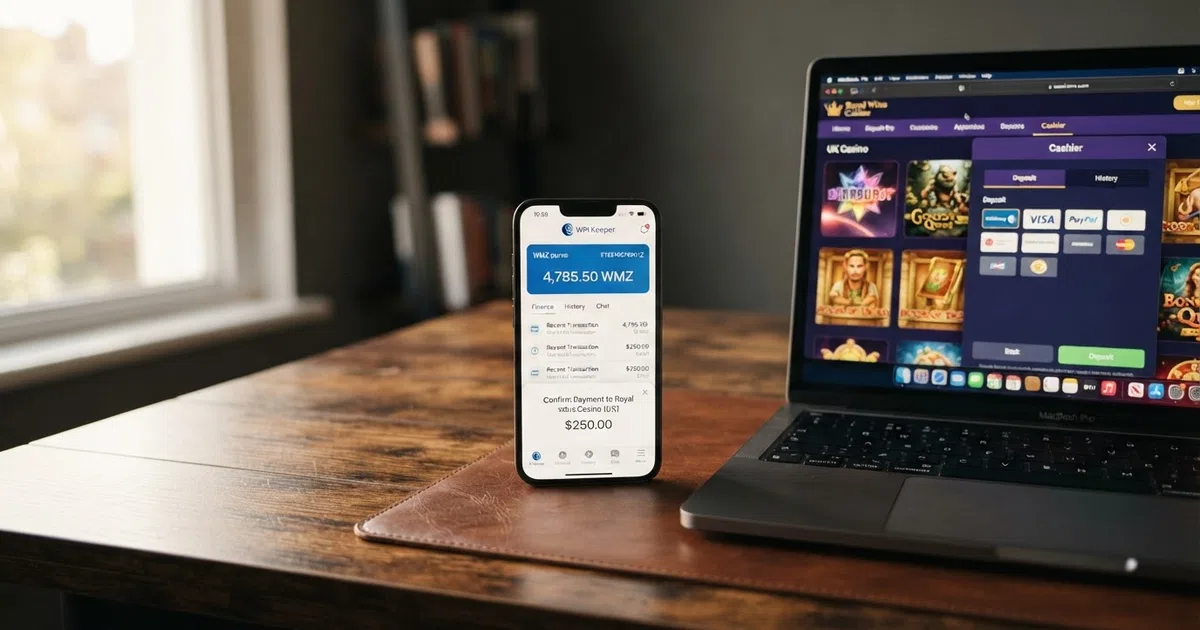
Where WebMoney is accepted, the deposit mechanics are straightforward. The player logs into WebMoney Keeper, selects the purse that matches the currency they want to deposit in (WMZ for dollars, WME for euros), and authorises a payment to the casino’s merchant account. The casino’s cashier credits the deposit typically within seconds, because the transfer moves through WebMoney’s internal ledger rather than through a card network or bank clearing system. The player does not need to enter card details at the casino, which is part of the appeal — the e-wallet acts as an intermediary between the player’s funding source and the gambling site.
The fee structure is consistent across the system. WebMoney charges 0.8% on each payment, with a minimum of 0.01 WM and a maximum cap that varies by currency (e.g., 50 WMZ or 50 WME). Internal transfers between WebMoney users carry no fee. The 0.8% charge is small relative to a bank wire or a card transaction, and for deposits above a few pounds it represents a modest cost. For very small deposits, the minimum fee of 0.01 WM becomes proportionally larger. The instant deposit claim holds only where the casino actually supports the WebMoney rail — and at a GB-licensed site, that condition is never met.
Where the Full List Lives — and Why It Changes Fast
Any printed list of WebMoney-accepting casinos ages quickly. Offshore operators add and drop payment methods as their processing arrangements change, and a site that accepted WebMoney last month may not accept it this month. The aggregator sites that track current WebMoney-accepting casinos — sites like Casinobankingmethods.com, Mr-gamble.com and Casino.guru — update their filters regularly, and a player who wants the current landscape should consult them rather than rely on a snapshot.
The distinction between sites that claim to accept WebMoney and sites where a deposit actually goes through matters. Some operators list WebMoney in their payment-method marketing but route it through a payment service provider that may decline UK customers at the funding stage. Others accept WebMoney from any jurisdiction, including the UK, with no identity verification and no GAMSTOP check. A newly launched WebMoney casino — one that appears on an aggregator this month and was unknown last month — should be evaluated with more scepticism than an established operator, because the licence displayed on its footer may be a Curaçao registration that grants the operator little more than a business number and the player none of the UKGC’s enforceable rights.
Depositing and Withdrawing with WebMoney: Speed, Costs and the Catch
The deposit side of WebMoney is genuinely fast. The withdrawal side is where the experience frays, and the fee structure is where a player who does not read the small print pays more than they expect.
Making a Deposit with WebMoney: Step by Step
The deposit flow at an offshore casino that accepts WebMoney runs through five steps. The player opens the WebMoney Keeper app or the web interface. They select the correct purse — WMZ if they hold dollar balances, WME for euros. They enter the deposit amount at the casino cashier, which generates a payment request to a WebMoney merchant ID. The player authorises the payment inside Keeper, confirming the purse and the amount. The casino’s balance updates typically within seconds, because WebMoney settlement is internal to its ledger. The 0.8% fee is deducted from the purse balance at the moment of authorisation, not at the moment of confirmation.
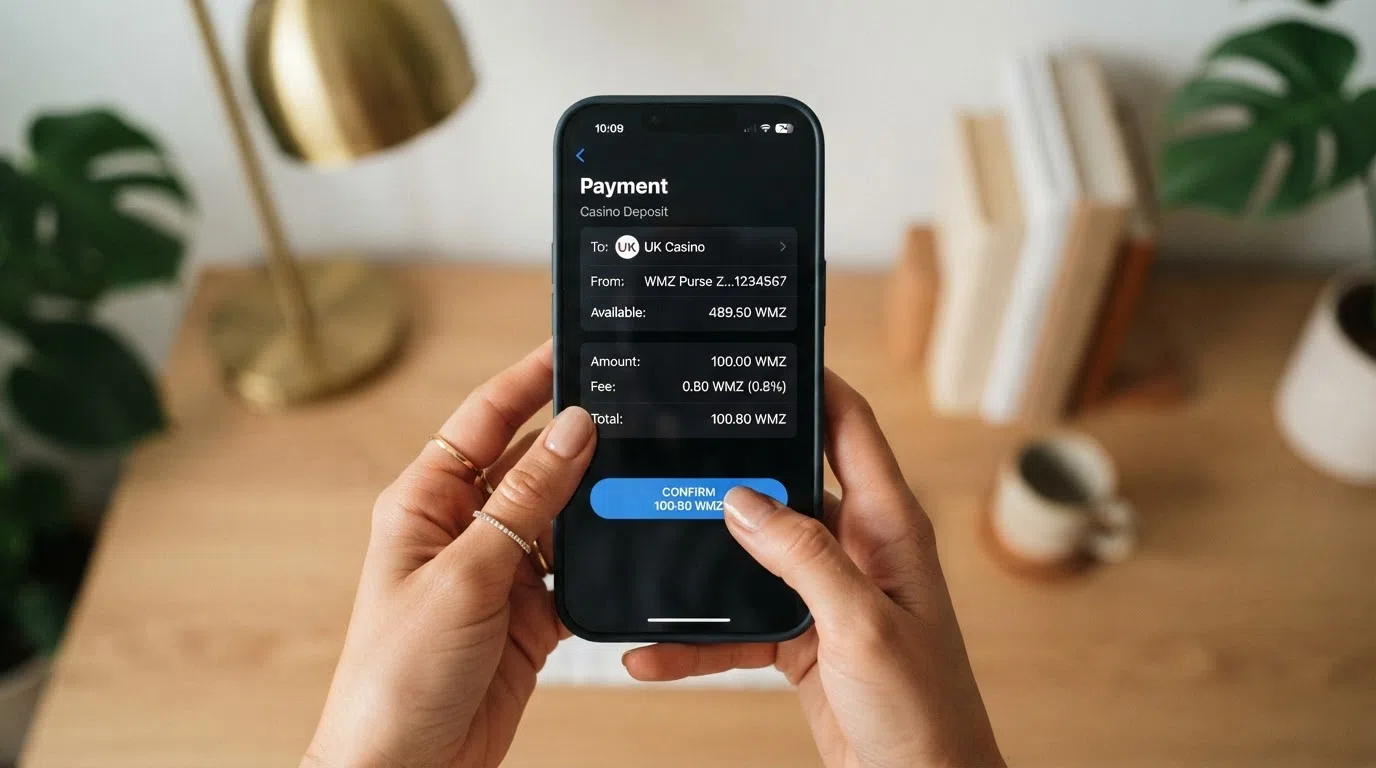
When the instant confirmation does not arrive, the cause is usually one of three things: the casino’s payment processor has declined the transaction, the player’s purse balance is insufficient once the fee is deducted, or WebMoney has flagged the merchant as requiring additional authentication.
Withdrawals and Payout Speed: How Long You Will Actually Wait
The casino’s marketing will say “fast withdrawals”. The reality depends on three layers. The casino’s internal processing window — the pending period between a cashout request and the casino releasing the funds — typically runs from a few hours to two business days at well-run offshore sites. WebMoney’s own settlement time depends on the withdrawal method the player chooses inside the Keeper app. A bank wire withdrawal from WebMoney carries a 2.5% fee and takes up to three days. A bank card withdrawal carries a 5% fee and takes up to three days. A peer-to-peer exchange withdrawal — sending the funds from one WebMoney user to another — carries zero fee and completes within an hour.
The total wait from cashout request to usable funds is therefore the casino’s pending period plus WebMoney’s settlement time. At a casino with a 48-hour pending window and a player who chooses bank card withdrawal, the total is five days. At a casino with a 24-hour pending window and a player who chooses P2P exchange, the total is under two hours. The range is wide enough that the choice of withdrawal method matters as much as the choice of casino.
What WebMoney Charges: Fees, Caps and the Fine Print
- Transaction fee on deposits and external payments: 0.8%, minimum 0.01 WM
- Maximum fee cap: 50 WMZ, 50 WME (varies by currency)
- Internal transfers between WebMoney users: no fee
- Bank wire withdrawal from WebMoney: 2.5%, up to 3 days
- Bank card withdrawal from WebMoney: 5%, up to 3 days
- P2P exchange withdrawal: from 0%, within 1 hour
The fee schedule is the same whether the payment is a casino deposit, an online purchase or a transfer to another user. The minimum deposit at an offshore casino is set by the casino, not by WebMoney, and the minimum deposit varies by operator. A £10 deposit at 0.8% costs the player £0.08 in fees, plus a possible currency-conversion charge if the player’s purse is not denominated in the same currency as the casino. That conversion charge is set by the casino’s processor and is rarely disclosed before the deposit.
Minimum Deposits, Maximum Limits and the Deposit-Linked Bonus Trap
Low minimum deposits at offshore WebMoney casinos sound attractive to a player with a small bankroll, and the marketing leans into that appeal. The bonus terms attached to a WebMoney deposit often rewrite the deal. A casino offering a 100% welcome match up to £200 with a 40× wagering multiplier on the bonus means that a £10 WebMoney deposit produces a £10 bonus that must be turned over £400 in stakes before any winnings become withdrawable. At slot RTP of around 96%, that £400 in turnover produces an expected loss of roughly £16 — the player has paid £10 in cash and lost £16 in expected value chasing a bonus worth £10. The “low minimum” is real; the value of the offer attached to it is not what the headline suggests.
If Not WebMoney: The Payment Methods UK Casinos Actually Accept
For a player who wants to stay inside the GB licensing system, the payment mix is narrower than it was a year ago. Debit cards (Visa, Mastercard, Maestro) remain universal. PayPal is accepted at most major operators but not all — Betfred removed PayPal along with Skrill, Neteller and PaysafeCard in January 2026, accepting now only debit cards, Apple Pay and Open Banking. Apple Pay works at every major UK-licensed casino. Bank transfer is universal, though minimums vary: £25 at William Hill, £100 at bet365, £10 at Sky Vegas. Trustly appears at 888 Casino and a handful of others. Revolut is accepted at Ladbrokes.
The credit-card ban, in force since 14 April 2020 under LCCP licence condition 6.1.2, closed off one entire rail — and it also closed off credit-card funding of e-wallets, which means a PayPal deposit funded by a credit card is treated as a credit-card gambling transaction and blocked at the merchant level. The financial vulnerability check at £150 net deposit in a rolling 30-day period, in force since 28 February 2025, adds another layer: at that threshold, the operator runs a light-touch affordability screen using publicly available data before accepting further deposits.
10 UK-Licensed Casino Operators — and Why Every One of Them Says No to WebMoney
The ten operators below dominate the GB licensed market by brand recognition, player base and product range. Each one was checked against the Gambling Commission’s public register and confirmed as actively licensed. Each one was checked against its published payment-method list and confirmed not to accept WebMoney. The column headings below describe what the reader is comparing; the cells describe what research actually establishes, with the em dash marking data that is not documented for a given operator.
Side-by-Side: How the Ten Compare on Licence, Bonus and Payment Methods
| Operator | UKGC Licence Status | Welcome Bonus | UK Payment Methods | Min Deposit |
|---|---|---|---|---|
| bet365 | Active (Account 39563) | £30 in bet credits after £10 qualifying stake | Debit cards, PayPal, Apple Pay, bank transfer | £5 (debit); £25 (PayPal); £100 (bank) |
| William Hill | Active (Account 38718) | Play £10 Get £30 | Debit cards, PayPal, Apple Pay, bank transfer | £5 (debit); £10 (PayPal); £25 (bank) |
| Sky Vegas | Active (Account 39439) | 50 no-deposit free spins + 200 free spins after £10 deposit | Debit cards, Apple Pay, PayPal, Pay by Bank | £10 |
| Ladbrokes | Active | Play £10 Get £30 + 200 no-wagering free spins | Debit cards, PayPal, Apple Pay, Google Pay, Revolut, Instant Bank Transfer, PaysafeCard | £5 (most methods) |
| Paddy Power | Active | Varies by product | Debit cards, PayPal, Apple Pay, bank transfer, PaysafeCard | — |
| Coral | Active | Play £10 Get £50 | Debit cards, PayPal, Apple Pay, bank transfer, PaysafeCard | — |
| Betfred | Active | Stake £10 Get 200 No Wager Free Spins on Starburst | Debit cards, Apple Pay, Open Banking | £5 |
| Gala Spins | Active | Varies by product | Debit cards, PayPal, Apple Pay, bank transfer | — |
| Betfair | Active | Varies (exchange and casino) | Debit cards, PayPal, Apple Pay, bank transfer, PaysafeCard, Skrill, Neteller | — |
| 888 Casino | Active (Account 39028) | Typically 100% deposit match up to a cap | Debit cards, PayPal, Apple Pay, bank transfer, Trustly | — |
The payment-method column is where the WebMoney question answers itself. Every operator lists debit cards, PayPal or Apple Pay. Most list bank transfer. A few add Google Pay, Revolut, PaysafeCard or Trustly. None adds WebMoney. The “Min Deposit” column carries the data research establishes — it does not invent figures for operators whose published minimum is not in research. The cells that take an em dash indicate that the minimum deposit for these operators is not documented in our research.
bet365 — The Market Leader with the Narrowest Payment Rail
bet365 is the largest operator in the UK by player base and the one whose licence status most readers will recognise: UKGC Account 39563, Remote Casino, Active. The welcome offer is sports-focused — £30 in bet credits after a £10 qualifying stake — with casino variants that vary by promotion period. The payment rail is the narrowest in the featured set: debit cards with a £5 minimum, PayPal with a £25 minimum, Apple Pay, and bank transfer with a £100 minimum. A player looking to deposit £10 or £20 has exactly one realistic option: debit card. PayPal’s £25 floor cuts out small-stake players. The bet credits are non-withdrawable and the stake is not returned with winnings, which means the £30 in credits is functionally a free bet rather than a cash bonus. WebMoney is not accepted.
For a high-stakes player who can fund via bank transfer, bet365’s product range and market depth are unmatched in the GB licensed set. For a small-stake player, the £25 PayPal minimum and £100 bank-transfer minimum push them toward debit card exclusively.
William Hill — Play £10 Get £30 and a PayPal Rail, but No E-Wallet Range
William Hill operates under UKGC Account 38718, Remote Casino, Active. The casino welcome bonus is Play £10 Get a £30 Welcome Bonus, which is more accessible than the bet365 sports-focused structure because the qualifying stake is on casino play. Payment methods are broader than bet365 at the low end: debit cards from £5, PayPal from £10, Apple Pay, and bank transfer from £25. Skrill and Neteller are not available for UK customers, which removes two of the e-wallets a continental European player might expect. WebMoney is not accepted.
The PayPal minimum of £10 is the lowest in the featured set, and combined with the £5 debit-card floor, William Hill serves small-stake players better than most. The £30 welcome bonus is subject to the 10× statutory wagering cap that came into force on 19 January 2026, which means £300 in turnover before withdrawal — a manageable figure at slot RTP of 96%.
Sky Vegas — 50 No-Deposit Spins and the Only Genuinely Free Offer in the Set
Sky Vegas is licensed under UKGC Account 39439, Remote Casino, Active. The welcome package is the most generous in the featured set by structure: 50 no-deposit free spins — genuinely free, no qualifying deposit required — plus 200 additional free spins after a £10 deposit and wager. The total is 250 free spins, and the first 50 cost the player nothing. Payment methods are debit cards, Apple Pay, PayPal and Pay by Bank, with a £10 minimum deposit.
The 50 no-deposit spins are the only genuinely deposit-free offer in the featured ten, and they are the reason Sky Vegas sits near the top of this list for any player who wants to test a casino without committing funds. The 200 deposit-gated spins are a separate offer with its own terms, and the wagering attached to winnings from those spins is subject to the 10× cap. WebMoney is not accepted.
Ladbrokes — 200 No-Wagering Free Spins and the Widest Payment Panel
Ladbrokes operates under an active UKGC Remote Casino licence. The welcome offer is Play £10 Get a £30 Welcome Bonus plus 200 no-wagering free spins on selected slots. The no-wagering structure on the free spins is the point: winnings from those 200 spins are credited as cash, not as bonus funds with a turnover requirement. The payment panel is the widest in the featured set: debit cards (£5), PayPal (£10), Apple Pay (£5), Google Pay (£5), Revolut (£5), Instant Bank Transfer (£5) and PaysafeCard (£5). Maximum deposit across methods is £2,000.
A player who wants maximum payment-method flexibility lands at Ladbrokes. Seven payment rails from a £5 minimum across most of them, plus a no-wagering free-spin offer that no other operator in the set matches in scale. WebMoney is not accepted. The Play £10 Get £30 cash bonus carries a 10× wagering requirement under the statutory cap, producing £300 in required turnover.
Paddy Power — A Varying Welcome Offer and a Standard Payment Mix
Paddy Power operates under an active UKGC Remote Casino licence as part of Flutter Entertainment. The welcome bonus varies by product — sports, casino and bingo offers change frequently and are not anchored to a single headline figure. Payment methods are the standard Flutter mix: debit cards, PayPal, Apple Pay, bank transfer and PaysafeCard. Minimums are not documented for this page. WebMoney is not accepted.
The varying welcome offer is both the strength and the weakness of Paddy Power’s positioning. A player who checks the promotions page at the moment of sign-up may find a strong casino offer or a modest one, depending on what Flutter is pushing that week. The payment panel is competitive but not the widest in the set.
Coral — Play £10 Get £50 and the Entain Payment Stack
Coral operates under an active UKGC Remote Casino licence as part of the Entain group, alongside Ladbrokes and Gala Spins. The welcome bonus is Play £10 Get £50 — the highest headline cash bonus in the featured set. Payment methods are the Entain stack: debit cards, PayPal, Apple Pay, bank transfer and PaysafeCard. WebMoney is not accepted.
The £50 headline is the largest in the featured ten, but it carries the same 10× wagering cap as every other GB-licensed welcome bonus, which means £500 in turnover before withdrawal. For a player who wants the largest cash bonus and is comfortable with the wagering requirement, Coral’s offer is the headline-grabber. The payment panel is functional rather than exceptional — five methods, no Trustly, no Revolut, no Google Pay.
Betfred — 200 No-Wager Free Spins on Starburst and the Slimmest Payment Panel
Betfred operates under an active UKGC Remote Casino licence. The welcome offer is Stake £10 Get 200 No Wager Free Spins on Starburst — and the no-wager structure means winnings from those 200 spins are paid as cash. Starburst’s RTP is 96.09%, volatility is low, and the maximum win is 500× the stake. At the minimum bet of £0.10 per spin, 200 spins cost the player £20 in qualifying stakes — but the £10 stake structure means the player funds £10, wagers it, and receives 200 free spins. The payment panel is the slimmest in the featured set after the January 2026 purge: debit cards, Apple Pay and Open Banking (Instant Bank Transfer). PayPal, Skrill, Neteller and PaysafeCard were all removed in January 2026. Minimum deposit is £5.
The trade-off here is stark. The best free-spin offer in the set sits behind the narrowest payment panel. A player who funded their casino play with PayPal at Betfred before January 2026 must now use a debit card, Apple Pay or Open Banking. WebMoney is not accepted.
Gala Spins — An Entain Brand with a Product-Specific Offer
Gala Spins operates under an active UKGC Remote Casino licence as part of the Entain group. The welcome bonus varies by product — Gala’s bingo and casino brands carry different promotional structures, and the casino welcome offer at Gala Spins is not anchored to a single headline figure. Payment methods are the core Entain mix: debit cards, PayPal, Apple Pay and bank transfer. WebMoney is not accepted.
For a player who values the Entain product suite across multiple verticals, Gala Spins sits alongside Ladbrokes and Coral in the same group structure. The lack of a headline-grabbing welcome offer puts it below Coral on the bonus comparison, and the slimmer payment panel puts it below Ladbrokes.
Betfair — Exchange and Casino Offers with the Broadest E-Wallet Support
Betfair operates under an active UKGC Remote Casino licence as part of Flutter Entertainment, alongside Paddy Power. The welcome offer varies — Betfair runs separate promotions for its exchange product and its casino product, and neither is anchored to a single headline figure. Payment methods are the broadest in the set for e-wallet coverage: debit cards, PayPal, Apple Pay, bank transfer, PaysafeCard, Skrill and Neteller. Betfair is the only operator in the featured ten that still lists both Skrill and Neteller for UK customers. WebMoney is not accepted.
A player who wants Skrill or Neteller as a deposit method at a UK-licensed casino has one option in this set: Betfair. Every other operator has either removed those e-wallets entirely (Betfred) or never offered them for UK customers (William Hill). The trade-off is the varying welcome offer — Betfair does not anchor its casino promotion to a headline figure the way Coral or William Hill do.
888 Casino — A 100% Deposit Match with a Trustly Rail
888 Casino operates under UKGC Account 39028, Remote Casino, Active. The welcome bonus is typically a 100% deposit match up to a cap, varying by promotion period. Payment methods are debit cards, PayPal, Apple Pay, bank transfer and Trustly. 888 is the only operator in the featured set that lists Trustly. WebMoney is not accepted.
The Trustly rail is a different kind of payment method from cards or PayPal — it is an open-banking protocol that connects the player’s bank account directly to the casino without card details. For a player who prefers not to use cards or e-wallets, Trustly at 888 is the closest equivalent to a direct bank-payment experience in the GB licensed set. The 100% deposit match structure is the most traditional welcome offer in the set, though the actual cap and wagering terms vary by promotion.
Why Your Casino Bonus Costs More Than It Looks — Even with WebMoney
A welcome bonus reads like free money. A wagering requirement turns it into a maths problem. The two ideas meet in the gap between what an offer advertises and what it costs the player who tries to clear it.
Welcome Bonuses on WebMoney Deposits: What the Market Actually Offers
Inside the GB licensing system, the wagering requirement on any bonus is capped at 10× the bonus amount, and mixed-product offers — “bet on football, get free spins” — are banned, both in force since 19 January 2026 under LCCP SR Code 5.1.1. The Commission’s stated rationale is that the cap “decreases the likelihood of harm, reduces complexity, and improves transparency while maintaining consumer choice”. A £30 welcome bonus at the GB 10× cap means £300 in required turnover before withdrawal. At slot RTP of 96%, that turnover produces an expected loss of roughly £12. The player has paid nothing to claim the bonus; they have paid £12 in expected value to clear it.
At an offshore WebMoney casino, the picture is different. Research carries no specific bonus terms for offshore operators, but the typical offshore welcome structure is a 100% match bonus with a wagering multiplier of 35× to 50×, a validity window of 7 to 30 days, and a maximum cashout cap that limits what the player can withdraw from bonus-derived winnings. A £30 bonus at 40× wagering means £1,200 in turnover, and at 96% RTP that turnover produces an expected loss of roughly £48. The player has accepted a “free” £30 and lost £48 clearing it. The 10× cap exists precisely because the offshore model without one is structurally expensive to the player.
No-Deposit Bonuses and Free Spins: Rare, Small and Worth Reading the Terms
A no-deposit bonus costs the player nothing to claim — that is the point. Inside the featured GB-licensed set, Sky Vegas is the only operator with a genuinely deposit-free offer: 50 no-deposit free spins on sign-up. Every other free-spin offer in the set requires a qualifying deposit first. Betfred’s 200 no-wager free spins on Starburst require a £10 stake. Ladbrokes’ 200 no-wagering free spins require a Play £10 qualifying bet. The distinction matters: a no-deposit bonus tests the casino without risk; a deposit-gated free-spin offer requires the player to commit funds before receiving the spins.
The free-spin value is typically the minimum bet on the featured slot. On Starburst, that is £0.10 per spin. Two hundred free spins at £0.10 represent £20 in slot turnover — but because the spins are no-wagering at Betfred, winnings are paid as cash. At 96.09% RTP over 200 spins, expected winnings are roughly £19.20 against £20 in spin cost, producing an expected net of around break-even plus the entertainment value of playing. That is the arithmetic of a no-wagering free-spin offer. A wagering free-spin offer at a 35× wagering multiplier produces a different picture: the winnings must be turned over 35× before withdrawal, and at each turnover the house edge takes its 4%.
Wagering Requirements: The 10× Cap and Why It Rewrites the Offer
Take a £30 welcome bonus at a UK-licensed casino. The 10× statutory cap means £300 in turnover. At Starburst’s RTP of 96.09%, the house edge is 3.91%, and the expected loss from £300 in turnover is £300 × (1 − 0.9609) = £11.73. That is the bonus’s real cost to the player: they accepted £30 in bonus funds, played through £300 in required stakes, and lost roughly £11.73 on average. The arithmetic holds for any slot at 96% RTP — the bonus cost scales linearly with the bonus amount and inversely with the RTP.
The same £30 bonus at a 40× offshore multiplier means £1,200 in turnover. Expected loss is £1,200 × (1 − 0.9609) = £46.92. The bonus’s real cost has quadrupled. This is why the GB 10× cap is a concrete consumer protection rather than a footnote — it caps the structural cost of accepting a welcome bonus at a level where the bonus is likely to be net-positive for the player on a single clearance. Offshore operators, operating outside the cap, attach multipliers that flip the same offer into a net-negative expectation.
What Games Can You Actually Play? Slots, Tables and Live Dealer with WebMoney
The game libraries at WebMoney-accepting casinos are large, and the titles below them are the same titles that appear at UK-licensed sites. The difference is in the regulatory frame around the games — what protections apply to how the player interacts with them.
Online Slots with WebMoney: The Titles, the RTPs and the Protections You Leave Behind
| Slot Title | Provider | RTP | Volatility | Max Win |
|---|---|---|---|---|
| Starburst | NetEnt | 96.09% | Low | 500× stake |
| Book of Dead | Play’n GO | 96.21% | High | 5,000× stake |
| Big Bass Bonanza | Pragmatic Play | 96.71% | Medium-High | 2,100× stake |
| Gonzo’s Quest | NetEnt | 95.97% | Medium-High | 2,500× stake |
These four titles appear across the GB licensed and offshore markets. Their RTPs are set by the provider and published in each game’s paytable. The volatility rating describes how the game’s payout distribution behaves: low volatility slots like Starburst pay frequently in small amounts; high volatility slots like Book of Dead pay rarely in large amounts. The max-win figure is the ceiling on what a single spin can return.
At a GB-licensed casino, these slots run inside a regulatory frame that has been in force since 31 October 2021. Auto-play is banned — the player must initiate each spin manually. The minimum spin speed is 2.5 seconds, which means a player cannot rapid-fire through bonuses. Speed-up features are banned. Losses disguised as wins — slot animations that celebrate a payout smaller than the triggering stake — are banned. Reverse withdrawals are permanently banned, so a player who requests a cashout cannot cancel it and return the funds to play. The session screen must display losses, wins and time played.
At an offshore WebMoney casino, none of these rules apply. Auto-play is enabled. Spin speeds are unrestricted. Losses disguised as wins still animate. Reverse withdrawals may be available. The game mechanics are identical; the protective frame around the mechanics is not. A player who crosses to the offshore side forfeits every protection above.
The statutory stake caps that apply to online slots in GB are age-banded: £5 per game cycle for players aged 25 and over, in force since 9 April 2025, and £2 for players aged 18–24, in force since 21 May 2025, imposed by SI 2025/215. At an offshore casino, the operator sets its own stake limits, and a £10 or £20 spin is unremarkable.
Table Games and Live Dealer: Roulette, Blackjack and Real-Time Play
Roulette, blackjack and baccarat tables are universal at both licensed and offshore WebMoney casinos. Live dealer studios — Evolution and Playtech are the dominant providers in the UK — stream real-time tables to player accounts, and a WebMoney-funded account plays the same live tables as a debit-card-funded account at the same casino. The game types are familiar: European roulette, American roulette, single-deck blackjack, multi-hand blackjack, punto banco baccarat. Research carries no per-title house-edge figures for table games at offshore WebMoney casinos, so the specific arithmetic of the house edge on any given table is not documented here.
What the offshore live-dealer experience forfeits is the UK regulatory frame. The stake caps and game-design rules that apply to slots do not extend to live dealer tables in the same way — live dealer is a different product class — but the broader protections around identity verification, affordability checks and dispute resolution do not follow the player offshore. A dispute over a live-dealer outcome at an offshore casino has no Commission complaints route and no approved ADR provider to escalate to.
WebMoney on Mobile: The Apps, the Keeper and the Trade-Off
WebMoney works on mobile through the Keeper app and through mobile casino sites that integrate the WebMoney payment rail. The experience is technically smooth. The regulatory gap follows the player onto the small screen.
Mobile Casino Sites and Apps That Take WebMoney
Mobile-optimised casino sites that accept WebMoney route deposits through the mobile browser version of the WebMoney Keeper web interface, or through a WebView that opens the Keeper app from the casino’s deposit page. Dedicated casino apps for Android and iOS at offshore WebMoney casinos function as thin clients around the mobile site, with native payment flows that integrate WebMoney alongside card and crypto options. At GB-licensed casinos, no dedicated app accepts WebMoney because no GB-licensed casino integrates the payment method.
The mobile experience at an offshore WebMoney casino is functionally equivalent to the desktop experience. The deposit flow opens Keeper, the player authorises the payment, and the casino balance updates typically within seconds. The 0.8% fee applies identically. The mobile-specific risk is that WebMoney’s mobile authentication — a PIN, a biometric or a one-time code — adds a step that some players find friction-heavy on a small screen.
Mobile Payments with WebMoney Keeper: The Flow on a Phone
Installing the WebMoney Keeper app on a phone is the first step. The player authenticates with their WMID and PIN, selects a purse, and the app holds the balance ready for payment authorisation. When the player deposits at a mobile casino site, the cashier redirects to Keeper — either as a WebView inside the casino’s mobile site, or as a deep link that opens the Keeper app and returns the player to the casino when the payment is authorised. The fee structure is the same 0.8%, the settlement is the same instant confirmation, and the failure modes are the same as on desktop.
The user experience on mobile is more dependent on the casino’s integration quality than on WebMoney itself. A well-integrated casino opens Keeper, completes the authorisation, and returns the player to the game lobby in under a minute. A poorly integrated casino drops the WebView, loses the session, and forces the player to restart the deposit flow.
Is It Legal? WebMoney, UK Gambling Law and the Offshore Reality
The legality of WebMoney casinos for UK players is not a yes-or-no question. The operator may be unlicensed, the player is not prosecuted, and the protections the player loses are the real cost of the choice.
GAMSTOP and WebMoney Casinos: The Disconnect
GAMSTOP is the UK’s national multi-operator self-exclusion scheme, and participation has been a mandatory condition of every GB-licensed online operating licence since 31 March 2020. The exclusion periods are six months, one year, five years, or five years with auto-renewal. Once registered, the exclusion cannot be cancelled early. GAMSTOP is the strongest single tool a UK player has for stopping their own gambling across the licensed market.
The disconnect is that GAMSTOP covers only GB-licensed online gambling sites. An excluded British player who registers at an offshore WebMoney casino the next day is not protected — the casino is invisible to the GAMSTOP database, has no integration with it, and has no obligation to check it. The same player who cannot place a single bet at bet365 can deposit £500 via WebMoney at a Curaçao-licensed casino within minutes. GamCare’s National Gambling Helpline saw 81.5% of contacts in 2026 cite online gambling as their primary form, and 996 referrals to treatment in January 2026 alone — up 48% year-on-year. The figure does not separate licensed from unlicensed play, but the structural gap GAMSTOP cannot bridge is part of why the helpline volume continues to grow.
Licensed vs Offshore: What Each Licence Actually Gives You
A UKGC licence is a bundle of enforceable protections. Identity verification before first deposit, mandatory since 7 May 2019. GAMSTOP participation, mandatory since March 2020. The 10× wagering cap, in force since 19 January 2026. The credit-card ban, in force since April 2020. The statutory stake caps, in force from April and May 2025. The financial vulnerability check at £150 net deposit, in force since 28 February 2025. An approved alternative dispute resolution provider. A Commission complaints route. A statutory levy funding treatment, prevention and research. These protections are not optional, and they apply to every GB-licensed operator uniformly.
An offshore licence — Curaçao, Anjouan, or an MGA licence without a UKGC extension — requires substantially less. The identity verification requirement is operator-set rather than regulator-set, and the threshold for what counts as verified varies. There is no GAMSTOP integration. Wagering multipliers of 35× to 50× are standard. The credit-card ban does not apply. The financial vulnerability check does not apply. ADR is operator-selected, not regulator-approved. The Commission’s role in disputes at offshore sites is limited to disruption — cease-and-desist notices, search-engine delisting referrals and payment-provider referrals, totalling 3,140 disruption notices, 447,778 URLs referred to search engines and 287,961 URLs removed between April 2024 and June 2025. The Commission does not hold statutory ISP or DNS blocking powers, so a player who wants to reach an offshore site can generally reach it. The player who gambles there is not prosecuted — the offence under section 33 of the Gambling Act 2005 applies to the operator providing unlicensed gambling, not to the player consuming it — but the player has no Commission complaints route and no enforceable right to a fair outcome.
No-Registration, No-Verification and the Scam Risk
A casino that asks for no ID and no registration is not offering convenience. It is offering the absence of every safeguard the UK licensing regime requires. The UK rule since 7 May 2019 is that every GB-licensed operator must verify the player’s name, address and date of birth before first deposit or any gambling activity. A site that skips this step is unlicensed, and the absence of verification is a signal rather than a feature.
The scam indicators at unlicensed casinos are consistent. No licence displayed in the footer, or a licence number that does not resolve on the regulator’s public register. No ADR provider named. No responsible-gambling tools — no deposit limits, no reality checks, no self-exclusion. The “not on GamStop” marketing angle that some offshore casinos use is a direct signal that the operator is targeting self-excluded UK players, which is the population GAMSTOP exists to protect. A casino that advertises its way around GAMSTOP is not a casino that has improved on the UK system; it is a casino that is bypassing it.
Staying Safe When the Safety Net Is Gone: Responsible Gambling Outside the UK System
Responsible-gambling tools and UK support services exist regardless of where a player chooses to gamble. The automatic protections vanish the moment the site is offshore.
GAMSTOP Self-Exclusion: What It Covers and Where It Stops
GAMSTOP is the UK’s strongest self-exclusion tool, and it stops dead at the GB licensing border. The registration process requires name, address and date of birth, and the exclusion is enforced at every GB-licensed online operator simultaneously. The four exclusion periods — six months, one year, five years, or five years with auto-renewal — give the player a range of commitment levels, but none of them can be cancelled early. A player who registers for five years and changes their mind at month six cannot withdraw the exclusion until the five years have elapsed.
The hard limit is that GAMSTOP cannot see, block or report an account at an offshore WebMoney casino. The self-exclusion is comprehensive inside the GB system and invisible outside it. A player who has registered with GAMSTOP and wants to extend their protection to offshore gambling must do so through individual casino-level self-exclusion at each offshore site — a process that is operator-by-operator, not database-wide.
Safer-Gambling Tools: Deposit Limits, Reality Checks and Time-Outs
- Deposit limits: every GB-licensed operator must offer a customer-set deposit limit before the first deposit (from 31 October 2025), and the limit must be called “deposit limit” using standardised vocabulary from 30 September 2026 under RTS 12. Decreases are actioned immediately; increases may not be.
- Reality checks: periodic on-screen notifications displaying session time and net position, mandatory at GB-licensed operators.
- Time-outs: short-term self-exclusion from a single operator, typically 24 hours to 6 weeks.
- Financial vulnerability check: mandatory light-touch check at £150 net deposit in a rolling 30-day period (in force since 28 February 2025).
None of these protections are guaranteed at an offshore WebMoney casino. The operator may offer equivalent tools voluntarily, or it may not. The deposit limit prompt that is mandatory at GB-licensed operators does not exist offshore. The £150 vulnerability check does not exist offshore. A player who wants these safeguards should stay inside the GB licensing system.
Where to Get Help: GamCare, NHS Clinics and the Full UK Support Network
The UK has one of the world’s most comprehensive gambling-harm support systems. The National Gambling Helpline is operated by GamCare, available 24/7 on freephone. The NHS runs gambling harm clinics in England, Scotland and Wales, and referrals increased from 2,284 in 2023/24 to 4,355 in 2024/25 — a 91% rise. GambleAware funds prevention and education work. Gamblers Anonymous runs peer-support meetings across the country.
The prevalence data behind these services is stark. The NHS Adult Psychiatric Morbidity Survey 2023–24 found 0.4% of adults scored 8+ on the Problem Gambling Severity Index — the threshold for problem gambling — and 1.6% scored 3+, indicating moderate-risk gambling. Men (2.2%) scored higher than women (1.0%), and prevalence was highest among 25-34 year-olds at 3.5%. Online gambling participation in the past four weeks was 37% in the September 2025 to January 2026 wave, falling to 15% excluding lottery-only players. The statutory levy from 6 April 2025 — 1.1% of gross gambling yield for remote casino licences — funds treatment (50%), prevention (30%) and research (20%), and the rising referral numbers show the funding is reaching the front line.
How We Selected and Ranked the Operators on This Page
The ten operators above were selected because each is licensed by the Gambling Commission, confirmed active against the Commission’s public register, and is among the most recognised UK-facing casino brands. The evaluation framework prioritised licence status, welcome-bonus value and terms, payment-method range, and the presence of free-spin or no-wagering offers. Bet365’s licence status was last updated against the public register on 29 July 2026.
The honest framing of this page is that the featured set covers GB-licensed operators only. The page does not rank or recommend offshore WebMoney-accepting casinos, because ranking them would require the kind of verification the GB public register provides and the offshore licensing environment does not. Every operator in the table above was checked for WebMoney acceptance and confirmed not to list it. The table’s payment-method column is therefore the answer to the page’s central question: this is what the legitimate UK market accepts, and WebMoney is not on the list.
What This Means for a UK Player Looking for a WebMoney Casino
The central finding is straightforward. Zero GB-licensed casinos accept WebMoney, and the reason is structural rather than temporary. WebMoney’s FCA e-money institution registration is no longer active, and without it, GB-licensed casinos have no compliant payment-processing route. The casinos that do accept WebMoney and serve UK players operate outside the GB licensing system, which means they are not covered by GAMSTOP, not subject to the 10× wagering cap, not bound by the credit-card ban, not integrated with the £150 financial vulnerability check, not obliged to verify identity before first deposit, and not answerable to the Gambling Commission’s complaints route. The player who crosses that line trades every UK safeguard for a payment method.
The alternative is to stay inside the GB licensing system and use what it accepts: debit cards from £5, PayPal from £10 or £25 depending on operator, Apple Pay universally, bank transfer with minimums ranging from £10 to £100, and at selected operators, Trustly, Revolut, Google Pay or PaysafeCard. The payment-method mix is narrower than the offshore market, but every method on the list runs inside a regulatory frame that enforces identity verification, affordability screening, dispute resolution and self-exclusion.
For a player who wants WebMoney specifically — because they hold balances in WMZ or WME purses, or because they prefer the e-wallet flow — the honest answer is that the licensed UK market does not support their preferred payment method, and the offshore market that does support it operates without the protections the UK system was built to provide. The decision is a trade-off, and the trade-off is the player’s to make.
Frequently Asked Questions
Why can I not deposit with WebMoney at a British online casino?
WebMoney Europe Ltd’s FCA e-money institution registration is no longer active, which means GB-licensed casinos have no compliant route to integrate WebMoney into their cashier systems. The e-wallet’s UK availability ended when the regulatory registration lapsed, and no major UK-licensed operator currently lists WebMoney as a payment method. To deposit at a British online casino, players must use debit cards, PayPal, Apple Pay or bank transfer.
Are WebMoney casinos safe for British players?
WebMoney itself is a regulated payment system, but the casinos that accept it and serve UK players are almost exclusively offshore-licensed. Those operators are not covered by GAMSTOP, are not subject to the Gambling Commission’s wagering cap, do not run the £150 financial vulnerability check and are not answerable to the Commission’s complaints route. The payment method is safe; the regulatory frame around the casino is not the UK frame a British player might expect.
What are the best alternatives to WebMoney for UK casino deposits?
Debit cards (Visa, Mastercard, Maestro) are universal from a £5 minimum. PayPal is accepted at most major operators — minimums range from £10 at William Hill and Ladbrokes to £25 at bet365. Apple Pay works everywhere. Bank transfer is universal with minimums from £10 to £100. Trustly appears at 888 Casino, Revolut and Google Pay at Ladbrokes, and Open Banking at Betfred after the January 2026 payment-method purge.
How fast are withdrawals from WebMoney casinos?
WebMoney deposits are typically instant. Withdrawals depend on two stages: the casino’s internal pending period (typically a few hours to two business days) and WebMoney’s settlement time by withdrawal method. Bank wire withdrawals carry a 2.5% fee and take up to three days; bank card withdrawals carry a 5% fee and take up to three days; peer-to-peer exchange withdrawals from WebMoney carry zero fee and complete within one hour. The total wait from cashout request to usable funds ranges from under two hours to five days depending on the method chosen.
Is it legal for UK players to use offshore casinos that accept WebMoney?
Playing at an offshore casino that accepts WebMoney is not criminalised for the player. The offence under section 33 of the Gambling Act 2005 applies to the operator providing unlicensed gambling to British customers, not to the player consuming it. The player is not prosecuted, but they lose every GB regulatory protection: GAMSTOP coverage, the Commission’s complaints route, approved ADR, the 10× wagering cap, the credit-card ban, the financial vulnerability check and the statutory stake caps. The choice is legal; the trade-off is the player’s to evaluate.
Payments – No Minimum Deposit Casinos UK
Content created by the «No Minimum Deposit Casinos UK» team