Casinos That Accept USDC for UK Players — Offshore Sites, Networks and the Regulatory Wall
 Available in GB
Data current as of 25 August 2026, checked against the UK Gambling Commission’s public register and the operator terms published by each featured casino.
Your USDC Won’t Work at Any UKGC-Regulated Casino — Here Is the Reality
A pound of it, a million of it, doesn’t matter. No casino licensed by the UK Gambling Commission accepts USDC, USDT, BTC, ETH or any cryptocurrency in 2026. The rule sits inside the Commission’s source-of-funds, anti-money-laundering and Licence Conditions and Codes of Practice requirements — not as a named crypto ban, but as a structural block. A licensed operator must know whose money it is taking, where it came from and whether the source is legitimate. A blockchain wallet address does not satisfy that test, so the deposit never lands.
Gamblingpedia’s 2026 assessment is direct: the UKGC’s source-of-funds, AML and LCCP requirements make direct crypto deposits “effectively impossible” at any operator legally serving Great Britain. The prohibition is not a gap in the market waiting to be filled; it is regulatory architecture. Every casino offering USDC deposits to UK players is licensed offshore. Most hold a Curaçao Gaming Authority licence. One on this list holds an Anjouan licence. None is authorised to advertise to or transact with British customers under the Gambling Act 2005.
The UKGC has not banned crypto outright. In February 2026, the Commission’s executive director Tim Miller told the Industry Forum that the Commission wants to “start looking at what the potential path forward would be to create a way for crypto assets to be used as a consumer payment option for licensed gambling operators.” That timetable runs to the FCA’s expanded cryptoasset regime, which enters full scope on 25 October 2027. Until then, the offshore route is the only route.
What USDC Casinos Are and How Blockchain Gambling Works
USDC is a stablecoin issued by Circle, pegged one-for-one to the US dollar and backed by reserves the company publishes monthly. Its value does not swing like Bitcoin’s; the dollar peg is the point. That peg, combined with multi-chain availability, is what makes USDC the practical deposit currency for online gambling — predictable value, fast settlement, transparent ledger.
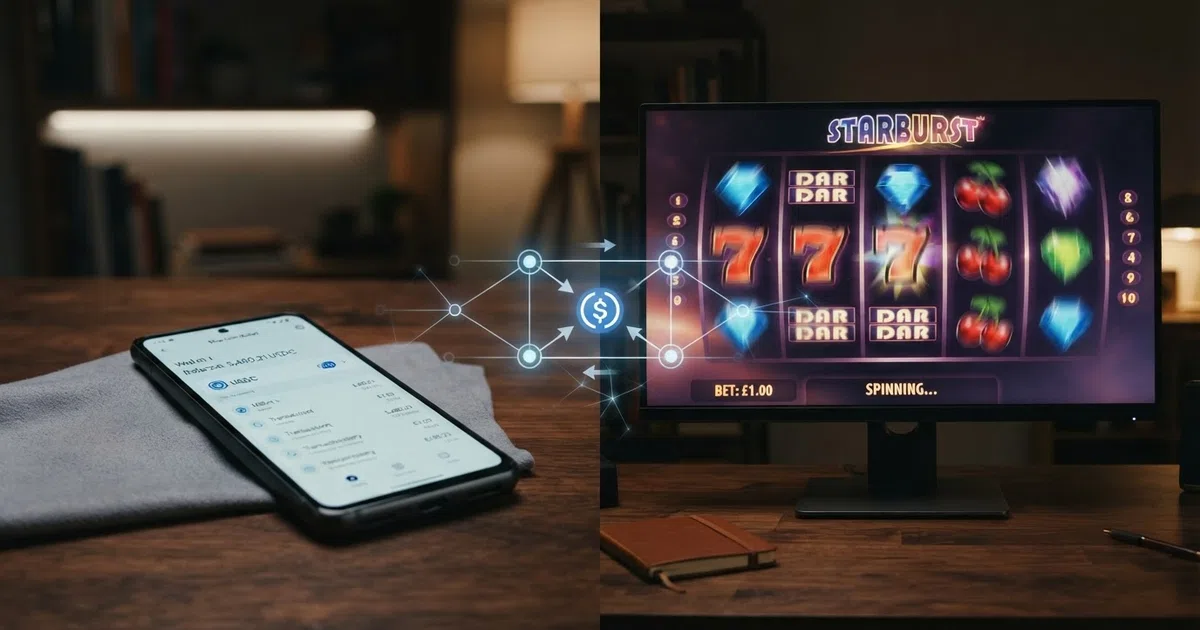
A USDC casino is an online gambling site that accepts deposits in USDC directly to a wallet address. The flow runs from the player’s wallet to the casino’s deposit address, through blockchain confirmation, to a credited gaming balance. The casino displays the balance in whatever currency it chooses — USDC, USD, EUR or GBP — and converts at the moment of credit.
The blockchain layer adds one feature a standard online casino cannot offer: provably fair games. These are titles whose outcomes are determined by a smart-contract algorithm whose inputs and outputs are visible on-chain before and after the spin. A player can verify, after the fact, that the result was not retroactively changed. This sits alongside the standard RNG titles from Pragmatic Play, Evolution and Hacksaw that UK players already know.
USDC operates across more than fifteen blockchain networks. On Solana, transactions settle in five to twenty seconds with fees under a cent. On Ethereum, transactions can cost several dollars at peak congestion. The network choice is the player’s first decision, and it determines whether the deposit feels like a bank transfer or a contactless tap.
Can You Use USDC at Online Casinos? The Practical Answer
Yes, at offshore sites. The practical steps are straightforward. Buy USDC on an FCA-registered exchange — Coinbase, Kraken or Bitstamp are the established names for UK customers. Move the USDC to a self-custody wallet or leave it on the exchange. Open an account at a USDC-accepting casino. Copy the casino’s deposit address, or scan the QR code it provides. Choose the correct network — sending USDC on the wrong chain is the most common way players lose deposits. Confirm the transaction in your wallet. The balance appears within minutes, sometimes within seconds.
The choice of network matters more than most guides admit. Solana is the default for speed and low cost. Polygon and Base sit in the middle. Ethereum is the expensive option during peak congestion. Tron handles volume cheaply but offers fewer casino integrations. The casino’s deposit page usually specifies which networks it accepts; following that specification is the difference between a five-second confirmation and a deposit that never arrives.
The casino credits the balance in its display currency. Some sites hold USDC natively; most convert to a USD or EUR figure for the gaming interface. The conversion rate is set by the casino at credit time and is not always transparent. Players who care about the exact exposure should deposit small amounts first and observe how the casino displays the balance.
Why Some UK Players Choose USDC — and What They Trade Away
The case for using USDC at an offshore casino rests on four advantages, each real and each priced:
- Settlement speed. A USDC deposit on Solana confirms in five to twenty seconds. A UK bank transfer can take hours; a card deposit goes through immediately but the transaction appears on a bank statement as a gambling payment. Crypto deposits do not appear on a UK bank statement at all — neither deposit nor withdrawal. For players who do not want a gambling line on their statement, USDC is one route to that.
- No payment-processor holds. Card deposits at offshore casinos are sometimes declined by the card issuer or by the payment processor behind it. Crypto deposits are not routed through Visa, Mastercard or any bank. The transaction settles or it does not; no intermediary can block it.
- Access to casinos that block UK IPs on fiat rails. Some offshore casinos accept crypto from UK players while declining GBP deposits. USDC is how those players fund the account.
- Provably fair gaming. Smart-contract-verified outcomes are a category of trust that traditional RNG auditing does not offer. Whether a given player values that enough to override the UK protections is a personal calculation.
The protections traded away are not minor:
- GAMSTOP coverage. GAMSTOP self-exclusion applies to GB-licensed operators. None of the offshore casinos on this list are registered with GAMSTOP. A player who has self-excluded for six months, one year or five years can still open an account at every operator reviewed here. GAMSTOP’s exclusions — six months, one year, five years or five years with auto-renewal, none of them cancellable early — do not extend to offshore sites.
- UKGC complaints route. The Commission does not adjudicate disputes with operators it does not licence. There is no British ADR provider standing behind a Curaçao-licensed casino.
- Deposit protection. There is no UK equivalent of the Financial Services Compensation Scheme for customer funds held at an offshore casino. If the operator goes insolvent, the player’s balance is unsecured.
- The £5 and £2 slot stake caps. Statutory maximums imposed in 2026 — £5 per game cycle for players 25 and over (in force 9 April 2025), £2 for players 18 to 24 (in force 21 May 2025) — apply only to GB-licensed operators. Offshore casinos are not bound. A player at an offshore site can stake £100, £500 or £1,000 per spin.
- Credit card ban. The 14 April 2020 prohibition on credit cards for remote gambling, including credit-card-funded e-wallet payments, sits inside the UKGC licence conditions. Offshore casinos are not subject to it. The ban does not reach them.
The trade is real and irreversible at the moment of deposit. Once USDC crosses to an offshore casino, every protection listed in the Gambling Act 2005 and the LCCP stops applying.
How USDC Casino Payments Work, What They Cost and What Holds Them Up
Depositing with USDC: Networks, Wallets and the Step-by-Step Flow
The deposit itself is simpler than a bank transfer. The complications sit in the network choice and the wallet custody model.
Network selection is the first decision and the easiest one to get wrong. The casino’s deposit page lists which networks it accepts — typically Ethereum, Solana, Polygon, Tron and BSC. The player selects one, the casino generates a deposit address on that chain, and the player sends USDC to that address. Sending USDC on a chain the casino does not accept means the deposit is lost. The blockchain will confirm it; the casino’s ledger will not credit it. Network mismatch is the single most common cause of vanished USDC deposits, and it is irreversible.
Solana is the practical default for most players. A Solana USDC transaction costs under a cent and settles in five to twenty seconds. Polygon and Base sit at a comparable price point with slightly slower settlement. BSC is cheap but its tooling is less polished. Tron handles USDC at fractions of a cent per transaction but most UK-facing casinos do not integrate it. Ethereum is the legacy option: familiar, well-supported, and the most expensive network to use at peak congestion. A Solana USDC deposit and an Ethereum USDC deposit arrive at the same casino credit; the player who chose Ethereum paid several dollars in gas to make it happen.
The wallet question is custody. A self-custody wallet — MetaMask, Trust Wallet, Phantom for Solana — gives the player full control of the USDC until the moment it is sent. An exchange-held wallet is convenient but introduces an extra step: the exchange must permit the withdrawal to an external address. For most UK players buying USDC on Coinbase or Kraken, the exchange allows external withdrawals but the network selection in the exchange’s send interface must match the casino’s accepted networks. Sending USDC from Coinbase as ERC-20 to a casino that only credits Solana USDC will not credit.
The casino’s deposit page specifies the minimum confirmations required before the balance is credited. One confirmation is the standard on fast chains; some sites require three on Ethereum for additional security. The wait between sending and credit is the difference between the casino’s confirmation policy and the blockchain’s settlement time — usually seconds on Solana, occasionally minutes on Ethereum during high traffic.
Withdrawing Winnings in USDC: Limits, Verification and What Actually Happens
The withdrawal direction reverses the deposit direction: casino balance to player wallet, on the same network the deposit used. The blockchain half is fast. The casino half is where the wait lives.
A typical offshore casino withdrawal runs through three stages. The player requests a withdrawal in USDC. The casino’s payments team reviews the request. The casino broadcasts the transaction to the blockchain. The player’s wallet confirms receipt.
The middle stage is the variable one. Some operators approve withdrawals in minutes — Jackbit is the standout for near-instant fee-free USDC payouts. Others hold the request for manual review, particularly on first withdrawal or on amounts above an internal threshold. The review can take hours or days, depending on the operator and the workload. Research did not surface per-operator withdrawal cap figures for most of the featured brands; the cap policy is qualitative and varies by site.
KYC is the trigger most players do not expect on the way out. Offshore casinos market themselves as “no verification” at the deposit stage, and that marketing is often accurate at that stage. The verification demand arrives when the player tries to cash out. The casino asks for proof of identity, proof of address and sometimes proof of source of funds. The request is grounded in the casino’s own licence obligations — Curaçao and Anjouan both require AML procedures, even if the threshold for triggering them is set higher than the UKGC’s. A player who supplied nothing at deposit is now supplying documents or waiting for a hold to lift.
The contrast with the UK-licensed market is stark. A UKGC-licensed casino verifies name, address and date of birth before first deposit, since 7 May 2019. The friction is paid up front. At an offshore casino, the friction is paid at the moment the player wants their winnings. Players who read “no KYC” as “no documents ever” are reading the marketing copy, not the licence conditions.
USDC Payout Speed: What Your Network Choice Means for Your Cashout
The casino might approve a USDC withdrawal in minutes. The blockchain then determines whether the funds arrive in the player’s wallet in five seconds or in twenty minutes.
Solana is the fastest end-to-end option. Once the casino broadcasts the transaction, Solana confirms it in five to twenty seconds at a cost under a cent. A withdrawal that the casino approves in two minutes will land in the player’s wallet inside three minutes total. This is the experience Jackbit markets on.
Polygon and Base sit in the next tier. Confirmation times of ten to thirty seconds at sub-cent fees. Casino approval times still dominate the total — the network is rarely the bottleneck for these chains.
Tron handles USDC cheaply but the integration with casino withdrawal flows is patchier. Most UK-facing operators do not broadcast Tron USDC withdrawals; when they do, the cost is fractions of a cent and the speed is comparable to Polygon.
Ethereum is the worst case for withdrawal speed. Network confirmation during low-traffic periods is under a minute. During peak congestion — NFT mints, token launches, USDC transfer surges — confirmation can stretch to ten minutes or more and gas fees climb above five dollars. A player withdrawing on Ethereum at the wrong moment pays for the network’s busiest hour.
The casino typically pays the gas on the withdrawal — most operators absorb the network fee rather than deducting it from the player’s payout. Research does not give a per-operator breakdown of this practice; the pattern is widespread across the featured set. A player who watches a withdrawal land at exactly the requested amount is seeing the casino absorb the fee.
USDC Casino Fees, Minimum Deposits and What the Casino Won’t Tell You
The casino says “no deposit fee.” Most crypto casinos do not add one — research confirms the player pays only the blockchain network charge. That charge varies by network and is visible before the transaction is signed.
The three layers of cost sit at different points in the journey.
The first layer is the exchange on-ramp fee. Buying USDC with GBP on Coinbase or Kraken costs somewhere between 0.5% and 2% depending on the payment method and the platform’s fee schedule. A debit card purchase of £1,000 worth of USDC may cost £10 to £20 in fees; a bank transfer purchase typically costs less but settles more slowly. This fee is paid once, at the moment of purchase, and is invisible to the casino.
The second layer is the network gas for the deposit transaction. On Solana and Polygon, this is fractions of a cent. On Ethereum at peak, it can be five to ten dollars. The fee is paid by the player from their wallet at the moment the transaction is signed. A player depositing $20 to an Ethereum-only casino may find that $5 of the deposit is consumed by gas before it reaches the casino.
The third layer is the spread between USDC and the casino’s gaming balance. Most offshore casinos credit deposits in USD, not in USDC, even when the deposit was sent in USDC. The conversion happens at the casino’s published rate, which may or may not match the market rate. Research does not give per-operator spread figures; players who care about exact exposure should test with a small deposit first.
Minimum deposit amounts at USDC casinos typically run from $10 to $20 equivalent, varying by operator and network. The minimum is denominated in the casino’s display currency and translated into USDC at the moment of deposit. On Ethereum, a $10 minimum is effectively higher because the gas fee consumes a larger share of a small deposit. A $20 minimum on Polygon is closer to $20 in practice. The minimum exists to keep the casino’s payment-processing economics sensible; small deposits generate more support tickets than revenue.
USDC vs USDT vs Bitcoin: Which Crypto Works Best for Casino Payments
USDC is the quiet workhorse. USDT is the louder cousin. Bitcoin is the expensive option that few UK casino players should still be using for this purpose.
USDC and USDT are both dollar-pegged stablecoins, both available on multiple chains, both accepted at every operator on this list. The differences are narrower than marketing suggests. USDC is issued by Circle, a US-regulated company with monthly reserve attestations; the transparency is a competitive advantage. USDT is issued by Tether and has wider adoption in the broader crypto ecosystem, including more casino integrations and more exchange pairings. For most players, the choice between USDC and USDT comes down to which the casino supports on the player’s preferred network. Jackbit takes both.
Bitcoin is a different category of asset for casino deposits. Its value moves — a £500 BTC deposit can be worth £480 or £520 by the time the casino confirms it. Settlement times are longer than stablecoin transfers: ten minutes for a single confirmation on a quiet network, much longer at peak. Network fees on Bitcoin during high-activity periods have exceeded $5 per transaction. The only argument for using BTC at an offshore casino is that some sites offer BTC-only promotions; the rest of the case has migrated to stablecoins.
Jackbit’s supported coin list gives the breadth of the modern offshore casino wallet: BTC, ETH, LTC, USDT, XRP, BNB, DOGE, BCH, SOL, TRX, XMR and DASH alongside USDC. Most of the other featured operators support a comparable range. The proliferation of supported coins reflects the exchange integrations rather than player demand — most UK players end up using USDC or USDT because the dollar peg removes volatility risk from the deposit and the withdrawal.
Top 10 USDC Casinos Accepting UK Players in 2026
The ranking is built from on-chain USDC deposit volume (DappRadar’s live tracker as the primary quantitative signal), bonus-term transparency, withdrawal reliability and game-provider depth. No operator on this list paid for placement. The structural caveat applies to every row: none holds a GB licence.
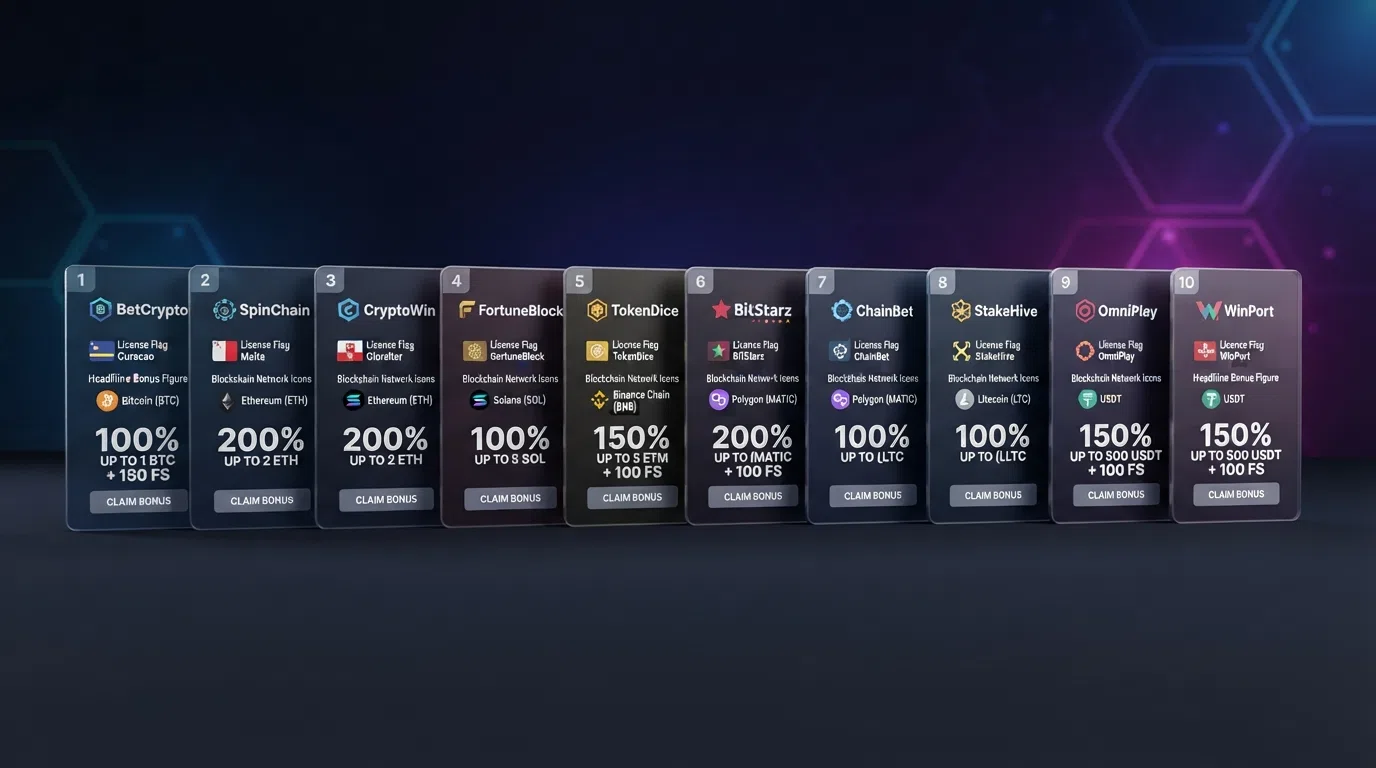
| Casino | Licence | USDC Networks | Welcome Offer | Wagering | Game Providers |
|---|---|---|---|---|---|
| Stake | Curaçao (CGA) | Ethereum, Solana, BSC | No standard welcome bonus (VIP rakeback) | N/A | Pragmatic Play, Evolution, Hacksaw, Nolimit City, Push Gaming |
| BC.Game | Curaçao (CGA) | Ethereum, Solana, BSC, Tron + others | Multi-tier welcome package | Varies by tier | Pragmatic Play, Evolution, BGaming, Hacksaw (6,000+ titles) |
| Jackbit | Curaçao (CGA) | Ethereum, Solana, Polygon, Tron + 8 others | 100 wager-free spins (£50 min deposit) | 0× on spins | Pragmatic Play, Evolution, Hacksaw, Play’n GO, Nolimit City |
| Lucky Block | Curaçao (CGA) | Ethereum, Solana, others | 200% up to £25,000 + 50 free spins | Bonus portion only | Pragmatic Play, Evolution, Hacksaw, Push Gaming (3,000+ titles) |
| Betpanda | Curaçao (CGA) | Ethereum, Solana, others | — | — | Evolution, Pragmatic Play, others |
| Vave | Curaçao (CGA) | Ethereum, Solana, others | — | — | Pragmatic Play, Evolution, others |
| FortuneJack | Curaçao (CGA) | Ethereum, others | 200% up to $2,000 | 40× (deposit + bonus), $15 max bet | Pragmatic Play, Evolution, Betsoft (3,000+ titles) |
| 7BitCasino | Curaçao (CGA) | Ethereum, others | — | — | Pragmatic Play, Evolution, BGaming (7,000+ titles) |
| Thrill | Anjouan (Anjouan Gaming Board) | Ethereum, Solana, Tron | 0× wagering model | 0× on all bonuses | Pragmatic Play, Evolution, Hacksaw (3,480+ games) |
| CasinOK | Curaçao (CGA) | Ethereum, USDC + 15+ coins | Reported welcome offer | 35× wagering | Pragmatic Play, Evolution, others (7,000+ titles) |
Bonus offers at these operators vary by promotion; verify current requirements on each site before depositing.
Stake: The Volume Leader with a VIP Model Instead of a Welcome Bonus
Stake is the largest USDC casino by on-chain deposit volume — $19.97M tracked across 41,671 deposits on BSC, Ethereum and Solana, per DappRadar’s live tracker. The volume is not marketing; it is a count of USDC transactions hitting Stake’s deposit addresses.
The model that volume flows toward is not a traditional welcome bonus. Stake runs a VIP rakeback system: players earn a percentage of the house edge back on every bet, scaled by wagering volume. A new player with a small bankroll sees little from this structure; a high-volume regular sees a steady rebate that no deposit match can match over time. There is no £25,000 headline figure. There is no wagering requirement. The trade is speed of return for depth of engagement.
The game library is anchored by Pragmatic Play, Evolution, Hacksaw, Nolimit City and Push Gaming — the same studios UK players already know from licensed sites. The difference is the regulatory framework around them. Pragmatic Play slots at Stake may run at RTP configurations that differ from the UKGC-mandated versions of the same titles; research does not give per-title RTP figures for USDC casinos, so the variance is qualitative.
For a player who wagers frequently and wants the rakeback structure, Stake is the volume leader and the reasonable top of the ranking. For a player depositing $200 and playing one weekend, the VIP curve is the wrong shape and a welcome bonus at a smaller operator may return more.
Lucky Block: The UK-Facing Contender with GBP-Native Support
Lucky Block is the closest thing to a UK-localised USDC casino on this list. The welcome bonus is denominated in pounds — 200% up to £25,000 plus 50 free spins — and the wagering applies to the bonus portion only. The deposit is excluded from the rollover, which is a structural advantage over bonuses that count deposit + bonus towards wagering.
The maths: a £1,000 deposit at the 200% match produces a £2,000 bonus. If wagering applies to the bonus only, the player must turn over £2,000 to clear it. If wagering applies to deposit + bonus — the more common offshore structure — the same scenario requires £3,000 in turnover. The Lucky Block structure is half the work for the same bonus.
The game library sits at 3,000+ titles from Pragmatic Play, Evolution, Hacksaw and Push Gaming. The licence is Curaçao. The bonus is sterling. The combination is unusual offshore and reflects Lucky Block’s UK-facing positioning.
For a UK player who wants a familiar currency on screen and a bonus structure that doesn’t double the wagering workload by counting the deposit, Lucky Block is the natural pick. The headline figure is high; the conditions are unusually clean.
Jackbit: The Withdrawal Speed Specialist with Wager-Free Spins
Jackbit wins on speed. Near-instant, fee-free withdrawals on USDC and USDT have made it consistently one of the quickest payout operators in offshore crypto gambling — the source is PlayonStake and Pamtree, both tracking the withdrawal-speed benchmark across the offshore set.
The welcome offer is structured unusually for the offshore market: 100 wager-free spins at 0× wagering. A £50 minimum deposit activates the promotion. There is no wagering requirement on the spin winnings; what the spins win is the player’s, withdrawable. There is no max cashout cap on the wager-free spins. The bonus is what the marketing calls “free” — and in this case, the marketing is accurate.
The wallet is broad. Jackbit accepts BTC, ETH, LTC, USDT, XRP, BNB, DOGE, BCH, SOL, TRX, XMR and DASH alongside USDC. The network support covers Ethereum, Solana, Polygon, Tron and eight additional chains — the widest USDC network coverage on this list. For a player who holds multiple cryptocurrencies and wants one operator to handle all of them, the breadth matters.
The game providers — Pragmatic Play, Evolution, Hacksaw, Play’n GO and Nolimit City — cover slots, live dealer and the high-volatility cluster UK players associate with Nolimit City and Hacksaw titles.
For a player prioritising payout speed and a no-strings welcome offer, Jackbit is the clearest match on this list. The wager-free structure removes the largest single source of bonus disappointment in offshore gambling.
FortuneJack: The Old-Guard Crypto Casino with Transparent USDC Bonus Terms
FortuneJack has been running long enough that the bonus terms are clear rather than obscured. The 2026 welcome bonus for USDC deposits is 200% up to $2,000 with 40× wagering on deposit + bonus and a $15 maximum bet while the bonus is active.
The wagering maths on this bonus are the reason it earns its place in the conversation. A player depositing $1,000 receives a $2,000 bonus. The combined wagering requirement is 40 × ($1,000 + $2,000) = $120,000 in turnover before withdrawal. The $15 max bet applies throughout the clearing window — a single spin above $15 typically voids the bonus and the winnings from it. Clearing $120,000 in turnover at $15 per spin requires 8,000 qualifying spins. At a five-second spin interval, that is 11.1 hours of continuous play, ignoring any non-slot activity that doesn’t count at 100% towards wagering.
The conditions are harsh by UK standards. Under the UKGC’s 10× cap from 19 December 2025, the same $1,000 deposit matched at $2,000 would require $20,000 in turnover — a sixth of the workload. The offshore bonus is larger in headline and smaller in realisable value for most players.
The game library runs to 3,000+ titles from Pragmatic Play, Evolution and Betsoft. The licence is Curaçao. The transparency is the asset: FortuneJack publishes the wagering multiple and the max-bet rule clearly, so a player can decide whether the bonus is worth the work before depositing.
For a player who values bonus clarity over bonus size, FortuneJack is the honest pick. The terms are not favourable; they are legible, which is rarer than it should be offshore.
Thrill: The Zero-Wagering Disruptor with an Anjouan Licence
Thrill is the only operator on this list with a 0× wagering model and the only one licensed in Anjouan rather than Curaçao. Both facts are unusual; both are deliberate.
The 0× model means what the marketing says. Bonus winnings are withdrawable immediately, with no turnover requirement attached. There is no “wagering requirement” line in the bonus terms because the requirement is zero. This is the inverse of the offshore norm, where 35× to 40× is typical and the marketing calls the bonus “generous”.
The 2025 launch and the $896.98K tracked USDC on-chain volume put Thrill at the newer end of the ranking. The licence from the Anjouan Gaming Board is less established than Curaçao’s, though Anjouan’s regulatory framework has tightened in recent years. The game library runs to 3,480 titles from Pragmatic Play, Evolution and Hacksaw.
For a player who has lost money to wagering requirements at other offshore sites and wants the simplest possible bonus structure, Thrill is the obvious choice. The trade is operating-history risk: a 2025 launch has a thinner track record than a 2018 launch, and the things that take years to prove (withdrawal consistency, support responsiveness) are still being proved.
BC.Game: The Multi-Chain Giant with 6,000-Plus Titles
BC.Game sits at the widest end of the operator set on game count and chain count. The library runs to 6,000+ titles. The network support covers Ethereum, Solana, BSC, Tron and additional chains. The licence is Curaçao.
The welcome package is multi-tier — a structure where the bonus amount and the wagering multiple change as the player deposits across the first few transactions. The specifics vary by tier and were not fully confirmed in research; players should read the promotions page carefully before committing to the full package.
The trade-off is the one the table does not show: massive breadth comes with uneven bonus transparency. Multi-tier packages are harder to compare than flat-percentage welcome bonuses. A player who values simplicity may find BC.Game harder to evaluate than Jackbit or Lucky Block.
For a player who wants the widest game catalogue and the broadest chain support, BC.Game is the practical pick. For a player who wants a clean bonus structure, the multi-tier package is the wrong shape.
7BitCasino: The Live-Dealer Specialist with a Retro Vibe
7BitCasino is described by Pokertube as the top USD Coin gambling site for live games. The positioning makes sense: the game library runs to 7,000+ titles with Evolution’s full live-casino suite as the centre of gravity.
Evolution is the dominant live-dealer provider across the offshore set, but the depth of integration varies. 7BitCasino carries the full Evolution catalogue — blackjack variants, roulette variants, baccarat, and the game-show titles (Crazy Time, Monopoly Live, Deal or No Deal) that have become live-dealer staples. For a player whose primary interest is the live-casino floor rather than the slot catalogue, Evolution’s depth matters more than slot count.
The welcome package was not fully confirmed this run. The licence is Curaçao. The network support covers Ethereum and others.
For a player prioritising live-dealer experience with a USDC balance, 7BitCasino is the standout. The game-show category is where Evolution’s product has moved the furthest from traditional table formats, and 7BitCasino carries it.
Betpanda: The Rising USDC Casino with an Anonymity Angle
Betpanda is listed on CryptoSlate as a top USDC casino. The welcome offer specifics were not confirmed in research and should be verified on the site before deposit.
The operator positions itself in the no-KYC niche — identity verification deferred or minimised at the deposit stage. Research notes the structural caveat: “no verification” at offshore casinos typically means verification deferred to withdrawal, where the casino’s licence obligations require it. The marketing is accurate in the narrow sense and misleading in the broad one.
The game providers include Evolution and Pragmatic Play. The network support covers Ethereum and Solana.
For a player who values the anonymity positioning and is comfortable with verification at the withdrawal stage, Betpanda is a fit. The verification is not avoided; it is delayed.
Vave: The Established Crypto Brand with a Sportsbook Crossover
Vave is listed by Webopedia as a top UK crypto casino. The product is a casino-plus-sportsbook combination, which is unusual in this list — most of the featured operators are casino-only or casino-dominant with a small sportsbook attached.
The welcome package was not fully confirmed this run. The licence is Curaçao. The game providers include Pragmatic Play and Evolution.
For a player who wants casino and sports betting under one account, Vave is the natural pick. The combination is not unique offshore, but it is less common in the USDC-accepting subset.
CasinOK: The 2025 Launch with a 7,000-Game Catalogue
CasinOK launched in 2025 and sits at the newer end of the ranking. The welcome offer is reported with 35× bonus wagering — a figure that should be verified on site before deposit. The game library runs to 7,000+ titles.
USDC is listed alongside 15+ other cryptocurrencies. The licence is Curaçao. Weekly and monthly cashout caps are reported but not confirmed with specific figures.
For a player comfortable with a 2025 launch, CasinOK offers the newest platform design and the competitive welcome offers that new operators typically use to attract first deposits. The shorter operating history means less evidence of withdrawal reliability over time.
Why an Offshore USDC Bonus Costs You More Than a UK-Licensed Offer
Bonus Structures: UKGC-Licensed vs. Offshore
| Feature | UKGC-Licensed Casino | Offshore USDC Casino |
|---|---|---|
| Max Wagering | 10× (from 19 Dec 2025) | 35×–40× (typical) |
| Slot Stake Cap | £5 (25+), £2 (18–24) | Uncapped |
| Bonus Type | Standard Match | High-Headline Match |
| Wagering Workload | Lower (10× multiplier) | Higher (40× multiplier) |
The headline numbers at offshore USDC casinos are bigger. The real cost is also bigger. The wagering maths at most offshore operators exceeds what a UKGC-licensed bonus now requires by a factor of three to four, and the difference is mechanical rather than negotiable.
The UKGC’s LCCP Social Responsibility Code 5.1.1 caps wagering requirements at 10× at GB-licensed casinos from 19 December 2025. A £100 bonus at a UK-licensed casino requires £1,000 in turnover before withdrawal. A £100 bonus at an offshore casino with 40× wagering requires £4,000 in turnover. The same bonus is four times harder to clear offshore, before counting any deposit inclusion in the rollover.
FortuneJack’s structure makes the offshore side of the comparison concrete. A $1,000 deposit at 200% produces a $2,000 bonus, with 40× wagering on deposit + bonus. Total turnover required: $120,000. Under the UKGC’s 10× cap, a $2,000 bonus at a licensed casino would require $20,000 in turnover — a sixth of the workload.
Lucky Block’s structure is the partial exception on the offshore side. Wagering applies to the bonus portion only, so a £1,000 deposit with a £2,000 bonus requires £2,000 in turnover — still twice the UKGC-licensed equivalent, but a fraction of FortuneJack’s workload.
The wagering multiplier is the single most important number in any bonus offer. Players comparing offshore and UK-licensed bonuses should always compute the total turnover requirement before deciding which bonus is “bigger”. The 200% headline is not the comparison; the 10× vs 40× multiplier is.
Welcome and Deposit Bonuses at USDC Casinos: The Numbers vs the Fine Print
The welcome bonus range across the featured operators runs from zero (Stake’s VIP rakeback) to £25,000 (Lucky Block’s 200% match). The wagering requirements run from 0× (Thrill, Jackbit’s spins) to 40× (FortuneJack). The headline-to-workload ratio is the comparison that matters.
Lucky Block offers the highest headline: 200% up to £25,000 plus 50 free spins, with wagering on the bonus portion only. The structure halves the typical offshore workload. A £25,000 bonus requires £25,000 in turnover to clear, not £50,000. That is still more than the UKGC’s 10× cap on a comparable bonus, but it is the cleanest large-bonus structure on the offshore side.
FortuneJack offers the clearest contrast. 200% up to $2,000 at 40× deposit + bonus, with a $15 max bet while the bonus is active. The $15 cap is the second number to watch: a single bet above $15 typically voids the bonus and any winnings from it. The combination of high wagering and a low max bet is the offshore structure that costs the most in real terms — even when the player is disciplined enough to stay under the cap.
Jackbit’s 100 wager-free spins at 0× wagering are the simplest structure on the list. A £50 minimum deposit activates the spins; the winnings are the player’s; there is no turnover requirement. The bonus is not the largest in headline; it is the most efficient in realisable value.
Stake’s VIP rakeback is a different category entirely. There is no front-loaded bonus; the player earns a percentage of the house edge back on every bet, scaled by volume. The model rewards engagement rather than rewarding deposit. For a regular player with a large bankroll, the rakeback compounds. For a casual player depositing $200, the rakeback over a weekend may amount to a few dollars.
BC.Game’s multi-tier welcome package is the hardest to evaluate without reading the site’s promotions page. Multi-tier structures vary by deposit count and tier level; the research could not confirm the specific terms this run.
No-Deposit USDC Bonuses: What Is Actually Available Right Now
No-deposit USDC bonuses are the most searched-for offer in crypto gambling and the rarest to find. None of the ten featured operators carries a confirmed no-deposit USDC bonus.
Jackbit’s 100 wager-free spins are the closest structure to a no-deposit offer, and they require a £50 minimum deposit for activation. The spins themselves are wager-free, but the deposit threshold means the offer is not a true no-deposit promotion. The distinction matters: a no-deposit bonus carries no deposit requirement; Jackbit’s spins carry a deposit gate.
The scarcity is structural. Crypto casinos acquire players through deposit flows; a no-deposit offer that doesn’t convert to a depositing player is pure cost. The retention economics push operators toward deposit-gated promotions rather than no-deposit offers. When a no-deposit USDC bonus does appear, it typically carries a max cashout cap (the casino will not pay more than a fixed amount on no-deposit winnings) and game restrictions (the bonus is valid on a small subset of slots).
Players searching for a no-deposit USDC bonus should expect not to find one. The offers that exist are deposit-gated, and the marketing language around them often obscures the deposit threshold.
Free Spins with USDC Deposits: Who Offers Them and on What Terms
Free spins at USDC casinos split into two categories: wager-free and bonus-bundled. The wager-free ones are worth the full face value; the bonus-bundled ones carry the same wagering load as the rest of the welcome package.
Jackbit’s 100 wager-free spins are the wager-free reference. 0× wagering, no max cashout cap, £50 minimum deposit to activate. The winnings from the spins are the player’s, withdrawable without further play. This is the structure the term “free spins” originally described, before offshore marketing attached the phrase to spins that are anything but free.
Lucky Block’s 50 free spins are bundled with the 200% deposit match. The spins are part of the welcome package rather than a standalone offer. The wagering treatment depends on the casino’s terms; research does not specify whether the free-spin winnings carry a separate wagering requirement or fall under the bonus-only wagering of the deposit match.
The eligible slots for free spins are typically named in the promotion terms — a specific title or a short list. Research does not name eligible titles for the featured operators. Players should check the promotion page for the slot list before activating.
No-Wagering Offers: The Rare Exceptions That Actually Deliver
Two operators on this list carry zero-wagering structures. Thrill operates at 0× across its entire bonus model — every bonus, every promotion, every free-spin win carries zero turnover. Jackbit operates at 0× on its 100 free spins — the spins are wager-free while the rest of the bonus structure follows the offshore norm.
The comparison with the UKGC’s 10× cap makes the offshore zero-wagering structure stand out. A UK-licensed 10× bonus is the cheapest bonus to clear in the UK market. An offshore 0× bonus is cheaper still. The asymmetry is unusual: offshore gambling typically offers worse terms than licensed gambling, but on the wagering dimension, the two zero-wagering operators offer better terms than the licensed baseline.
The catch is volume. Zero-wagering bonuses tend to be smaller in headline than high-wagering bonuses. The casino trades bonus size for bonus simplicity. A player who clears a £100 wager-free bonus has £100 in winnings; a player who clears a £2,000 bonus at 40× has earned the right to withdraw whatever remains after the wagering is complete. The two structures appeal to different player profiles.
Bonus Codes and Promotions: What the Fine Print Hides
Offshore casinos use bonus codes and time-limited promotions. The codes themselves are short — typically a word or an alphanumeric string entered at deposit or claimed via a promotions page. The codes are not the substance; the terms attached to the bonuses they unlock are.
Three terms determine a bonus’s real value. Game weighting: slots typically count 100% towards wagering, table games count 5% to 10%, and live-dealer games often count 0%. A player clearing a bonus on blackjack at a casino with 10% table weighting must wager ten times the stated requirement to clear the same bonus — £100 in blackjack wagers counts as £10 towards a £1,000 wagering target. Max bet during bonus: FortuneJack’s $15 cap is the explicit example; exceeding it typically voids the bonus and the winnings from it. Validity window: the number of days to complete wagering before the bonus and the winnings from it are forfeited. Most offshore bonuses carry a 7-to-30-day validity window; UK-licensed bonuses do not always specify one because the wagering workload is small enough that most players clear it inside the window regardless.
No bonus codes or promotion codes are printed in this article. The codes themselves are distribution tokens rather than substance, and the substance is the bonus structure, which is described above.
The Games You Can Actually Play with USDC: Slots, Tables and Live Dealer
The provider overlap between offshore USDC casinos and UK-licensed casinos is near-total. Pragmatic Play, Evolution, Hacksaw, Nolimit City, Push Gaming, Play’n GO, BGaming and Betsoft appear across both sides of the regulatory divide. A UK player who has played a Pragmatic Play slot at a licensed site will find the same studio’s games at an offshore casino; the experience is familiar at the studio level and unfamiliar at the regulatory level.
What changes is the configuration. Offshore casinos may run the same slot titles at different RTP settings than UKGC-licensed casinos. The same Hacksaw or Nolimit City title can run at 96% RTP at one site and 94% at another, depending on the operator’s configuration. Research does not give per-title RTP figures for USDC casinos; players who care about exact RTP should check the paytable information on the specific title at the specific operator before playing.
The stake-cap absence is the other structural difference. UKGC-licensed slots are capped at £5 per game cycle for players 25 and over and £2 for players 18 to 24. Offshore casinos are not bound by these caps. A player at an offshore site can stake £10, £50 or £500 per spin. The wider stake range changes the volatility profile — high-volatility slots with maximum bets of £20 or more play differently at £500 per spin than at £5.
USDC Slots: What You Can Spin and What the RTP Looks Like
The slot libraries at the featured operators run from 3,000 titles (Lucky Block, FortuneJack) to 7,000+ (7BitCasino, CasinOK). The providers are the studios UK players already know.
Pragmatic Play anchors most libraries. The studio’s slot catalogue — Gates of Olympus, Sweet Bonanza, Sugar Rush, the Big Bass series — is present at every featured operator. Hacksaw Gaming carries the high-volatility cluster UK players associate with Wanted Dead or a Wild, Le Bandit and the chaos-themed slots. Nolimit City pushes the upper end of volatility with slots like San Quentin, Mental and the studio’s more extreme titles. Push Gaming adds the cluster of Fat series and Jammin’ Jars titles. Play’n GO carries the Book of Dead lineage and the studio’s other high-volatility work.
RTP configurations vary by operator. The paytable information on each slot title — accessible from within the game at most casinos — shows the active RTP. A slot configured at 96% and a slot configured at 94% pay differently over time; the difference compounds across thousands of spins. Research does not name per-title RTP figures for the featured operators. Players should check the paytable.
The volatility class matters as much as the RTP. High-volatility slots pay less frequently and in larger amounts; low-volatility slots pay more frequently and in smaller amounts. The paytable information on each slot title shows the volatility rating. A player with a small bankroll typically does better at medium-to-low volatility; a player with a large bankroll can absorb the variance of high-volatility slots.
Blackjack and Roulette with USDC: Table Games at Crypto Casinos
The classic table games are present at every featured operator. Evolution and Pragmatic Play Live supply the live-dealer versions; the same studios supply RNG versions of blackjack, roulette and baccarat for the non-live interface.
Blackjack variants at USDC casinos include the standard formats (Classic, European, Vegas Strip) plus the live-dealer variants from Evolution (Infinite Blackjack, Lightning Blackjack, Speed Blackjack). Roulette variants include European, American, French and the Evolution Lightning Roulette format with multiplied payouts on specific numbers. Baccarat sits in the live-dealer suite alongside the game-show titles.
The critical bonus term is game weighting. Table games typically contribute 5% to 10% towards wagering requirements at offshore casinos — slots count 100%. A £100 blackjack wager at a 10% weighting counts as £10 towards a wagering target. Clearing a 40× bonus on blackjack alone would require £400,000 in blackjack wagers to satisfy a £10,000 turnover requirement — effectively impossible at typical table-game RTP.
The wagering maths make table games impractical for bonus clearing at high-wagering offshore casinos. Players who want to play blackjack or roulette with bonus funds should look at low-wagering or zero-wagering operators. Players who want to play table games without bonus restrictions should forfeit the bonus and play with the cash balance.
Live Dealer USDC Casinos: Real Dealers, Real Tables, Crypto Balances
Evolution is the near-universal live-dealer provider across the featured operators. Pragmatic Play Live is the secondary supplier. The live-dealer experience at an offshore USDC casino is, at the studio level, identical to the live-dealer experience at a UK-licensed casino — the same dealers, the same tables, the same game-show formats.
The difference is the regulatory envelope. A live-dealer blackjack hand at a UK-licensed casino runs under UKGC supervision, with the regulatory framework covering dealer conduct, table integrity and dispute resolution. The same hand at an offshore casino runs under the casino’s home-jurisdiction framework — Curaçao or Anjouan, typically — which is thinner on player recourse.
The live-dealer suite typically includes blackjack, roulette, baccarat and the game-show titles (Crazy Time, Monopoly Live, Deal or No Deal, Funky Time) that have become the studio’s signature products. 7BitCasino’s positioning as the top USDC live-dealer casino reflects the depth of its Evolution catalogue rather than a different studio.
The gaming balance is the operational detail most players miss. Live-dealer games at offshore casinos typically operate in fiat — USD or EUR — rather than in USDC. The casino converts the player’s USDC balance to fiat at the moment the live-dealer table is opened, and reconverts at the moment the player leaves the table. The conversion rate is set by the casino; the spread is not always published.
Bingo, Crash Games and the Rest: What Else USDC Casinos Offer
Beyond slots and tables, USDC casinos carry categories with no UK-licensed equivalent. The most visible is crash games — Aviator-style multiplier titles where the player bets, watches a multiplier climb, and must cash out before the multiplier “crashes” to zero. The mechanic is simple; the variance is extreme; the house edge is typically 3% to 5%. Crash games are a crypto-native category that has migrated from crypto gambling sites into the mainstream offshore library.
Bingo availability at USDC casinos is patchy. The category sits in a smaller subset of operators; research notes the term in the search pool but does not name a specific bingo-focused USDC casino. Players looking for crypto bingo will find it at multi-vertical operators rather than at dedicated bingo sites.
Provably fair originals are the smart-contract games built into the casino’s own platform — dice, crash, plinko, limbo, hilo. These titles run on algorithms whose inputs and outcomes are visible on-chain; the player can verify the result was not retroactively changed. The category is small compared to the slot catalogue but represents the genuinely crypto-native product.
The game-show category (Evolution’s Crazy Time, Monopoly Live, Deal or No Deal, Funky Time) sits at the intersection of live-dealer and game-show formats. These titles are present at every operator with Evolution in its provider list.
USDC Casinos on Mobile: What Works and What Doesn’t on Your Phone
The mobile experience at USDC casinos is browser-based by default. None of the ten featured operators holds an iOS App Store listing — Apple’s gambling-app policy excludes offshore-licensed operators from the UK App Store. A handful of operators offer Android APK downloads from their websites; the rest expect players to use the mobile browser.
Browser vs App: How USDC Casino Mobile Play Actually Works
The browser delivers most of the desktop experience. The featured operators run responsive web apps that adapt to mobile screen sizes without a separate mobile codebase. Pragmatic Play and Evolution titles are mobile-optimised — the studios have invested in HTML5 builds that work across device classes.
An Android APK is an installation package downloaded directly from the casino’s website rather than from the Google Play Store. The APK installs the casino’s mobile client on the device. The advantage over the browser is push notifications and slightly faster load times; the disadvantage is the security trade-off of sideloading — the APK is not vetted by Google’s app store review, and the player is trusting the casino’s software directly. Reputable operators sign their APKs and publish the signature for verification; players who care about the integrity of the install can check the signature against the published hash.
There is no iOS app for any offshore USDC casino in the UK App Store. Apple’s policy on gambling apps requires a licence from a recognised regulator in the app distribution region; offshore Curaçao and Anjouan licences do not qualify. Safari and Chrome on iOS are the routes in.
The mobile game catalogue is typically the full catalogue. Studios have invested in mobile-first builds over the last several years; the slot that doesn’t work on a phone is rare. Live-dealer titles require a stable connection — Evolution’s live video stream consumes more bandwidth than a slot spin, and a weak mobile signal drops the stream.
Depositing and Playing with USDC on an Android or iOS Device
The mobile USDC deposit flow is faster than typing a bank sort code. The casino’s deposit page displays the deposit address and a QR code. The player opens their mobile wallet — Trust Wallet, MetaMask mobile, or the exchange’s app — and either pastes the address or scans the QR code. The wallet prompts for network selection; the player confirms. The transaction broadcasts and confirms on the same timescales as desktop.
The gaming interface on mobile is the responsive web app. Slot reels, live-dealer video, table layouts all adapt to the screen. The USDC balance displays in the casino’s chosen currency — USDC, USD, EUR or GBP — and updates after each bet or spin.
Cashout from mobile is the same flow as desktop. The withdrawal request, the casino’s review, the blockchain broadcast, the wallet receipt. The mobile-specific experience is the QR code at deposit and the wallet-app confirmation; everything else mirrors the desktop flow.
New USDC Casino Launches in 2026 and Whether They’re Worth Your Time
Two 2025 launches made the top-ten ranking. Thrill launched in 2025 with its 0× wagering model and Anjouan licence. CasinOK launched in 2025 with a 7,000-game catalogue and a reported 35× welcome bonus. Both are recent enough that the track record is short.
What New USDC Casinos Get Right — and Where They Fall Short
New USDC casinos typically deliver three things and lack three things. The delivery side: larger welcome bonuses than established operators, because the casino is buying first-deposit players rather than retaining existing ones. Modern platform design, because the technology stack is current. Newer game catalogues with the latest studio releases.
The lack side: withdrawal-speed track record, because the operator has not yet processed enough withdrawals to establish a public benchmark. Player-review history, because Trustpilot and forum discussions take time to accumulate. Established support responsiveness, because the support team has not yet handled the volume that reveals its weaknesses.
How to evaluate a new USDC casino before depositing. Check the licence — Curaçao (CGA) is the standard; Anjouan is the alternative on Thrill. Test a small withdrawal before depositing seriously — the first cashout is the proof that the operator pays. Search player forums for payout complaints — the absence of complaints is not proof, but the presence of unresolved complaints is a signal. Read the bonus terms carefully — new operators sometimes ship promotions with inconsistent terms that are tightened after launch.
Thrill and CasinOK are the 2025 examples on this list. The 0× model at Thrill is the structural advantage; the 2025 launch is the structural risk. The 35× bonus at CasinOK is in line with offshore norms; the 2025 launch is the same risk as at any new operator.
The Legal Reality: Offshore Licences, UK Prohibitions and What the Law Actually Says
USDC casino gambling sits in a regulatory grey area for the player — but the grey is one-sided. The operator commits the offence, not the customer. The Gambling Act 2005, section 33, makes providing gambling facilities without the required licence a criminal offence: up to 51 weeks’ imprisonment, an unlimited fine, or both. The section is aimed at operators, advertisers and intermediaries. No established penalty applies to the player who gambles at an unlicensed site. The player’s loss is the loss of UK protections, not liberty.

Why No UKGC-Licensed Casino Accepts USDC — and When That Might Change
The prohibition is structural. Three barriers sit between a USDC deposit and a UKGC-licensed casino.
Source-of-funds verification under the LCCP requires the casino to know where the customer’s money came from. A blockchain wallet address does not satisfy that test — the casino cannot verify the source of funds from a wallet address alone. Verification under the LCCP’s customer identity rules requires name, address and date of birth before first deposit, in force since 7 May 2019; the rule predates crypto but blocks crypto at the same checkpoint. The AML framework requires the casino to identify and report suspicious transactions; a USDC deposit from an unhosted wallet offers no identification pathway that meets the standard.
The UKGC has not banned crypto by name. The block sits in the framework, not in a named prohibition. Tim Miller’s February 2026 statement to the Industry Forum acknowledged this — the Commission is exploring a “potential path forward” for crypto as a consumer payment option. The exploration is timed to the FCA’s expanded cryptoasset regime, which enters full scope on 25 October 2027.
The realistic timeline for the first GB-licensed USDC-accepting casino runs past 2027. Even after the FCA regime commences, the UKGC will need to write new LCCP provisions, consult on them and bring them into force. No GB-licensed casino is expected to accept crypto before the second half of 2027 at the earliest, and most likely not immediately after.
Offshore Licences Explained: Curaçao, Anjouan and What They Actually Mean
Nine of the ten featured operators hold a Curaçao Gaming Authority (CGA) licence. Thrill holds an Anjouan Gaming Board licence. Neither is a substitute for a UKGC licence under the Gambling Act 2005.
A Curaçao licence permits the operator to offer gambling services under Curaçao law. The licence framework covers AML procedures, reporting obligations and player dispute pathways through the Curaçao Gaming Authority. The framework is thinner than the UKGC’s: fewer player-fund protection requirements, lighter advertising controls and a less formal complaints route. A Curaçao-licensed operator can legally exist; it cannot legally serve GB customers under the Gambling Act 2005 without an additional GB licence.
Anjouan’s licence framework is newer. The Anjouan Gaming Board has tightened its regulatory framework in recent years, but the framework is still less established than Curaçao’s or Malta’s. Thrill’s Anjouan licence is the only one on this list.
The structural point for UK players: an offshore licence is an existence permit for the operator. It is not a route to UK protections. GAMSTOP does not cover Curaçao-licensed sites. The UKGC complaints process does not adjudicate disputes with Curaçao-licensed operators. British ADR providers do not handle complaints against Curaçao-licensed operators. The UK statutory slot stake caps do not apply. The credit card ban does not apply.
USDC Casinos Not on GamStop: What Self-Exclusion Does and Doesn’t Cover
GAMSTOP is the UK’s national self-exclusion scheme. Every GB-licensed online operator is required to register with GAMSTOP. A player who registers for six months, one year or five years is blocked from opening an account or depositing at any GB-licensed operator for the chosen period. Five-year registrations can be set to auto-renew. The registration cannot be cancelled early.
None of the USDC casinos on this list are registered with GAMSTOP. The registration requirement applies to GB-licensed operators only; the offshore operators on this list do not hold GB licences and are not in the GAMSTOP system. A player who has self-excluded via GAMSTOP can still open an account and deposit USDC at every operator reviewed here. The self-exclusion does not extend offshore.
The practical consequence for a self-excluded player who is considering an offshore USDC casino is straightforward: the GAMSTOP block does not apply. The protection that GAMSTOP provides — automatic exclusion from every GB-licensed operator — ends at the GB-licence boundary. The offshore casinos operate outside that boundary.
Additional blocking tools exist. Device-level gambling blocks (available on iOS via Screen Time and on Android via Digital Wellbeing) block access to gambling sites at the device level rather than the operator level. Crypto exchange self-exclusion is a newer option: some FCA-registered exchanges allow customers to block their own ability to buy crypto for gambling, though the feature is not universal.
No-Verification USDC Casinos: The KYC-Free Promise and Its Real Risks
“No verification” is the marketing language the offshore crypto casino sector uses to describe its onboarding flow. The marketing is accurate in one specific sense and misleading in another.
At deposit: most offshore casinos do not require identity verification before the first USDC deposit. The player creates an account, supplies an email address and deposits. No passport, no proof of address, no source-of-funds documentation. The flow is faster than the UKGC’s mandated flow, which requires name, address and date of birth verification before first deposit.
At withdrawal: most offshore casinos require identity verification at the cashout stage. The casino asks for proof of identity, proof of address and sometimes proof of source of funds — the same documents a UKGC-licensed casino would have asked for at deposit, deferred to the moment of withdrawal. The verification is triggered by the casino’s own AML obligations under its Curaçao or Anjouan licence. The delay can be hours or days, depending on the operator and the documents supplied.
The risk profile of a casino that asks for no documents at any stage is different. A casino with no identity verification has no way to confirm it is not taking deposits from stolen wallets or sanctioned individuals. The licensed-market baseline exists because the alternative is a casino that cannot answer basic AML questions. Offshore operators who skip verification entirely are skipping the check, not the obligation.
How to Spot an Unlicensed or Scam USDC Casino
The unregulated USDC casino landscape contains clone sites and outright scams. Five red flags distinguish a scam from a legitimate operator: an absence of visible licence information, bonus terms surfaced only after deposit, generic slots with no named providers, a pattern of unresolved withdrawal complaints on forums, and unrealistic bonus offers (e.g., 500%+ matches). A legitimate offshore operator displays licence details in the footer, publishes terms clearly, and works with established studios like Pragmatic Play or Evolution. An unrealistic match (500%+) is usually a sign of impossible wagering requirements.
The cheapest check is a small withdrawal before depositing seriously. A casino that processes a $50 USDC withdrawal cleanly is more likely to process a $5,000 withdrawal cleanly. A casino that stalls the first withdrawal is signalling the second.
Staying Safe When UK Gambling Protections Stop at the Border
Offshore USDC casinos sit outside every UK player-protection framework. The protections do not extend; the player is unprotected.
What GAMSTOP Covers — and the Offshore Gap It Leaves
GAMSTOP is effective. A single registration blocks the player from every GB-licensed online gambling operator in Britain. The exclusion periods run from six months to five years; five-year registrations can auto-renew. The block holds for the chosen period and cannot be cancelled early.
GAMSTOP was not designed to block offshore crypto casinos. The registration requirement applies to GB licensees; offshore operators are not registered. The block holds for the licensed market and stops there.
A GAMSTOP-registered player considering an offshore USDC casino should know that the self-exclusion does not extend. The block stops at the GB-licence boundary. Additional blocking tools exist at the device level and at the exchange level, but none replicates GAMSTOP’s market-wide scope outside the licensed market.
UK Gambling Help Resources: Where to Turn if Things Go Wrong
The UK operates one of the world’s most developed gambling-harm treatment infrastructures. Every service on this list is free, confidential and available regardless of where the player gambled.
The National Gambling Helpline (GamCare) runs on 0808 8020 133, free and confidential, 24 hours a day. The helpline handled over 52,000 calls in the most recent reporting period and 130,000+ calls and online messages in total. GamCare made 996 referrals to treatment and peer-based support services in January 2026 — a 48% increase from January 2025. Collective debts reported to the service since January totalled over £5.3 million, averaging £4,682 per person.
GamCare offers free online self-assessment tools and structured counselling. The average wait time for treatment is 1.3 days. The service makes 7,100 referrals into further treatment per year. 81.5% of helpline contacts in 2026 cited online gambling — a five-year high.
NHS gambling harm clinics operate in England, Scotland and Wales. The clinics provide specialist treatment for problem gambling, free at the point of use. GambleAware is the commissioning body for prevention and treatment research. Gamblers Anonymous provides peer support through local meetings across the UK.
The prevalence context: the Gambling Survey for Great Britain (2025, Year 3) found 47% of adults had gambled in the past four weeks, with 38% gambling online. The Year 2 survey found 2.7% of participants scored 8+ on the Problem Gambling Severity Index (problem gambling), 3.1% scored 3–7 (moderate risk), and 8.8% scored 1–2 (low risk). The National Gambling Treatment Service treated 11,960 clients in 2024/25, an 11% year-on-year increase; 93% of clients completing treatment saw improvement.
How We Selected and Ranked These USDC Casinos
The ranking draws on DappRadar’s on-chain USDC deposit volume tracker as the primary quantitative signal. DappRadar monitors USDC transactions to known casino deposit addresses across multiple chains and publishes the volume rankings live. Stake’s $19.97M across 41,671 deposits is the headline figure. Thrill’s $896.98K tracked volume is the figure that puts a 2025 launch on the list.
Operator data came from CryptoSlate, Webopedia, CoinGape, CoinCodex, BitDegree, Gamblingpedia, Ibebet, Pokertube, PlayonStake, WiseCasinoPicks and Pamtree — the standard set of offshore-casino review sites that publish operator profiles, bonus terms and withdrawal-speed benchmarks. Bonus terms for Betpanda, Vave, 7BitCasino and CasinOK were not fully confirmed in research; those rows carry the “verify on site” qualifier rather than a fabricated figure.
The criteria for the ranking, in order of weight: USDC deposit volume (the strongest available quantitative signal), bonus-term transparency (clearly stated wagering, max-bet and validity), withdrawal reliability (documented payout speed and fee structure), game-provider quality (presence of Pragmatic Play, Evolution and Hacksaw as a floor). Licence jurisdiction is the negative filter: only operators with verifiable Curaçao or Anjouan licences are included.
The structural caveat applies to every operator on this list: no GB-licensed casino accepts USDC, so the ranking universe is offshore by necessity. The ranking reflects on-chain volume, bonus transparency and game depth. It does not reflect UK regulatory approval, because none exists.
What UK Players Should Actually Do About USDC Casinos: The Verdict
The honest answer in 2026: convert USDC to GBP and play at a UKGC-licensed casino. The protections you gain outweigh the speed and privacy you lose.
The page has established the structure. No GB-licensed casino accepts USDC. Every USDC casino serving UK players is offshore. GAMSTOP does not cover any of them. The UKGC complaints route does not exist for them. The UK statutory slot stake cap of £5 (25+) or £2 (18–24) does not apply to them. The credit card ban does not reach them. The financial vulnerability checks at the £150 net-deposit threshold do not apply. Section 33 of the Gambling Act 2005 makes the operator’s provision of unlicensed gambling a criminal offence — but no established penalty falls on the player.
The counter-argument is real. USDC deposits settle faster than bank transfers. Crypto transactions do not appear on UK bank statements as gambling payments. Offshore casinos offer higher headline bonuses and looser stake caps. For a disciplined player who understands the risks, picks a vetted operator and manages their own exposure, the offshore experience can be smooth. Jackbit’s near-instant fee-free withdrawals and Thrill’s zero-wagering model are real advantages that no UKGC-licensed casino currently matches on those dimensions.
The practical path for the risk-averse majority runs through pounds. Convert USDC to GBP on an FCA-registered exchange — Coinbase, Kraken or Bitstamp are the established options. Withdraw GBP to a UK bank account. Deposit at a GB-licensed casino via debit card, PayPal, Apple Pay or e-wallet. The USDC speed advantage is lost in the conversion. The UKGC protections are gained: GAMSTOP coverage, the 10× wagering cap, the £5 slot stake cap, the UKGC complaints route, the financial vulnerability check, the mandatory deposit limit prompt. The bonus offers at UKGC-licensed casinos are smaller in headline; the wagering workload is a fraction of the offshore equivalent.
For the player who chooses the offshore route anyway: pick from the list above, start with a small deposit, test a withdrawal before committing, and use a casino with verifiable bonus terms and a documented withdrawal-speed record. The page has done the structural work; the choice is the player’s.
Frequently Asked Questions
Can I use USDC to deposit at online casinos in the UK?
Not at any UK Gambling Commission-licensed casino. The UKGC’s source-of-funds, AML and LCCP requirements make direct crypto deposits structurally impossible at any operator legally serving Great Britain. Every casino accepting USDC from UK players is licensed offshore — typically Curaçao or Anjouan — and is not authorised under the Gambling Act 2005 to transact with British customers.
Are USDC casinos legal for UK players in 2026?
The player is not committing an offence. Section 33 of the Gambling Act 2005 criminalises providing gambling facilities without a licence, aimed at operators rather than customers. The player who gambles at an unlicensed site loses UK protections — GAMSTOP coverage, UKGC complaints route, the £5 and £2 slot stake caps — but does not face prosecution. The realistic legal path is to convert USDC to GBP via an FCA-registered exchange and deposit at a UKGC-licensed casino.
What licence do USDC casinos hold and are they safe?
Nine of the ten featured operators hold a Curaçao Gaming Authority licence; one holds an Anjouan Gaming Board licence. Neither is a substitute for a UKGC licence. The offshore licence permits the operator to exist under its home jurisdiction’s rules; it does not provide UK player protections. The safety profile depends on the operator’s track record, withdrawal reliability and bonus-term transparency rather than on the licence alone.
How fast are USDC deposits and withdrawals at crypto casinos?
USDC on Solana settles in five to twenty seconds at sub-cent fees. Polygon and Base settle in ten to thirty seconds at comparable cost. Ethereum is the slowest option, with settlement times stretching beyond ten minutes at peak congestion and fees exceeding several dollars. Jackbit’s near-instant fee-free USDC withdrawals are the fastest operator-level benchmark. Most operators approve withdrawals within minutes; some hold requests for manual review, particularly on first withdrawals.
Do USDC casinos offer bonuses and what are the wagering requirements?
Welcome bonuses at the featured operators range from Stake’s VIP rakeback (no front-loaded bonus) to Lucky Block’s 200% up to £25,000. Wagering requirements range from 0× at Thrill and on Jackbit’s free spins to 40× at FortuneJack on deposit + bonus. By comparison, UKGC-licensed casinos are capped at 10× wagering under LCCP SR Code 5.1.1 from 19 December 2025. Offshore bonuses are larger in headline; UK-licensed bonuses are cheaper to clear.
What happens if I have a dispute with an offshore USDC casino?
The UKGC does not adjudicate disputes with operators it does not licence. There is no British ADR provider standing behind Curaçao or Anjouan-licensed casinos. Dispute resolution runs through the casino’s home-jurisdiction framework, which is thinner than the UKGC’s. Players should document transactions, retain withdrawal confirmations and escalate through the casino’s support channels; the practical recourse if those channels fail is limited compared with the licensed-market alternative.
What are the alternatives to USDC for UK casino deposits?
For a player holding USDC who wants UK protections: convert to GBP on an FCA-registered exchange (Coinbase, Kraken, Bitstamp), withdraw to a UK bank, and deposit at a UKGC-licensed casino via debit card, PayPal, Apple Pay or e-wallet. The conversion costs 0.5% to 2% depending on the exchange and payment method. The protections gained are GAMSTOP coverage, the 10× wagering cap, the £5 slot stake cap and the UKGC complaints route. Other crypto alternatives at offshore casinos include USDT, BTC, ETH and the broader altcoin range at operators like Jackbit.
The Reality Check: Are USDC Casinos Still Available to UK Players in 2026?
The sites exist and accept UK players. None holds a UKGC licence. That is the structural fact every other observation on this page sits on top of. The search results a UK player sees when typing “USDC casino UK” all point offshore — Curaçao, Anjouan, occasionally Costa Rica. The page exists because players land on it; the page is honest because that is what the search deserves.
The UKGC’s response is disruption, not blocking. Britain has no statutory power to order ISPs to block unlicensed sites — legislation has been proposed but never enacted. What the Commission does instead is issue disruption notices and refer URLs to search engines for delisting. Between April 2024 and June 2025, the UKGC issued 3,140 disruption notices, referred 447,778 URLs to search engines and secured the removal of 287,961 of them. Engagement on the disrupted sites fell by an average of 32% across 160 measured domains. The programme works as a brake, not a wall.
What this means for someone searching today: the operators that survive a multi-year disruption programme are, by definition, the ones with the resources to keep their domains active and their marketing funded. That is not a quality endorsement — it is a survival signal. The list below concentrates on operators with public on-chain volume data and verifiable bonus terms.
USDC Debit Cards and Casino Deposits: Do They Work?
The cards exist but the route is closed for UK casino deposits.
USDC debit cards are issued by crypto exchanges — Crypto.com, Coinbase, Wirex and a handful of others. They convert USDC held on the exchange to fiat at the point of sale and route the payment through the Visa or Mastercard network. A player who holds USDC on Crypto.com and tops up the card can spend pounds at any retailer that accepts Visa.
That card cannot be used at any UKGC-licensed casino. The UK credit-card gambling ban, in force since 14 April 2020 under LCCP licence condition 6.1.2, applies to all credit-card-funded remote gambling payments. Crypto-funded debit cards are not credit cards, so the literal ban does not catch them. The catch sits elsewhere: the LCCP also extends the prohibition to credit-card-funded e-wallet payments, and most GB-licensed operators apply a similar restriction to crypto-funded cards as a matter of compliance policy. The card declines.
Offshore casinos are a different question. A USDC debit card issued by Crypto.com or Coinbase can fund an offshore casino deposit if the casino accepts Visa or Mastercard directly. Most offshore USDC casinos do not, because accepting card rails exposes them to card-network enforcement against unlicensed gambling. The cards that exist do not, in practice, route UK casino deposits through the regulated or the offshore side of the market.
The realistic alternative for a UK player with USDC who wants to play at a licensed casino runs through pounds. Convert USDC to GBP on an FCA-registered exchange. Withdraw the GBP to a UK bank account. Deposit at a UKGC-licensed casino via debit card. The speed advantage of USDC is lost. The protections are gained.
Payments – No Minimum Deposit Casinos UK
Content created by the «No Minimum Deposit Casinos UK» team