Tether Casinos for UK Players: What Actually Exists, and What It Costs You
 Available in GB
Every Tether casino available to a UK player in 2026 is unlicensed in Great Britain. That single sentence is the most important fact on this page, and it shapes everything that follows. The Gambling Commission does not license a single online casino that accepts Tether, Bitcoin, or any other cryptocurrency. What the market calls a “Tether casino UK” is, in practice, a Curaçao or Anjouan-licensed operator running offshore and accepting British traffic without a British licence.
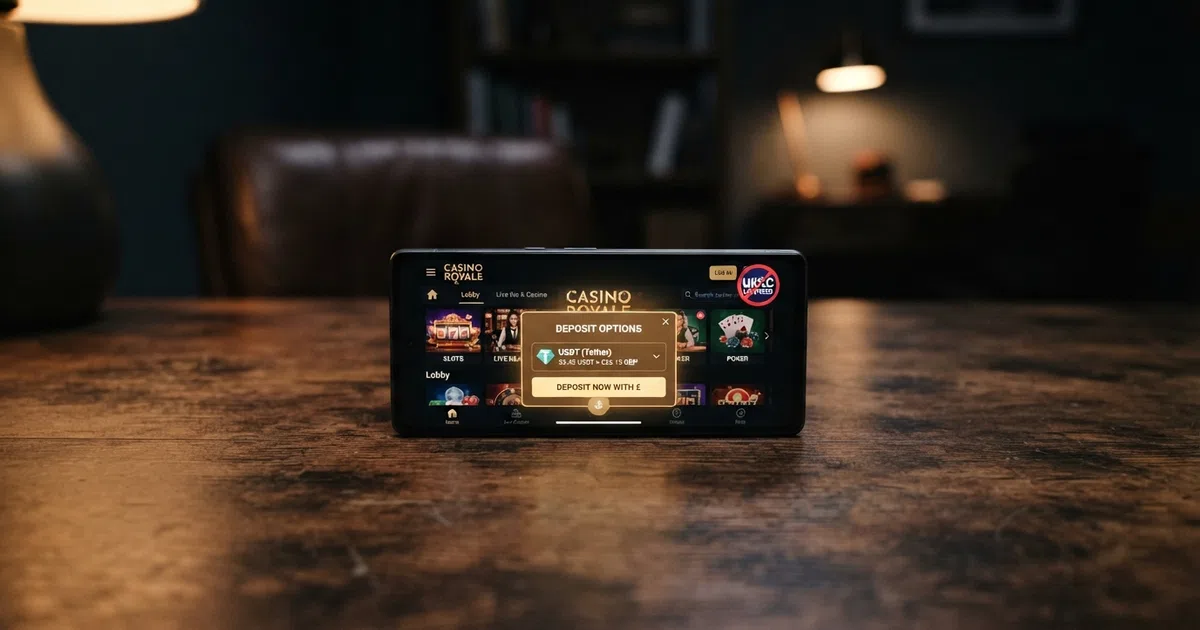
This guide ranks the ten offshore operators that genuinely accept USDT from UK-based players in 2026. It also explains the regulatory gap, the real cost of the welcome bonuses, how the deposit mechanics work, and what protections disappear the moment a player steps outside the UKGC framework.
Data current as of 25 August 2026 and verified against the UK Gambling Commission’s public register.
What a Tether Casino Actually Is — and Why No UK-Licensed Site Offers One
A Tether casino is an online gambling site that accepts deposits and pays withdrawals in USDT, a cryptocurrency whose value is pegged 1:1 to the US dollar. The “Tether” and “USDT” are the same thing: USDT is the exchange ticker; Tether is the company and the colloquial name. The peg matters for gamblers because a 1,000 USDT bankroll is, in dollar terms, the same at the start of a session and the end, with no surprise from a price crash or rally mid-spin.
In Great Britain, that casino does not exist. The Gambling Commission has made it clear that any operator applying for a GB licence with a cryptocurrency funding element must supply a complete history of source-of-funds. The compliance burden has been high enough that no major licensed brand has integrated crypto. The Commission is now actively exploring whether licensed crypto payments might work under the new FCA regime expected to take effect in late 2027, but for now the answer is straightforward: a UK player who wants to gamble with USDT must use an offshore operator, and that operator is not bound by any UK rule.
That structure produces a specific trade-off. Offshore Tether casinos typically offer larger bonuses, faster withdrawals, and provably fair games that GB-licensed sites cannot legally offer. They also offer no ADR, no fund segregation, no GAMSTOP coverage, and no recourse if the operator refuses to pay. The rest of this page helps a reader decide whether that trade-off is one they want to make.
Tether vs USDT — Two Names, One Stablecoin
USDT is the ticker symbol; Tether is the company that issues it, and the brand name most players use. The two are interchangeable in every casino context: a “Tether casino” and a “USDT casino” describe the same product.
The practical reason Tether dominates crypto gambling is the peg. Bitcoin can move 10% in an afternoon; a player’s £500 bankroll in BTC might be worth £450 by the time they sit down to play. USDT does not move like that. A 1,000 USDT balance is functionally a $1,000 balance, which makes stake sizing, bonus tracking, and bankroll management behave the way they do at a fiat casino. Volatility is the headache stablecoins were designed to remove, and they remove it.
How a Crypto Casino Differs from a Traditional UK Online Casino
The differences are structural rather than cosmetic. Deposits and withdrawals move on a blockchain rather than through Faster Payments or card rails, so there is no bank intermediary, no card-issuer decline, and no 3-to-5-day settlement. A player can move from exchange to casino to cash-out in under an hour, sometimes in minutes. That speed is the single most tangible advantage of a Tether casino over a UKGC-licensed site.
Inside the operator, the differences widen. GB-licensed sites must verify identity before the first deposit and segregate player funds from operating capital; offshore Tether casinos do neither as a rule. GB-licensed sites must enforce the £5/£2 age-banded slot stake cap, the 10× wagering ceiling, and the credit-card ban; offshore sites apply their own house rules. Game libraries are similar at the studio level, but offshore platforms add provably fair originals — Crash, Plinko, Dice, Mines — that GB-licensed operators cannot offer under the current RTS framework. And a UK player who opens an account at an offshore Tether casino will see balances in USDT, not GBP, which means a small mental adjustment every time they check their bankroll.
The Core Trade-Off — No UKGC Licence, No UK Protection
A UKGC licence is not a marketing badge. It obliges the operator to segregate player funds, submit to dispute resolution through an approved ADR provider, participate in GAMSTOP, and follow the statutory stake and bonus caps. None of these obligations apply to a Curaçao-licensed Tether casino. The operator has chosen a different legal regime, with different rules and different (or absent) enforcement.
The UKGC does pursue unlicensed operators, primarily through disruption. In the period from April 2024 to June 2025 the Commission issued 3,140 disruption notices, referred 447,778 URLs to search engines, and achieved 287,961 removals. That is meaningful action against the supply side, and it is part of why the most visible brands have changed shape: TGP Europe, which ran the GB-facing Stake.uk.com white-label, surrendered its licence in February 2025 after the Commission told it to pay a £3.3 million penalty, and the .uk domain shut down by 11 March 2025. Stake.com itself continues offshore. The Commission disrupts, but it does not block individual players. The player’s winnings are not taxed either way, but the protection that comes with the licence is gone the moment a player opens an offshore account.
The Best Tether Casinos Accepting UK Players in 2026
The ten operators below were selected for verified USDT support, active UK-facing operations, and real-money play in the current year. None holds a GB gambling licence. Each is described in its own block, with the bonus terms spelled out exactly as the operator publishes them, and a closing verdict on what the brand is actually worth to a UK player.

| Operator | Licence | Welcome Bonus | Wagering | Free Spins | Bonus Validity | USDT Networks |
|---|---|---|---|---|---|---|
| Stake.com | Curaçao (Easygo) | 200% up to $2,000 | 40× | 200 (variant) | 30 days | TRC20, ERC20, others |
| BC.Game | Curaçao / Anjouan | 380% up to $4,000 + 400 FS | 40–45× | 400 across 4 deposits | 14 days | ERC-20, TRC-20, BEP-20 |
| Cloudbet | Curaçao | Up to $2,500 cash + 200 FS | 0× | 200 | 30 days | Multiple |
| BitStarz | Curaçao | Up to 5 BTC + 180 FS | 40× | 180 + 50 no-deposit | — | 10 cryptos incl. USDT |
| BetFury | Curaçao | 590% up to $10,500 + 225 FS | 40× | 225 + 100 no-deposit | — | USDT, Lightning 2026 |
| Roobet | Curaçao | 20% cashback, 7 days | 0× | 0 (cashback) | 7 days | 12+ coins |
| Bets.io | Curaçao | 225% up to 1 BTC + 225 FS | 40× | 225 across 3 deposits | — | 70+ cryptos |
| Wild.io | Curaçao | 350% up to $3,000 + 200 FS | 40× | 200 | 7 days | BTC, ETH, USDT, others |
| Crashino | Anjouan | 100% up to 1,000 USDT + 50 FS | 35× (bonus), 10× (FS) | 50 | 5 days | 14 cryptos |
| Cryptorino | Costa Rica | 100% up to 1 BTC | 66× | — | 7 days | 11+ cryptos |
Stake.com — The Market Leader That Left the UK
Stake.com is the brand most readers will already know by name. The welcome offer is a 200% deposit match up to $2,000 with a 40× wagering multiplier and 30-day validity; some regions see a 100% match up to 500 USDT plus 200 free spins instead. The game library runs Pragmatic Play, Evolution, Hacksaw, Nolimit City, and the Stake Originals suite, which is provably fair and includes Crash, Plinko, Dice, Mines, and Limbo.
The UK relevance is the inverse. Stake.com used to operate a GB-facing site, Stake.uk.com, through a white-label run by TGP Europe Ltd. The Gambling Commission told TGP Europe in February 2025 that it needed to pay a £3.3 million penalty for failing to carry out sufficient checks on business partners and breaching anti-money-laundering rules. TGP Europe surrendered its licence, and the .uk site shut down by 11 March 2025. Stake.com itself continues offshore from Curaçao, still accepting UK players, still paying out in USDT, and still carrying none of the UKGC’s statutory protections. For a UK player who specifically wants Stake’s originals and accepts the offshore trade-off, this is the canonical choice. For a player who wants a UKGC-licensed brand, it is not a choice at all.
BC.Game — The High-Bonus Contender
BC.Game’s headline figure is the largest in the featured set: 380% across the first four deposits, up to $4,000, plus 400 free spins. The catch sits in the wagering: 40× to 45× on deposit plus bonus, with an effective turnover burden that has been measured at roughly 88× the deposit amount once the structure is fully unwound. The validity is short — 14 days from claim. The brand supports more than 150 cryptocurrencies, including USDT on ERC-20, TRC-20, and BEP-20, which makes it one of the more network-flexible operators on the page. A small $5 no-deposit bonus is available monthly, limited to the first 150 claims and requiring KYC.
The licence is Curaçao with an Anjouan-registered entity. For a player with a large bankroll and a high tolerance for short-fuse bonus terms, BC.Game delivers more bonus value than any other entry here. The short validity is the binding constraint: clearing 14 days of wagering on a 380% match at 40× is a workload that does not fit casual play.
Cloudbet — Zero-Wagering Rewards in Real Cash
Cloudbet is the only operator in the featured set that pays its welcome reward as withdrawable cash from day one. The structure is a 30-day rakeback and cash-drop programme worth up to $2,500 in real cash plus 200 free spins, with a 0× wagering multiplier. There is no turnover obligation; whatever the player accumulates is theirs to withdraw immediately. Minimum deposit is 0.001 BTC, with USDT and multiple other cryptos supported.
The trade-off is that the cash comes drip-fed through the rakeback programme, not as a single lump-sum match. A high-volume player will extract the full value faster than a casual one. The licence is Curaçao. For a UK player who dislikes the bonus-clearing treadmill entirely, Cloudbet is the cleanest offer on the page.
BitStarz — No-Deposit Free Spins and a Decade of Trust
BitStarz has been operating since 2014, which makes it the longest-running brand in the featured set. The welcome package runs up to 5 BTC plus 180 free spins across the first four deposits at 40× wagering. The stand-out is the no-deposit offer: 50 free spins at registration, with winnings capped at €150 and subject to 40× wagering. That is the most accessible way to test a crypto casino without committing funds, though the cashout ceiling is tight.
Game providers include Pragmatic Play, Evolution, NetEnt, Hacksaw, Nolimit City, and BGaming. The licence is Curaçao. BitStarz suits a UK player who wants a low-commitment way to evaluate an offshore casino, and who values a long operating history over the latest bonus headline.
BetFury — Massive Bonus and Lightning USDT Innovation
BetFury’s headline is the biggest on the page: 590% across the first three deposits, up to $10,500, plus 225 free spins with deposit and another 100 free spins at registration, all at 40× wagering. The library is the largest in the featured set, with more than 11,000 games including Pragmatic Play, Evolution, Hacksaw, Nolimit City, and the BetFury Originals suite with provably fair Crash, Plinko, Dice, and HiLo.
The technical development to watch is the Utexo partnership. BetFury is rolling out Bitcoin Lightning-based USDT payments in summer 2026, described as one of the first major Lightning USDT deployments in iGaming. The licence is Curaçao (OGL/2024/1494/0942). The bonus is enormous; the wagering is standard offshore; the Lightning integration is genuinely new. If you value both massive bonus potential and forward-looking payment tech, BetFury is a top-tier choice.
Roobet — Cashback Over Wagering, a Different Kind of Bonus
Roobet does not run a traditional welcome match. Instead, it offers 20% cashback on net losses for the first seven days, paid as real cash with no wagering. The library includes about 6,000 slots, 500+ live dealer tables, and the Roobet Originals suite with provably fair Crash. The licence is Curaçao (Raw Entertainment B.V.).
The math favours a player who expects to lose a meaningful amount in the first week, since the cashback softens the hit directly. A player who plans to play cautiously and walk away up will see very little value from it, because the cashback is loss-based. Roobet is the right pick for the bonus-skeptical player who would rather take the smaller, cleaner offer than chase a 590% match.
Bets.io — Award-Winning Library of 10,000+ Games
Bets.io won Crypto Casino of the Year 2023/24 at the SiGMA awards, which is a useful data point in a market with limited external validation. The welcome offer is 225% up to 1 BTC plus 225 free spins across the first three deposits at 40× wagering, with a minimum deposit of 20 USDT. The library is the second-largest in the featured set at more than 10,000 games from over 80 providers, including Pragmatic Play, Evolution, Hacksaw, and Nolimit City.
The licence is Curaçao (8048/JAZ2020-13, operated by Bets Entertainment N.V.). For a UK player who values catalogue breadth and an industry award over headline bonus size, Bets.io is the strongest fit in the set.
Wild.io — High-Match Bonus for Bigger Bankrolls
Wild.io’s offer is a 350% match plus 200 free spins across the first three deposits, up to $3,000, at 40× wagering with a 7-day validity. Free-spin winnings are capped at 50 USDT. The library is the standard offshore set: Pragmatic Play, Evolution, Hacksaw, Nolimit City, BGaming.
The important caveat is the restricted-territory note. UK is listed as a restricted territory in some versions of Wild.io’s terms, which means a UK player should verify current access before depositing. The licence is Curaçao. For a UK player who can confirm access, the offer is competitive; for one who cannot, the verification step is the part that decides whether this entry belongs on the shortlist.
Crashino — Built for Crash-Game Players
Crashino is a specialist: the library includes 199 crash-game titles, which is the largest dedicated crash catalogue in the featured set. The welcome offer is 100% up to 1,000 USDT plus 50 free spins, with 35× wagering on the bonus, 10× on free-spin winnings, and a 5-day claim window. Maximum cashout from the offer is capped at 10× the bonus amount, with an absolute ceiling of €2,000. Minimum deposit is €20.
The 5-day validity is the tightest in the set. The 10× bonus cashout cap is the most restrictive withdrawal ceiling. The licence is Anjouan (Igloo Ventures SRL). Crashino is the right pick for a player who specifically wants crash games and accepts the short-fuse bonus terms in exchange.
Cryptorino — No-KYC Play with a Costa Rican Licence
Cryptorino is the only featured operator with an explicit no-KYC policy. The welcome offer is 100% up to 1 BTC (or USDT equivalent) at 66× wagering with a 7-day clearance window. Minimum deposit is €10. The library is more than 6,000 games from over 70 providers, including live casino and a sportsbook.
The licence is a Costa Rica data-processing licence held by Star Bright Media S.R.L., not a gambling-specific licence, which is structurally weaker than Curaçao or Anjouan. The “no KYC” claim is accurate only up to the cumulative withdrawal threshold, at which point verification is triggered. For a UK player who values minimum deposit size and minimal initial paperwork, Cryptorino is the most accessible entry. The 66× wagering is the highest in the set, and the Costa Rica licence offers the least regulatory backstop.
How USDT Deposits and Withdrawals Work at Crypto Casinos
The deposit process is the same in shape at every Tether casino, even where the brand and the licence differ. The player buys USDT on an exchange (or withdraws from a self-custody wallet), copies the casino’s deposit address for the chosen network, and sends the funds. The casino credits the balance after the required number of network confirmations. The withdrawal reverses the path: the player requests a payout, the casino’s internal review approves it, and the funds arrive at the player’s external wallet.
The speed is the headline. USDT on TRC20 confirms in seconds to about one minute, with fees of roughly $0 to $1. USDT on ERC20 confirms in one to several minutes, with fees ranging from $2 to $15+ depending on Ethereum gas. A withdrawal that has cleared the casino’s internal review is therefore limited mainly by network speed, not by the kind of multi-day settlement that card or bank-rail withdrawals require.
Making a Tether Deposit — Step by Step
A typical deposit runs as follows. The player logs into the casino, opens the cashier, and selects USDT. The casino displays a deposit address and a network selector (TRC20, ERC20, BEP20, and so on). The player copies the address, opens their exchange or wallet, selects the same network, and sends. The casino credits the balance after the required confirmations. The whole flow takes minutes, not days.
Minimum deposit thresholds across the featured set range from 0.001 BTC at Cloudbet down to €10 at Cryptorino, with Bets.io at 20 USDT and Crashino at €20. Sending on the wrong network — for example, TRC20 USDT to an ERC20 address — is the single most common way to lose a deposit, since the funds cannot be recovered. Match the network the casino provides, and send a small test first if the amount is meaningful.
Withdrawal Speed — Why USDT Cashouts Beat Bank Transfers
A bank-transfer withdrawal at a UKGC-licensed casino typically takes 3 to 5 business days, sometimes longer, and routes through Faster Payments or an international wire. A USDT withdrawal at an offshore casino is limited by two things: the casino’s internal review queue, and the blockchain confirmation time. Most featured operators process within 24 to 48 hours, and the network adds minutes on top of that. End-to-end, a same-day cashout is achievable at most of the operators in the set.
The factors that slow a withdrawal are the same at any regulated or unregulated operator. KYC checks trigger when cumulative withdrawals cross the operator’s threshold, which is typically between £2,000 and £8,000. AML flags hold payouts while the operator requests source-of-funds documentation. Bonus-related terms, including max-cashout caps, can also limit the withdrawal ceiling. The UKGC’s own enforcement commentary has noted rising VPN use and cryptoasset-linked funds as factors that make illegal-market activity harder to measure, which is a separate but adjacent issue: it has no effect on a legitimate withdrawal, but it does affect the wider regulatory mood around crypto gambling.
Why Your Tether Casino Bonus Is Smaller Than It Looks
A 590% welcome bonus sounds enormous. The number that actually matters is the wagering multiplier, because the multiplier is what turns a bonus headline into a turnover obligation. At BetFury’s 590% match, 40× wagering on the bonus means the player has to run the bonus amount through 40 turns before any of it is withdrawable. At Cryptorino’s 66× on deposit, the obligation is even heavier. A 200% match at 0× wagering, by contrast, requires no playthrough at all, which is why Cloudbet’s offer, despite the smaller headline, often produces a higher realisable value.
The contrast with the UKGC framework is sharp. From 19 December 2025, GB-licensed operators are capped at 10× wagering under LCCP Social Responsibility Code 5.1.1, and mixed-product offers (the “bet on football, get free spins” pattern) are banned. The offshore market routinely runs 35× to 66×, with no statutory ceiling. Bonus terms also vary widely on maximum cashout: BitStarz caps no-deposit free-spin winnings at €150, Crashino caps bonus withdrawals at 10× the bonus amount or €2,000, and the rest of the featured set applies no published cap on bonus-derived winnings.
Welcome Bonuses for Tether Depositors
The welcome landscape splits into three patterns across the featured set. The first is the high-match model, where BC.Game, BetFury, Wild.io, and others compete on percentage and cap. The second is the cashback model, where Roobet pays 20% of net losses over seven days as real cash. The third is the rakeback model, where Cloudbet drip-feeds a 30-day programme of cash and free spins with zero wagering. Each has a different break-even, and the right one depends on the player’s expected volume and tolerance for bonus-clearing.
Free-spin bundles are typically spread across the first three to four deposits: 400 across four at BC.Game, 225 across three at Bets.io, 200 at Stake.com’s variant offer. The spins are usually locked to specific slots and carry their own wagering, separate from the deposit match.
No-Deposit Bonus Offers — Free Spins Without a Deposit
Three of the ten featured operators offer something for nothing, and the offers vary widely in what they actually deliver. BitStarz gives 50 free spins at registration with winnings capped at €150 and 40× wagering. BetFury gives 100 free spins at registration at 40× wagering. BC.Game runs a $5 no-deposit bonus, limited to the first 150 claims each month, with KYC required to claim. The other seven operators require a deposit to unlock any reward.
A no-deposit offer is worth evaluating, not chasing. The €150 cap at BitStarz, for example, means a player who hits a meaningful win on the free spins still walks away with €150 after the wagering is done, not the headline prize.
Wagering Requirements — The Number That Decides What You Keep
Wagering is the multiplier applied to the bonus (and sometimes the deposit) that determines how much the player must turn over before the bonus becomes withdrawable cash. A 40× multiplier on a $1,000 bonus means $40,000 of qualifying bets before the $1,000 is unlocked. The same multiplier on a $1,000 deposit-plus-bonus combination effectively doubles the turnover obligation.
The range across the featured set is wide. Cloudbet and Roobet run 0× — the rewards are real cash from day one. BitStarz, Stake.com, BetFury, Bets.io, and Wild.io sit at 40×. BC.Game runs 40× to 45× with a structure that effectively lifts the burden higher. Crashino runs 35× on the bonus and 10× on free-spin winnings. Cryptorino runs 66×, the highest in the set. The UKGC’s 10× cap, by comparison, is the strictest in the regulated market.
To put a concrete number on what clearing a Stake.com bonus actually costs in time, take the headline 200% match up to $2,000 at 40× wagering. Assuming a player claims the full $2,000 bonus, the required turnover is $80,000. At a £5 stake per spin, that is 16,000 spins; at a 5-second spin interval, that is 80,000 seconds, or about 22.2 hours of continuous play. The expected loss across those 16,000 spins, at a 96% return-to-player average, is $3,200, which is larger than the bonus itself. That is the cost of the offer in plain arithmetic: the player receives up to $2,000 of bonus value and gives back roughly $3,200 in expected house edge. The bonus is real value, but it is not free value.
How Offshore Bonus Terms Compare to UKGC-Capped Offers
The UKGC’s 10× cap, in force from 19 December 2025, is the tightest wagering ceiling in any major regulated market. Offshore operators are not bound by it, and the 35× to 66× range in the featured set is the consequence. The UKGC’s mixed-product ban closes off the “bet £10 on football, get free spins” pattern at GB-licensed sites; offshore operators still run that pattern. The UKGC’s opt-in rules require per-product, per-channel consent from May 2025; offshore operators are free to email and push-promote as they choose.
A UK player who values bonus size will find the offshore market more generous. A player who values predictable terms and a hard ceiling on the obligation will find the UKGC framework more protective. The arithmetic above shows that offshore generosity comes at a literal cost.
What You Can Play with Tether — Slots, Live Dealer and Crypto Exclusives
The game library at a Tether casino is, in the main, the same library a UK player would find at a UKGC-licensed site, with one important addition. Slots come from Pragmatic Play, Hacksaw, Nolimit City, NetEnt, BGaming, and Betsoft, all of which supply both licensed and offshore operators. Live dealer blackjack, roulette, baccarat, and game-show formats come from Evolution, which is the dominant supplier across the featured set. The difference is the crypto-exclusive layer: provably fair originals like Crash, Plinko, Dice, and Mines, which exist only on crypto-native platforms and are not available at any GB-licensed site.
Slot Games at USDT Casinos
The slot catalogue across the featured set ranges from about 4,000 titles at Crashino to more than 11,000 at BetFury. The major studios are well represented: Pragmatic Play and Hacksaw appear at every operator in the set, Nolimit City at most, NetEnt at BitStarz and a handful of others. The slot math, mechanics, and feature sets are identical to what a UK player would see at a licensed site, because the games themselves are the same.
The one structural difference is the stake ceiling. At a GB-licensed site, slots are capped at £5 per spin for players aged 25 and over, and £2 for players aged 18 to 24, in force from April and May 2025 respectively under SI 2025/215. Offshore casinos are not bound by that rule, and many of the high-volatility Nolimit and Hacksaw titles are designed to be played at stakes well above £5. For players wanting higher-stakes play beyond the £5 cap, the offshore market provides the necessary freedom.
Live Dealer Tables — Blackjack, Roulette and More
Evolution supplies live dealer tables to Stake.com, BC.Game, BitStarz, BetFury, Roobet, Bets.io, Wild.io, and Crashino, which is effectively the entire featured set. Roobet lists more than 500 live tables, the highest count in the group. The product mix is standard: blackjack, roulette, baccarat, Casino Hold’em, plus the game-show formats like Crazy Time and Monopoly Live.
Live dealer games are not provably fair. The integrity of a live table rests on the studio’s reputation and the platform operator’s willingness to honour results, the same model a UK player would recognise from a licensed casino. A UK player moving to an offshore site is not changing how live dealer fairness works, only the regulatory backstop if something goes wrong.
Crash Games and Crypto-Exclusive Titles
Crash, Plinko, Dice, and Mines are the games that exist nowhere else. They are simple, fast, and built on cryptographic verification: each round’s outcome is generated by a server seed combined with a client seed and a nonce, and the result can be checked independently after the round closes. Stake Originals, BetFury Originals, and Roobet Originals are the most established libraries, and Crashino dedicates 199 of its 4,000+ games specifically to crash variants.
The “provably fair” label is not a marketing word; it is a verifiable mechanic. A player can copy the seed pair from any previous round, run the hashing algorithm themselves, and confirm the outcome was not changed after the bet. That is a real form of player-side verification, and it is the structural reason crypto-exclusive games have built a following among players who do not want to take the operator’s word for the result.
New Tether Casinos Worth Watching — and What to Check Before You Join
The newest USDT-accepting brands in the featured set are Cryptorino and Crashino, both launched in the last two years. The most technically interesting development is BetFury’s Lightning USDT integration with Utexo, rolling out in summer 2026 as one of the first major Lightning deployments in iGaming. The most consequential regulatory development is the UKGC’s exploration of crypto payments under the new FCA regime, with the rules expected to take effect in late 2027.
New casinos compete on bonus size, because they have no track record to offer instead. Crashino’s 100% up to 1,000 USDT plus 50 free spins comes with a 5-day claim window and a 10× bonus cashout cap. Cryptorino’s 100% up to 1 BTC comes with 66× wagering. The trade-off is consistent across the new-entrant set: a more generous headline, tighter terms underneath.
The Newest Tether Casinos in 2026
Cryptorino and Crashino are the most recent additions to the UK-facing Tether casino set. Both are active and processing real-money play in the current year. The bigger story for the wider market is the UKGC’s posture shift. Tim Miller, the Commission’s executive director, has confirmed that the regulator is examining whether cryptoassets could be introduced as a licensed payment method, with the FCA’s new crypto regime providing the framework. Andrew Rhodes, the Commission’s CEO, has framed the question as one of harm reduction: licensed crypto may stop some players drifting to the illegal market, where ‘crypto’ is the second most used term in online gambling searches. If the framework lands, the market covered by this page changes shape materially. Until then, the offshore operators below are the entire UK-accessible market.
What to Verify Before Depositing at a New Crypto Casino
A short checklist for any new or unfamiliar Tether casino before a first deposit:
- Confirm the licence and what it actually covers. Curaçao, Anjouan, and Costa Rica are the three jurisdictions in the featured set, and they are not equivalent. Curaçao has a Gaming Control Board with formal operator rules; Anjouan has a lighter framework; Costa Rica’s licence category is data-processing, not gambling-specific. None substitutes for a UKGC licence.
- Search player forums for unresolved complaints. Withdrawal delays, bonus term disputes, and account closures are the issues that surface in community threads before they surface anywhere else. A pattern of complaints matters more than an individual one.
- Verify the operator still accepts UK players. Wild.io’s terms list UK as a restricted territory in some versions, which is a concrete example of an operator changing its UK posture without announcing it.
- Read the bonus terms before claiming. The wagering multiplier, the validity window, the maximum cashout, and the eligible games are all in the terms, and the audit is faster than the surprise.
New-Casino Bonuses — What They Offer and What to Watch For
New-entrant bonuses skew aggressive. Crashino’s 5-day claim window is the shortest in the set, and the 10× bonus cashout cap means a player who runs up a big balance during the bonus period can still be limited on withdrawal. Cryptorino’s 7-day clearance at 66× is the heaviest wagering in the featured group. Both are real offers at real operators, and both carry terms that are tighter than what the established brands publish.
A reasonable read: a new casino is a place to play a small test amount first, verify the payout works, and only then consider a larger deposit. The aggressive bonus is the marketing budget; the unproven payout history is the cost.
The Legal Reality — Offshore Casinos, No UKGC Protection and What You Give Up
The legal framework in Great Britain is not ambiguous. The Gambling Act 2005, extended by the Gambling (Licensing and Advertising) Act 2014, requires any operator serving GB customers to hold a Gambling Commission licence. Providing gambling facilities without one is a criminal offence under section 33 of the Act, with penalties of up to 51 weeks’ imprisonment, an unlimited fine, or both. The Commission enforces that rule against the supply side, primarily through disruption: cease-and-desist notices, search-engine delistings, registrar and host pressure, payment-provider referrals, and test purchasing.
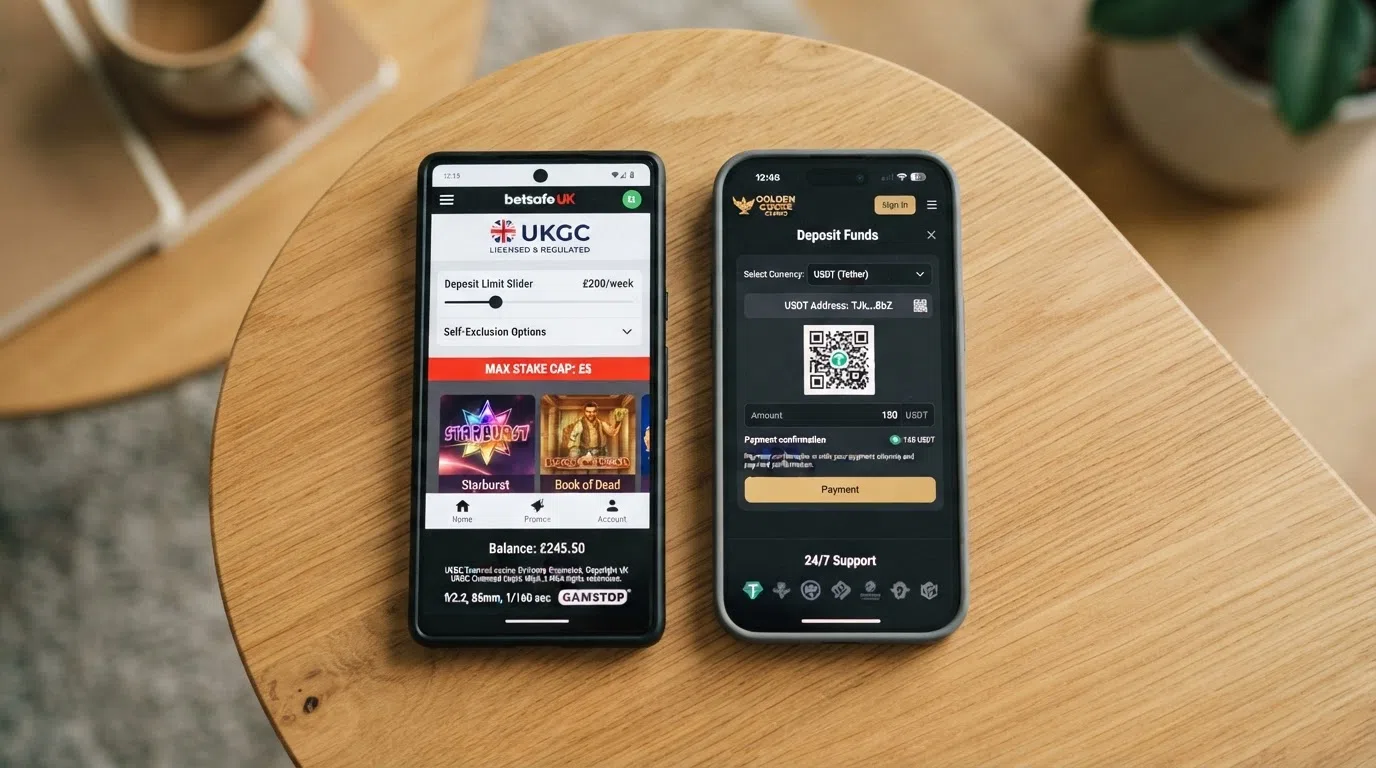
The Commission has no statutory power to block access at the ISP level, and the legislation that would give it that power has been proposed but not enacted. What the Commission has not done, in any published case, is penalise a player for gambling on an unlicensed site. The player pays no tax on winnings either way; player-side betting duty was abolished in 2001. What the player loses is the protection the licence would have provided.
UKGC Licensing and Why No GB Casino Accepts Tether
The Gambling Commission has not passed an explicit rule banning cryptocurrency at licensed casinos. The barrier is the anti-money-laundering framework, which requires operators to verify the source of every pound that flows through the account. For a card or bank deposit, that is a routine exercise; for a crypto deposit, the operator must trace the on-chain history of the funds back to their origin, which is operationally heavy enough that no major GB-licensed brand has integrated it. The Commission’s position is that it will not consider any operating licence application with a crypto funding element without a complete source-of-funds history.
The Commission has separately raised the AML risk rating for gambling software from low to medium, and has noted the rising use of e-wallets, pre-paid cards, and cryptoasset-linked funds across the remote sector. The same enforcement data shows increased VPN use, which makes the size of the offshore market harder to measure. None of this changes the immediate position: there is no GB-licensed Tether casino, and there will not be one until the FCA’s crypto regime is in force and the Commission builds a workable framework on top of it.
On GamStop vs Off GamStop — What Self-Exclusion Actually Means Here
GAMSTOP has been mandatory for every GB-licensed online operator since 31 March 2020. A player can self-exclude for 6 months, 1 year, 5 years, or 5 years with auto-renewal, and the exclusion cannot be cancelled early. GAMSTOP is the most effective self-exclusion tool in the British market, and it has helped many players control their gambling.
GAMSTOP is also a licence condition, not a general internet block. It does not reach any operator that does not hold a GB licence. A player who has self-excluded via GAMSTOP is not blocked from any of the operators on this page, and that is both the appeal of the offshore market and its single most serious risk. The same gap that allows a UK player to deposit USDT also allows a player who has decided to stop gambling to keep playing. Anyone reading this page who has an active GAMSTOP exclusion should treat offshore access as a feature, not an opportunity.
KYC and Verification — What “No KYC” Really Means
At a GB-licensed site, the operator must verify the player’s name, address, and date of birth before the first deposit and before any gambling, a rule in force since 7 May 2019. Anonymous play is not possible inside the licensed market.
Offshore Tether casinos advertise anonymity, and the claim is partly true. Cryptorino explicitly markets a no-KYC policy, and most featured operators will let a player deposit and play without documents for some time. The verification eventually arrives, however, at cumulative withdrawal thresholds that typically fall between £2,000 and £8,000 depending on the operator. Above those thresholds, every operator in the set will request identity documents and proof of address, and the UK’s Travel Rule, in force since September 2023, additionally requires virtual asset service providers transmitting crypto above £1,000 to attach originator and beneficiary information to the transfer. “No KYC” at an offshore casino is a delay, not an exemption, and the delay ends at the cashout.
Player Protection You Lose Outside the Licensed Market
The protection a UKGC licence provides is concrete and specific. A licensed site must segregate player funds from operating capital under the LCCP, must participate in an approved alternative dispute resolution (ADR) scheme, must enforce the £5/£2 age-banded slot stake cap, must honour the credit-card ban under LCCP 6.1.2 (in force since 14 April 2020), and must apply the 10× wagering cap and the mixed-product bonus ban. None of these obligations applies at an offshore Tether casino. A UK player who chooses an offshore operator gives up each of them.
The practical consequences are the ones a reader can act on. If an offshore casino refuses to pay a withdrawal, there is no ADR provider to escalate to and no Commission complaints route to open. If the operator becomes insolvent, player funds are not ring-fenced and are treated as general assets in any restructuring. If a player has self-excluded via GAMSTOP, the exclusion does not extend to the offshore account. If a player tries to dispute a transaction through their bank or card issuer, the result depends on the issuer’s policies rather than on a statutory right.
Safer Gambling Tools and Where to Get Help
The UK has an extensive free help infrastructure for anyone whose gambling has become difficult to control, and it is available regardless of whether the gambling happened at a licensed site or offshore. The same tools serve both situations.
- National Gambling Helpline (GamCare): 0808 8020 133 — free, 24/7, by call, live chat, or WhatsApp. The helpline handled more than 130,000 contacts in the year to March 2025, made 7,100 referrals into further treatment, and recorded 996 referrals in January 2026 alone, a 48% year-on-year increase.
- National Gambling Treatment Service: 11,960 clients treated in 2024–25 (an 11% increase on the prior year), with 93% of those completing treatment showing improvement. One quarter of clients said problem gambling started by age 18.
- NHS gambling treatment clinics: specialist clinics across England, Scotland, and Wales, with self-referral available.
- Gamblers Anonymous: peer-support meetings in person and online.
- GAMSTOP: self-exclusion from every GB-licensed online gambling operator; not a substitute for help, but a useful circuit-breaker for anyone who wants to close the licensed market to themselves.
- GamCare self-assessment: free online tools to evaluate gambling behaviour.
The statutory levy that funds much of this infrastructure took effect on 6 April 2025, with remote casino licences paying 1.1% of gross gambling yield. Half the proceeds go to treatment, 30% to prevention, and 20% to research. The system is funded and it is staffed; using it is not a sign of failure.
How We Selected and Ranked These Tether Casinos
The ten operators in the ranking were each verified as accepting UK players and processing real-money Tether deposits in the current year. The GB-licence status of each was checked against the Gambling Commission’s public register, and none of the ten holds a GB operating licence for the product this page covers.
The comparison looks at five dimensions: bonus value (the wagering multiplier, the match percentage, the validity window, and the maximum cashout), game-catalogue breadth (provider count, total title count, presence of provably fair originals), USDT network support (TRC20, ERC20, BEP20, and any Lightning deployment), licensing jurisdiction (Curaçao, Anjouan, or Costa Rica, with the differences in regulatory backstop noted), and payment infrastructure (minimum deposit, supported networks, withdrawal processing). The ranking reflects a qualitative assessment across these dimensions rather than a scored formula, and the verdicts below each operator name the specific trade-off the brand represents.
No proprietary weighting has been applied, and no operator is presented as “best for everyone.” The page is a buyer’s guide, not a recommendation, and the responsibility for choosing sits with the reader.
What You Should Actually Do — A Verdict on Tether Casino Gambling from the UK
The data on this page leads to one conclusion that no operator profile can soften. Every Tether casino available to a UK player in 2026 is unlicensed in Great Britain. The bonuses are larger than what a UKGC-licensed site can offer, the withdrawals are faster than any bank rail can deliver, and the games include provably fair originals that the licensed market does not carry. None of those advantages is free. They are paid for with the loss of fund segregation, the loss of ADR, the loss of GAMSTOP coverage, and the loss of the credit-card ban. The arithmetic on the Stake.com bonus above, 22.2 hours of play for $3,200 of expected loss against $2,000 of bonus value, is the clearest picture of what “more generous” actually means in practice.
A player who chooses to proceed should do three things. They should set a hard ceiling on what they are willing to lose in total and stop when they reach it, because no offshore operator’s responsible-gambling tools can be relied on the way a UKGC-licensed site’s can. They should verify the operator’s licence and payout record independently before any meaningful deposit, and they should treat the absence of a UKGC licence as a hard fact rather than a footnote. They should not treat offshore access as a workaround for a GAMSTOP exclusion; the tools in the section above exist precisely because the licensed market is the only place the exclusion applies.
The page does not pick an operator. The ten entries above are the only material that exists for a UK player who wants to gamble with Tether in 2026, and the choice between them is a choice between different shapes of trade-off, not between safety and risk. Safety, in the strict statutory sense, is not on the table.
Frequently Asked Questions
Are Tether casinos legal for UK players if they are not on GamStop?
A Tether casino without a UKGC licence is operating in breach of the Gambling Act 2005 by serving GB customers, but the Commission has not, in any published case, penalised a player for gambling on such a site. The legal risk sits with the operator, not the player. The practical risk sits with the player, in the form of no ADR, no fund segregation, and no GAMSTOP coverage. Legal and safe are not the same thing here.
Do Tether casino bonuses have wagering requirements, and how do they compare to UKGC-licensed sites?
Every welcome bonus in the featured set except Cloudbet’s and Roobet’s carries a wagering multiplier, ranging from 35× at Crashino to 66× at Cryptorino, with 40× the most common rate. The UKGC caps wagering at 10× for licensed operators from 19 December 2025. Offshore bonuses are therefore typically 3.5× to 6.6× the licensed-market ceiling, which is the structural reason the headline figures look so much larger.
What happens if a non-GamStop Tether casino refuses to pay out my winnings?
There is no ADR provider to escalate to, no Gambling Commission complaints route, and no British consumer redress scheme that covers offshore operators. The remaining options are the casino’s own internal review, a chargeback through the originating funding source (limited because crypto is a push payment, not a pull payment), and a civil claim in the operator’s home jurisdiction, which is expensive and uncertain. This is the most concrete loss a UK player suffers by leaving the licensed market.
Is my Tether deposit safe at a Curaçao-licensed casino that accepts UK players?
The funds are not segregated from the operator’s operating capital, so they are at risk if the operator becomes insolvent. Curaçao’s Gaming Control Board provides regulatory oversight, but the enforcement record is thinner than the UKGC’s. The “provably fair” mechanic covers the integrity of game outcomes, not the safety of deposits. A player who values fund safety more than game fairness is in the wrong market.
Can I set deposit limits or self-exclude at a Tether casino that is not on GamStop?
Most featured operators offer some form of deposit limit, session limit, or self-exclusion in their account settings, but the tools are operator-controlled rather than regulator-mandated, and there is no external body to enforce them. GAMSTOP itself does not reach any operator on this page. For a UK player who wants the strongest form of self-exclusion, GAMSTOP plus the support services listed in the safer-gambling section above is the most effective combination, and the offshore market does not add to that combination.
TRC20 vs ERC20 vs BEP20 — Which Network Should You Use?
Three networks carry the majority of USDT casino traffic, and the choice between them is a real cost-and-speed decision.
| Network | Typical Transfer Fee | Confirmation Time | Best For |
|---|---|---|---|
| TRC20 (Tron) | ~$0–$1 | Seconds to ~1 minute | Most casino deposits and withdrawals |
| ERC20 (Ethereum) | ~$2–$15+ | 1 to several minutes | When TRC20 is not supported |
| BEP20 (BNB Chain) | Low | Fast | Alternative when offered |
TRC20 is the default for most players because the fees are negligible and the confirmations are fast. ERC20 remains the most widely supported, but the gas fees can dominate a small deposit; sending $20 of USDT and paying $8 of Ethereum gas is a poor trade. BEP20 sits in between, with low fees and fast blocks, but is less universally accepted. The rule is straightforward: use the network the casino supports with the lowest fee at the time, and never mix networks.
Payments – No Minimum Deposit Casinos UK
Content created by the «No Minimum Deposit Casinos UK» team