
Casinos That Accept Mastercard in the UK – 2026 Tested Sites and Honest Payments Guide
 Available in GB
The card in your wallet almost certainly works. Mastercard debit is accepted at every UKGC-licensed online casino, the deposit lands in seconds and no UK site charges a player-side fee for using it. What does not work, and has not worked since 14 April 2020, is the credit version of the same card. That single distinction — debit in, credit banned — is the one that decides whether a UK player can use the card they already hold. Get that right, and the rest of this page is the practical bit: which sites to consider, how fast your money actually moves, what the bonus terms look like under the post-January 2026 rules, and where the regulatory framework draws a line.

Verified against the UK Gambling Commission’s public register on 24 August 2026 and the Commission’s published licence conditions and codes of practice.
Your Mastercard Still Works at UK Casinos — Here Is What You Need to Know
The headline fact, before anything else: a UK player can deposit with a Mastercard debit card at any of the several thousand gambling businesses on the Gambling Commission’s register. A UK player cannot deposit with a Mastercard credit card at any of them. The first is industry standard, supported by the card network, processed instantly and protected by the same UK consumer rules that cover every other payment method. The second has been a regulatory flat line for more than five years.
When the Gambling Commission announced the credit card ban on 14 April 2020, the stated aim was blunt: to “reduce the risks of harm to consumers from gambling with money they do not have”. The reasoning rested on a piece of data that has not been refuted since — that 22% of online gamblers who used credit cards were already classed as problem gamblers, a rate several times the population baseline. The ban was written into LCCP licence condition 6.1.2, which prohibits every GB-licensed operator from accepting credit card payments, including credit-card-funded e-wallet transactions. Non-remote lottery is the only remaining carve-out.
What that leaves in a UK player’s hand is, in practice, the same network but a different product. Debit cards pull from a current account, only what is already there. Prepaid Mastercards work the same way for the purposes of a casino deposit, with the added wrinkle that they cannot receive withdrawals. Credit cards, where the spend is borrowed and the bill arrives later, are off the table at every site that holds a Gambling Commission licence.
The trust framework that decides whether a casino is worth the deposit is layered. The UKGC licence is the floor: any operator serving GB customers has to hold one, the register of licensed businesses held 2,663 records when it was last refreshed on 29 July 2026, and that number is the total market, not a shortlist. The next layer is consumer protection inside the licence: segregated player funds, mandatory participation in GAMSTOP since 31 March 2020, dispute resolution through an approved ADR provider, and a stack of social-responsibility codes covering everything from stake limits to wagering caps. The third layer is technical — TLS encryption on the cashier page, 3D Secure / Mastercard SecureCode authentication, and a payment rail that settles in seconds rather than days.
A site that does not have all three layers, and that is, in practice, the offshore market operating outside the Commission’s reach, may still take a Mastercard. It will not be covered by the protections UK players are used to.
Debit Works, Credit Is Banned — the Distinction Every Player Needs
The 14 April 2020 ban was not a single-rule change aimed at one product. It was a network-wide prohibition written into the Commission’s standard licence conditions, with two practical consequences. First, no GB-licensed operator may accept a Mastercard credit card for a gambling transaction, online or in a betting shop. Second, the prohibition extends to credit-card-funded payments routed through e-wallets — a player cannot load Skrill or Neteller with a credit card and then spend those funds at a licensed casino, because operators are required to refuse payments from money service businesses that have not themselves blocked credit-card funding.
Mastercard debit was untouched. The Commission made no move to ban a payment method that draws directly on funds the customer already holds, and the result is that a UK player with a current account and a Mastercard debit card can deposit at any of the 2,663 licensed businesses on the register. Prepaid Mastercards, treated as standard debit-card transactions for the purposes of the ban, are also accepted for deposits — though, as a separate matter of payment infrastructure, they cannot receive withdrawals because they lack the standing account a push payment needs.
The 2020 ban has had time to be evaluated. NatCen’s 2024 evaluation, commissioned by Greo Evidence Insights for the Commission, found a conscious switch from credit to debit among people who had been using credit cards extensively for gambling. The friction that the ban introduced — having to find a different card, change the default payment method, or stop gambling on credit — turned out to be the point. Players who had been gambling on credit did not simply move to a different funding source of equivalent risk. They moved to one with a hard ceiling.
Key Responsible Gambling Tools
| Tool | Purpose | Coverage |
|---|---|---|
| Deposit Limits | Caps daily, weekly, or monthly spend | Every UKGC site |
| Reality Checks | Pop-up reminders of time/spend | Every UKGC site |
| Time-Outs | Account freeze (24h–6w) | Every UKGC site |
| GAMSTOP | National self-exclusion register | Mandatory (all UKGC sites) |
The first deposit at a new site is usually where a few additional prompts appear. Mastercard SecureCode or 3D Secure may ask the player to authenticate through their banking app or a one-time code, a step that the bank’s fraud engine triggers when a new merchant is added to a card. A light KYC check — name, address, date of birth — is also standard on first deposit, because the UKGC’s identity-verification rules apply to every customer before any gambling takes place. None of this adds more than a minute to the flow.
A practical threshold worth knowing: a £150 net deposit in a rolling 30-day period triggers a financial vulnerability check under LCCP Social Responsibility Code 3.4.4, in force since 28 February 2025. The check uses publicly available data only — it is not a deep dive into a player’s bank statements — and it exists to flag customers whose deposit pattern suggests financial pressure rather than to gate access. Hitting the threshold does not stop play; it starts a review.
How to Spot a Trustworthy Mastercard Casino
The signals that separate a licensed UK site from an offshore one are not subtle, and they cost the player nothing to check. The UKGC licence number in the footer — the account number, not the regulator’s name — should match a record on the public register, which the Commission maintains at its own domain. A valid licence is the precondition for everything else on this list. Without it, the site is operating outside the GB framework, and none of the protections that follow apply.
GAMSTOP participation, marked by the scheme’s logo in the responsible-gambling section, is mandatory for every GB-licensed online operator since 31 March 2020. A site without it is either outside the regime or in breach. BeGambleAware.org’s logo, where present, indicates a contribution to the National Gambling Support Network. The padlock in the address bar and a TLS certificate on the cashier page are the technical floor — payment data is encrypted in transit, and the issuer’s 3D Secure layer sits behind it.
None of these is a guarantee of a good experience, and a site that fails any one of them is one to leave alone. The licence is the dealbreaker; the rest is the difference between a careful operator and a careless one.
Why Use Mastercard for Casino Play — the Real Pros and Cons
The case for using a Mastercard debit card at a UK casino is built on three structural advantages. Deposits are instant. The card is universally accepted at UKGC-licensed sites — the entire licensed market, not a shortlist of partnerships. And the player pays no fee on the transaction; the casino does not surcharge debit, and most UK banks do not either.
The downsides are not about acceptance but about the return trip. Withdrawals back to a Mastercard take 1–5 business days, slower than e-wallets that can clear in hours. The Original Credit Transaction (OCT) mechanism Mastercard uses to return funds can only refund up to the original deposit amount, and any winnings above that have to come back through a different method — usually bank transfer, sometimes an e-wallet. And there is no credit-card fallback at licensed sites, which is a feature rather than a bug, but it does mean the card a player uses has to be a debit.
The practical shape of that trade-off depends on what a player values. Someone depositing £20 for a single session and withdrawing the same evening will feel the five-day window as a friction. Someone depositing £200 for a longer run, who does not need the money back the same day, will find the 1–5 day window either neutral or useful — it functions as a forced cooling-off period between the impulse to withdraw and the funds actually arriving. Players pay no tax on gambling winnings in the UK — that obligation was abolished in 2001 and has not returned.
The Best Mastercard Casino Sites in the UK — 2026
Every site below holds an active UKGC licence, accepts Mastercard debit, and was checked against the Commission’s public register. The ranking weights Mastercard payment terms first — deposit speed, withdrawal speed, minimums — then welcome-bonus quality, then game-catalogue breadth. No operator paid for inclusion, and the order reflects fit for a payments-led page rather than market share.
| Casino | UKGC Licence | Welcome Bonus | Free Spins | Wagering on Bonus | MC Min Deposit | MC Withdrawal Speed |
|---|---|---|---|---|---|---|
| Bet365 | Active | Bet £10, Get £30 in bet credits (sports) | Varies by product | Varies | £5 | 1–5 business days (e-wallets 1–4 hours) |
| Sky Vegas | Active (Flutter) | Stake £5, get up to 200 Free Spins | Up to 200 | 0× | £10 | 1–3 working days (1–4 hours on instant-eligible cards) |
| Betfair | Active (Flutter) | 50 No-Deposit Free Spins + 100 on £10 deposit | 150 total | 0× | £5 | 2–5 business days |
| Ladbrokes | Active (Entain) | Play £10, Get 100 No-Wagering Free Spins | 100 | 0× | £5 | 1–5 business days |
| Coral | Active (Entain) | Bet £5, Get £30 (sports); casino varies | Varies | 4× on bingo | £5 | 1–5 business days |
| Betfred | Active | Stake £10, get 200 Free Spins | 200 | 10× on winnings | £5 | 1–5 business days |
| William Hill | Active (evoke plc, licence 39225) | Deposit £10, get 200 Free Spins on Big Bass Splash | 200 | 10× on winnings | £5 | 2–5 business days standard (same-day via PayPal/Visa Direct) |
| Gala Bingo | Active (Entain) | Deposit £10, spend £10 on slots, get 100 Free Spins | 100 | 0× | £10 | 1–5 business days |
| Virgin Games | Active (Gamesys / Bally’s) | Deposit £10, wager £10 on slots, get 100 Free Spins | 100 | 0× | £10 | 1–5 business days |
| 32Red | Active (evoke plc) | Deposit & stake £30, get 320 Free Spins on Big Bass Splash | 320 | 10× on winnings | £10 | 1–5 business days |
All ten sites accept Mastercard debit deposits, and every deposit is instant, fee-free, and processes through 3D Secure on first use. Where one site differs from another on the speed of getting money back, the difference is in the withdrawal path — and the OCT cap that limits returns to the original deposit amount applies equally across the set.
Bet365
The market heavyweight, and the operator on this list with the most payment-method clarity. Bet365 lists Mastercard debit with a £5 minimum and a £20,000 maximum, deposits are instant, and the cashier page is one of the few in the market to spell out processing times by method. Withdrawals back to Mastercard take 1–5 business days; e-wallets clear faster, in 1–4 hours.
The welcome offer is a sports product — Bet £10, Get £30 in bet credits — and the casino welcome varies by game, with no single headline. For a player whose priority is the breadth of game providers (Playtech, NetEnt, Pragmatic Play, Evolution, Microgaming) and a payment interface that does not hide the numbers, Bet365 is the most frictionless entry on the list. The trade-off is that only debit card deposits qualify for the welcome offer by default; other payment methods require full ID verification before the bonus is unlocked. For a Mastercard user, that is the path of least resistance.
Sky Vegas
Sky Vegas is the cleanest welcome offer on the market for a player who values simplicity over scale. Stake £5, get up to 200 free spins on a selected slot, no wagering on whatever the spins win. The minimum deposit is £10, the daily maximum is £10,000, and the same instant deposit applies.
The differentiator is the withdrawal. Sky Vegas is one of the few operators to publish an instant-eligible card return route — Visa or Mastercard cards that support it can receive funds in 1–4 hours, against a standard 1–3 working days for ordinary card returns. The free spins expire in seven days, and the qualifying stake and deposit must be made within 30 days of registration. NetEnt, Pragmatic Play, Evolution, Blueprint and IGT supply the bulk of the lobby.
Sky Vegas provides a transparent, simple bonus structure, making it a reliable choice for players who prefer to avoid complicated wagering requirements.
Betfair
Betfair is the only operator in the featured set with a genuine no-deposit offer. New customers get 50 free spins on Jackpot King games — including Crabbin’ For Cash Extra Big Catch — before spending a penny. A £10 deposit unlocks another 100 free spins, bringing the total to 150. Both elements carry zero wagering.
The minimum Mastercard deposit is £5, and the 100 deposit-gated spins sit alongside the no-deposit 50 on the same zero-wagering terms. Free spins are valued at £0.10 each and expire seven days from credit. The £5 minimum is the joint-lowest in the featured set; the 2–5 business day withdrawal window is the longest.
This is the right offer for a player who wants to test a site before committing. Fifty free spins on someone else’s money is enough to feel the platform, the game performance, and the cashier flow, all without a deposit landing on the card statement.
Ladbrokes
A high-street name with a no-nonsense welcome. Play £10, get 100 free spins, no wagering. The minimum Mastercard deposit is £5, the maximum single transaction is £2,000, and the deposit is processed instantly.
The withdrawal has two conditions worth reading. First, the Mastercard withdrawal requires Mastercard SecureCode authentication, which means the player has to have completed a 3D Secure verification on file. Second, Ladbrokes requires that a deposit has been made on the card within the last six months for the card to remain an active withdrawal method. The standard 1–5 business day window then applies.
Playtech, NetEnt, Pragmatic Play, Evolution and Blueprint supply the games. The 14-day validity on the free spins is generous against the seven-day windows most of the rest of the set offer. For a player who already has a Ladbrokes high-street relationship, the cross-channel account convenience is a distinct advantage.
Coral
Coral carries the lowest deposit threshold of the featured set — £5 is enough — and a sports-led welcome that mirrors Bet365’s structure: Bet £5, Get £30 in free bets (six £5 free bets), with a casino welcome that varies by product and a bingo bonus that carries 4× wagering. The sports free bets expire in 30 days; bingo bonuses in 14.
The Mastercard deposit is instant and fee-free. The withdrawal takes 1–5 business days. The crucial detail for a payments-focused player is which deposit methods qualify for the welcome: Visa and Mastercard debit, plus Apple Pay, do. E-wallets (PayPal, Neteller, Skrill), Paysafecard and prepaid cards do not. A player depositing with a Mastercard debit card is on the qualifying side of that line; a player depositing with anything else has to check first.
Betfred
200 free spins for a £10 stake is the headline, and the spin count is among the highest in the set. The trade-offs sit in the terms. The free-spin winnings carry 10× wagering, and the spins are credited within 48 hours of the qualifying stake and expire seven days after that. The 10× multiple is at the post-January 2026 regulatory cap, so this is as high as a UKGC-licensed welcome can go.
Mastercard deposits are £5 minimum, instant, fee-free. Withdrawals take 1–5 business days. E-wallets and prepaid cards are excluded from the welcome, the same pattern as Ladbrokes. Playtech, IGT, Pragmatic Play and Evolution supply the lobby.
For a player who counts spins rather than cash, Betfred delivers a substantial volume on the initial stake. The wagering terms are the primary trade-off to consider for this higher spin count.
William Hill
200 free spins on Big Bass Splash for a £10 deposit, with 10× wagering on winnings and a 72-hour expiry on the spins — the shortest validity window in the featured set. The minimum deposit is £5 and the minimum withdrawal is also £5, the lowest in the set for the latter.
The standard card withdrawal takes 2–5 business days, and William Hill offers a same-day route through PayPal and Visa Direct for players who want speed over the card return. William Hill standard withdrawal minimums apply. The licence is held by evoke plc, number 39225 on the public register.
For a player who wants a single account that bridges sports, casino and the high-street bookmaker, William Hill is the most established name. The 72-hour spin expiry is the time pressure a player has to manage.
Gala Bingo
The bingo-casino crossover on the list, sitting on the Entain platform alongside Ladbrokes and Coral. The welcome is a £10 deposit plus a £10 slots spend, which unlocks 100 free spins on selected games. The wagering is zero on the spin winnings for those selected titles, and the spins expire seven days from credit. The minimum Mastercard deposit is £10, withdrawals 1–5 business days, deposits instant.
The slot lobby is supplied by Playtech, Pragmatic Play, Evolution and Eyecon, the last of which is the supplier behind a lot of the UK’s bingo-branded slot content. The combined bingo-and-slots product is the right fit for a player who wants both rooms in one account and is happy to meet the £10 spend threshold before the spins unlock.
Virgin Games
The widest slot library in the featured set, at 900+ titles across 60+ providers — Pragmatic Play, NetEnt, Evolution, Red Tiger, Blueprint, IGT, Gamesys in-house and Eyecon among them. The welcome is 100 free spins for a £10 deposit and a £10 wager on slots, at 1p coin size and max lines, with no wagering on winnings and a 30-day validity window.
The 30-day validity is the longest in the set, comfortably ahead of the seven-day norm. The minimum Mastercard deposit is £10, the withdrawal takes 1–5 business days, and the deposit is instant. This operator provides the most extensive game library in the featured set for players who enjoy variety.
32Red
The highest free-spin count in the featured set, at 320 spins on Big Bass Splash. The entry point is the steepest — a £30 deposit and stake on slots, against the £10 entry that most of the rest of the set asks for. The 10× wagering on winnings is at the cap, the spins expire in seven days, and the qualifying deposit and stake must be made on a debit card or instant bank transfer.
The minimum Mastercard deposit for ongoing play is £10, but the welcome itself needs £30. The platform is evoke plc, the same parent as William Hill, with Microgaming, Evolution, Pragmatic Play and NetEnt supplying the games. For a player whose budget runs to £30 on day one and who values spin count over entry cost, 32Red is the right offer. For a player starting with a smaller first deposit, the rest of the set fits better.
How Your Money Moves — Deposits, Withdrawals and the Real Speed of Mastercard
Mastercard at a UK casino is a deposit-first payment method, and the asymmetry between the two directions of travel is the single most important thing to plan for. The deposit is instant. The withdrawal is not. The reason is mechanical: an outbound card transaction is a normal merchant payment, authorised in real time by the card issuer. An inbound card refund has to be processed by the acquiring bank, which then pushes the funds back to the card through the Original Credit Transaction (OCT) mechanism. That push runs on banking hours, not on casino hours, and 1–5 business days is what the rail delivers.
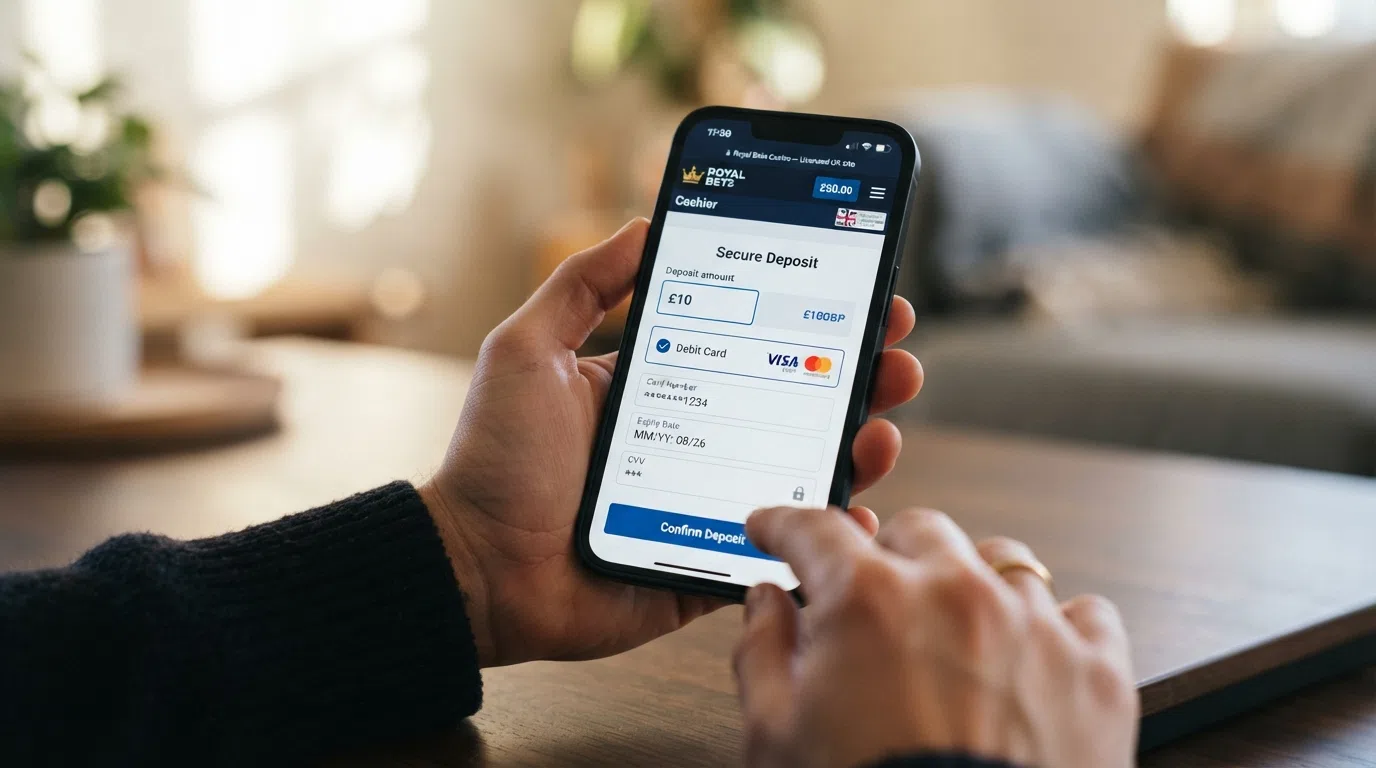
The OCT mechanism is also why a player cannot withdraw more to a Mastercard than was deposited on it. The push-back path can only return what came in on the same card. Any winnings above the original deposit amount have to come back through a different method — usually a bank transfer, sometimes an e-wallet like PayPal. For most UK players on most sessions, the original-deposit cap is not a constraint, because the winnings are smaller than the deposit was. For the player who hits a larger balance, the second-method step is the one that takes the most planning.
No UKGC-licensed casino charges a player-side fee on Mastercard deposits or withdrawals. The casino’s processing cost is built into its margin, and the Commission’s rules do not permit surcharging on payment methods. If a fee appears, it is on the card issuer’s side, and most UK banks do not charge for debit card transactions at gambling merchants either.
Mastercard Deposits — Instant, Direct and Fee-Free
The deposit side of the flow is fast because nothing on the rail is slowing it down. A Mastercard debit deposit is a card-not-present transaction, authorised by the card issuer in real time, with the casino crediting the player balance on the same hook. The minimum deposit across the featured set runs from £5 (Bet365, Betfair, Ladbrokes, Coral, Betfred, William Hill) to £10 (Sky Vegas, Gala Bingo, Virgin Games, 32Red), and the maximum single transaction ranges from £2,000 (Ladbrokes) to £20,000 (Bet365).
The first deposit at a new site is where 3D Secure — branded as Mastercard SecureCode — is most likely to trigger. The card issuer’s fraud engine wants to confirm the cardholder is the person making the payment, and the redirect to a banking app or a one-time code is the standard response. From the second deposit onwards, the issuer is more familiar with the merchant and the prompt is less frequent. The flow, including the SecureCode step, typically completes in under 30 seconds on mobile and under 20 seconds on desktop.
Mastercard Withdrawals — the Speed Gap You Need to Know
The standard 1–5 business day window is the figure the rail delivers, and the variation between one day and five is usually the acquiring bank’s queue. The casino’s own processing time is often added on top — a casino that takes 24 hours to approve a withdrawal before releasing it has effectively shifted the window to 2–6 business days from the player’s point of view. The faster operators in the set approve within hours, not days, and the rest of the timing is in the bank’s hands.
A few operators offer faster paths. Sky Vegas publishes a 1–4 hour return window for instant-eligible Visa and Mastercard cards — cards that have been registered for the faster push-payment scheme. William Hill offers same-day withdrawal via PayPal and Visa Direct, with the standard 2–5 business days still applying for ordinary card returns. Bet365’s e-wallet return is 1–4 hours, against 1–5 days for card. None of these shortcuts change the OCT cap: any route other than the original card can return the full balance.
The £200 Mastercard withdrawal threshold flagged for William Hill in one research source is carried here as unconfirmed. The figure does not appear on William Hill’s own materials at the time of writing, and the right reading is that the standard £5 minimum applies until the operator itself says otherwise.
Minimum Deposits, Maximum Limits and Fees
The numbers on deposit floors and ceilings are tight enough to summarise. Across the featured set, the minimum Mastercard deposit is £5 at six operators and £10 at four. The maximum single deposit ranges from £2,000 (Ladbrokes) to £20,000 (Bet365), with most operators setting their maximum in the £2,000–£10,000 range. None of the featured operators charges a player-side fee on Mastercard deposits or withdrawals.
If a fee ever appears on a statement, it is most likely from the card issuer, not the casino. Some UK banks treat gambling transactions as a separate MCC (merchant category code) category and may apply cash-equivalent fees to credit card transactions — a moot point for credit, since credit is banned at licensed sites, but worth knowing for any player whose bank has a generic policy. The simpler rule is: a debit card deposit at a UKGC-licensed site is free at the casino and almost always free at the bank.
Debit, Credit and Prepaid — Which Mastercard Works Where
Three Mastercard products, three different answers, and the answer for credit is the same everywhere. Debit is accepted at every UKGC-licensed casino. Credit has been banned at every GB-licensed operator since 14 April 2020 under LCCP 6.1.2. Prepaid is accepted for deposits but not for withdrawals, because the prepaid card lacks the standing infrastructure to receive a push payment.
The credit ban is the one that catches players out. The card in the wallet might be a Mastercard, but if the spend is being drawn on a credit facility rather than a current account, the casino’s payment system will refuse it. The error message on a credit card decline at a licensed site is a feature, not a bug — the system is doing what the regulator required. The offshore sites outside the GB regime may still take credit cards, which is one of the differences between licensed and unlicensed play, and the one that carries the most risk.
For prepaid, the practical pattern is to deposit with the prepaid card and arrange a withdrawal to a bank account or e-wallet, even when the casino’s withdrawal screen offers the prepaid card as a destination. The push payment will fail in most cases, and the player will have to set up an alternative method anyway.
Payment Alternatives — What Else Works Alongside Mastercard
Mastercard sits inside a wider payment mix at UK casinos, and the alternatives have their own trade-offs. Visa debit is functionally identical to Mastercard debit — same instant deposits, same 1–5 day withdrawal window, same OCT cap. A player who has both can use either interchangeably.
PayPal and other e-wallets (Skrill, Neteller) offer faster withdrawals, often 1–4 hours, because the e-wallet is the recipient of the refund rather than the card network. The trade-off is that some operators exclude e-wallet deposits from the welcome offer — Coral, Betfred and Ladbrokes are explicit about this, and the pattern is common across the rest of the set. Apple Pay is accepted at a growing number of sites, including Coral, where it qualifies for the welcome offer alongside debit cards.
Bank transfers are slower for deposits — typically same-day to next-day — but carry no OCT cap on withdrawals, because the refund is a standard Faster Payment rather than a card push. This method is the optimal solution for those needing to return a balance that exceeds their original deposit amount.
Crypto Casinos That Also Take Mastercard
A handful of crypto-facing casinos accept Mastercard as a fiat on-ramp for deposits — the card loads a fiat balance, the player buys crypto with it, and the crypto is what stakes the games. These sites typically operate outside the UKGC licensing system, often under a Curaçao or other offshore licence. The UK credit card ban does not reach unlicensed offshore operators, and these sites may accept Mastercard credit cards as a result.
The trade-off for that flexibility is the loss of every UK consumer protection. There is no GAMSTOP coverage, no Commission complaints route, and no approved ADR. A dispute over a withdrawal that cannot be resolved with the operator’s customer-service team has no formal escalation path. A player who has self-excluded through GAMSTOP and is gambling at an offshore site is using a payment method that GB-licensed sites would not let them use, on a platform that the GB self-exclusion scheme does not reach. That combination is the one the offshore market is built to serve.
Why Your 2026 Mastercard Bonus Is Smaller Than It Looks
The bonus landscape at UKGC-licensed casinos was reshaped on 19 January 2026, and the change is the reason the offers on this page look the way they do. Two rules came into force on the same date. The first, LCCP Social Responsibility Code 5.1.1, capped wagering requirements on bonus funds at 10× the bonus amount — a hard ceiling that replaced requirements as high as 60× in some legacy offers. The second, LCCP SR Code 5.1.1(3b), banned mixed-product promotional offers — a casino can no longer tie free spins to a sports bet, or a bingo bonus to a slots deposit.
The result is a market that looks smaller and is, in practical terms, much better. A 10× cap means a player who claims a £10 bonus has to wager £100 before withdrawing the bonus funds — a known quantity, calculable in advance. The pre-2026 market offered multiples that pushed the same player into hundreds of pounds of turnover on a small bonus, with no upper bound. The 0× free-spin offers that dominate the current featured set — Sky Vegas, Betfair, Ladbrokes, Virgin Games, Gala Bingo — are an even sharper version of the same shift, because there is no wagering at all on whatever the spins win.
The mixed-product ban matters more than it sounds. An offer that gave a player free spins in exchange for placing a sports bet was, in effect, asking a casino customer to open a betting product they had not planned to use. The ban closes that cross-sell, and the welcome offers on this page are the cleaner result — every bonus sits inside a single product.
Welcome Bonuses and Deposit-Match Offers
The featured set is almost entirely free-spin-led. Sky Vegas, Betfair, Ladbrokes, Betfred, William Hill, Gala Bingo, Virgin Games and 32Red all structure their welcome around free spins rather than a cash match. Bet365 and Coral lean toward sports-crossover offers, and the casino welcome on those sites varies by product and promotion.
The absence of large-percentage deposit matches is a UK market feature, not a research gap. A 100% match on a £100 deposit creates £100 of bonus funds that, at the pre-2026 multiples of 30×–60×, would have required £3,000–£6,000 of playthrough. Under the 10× cap, the same offer requires £1,000 — still significant, but the math now works in a way the operator can price. Free spins, with their capped maximum win and shorter validity, are a more predictable cost. The shift is what the cap produced.
The offer that breaks the pattern is Betfair’s no-deposit 50 free spins, which sits alongside a £10-deposit 100 free spins, both at 0× wagering. For a player who wants the bonus to be the headline rather than the qualifier, Betfair’s structure is the cleanest in the set.
No-Deposit Bonuses and Free Spins
A no-deposit bonus — free spins or bonus funds credited before the player has spent a penny — used to be a common acquisition tool. In the current UK market it is rare, and the reason is the regulatory friction that has built up around customer acquisition. Every new player has to pass age and identity verification, has to be checked against GAMSTOP, and is on the hook for a financial vulnerability check at £150 of net deposits in a rolling 30-day period. Acquiring a customer who may turn out to be vulnerable is a cost the operator has to absorb, and a no-deposit bonus is the most exposed end of that calculation.
Betfair’s 50-spin no-deposit offer on Jackpot King games, including Crabbin’ For Cash Extra Big Catch at 0× wagering, is the only no-deposit welcome in the featured set. The structure is the template for what a genuine zero-cost bonus looks like in the current market: no deposit required, no wagering on winnings, but a defined game list and a seven-day expiry. The fact that one offer in ten carries this structure tells a reader how far the no-deposit market has shrunk.
Wagering Requirements — the 10× Cap and What It Means for Your Winnings
Wagering is the multiple of bonus funds (or free-spin winnings) that the player has to stake through before the balance becomes withdrawable. A 10× wagering requirement on a £10 bonus means £100 of qualifying stakes before the £10 is released. A 0× requirement — increasingly common on free-spin offers — means the winnings are withdrawable as soon as the spin settles.
The distribution in the featured set is telling. Sky Vegas, Betfair, Ladbrokes, Virgin Games and Gala Bingo all sit at 0×. Betfred, William Hill and 32Red sit at 10×, the regulatory ceiling. Coral’s bingo bonus is 4×. Bet365’s sports credits are 1×. The cleanest offers in the set are the ones a player can withdraw immediately; the ones with wagering demand the £100-per-£10 calculation before the offer is worth claiming.
The 10× cap also imposes a discipline on the operator. A bonus that requires £100 of playthrough per £10 issued is a bonus the operator can price, because the expected loss over £100 of slots play is calculable from the RTP. A 60× requirement, the legacy ceiling, was an offer the operator priced on the assumption that most players would not complete the playthrough — a structure that paid the operator on player failure. The cap is the regulatory answer to that alignment.
The bonus-cost calculation, for a representative welcome bonus at the 10× ceiling: a £10 bonus carries a £100 turnover requirement, and at the £0.10 free-spin stake and a 5-second sustained-play interval, that is 1,000 spins, taking roughly 1 hour and 23 minutes of continuous play. The expected loss across those 1,000 spins depends on the slot’s RTP, and varies by title — but the time cost is the same regardless of which game the spins land on.
The Rules That Protect Your Money — UK Licensing, the Credit Card Ban and Safer-Play Tools
The UK is one of the most tightly regulated online gambling markets in the world, and the regulatory layer is not a single rule but a stack. A UKGC licence is the precondition — every operator serving GB customers has to hold one, the framework is set by the Gambling Act 2005 as extended by the Gambling (Licensing and Advertising) Act 2014, and the operational detail sits in the Licence Conditions and Codes of Practice (LCCP) and the Remote Technical Standards (RTS). On top of the licence come the social-responsibility codes (stake limits, the wagering cap, the mixed-product ban, the financial vulnerability check), the player-protection infrastructure (GAMSTOP, deposit limits, reality checks), and the enforcement tools (fines, licence revocation, payment-provider referrals).
Every Mastercard debit deposit on this page sits inside that stack. The credit card ban is one layer. The stake limit on online slots is another. The 10× wagering cap is a third. The £150 financial vulnerability check is a fourth. The mandatory GAMSTOP participation is a fifth. None of them is optional, and none of them is a marketing line — they are enforceable conditions written into the licence.
The UKGC Licence — What It Means for Your Money
A UKGC licence is not a badge on a footer. It is an operating agreement with enforceable conditions, audited by the Commission and backed by the power to fine, suspend or revoke. The Commission’s public register, last refreshed on 29 July 2026, lists 2,663 licensed business records — that is the total UK-facing market, not a curated set.
The LCCP sets the binding operator obligations. Customer funds have to be held in segregated accounts, with disclosure of the protection level. Disputes that cannot be resolved with the operator have to be referred to an approved ADR provider. Participation in GAMSTOP is mandatory. Identity verification has to happen before any gambling takes place, not after the first withdrawal request. Social-responsibility codes set out the affordability, marketing and intervention requirements.
A Curaçao, Maltese or Gibraltar licence does not substitute for a GB licence for an operator serving GB customers. The Commission’s view is that any operator taking GB customers without a GB licence is operating illegally under section 33 of the Gambling Act 2005, and the player loses every GB consumer protection when playing on such a site. The Commission’s enforcement works through disruption rather than ISP blocking — cease-and-desist notices, search-engine URL referrals (447,778 URLs referred between April 2024 and June 2025), domain suspensions, and payment-provider pressure. The 208,088 enforcement actions reported for October 2024–September 2025 are the scale of that disruption work.
The Credit Card Ban — Why It Happened and What Changed
The 14 April 2020 ban was the single most important consumer-protection intervention of the last decade in UK online gambling. Its mechanism is simple: every GB-licensed operator is prohibited from accepting credit card payments, including credit-card-funded e-wallet transactions, and the prohibition is written into the standard licence conditions rather than passed as separate legislation.
The Commission’s stated ground was that 22% of online gamblers who used credit cards were classed as problem gamblers, several times the population rate. The 2020 ban did not just close a payment method — it introduced a friction that changed behaviour. The NatCen 2024 evaluation found a conscious switch from credit to debit among previously extensive credit-card gamblers. Players who had been gambling on borrowed money did not simply move to a different funding source; they moved to a source with a hard ceiling. That is the policy outcome the Commission measured.
The carve-out is narrow. Non-remote lottery sales, the National Lottery and society lotteries, are exempt. Offshore sites outside the GB licensing system are not covered by the ban at all — which is one of the reasons they accept credit cards and one of the reasons the GB self-exclusion scheme does not reach them. For a UK player at a UKGC-licensed site, credit is simply off the menu.
GamStop, Self-Exclusion and the Offshore Loophole
GAMSTOP is the UK’s national self-exclusion scheme, mandatory for every GB-licensed online operator since 31 March 2020. A player can register for six months, one year, five years, or five years with auto-renewal, and the exclusion cannot be cancelled early. Once registered, the player cannot open new accounts at any GB-licensed site, and deposit limits at existing accounts are tightened.
The scheme covers online gambling only — it does not reach betting shops, casinos or arcades. It also does not reach offshore sites, which is the structural gap the non-GamStop market is built around. A player who has self-excluded through GAMSTOP and then opens an account at an offshore casino is using a route the GB scheme was never designed to close, and the offshore site knows it. The marketing these sites run — the “not on GamStop” framing, the credit card acceptance, the looser affordability checks — is aimed at the player the GB system is trying to protect.
No UK player has been prosecuted for gambling at an unlicensed site. The legal risk sits with the operator, not the customer. The customer-side loss is the protection layer: no Commission complaints route, no ADR, no recourse if the operator refuses a withdrawal. The page’s stance on this is that the loss of protection is real, even where the law is silent.
Slot Stake Limits, Affordability Checks and the New Player Protections
The post-2025 rulebook is the densest layer of player protection the UK has imposed, and the relevant pieces for a Mastercard deposit are the stake limits, the affordability check regime, and the financial vulnerability check.
Online slots carry age-banded maximum stakes. Players aged 25 and over face a £5 maximum per game cycle, in force since 9 April 2025. Players aged 18–24 face a £2 maximum, in force since 21 May 2025. The caps were imposed by SI 2025/215 and apply to online slots only — not to roulette, blackjack, baccarat, live casino or any other product. Two adults at the same casino can face different maximum bets on the same slot, and that asymmetry is the design.
The financial vulnerability check, in force since 28 February 2025 under LCCP Social Responsibility Code 3.4.4, triggers at £150 of net deposits in a rolling 30-day period. The check uses publicly available data only — it is not a deep dive into a player’s bank statements, and it is not a hard stop on play. Its function is to flag customers whose deposit pattern suggests financial pressure, so the operator can intervene with deposit-limit suggestions or a conversation.
The affordability check regime is the next layer, and it has been announced but not commenced. The UKGC Board confirmed on 7 July 2026 that it will proceed with a staged rollout, with Stage 1 thresholds at £5,000 of net deposits in a rolling 24 hours for players aged 25 and over and £2,500 for players under 25. The final thresholds, applying to ongoing play rather than the initial trigger, are £1,000 in 24 hours or £3,000 in 90 days for players 25+ and £750 in 24 hours or £2,000 in 90 days for players under 25. The start date has not been confirmed at the time of writing, and the regime should be read as announced but not yet commenced.
Responsible Gambling Tools and Where to Get Help
Every UKGC-licensed casino has to offer a standard set of safer-gambling tools. Deposit limits — daily, weekly, or monthly — let the player cap what lands on the site. Reality checks are pop-up reminders that surface at intervals to show time spent and money staked. Time-outs, ranging from 24 hours to six weeks, freeze the account without registering with GAMSTOP. Self-exclusion through GAMSTOP, the longer-term option, covers every GB-licensed site for the chosen period.
The prevalence data behind the regulatory layer is from the NHS Adult Psychiatric Morbidity Survey 2023–24. 1.6% of UK adults are at moderate-risk gambling (PGSI 3+) and 0.4% are at problem-gambling level (PGSI 8+). The highest rate is among 25–34 year olds, at 3.5%. Men (2.2%) are more than twice as likely as women (1.0%) to be at moderate risk.
The help infrastructure is set up to be reachable. GamCare runs the National Gambling Helpline on 0808 8020 133, a freephone number. In 2024–25 the line handled over 130,000 calls and online messages and made 7,100 referrals into treatment. In January 2026 the line made 996 referrals — a 48% increase on January 2025. GambleAware commissions the National Gambling Support Network, which handles around 55,000 calls and chats a year. NHS gambling harm clinics operate in England, Scotland and Wales. Gamblers Anonymous runs peer-support meetings. GamCare’s Money Guidance Service, which supports players on gambling-related debt, reported £7.2 million of debt in 2025, an average of £21,269 per person, up from £2.8 million in 2024.
For a player whose gambling is starting to cost more than they can afford, the first call is GamCare. For a player who wants to step back from every UK-licensed site at once, the first registration is with GAMSTOP.
What You Can Actually Play — Slots, Tables and Live Dealer with a Mastercard Deposit
A single Mastercard debit deposit unlocks the full game catalogue at a UKGC-licensed casino. Slots, table games, live dealer — every product is funded from the same balance, and the only variable is the stake limit on online slots. There is no separate payment method for the live casino and no surcharge for table games. The deposit the player makes at the cashier is the deposit that funds every game in the lobby.

The catalogue depth varies by operator. Bet365, with five-plus providers including Playtech, Microgaming, NetEnt, Pragmatic Play and Evolution, has one of the widest ranges. Virgin Games lists 900+ slots across 60+ providers. Sky Vegas, Ladbrokes, Coral and the rest of the featured set all carry the major providers, with Evolution and Playtech as the live-dealer backbone. The variability is in the long tail — the niche providers, the exclusive titles, the branded slots — rather than in the headline games, which are present across the licensed market.
Online Slots — the UK’s Most Popular Casino Game
Slots dominate UK online casino play, and the welcome offers on this page point to the titles the operators want new players to try. Big Bass Splash is the branded slot on William Hill and 32Red. Jackpot King games, including Crabbin’ For Cash Extra Big Catch, are the no-deposit slot at Betfair. Across the wider UK casino lobby, Big Bass Bonanza, Starburst and Book of Dead are the recurring titles in bonus-eligible game lists.
The regulatory environment around slots is the densest in the market. Age-banded stake limits (£5 for 25+, £2 for 18–24) are the most distinctive feature. Auto-play is banned. Spin speed is capped at a 2.5-second minimum per game cycle. Losses disguised as wins — slot outcomes that show a smaller payout than the stake with celebratory graphics — are banned. Reverse withdrawals, the practice of letting a player cancel a withdrawal request and return the funds to the play balance, were banned permanently in 2021. The shape of a UK online slot in 2026 is a heavily engineered consumer-protection surface, and a Mastercard deposit is the only way in.
Volatility and RTP vary by title, and the page does not give per-title figures — research carries no specific values for the slot titles in the bonus offers, and the audit rules prevent fabrication. The general pattern in the UK market is that branded welcome-offer slots sit in the medium-to-high volatility range, with RTPs clustered in the 94%–96.5% band. A player who wants the specific RTP and volatility for a title should check the game’s information panel inside the casino lobby, where the operator is required to publish the figure.
Table Games — Roulette, Blackjack and More
Table games sit outside the slot stake limit regime. The £5 and £2 maximums apply to online slots only, and the £5 cap does not carry over to a roulette or blackjack hand. A player aged 25 and over can stake more than £5 on a single blackjack hand at a UKGC-licensed casino, and that asymmetry is deliberate — the consumer-harm evidence that drove the slot stake limits was about slots specifically.
Every featured operator carries a table-games lobby accessible from the same Mastercard balance. The RNG (random number generator) tables — automated roulette, blackjack, baccarat — are available around the clock. The live-dealer tables stream from studios operated by Evolution and Playtech, with the same balance funding both. The specific game rules and side-bet availability vary by operator; the page does not carry per-operator table-game specifics beyond the provider list.
Live Dealer Casinos
The live casino is the closest thing to a casino floor a UK player can reach from home. Real dealers, real tables, real cards and wheels, streamed in real time from studios in Malta, Latvia, Romania and elsewhere. The product range covers roulette, blackjack, baccarat, sic bo, Dragon Tiger, craps and the game-show formats — Crazy Time, Monopoly Live, Deal or No Deal — that have driven much of the live casino’s growth.
The live-dealer offering is funded from the same Mastercard balance as the slots. There is no separate payment method, no separate deposit, and no stake limit outside the table-maximum rules the operator publishes. The bet limits vary by table, with VIP rooms running higher than the standard floor, and most operators offer a range that covers both small-stake and high-stake play.
For a player who wants the social texture of a real casino — the banter with the dealer, the pace of a physical table, the visibility of the spin — the live lobby is where the product gets closest to the experience. A Mastercard deposit funds every minute of it.
Free Play and Demo Mode
Most UKGC-licensed casinos offer demo or free-play mode on slots, and to a lesser extent on table games. Demo play is accessible after registration but before depositing, which means a player can test a game’s mechanics, volatility feel, and bonus-trigger pattern without spending anything.
The demo balance is virtual, and any winnings are virtual as well. There is no path from a demo win to a real withdrawal — the demo is a testing tool, not a free-roll promotion. For a player who wants to feel the slot titles the welcome bonus points to before committing a £10 stake, the demo lobby is the right first stop. A Mastercard deposit does not have to be the first action.
Mastercard Casinos on Mobile — Apps, Browsers and What Works
Every operator on the featured set offers a mobile-responsive browser site that accepts Mastercard deposits with the same limits and processing times as the desktop version. The cashier flow is identical, the 3D Secure prompt is identical, and the balance updates within the same seconds. A player who does not want to install anything can play the full casino from a phone browser with no loss of function.
Native iOS and Android apps are available for most operators, and the convenience case is real. Saved card details, biometric login, push notifications for bonuses, and a cashier that opens with a single tap rather than a navigation sequence. The trade-off is storage space, the update cycle of the app, and the fact that the browser version is always current without an update step. Either route uses the same TLS encryption and the same 3D Secure authentication — the difference is in the surface, not the security.
Mobile Browser vs Native Apps — Which Works Better for Mastercard Deposits
The browser casino works on any device with no installation. A Mastercard deposit goes through the same cashier flow as on desktop — card number, expiry, CVV, amount, confirm — and typically completes in under 30 seconds including the 3D Secure step. The browser route also has the lightest friction when a payment needs authentication: the redirect to a banking app or a one-time code opens in the same browser context, and the return to the casino is automatic.
The native app stores the card details after the first deposit, and subsequent deposits become a single-tap flow — confirm the amount, authenticate with Face ID or a fingerprint, done. For a player who deposits often, the saved-card path is meaningfully faster. The app also surfaces reality checks, deposit-limit settings and bonus notifications more visibly than the browser lobby tends to.
Both routes are equally secure. The 3D Secure layer sits behind the casino’s own TLS, and the issuer’s authentication is the same regardless of whether the request came from an app or a browser. The choice between them is a choice about convenience, not safety.
Android Casinos That Accept Mastercard
Android users face one specific distribution detail. Google Play policy restricts real-money gambling apps in the UK, and most UK casino Android apps are not available on the Play Store. The standard route is to download the APK directly from the operator’s website, after enabling installation from unknown sources in the device settings.
The mobile browser route is the alternative that avoids the APK step entirely. The browser version of every featured operator accepts Mastercard deposits with the same limits, and the cashier experience is functionally identical to the app. A player who would rather not manage APK installations can stay in the browser and lose no functionality.
Mastercard deposits via Google Pay are available at a subset of operators — Google Pay tokenises the card and processes the payment through the Google Pay wallet, with the underlying card still being the player’s Mastercard debit. The research does not carry per-operator Google Pay data, and the page does not name specific operators for this route; the practical check is whether the cashier lists Google Pay as a deposit method, and the choice between Google Pay and direct card entry is mostly a matter of personal preference.
New Mastercard Casinos Worth Your Attention in 2026
The newest UKGC-licensed arrivals are worth a separate look, because the new-casino proposition is double-edged. New sites often carry more aggressive welcome offers — higher free-spin counts, lower deposit thresholds, longer validity windows — to build a player base. They also lack the track record and user-review history of established brands, which is the cost of being early.
A new casino is not automatically a new operator. Many of the newest casino brands in the UK are white-label launches on the established platforms — Entain, Flutter, evoke plc, Gamesys — and a player who has already used a Ladbrokes, Paddy Power, William Hill or Virgin Games product has effectively used the underlying platform. The newness is in the brand wrapper, not necessarily in the operating infrastructure.
The Newest Mastercard Casino Launches
The new-entrant landscape in 2026 is shaped by the same regulatory conditions that govern the rest of the market. New UKGC licensees face the full stack on day one — the 10× wagering cap, the credit card ban, the mandatory GAMSTOP integration, the financial vulnerability check, the slot stake limits. The newer the brand, the more the welcome offer has to do the work of attracting players, because the brand has no reputation to lean on.
The pattern across recent launches is familiar from the rest of the market: free-spin-led welcome offers, deposit thresholds in the £5–£10 range, instant Mastercard deposits, 1–5 business day withdrawals. The differentiation tends to be in the bonus mechanics rather than the payment infrastructure, because the payment rail is the same for everyone.
A new casino that does not hold a UKGC licence is not a “new Mastercard casino” in any sense a UK player should care about — it is an offshore site, and the protections in the section above apply.
What to Check Before Joining a New Casino
The same trust signals that govern the rest of the market apply to new entrants, with the stakes slightly higher because the brand has no track record.
The UKGC licence number should be in the footer, and it should match a record on the public register. GAMSTOP participation should be visible in the responsible-gambling section. Mastercard debit should be listed as a deposit method with a stated processing time and a stated minimum. The welcome-bonus terms should specify the wagering multiplier, the validity window, and any game restrictions in clear language. An approved ADR provider should be named in the complaints section.
A new casino missing any of these is one to leave alone. The research did not carry per-brand data for new-only Mastercard casinos beyond the observation that recent affiliate coverage focuses on this segment, and a player evaluating a new launch should run the same checks they would run on any other site. The list of trust signals is short, and it is the same for every operator.
How We Selected and Ranked These Mastercard Casinos
The ranking on this page rests on a fixed set of criteria, applied in a fixed order. The first filter is the UKGC licence. Every operator was checked against the Gambling Commission’s public register, which held 2,663 licensed business records when last refreshed on 29 July 2026. Operators without an active licence, or with a suspended or revoked licence, were excluded.
The second filter is Mastercard debit acceptance with stated processing times. Operators that accept Mastercard but do not publish deposit and withdrawal windows were downweighted. The third filter is the welcome-bonus terms, specifically the wagering multiplier, the validity window, and the game restrictions. Operators with offers above the 10× regulatory cap (none in the featured set) would have been excluded.
Within the operators that pass all three filters, the ranking weighs Mastercard payment terms first — deposit speed, withdrawal speed, minimum and maximum limits. The welcome-bonus quality comes next, with the no-deposit offer and the 0× wagering offers ranked above the 10× offers. The game-catalogue breadth is the third tiebreaker.
The information was sourced from operator websites, the UKGC public register, the Gambling Commission’s policy publications, and GamCare’s published service data. No operator paid for inclusion in the ranking, and no placement on this page is paid placement. The figures and terms are as published by the operators at the time of writing, and a player should always re-check the bonus terms on the operator’s own site before claiming.
Should You Use Mastercard for Online Casino Play? Our Verdict
The case for Mastercard debit at a UK casino is structural, and the case is strong. The card is accepted at every UKGC-licensed site. Deposits are instant and fee-free. The card sits in the player’s wallet already, and the player does not need to set up an e-wallet, link a bank account to a third party, or download a crypto wallet. The credit card ban means the card the player is most likely to be holding — the one that draws on a current account — is exactly the card the licensed market accepts.
The withdrawal speed is the method’s one structural weakness. 1–5 business days is what the card rail delivers, against hours for e-wallets. The OCT cap means winnings above the original deposit have to come back through a different method, which adds a step for the player with a larger balance. Neither of these is a dealbreaker, but both are worth planning for — the withdrawal window as a forced cooling-off period, the OCT cap as a reason to keep a second withdrawal method set up.
The 10× wagering cap and the shift to 0× free-spin offers have made the bonus landscape healthier than it has been in years. The offers on this page are clearer, the playthrough is bounded, and the marketing word “free” is closer to its plain meaning than it was before January 2026. The mixed-product ban has stripped the cross-sell mechanics, and the welcome offer on a casino is now a casino offer.
The practical next step for a player who has decided to use a Mastercard debit card at a UK casino: pick a site from the comparison table whose welcome offer and withdrawal speed match the player’s priorities — speed of return for someone who wants fast access to winnings, higher spin count for someone who values playtime, 0× wagering for someone who values clean terms. Verify the licence on the public register. Set a deposit limit before the first transaction, not after. Treat the 1–5 day withdrawal window as a feature, not a frustration, and use the time it gives the player to confirm the withdrawal was the right call.
The card in the wallet works. The rest of the decision is the player’s.
Frequently Asked Questions
What happens if my Mastercard deposit is declined at an online casino?
A decline at a UKGC-licensed casino is most often a credit-versus-debit issue — the card being used is a credit card, which the operator cannot accept under LCCP 6.1.2. The next most common cause is the card issuer’s fraud engine blocking a new merchant, which clears on confirmation through the banking app. A few issuers treat gambling transactions as a separate category and block them by default; the player can lift the block in the banking app or by calling the issuer. The casino’s own cashier will surface a specific decline reason in most cases.
Do all UKGC-licensed casinos accept Mastercard debit cards?
Yes. Every operator on the Gambling Commission’s public register accepts Mastercard debit for deposits, and the acceptance is universal across the 2,663 licensed business records. Credit cards are not accepted at any GB-licensed operator, in any form. Prepaid Mastercards are accepted for deposits but cannot receive withdrawals because they lack the account infrastructure for a push payment.
Is it safe to enter my Mastercard details at an online casino?
At a UKGC-licensed casino, yes. The cashier page is encrypted with TLS, 3D Secure / Mastercard SecureCode adds an issuer-side authentication layer, and the operator is bound by the Commission’s rules on data handling. At an offshore site outside the GB licensing system, the same protections do not apply, and the player has no Commission complaints route if a dispute arises. The licence check is the relevant filter.
Can I claim a welcome bonus when depositing with Mastercard?
At the majority of featured operators, yes. Sky Vegas, Betfair, Ladbrokes, Betfred, William Hill, Gala Bingo, Virgin Games and 32Red all accept Mastercard debit deposits as welcome-bonus qualifying. Coral qualifies Mastercard debit and Apple Pay, but excludes e-wallets, Paysafecard and prepaid cards. Bet365’s welcome is sports-led and qualifies debit card deposits by default. The bonus terms on the operator’s own site are the right place to confirm before depositing.
Are there any fees for depositing or withdrawing with Mastercard at UK casinos?
No UKGC-licensed casino charges a player-side fee on Mastercard deposits or withdrawals. If a fee appears on the card statement, it is from the card issuer, and most UK banks do not charge for debit card transactions at gambling merchants. The Commission does not permit operators to surcharge payment methods, so the casino side of the transaction is fee-free by rule.
How long do Mastercard withdrawals take at UK online casinos?
The standard window is 1–5 business days, set by the card rail and the acquiring bank’s processing queue. A few operators publish faster windows — Sky Vegas offers 1–4 hours on instant-eligible Visa and Mastercard cards, and William Hill offers same-day via PayPal and Visa Direct — but these are operator-rail combinations, not standard Mastercard returns. The OCT mechanism caps the card return at the original deposit amount, with any excess going through a second method.
What is the difference between Mastercard debit and credit for online gambling?
Mastercard debit draws on a current account — the player can only spend what is already in the account. Mastercard credit draws on a borrowed balance that is repaid later, usually with interest. The Gambling Commission banned the use of credit cards for gambling at every GB-licensed operator from 14 April 2020, under LCCP licence condition 6.1.2, because 22% of online gamblers who used credit cards were classed as problem gamblers. Debit is accepted at every UKGC-licensed casino. Credit is accepted at none of them, and the ban extends to credit-card-funded e-wallet transactions as well.
Payments – No Minimum Deposit Casinos UK
Content created by the «No Minimum Deposit Casinos UK» team