
Where echeque actually works: UK casinos that take bank transfer and Open Banking
 Available in GB
An echeque at a UK casino is not a cheque and not the American ACH system. It is the bank itself acting as the clearing layer for a deposit — the cashier at the gambling site moves money from your current account, your bank authorises it, and the funds arrive in your casino balance. Three mechanisms sit behind that label, and on a regulated site they all behave the same way at the cashier: fee-free in pounds, governed by the Gambling Commission’s licence conditions, and paid back out to the same bank account when you win.

This page ranks the ten UKGC-licensed casinos that handle echeque deposits most cleanly in 2026, explains what an echeque actually is in the UK context, and sets out the rules that govern bank-to-bank gambling payments — from the credit card ban of 2020 to the wagering cap that took effect in December 2025.
The data is current as of 24 August 2026 and was checked against the UK Gambling Commission’s public register of operating licence holders.
Not your American eCheck: what echeque actually means at UK casinos
A US eCheck runs on the ACH network. The UK has no equivalent of ACH. When a UK casino advertises “echeque”, “eCheck” or “e-cheque” in its banking page, it is offering one of three bank-to-bank mechanisms, all of which route through your current account rather than a card scheme or e-wallet: Bacs Direct Debit, Faster Payments, or a Trustly-style Open Banking transfer that authorises the cashier to pull funds directly from your bank.
That distinction matters because the rules that govern each mechanism differ, and the player experience — how fast money lands, whether a bank can block it, how visible the payment is on a statement — depends on which one the casino has wired into its cashier. What does not differ is the regulatory position: Bacs, Faster Payments and Open Banking deposits are all legal, all fee-free at UKGC-licensed operators, and all unaffected by the credit card ban that has shaped UK online gambling since April 2020.
The bank sits where a card scheme would otherwise sit, as the clearing layer and the source of payment authorisation. Your bank credentials never leave your banking app.
Bacs, Faster Payments and Open Banking: the three ways UK echeque works
Bacs Direct Debit is a batched transfer system. You authorise a Direct Debit mandate at the casino cashier, the casino submits the instruction, and the payment clears with the next Bacs run — typically within a few hours but always inside two working days. It is the slowest of the three methods and the one most often described as “echeque” because it most closely resembles a paper cheque’s pull-from-account mechanic. The advantage is that virtually every UK current account supports it, including accounts at banks that block other gambling payment methods.
Faster Payments is a near-instant push transfer. From your bank’s app or your casino’s cashier, you authorise an immediate single payment to the operator’s sort code and account number. The funds usually arrive in seconds, although the receiving casino may hold the deposit for a short internal check before crediting your balance. It is the standard for smaller deposits, the one that feels most like paying a friend back, and the one that pairs cleanly with a no-deposit or low-trigger welcome offer.
Trustly-style Open Banking is the modern variant. The casino’s payment page asks you to pick your bank, your bank app opens, and you approve a one-off payment instruction that authorises the casino to debit a fixed amount from your current account. The cashier never sees your login. Strong Customer Authentication under PSD2 sits underneath the flow, which is why Open Banking deposits are the ones UK banks are least likely to decline and the ones most often cleared in under a minute.
The three methods are not interchangeable. A player whose bank has a gambling-block flag on Faster Payments may still complete a Bacs Direct Debit. A player whose account has no Open Banking coverage will need to fall back on Bacs or Faster Payments. The casino’s cashier page lists which methods it supports, and a UKGC operator is required to disclose any payment fee in the cashier — though in practice operators absorb the cost on GBP transactions and the deposit lands fee-free.
How to deposit with echeque at a UK casino: a step-by-step guide
The flow varies slightly between the three mechanisms, but the shape is consistent: select a bank-based method in the cashier, authorise the payment in your bank, wait for the funds to clear, and play. Faster Payments and Open Banking move in seconds. Bacs Direct Debit can take up to two working days.
The credit card ban sits behind this whole flow. Since 14 April 2020, licence condition 6.1.2 has prohibited GB-licensed operators from accepting deposits funded by credit card, and the ban extends to credit-card-funded e-wallet payments — including any PayPal, Skrill or Neteller top-up that originated on a credit card. Bank-to-bank echeque is the structurally compliant alternative, and every UKGC operator routes at least one bank-based method precisely because it cannot route a credit card.
In practice the player experience looks like this: log in, open the cashier, choose “bank transfer” or “Pay by Bank” or “Trustly”, enter the deposit amount, authorise the payment through your bank, and watch the casino balance update. No card number, no e-wallet balance, no intermediary — the money moves between your current account and the operator’s client account, and your bank statement carries the line.
Mobile echeque casinos: banking on the go
On a phone the flow is the same, with the authorisation step moved into your banking app. The casino’s mobile cashier hands off to your bank via the Open Banking redirect (for Trustly-style flows) or via your bank’s own mobile interface (for Faster Payments and Bacs). You authorise, the deposit clears, and the casino balance updates — usually before you have switched back from your bank app.
There is no feature loss versus desktop. Faster Payments and Open Banking work identically on both, Bacs Direct Debit mandates can be set on a phone, and most UK banks now expose the gambling-block toggle inside their mobile settings, which means a player who has blocked gambling on their current account will know before they reach the cashier. The mobile experience is the cleaner one because the bank app is already open and the Strong Customer Authentication step is built into it.
New UK casinos accepting echeque in 2026
Every UKGC licensee launched since the credit card ban took effect in April 2020 has had to offer a non-card deposit path from day one, and that path is almost always bank-based. Newer operators — and there is a steady churn of new UKGC licensees each year — tend to launch with Open Banking built in, sometimes as the headline deposit method, with Bacs and Faster Payments as fallbacks. The result is that a new UK casino accepting echeque in 2026 is closer to the rule than the exception, and the question is less whether it accepts bank transfer than how cleanly the cashier implements it.
The things worth checking on a new casino’s banking page before signing up: the supported bank methods (look for a named partner — Trustly, TrueLayer, BankID — rather than an unbranded “bank transfer” line); the deposit and withdrawal minimums and maximums; the stated processing time per method; the fee disclosure (a UKGC operator must show any fee in the cashier, and a fee-free disclosure is the norm); and the licence status on the UKGC public register. A new licensee is on the register from the day its licence activates, and the register is the source that establishes what an operator can lawfully do.
The best echeque casinos UK: top 10 sites for 2026
The ten operators below were selected because each one is GB-licensed, has documented bank-transfer or Open Banking support, and accepts echeque deposits in pounds without fee. They are ordered by how cleanly bank payments sit alongside the welcome offer, with the operators that have the broadest bank-payment coverage — Open Banking, Faster Payments, Bacs, online banking — at the top.
Every operator on this list is subject to the same regulatory ceiling: the 10× wagering cap introduced under LCCP Social Responsibility Code 5.1.1, in force from 19 December 2025, which limits the playthrough a casino can demand on any bonus. Every operator participates in GAMSTOP, the mandatory self-exclusion register. The comparison table below summarises the welcome offer, the wagering, the bonus validity and the bank payment methods at each site; the operator write-ups that follow cover the specifics in detail.
| Operator | Welcome Bonus | Free Spins | Wagering Requirement | Bonus Validity | Bank Payment Methods |
|---|---|---|---|---|---|
| Bet365 | Up to 500 free spins (no wagering) | Up to 500 (across 10 reveals) | None | 30 days to claim; 24 hours per selection | Bank transfer £100–£100,000, Trustly instant from £5 |
| Sky Vegas | 50 no-deposit free spins + 200 free spins after £10 stake | 50 + 200 | None | 7 days from credit | Pay by Bank, debit card |
| William Hill | 200 free spins on Big Bass Splash (10p each) | 200 | 10× on spin winnings | 72 hours from credit | Online banking, debit cards, e-wallets, Apple Pay |
| Betfred | Stake £10 get 200 wager-free spins | 200 | None | 7 days from credit | Debit card, bank transfer |
| Operator | Welcome Bonus | Free Spins | Wagering Requirement | Bonus Validity | Bank Payment Methods |
| — | — | — | — | — | — |
| Coral | 100 free spins at £0.10 each on £10 stake | 100 | Under 10× cap | Accept within 48 hours; valid 7 days | Debit card, e-wallets, bank transfer |
| 888 Casino | 100% bonus up to £100 on £10+ first deposit | — | 10× on bonus funds | 90 days from credit | Bank transfer, Trustly, debit card, PayPal, Apple Pay, Neteller |
| 32Red | 320 free spins on Big Bass Splash (10p each) on £30 stake | 320 | Under 10× cap | Claim within 48 hours; 30-day expiry | Debit card, bank transfer |
| Betfair | 150 free spins (50 no-deposit), no wagering | 150 | None | — | Debit card, PayPal, bank transfer, Apple Pay |
| PlayOJO | 80 no-wagering free spins on first deposit | 80 | None | — | Debit card, PayPal, bank transfer |
Bet365
Bet365 sits at the top of this list because it offers the widest range of bank payment methods of any UKGC operator, with both a high-value bank transfer route and a low-value Open Banking route under the same account. The headline welcome offer is up to 500 free spins with no wagering, distributed across ten selection reveals of between 5 and 50 spins each, with a 20-day window to use each selection and a 30-day window to claim the offer overall. A minimum of £10 in lifetime deposits is required to trigger the offer.
The bank-payment specifics matter here. Bet365’s bank transfer route takes deposits of £100 to £100,000 and processes them in 2 to 10 business days, which makes it the option for higher-stakes players who want to move larger sums. The Trustly instant bank option, by contrast, accepts deposits from £5 and is the cleaner path for someone who wants to play a £10 welcome offer without sitting through a Bacs cycle. Hillside (UK Gaming) ENC, the Bet365 entity, holds UKGC account 38721 and has done so since 1 January 2009.
For a player whose bank is one of the UK banks that decline gambling transactions on Faster Payments, Bet365’s dual offering is the practical answer: bank transfer still works because Bacs Direct Debit is a different scheme, and the Trustly route uses a different authorisation path. The verdict: the best all-round UKGC operator for bank payments in 2026, and the right pick for players who want both a low-friction Open Banking deposit and a high-ceiling Bacs path in the same cashier.
Sky Vegas
Sky Vegas offers the most generous no-deposit component on this list: 50 free spins with no deposit required, followed by a further 200 free spins after a £10 deposit and stake, with no wagering on either batch. The total is 250 free spins, paid in cash, and the 7-day expiry from credit is the only pressure on the player.
The banking setup is where Sky Vegas has narrowed. Pay by Bank is the headline echeque-style method, with debit card and Apple Pay alongside it. Google Pay and PayPal support was dropped in mid-2024, and the change shows up in the cashier: a player used to PayPal funding will not find it here. The Sky Betting & Gaming licence is held under the Flutter Entertainment group, with the same regulator-facing structure as Paddy Power and Betfair.
For a player who values no-wagering terms and does not mind a smaller bank-method selection, Sky Vegas is the right pick. For a player who specifically wants Trustly or a high-ceiling bank transfer, it falls short. The verdict: the cleanest no-wagering welcome in the market, with Pay by Bank as the echeque method, and the trade-off is a narrower banking menu than Bet365 or 888.
William Hill
William Hill’s online casino welcome offer is 200 free spins on Big Bass Splash at 10p each, triggered by a £10 deposit and a £10 stake on the advertised game, with 10× wagering on spin winnings and a £30 maximum cashout. The 72-hour validity from credit is the shortest in this list, and the qualifying deposit and stake must happen within 7 days.
The banking menu is one of the broadest in the UK market. William Hill accepts debit cards, e-wallets, Apple Pay, online banking, cash vouchers, prepaid cards and cash transfers — which means the echeque route can run through several bank-side methods depending on what the player prefers. UKGC account 2752 covers the William Hill Organization Limited entity, with a second account at 39225 covering the broader online operation.
The wagering and cashout cap is the trade-off. 10× on spin winnings is now the legal ceiling under SR Code 5.1.1, but the £30 cap on what can actually be withdrawn from the bonus is a tight one — a player who hits the 10× playthrough on the full 200 spins is unlikely to clear £30 of bonus winnings on a 10p-per-spin stake, and the cap effectively limits the realistic value of the offer. The verdict: the broadest banking menu in the list, and a tight bonus with a short validity window. Best for a player who values banking flexibility over bonus size.
Betfred
Betfred’s casino welcome offer is the simplest wager-free structure on this page: stake £10 on selected titles, receive 200 free spins at 10p each, and withdraw any winnings as cash. The 7-day expiry is the only timer, and the offer is triggered via a debit card deposit at sign-up.
The banking menu covers debit card and bank transfer. Betfred does not feature Trustly or Open Banking in its headline cashier, so the echeque label maps specifically to a bank transfer route. The wager-free terms and the named-operator simplicity — Betfred is a UK high-street name with the same group operating the shop estate — are the points in its favour. The trade-off is a smaller spin batch than 32Red or Bet365 and no Open Banking option for low-deposit players.
The verdict: a straightforward, wager-free offer from a familiar UK high-street name. Ideal for players who want a simple debit-card-or-bank-transfer path and a clear, no-nonsense bonus.
Ladbrokes
Ladbrokes’ casino welcome offer is 100 free spins plus 300 Ladbucks loyalty credit when depositing and playing £10 on slots, with a minimum deposit of £10. The Ladbucks element is a loyalty credit that converts to bonus funds or stake credit at the operator’s rate, and it is a different mechanism from a straight free-spin bundle. The wagering sits under the 10× cap imposed by SR Code 5.1.1, though the specific wagering multiple is not stated in the offer’s headline terms.
The Ladbrokes licence is held within the Entain group, alongside Coral. The banking menu covers debit card, PayPal and bank transfer — a tighter set than Bet365 or William Hill, but with a recognised echeque path through the bank transfer option. For a player who already banks with a UK high-street current account, the bank transfer path is the natural pick; the PayPal option is also there for players who prefer an e-wallet buffer between their bank and the casino.
The verdict: an Entain-brand welcome with a hybrid free-spin and loyalty-credit offer. It’s well-suited to players who favour the Ladbrokes brand name and a low £10 trigger, and who prefer traditional banking or PayPal over Open Banking.
Coral
Coral’s casino welcome offer is 100 free spins at £0.10 each when depositing and betting £10 or more on slot games, with a 48-hour window to accept the spins and a 7-day window to use them. The wagering sits under the 10× regulatory cap. The structure is the same £10 trigger as Ladbrokes — unsurprising given both are Entain brands — and the spin count is the same.
The banking menu accepts debit card, e-wallets and bank transfer, with no Open Banking or Trustly option in the headline cashier. A player looking specifically for a Trustly-style pull-from-account authorisation will need to look at Bet365 or 888. A player who is happy with a standard bank transfer or a debit card deposit will find Coral’s cashier straightforward.
The 48-hour acceptance window is the one to watch. Unlike Bet365 or Sky Vegas, where the offer credit is automatic, Coral requires the player to log in and accept within two days of qualifying — miss the window and the spins are forfeit. The verdict: a familiar Entain-brand option that rewards a £10 deposit with a solid free-spin bundle, best suited to those who value a known high-street name.
888 Casino
888 Casino is the only cash-match offer on this list: 100% bonus up to £100 on a first deposit of £10 or more, with 10× wagering on selected slots within a 90-day validity. Skrill and Neteller deposits are excluded from the offer, but bank transfer and Trustly deposits qualify, alongside Visa, Mastercard, PayPal, Apple Pay and Neteller. The 90-day window is the longest on the page — a contrast to William Hill’s 72 hours — and gives a player with a smaller budget time to clear the playthrough in stages.
The bonus structure is the simplest to read. £100 in, £100 in bonus, £1,000 of qualifying slot play to clear the 10× cap. With a £5 maximum stake per game cycle (the statutory cap for players aged 25 and over), that is at least 200 game cycles at the cap. The maths is below in the calculation section.
The 888 entity is evoke plc (formerly 888 Holdings), and the licence is on the UKGC public register. The banking menu is the broadest on this list once Trustly is included — bank transfer, Trustly, debit card, PayPal, Apple Pay and Neteller all sit in the cashier. The verdict: the only cash-match offer, the longest validity, and the broadest banking menu. The right pick for a player who prefers bonus funds over free spins and who can clear a 10× playthrough.
32Red
32Red’s welcome offer is the highest free-spin count on this list: 320 free spins at £0.10 each on Big Bass Splash, triggered by depositing and staking £30 on slots. The qualifying stake is three times the £10 minimum at most of the other operators on this page, and the offer sits in the higher-trigger bracket as a result. Spins must be claimed within 48 hours and expire 30 days after claim.
32Red is a Kindred Group subsidiary, and the licence is on the UKGC public register. The banking menu is debit card and bank transfer, with no PayPal or Open Banking in the headline cashier. The wagering sits under the 10× regulatory cap.
The £30 trigger is the trade-off. 320 spins is more than the next-highest offer on the list, but the qualifying stake is higher and the £3-per-spin face value (£0.10 × 320 = £32) only just exceeds the £30 minimum — a player who values bonus size over the trigger threshold will find this attractive; a player who wants a £10 trigger will look elsewhere. The verdict: a heavy-hitter spin offer for players who prefer larger bundles and don’t mind a higher initial qualifying stake.
Betfair
Betfair’s casino welcome offer is 150 free spins with no wagering, of which 50 are no-deposit and 100 follow a qualifying stake. The 50-spin no-deposit component puts Betfair in the same bracket as Sky Vegas — one of only two offers on this list that pays out free spins before the player has deposited. Betfair holds its licence within the Flutter Entertainment group, alongside Sky Vegas and Paddy Power.
The banking menu accepts debit card, PayPal, bank transfer and Apple Pay, with no Open Banking or Trustly option in the headline cashier. The wagering is none on either batch of spins, so the offer value is paid in cash with no playthrough cap. The bonus validity terms are available on the operator’s site before claiming.
The verdict: a no-wagering welcome with a 50-spin no-deposit component and a Flutter-group licence. The right pick for a player who values a no-deposit starter and is happy with bank transfer or PayPal rather than Trustly.
PlayOJO
PlayOJO’s welcome offer is 80 free spins with no wagering on the first deposit, with money back on every spin and all wins paid in cash. The structure is the simplest on this list — there is no bonus balance, no wagering, no cap. Whatever the spins return is paid as cash that can be withdrawn immediately. The operator is Skill on Net Ltd, and the licence is on the UKGC public register.
The banking menu accepts debit card, PayPal and bank transfer, with no Open Banking in the headline cashier. PlayOJO advertises instant cash-outs on its withdrawal page, which means the bank transfer withdrawal path is the one to check for actual processing time once the casino has approved the payout. With no wagering to clear, the gap between claiming the offer and being able to withdraw is the smallest in this list.
The 80-spin count is lower than Sky Vegas or Betfair, but the absence of any wagering or cap means the per-spin value is more transparent. The verdict: the cleanest terms on the list, with cash wins and instant withdrawals. The right pick for a player who values simplicity over spin count and is happy with debit card, PayPal or bank transfer.
Why bank payments beat cards: echeque deposits and withdrawals at UK casinos
The credit card ban is the structural reason bank-based payments matter at UK casinos. Since 14 April 2020, no GB-licensed operator can accept a deposit funded by credit card, and the ban extends to credit-card-funded e-wallets including Skrill, Neteller and PayPal. A player who funds a casino account from a current account is, in regulatory terms, using the echeque model by default — there is no card scheme in the flow, no credit balance accruing, and no borrowing against the deposit.
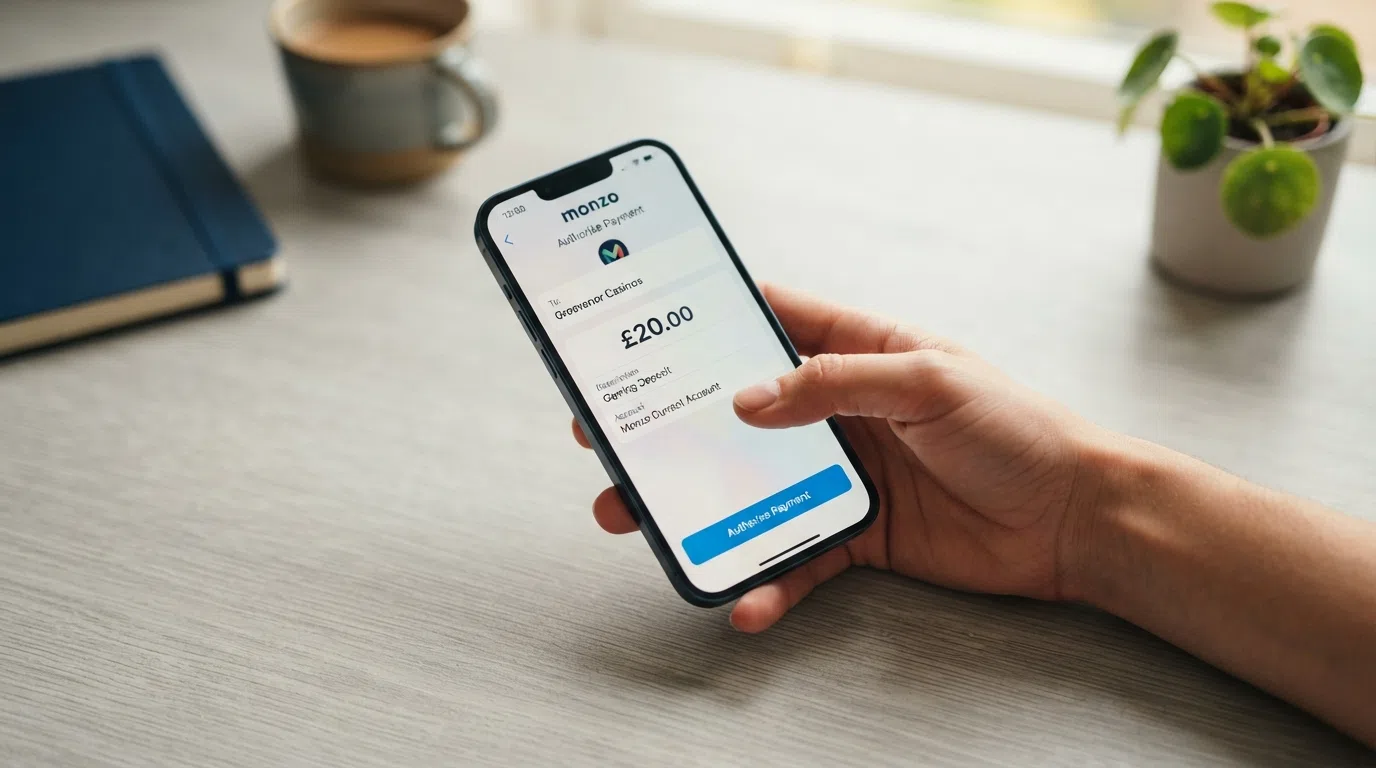
Bank-to-bank echeque is not just compliant by default; it is also the method that gives the player the most spend visibility. A Bacs, Faster Payments or Open Banking deposit shows up as a named line on the bank statement, which is a layer of self-tracking no card payment can match. At a UKGC operator, the deposit is fee-free in pounds — operators absorb the cost rather than charge it through the cashier — and the same route that brought the money in is the one that will pay it back out at withdrawal.
| Payment Method | Deposit Speed | Withdrawal Speed | Fees | Bonus Eligibility | Spend Tracking |
|---|---|---|---|---|---|
| Echeque (Bacs/Faster Payments/Open Banking) | Faster Payments and Trustly near-instant; Bacs up to 2 working days | 1–3 business days after casino approval | Fee-free at UKGC operators in GBP | Eligible (Skrill/Neteller exclusions do not apply) | Visible on bank statement as a named line |
| Debit Card | Instant | 1–3 business days after casino approval | Fee-free at UKGC operators in GBP | Eligible | Visible on card statement but not as clearly itemised as a bank transfer |
| PayPal / E-wallets | Instant | Within 24 hours at most UKGC operators | Fee-free at UKGC operators in GBP | Often excluded (Skrill and Neteller specifically) | Buffered through the e-wallet; not visible on bank statement without linking |
Echeque deposit times: how fast your money lands
The deposit speed depends entirely on which underlying mechanism the casino uses. Faster Payments and Trustly-style Open Banking transfers clear in seconds — the casino balance typically updates before the player has closed the banking app. Bacs Direct Debit is slower, with a clearing window of a few hours to two working days depending on the time of day the mandate is set.
A small number of UK banks have started declining gambling-related payments on Faster Payments as a default, and that is the one deposit-time risk worth flagging. The decline is at the bank’s discretion, not the casino’s, and a player whose bank has implemented a gambling block on Faster Payments will need to either lift the block inside their banking app or fall back on Bacs Direct Debit, which most banks do not flag the same way. The casino cannot override the bank’s decision, and the deposit will simply not land. The fix is to check the bank’s gambling-block setting before depositing, and to choose a bank-method that the bank has not flagged.
Are echeque casinos legal? Your protections under UK law
Echeque deposits at UK casinos are fully legal. The Gambling Act 2005, extended to remote operators by the Gambling (Licensing and Advertising) Act 2014, makes a GB operating licence compulsory for any operator serving GB customers, and the Gambling Commission is the single statutory regulator. Three licensing objectives sit at the top of the regime: preventing gambling from being a source of crime or disorder, ensuring gambling is conducted fairly and openly, and protecting children and vulnerable persons from harm.
Echeque and bank-transfer payments are not restricted under any of those objectives. The one payment prohibition is the credit card ban, in force since April 2020 and extended to credit-card-funded e-wallets. Other than that, the only payment-side rule that touches bank-to-bank gambling is the obligation on operators to verify a customer’s name, address and date of birth before allowing a deposit — a rule that has been in place since 7 May 2019 and that every UKGC operator enforces at sign-up.
The two tax-side changes worth knowing about are the statutory levy and the Remote Gaming Duty rate. From 6 April 2025, the statutory levy replaced voluntary contributions, with the top rate of 1.1% of gross gambling yield applied to remote casino, remote bingo, remote general betting and gambling software licences. From 1 April 2026, the operator-side Remote Gaming Duty rose from 21% to 40%. Both apply to operators, not players — the player pays no tax on gambling winnings in the UK, a position unchanged since betting duty was abolished at the player level in 2001.
The UK Gambling Commission: what a GB licence guarantees
A UKGC licence is not a rubber stamp. It carries enforceable conditions — the Licence Conditions and Codes of Practice (LCCP) — that every operator must meet, and the Commission publishes a public register of every licence holder, including the licence number, the entity name, the licence type, and the dates the licence is active.
To verify a licence, the player looks up the operator on the public register at the Commission’s website. The entry shows the account number, the operating entity, the licence status (active, suspended, revoked), and the trading names the licence covers. The register is the source the Commission’s enforcement actions reference, and a player who wants to check whether a casino holds a genuine GB licence does it there.
The LCCP conditions operators must meet cover the three licensing objectives in operational terms: crime prevention (anti-money-laundering checks, social responsibility interactions), fairness (game integrity, transparent terms, dispute resolution), and child and vulnerable-person protection (age verification, self-exclusion, safer-gambling tools). The Commission also approves Alternative Dispute Resolution (ADR) providers, and a player who has exhausted an operator’s internal complaints process can refer the dispute to an ADR provider or back to the Commission itself.
From 31 October 2025, every operator must prompt a customer to set a financial limit before their first deposit. From 30 September 2026, only a gross deposit limit may be called a “deposit limit”, and that form must be offered with at least equal prominence. A decrease to a deposit limit takes effect immediately; an increase is subject to a cooling-off period.
Why the credit card ban makes echeque the safer choice
The credit card ban sits on the statute book because the Commission and the Government concluded that borrowing to gamble is a particular kind of harm. LCCP 6.1.2 prohibits GB-licensed operators from accepting payment by credit card, and the prohibition extends to credit-card-funded payments routed through e-wallets — Skrill, Neteller, PayPal. A player who tops up a PayPal account with a credit card and then deposits from the PayPal balance is using a credit-card-funded payment, and the operator cannot accept it.
Echeque and bank transfer are the structural alternative. They are bank-to-bank payments funded from a current account, not a credit balance, and the ban does not touch them. In practice, every UK player who funds a casino account from a UK current account is using the echeque model by default — the bank transfer is the flow, the bank is the clearing layer, and the regulatory framework treats the deposit as a debit against funds the player already holds.
The practical effect is that the credit card ban has pushed the UK online market toward bank-based deposits as the default. The operators on this list, and the broader UKGC market, route most deposits through Bacs, Faster Payments or Open Banking for exactly this reason.
What happens if you play at an unlicensed casino
The risk is not prosecution. There is no criminal penalty established against a player who merely gambles on an unlicensed site — what a player loses by going offshore is the protective envelope that sits over a UKGC license.
A GB licence is compulsory at the point of consumption since the 2014 reform, and operating without one is a criminal offence under section 33 of the Gambling Act 2005 — up to 51 weeks’ imprisonment (six months in Scotland), a fine at level 5 (effectively uncapped), or both. The Commission’s enforcement model is disruption, not ISP blocking. Between April 2024 and June 2025, the Commission issued 3,140 disruption notices, referred 447,778 URLs to search engines, and saw 287,961 URLs removed. The Commission does not hold statutory ISP or DNS blocking powers, though legislation has been proposed.
A player at an unlicensed site loses GAMSTOP coverage, the Commission’s complaints route, and any approved ADR provider. Self-exclusion does not propagate. The age verification, the deposit limit prompt, the stake cap, the wagering cap, the safer-gambling tools — none of them apply. If a dispute arises, the player has no regulator to escalate to. The offshore operator runs on its own house rules, and the player has no fallback.
Staying in control: safer gambling tools at UK echeque casinos
UK regulation mandates a safer-gambling framework that operates regardless of payment method, and the tools it requires are the ones the player will encounter at every UKGC operator. The frame is the three licensing objectives, and the operational tools are the financial limit prompt, the deposit limit, reality checks, time-out, GAMSTOP self-exclusion, and the financial vulnerability check at a £150 rolling 30-day net deposit threshold.

The prevalence numbers sit behind those tools. According to the most recent treatment and support survey, 13.1% of GB adults — approximately 6.8 million people — are classified as experiencing any level of gambling problems (PGSI 1+), and 2.5% are at the problem-gambling threshold (PGSI 8+). In January 2026, GamCare made 996 referrals to treatment and peer-based support services, up 48% year-on-year from 674 in January 2025. The trend is up. The regulatory response — mandatory prompts, deposit limits, self-exclusion — is calibrated against that trend.
The echeque method adds one structural aid that no card-based funding offers: a clean bank-statement record. A player who funds exclusively by bank transfer can see every deposit, every withdrawal, and the net position across them, on a single bank statement page, without exporting casino-side data. That visibility is not a substitute for the regulator-mandated tools, but it is a self-awareness layer that sits on top of them.
GAMSTOP: how self-exclusion works with echeque payments
GAMSTOP has been mandatory for every GB-licensed online operator since 31 March 2020. A player who registers with GAMSTOP is excluded from every GB-licensed online gambling site, regardless of the deposit method they would otherwise use — bank transfer, debit card, PayPal, the echeque route, all of them are blocked at the cashier. The exclusion periods on offer are six months, one year, five years, or five years with auto-renewal, and none of them can be cancelled early.
The coverage is national across GB-licensed sites and stops at the GB border. An offshore site is not on GAMSTOP, and a player who has registered for self-exclusion can still reach an unlicensed site — which is one of the reasons the credit card ban, the public register, and the safer-gambling tools all point at licensed operators as the only regulated environment. A player who wants the exclusion to stick needs to play only at GB-licensed sites, and GAMSTOP is the mechanism that enforces that boundary.
Deposit limits, reality checks and the tools you set yourself
From 31 October 2025, every UKGC operator must prompt a customer to set a financial limit before their first deposit. The prompt is a hard requirement — the casino cannot skip it — and the player can set a daily, weekly or monthly limit, or all three. Decreases to a limit take effect immediately; increases are subject to a 24-hour cooling-off period as standard. From 30 September 2026, the only form that may be called a “deposit limit” is a gross deposit limit (RTS 12), and that form must be offered with at least equal prominence to any other financial limit option.
The other tools sit alongside the limit prompt. Reality checks pop up at intervals to show time played and net position. Time-out tools block access for a chosen period, from 24 hours to several weeks. Self-exclusion through the operator itself — separate from GAMSTOP — blocks access for six months or more. The October 2021 game-design rules, also still in force, ban auto-play, impose a 2.5-second minimum spin speed, ban losses disguised as wins, ban reverse withdrawals, and require the operator to display total session losses, wins and time played.
Where to get help: GamCare, NHS clinics and the National Helpline
The National Gambling Helpline, run by GamCare, is available free and confidentially 24 hours a day, 7 days a week on 0808 8020 133. GamCare also runs a live chat service and a WhatsApp support line for players who prefer text-based contact. The NHS operates gambling harm clinics in England, Scotland and Wales, providing specialist treatment for gambling disorder. The GambleAware service finder locates local support, and Gamblers Anonymous UK runs peer-based meetings.
The demand for these services has risen sharply. GamCare’s January 2026 referral number — 996, up 48% year-on-year — is the most recent published figure, and the trend through 2025 was consistently upward. A player who feels their gambling is no longer under control has multiple free routes into support, all of them confidential, and the regulator-mandated tools at the operator are designed to work alongside them.
How we ranked the best echeque casinos in the UK
The ten operators above were selected against four criteria, in this order of weight. First, the operator had to be verifiable on the UK Gambling Commission’s public register of operating licence holders — a real, active GB licence, not an offshore registration. Second, the operator had to offer documented bank-transfer or Open Banking support at the cashier, so the “echeque” label is a working deposit path rather than a marketing line. Third, the welcome offer had to comply with the 10× wagering cap under SR Code 5.1.1, in force from 19 December 2025. Fourth, the operator had to be a participating member of GAMSTOP, which is a condition of every GB online operating licence and so is satisfied by every operator on the list.
The ranking order then reflects how cleanly bank payments sit alongside the welcome offer. Operators with a Trustly or Open Banking route and a high-ceiling Bacs route outranked operators with a single bank-transfer line. Operators with no-wagering free-spin offers outranked operators with wagering on winnings, other things being equal. No operator paid for placement, and the licence verification was done against the public register as the source of truth.
Your echeque casino: what to look for beyond the bonus
The best echeque casino for a specific player depends on three things the bonus headline does not answer: which underlying bank mechanism the player’s own bank supports, how fast the operator processes withdrawals, and which bonus terms the player can actually clear. A player whose bank has a gambling block on Faster Payments will want an operator with Bacs Direct Debit or Open Banking in the cashier; a player whose bank runs cleanly on Faster Payments will not care. A player who values fast withdrawals will weight the operator’s stated processing time more than the spin count; a player who plays once and cashes out will look at the same line.
The bonus validity window is the easiest number to underestimate. William Hill’s 72-hour offer is the shortest on this page, and a player who signs up on a Friday night and returns on Monday will have missed it. 888’s 90-day offer is the longest, and a player who deposits £100 and clears the playthrough in stages over three months has the time to do it. The match between bonus validity and play pattern is more important than the bonus size.
The single check worth doing before depositing is the licence verification on the UKGC public register. The register shows the licence number, the operating entity, the status, and the trading names — the data that proves the operator is the one the marketing page claims to be. A player who takes five minutes to look the operator up before signing up has done the one piece of due diligence that the echeque flow itself cannot do.
The decision that can be made right now, on this page, is to pick a UKGC-licensed operator with documented bank-payment support, no-wagering terms where possible, and a bonus validity that matches how the player actually plays. The top of this list is built for that pick.
Frequently asked questions about echeque casinos in the UK
Do I qualify for a welcome bonus if I deposit by echeque at a UK casino?
Yes, in most cases. Echeque and bank-transfer deposits are eligible for the standard welcome offer at every UKGC-licensed operator, including the ten on this page. Skrill and Neteller are commonly excluded from bonuses, but bank transfer and Open Banking are not — and where research shows a Skrill/Neteller exclusion (for example at 888 Casino), bank transfer deposits still qualify. Check the offer’s payment-method exclusions before depositing.
What happens if my bank blocks an echeque gambling payment?
The deposit will not clear. A small number of UK banks have started declining gambling-related transactions on Faster Payments and, less often, on debit card. The block sits at the bank, not the casino, and the casino cannot override it. The fix is to check the gambling-block setting in the banking app, lift it if the player chooses, or fall back to Bacs Direct Debit or Open Banking, which most banks do not flag the same way. A player whose bank has a hard block should choose a casino with a Bacs or Open Banking route.
Must I set spending caps before my first echeque casino deposit?
Yes, from 31 October 2025. Every UKGC operator is required to prompt a customer to set a financial limit before their first deposit, and the prompt is a hard requirement — the cashier will not let the player deposit without it. Decreases to a limit take effect immediately; increases carry a 24-hour cooling-off period. From 30 September 2026, only a gross deposit limit may be called a “deposit limit”, and that form must be offered with at least equal prominence.
How do I know if an echeque casino holds a genuine UKGC licence?
Check the Gambling Commission’s public register. The register lists every operating licence holder, the account number, the entity name, the licence status, and the trading names the licence covers. The data is published in real time, and a player who searches the operator’s brand name or licence number can confirm the entry within seconds. The register is the source of truth for every licence claim a casino makes.
Are my echeque casino winnings taxable in the UK?
No. Gambling winnings are not taxable at the player level in the UK — betting duty was abolished for punters in 2001 and has not been reinstated. The operator pays Remote Gaming Duty, which rose from 21% to 40% on 1 April 2026, but that is an operator-side levy, not a player-side tax. A player at a UKGC-licensed casino keeps the full amount of any winning, with no tax obligation to declare it.
Does the UK statutory levy change anything for echeque casino players?
No, not directly. The statutory levy is an operator-side payment that replaced voluntary contributions from 6 April 2025, with the top rate of 1.1% of gross gambling yield applied to remote casino and gambling software licences. The proceeds are split 50% to treatment, 30% to prevention and 20% to research, and the levy is separate from Remote Gaming Duty. The player does not pay the levy, and the deposit, withdrawal and bonus mechanics at the casino are unchanged.
Withdrawing winnings: can you cash out by echeque?
Withdrawals go back to the bank account, almost always via bank transfer. The processing window is 1 to 3 business days after the casino has approved the payout, and most UKGC operators run a 24-to-48-hour internal approval window before the bank transfer clears. Total time from “withdraw” button to funds in the current account is typically 2 to 5 business days.
There is no reverse-withdrawal loophole. Since 31 October 2021, the Commission’s game-design rules have permanently banned the practice of letting a player pull a withdrawal request back into a playing balance, and a UKGC operator will not offer that option. A withdrawal, once approved, is on its way to the bank.
A bank-statement record of withdrawals also helps with the spend side of safer gambling. Where a deposit shows as a named line, a withdrawal shows as a named line in the other direction, and a player who wants to keep a clean record of what has gone in and what has come out has it without doing any extra work.
Echeque vs PayPal vs debit card: which UK payment method wins?
Each method has a structural advantage. Echeque wins on spend visibility — the bank statement carries a named line in both directions — and on regulatory compliance, because no version of it is covered by the credit card ban. Debit card wins on universal acceptance and instant deposit, and the only structural weakness is that a small number of UK banks have started applying gambling blocks to debit card transactions, in which case the deposit will not clear. PayPal wins on speed — both deposit and withdrawal are near-instant — but loses on bonus eligibility (Skrill and Neteller are commonly excluded, and PayPal is often restricted or excluded from welcome offers) and on the credit-card-funding prohibition, which extends to credit-card-funded PayPal accounts.
For a player who values transparency, the echeque path is the cleanest. For a player who values speed above all else, PayPal is the practical answer. For a player who values universal acceptance, debit card remains the default — with the caveat that the bank’s gambling-block setting can override it.
Payments – No Minimum Deposit Casinos UK
Content created by the «No Minimum Deposit Casinos UK» team