
Casinos That Accept Diners Club UK — The Ban, The Alternatives, The Ten Worth Your Deposit
 Available in GB
Diners Club cannot fund any UK-licensed online casino. The reason is straightforward and it has nothing to do with Diners Club specifically: the card is a credit card, and since 14 April 2020 the Gambling Commission has barred every GB-licensed operator from accepting credit cards, including credit routed through e-wallets. That rule catches Diners Club the same way it catches Visa Credit or American Express. The card still works for non-gambling merchants in the UK, and it still works at online casinos licensed outside Great Britain. But at any operator holding a Gambling Commission licence, the cashier will refuse it.
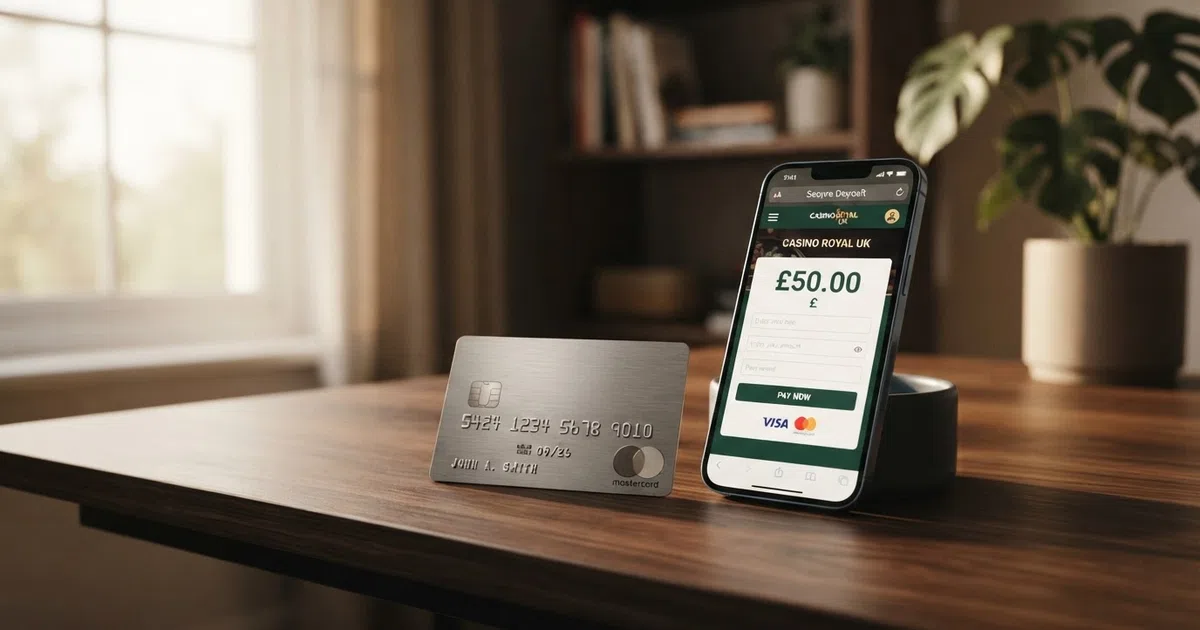
Current as of 23 August 2026 against the Gambling Commission’s public register and its published guidance on credit-card use.
Diners Club is banned at every licensed UK casino
A UK player carrying a Diners Club card has a problem before they reach the deposit screen. The problem is not the brand, the issuer, or the network’s reach. It is the product type. Diners Club is a credit card; UK gambling regulation has prohibited credit cards at every GB-licensed operator since 14 April 2020 under Licence Condition 6.1.2 of the LCCP. The prohibition covers all remote gambling (betting, gaming and lotteries) and non-remote betting, and it reaches credit-card funds routed through Skrill, Neteller or PayPal as well. No card with a credit balance gets through, no matter what logo sits on the front.
The card’s global footprint is not in dispute. Diners Club International is accepted in more than 190 countries and territories, with issuers in more than 35 countries. In the UK, however, the sole issuer is Affiniture Cards Limited, whose business focus sits well outside gambling: B2B statement accounts for rail travel through Trainline. Moorwand Ltd’s acquiring arrangement with Diners Club International does open UK merchant acceptance for Diners Club, Discover and 30 alliance cards, but that arrangement applies to ordinary retail and travel merchants — not to gambling sites subject to the credit-card ban. LCB lists the United Kingdom as a restricted country for Diners Club Credit at online casinos. There is no GB-licensed list of casinos accepting Diners Club, because no such casino can legally exist.
What accepting this card would even mean
A casino that accepted Diners Club would look, from the player’s side, much like any other card-funded cashier: pick an amount, type card details, complete 3-D Secure, wait for the funds. The card network is global, the issuer footprint broad, the authentication rail identical to what Visa and Mastercard run. The difference at a UK operator is that none of this gets past the deposit screen, because the operator’s payment team has been instructed by its regulator not to allow it. A casino that wanted to fund deposits with Diners Club would have to be licensed somewhere else.
In the UK, even outside gambling, Diners Club acceptance runs narrower than the global footprint suggests. Affiniture Cards Limited issues the card domestically, and Moorwand’s acquiring work is about opening merchant acceptance in retail and travel categories, not in regulated gambling. The card works on Trainline and similar merchants. It works in casinos licensed outside the UK. The single thing the card cannot do is fund a deposit at an operator holding a Gambling Commission licence.
Why it disappeared from casino cashiers
The switch-off happened on 14 April 2020. The rule sits in Licence Condition 6.1.2 of the LCCP, the Gambling Commission’s licence conditions and codes of practice. It prohibits any GB-licensed operator from accepting payment by credit card, including credit cards routed through e-wallets or money service businesses. The text was written broadly on purpose: it covers all remote gambling and non-remote betting, and it catches any payment where the underlying source is credit, however the funds are wrapped on the way in. A player funding Skrill with a credit card and then depositing from Skrill runs into the same wall as a player paying directly.
The rule has held since 2020 without amendment. The Gambling Commission’s published guidance on preventing credit card use restates the prohibition and lists the three e-wallets specifically. No consultation has opened the door. No carve-out exists for premium or charge cards. The product is the thing, not the brand on the plastic.
Real-money wagers and where the full list lives
Real-money play is ordinary once an accepted method is in place. The ban does not stop gambling; it stops one funding route. A player who deposits through Visa Debit, a PayPal wallet that was topped up from a debit card, or an Open Banking transfer can wager on slots, table games, and live dealers exactly as before. The full list of operators worth a deposit sits in the next section: ten GB-licensed brands, all of which have refused credit cards for the past six years under the same rule.
The card itself is fine for non-gambling merchants. Trainline, hotel groups, certain retailers and other UK businesses that accept Diners Club will continue to take the card without issue. There is no GB-licensed list of casinos accepting Diners Club, and there will not be one: the rule that stops the card is structural, not a brand-by-brand policy.
The ten GB-licensed operators worth your deposit
The pivot from a banned card to working deposits is the only useful thing this page can offer, so the rest of the comparison ranks ten GB-licensed casinos against the welcome offer each one currently runs. Every operator on this list holds a Gambling Commission licence and therefore refuses Diners Club at the cashier. The ranking reflects offer terms and licence status, not card acceptance, because acceptance is uniformly zero. The criteria behind the order sit in their own section further down.
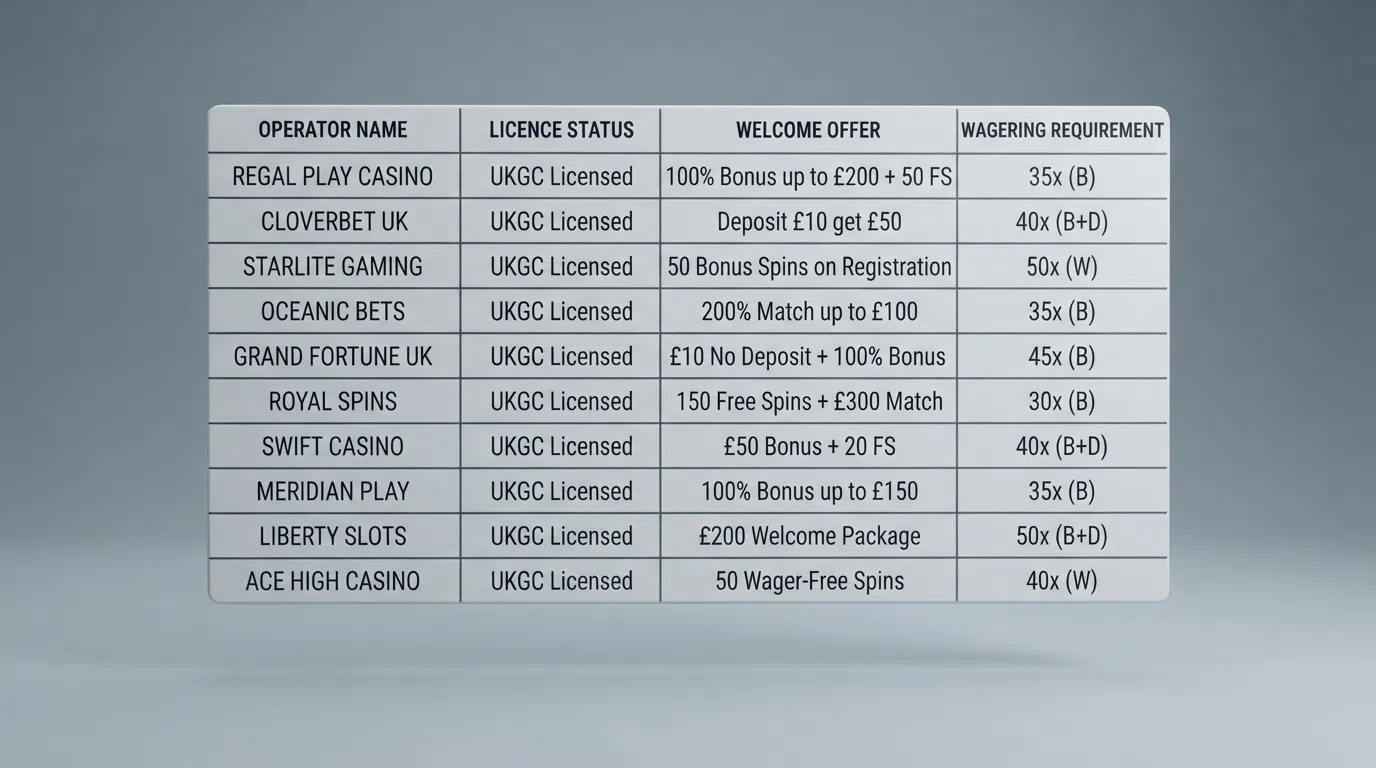
| Operator | Licence | Welcome offer | Wagering | Validity |
|---|---|---|---|---|
| Bet365 | UKGC | Up to 500 free spins (10 reveals) | 0× (cash) | 30 days to claim |
| William Hill | UKGC | 200 spins on Big Bass Splash | 10× on winnings | 72 hours |
| Sky Vegas | UKGC | 50 no-deposit + 200 deposit spins | 0× (cash) | 7 days |
| Ladbrokes | UKGC | 100 spins + 300 LadBucks | Standard (within 10× cap) | 48h accept / 7 days |
| Paddy Power | UKGC | 260 spins (60 no-deposit) | 0× (cash) | 7 days |
| Coral | UKGC | 100 spins on £10 play | 10× on bonus funds | 48h accept / 7 days |
| Betfred | UKGC | 200 wager-free spins | 0× (cash) | 48h to claim |
| 888 Casino | UKGC | 100% match up to £100 | 10× on bonus funds | 90 days |
| Betfair | UKGC | 50 spins (up to 100) | 0× (cash) | Not specified |
| Virgin Games | UKGC | 100 spins on first £10 play | 0× (cash) | 30 days |
The ten offers split cleanly. Six pay free-spin winnings as cash with no wagering at all. Two add bonus funds with a 10× playthrough that sits exactly at the regulatory ceiling. One bundles LadBucks alongside spins, again within the cap. The standout is the deposit match at 888 Casino, the lone entry that is not a free-spin offer, and the only one where the wagering requirement is paid in bonus pounds rather than cash winnings. A reader scanning the column for the lowest wagering finds six zeroes and four tens; a reader scanning for the highest headline spin count finds Bet365’s 500.
Bet365 — 500 spins, cash with no wagering
The headline number on this list belongs to Bet365. New registrants can earn up to 500 free spins through a reveal mechanic — ten reveals in total, each awarding 5, 10, 20 or 50 spins — once £10 in lifetime deposits has been made. The wins land as cash with zero wagering. The claim window runs 30 days from registration, with 20 days to complete the ten reveals and a 24-hour gap between reveals. The minimum deposit is £5, and withdrawals clear in 1–24 hours via e-wallets and 1–4 hours via debit card.
Verdict: the largest spin count on the page and the cleanest wagering treatment. The 30-day claim window is the trade for the volume — a reader who forgets to log in for a fortnight loses the spin balance. Worth the deposit for a player who actually intends to log in across the window.
William Hill — Big Bass Splash spins, £30 cap
William Hill’s offer runs in the opposite direction: fewer spins, a hard cashout ceiling, and a tight clock. The welcome package is 200 free spins on Big Bass Splash at 10p per spin, triggered by a £10 deposit and stake. Winnings carry a 10× wagering requirement, must be used within 72 hours of credit, and the maximum cashout is capped at £30.
Verdict: the smallest ceiling on the list, and the 72-hour validity is unforgiving. A reader chasing headline spin count should look elsewhere; a reader who wants a tight, defined test of a brand — deposit, stake, watch the cashout cap — gets that here with no ambiguity.
Sky Vegas — 50 spins handed over upfront
Sky Vegas pays out before a deposit lands. The package gives 50 free spins on registration, no deposit required, with a further 200 spins once £10 has been deposited and spent on eligible games. Wagering is zero; winnings are paid as cash. The spins expire 7 days after credit, and the minimum deposit is £5. Withdrawals through Pay by Bank are immediate; eligible cards clear in 1–4 hours and standard cards in 2–5 working days.
Verdict: the most generous no-deposit slice on the page after Paddy Power. New players receive 50 spins immediately, and the low £5 minimum deposit makes the further 200 spins easily accessible. This is a standout option for testing a brand before committing cash.
Ladbrokes — 100 spins plus 300 LadBucks
Ladbrokes offers 100 free spins at 10p each alongside 300 LadBucks, triggered by depositing and spending £10 on slot games. Standard wagering applies, sitting within the Gambling Commission’s 10× cap. The acceptance window is 48 hours and the spins are valid for 7 days. The minimum deposit is £10; PayPal withdrawals clear in under 5 hours, and Skrill and Trustly are available.
Verdict: Ladbrokes is notable for including 300 LadBucks alongside its free spins, all bound by a 10× wagering cap. It is a preferred choice for players who enjoy variety beyond standard slots, though the 48-hour claim window requires prompt action.
Paddy Power — 60 spins before any money
Paddy Power runs the largest no-deposit slice of the ten. The package is 260 spins total, of which 60 are deposit-free (50 on eligible slots and 10 on Paddy’s Mansion Heist, a Paddy Power exclusive), with 200 more on a £10 deposit and wager. Wagering is zero across the board, and the spins expire after 7 days. The minimum deposit is £10.
Verdict: the strongest no-deposit proposition on the page. A reader who wants to sample a brand before paying in gets more spins here than anywhere else on the list, with the Paddy’s Mansion Heist line adding a title nobody else on the page offers.
Coral — £10 of play, 100 spins back
Coral gives 100 free spins when £10 has been played on any slot, with an alternative route: a £10 slot bonus plus 100 spins for £5 of play. Wagering is 10× on bonus funds, sitting at the regulatory ceiling. The 48-hour acceptance window and 7-day validity apply. The alternative route carries a £5 minimum deposit.
Verdict: the £5 entry point on the alternative route is the lowest on the page. A reader with a tight bankroll gets a genuine path in, in exchange for accepting the 10× playthrough on the bonus fund.
Betfred — 200 spins, no wagering attached
Betfred hands over 200 wager-free spins once £10 has been staked on casino slots. Wagering is zero; winnings are paid as cash. The spins must be claimed within 48 hours. The minimum deposit is £10.
Verdict: a clean, wager-free offer with a low entry point. The 48-hour claim window is tight — a reader who lets it lapse loses the spins — but the wagering position is the strongest on the page after Bet365 and Sky Vegas.
888 Casino — 100% match up to £100
The only deposit-match offer on this list. 888 Casino matches the first deposit 100%, up to £100, with 10× wagering on bonus funds across selected slots. The bonus is valid for 90 days, the maximum cashout is capped at £100, and the minimum deposit is £10.
Verdict: the longest validity on the page (90 days) and the only offer that scales with deposit size. The 10× playthrough on bonus funds — rather than cash winnings — is the heavier cost of the offer, and the £100 cashout cap is the lowest on the list.
Betfair — 50 spins paid straight as cash
Betfair offers 50 free spins (up to 100) once £10 has been deposited and played through, with winnings paid as cash and no wagering attached. E-wallet deposits and Apple Pay deposits are excluded from the offer — a player funding through PayPal or Apple Pay will not trigger the spins. The minimum deposit is £10.
Verdict: a strong, cash-paid offer with a meaningful payment-method restriction. A reader paying by debit card gets the spins; a reader paying through an e-wallet does not. That distinction matters at the deposit screen.
Virgin Games — 100 spins, winnings yours outright
Virgin Games pays 100 free spins at 10p each on the first £10 of play, with zero wagering and a 30-day expiry. There is no cap on winnings.
Verdict: the simplest cash-paid offer on the page. No wagering, no cap, a £10 entry point, a 30-day window. A reader who wants the cleanest possible wager-free offer gets it here, with the trade-off being a smaller spin count than Bet365, Paddy Power or Betfred.
How money moves without the banned card
Five years after the credit-card ban, the deposit mix at British online gambling operators looks very different from what it did in 2019. Debit cards are the default rail. E-wallets handle most of the same-day cashouts. Open Banking Pay by Bank is the fastest-growing rail and carries the lowest deposit fees. The remaining options sit on the edge: Apple Pay and Google Pay work for deposits but cannot receive withdrawals back to the wallet, and Paysafecard is deposit-only.
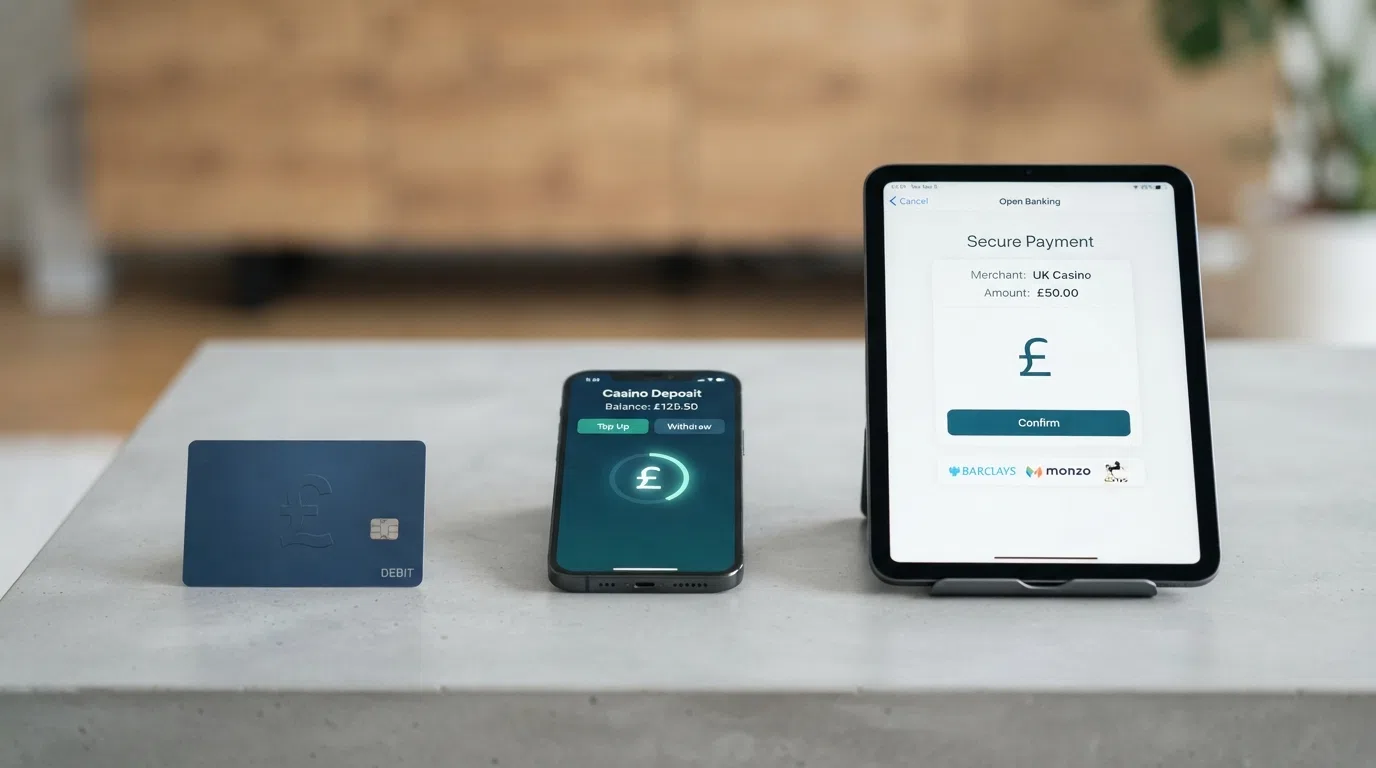
| Method | Deposit speed | Withdrawals |
|---|---|---|
| Visa Debit / Maestro | Instant | 1–3 business days |
| E-wallets (PayPal, Skrill, Neteller) | Instant | Often same day |
| Open Banking / Pay by Bank | Instant | Often same day |
| Apple Pay / Google Pay | Instant | Not supported back to the wallet |
| Paysafecard | Instant | Deposits only |
The shift is structural. None of these rails carries a credit balance from a credit card, which is exactly why they pass the cashier. A player funding any of them from a debit source lands inside the rule.
Paying in: three straightforward steps
The first step is the choice of operator, and the ranking above is built around that choice. A GB-licensed operator is the only kind that applies the consumer protections a UK player expects: GAMSTOP self-exclusion, the Gambling Commission’s complaints route, an ADR option, and the £150 vulnerability check at the deposit screen. Offshore brands offer none of these, even when they accept Diners Club.
The second step is identity verification. Since 7 May 2019, every GB-licensed remote operator has been required to verify a customer’s name, address and date of birth before any deposit or any gambling. The check runs against public sources and against the operator’s own records. A player who has not yet verified cannot deposit, regardless of payment method.
The third step is the deposit itself. Visa Debit or Maestro is the most widely accepted rail. PayPal, Skrill or Neteller are the e-wallet choices, and they often clear withdrawals the same day. Trustly, TrueLayer and other Open Banking providers are the fastest-growing option. Apple Pay and Google Pay fund the deposit instantly but do not receive the cashout — that routes back to a bank account or debit card.
Debit cards pass; credit cards do not
The line between allowed and banned funding sits at a single word: credit. Visa Debit and Maestro are accepted at every GB-licensed casino; Visa Credit, Mastercard Credit, American Express Credit and Diners Club Credit are not. The distinction is not the brand on the card and not the network processing it; it is whether the underlying product extends a credit balance. A card that draws on money the issuer has already lent cannot be used at a GB-licensed cashier.
The rule reaches further than direct card payments. Credit-card funds routed through Skrill, Neteller or PayPal are caught by the same prohibition. The Gambling Commission’s published guidance lists those three e-wallets by name. The wording is broad on purpose: a player funding a wallet with a credit card and then depositing from the wallet hits the same wall as a player paying directly. No card, no rail, no wrapper gets credit through.
How fast cashouts actually arrive
Cashout speed is set by the receiving rail, not the deposit rail. Debit card withdrawals take 1–3 business days at most GB-licensed operators. E-wallet withdrawals often clear the same day, with PayPal, Skrill and Neteller all capable of intraday settlement. Open Banking cashouts through Pay by Bank are increasingly same-day as well. Sky Vegas publishes Pay by Bank as immediate on eligible withdrawals.
Apple Pay and Google Pay sit on the wrong side of this question. Both fund deposits instantly, but neither receives withdrawals back to the wallet. A player depositing through Apple Pay needs a debit card or bank account to receive the cashout. The asymmetry is worth knowing at the deposit step, because the rail that feels fastest at deposit is not always the rail that feels fastest at withdrawal.
Minimums, limits and what fees cost
Minimum deposits sit at £5–£10 across the ten operators on this page. The £5 floor belongs to Bet365, Sky Vegas and Coral’s alternative route. The £10 floor belongs to William Hill, Ladbrokes, Paddy Power, Betfred, 888 Casino, Betfair and Virgin Games. None of these is a barrier; the lowest is half what the highest costs and ten times smaller than a typical UK supermarket shop.
Britain sets no nationwide deposit or loss ceiling. The state caps the slot stake per spin and compels every operator to offer a customer-set deposit limit; the level of that limit stays with the player. From 31 October 2025, every GB-licensed operator must prompt a customer to set a financial limit before the first deposit.
Fees cluster on a single rail. Open Banking Pay by Bank carries the lowest deposit fees at around 4.5%. E-wallets may carry provider fees depending on the wallet. Debit cards and Apple/Google Pay generally carry no fee at the operator’s end. A player moving £100 through Open Banking pays roughly £4.50 in fees; a player moving the same amount through PayPal pays whatever PayPal charges on the transfer.
Why the welcome offers are smaller than they look
The ten offers on the previous table are smaller than they look, and the regulatory caps are the reason. Since 19 December 2025, every GB-licensed casino has lived under two hard limits: a 10× ceiling on bonus wagering and a ban on mixed-product promotional offers. Both sit in the LCCP Social Responsibility Code 5.1.1. The cap is not on the value of the bonus itself; the state confirmed no cap on the monetary value of a bonus. The cap is on what the player has to do to convert the bonus into withdrawable cash.
The 10× ceiling reshapes the welcome offer column in the table above. Six of the ten sit at zero wagering, paying spin winnings straight as cash. Three sit at the 10× cap, where the player has to wager the bonus a fixed number of times before any winnings become withdrawable. One (888 Casino) sits at 10× on bonus funds with a deposit match — the only offer on the list where the wagering applies to the bonus pounds, not to cash winnings. The shape of a UK welcome offer has tilted hard toward wager-free spins and away from bonus funds, and the 10× cap is the mechanism that did the tilting.
The expected cost of clearing a bonus at the cap is a significant consideration for a player choosing an offer. A reader weighing the deposit match at 888 Casino against the wager-free spins at the other nine should know what the wagering actually costs before choosing the offer that looks largest.
Where the ten-times ceiling bites
The 10× cap is a hard ceiling, not a guideline. No GB-licensed operator may attach a wagering requirement higher than 10× to any bonus. The cap also forbids mixed-product promotional offers: no cross-product promotions where a sports bet earns free spins, or where a casino deposit earns bingo bonus. The rule has been in force since 19 December 2025.
Among the ten featured offers, the ceiling bites only on those that carry wagering at all. William Hill, Coral and 888 Casino sit at the 10× mark; Ladbrokes runs standard wagering within the cap. Six others sit at zero, paying wins as cash. The asymmetry is informative: a reader looking at the table is comparing offers that look similar in headline terms but behave very differently when the spin winnings come to withdraw. The 10× ceiling is what makes “no wagering” a meaningful label rather than a marketing word.
No-deposit spins and what one spin is worth
Two of the ten offers hand over spins before any money changes hands: 50 spins at Sky Vegas on registration and 60 spins at Paddy Power on registration (50 on eligible slots plus 10 on Paddy’s Mansion Heist). The other eight trigger only after a £10 deposit and stake, with a single spin value of 10p across the offers that state it (William Hill, Ladbrokes, Sky Vegas, Paddy Power, Coral, Betfair and Virgin Games all price a spin at 10p).
The no-deposit wins still face whatever the offer attaches. Sky Vegas pays them as cash with no wagering; Paddy Power does the same. An offer that combines no-deposit spins with a high wagering multiplier would behave differently. None of the ten does. A reader who values testing a casino without paying in gets a genuine trial at Sky Vegas and a larger one at Paddy Power, with the rest of the table requiring the £10 stake to release anything.
No-wagering offers and the code question
Six of the ten pay spin winnings as cash: Bet365, Sky Vegas, Paddy Power, Betfred, Virgin Games and Betfair. The other four attach wagering within the 10× cap. The wagering position is the most important column in the table after the offer itself, because it determines what a player has to do to convert a spin win into withdrawable cash.
No featured offer requires entering a code. Each one triggers on the deposit and stake that the terms specify. Validity windows range from 72 hours (William Hill) to 90 days (888 Casino). A reader who loses a spin balance to an expired clock has not lost the offer to a hidden condition — the window is stated up front, and the audit lives in the player’s calendar.
What you can actually play — slots, tables, dealers
The catalogue is unaffected by the payment change. Slots, table games and live-dealer tables are all open once an accepted method is in place. The new limit sits on the slot stake: £5 per game cycle for players aged 25 and over since 9 April 2025, and £2 for players aged 18 to 24 since 21 May 2025, under SI 2025/215. The same operator may enforce two different maximum bets for two adults sitting in the same room. Table games, live dealer tables, sports betting and bingo sit outside the cap.
Slots and the published RTP to expect
Three slot titles carry published return rates that a reader can quote. Starburst (NetEnt) runs at 96.09% RTP with low volatility and a 500x maximum win. Book of Dead (Play’n GO) runs at 96.21% RTP with high volatility and a 5,000x maximum win. Big Bass Bonanza (Pragmatic Play) runs at 96.71% RTP with medium-high to high volatility and a 2,100x maximum win. These are not the only titles available, but they are the three where the return rate is published and where a player can compare the published figure against the £5/£2 stake cap before sitting down.
The cap itself changes what the numbers mean. A 500x maximum win on Starburst at the £5 stake produces a £2,500 ceiling per spin cycle. A 5,000x maximum win on Book of Dead at the £2 stake for an 18–24-year-old produces a £10,000 ceiling. The volatility bands matter: low volatility on Starburst means smaller, more frequent returns; high volatility on Book of Dead means larger but rarer payouts. The £5/£2 cap stops the stake from running away, but it does not change the return profile of the underlying game.
Blackjack, roulette and the dealer-led games
Blackjack, roulette and bingo sit outside the slot stake cap. The £5/£2 age-banded maximum is imposed by SI 2025/215 on online slots only; sports betting, live casino and bingo are not covered by the same instrument. A player at a live-dealer blackjack table from Evolution or Pragmatic Play is bound by the table’s own minimum and maximum, not by a state-mandated ceiling.
The provider list across the ten operators is broadly consistent: Evolution appears in the live-dealer mixes of William Hill, Sky Vegas, Ladbrokes, Paddy Power, Coral, Betfair and Virgin Games. Pragmatic Play, NetEnt and Playtech cover the slots side. The mix does not change because of the payment method — a deposit through Visa Debit opens the same catalogue as a deposit through Open Banking. The only thing the payment method changes is which rail the funds arrive on.
Playing and paying on the move — apps and Android
Mobile play is identical to desktop play in regulatory terms. The same accepted methods apply. The same identity check runs before the first deposit. The same £5/£2 slot stake cap applies regardless of device. Android and iOS both carry the full catalogue; the difference between platforms is not the rules but the deposit rail a player tends to use.
Mobile sites, apps and Apple Pay
A deposit through the casino app runs on the same rails as a deposit through the desktop site: debit card, e-wallet, Open Banking, or Apple Pay on iOS. Apple Pay funds the deposit instantly; Google Pay does the same on Android. Neither route can receive the cashout back to the wallet. A player who deposits through Apple Pay needs a debit card or bank account to receive the winnings — the asymmetry between deposit and withdrawal rails is the same on mobile as on desktop.
The same £5/£2 slot stake cap applies in-app. The same 10× wagering ceiling applies to in-app offers. The same GAMSTOP self-exclusion covers mobile play. A reader who has set a GAMSTOP exclusion cannot bypass it by switching from desktop to mobile. The instrument is the operator, not the device.
Crypto and the card ban — what’s allowed
Cryptocurrency sits outside the credit-card ban. Bitcoin and other tokens are not credit cards, and the Gambling Commission has not published a rule permitting or prohibiting crypto deposits at GB-licensed operators. The silence is not the same as a green light; a player who wants crypto deposits needs to check the operator’s own cashier before depositing. None of the ten featured operators is documented as accepting crypto, and the page does not name one.
Bitcoin, crypto and the missing rule
No confirmed UK rule permits or prohibits cryptocurrency deposits at GB-licensed operators. The absence of a rule does not mean crypto is anonymous. A GB-licensed operator verifies identity before the first deposit or any gambling; crypto funding that passes through a verified wallet still sits inside the verification regime. The “anonymous play” claim that occasionally attaches to offshore crypto casinos is incompatible with a GB licence, because the licence itself requires the verification.
Unlicensed offshore sites that offer crypto deposits carry none of the GB protections. No GAMSTOP, no Commission complaints route, no ADR, no British redress. A player who loses funds to a withholding offshore operator has lost both the funds and the route back. The cost of accepting crypto at an unlicensed site is the loss of every safeguard a UK player expects.
The newest operators face the same block
New launches inherit the credit-card ban, not an exemption. The rule sits in LCCP 6.1.2 and binds every GB-licensed operator regardless of launch date. A brand that opened its cashier yesterday applies the same prohibition as one that has been licensed for a decade. There is no new-entrant carve-out, and there is no transition period during which a launch may take credit cards while settling into compliance.
Fresh launches, unchanged payment rules
Newness never exempts a site from the credit-card ban, the 10× wagering ceiling, the £5/£2 slot stake cap, or the verification-before-deposit requirement. A new GB-licensed casino accepts debit, e-wallet and Open Banking from day one; it refuses Diners Club from day one. The deposit mix the Gambling Commission describes — debit, e-wallets and increasingly Open Banking Pay by Bank — applies to fresh launches as much as to established brands.
A reader looking at a new brand should verify the licence on the Gambling Commission’s public register before depositing. The register is searchable and updated daily; 2,665+ licensed businesses sit on it as of August 2026. A brand that cannot be found on the register is not a GB-licensed operator, regardless of what its homepage claims.
The law that stops the card — licence, GamStop, offshore
The regulatory spine has three parts. The Gambling Commission is the sole statutory regulator for Great Britain under the Gambling Act 2005 and the 2014 point-of-consumption reform. The LCCP is where the credit-card prohibition and the bonus caps sit. GAMSTOP is the multi-operator self-exclusion scheme that has been mandatory for every online licence since 31 March 2020. Offshore operators sit outside all three.
| Measure | Cap | In force |
|---|---|---|
| Credit cards at GB-licensed operators | Banned (LCCP 6.1.2) | 14 April 2020 |
| Slots stake, age 25+ | £5 per game cycle | 9 April 2025 |
| Slots stake, age 18–24 | £2 per game cycle | 21 May 2025 |
| Bonus wagering requirement | 10× maximum | 19 December 2025 |
| Mixed-product promos | Banned (SR Code 5.1.1) | 19 December 2025 |
| Financial vulnerability check | £150 net deposit / 30 days | 28 February 2025 |
| Statutory levy (remote casino) | 1.1% of GGY | 6 April 2025 |
| Remote Gaming Duty | 40% of operator profits | 1 April 2026 |
| GAMSTOP participation | Mandatory for every online licence | 31 March 2020 |
UK licensing and the credit-card rule
A GB licence has been compulsory at the point of consumption since 2014. A Curaçao, Maltese or Gibraltar licence is not a substitute. The minimum gambling age is 18, and since 7 May 2019 every remote licensee must verify a customer’s name, address and date of birth before any deposit or any gambling. The credit-card prohibition sits in LCCP 6.1.2. Remote Gaming Duty rose to 40% from 1 April 2026, up from 21% — the operator-side tax, not the player-side.
The player-side tax is none. UK players pay no tax on gambling winnings. Winnings are not income and are outside capital gains; the player-side betting duty was abolished in 2001. A player who withdraws £5,000 from a GB-licensed casino keeps £5,000, with no tax deduction at source. The duty change at 40% sits on the operator, not on the player.
GamStop and the no-verification myth
GAMSTOP has been mandatory for every Gambling Commission online operating licence since 31 March 2020. Exclusion periods run six months, one year, five years, or five years with auto-renewal. None of the periods can be cancelled early. After expiry, GAMSTOP continues for up to seven years if the customer is not contacted. The scheme is licence-bound — it covers GB-licensed online operators only, not retail betting shops, not overseas sites, and not unlicensed offshore brands.
Anonymous play is impossible at a GB-licensed site. Identity must be verified before the first deposit or any gambling. A player who claims a casino offers “no verification” is describing an unlicensed site, because the verification is what the licence requires. The “no-verification” pitch is a marketing line that no GB-licensed operator can honour.
Offshore sites and what protection you lose
Unlicensed offshore sites may accept credit cards including Diners Club. They carry no GAMSTOP. They offer no Gambling Commission complaints route. They have no ADR option, no British consumer redress, and no British regulator to complain to if funds are withheld. A player who loses funds to an unlicensed operator has lost both the money and the path back to it.
No established criminal penalty attaches to the player who gambles on an unlicensed site. The sanctions target operators, advertisers and intermediaries. What the player loses is protection, not liberty. Enforcement works through disruption rather than blocking: cease-and-desist notices, search-engine referrals, domain registrar pressure. Published figures for April 2024 to June 2025 record 3,140 disruption notices, 447,778 URLs referred to search engines, and 287,961 URLs removed. The UK does not currently hold statutory ISP or DNS blocking powers.
Safer gambling — the tools and help that exist
The safer-gambling infrastructure is wider than the deposit screen. The Gambling Survey for Great Britain Wave 4 (September 2025 to January 2026) recorded 47% overall past-four-week gambling participation and 37% online participation (15% excluding lottery-only players). GamCare reported that 82.6% of helpline contacts in 2026 cited online gambling — the highest rate since 2021. The tools below sit on top of that landscape.
Self-exclusion, limits and reality checks
GAMSTOP self-exclusion runs through four period lengths: six months, one year, five years, or five years with auto-renewal. Each one starts at registration and cannot be shortened. Customer-set deposit limits are operator duties: since 31 October 2025, every GB-licensed operator must prompt a customer to set a financial limit before the first deposit. The £150/30-day vulnerability check under LCCP 3.4.4 sits alongside it, in force since 28 February 2025. Reality checks, time-outs and session displays are also operator duties.
The £150 check is a vulnerability flag, not an affordability check. It uses publicly available data (CCJs, bankruptcy orders, IVAs, DROs) and does not credit-check income. Affordability checks — financial risk assessments with staged thresholds — were announced on 7 July 2026 with Stage 1 thresholds of £5,000/£2,500 (25+/under 25) net deposits in 24 hours and final thresholds of £1,000–£3,000/£750–£2,000, but have not yet commenced. The two regimes are separate and should not be merged.
Where to get help — GamCare and the rest
- GamCare runs the National Gambling Helpline, the front door for anyone worried about their own gambling or someone else’s. In 2026, 82.6% of contacts cited online gambling.
- GambleAware funds the National Gambling Support Network (formerly the National Gambling Treatment Service). 2024–25 data shows 72% of treatment clients gambled online and the rate of problem gambling fell from 87% to 27% between initial and final assessment.
- NHS gambling-harm clinics operate in England, Scotland and Wales. Referral is usually through a GP, though self-referral is increasingly available.
- Gamblers Anonymous offers peer support through local meetings and online groups.
The statutory levy funds the wider system. Since 6 April 2025, remote casino operators have paid 1.1% of gross gambling yield, with proceeds split 50% to treatment, 30% to prevention and 20% to research.
How we reviewed these operators
The ranking draws on the Gambling Commission’s public register at gamblingcommission.gov.uk/public-register, which lists every licensed business and updates daily. Each of the ten operators was checked against the register during the review. The register held 2,665+ licensed businesses as of August 2026.
The ranking reflects four criteria: licence status (every operator on the list holds an active UKGC licence), offer terms (welcome package, free-spin count and wagering position), wagering multiplier (the most important column after the offer itself) and validity window (the clock the offer runs on). No invented weighting sits behind the order — the criteria are stated, and the table carries the data. Competitor pages were assessed for the depth and the credit-card-ban gaps this page fills; the absence of any competitor covering the UK ban explicitly is the gap the ranking is built to address.
What to do instead of waiting for Diners Club
No licensed casino will ever take Diners Club. The credit-card ban has held since 14 April 2020 with no amendment and no consultation toward an amendment; the rule is structural and applies to every GB-licensed operator regardless of brand. A reader who wants to play at a UK-licensed casino picks an accepted rail, not a workaround.
The practical move is straightforward. Pick one of the ten operators on the ranking above, deposit through Visa Debit, a PayPal wallet that was topped up from a debit card, or an Open Banking Pay by Bank transfer, and verify identity before the first deposit. Choose a wager-free offer if the wagering position matters; choose the 888 Casino deposit match if the bonus value matters more than the wagering cost and the player is prepared to clear a 10× playthrough on bonus funds. Set a customer-set deposit limit before playing, and register with GAMSTOP if self-exclusion is needed. The £150 vulnerability check will trigger automatically once the rolling 30-day net deposit threshold is crossed.
The choice between wager-free spins and a bonus match is the only decision the offers actually put on the table. Six of the ten pay spin winnings as cash with zero wagering. One takes bonus pounds at 10×. The wagering cost of the bonus match runs through the calculation earlier on this page; the headline spin count and headline bonus value are not the right comparison metric once that cost is on the table. The ten offers are smaller than they look, and the regulator is the reason.
Frequently asked questions
What problem was the credit-card ban meant to solve?
The credit-card ban addresses the harm that comes from gambling with borrowed money. The Gambling Commission introduced the prohibition in 2020 after evidence that credit-funded gambling was associated with higher rates of problem gambling. The rule covers all GB-licensed operators and extends to credit-card funds routed through e-wallets, closing the path where a player could load Skrill or PayPal from a credit card and then deposit.
Are any UK casinos still allowed to take credit cards?
No. Every Gambling Commission-licensed operator has been barred from accepting credit cards since 14 April 2020. The rule sits in Licence Condition 6.1.2 of the LCCP. The only places where credit cards including Diners Club still work for casino deposits are unlicensed offshore sites, which carry no GAMSTOP coverage, no Commission complaints route and no British consumer redress.
Are casino winnings taxed in the UK?
No. UK players pay no tax on gambling winnings. Winnings are not treated as income and fall outside capital gains; the player-side betting duty was abolished in 2001. A player who withdraws £5,000 from a GB-licensed casino keeps the full £5,000. The operator-side tax (Remote Gaming Duty) rose to 40% from 1 April 2026, up from 21% — that sits on the operator, not on the player.
How do I sign up to GAMSTOP?
Registration runs through gamstop.co.uk. The customer chooses one of four exclusion periods — six months, one year, five years, or five years with auto-renewal — and provides the details the scheme needs to identify them across GB-licensed online operators. Once registered, the exclusion applies automatically across every participating operator. The period cannot be cancelled early. GAMSTOP has been mandatory for every UKGC online operating licence since 31 March 2020.
How high can a bonus wagering requirement go?
The maximum is 10×. Since 19 December 2025, the Gambling Commission’s LCCP Social Responsibility Code 5.1.1 has capped wagering requirements on bonus funds at 10× and banned mixed-product promotional offers. Every offer on the ten-operator ranking sits within the cap; six of the ten sit at zero, paying spin winnings as cash.
Payments – No Minimum Deposit Casinos UK
Content created by the «No Minimum Deposit Casinos UK» team