
Casino Sites That Accept Debit Card UK: A Payer's Guide for 2026
 Available in GB
Data current as of 22 August 2026, verified against the UK Gambling Commission’s public licence register.

A UK player looking for somewhere to deposit by debit card is, on paper, spoiled for choice. The market is dense, the welcome offers are loud, and the deposit button lights up in under a second on virtually every site. The harder part is choosing well, because the difference between a clean offer and a costly one is buried in terms no one reads on a phone. This guide ranks the ten UKGC-licensed operators where a Visa or Mastercard debit card is the standard route in and out, sets out what the new 2026 rules actually change for someone paying in pounds, and shows what a wagering requirement costs the player at the table rather than on the marketing page.
The headline finding before the detail: five of the ten featured operators carry no wagering requirement on their welcome free spins at all, and the other five now sit at the new statutory maximum of 10× — a cap that landed on 19 January 2026 and replaced a market norm of 35× to 50× overnight. Withdrawals to a debit card are still typically one to three working days, though a handful of operators now route through Visa Direct and clear the same transaction in under four hours, provided the player’s own bank is enrolled. None of that is an accident; each of those numbers sits on top of a regulatory framework that is now the densest in online gambling.
Debit Cards Are the Standard Card Payment for UK Online Casinos
Yes, You Can Use a Debit Card at Any UKGC-Licensed Online Casino
Every operator holding a Gambling Commission licence for remote play in Great Britain accepts Visa and Mastercard debit cards at the cashier. That is not a feature the operator chose to switch on; it is the default state of the market, and any UKGC site that did not offer debit cards would lose customers to a competitor within a week. The specific sub-types of debit card that clear depend on the operator’s acquiring bank — a Monzo debit card, a Starling card, a Barclays card, a Revolut card, a Chase card — all run through the same Visa or Mastercard rails, and all settle the same way at the casino end.
Before 14 April 2020, a player could also use a credit card, and many did. The credit card ban, imposed by the Gambling Commission under LCCP licence condition 6.1.2, removed that route entirely, and it was not a soft ban. The rule extends to credit-card-funded e-wallet deposits, so loading Skrill, Neteller or PayPal from a credit card and then paying a casino from the e-wallet is also blocked. The practical effect is that a UK player who wants to use a card for online gambling now has exactly one option: a debit card.
The broader point is that UKGC licensing itself is compulsory at the point of consumption, under the Gambling (Licensing and Advertising) Act 2014. Any operator serving a customer in Great Britain, wherever the operator is incorporated, must hold a GB operating licence. The licence is what makes the debit card route a regulated one, with mandatory age checks, deposit-limit prompts, stake caps on slots and the full architecture of safer-gambling tools behind it. A site without a GB licence may still take a debit card deposit, but it is taking it outside the UK regulatory perimeter, and the protections that come with the licence go with it.
Where Your Debit Card Works: Online Casinos vs Land-Based Venues
The same Visa or Mastercard debit card works in two distinct settings, and the experience at the cashier is different in each. Online, the card details go into a deposit form on the operator’s website or app — card number, expiry, CVV, amount — and the funds are authorised through the card network and the operator’s payment gateway. The deposit typically lands in the casino balance in under thirty seconds, because the card network only authorises the transaction at this stage; settlement happens later in a batch.
In a physical casino, the same card goes into a chip-and-PIN terminal at the cashier cage. The player hands the card to the cashier, enters the PIN, and the terminal debits the bank account. The funds are used to buy chips at the table, and the casino holds the cash, not the card balance. Withdrawals from a land-based cashier reverse the flow: chips cashed in, card swiped again, money sent back to the bank account. The experience is slower in person because the human in the middle is a cashier, not a payment gateway, and the bank processing still applies.
The regulatory split matters here too. The Gambling Commission covers Great Britain — England, Scotland and Wales. Northern Ireland has its own legal framework and is outside the Commission’s remit. A debit card works at any licensed venue in either jurisdiction, but the licence, the safer-gambling regime and the dispute routes differ between the two. Players in Northern Ireland are looking at a different regulator; the cashier and the card are the same.
How the 2020 Credit Card Ban Made Debit Cards the UK Casino Standard
The 2020 ban was not a slow drift; it was a hard cut. From 14 April 2020, LCCP licence condition 6.1.2 prohibited all credit card payments for remote gambling in Great Britain, and the rule was written to close the obvious workarounds. An e-wallet funded from a credit card counts as a credit card payment; a money-laundering route through a prepaid card is not the loophole it might appear, because the operator is on the hook for the source-of-funds check. The ban’s scope covers all remote gambling, which means every casino, bingo, slot, poker and betting site operating under a GB licence.
The effect on a player opening a new account today is direct and concrete. The deposit form shows debit card, e-wallets (where supported), bank transfer, and possibly Apple Pay or Google Pay. There is no credit card option. There is no way to make a credit card deposit by routing through PayPal, because the operator checks the funding source. A player who used to pay with a credit card has either switched to a debit card, switched to an e-wallet, or left the market.
This is also why every featured operator in this guide treats debit cards as the primary funding route, with welcome-offer terms that almost always require a debit card deposit specifically. Ladbrokes, Paddy Power, Coral, Betfred and William Hill all name Visa and Mastercard debit as eligible methods. Paddy Power and Ladbrokes also accept Apple Pay and Google Pay as alternates. bet365, notably, excludes Paysafecard from its welcome offer — a tightening that points to where the operator’s payment-risk team is seeing the most friction. The industry-wide shift to debit-only terms simply reflects the regulatory landscape where operators now compete.
Why Your Debit Card Funds Clear Instantly — and Why Withdrawals Take Days
How to Deposit With a Debit Card at a UK Casino — Step by Step
A debit card deposit at a UKGC casino passes through more checks now than it did before 2019, and the order of operations matters. A new account cannot accept a deposit until the operator has verified the customer’s name, address and date of birth against public data — the age and identity check that the Gambling Commission has required since 7 May 2019. There is no grace period. The verification happens before any deposit, before any bet, and before the welcome offer activates. A player who tries to deposit first and verify second will be blocked.
From 31 October $$CY-1$$, an additional step applies: before the first deposit, the operator must prompt the customer to set a financial limit. The limit is the player’s choice, but the prompt is mandatory. From 30 September 2026, the limit on offer must be a gross deposit limit — based solely on money paid in — and only that form may be called a “deposit limit.” This is the term the operator must use, and the limit the player is asked to set.
Once verification is complete and a limit is in place, the deposit itself is a four-field form: card number, expiry date, CVV, amount. The operator sends the transaction to the card network, the network contacts the issuing bank for authorisation, the bank approves (or declines, most often for a gambling transaction block — covered later), and the funds land in the casino balance. The whole round trip is usually under thirty seconds. The deposit appears as pending at the bank end until the operator’s acquirer settles the batch, which is typically at end-of-day and never visible to the player as a delay.
A decline at this stage is almost always a bank-side decision, not an operator one. The most common cause in 2026 is the gambling transaction block — a feature offered by Barclays, Monzo, NatWest, Starling and other UK banks, where the cardholder has asked the bank to refuse gambling transactions. The block applies at the issuing bank, so the operator simply sees a generic decline. Calling the operator’s support line will not help; the player needs to contact their own bank.
The Real Reason Debit Card Withdrawals Take 1–3 Working Days
A deposit clears in seconds because the card network only authorises the transaction. A withdrawal takes longer because the network has to move money the other way, and there are three sequential stages, each of which can hold the funds. The first is the operator’s internal processing window — typically 24 to 48 hours, during which the operator reviews the withdrawal request, runs any outstanding verification checks, and confirms the funds are clear to release. The second is the acquiring bank’s batch settlement, which adds up to one further working day. The third is the receiving bank’s clearing, which at the standard card network pace is another working day.
A first withdrawal is usually slower than subsequent ones, because the operator is running a more thorough verification check the first time funds leave the account. The check looks at name, address, payment method and sometimes source of funds. Subsequent withdrawals to the same verified card process through the same pipeline but with most of the verification already on file. The result is a typical range of one to three working days from the moment the player hits “withdraw” to the moment the money lands in the current account.
There is one more thing the operator will not do, ever: cancel a withdrawal and return the funds to the playable balance. Reverse withdrawals were banned permanently in Great Britain from 31 October 2021. Once a player has asked for the money, it goes. That rule is the single biggest behavioural protection in the UKGC framework, and it works at the operator level regardless of the payment method.
Visa Fast Funds: The Casinos That Pay Out in Under Four Hours
The standard pipeline is not the only one. A subset of UK operators supports Visa Fast Funds — sometimes called Visa Direct — which collapses the working-day wait into hours, and sometimes into minutes. The mechanism is straightforward: rather than waiting for the acquiring bank’s batch settlement, the operator pushes the withdrawal through the card network in near real time, and the funds land in the customer’s current account as soon as the issuing bank accepts the push. The issuing bank has to be enrolled in Visa Fast Funds for this to work; a non-enrolled bank falls back to standard processing.
In the featured set, Visa Fast Funds is live at bet365, BetMGM, Betfred, Ladbrokes, Sky Vegas, Paddy Power, Coral and William Hill. At bet365, BetMGM, Betfred and Ladbrokes, the documented window is minutes to two hours. William Hill reports up to four hours via Visa Direct. Paddy Power’s published window is up to two hours. Sky Vegas and Coral are Fast Funds eligible, with the actual time depending on the issuing bank. Betway and Grosvenor do not currently publish a Fast Funds window, which puts them on the standard one to three working day rail.
The practical range for a player at a supported operator is one to four hours at best, versus one to three working days at a non-participating bank. The catch is on the player’s side: a debit card from a bank that has not enabled Fast Funds will not receive a fast withdrawal, even at the most modern operator. The list of participating issuing banks is not a static one — banks enrol over time — but as of 2026 the major UK high-street names are live.
What to Check Before You Pick a Debit Card Casino
The headline ranking is the starting point, but the choice that lands the player’s money safely rests on five checks that take a minute each. The first is the UKGC licence number: every licensed operator publishes one in the site footer, and the number should resolve on the Commission’s public register at the same name. A licence number that does not resolve, or resolves to a different operator, is the single most important red flag there is. The second is Visa Fast Funds support, and not just the operator’s claim of it — the withdrawal page should state the actual time window, and the page should distinguish Fast Funds processing from the standard working-day pipeline. The third is the deposit and withdrawal method list: Visa debit and Mastercard debit should appear as separate entries, not bundled under a generic “cards” label. The fourth is the pending-period policy in the withdrawal terms — a casino that quietly allows itself seven days of internal review is not the same as one that commits to 24 hours. The fifth is the currency: minimum deposit and maximum withdrawal should be stated in pounds sterling, with no FX conversion on the player’s side. A euro or dollar minimum on a UK-facing site is a sign the cashier has not been localised.
The Best Debit Card Casino Sites in the UK for 2026
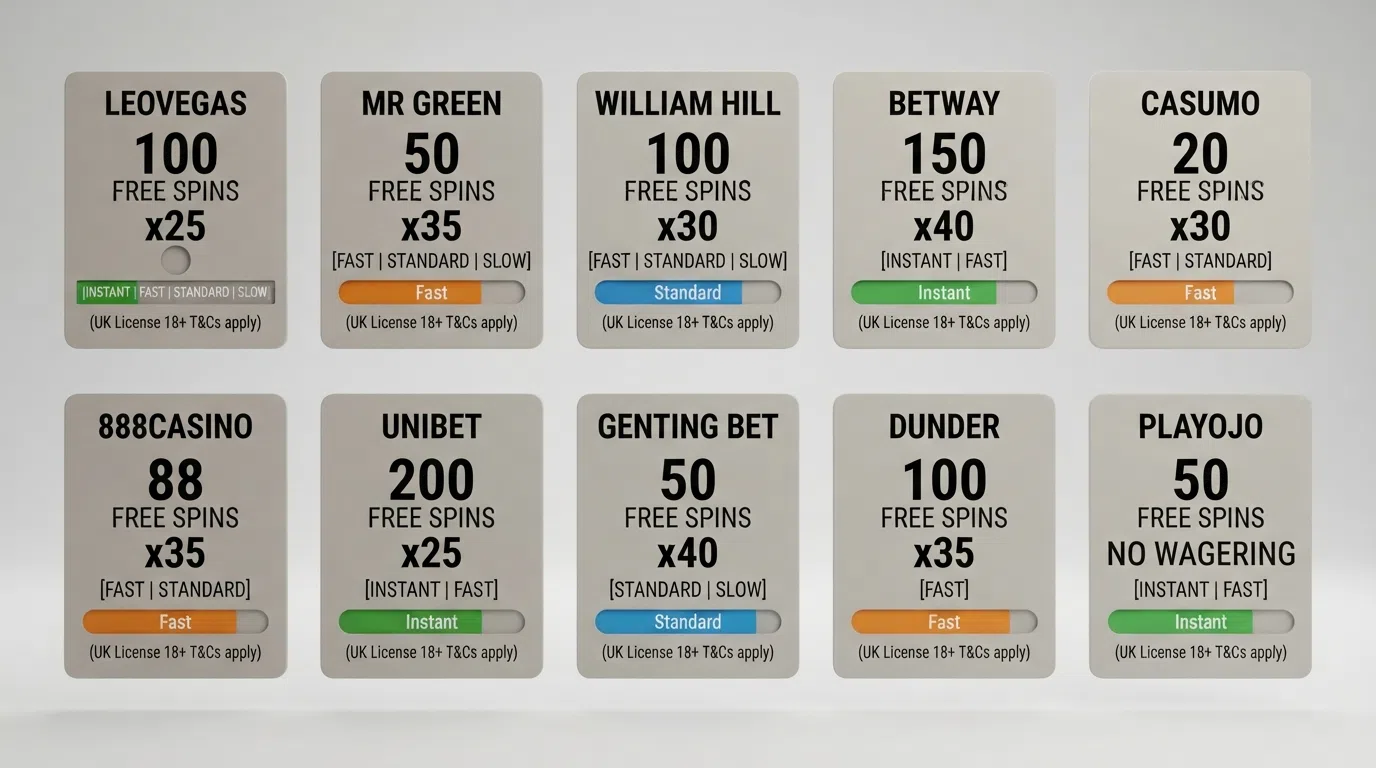
The table below compares the ten featured operators on the five columns that carry data for at least half the set: UKGC licence status, the welcome offer in headline terms, the free-spin count, the wagering multiplier on that offer, and the documented debit card withdrawal speed. The order is editorial — bonus fairness first, then withdrawal speed, then game-library breadth — and the write-ups that follow it are grouped by bonus type, because that is the decision a player actually makes.
| Operator | UKGC Licence | Welcome Bonus | Free Spins | Wagering |
|---|---|---|---|---|
| bet365 | Yes (No. 55149) | Up to 500 free spins, no wagering | 500 | 0× |
| Sky Vegas | Yes | 50 no-deposit + 200 free spins, no wagering | 250 | 0× |
| Paddy Power Games | Yes | 60 no-deposit + 200 free spins, no wagering | 260 | 0× |
| Ladbrokes | Yes (No. 54743) | Deposit & bet £10 for 100 free spins | 100 | 0× |
| Betfred | Yes | Stake £10 get 200 wager-free spins | 200 | 0× |
| Coral | Yes | Bet £5 for £10 bonus + 100 free spins | 100 | 10× |
| William Hill | Yes | 200 free spins on Big Bass Splash | 200 | 10× |
| Betway | Yes | Stake £10 get 150 free spins | 150 | 10× |
| Casumo | Yes | 100% deposit match + free spins | — | 10× |
| Grosvenor | Yes | Deposit £20, play with £50 | — | 10× |
The split down the middle of the table is the split the player should notice first. Five offers carry no wagering requirement at all, and the other five sit at the new 10× statutory maximum — the cap that landed on 19 January 2026 under LCCP Social Responsibility Code 5.1.1. The 10× cap is dramatic in context: the pre-2026 market norm was 35× to 50×, and offers at 65× and 80× were not unheard of at offshore brands. The same five that now sit at 10× would, in a pre-2026 market, have been a substantially worse deal. They are still worse than the no-wagering half, but the gap has narrowed.
The No-Wagering Bonus Operators — Free Spins You Keep
Five of the ten featured operators attach no wagering requirement to free-spin winnings. The phrase that matters is in the terms: “winnings are added straight to your withdrawable balance.” What it means in practice is that anything a free spin produces is cash, not bonus credit. The player can withdraw it, play it further, or leave it sitting in the account; it is not locked behind a turnover requirement. The five operators are bet365, Sky Vegas, Paddy Power, Ladbrokes and Betfred.
The catch is always somewhere else. bet365’s 500 free spins are credited across twenty days in batches of five to fifty, with a twenty-four-hour window to use each batch — and the offer requires a minimum £10 lifetime deposit, not a fresh deposit each day. Sky Vegas’s 250 total breaks into 50 no-deposit spins and 200 deposit-triggered spins, both seven-day expiry, with the deposit-triggered batch requiring the player to stake £10. Paddy Power’s 260 total breaks into 60 no-deposit spins and 200 after a £10 deposit via debit card or Apple Pay, again seven-day expiry. Ladbrokes’ 100 free spins trigger on a £10 deposit and a £10 bet on slots, with 48 hours to accept the offer and seven days to use the spins. Betfred’s 200 wager-free spins trigger on a £10 stake within fourteen days of registration, with a seven-day expiry once credited.
In every case, the cost to the player is the deposit itself. The free spins are paying for a session the player would probably have paid for anyway, and the welcome credit is a margin on top. None of these offers are free in the way the marketing language suggests, but they are the cleanest welcome structure in the market: the player knows what the spin is worth, the player keeps whatever the spin produces, and there is no clearing requirement to meet before cashing out.
The Wagering-Carrying Bonuses — and What That 10× Cap Really Costs
The other five offers — Coral, William Hill, Betway, Casumo and Grosvenor — all carry a 10× wagering requirement, the new statutory maximum under LCCP SR Code 5.1.1 that took effect on 19 January 2026. The cap replaced a market where 35× to 50× was standard, and it is the single biggest change to UK casino bonus terms in years. The same requirement that now sits at 10× would, in a pre-2026 market, have been an aggressive offer at a quality operator; today, it is the ceiling.
What the cap actually means at the table: a £10 bonus with 10× wagering requires the player to place £100 of qualifying bets before the bonus — and any winnings attributable to it — becomes withdrawable. A 10p slot spin with a 96% return-to-player over those £100 of bets costs the player, on average, £4 in expected house edge. That is the real price of clearing a £10 bonus. The arithmetic is straightforward, and it is what the calculation later in this section sets out in full. The relevant number, to the player deciding between two offers, is not the bonus amount; it is the bonus amount times the wagering multiplier times the house edge.
The five operators split further on structure. Coral and William Hill attach wagering to free-spin winnings specifically, with Coral’s bonus cash also at 10×. Betway and Casumo attach wagering to the bonus cash, with Casumo the only percentage match in the set. Grosvenor’s £20-for-£50 structure is the only cash match in the set where the bonus amount exceeds the deposit, and the highest minimum deposit in the table at £20.
How These Rankings Were Determined
The ranking in this guide applies three criteria, qualitatively, against the published terms of each operator. Bonus fairness is the primary axis: the wagering multiplier and the deposit-free availability of the offer, weighted by the size of the spin allocation. Withdrawal speed is the secondary axis: documented Visa Fast Funds support, with a tie-break for the published internal processing window. Game-library breadth is the tertiary axis: the number of providers in the lobby and the presence of the four popular slots whose RTPs are documented later in this guide.
The data is sourced from each operator’s published welcome-offer terms and from independent review sites — RacingPost, Casino.org, ClearCasinos, talkSPORT, BettingLounge, BritishGambler, SpinVerdict and Bookies.com — as of 2026. The UKGC licence numbers are confirmed against the Commission’s public register. The ranking order is not a recommendation to play; it is a structured comparison, and the player makes the choice from there.
bet365 — Up to 500 Free Spins, No Wagering, Visa Direct in Under Four Hours
bet365’s welcome offer is the largest no-wagering free-spin allocation in the UK market: up to 500 free spins on selected titles including Book of Horus, Curse of the Bayou, Magic Forge and Wrath of the Deep, with a minimum £10 lifetime deposit to trigger. The 500 are not credited at once; they arrive in batches of five to fifty over twenty days, and each batch has a twenty-four-hour window before it expires. The seven-day validity on each credited batch is what the marketing page does not foreground, and a player who logs in once a week will lose batches.
The offer’s terms are clean. There is no wagering requirement on winnings; “winnings are added straight to your withdrawable balance,” to use the published phrase. The Paysafecard deposit exclusion is the only payment-method restriction, and it does not affect a debit card deposit. Withdrawal speed is the strongest in the set: bet365 routes through Visa Direct, and the documented window is minutes to two hours at the issuing-bank end, with standard one to three working days as the fallback. The UKGC operating licence is No. 55149, held by bet365 Group Limited.
The game library is broad — NetEnt, Playtech, Microgaming, Pragmatic Play, IGT, Big Time Gaming, Play’n GO, Red Tiger and Evolution are all in the lobby. The provider roster is not the largest in the set, but the depth on each is, and Starburst, Book of Dead, Big Bass Bonanza and Gates of Olympus are all present. The verdict: the cleanest welcome in the set, the fastest withdrawal rail, and a batch-credit structure that rewards regular play. Casual logins will miss batches; daily players maximise the allocation.
Sky Vegas — 50 No-Deposit Free Spins Plus 200 More, No Wagering
Sky Vegas is the only featured operator offering a genuinely deposit-free first batch of free spins alongside a deposit-triggered second batch, and neither carries a wagering requirement. The structure is 50 free spins on registration, no deposit required, and 200 more once the player has deposited and staked £10. Both batches carry a seven-day expiry. The 50 no-deposit spins are the most valuable in the featured set because they cost the player nothing to claim.
The operator is part of Flutter Entertainment, and the game library carries NetEnt, Playtech, IGT, Pragmatic Play, Big Time Gaming, Evolution, Red Tiger and Blueprint. Visa Fast Funds is supported, with a published one to four hour window at supported banks. The standard debit card withdrawal window, where the issuing bank is not enrolled in Fast Funds, is two to five working days — the slowest standard window in the set. For players prioritising speed, other options in this guide provide faster standard processing.
Paddy Power Games — 60 No-Deposit Spins, 260 Total, Zero Wagering
Paddy Power’s welcome is the highest total free-spin count among deposit-free offers in the set: 60 spins on registration, no deposit required, and 200 more after a £10 deposit via debit card or Apple Pay, for 260 total. Neither batch carries a wagering requirement, and the seven-day expiry applies to both. The Apple Pay eligibility on the deposit is notable, because it is the only featured offer besides Ladbrokes that explicitly accepts Apple Pay for the welcome trigger.
The operator is part of Flutter Entertainment, and the licence sits with PPB Counterparty Services Limited. Visa Fast Funds is supported, with a documented up-to-two-hour window. The standard withdrawal window is one to two working days, faster than Sky Vegas on the standard rail. The game library carries Playtech, NetEnt, Pragmatic Play, IGT, Blueprint, Evolution, Red Tiger and Big Time Gaming. The verdict: the strongest combination of a generous no-deposit batch and a fast withdrawal rail, with Apple Pay as a genuine alternative to a debit card for players who prefer to keep the card off the casino’s cashier.
Ladbrokes — Deposit and Bet £10 for 100 Free Spins, Visa Fast Funds
Ladbrokes’ welcome offer is the simplest structure in the set: deposit and bet £10 on slots, and the player receives 100 free spins at £0.10 each on selected games. There is no wagering requirement stated on the free spin winnings, and the 48-hour acceptance window and 7-day use window are the validity terms. The eligible deposit methods are Visa and Mastercard debit, Apple Pay and Google Pay, which gives the player the broadest method choice on the welcome trigger in the set.
Ladbrokes’ UKGC operating licence is No. 54743, held by LC International Limited under the Entain group. Visa Fast Funds withdrawals are documented at one to two hours, and the standard card window is one to three working days. The game library is the broadest in the set: Playtech, NetEnt, Pragmatic Play, IGT, Evolution, Red Tiger, Blueprint, Big Time Gaming and Microgaming. The verdict: a clean offer with the broadest deposit-method choice and the broadest provider roster, well suited to a player who values flexibility over the size of the spin allocation.
Betfred — Stake £10, Get 200 Wager-Free Spins, Withdrawals Within Four Hours
Betfred’s welcome is a £10 stake for 200 wager-free spins on selected titles, with a seven-day expiry once credited. The trigger window is 14 days from registration, so the player has two weeks to make the qualifying stake. A debit card deposit is required for the trigger, and the operator’s published withdrawal window is within four hours on Visa and Mastercard debit — one of the fastest documented windows in the featured set.
The operator is licensed via Petfre (Gibraltar) Limited, and the game library carries Playtech, IGT, NetEnt, Pragmatic Play, Red Tiger, Evolution and Blueprint. The provider roster is mid-sized, but the debit card withdrawal speed is the standout. Instant bank transfer withdrawals are also offered, with a within-six-hour window, which gives the player an alternative rail. The verdict: the right offer for a player whose main criterion is how fast the winnings land, with a clean no-wagering structure underneath.
Coral — Bet £5 for a £10 Bonus and 100 Free Spins, 10× Wagering
Coral’s welcome offer has the lowest cash trigger in the set at £5: bet £5 on slots, and the player receives a £10 bonus (10× wagering on the bonus, with a £2 maximum stake while the bonus is active) and 100 free spins at 10p each on selected games. The bonus has 30-day validity, the free spins have 7-day validity, and the offer must be accepted within 48 hours of credit. The £5 minimum is the lowest in the set, and it is what makes Coral the entry-level option on this list.
Coral is part of the Entain group alongside Ladbrokes, and the operator’s licence is held by LC International Limited. Visa Fast Funds withdrawals are supported with a one to two hour window. The game library carries Playtech, NetEnt, Pragmatic Play, Evolution, IGT, Red Tiger, Blueprint and Big Time Gaming. The verdict: a low-cost entry into a wagering-carrying welcome, with the wagering requirement now at the new statutory 10× ceiling. A player with a small bankroll can clear the bonus in 50 spins at 20p; a player with a larger bankroll will see the £2 maximum-stake rule, which is the regulator’s safer-gambling architecture biting in the way it was designed to.
William Hill — 200 Free Spins on Big Bass Splash, 10× Wagering, 72-Hour Window
William Hill’s welcome is the most time-pressured offer in the set: 200 free spins at 10p each on Big Bass Splash with a £10 deposit, 10× wagering on winnings, a £30 maximum-winnings cap, and a 72-hour validity on both the spins and the wagering. The 72-hour window is shorter than every other offer in the table, and the £30 cap on winnings is the only one in the set. The 10× wagering applies to whatever the spins produce, not the deposit.
The operator is licensed via WHG (International) Limited under evoke plc, and the game library carries Playtech, NetEnt, Evolution, IGT, Pragmatic Play, Red Tiger, Blueprint and Big Time Gaming. Visa Direct withdrawals are documented at up to four hours. The verdict: a tightly-scoped, single-title offer for a player who knows they will play Big Bass Splash inside a three-day window. Anyone who cannot clear 10× wagering inside 72 hours will lose the bonus, and the £30 cap on winnings means the offer’s upside is bounded even when it is cleared.
Betway — Stake £10, Get 150 Free Spins, 10× Wagering
Betway’s welcome is a £10 stake for 150 free spins with 10× wagering on winnings, a mid-sized spin allocation in the set. The wagering requirement sits at the new 10× ceiling, and the qualifying stake is a deposit plus a bet. The game library is Microgaming-led, with NetEnt, Evolution, Pragmatic Play, IGT, Red Tiger and Big Time Gaming alongside — the strongest Microgaming presence in the featured set.
The operator’s UKGC licence is held by Betway Limited under Super Group. The standard debit card withdrawal window is one to three working days. PayPal withdrawals are documented at under four hours, and Trustly and Skrill are also available as fast routes. The verdict: a credible offer with a strong Microgaming-led library, but without a documented Visa Fast Funds window. For same-day payouts, PayPal is the recommended route over debit cards.
Casumo — 100% Deposit Match With Free Spins, 10× Wagering
Casumo’s welcome is the only percentage-match offer in the set: a 100% deposit match on the first deposit, plus free spins, with 10× wagering on the bonus cash. The match structure doubles the player’s stake up to the operator’s published maximum, and the wagering requirement applies to the bonus cash only, not the deposit. The operator’s UKGC licence is held by Jocularis Limited.
Casumo has the broadest provider roster in the featured set: NetEnt, Microgaming, Play’n GO, Pragmatic Play, Evolution, Big Time Gaming, Quickspin, Red Tiger, Thunderkick and Yggdrasil — ten studios. The debit card withdrawal window is the fastest in the set, with Visa debit tested at under one hour. The verdict: the broadest game library in the table, with the fastest documented debit card withdrawal. The 100% match is a different offer shape from the free-spin-heavy welcome elsewhere, and it suits a player who plans to play a mix of slots and tables rather than chasing a single free-spin promotion.
Grosvenor — Deposit £20, Play With £50, 10× Wagering
Grosvenor’s welcome has the highest minimum deposit in the set at £20, with a cash-match structure that gives the player £50 of playable funds. The 10× wagering applies to the bonus cash, and the offer is operated by Rank Digital Gaming (Alderney) Limited under the Rank Group — the operator behind over fifty land-based UK casinos. The group connection matters for a player who values brand continuity between an online account and a high-street casino.
The game library carries Playtech, NetEnt, IGT, Evolution, Red Tiger, Pragmatic Play, Blueprint and Big Time Gaming. The standard debit card withdrawal window is one to three working days, with PayPal withdrawals under three and a half hours. The verdict: the strongest brand-continuity play in the set, and the highest minimum deposit, paired with a 10× wagering requirement on bonus cash. A player who already plays at a Grosvenor land-based venue has the cleanest reason to choose this operator.
The Slot Titles Worth Playing at UK Casinos — and Their Real RTP
How Depositing to Slots by Debit Card Works
The slot-deposit flow is identical to the general casino deposit. There is no separate slot cashier, and there is no separate verification step. The age and identity check that the operator runs before any deposit applies to slot play in the same way it applies to any other game. The financial-limit prompt that has been mandatory before the first deposit since 31 October $$CY-1$$ applies to slot play in the same way. The age-banded stake cap — £5 per game cycle for players 25 and over, £2 for players 18 to 24 — applies to online slots specifically and to no other casino game.
The stake cap is the one rule that interacts with the deposit amount. A player aged 25 and over who deposits £10 by debit card can place a maximum of £5 per game cycle, which means the £10 lasts two spin cycles on a single slot at the maximum stake. A player aged 18 to 24 faces a £2 ceiling, which means the same £10 lasts five spin cycles at the maximum stake. The cap is the same per spin regardless of the deposit size, so a larger deposit does not give a younger player more headroom per spin; it gives them more cycles at the same capped stake.
Four Popular UK Slot Titles at Debit Card Casinos — With Their Highest Published RTP
The table below sets out the four popular UK slot titles whose highest published RTP configurations are documented. The RTP column is the highest published figure for each title; some UK casinos run these same games at lower RTP tiers under variable-RTP deployment, and the only way to know which tier a given operator is running is to check the in-game information panel after loading the game.
| Slot Title | Provider | Highest Published RTP | Volatility | Max Win |
|---|---|---|---|---|
| Starburst | NetEnt | 96.09% | Low | ~500× |
| Book of Dead | Play’n GO | 96.21% | High | 5,000× |
| Big Bass Bonanza | Pragmatic Play | 96.71% | High | 2,100× |
| Gates of Olympus | Pragmatic Play | 96.50% | High | 5,000× |
Starburst is the most ubiquitous slot in UK casinos and the title most likely to be deployed at a reduced RTP tier at some operators. The 96.09% figure is the highest published; multiple lower tiers exist, and the difference is invisible from the lobby. Book of Dead is the high-volatility benchmark in the set, with the same 5,000× max win as Gates of Olympus and a near-identical RTP. Big Bass Bonanza is the highest published RTP in the table at 96.71%, and the William Hill welcome offer is built around this title specifically. Gates of Olympus is the highest max-win in the table at 5,000×, with high volatility and a tumbling-reels mechanic that makes the bonus round the player’s main path to a large win.
The variable-RTP point is worth carrying forward into a deposit decision. Two operators running Book of Dead at 96.21% and 94.20% are running two different games from the player’s perspective, even though the title is the same. The three-percentage-point gap is the difference between a £3 and a £6 expected loss on £100 of wagering. The player who cares about RTP will check the in-game information panel after the first deposit, before committing a session’s worth of stake.
What the UKGC Licence Means for the Money You Pay In
The UKGC Licence: What It Requires of Every Casino You Play At
The Gambling Commission is the regulator for commercial gambling in Great Britain, set up under the Gambling Act 2005. Its three licensing objectives are preventing crime, ensuring fair and open gambling, and protecting children and other vulnerable people. Those three lines are the spine of every rule that applies to a debit card deposit at a licensed casino. The point-of-consumption requirement — under the Gambling (Licensing and Advertising) Act 2014 — means any operator serving a customer in Great Britain, wherever it is based, must hold a GB operating licence. There is no second tier of regulation; the GB licence is the licence.
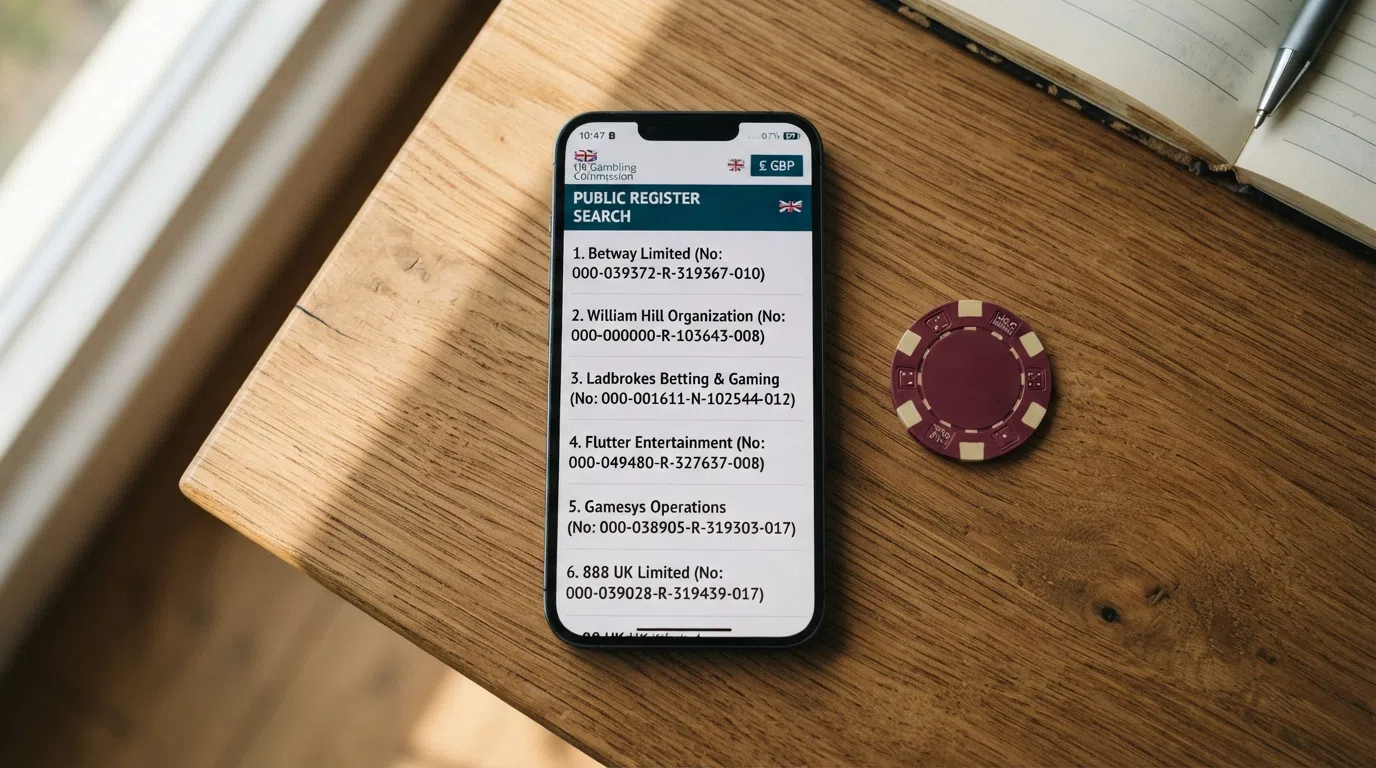
A licence imposes a layer of mandatory controls on every deposit. Age and identity must be verified before any deposit or any gambling, with no grace period, since 7 May 2019. The verification is against public data, and the operator blocks the account if the check fails. A financial-limit prompt is mandatory before the first deposit, from 31 October $$CY-1$$. A financial vulnerability check is triggered at £150 net deposit in a rolling 30-day period, from 28 February $$CY-2$$, using only public data: county court judgments, bankruptcy orders, individual voluntary arrangements and debt relief orders. The check is light-touch at this threshold — a frictionless data check, not a request for documents — and the player continues to play unless the data flags something.
Game-design rules from 31 October 2021 apply to the play after the deposit clears. Auto-play is banned. Spin speed has a 2.5-second minimum. Features that speed up play are banned. Losses disguised as wins are banned. Reverse withdrawals are permanently banned. The session loss, session win and elapsed time are displayed in a mandatory on-screen indicator. The cumulative effect is a slot environment where the player cannot accelerate, cannot undo a withdrawal, and cannot miss the session clock.
The player pays no tax on gambling winnings. The operator pays Remote Gaming Duty, which rose from 21% to 40% on 1 April 2026, and a statutory levy of 1.1% of gross gambling yield, which replaced voluntary contributions from 6 April 2025 and is split 50% treatment, 30% prevention, 20% research. Both taxes are operator-side; the player’s debit card transaction is gross of any tax obligation, and the winnings are theirs at the end.
GamStop and Your Debit Card: What Self-Exclusion Actually Does
GAMSTOP is the national multi-operator self-exclusion scheme for online gambling in Great Britain, mandatory for every GB-licensed online operator since 31 March 2020. Registration is at gamstop.co.uk, and the player chooses an exclusion period of six months, one year, five years, or five years with auto-renewal. None of those periods can be cancelled early. The exclusion applies at the account and identity level, not at the card level — a player who has registered with GAMSTOP cannot open a new account at any UKGC-licensed site, regardless of which debit card they try to fund it with.
The exclusion’s reach extends further than the registered period. If a player does not contact GAMSTOP to lift the exclusion at the end of the period, the exclusion continues for up to seven years after expiry. The mechanism is designed to prevent a vulnerable player from ending the exclusion in a moment of compulsion and reopening accounts immediately. The debit card is not on the exclusion list — there is no card-level block — but the account opening requires identity verification, and a GAMSTOP-registered identity will be flagged at that step. The card payment is never the thing that fails; the account creation is.
Playing Outside the UKGC: The Protections You Surrender
A casino that accepts a UK debit card without holding a GB operating licence is operating illegally under section 33 of the Gambling Act 2005, with the same applying to the player using such a site. The bank-side response has tightened over the last two years. UK banks are increasingly declining or blocking transactions to known unlicensed gambling sites, and both Mastercard and Visa have tightened their merchant-coding guidance for gambling-coded transactions to non-UKGC operators. A debit card deposit that clears at an offshore site in 2024 may be declined in 2026, not because the bank changed its mind, but because the merchant code flagged it.
The protections surrendered are the full UKGC architecture. No age and identity verification before deposit — the player is on the operator’s word. No GAMSTOP coverage — a player who has self-excluded can open an account at the same site under a different email address. No alternative dispute resolution route — there is no UKGC ADR scheme to escalate to, and no Commission complaints procedure. No mandatory deposit-limit prompt, no financial vulnerability check, no game-design rules. Auto-play and reverse withdrawals, both banned under UKGC, are often present. The slot stake cap does not apply, and the £5 or £2 maximum does not bind. A player used to the UK environment is gambling on operator-defined rules, in an environment where the operator has no UK regulator to answer to.
The UKGC’s enforcement effort against the offshore market is substantial. Between April 2024 and June 2025, the Commission issued 3,140 disruption notices, referred 447,778 URLs to search engines and saw 287,961 of those URLs removed. The 160 disrupted sites that the Commission tracked saw an average 32% fall in user engagement. The October 2024 to September 2025 period produced 208,088 enforcement actions on illegal online gambling. None of that changes the player’s position if a debit card deposit has already cleared at an unlicensed site; the protections the player gave up at the cashier are not recoverable through the Commission’s enforcement.
One further point on recourse. A debit card chargeback under the Visa or Mastercard scheme provides some recovery route — but it is weaker than the Section 75 protection that applies to credit card transactions over £100. Section 75 is a credit-card-specific consumer protection, and it does not apply to debit cards. A player who deposits £500 by debit card at an unlicensed site and disputes the charge has a chargeback route, not a Section 75 claim, and the chargeback route is discretionary with the issuing bank. The legal tool the credit-card ban took off the table is exactly the tool that would have helped a player in this position.
The 2026 Regulatory Changes Every Debit Card Player Should Know
Four reforms between 2025 and 2026 change what happens at the cashier. The first is the online slots stake cap: £5 per game cycle for players 25 and over, from 9 April 2025, and £2 for players 18 to 24, from 21 May 2025, imposed by SI 2025/215. The cap applies to slots only, and does not cover roulette, blackjack, live casino, bingo or sports betting. Two adults at the same casino face different maximum bets on the same slot.
The second is the wagering requirements cap: from 19 January 2026, wagering requirements on casino bonuses are capped at 10× under LCCP Social Responsibility Code 5.1.1, and mixed-product promotional offers — a “bet £10 on football, get free spins” structure — are banned. The third is the deposit-limit architecture: the mandatory prompt to set a financial limit before the first deposit, from 31 October $$CY-1$$, and the requirement that from 30 September 2026 a gross deposit limit must be offered, with only the gross-deposit form allowed to be called a “deposit limit.” The fourth is the financial vulnerability check, triggered at £150 net deposit in a rolling 30-day period, from 28 February $$CY-2$$, using only public data.
A financial risk assessment — the deeper affordability check — has been announced but is not yet in force. The Stage 1 thresholds were £5,000 net deposits in 24 hours for players 25 and over, and £2,500 for under-25s, with final thresholds of £1,000 to £3,000 (25+) and £750 to £2,000 (under 25) under consultation. The commencement date is pending; the rule exists in policy, not in practice. A player who sees a deposit-limit prompt at the threshold is seeing the announced-but-not-yet-commenced policy or a heavier version of it, depending on the operator.
The Responsible Gambling Tools That Come With Every Debit Card Casino Account
Deposit Limits: The Mandatory First Step Before You Can Play
From 31 October $$CY-1$$, every UKGC casino must prompt a customer to set a financial limit before the first deposit. The prompt is mandatory, and the player can set a limit at zero if they choose, which blocks the deposit. The limit is the player’s decision; the prompt is the operator’s obligation. From 30 September 2026, the limit on offer must be a gross deposit limit — based solely on money paid in — and only that form may be called a “deposit limit.” The architecture is a deliberate naming restriction: a “deposit limit” must mean a limit on deposits, not a net-loss limit or a net-deposit-after-withdrawals figure.
Decrease requests are actioned immediately. Increase requests may carry a cooling-off delay — a 24-hour or longer gap between the request and the new limit taking effect. The asymmetry is deliberate: a player who wants to gamble less gets that change instantly; a player who wants to gamble more is given a window to reconsider. The cooling-off is a structural feature, not a bug.
Self-Exclusion, Reality Checks and Time-Outs — Built Into Every Session
GAMSTOP is the national layer, but every UKGC casino also runs its own self-exclusion and time-out tools at the operator level. A player who self-excludes at a single operator is blocked at that operator; a player who registers with GAMSTOP is blocked at every GB-licensed operator. The two routes serve different purposes. The operator-level route is faster to set up and reverses through the operator’s safer-gambling team; the GAMSTOP route takes longer to clear and exists precisely because the operator-level route is reversible at all.
Reality checks display at intervals set by the player — every 15 minutes, 30 minutes, an hour. The display shows elapsed session time and net position. A player who has set a 15-minute reality check will see a popup every 15 minutes with the running loss or win, and the popup cannot be dismissed instantly. The mechanism is the same as a session clock with a forced pause. Time-outs run from 24 hours to six weeks and suspend the account temporarily, without the GAMSTOP-level irreversibility. None of these tools depend on the debit card in use; the block is at the account and identity level.
Where to Get Help: The UK Gambling Support Network
The National Gambling Helpline, run by GamCare, is available 24/7 at 0808 8020 133, with webchat and group chat options alongside the phone line. GamCare also runs a self-assessment tool at its website. The NHS operates gambling harm clinics, including the Northern Gambling Service and the National Gambling Clinic in London, plus clinics in Scotland and Wales. GambleAware provides information and self-assessment. Gamblers Anonymous runs peer-support meetings across the country.
The demand on these services is rising sharply. GamCare’s National Gambling Helpline made 996 referrals to treatment and peer-based support services in January 2026, up 48% from 674 in January $$CY-1$$. Online gambling accounts for 81.5% of contacts the helpline received in 2026, with 3,053 contacts as of June. NHS gambling referrals in 2024/25 totalled 4,355, up 91% from 2,284 the year before. Five per cent of adults in England had a PGSI score of 1 or more in 2024, with men (7%) more likely than women (3%). The infrastructure behind these numbers is publicly funded, in part through the statutory levy that took effect on 6 April 2025 — 1.1% of operator gross gambling yield, split 50% treatment, 30% prevention, 20% research.
Bank-side gambling blocks are a separate layer, sitting between the player and the cashier. Barclays, Monzo, NatWest, Starling and other UK banks offer gambling transaction blocks on debit cards; the block is set at the bank, not at the operator, and a player who has self-excluded at the bank cannot deposit at any casino using that card. The block is the most effective single tool for a player who wants to take a debit card out of gambling, because it is independent of the casino’s own safer-gambling architecture.
How We Selected and Ranked These Debit Card Casinos
The ten featured operators were drawn from the UK Gambling Commission’s public register of licensed remote gambling operators and cross-checked against the Commission’s licence-number database. Each operator’s bonus terms and withdrawal speeds were sourced from the operator’s own published terms and conditions and verified against independent review sites — RacingPost, Casino.org, ClearCasinos, talkSPORT, BettingLounge, BritishGambler, SpinVerdict and Bookies.com — as of 2026. The review sites used are listed in the research notes, and the licence numbers are verifiable on the Commission’s public register at the same legal entity name.
Three criteria were applied qualitatively. Bonus fairness was measured by the wagering multiplier and the deposit-free availability of the welcome offer. Documented debit card withdrawal speed was measured by Visa Fast Funds support and the published pending-period window. Game-library breadth was assessed by the number of providers in the lobby and the presence of the four popular slots whose RTPs are documented in the slot section. Every operator in the featured set holds an active UKGC operating licence at the time of evaluation.
The ranking is not a recommendation. The five no-wagering offers clear the bonus-fairness bar by the structure of the offer itself. The five wagering-carrying offers sit at the new 10× statutory maximum, and the calculation that follows sets out what clearing that 10× costs at the table. The choice is the reader’s; the data is the page’s job.
What Your Debit Card Casino Choice Comes Down To in 2026
Debit cards are the only card-based payment route in UK online gambling, and every UKGC-licensed casino clears the safety bar that the licence sets. Age verification runs before any deposit. A deposit-limit prompt is mandatory before the first spend. The 10× wagering cap on bonuses is in force. The slots stake cap is age-banded. GAMSTOP coverage is national. The bank-side gambling block is available on most UK debit cards. None of those protections are optional, and none of them depend on the operator a player chooses.
The three differentiators that separate the featured set are the ones the page has now armed a reader to evaluate. The first is the bonus structure: five offers carry no wagering at all, and the other five sit at the new 10× ceiling, with the calculation earlier in this article setting out what that 10× actually costs. The second is the withdrawal speed: Visa Fast Funds is supported at eight of the ten featured operators, and the player whose issuing bank is enrolled can clear a withdrawal in under four hours at most of them. The third is the slot lobby: variable-RTP deployment means the same title can run at different RTP tiers at different UK casinos, and the only way to know which tier the player is getting is to check the in-game information panel after the first deposit. That one action is the one no section of this guide can take on the player’s behalf.
Frequently Asked Questions
Are credit cards banned for gambling in the UK, and does that mean debit cards are the only card option?
Yes. Since 14 April 2020, the Gambling Commission has prohibited all credit card payments for remote gambling in Great Britain under LCCP licence condition 6.1.2, and the rule extends to credit-card-funded e-wallet deposits. Debit cards are the only card route for UKGC-licensed online casinos, alongside e-wallets, bank transfer, and Apple Pay or Google Pay at operators that accept them.
What happens if I try to use a debit card at a non-GamStop casino?
A non-GamStop casino that accepts a UK player is operating outside the UKGC licence framework, and the bank may decline the transaction at the issuing end. UK banks have tightened their gambling-merchant declines over the last two years, and Mastercard and Visa have tightened merchant-coding guidance for non-UKGC operators. If the deposit does clear, the player loses GAMSTOP coverage, age verification, deposit-limit prompts, financial vulnerability checks, ADR routes and the Section 75 protection that applies only to credit cards.
Can my bank block gambling transactions on my debit card?
Yes. Barclays, Monzo, NatWest, Starling and other UK banks offer gambling transaction blocks at the card level, separate from any operator-side safer-gambling tools. The block is set at the bank and applies across all gambling merchants, and a player who has the block set cannot deposit at any UK casino using that card, regardless of the operator’s own exclusions.
How do debit card withdrawal times compare to PayPal and bank transfers?
Debit card withdrawals typically take one to three working days at the standard processing rate, with Visa Fast Funds pushing the window down to under four hours at supported operators where the issuing bank is enrolled. PayPal withdrawals are typically two to 24 hours, with several featured operators documenting under four hours. Bank transfers via Faster Payments or Trustly can land within hours where supported. E-wallet rails are consistently faster than standard card processing.
What is the maximum I can deposit or withdraw with a debit card at a UK casino?
There is no statutory maximum on a single debit card deposit or withdrawal at a UKGC casino, but a financial vulnerability check is triggered at £150 net deposit in a rolling 30-day period, using only public data. A deeper financial risk assessment, with announced but not-yet-commenced thresholds of £1,000 to £3,000 (25+) and £750 to £2,000 (under 25) net deposits, is pending. Withdrawal maxima are operator-set and stated in the cashier terms.
Do all UKGC-licensed casinos accept Visa and Mastercard debit cards?
Yes. Every operator holding a GB operating licence accepts Visa and Mastercard debit at the cashier as a regulatory default. The specific sub-types of debit card that clear depend on the operator’s acquiring bank, but a UK high-street debit card on either scheme will be accepted by every operator in the featured set. The Paysafecard exclusion at bet365 is a welcome-offer restriction, not a payment-method one.
Visa Debit vs Mastercard Debit: Does It Matter at UK Casinos?
For deposits, it does not. Every featured operator accepts both Visa debit and Mastercard debit, and the deposit experience is identical. The interesting difference is on the withdrawal side, where Visa has built out Fast Funds as a card-network feature and Mastercard Send has narrower UK casino adoption. A player whose debit card is on the Visa network can use Fast Funds at any of the operators listed above; a player whose debit card is on the Mastercard network is more likely to land on standard one to three working day processing, depending on the operator.
The other difference is bank-level policy. A small number of issuing banks treat gambling transactions differently by scheme — blocking Mastercard debit gambling transactions but allowing Visa, for example, usually because of the bank’s own fraud appetite rather than the card network. These cases are rare and are not predictable from the operator’s side. If a player’s debit card is being declined at one operator and accepted at another, the cause is almost always the bank, not the card network.
The recommendation that follows from this is simple: if fast withdrawals matter, pick a Visa debit card from a Fast Funds-enrolled bank, and pick a casino that has documented the Fast Funds window. The card and the operator both have to be in the right place; either side missing falls back to standard processing.
Which Slot Sites Accept Debit Card Deposits?
Every UKGC-licensed casino site accepts debit card deposits, including for slot play. The slot lobby sits behind the same cashier as the rest of the casino, and there is no separate deposit method or route for slot play specifically. The differentiator between operators is the slot library: which providers are in, which titles are featured, and — critically — which RTP tier the operator has deployed for each title. The first two are visible on the slot lobby page. The third requires the player to load the game and check the in-game information panel after the first deposit.
A player who is choosing between operators on slot play alone should look at the provider roster. The popular UK titles — Starburst, Book of Dead, Big Bass Bonanza, Gates of Olympus — come from NetEnt, Play’n GO and Pragmatic Play, and an operator that carries all three has the full popular-titles set. The featured operators all carry NetEnt, and most carry Play’n GO and Pragmatic Play. The differentiator is depth: Casumo’s ten-studio roster is the broadest, Grosvenor and bet365 are both deep, and Betfred is the narrowest. The breadth of the roster matters less for a player who plays a small set of titles, and more for a player who wants access to the full back-catalogue.
Payments – No Minimum Deposit Casinos UK
Content created by the «No Minimum Deposit Casinos UK» team