
Best RTP Casino Slots UK – The Highest Return-to-Player Slots at Licensed UK Casinos in 2026
 Available in GB
Return to player is the single number that decides how much of every pound a slot keeps over time. It is also the number most UK players never properly check, because the casino advertises the jackpot and the provider advertises the theme, and the percentage in the small print rarely gets a second look. That is backwards. If you care about where your money goes, the RTP figure is the headline and everything else is decoration.

This page ranks the highest-RTP slots actually available to UK players right now, explains what those percentages mean once they meet volatility, and lists ten UKGC-licensed casinos where the wagering terms on top of those slots do not strip the return back out. Every number below carries a source; every operator has been checked against the Gambling Commission’s public register.
21 August 2026 · Verified against the Gambling Commission public register and UKGC Remote Technical Standards.
What RTP Actually Means — And Why It Shapes Every Spin You Play
RTP stands for return to player, and it is the share of every pound staked that a slot is mathematically programmed to return over its full lifetime. The standard is a percentage: a 96% slot returns £96 for every £100 wagered across millions of spins. The arithmetic runs the other way too: the house keeps the rest, which is why every RTP figure has a twin number nobody prints, the house edge. A 96% slot carries a 4% edge. A 92% slot carries an 8% edge. The gap between those two numbers is where the casino’s long-run profit lives, and the slot’s design is what sets it.
The crucial qualifier is “over its full lifetime”. RTP is not a session promise. It emerges only after the math has been run across millions of simulated spins, which is why the Gambling Commission insists every UK-licensed slot is independently tested by accredited laboratories analysing millions of game cycles before the title goes anywhere near a real-money lobby. The test result is what you see in the in-game information pane, and it is the figure the slot will return to across a large population over a long period. No individual session will hit that number. Some will be far above it; most will be far below.
The UK-licensed market sits between roughly 92% at the floor and 98% at the player-favourable ceiling, with the bulk of titles running between 95% and 96.8%. That is the band a casual player encounters most often, and it is also the band where the difference between a slot at the top end and one at the bottom end of the typical range becomes a meaningful chunk of a bankroll over a few hundred spins.
RTP and volatility are independent settings on the math sheet. A studio can hit the same 96% target through a high-hit-frequency, low-payout design or a low-hit-frequency, high-payout design, and both routes are equally valid ways to arrive at the same long-run number. That is the detail that decides whether a 98% slot drains a £200 bankroll in twenty minutes or keeps it ticking over for two hours, and it is what the rest of this page is built around.
Good RTP vs Average RTP: What the Numbers Actually Deliver
The 95% to 96.8% band that fills most UK slot lobbies is not “bad”. It is just not what people who search for “high RTP” came looking for. The arithmetic gap matters in plain money. If you stake £1 per spin and run 1,000 spins at 95% RTP, expected return sits at £950, expected loss at £50. The same 1,000 spins at 98% RTP put expected return at £980 and expected loss at £20. Move the stake to £2 per spin and the figures double: £100 expected loss against £40. A 3-percentage-point difference compounds fast, and a 6-point difference, from 92% to 98%, roughly quadruples what the same volume of play costs you.
That is not an argument for ignoring the slot theme, the bonus rounds, or the volatility curve. It is an argument for checking the RTP pane before you load the reels, because the casino lobby will not surface it for you. It sits in a tab labelled “information” or a question-mark icon, and it is the only number on the screen that determines how much of your bankroll survives the next hour.
The slots on the ranked table below all sit at 97.66% or above. That is not because 97% is the floor for a “good” slot. It is because this page is about the best of the best, and at that level the differences between titles come down to volatility and max win rather than raw return percentage.
The Highest-RTP Slots Available to UK Players in 2026
The table below ranks verified high-RTP titles playable under a UKGC licence. RTP figures come from provider-published data and independent RTP-tracking databases that log the configuration each UK casino deploys. Volatility and max-win figures are from the same sources. Slots without a confirmed max-win figure or volatility rating are marked accordingly rather than padded out.
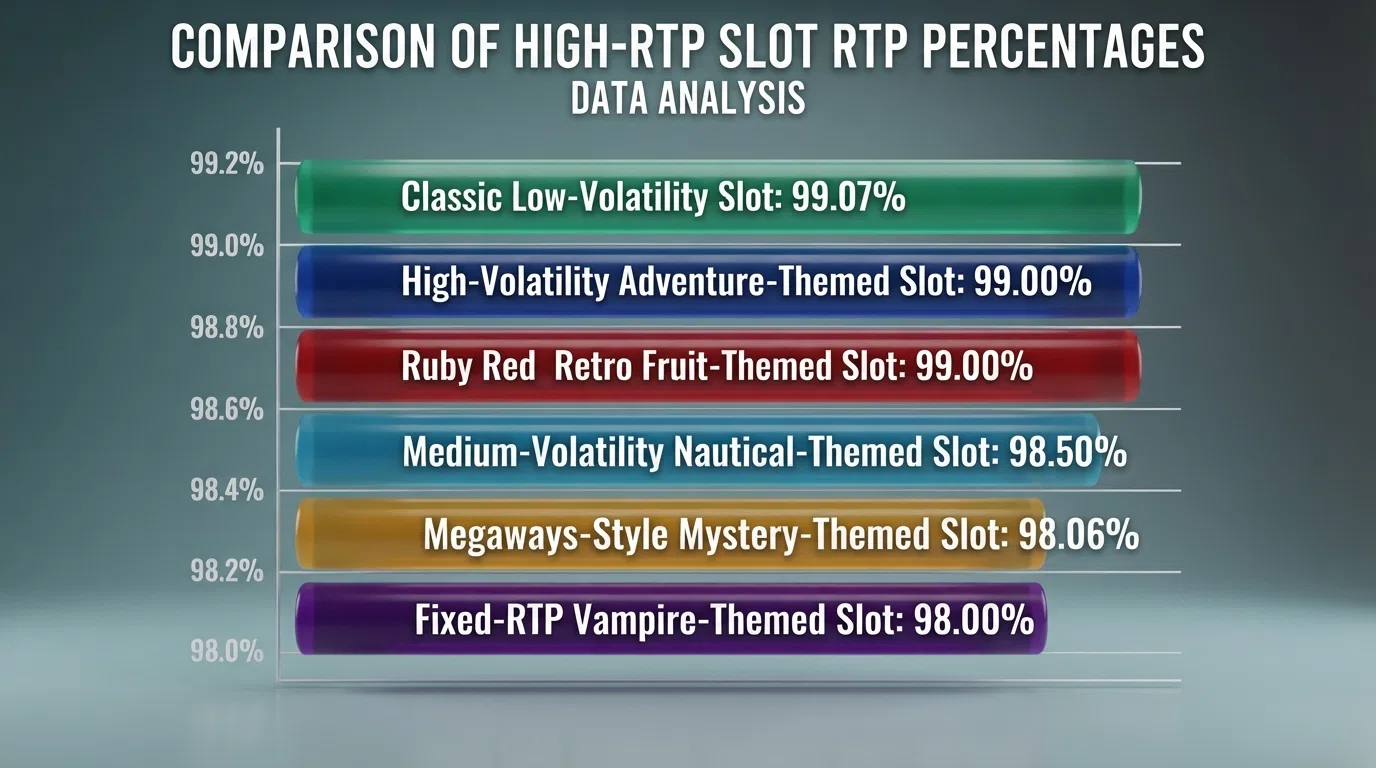
| Slot Title | Provider | RTP | Volatility | Max Win |
|---|---|---|---|---|
| Ugga Bugga | Playtech | 99.07% | Low | 1,000x |
| Book of 99 | Relax Gaming | 99.00% | High | 10,000x |
| Mega Joker | NetEnt | 99.00% (Supermeter mode at max stake only) | — | — |
| 1429 Uncharted Seas | Thunderkick | 98.50% | Medium | 670x |
| Mystery Reels Megaways | Blueprint (Red Tiger) | 98.06% | — | — |
| Blood Suckers | NetEnt | 98.00% (fixed configuration) | — | — |
| Blood Suckers Megaways | Red Tiger | 97.66% | — | 20,521x |
| Starburst | NetEnt | 96.09% theoretical; certified tiers down to 90.05% | — | — |
Ugga Bugga is the highest-RTP slot a UK player can load today, and it does so with a low-volatility profile that keeps session play steady rather than spiky. Book of 99 sits a fraction behind at 99.00% and swaps that gentle ride for a high-volatility one with a 10,000x ceiling. The two slots together define the choice facing any player who wants to maximise return: steady low-variance play at near-total payback, or volatile high-ceiling play at the same near-total payback. Mega Joker’s 99% figure is conditional: it only runs at that rate in Supermeter mode at maximum stake, which is a tiered-RTP design rather than a flat one. Blood Suckers is the rare fixed-RTP slot in the NetEnt catalogue; the same 98.00% ships to every UK casino, and no operator can quietly deploy a lower tier.
The ranking is not a recommendation. A 99% low-volatility slot and a 99% high-volatility slot are not interchangeable, and the choice between them depends on the bankroll and the session length, not on the headline number.
Why Your 2026 High-RTP Slot Can Still Drain a Bankroll: RTP Meets Volatility
The math behind RTP is settled across millions of spins, which means the short-run experience is dictated by a different variable entirely: volatility. A 98% slot with high volatility is not “better” than a 96% slot with low volatility. It is a different shape of game, with longer losing runs, bigger single wins, and a session budget that has to absorb the troughs between payouts. The two settings are independent on the math sheet, and treating them as one number is the most common mistake in RTP-based slot selection.
Low-volatility high-RTP slots keep a bankroll ticking over for longer because wins land frequently, even if each one is modest. The session feels busy, the credits ebb and flow without sharp swings, and a £50 deposit can stretch to an hour of continuous play. Ugga Bugga is the clearest example in the high-RTP tier: 99.07% RTP combined with low volatility and a 1,000x max win means the session pays back nearly everything staked while rarely threatening a brutal losing streak. It is the slot a player who wants to feel the RTP working would choose.
High-variance high-RTP slots work the same math over a longer window, but with a brutal short-run distribution. The same 99.00% RTP sits behind Book of 99, but the design routes that return through infrequent but massive payouts. The 10,000x max win is real, and so is the gap between spins that pay nothing and the spin that pays for the session. A player who loads Book of 99 with a £20 bankroll is not playing a 99% slot. They are playing a 99% slot with a session budget that may not survive the wait for the return to manifest.
Medium-volatility options split the difference. 1429 Uncharted Seas runs at a fixed 98.50% RTP with medium volatility and a 670x max win, and it is the slot a player who wants the high-RTP maths without committing to either a long flat session or a long volatile wait. The trade-off is a smaller ceiling; the upside is a smoother ride that most session budgets can absorb.
The Best Low-Volatility High-RTP Slots for Longer Sessions
Low volatility paired with high RTP produces the slot a session budget survives longest on. Ugga Bugga is the standout in this bracket: 99.07% return, low volatility, and a 1,000x ceiling that keeps the maximum payout credible without requiring a hundred dry spins beforehand to reach it. Blood Suckers sits beside it at a fixed 98.00%, which makes it a particularly clean choice because the fixed configuration means every UK casino is running the same return.
What a player gets from this bracket is time. The maths is the same as any other 98%+ slot over millions of spins, but the distribution lands small wins often enough that a session feels like it is moving. A £50 bankroll at 50p per spin on a 99% low-volatility slot behaves very differently from the same stake on a 99% high-volatility title. The first keeps the credits visible; the second can wipe them out before a feature triggers.
High-Variance High-RTP Slots: Bigger Wins, Longer Waits
Book of 99 is the rare 99% slot built for the player who wants the high-variance ride. Its 10,000x max win is one of the highest ceilings on any UK-available high-RTP title, and its high volatility means that ceiling is reached rarely enough that every spin before it carries meaningful risk. The same 99% return as Ugga Bugga, distributed through a much wider payout spread.
The practical implication is bankroll sizing. A session budget that would comfortably cover an hour on a low-volatility 99% slot may last twenty minutes on a high-volatility one, or less if the bonus round does not land. Players who pick this bracket are not picking the highest return. They are picking the highest return inside a payout structure that may not deliver it within any individual session.
Megaways, Progressives, and Enhanced RTP: How the Slot Type Changes the Return
Not every slot format returns at the same rate. Megaways titles, progressive jackpot games and enhanced-RTP versions each move the percentage in a different direction, and the shape of the game changes what that percentage actually delivers.
Megaways slots can hit very high RTPs. Mystery Reels Megaways runs at 98.06% with a 39.13% hit frequency, the highest-RTP Megaways title in the UK market. Blood Suckers Megaways, by contrast, sits at 97.66% with a 20,521x max win: lower RTP than the original NetEnt Blood Suckers at 98.00%, but a vastly larger ceiling. The pattern is typical. Megaways engines pay for their expanding reel structure and feature complexity through the payout distribution rather than the headline return, so a Megaways slot at 98% often feels more volatile than a non-Megaways slot at the same figure.
Progressive jackpot slots run a different trade-off entirely. The headline prize is funded by taking 1–2 percentage points off the base-game return, with that slice redirected into the progressive pool. A Jackpot King title will typically run at 92% to 94% on its base game, with the missing percentage funding the chance at a seven-figure payout. The published RTP is not the whole story, because the progressive prize itself contributes a share of the overall return that only triggers on the rarest spin.
Enhanced-RTP versions are a separate category. Some studios release multiple configurations of the same slot, with one running at a higher return than the standard build, and certain casinos or affiliate deals carry only the enhanced version. The percentage on the in-game info pane is the deployed version, not the standard one, which is the part of the system that makes the variable-RTP question matter as much as it does.
Progressive Jackpot RTP: The Hidden Cost of Chasing a Life-Changing Win
The progressive prize is real money, and it has to come from somewhere. In a Jackpot King progressive, the contribution is typically 1–2 percentage points shaved off the base-game RTP, with that slice redirected into the seed and growth of the headline jackpot. The base game still pays out, still has its features, still has its bonus rounds, but it pays out at a lower rate than the non-progressive version of the same game.
A player who chases the progressive is paying that 1–2 percentage point premium on every spin, and recovering it only if and when the jackpot lands. The math is the same as any insurance trade-off: most players pay the premium and never collect. The slot’s published RTP reflects this: the base-game figure is lower than its non-jackpot sibling, and the progressive prize itself is what closes the gap to a comparable return over a very large spin volume.
That is not an argument against progressive slots. It is an argument for knowing what the trade looks like before choosing it. A player who wants the high-RTP maths picks a fixed-configuration slot. A player who wants the progressive prize accepts a lower base return and plays accordingly.
How to Find and Verify a Slot’s RTP Before You Stake a Penny
The UK’s regulatory framework makes RTP visible on every licensed slot, and the process of checking it is straightforward once you know where to look. The first stop is the in-game information pane: the question-mark icon or “i” button that opens the slot’s rules, paytable and theoretical figures. Every UK-licensed slot is required to display its RTP in that pane, and the figure shown there is the configuration that casino is actually running, not a generic studio average.
Independent verification sits one layer back. RTP-tracking databases such as RTPTrack log the deployed configuration of each slot at each UK casino, so a player can cross-check whether the 96.09% advertised on a casino’s lobby matches what the slot is actually paying out. The Gambling Commission’s Remote Technical Standards require independent testing-laboratory certification before any slot can be deployed to a UK operator, and the certificate number sits in the same regulatory trail.
Starburst is the cleanest example of why this matters. The slot’s theoretical RTP is 96.09%, and NetEnt ships six certified configurations ranging down to 90.05%. Two UK casinos can carry Starburst in their lobby and run it at different tiers without either of them surfacing that fact to the player. The only way to know which tier you are facing is to read the in-game pane or check the deployment on a tracking database.
The general point is that “RTP” is not a single fixed number for every slot. For some titles it is: Blood Suckers ships at a fixed 98.00% to every UK casino, and there is no lower tier to fall back to. For most titles it is not, and the figure on the screen is the only reliable read of what the slot is actually returning.
Why the Same Slot Can Pay Less at a Different Casino
A single slot can ship with several certified RTP tiers, and UK operators choose which one to deploy. The system is licensed by the Gambling Commission, because the regulator’s concern is that the slot has been tested at every tier it ships, not that every casino runs the highest one. Starburst is the clearest illustration: six certified tiers from 96.09% down to 90.05%, with the actual deployment varying by operator.
A player at one UK casino can be playing Starburst at 96.09% while a player at a different UK casino plays the same game at 90.05%, and neither will be told which tier they are on unless they check the in-game pane or a tracking database. The spread on a high-traffic title like Starburst is wide enough that the choice between two casinos running different tiers is the difference between an expected loss of £3.91 and an expected loss of £9.95 per £100 wagered.
Blood Suckers is the counter-example. The slot ships in a single fixed configuration at 98.00%, with no lower tier to deploy. Any UK casino running NetEnt’s catalogue is running the same return. The contrast between the two slots is the contrast between fixed and variable RTP, and it is the single most useful distinction a player can learn before picking a title.
Where to Play High-RTP Slots in the UK: 10 Licensed Casinos Compared
The table below compares ten UKGC-licensed casinos against the criteria that matter for a high-RTP slot player: licence status, the structure of the welcome offer, the free-spin count where one applies, the wagering requirement, the validity window, and the provider mix on the games side. Every operator holds a current operating licence on the Gambling Commission’s public register. Where a piece of offer data was not surfaced in the source material, the cell is left blank rather than padded.
| Operator | Licence Status | Welcome Offer | Free Spins | Wagering | Bonus Validity | Game Providers |
|---|---|---|---|---|---|---|
| Sky Vegas | UKGC-licensed | 50 no-deposit FS + 200 FS on £10 deposit | 250 | 0× (wager-free) | 7 days per batch | Playtech, NetEnt, Pragmatic Play, Blueprint, Red Tiger |
| Betfair | UKGC-licensed | 50 FS no deposit + 50 FS on £10 deposit | 100 | 0× (wager-free) | 7 days per batch | Playtech, NetEnt, Pragmatic Play, Blueprint, Red Tiger |
| 32Red | UKGC-licensed | 320 FS on £30 stake | 320 | 0× (wager-free) | 30 days | Games Global, NetEnt, Pragmatic Play |
| 888 Casino | UKGC-licensed | 100% deposit match up to £100 | — | 10× (selected slots) | 90 days | NetEnt, Playtech, Pragmatic Play, Red Tiger |
| Virgin Games | UKGC-licensed | 100 FS on £10 deposit | 100 | 0× (wager-free) | 30 days | Games Global, NetEnt, IGT |
| JackpotJoy | UKGC-licensed | 30 FS on Double Bubble or £50 bingo on £10 deposit | 30 | 0× on FS (4× on bingo) | 30 days | Games Global, IGT, NetEnt |
| Gala Spins | UKGC-licensed | 100 FS on £10 deposit | 100 | 0× (wager-free) | 7 days | Playtech, Pragmatic Play, Blueprint |
| BetVictor | UKGC-licensed | £30 bonus + 50 FS on Fishin’ Frenzy on £10 deposit | 50 | 10× on bonus funds | 30 days | NetEnt, Pragmatic Play, Evolution, Play’n GO |
| Paddy Power | UKGC-licensed | 60 FS no deposit + 100 FS on £10 deposit | 160 | 0× (wager-free) | 7 days per batch | Playtech, NetEnt, Pragmatic Play, Blueprint |
| Ladbrokes | UKGC-licensed | 100 FS + 300 LadBucks on £10 deposit | 100 | — | 7 days | Playtech, NetEnt, Pragmatic Play, Red Tiger, Evolution |
The split that matters is between the wager-free free-spin offers and the two deposit-match structures in the set. Eight of the ten run wagering at 0×, which means whatever a free spin wins is withdrawable as cash once the spins are played. 888 Casino’s 100% match up to £100 and BetVictor’s £30 bonus + 50 spins carry the 10× statutory cap, and clearing them changes the offer math entirely. The expected-loss calculation in the section on the wagering cap walks through what that difference costs in practice.
Sky Vegas
Sky Vegas runs the standout no-deposit offer in the UK market: 50 free spins before any deposit, with zero wagering attached to anything they win. A further 200 spins unlock on a £10 deposit, also wager-free, running at £0.10 per spin across a seven-day window per batch. The provider lineup carries Playtech, NetEnt, Pragmatic Play, Blueprint and Red Tiger, which covers the bulk of the high-RTP catalogue available to UK players.
For a player who wants to test a high-RTP slot without committing a deposit first, this is the cleanest entry point in the set. The 50 no-deposit spins are a small enough number that they will not fund serious play, but they let a player confirm the casino’s deployment of the slot and the in-game RTP pane before deciding whether to deposit.
Betfair
Betfair’s welcome package routes 50 free spins as no-deposit, then 50 more on a £10 deposit, all wager-free and on a seven-day validity. The slot selection includes Jackpot King games, which sits at the intersection of this page’s RTP discussion: progressive titles carry a 1–2 percentage point lower base-game RTP to fund the progressive prize, and Betfair’s choice to put free spins on those titles means a player using the offer is paying the progressive premium on every spin.
The provider range matches Sky Vegas across Playtech, NetEnt, Pragmatic Play, Blueprint and Red Tiger, so the same high-RTP catalogue is accessible once the welcome offer is consumed. For a player who specifically wants to play Jackpot King titles, Betfair remains the most suitable choice in this lineup.
32Red
32Red’s offer is the largest free-spin package in the set: 320 spins on Big Bass Splash, triggered by a £30 stake, with zero wagering on the winnings. The 30-day claim window is more generous than the seven-day standard, and the £0.10 spin value keeps the total spin cost manageable. The provider mix is led by Games Global (Microgaming) alongside NetEnt and Pragmatic Play.
For a player who wants extended wager-free slot play from a single offer, this is the most generous spin count in the table. The trade-off is the deposit threshold: £30 is three times the £10 baseline that most of the other offers in the set require, which moves 32Red out of the low-stakes welcome bracket.
888 Casino
888 Casino is the only deposit-match bonus in the featured set: 100% up to £100, with wagering capped at the new statutory 10× level. The 90-day validity is the longest in the table, and the provider mix carries NetEnt, Playtech, Pragmatic Play and Red Tiger. The wagering multiple is where the offer’s real shape lives, and the calculation further down this page walks through what 10× wagering costs in expected loss on a 99% RTP slot versus a 98% RTP slot versus a typical 95%–96.8% market slot.
This operator represents the only deposit-match structure among our featured sites, making it a distinct choice for players who prefer traditional bonus funds.
Virgin Games
Virgin Games’ offer is the cleanest in the set: 100 wager-free spins on a £10 deposit, with a 30-day window and a £0.10 spin value. The slot selection centres on Game of Thrones at a 1p coin size across 10 lines. The provider mix is Games Global, NetEnt and IGT, which covers most of the catalogue outside the Megaways and Blueprint titles.
Virgin Games provides a highly accessible experience for those seeking transparent, wager-free spins with a flexible 30-day usage window.
JackpotJoy
JackpotJoy runs a dual-path welcome: 30 free spins on Double Bubble, or £50 in bingo tickets, on a £10 deposit. The free spins carry zero wagering but a £100 maximum withdrawal cap from spin winnings, which is the constraint that distinguishes this offer from the rest of the wager-free set. The bingo tickets carry 4× wagering. The provider mix is Games Global, IGT and NetEnt.
For a player who wants the wager-free slot experience, the £100 cap is the number to weigh. It is enough to make a small withdrawal meaningful, and it is low enough that a lucky spin result will be capped well before the full potential payout.
Gala Spins
Gala Spins’ offer is 100 wager-free spins on a £10 deposit, with a seven-day validity and a £0.10 spin value across a rotating selection of featured slots. The provider mix is Playtech, Pragmatic Play and Blueprint, which covers most of the Megaways and progressive catalogue but excludes NetEnt’s high-RTP titles.
For a player who prefers Blueprint and Pragmatic slots, this is the wager-free entry point in the set. The seven-day window is shorter than Virgin Games’ 30 days, which matters for a player who cannot commit to playing the spins within a week.
BetVictor
BetVictor’s offer is a hybrid: £30 in casino bonus funds plus 50 free spins on Fishin’ Frenzy, triggered by a £10 deposit. The bonus funds carry 10× wagering with a £300 maximum withdrawal cap, and the free spins sit separately. The 30-day validity is standard. The provider mix carries NetEnt, Pragmatic Play, Evolution and Play’n GO, which covers the live-dealer and slot catalogue from those studios.
For a player who wants a hybrid offer with bonus funds and spins, this is the only structure of its kind in the set. The £300 withdrawal cap on bonus funds is the constraint to weigh against the wagering requirement.
Paddy Power
Paddy Power runs the largest no-deposit free-spin count in the set: 60 spins deposit-free, with a further 100 spins on a £10 deposit, all wager-free across two seven-day batches at £0.10 per spin. The slot selection rotates around Paddy Power’s top slots and Daily Jackpot games. The provider mix is Playtech, NetEnt, Pragmatic Play and Blueprint.
For a player who wants the most no-deposit spins before any commitment, Paddy Power is the highest count in the set. The two-batch structure means the no-deposit spins and the deposit-triggered spins have separate expiry windows, which a player needs to track to avoid forfeiting either batch.
Ladbrokes
Ladbrokes’ offer runs 100 free spins plus 300 LadBucks loyalty currency on a £10 deposit, with a seven-day validity and a £0.10 spin value. The provider mix is the widest in the set: Playtech, NetEnt, Pragmatic Play, Red Tiger and Evolution. Wagering on the free spins is not specified in the source material, and the cell is left blank rather than filled with a guess.
For a player who wants the broadest provider range and is comfortable with the dual-currency structure (cash spins plus LadBucks loyalty points), Ladbrokes covers more of the catalogue from a single account than any other operator in the table.
UK Slot Regulation in 2026: The Rules That Shape Every Spin You Make
The UK’s regulatory framework sits among the strictest in the world for online slots, and the rules in force in 2026 shape both what a slot can do mechanically and what a casino can offer alongside it. The Gambling Commission, an executive non-departmental public body sponsored by the Department for Culture, Media and Sport, is the single statutory regulator under the Gambling Act 2005. Every slot offered to GB players is required to display its RTP in the in-game information pane and to carry independent testing-laboratory certification verifying the figure across millions of simulated spins before deployment. Annual games testing audits are mandatory, counter-signed by a Personal Management Licence holder.
The game-design rules that came into force on 31 October 2021 changed how a slot feels to play. Auto-play is banned. Spin speed cannot be faster than 2.5 seconds per game cycle. Features that accelerate play are banned. Losses disguised as wins, the slot animations that celebrate a payout smaller than the triggering stake, are banned. Reverse withdrawals are permanently banned: once a player requests a withdrawal, it cannot be cancelled in favour of re-gambling. Total losses, wins and time played must be displayed during a slots session.
The stake-cap age bands introduced in 2025 impose a per-game-cycle maximum: £5 for players aged 25 and over (in force 9 April 2025), £2 for players aged 18 to 24 (in force 21 May 2025), under SI 2025/215. Two adults playing the same slot at the same casino face different maximum bets depending on age. The cap applies to the total staked within a single game cycle, not per payline.
On the operator side, the bonus framework tightened materially in December 2025. From 19 December 2025, wagering requirements on bonuses are hard-capped at 10× the bonus amount under LCCP Social Responsibility Code 5.1.1, and mixed-product promotional offers (the “bet on football, get free spins” structure) are banned. Credit cards have been banned for gambling payments since 14 April 2020, including credit-card-funded deposits through e-wallets. Remote Gaming Duty, the tax on operator gross profits, rose from 21% to 40% from 1 April 2026.
Licensed vs Offshore: What a UKGC Licence Actually Protects
A GB licence is compulsory at the point of consumption, under the Gambling (Licensing and Advertising) Act 2014. An MGA, Curaçao or Gibraltar licence is not a substitute for serving GB players, and providing gambling facilities without a UKGC licence is a criminal offence under section 33 of the Gambling Act 2005, carrying up to 51 weeks’ imprisonment, an unlimited fine, or both.
A player gambling on an unlicensed offshore site is not committing a criminal offence, but they lose several protections that the UKGC framework guarantees. GAMSTOP self-exclusion does not reach offshore operators: a player who has registered to exclude themselves can still open an account at an unlicensed site. ADR provider access and the Commission complaints route are not available. British consumer redress if funds are withheld is unavailable, and the enforcement against the operator runs through the jurisdiction that issued the offshore licence rather than the UK.
The Commission works through disruption rather than ISP blocking: cease-and-desist orders, search-engine delisting, domain suspension and payment-provider referrals. Legislation for statutory blocking powers has been proposed but not enacted, which means there is no national list of blocked offshore domains equivalent to the systems in some other jurisdictions. The practical protection is the player’s own choice to use a UKGC-licensed site, and the Commission’s role is to make that choice the easy one.
How the 10× Wagering Cap Changes Bonus Strategy for High-RTP Slots
The December 2025 wagering cap at 10× the bonus amount transforms the math of clearing a bonus on a high-RTP slot. Before the cap, UK bonuses routinely carried wagering requirements of 35× or higher; a £100 bonus at 35× wagering meant £3,500 in required turnover. At 10×, the same bonus requires £1,000 in turnover, and the expected loss from clearing it shrinks accordingly.
The calculation is straightforward. For a £100 deposit-match bonus at 10× wagering on a slot at the highest available RTP, Book of 99 at 99.00%, the required turnover is £1,000 (bonus × wagering factor). Expected loss is turnover × (1 − RTP), which gives £1,000 × 0.01 = £10. The same bonus cleared on Blood Suckers at 98.00% fixed RTP gives an expected loss of £1,000 × 0.02 = £20. The same bonus cleared on a typical 95%–96.8% market slot gives an expected loss between £32 and £50, depending on where in the band the slot sits.
The conclusion is bounded by what the formula produces: an estimate of expected loss over the turnover volume, nothing about how likely a win is, nothing about the value of any single payout. The point is that the slot a player chooses to clear the bonus on materially changes what the offer costs in expected return, and a high-RTP slot can cut the cost by more than half compared to a typical market slot.
The ban on mixed-product promotional offers removes a structural feature that used to make bonus terms harder to compare across operators. A “bet £10 on football, get 50 free spins” structure is no longer legal, so every bonus a player evaluates at a UKGC-licensed casino is now a casino-only or slots-only offer. That simplifies the comparison at the cost of removing a category of deal some players used to value.
Responsible Play: RTP Is a Long-Run Number, Not a Session Promise
RTP emerges over millions of spins, not over the session a player is about to run. In a single session, variance dominates: a high-RTP slot can pay nothing for an hour, a low-RTP slot can hit a feature on the second spin. The math is correct over the long run; the short run is noise. The UK’s player-protection infrastructure is built around that distinction, because the alternative is treating RTP as a session promise it was never designed to be.
GAMSTOP, the national self-exclusion scheme, has been mandatory on every GB-licensed online operator since 31 March 2020. A player can register to exclude themselves for six months, one year, five years, or five years with auto-renewal, and the exclusion cannot be cancelled early. From 31 October 2025, every gambling business must prompt a customer to set a financial limit before their first deposit and action any request to decrease a limit immediately. A financial vulnerability check at £150 net deposit in a rolling 30-day period has been in force since 28 February 2025.
The prevalence data behind those tools is real. GambleAware’s Annual Treatment and Support Survey found 13.1% of adults who gamble (approximately 6.8 million GB adults) were classified as experiencing any level of gambling problems under the PGSI 1+ threshold. Almost one in three adults who gamble and experience problems want treatment, support or advice, nearly double the 17% figure from 2020. The infrastructure exists because the demand exists.
Where to Get Help: UK Support Services at a Glance
The following services are free, confidential, and available to any UK player regardless of which casino they use.
- GamCare National Gambling Helpline — 0808 8020 133, available 24 hours a day, 7 days a week. Online chat and WhatsApp also available.
- GAMSTOP — the national self-exclusion scheme, mandatory on all GB-licensed online operators. Exclusion periods of six months, one year, five years, or five years with auto-renewal. Does not reach offshore operators.
- NHS gambling harm clinics — available in England, Scotland and Wales.
- Gamblers Anonymous — peer support meetings available across GB.
- GambleAware self-assessment tool — completed over 160,000 times; over half of those completing took a meaningful action.
How We Ranked the Best High-RTP Slots and Casinos for UK Players
The slot ranking is built on three criteria: verified RTP percentage (from provider-published figures and independent RTP-tracking databases), UK availability under a UKGC licence, and fixed-versus-variable RTP status. Slots with the highest verified RTP are listed first; the distinction between fixed and variable RTP is surfaced in the table because it determines whether every UK casino is running the same configuration or whether a player needs to check the in-game pane.
The casino comparison is built on UKGC licence verification (every operator checked against the public register), offer terms as published on each operator’s site, the provider mix on the games side, and the qualitative breadth of the high-RTP slot catalogue each operator carries. Where a piece of offer data was not surfaced in the source material, the cell is left blank rather than padded.
Every factual claim on this page carries a source: the UKGC public register for licence status, provider-published RTP figures and independent RTP-tracking databases for slot data, Gambling Commission publications for regulatory facts, and operator sites for offer terms. The Remote Technical Standards requirement that RTP be displayed and independently tested is the framework that makes the slot-side rankings verifiable at all.
What the Numbers Say: Should You Chase the Highest RTP?
The case for prioritising high-RTP slots within a session budget is clean. A 99% slot returns roughly four times as much of every pound wagered as a 92% slot over the same volume, and the difference between a 96% slot and a 98% slot is large enough to double a session budget’s expected lifespan at constant stake. That is a real edge for a player who chooses deliberately.
The casino’s RTP tier deployment matters as much as the slot’s published figure. A 98% slot deployed at the lowest certified tier is not a 98% slot in practice, and the in-game information pane is the only read a player has of which tier is running. Fixed-RTP slots (Blood Suckers, Ugga Bugga, 1429 Uncharted Seas) sidestep this problem entirely. Variable-RTP slots (Starburst, most NetEnt, Pragmatic Play and Red Tiger titles) require the player to check.
Volatility is the variable that decides whether RTP matters in any single session. A 99% high-volatility slot can wipe out a £200 bankroll in twenty minutes; a 96% low-volatility slot can stretch the same bankroll across two hours. The RTP figure is the same over millions of spins. The session experience is not.
The concrete takeaway: choose a UKGC-licensed casino that carries the high-RTP catalogue you want to play, check the in-game RTP pane before loading a reel, prefer fixed-RTP titles where the slot choice allows, and pick a wager-free welcome offer so the bonus terms do not strip the return back out. Among the ten operators compared above, the wager-free free-spin offers deliver the cleanest combination of return, play time and protection, and the two deposit-match offers carry a small expected cost to clear at the new 10× statutory cap. The rest of the page is the supporting evidence for that conclusion.
Frequently Asked Questions
Do all UK casinos offer the same RTP version of the same slot?
No. Many slots ship with several certified RTP tiers, and UK operators choose which tier to deploy. Starburst, for example, has six certified configurations from 96.09% down to 90.05%, and different UK casinos run different tiers. The in-game information pane shows the deployed version; RTP-tracking databases log which casino runs which configuration.
Are high-RTP slots always the best choice for every player?
Not always. RTP and volatility are independent settings, so a 99% high-volatility slot can drain a session budget faster than a 96% low-volatility slot. The right choice depends on bankroll size, session length and how a player responds to losing runs. A high RTP is one factor among several, not a guarantee.
How does a progressive jackpot reduce a slot’s base-game RTP?
The progressive prize is funded by taking 1–2 percentage points off the base-game return and redirecting that slice into the jackpot pool. Jackpot King titles typically run at 92% to 94% on the base game, with the missing percentage funding the progressive prize. The published base-game RTP reflects this; the progressive prize itself closes the gap over a very large spin volume.
Do UK players pay tax on online slot winnings?
No. UK players pay no tax on gambling winnings, regardless of stake or payout size. The tax runs the other way: Remote Gaming Duty, charged on operator gross profits, rose from 21% to 40% from 1 April 2026.
What happens if I play at an online casino without a UKGC licence?
The player is not committing a criminal offence, but they lose several protections. GAMSTOP self-exclusion does not reach offshore operators, ADR provider access is unavailable, the Gambling Commission complaints route is closed, and British consumer redress if funds are withheld is unavailable. A GB licence is compulsory at the point of consumption under the Gambling (Licensing and Advertising) Act 2014.
Is there a legal maximum stake per spin on UK online slots in 2026?
Yes. Online slots carry a statutory maximum stake per game cycle: £5 for players aged 25 and over, £2 for players aged 18 to 24, under SI 2025/215. The £2 cap for the younger age band has been in force since 21 May 2025; the £5 cap for the older band since 9 April 2025. Two adults playing the same slot at the same casino face different maximum bets depending on age.
Limits – No Minimum Deposit Casinos UK
Content created by the «No Minimum Deposit Casinos UK» team