Best offshore casinos for UK players — and the licence they actually hold
 Available in GB
An offshore casino is, for a British reader, a gambling site that takes your money and pays your winnings without holding a Gambling Commission licence. Some are honest businesses that run on a Curaçao or Anjouan permit. All of them are operating illegally in Great Britain the moment they accept a deposit from someone in London, Manchester or Cardiff.
Current as of 20 August 2026; licence status verified against the UK Gambling Commission’s public register.
What an offshore casino is — and why players end up there
The word “offshore” used to mean a server in another country. In British gambling law, it means nothing of the sort. Since the Gambling (Licensing and Advertising) Act 2014, any operator providing remote gambling facilities to customers in Great Britain needs a Gambling Commission licence — regardless of where the operator, the server, or the licence sits. A Curaçao permit authorises the operator to run a casino. It does not authorise that casino to take a £20 deposit from a player in Birmingham.
That is the line the rest of this page stands on. The ten operators ranked later all hold an overseas licence. None of them appears on the UK Gambling Commission’s public register. Every one of them is committing a criminal offence under section 33 of the Gambling Act 2005 each time it serves a GB customer — a point that carries up to 51 weeks’ imprisonment or an unlimited fine, levied against the operator, not the player.
So why do players go looking? Five reasons recur, and they are worth naming plainly:
- Higher stake limits. From 9 April 2025, online slots at GB-licensed casinos carry a statutory cap of £5 per game cycle for players aged 25 and over, and £2 for players aged 18 to 24. Offshore sites do not impose that cap.
- Bigger bonuses. From 19 December 2025, wagering requirements at GB-licensed casinos are capped at 10× bonus amount. Offshore sites routinely offer 30× to 50× bonus amounts — a larger headline number behind a much stiffer turnover demand.
- Crypto deposits. No UK Gambling Commission-licensed casino accepts cryptocurrency deposits in 2026. The Commission’s source-of-funds and anti-money-laundering requirements make direct crypto deposits effectively impossible at any operator legally serving Great Britain. Offshore sites fill that gap.
- No GAMSTOP coverage. GAMSTOP, the national self-exclusion scheme, is mandatory for every GB-licensed online operator. It does not cover offshore sites — meaning a player who has self-excluded through GAMSTOP can still open an account and deposit at any of the ten brands below.
- No pre-deposit ID check. Since 7 May 2019, GB-licensed operators must verify a customer’s identity before accepting a first deposit. Offshore sites can ask for documents at withdrawal instead, which some players experience as faster onboarding.
That is the offer. It is also the protection gap.
What “offshore” means in practice
Offshore means no Gambling Commission licence — not a distant server, not a different currency, not a brand that started abroad. The point-of-consumption rule, written into the 2014 Act, was designed precisely to close the loophole that “offshore” used to describe: an operator licensed in Malta or Curaçao, running servers there, accepting GB customers anyway. After 2014, geography no longer mattered. The licence that matters is the one issued by the Gambling Commission, and the Commission only issues licences to operators that apply, pay the application fee, pass the fit-and-proper test, and accept ongoing compliance with the LCCP and RTS. None of the ten operators ranked on this page has done so.
A recurring consumer misconception is that if an offshore gambling site is accessible in Great Britain, it must be lawful. The Gambling Commission explicitly rejects this: an overseas licence does not authorise provision to Great Britain consumers, and unlicensed provision is illegal regardless of what the operator’s own marketing claims.
How offshore sites differ from GB-licensed operators
One sentence does the work: a GB licence forces a set of consumer protections that an offshore site skips. The forced protections include the £5/£2 slot stake caps mentioned above, the 10× wagering cap that took effect on 19 December 2025, the credit-card ban that has applied to all remote gambling since 14 April 2020, and the pre-deposit identity check that has applied since May 2019. A site licensed in Curaçao answers to none of those requirements. The crypto ban at GB-licensed sites is the cleanest illustration — a GB-licensed casino cannot legally accept a bitcoin deposit, full stop, so an offshore site accepting one is operating in territory a domestic licence cannot occupy.
Staking real money at these sites
Real-money play exists at offshore casinos. Deposits can be made in fiat through Visa and Mastercard, in e-wallets like Skrill and Neteller, or in cryptocurrencies including bitcoin and ethereum. Real-money wagering follows — same slots, same roulette wheels, same live-dealer blackjack tables, same software providers (Pragmatic Play, Evolution, NetEnt) that supply GB-licensed operators. What does not follow the money is the protection: no UKGC complaints route, no approved alternative dispute resolution (ADR) provider, no British consumer redress if the operator refuses to pay.
The 10 offshore casinos we checked, ranked — and the licence they each actually hold
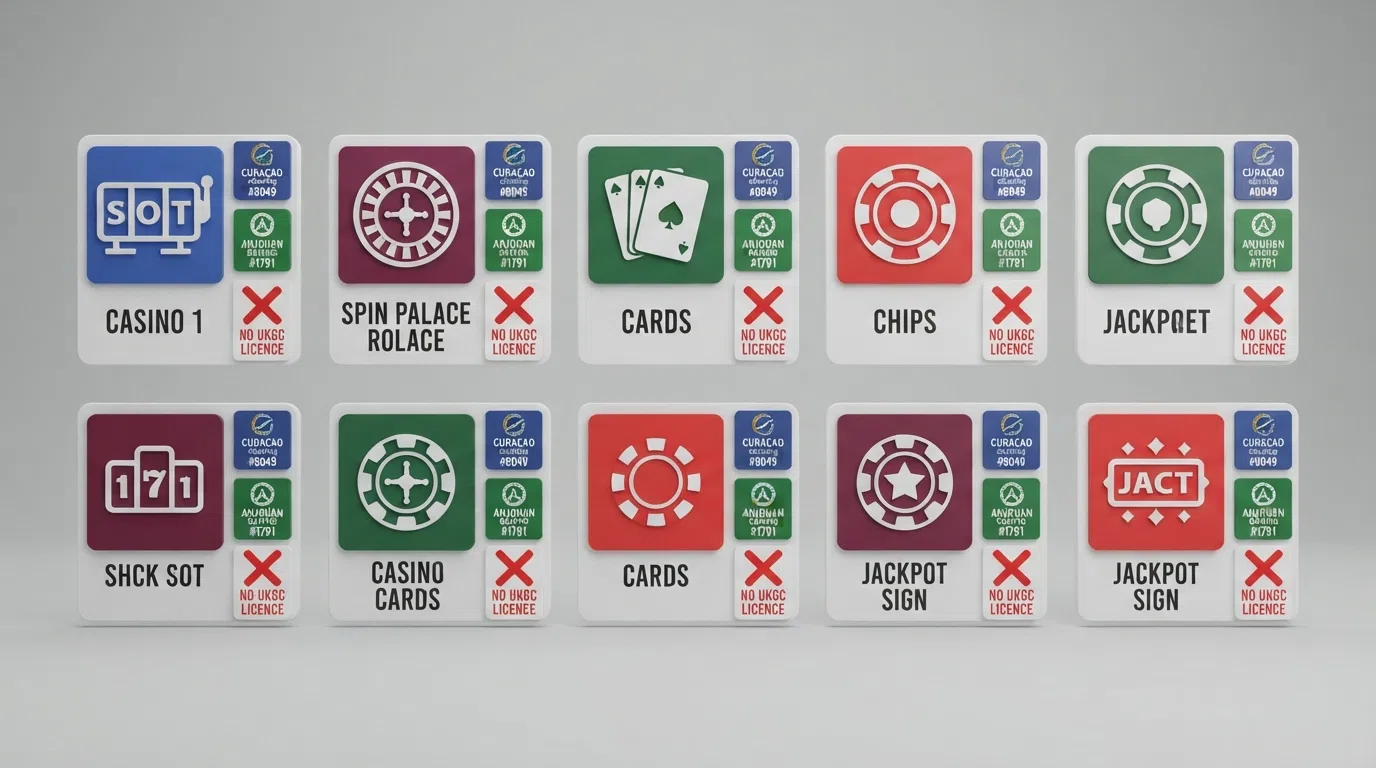
Every operator below is ranked honestly. Each is labelled with its real licence jurisdiction, its welcome offer as published, and the wagering terms that go with it. None of the ten holds a Gambling Commission licence; none appears on the UKGC public register (last updated 29 July 2026, 2,663 records). Every listed site is operating illegally in Great Britain at the point of consumption. That is the headline a reader needs before the rest makes sense.
| # | Operator | Licence jurisdiction | Welcome bonus headline | Wagering multiplier | Free spins | Game providers |
|---|---|---|---|---|---|---|
| 1 | Stake | Curaçao (Medium Rare N.V., since 2017) | No traditional welcome bonus — daily races and reloads | — | — | Stake Originals, Pragmatic Play, Evolution, Hacksaw Gaming, Push Gaming |
| 2 | BC.Game | Anjouan | 120% up to $1,000 first deposit (380% combined up to $4,000) | 40× on deposit+bonus | 400 (100 per deposit) | 5,000+ titles, in-house originals, Evolution, Pragmatic Play, Hacksaw |
| 3 | MyStake | Curaçao | 150% up to £750 first (total £1,500 across 3 deposits) | 30× on deposit+bonus | 30 | Pragmatic Play, NetEnt, Evolution, Play’n GO, Betsoft, Hacksaw |
| 4 | Donbet | Curaçao | Casino: 150% up to €750 + 50 FS · Crypto: 170% up to €1,000 + 100 FS | 30× on deposit+bonus+FS winnings | 50 (casino) / 100 (crypto) | Pragmatic Play, Evolution, NetEnt, Betsoft, Play’n GO |
| 5 | Goldenbet | Curaçao | 100% up to $500/€500 | 35× on deposit+bonus | — | Pragmatic Play, Evolution, NetEnt, Play’n GO, Hacksaw |
| 6 | Jackbit | Curaçao | 100 wager-free free spins on Hot Chilli Bells | 1× on deposit+winnings | 100 (wager-free) | Pragmatic Play, Evolution, Hacksaw, Play’n GO, NetEnt |
| 7 | Cloudbet | Curaçao + Anjouan | Up to $2,500 zero-wagering rakeback over 30 days | 0× | — | Evolution, Microgaming, NetEnt, Pragmatic Play, Betsoft |
| 8 | 7Bit Casino | Curaçao GCB (OGL/2023/174/0082) | 325% up to $10,800 or 5 BTC + 250 FS | 35× on cash + FS | 250 | 10,000+ games, NetEnt, Microgaming, Pragmatic Play, Betsoft, Evolution |
| 9 | Vave | Curaçao (Latcas B.V.) | 150% up to 1.5 BTC + 100 FS | 50× bonus / 40× FS winnings | 100 (25/day over 4 days) | 7,000+ titles, Pragmatic Play, Evolution, NetEnt, BGaming |
| 10 | Rolletto | Curaçao | 150% up to £500 + 200 FS first deposit (package up to £5,500 + 200 FS across 3) | 30× on bonus amount | 200 | Pragmatic Play, Evolution, NetEnt, Play’n GO, Betsoft |
Stake — no welcome bonus, daily races instead
Stake has operated under a Curaçao licence since 2017, run by Medium Rare N.V. Unlike the rest of the ranked set, it does not offer a traditional welcome bonus. The headline is daily races — wagering leaderboards with cash prizes — and reload promotions for returning players. Crypto withdrawals are paid near-instantly, which is the feature that pulls players to Stake over slower-paying offshore competitors. For a player who cares more about payout speed than about a matched deposit, Stake is the cleanest entry in the set. For a player chasing a headline bonus number, the table has louder rows.
BC.Game — the biggest package, the tightest cap
BC.Game operates under an Anjouan licence and accepts more than 150 cryptocurrencies — the broadest crypto support in the ranked set. The welcome package totals up to $20,000 in matched deposit bonuses across four deposits plus 400 free spins, with 40× wagering on deposit and bonus combined. The figure to read twice is the $10 maximum withdrawal cap per batch of free spin winnings. A bonus of $20,000 sounds transformational; a cap that limits each batch of free-spin winnings to $10 is what it actually pays. The minimum deposit per tranche is $5, so the door is easy to walk through. The 40× multiplier on a $1,000 deposit means $40,000 in turnover before withdrawal clears — the maths that decides whether this offer is worth taking.
MyStake — a three-part deposit match in pounds
MyStake offers a 150% match up to £750 on the first deposit, then 100% up to £500 on the second, then 50% up to £250 on the third — £1,500 in headline total, priced in pounds for a UK audience. The wagering requirement is 30× on deposit and bonus combined. The constraint that matters is the $5 maximum bet while the bonus is active; a player who bets above that line during clearing forfeits the bonus. Minimum deposit is £20. The sterling pricing and the £1,500 total are what make MyStake feel familiar; the 30× turnover is what the familiarity hides.
Donbet — a casino match and a separate crypto match
Donbet runs two welcome tracks. The casino track is a 150% match up to €750 plus 50 free spins, with 30× wagering on deposit, bonus, and free-spin winnings combined. The crypto track is steeper: 170% up to €1,000 plus 100 free spins. Minimum deposit is €20. Maximum bet while the bonus is active is €5 per spin. The choice between tracks is also a choice about turnover volume — the crypto offer looks larger, and the volume it demands is larger too.
Goldenbet — a straight 100% match with a 35× tag
Goldenbet offers a 100% match up to $500 or €500, with 35× wagering on deposit and bonus combined. Minimum deposit is $40 or €40. Maximum stake while the bonus is active is $5 or €5. The 35× multiplier sits between the 30× crowd (MyStake, Donbet, Rolletto) and the 40× bracket (BC.Game) — neither the lowest in the set nor the highest. The minimum deposit of $40 is twice what MyStake and Donbet ask, which is the first filter on who actually takes this offer.
Jackbit — 100 wager-free spins, with a 1× catch
Jackbit’s headline is the closest thing to a clean offer in the ranked set: 100 wager-free free spins on Hot Chilli Bells, on a first deposit of £50 or more. The catch is the 1× wagering requirement on deposit and winnings before withdrawal, and the $100 maximum withdrawal cap on free-spin winnings. Crypto withdrawals are processed in under an hour. The offer is the simplest in the table — a player reads the small print once, sees the £50 minimum and the $100 ceiling, and either takes it or moves on. The 1× multiplier is what every other operator on this page charges 30× to 50× to avoid.
Cloudbet — zero wagering, paid as rakeback
Cloudbet’s model is different from the rest of the ranked set. There is no deposit match and no free-spin bundle. Instead, the welcome package pays up to $2,500 in rakeback over 30 days — 10% of the house edge returned as real cash, with zero wagering requirement. Minimum deposit is 0.001 BTC (roughly $10). The 0× wagering multiplier is the smallest in the table. The trade-off is that the offer rewards play, not deposit volume: a player who deposits and walks away earns nothing, while a player who plays at length earns their edge back in cash. For a high-volume player who would play anyway, this is the most honest offer on the page.
7Bit Casino — the biggest headline number
7Bit Casino operates under Curaçao Gaming Control Board licence OGL/2023/174/0082, run by Dama N.V. on the SoftSwiss platform since 2014. The welcome pack is a 325% match up to $10,800 or 5 BTC plus 250 free spins, with 35× wagering on cash and free-spin winnings. Minimum deposit is $20. The headline number is the largest in the set. The 35× multiplier is what the headline hides: a $10,800 bonus at 35× on cash and bonus combined means roughly $770,000 in turnover before withdrawal clears — a figure that takes weeks of continuous play to reach. The 250 free spins are use-or-lose within a day of credit, which is the smallest validity window in the table.
Vave — 150% in bitcoin with a four-day drip
Vave offers a 150% match up to 1.5 BTC plus 100 free spins on the first deposit, with 50× wagering on bonus funds and 40× on free-spin winnings. Minimum deposit is 20 USDT. The 100 free spins drip at 25 per day over four days on Lady Wolf Moon Megaways — a payout schedule that keeps the offer alive across a week rather than handing it over in one tranche. The 50× multiplier on bonus funds is the second-highest in the ranked set, behind only Betpanda’s 80× (which sits outside the top ten). For a crypto-native player, Vave’s match is generous; for a player who reads the multiplier, the generosity is partly the multiplier itself.
Rolletto — the largest sterling headline
Rolletto offers a welcome package up to £5,500 plus 200 free spins across three deposits: 150% up to £500 plus 200 free spins on the first deposit, then 100% up to £2,000 on the second, then 100% up to £3,000 on the third. Wagering requirement is 30× on bonus amount. The first-deposit headline of £500 plus 200 free spins is the largest in sterling among the ranked set; the £5,500 package total is the largest headline period. The 30× on bonus amount (not deposit+bonus combined) is meaningfully lighter than MyStake’s 30× on deposit+bonus — a £500 bonus at 30× is £15,000 of turnover, where a £500 deposit plus £500 bonus at the same multiplier is £30,000.
Why offshore casinos are illegal to run in Britain — and safe to use
The legal position splits in two, and the split is the entire point of this page. The operator is committing an offence by serving a British customer without a Gambling Commission licence. The player is not. No UK player has been prosecuted for using an offshore casino; every sanction traced targets operators, advertisers and payment intermediaries. What the player loses is protection, not liberty.
That distinction is worth sitting with. A reader who reaches for an offshore casino is not exposing themselves to prosecution. They are exposing themselves to a different set of risks: no ADR if the operator refuses to pay, no UKGC complaints route, no consumer redress if funds are withheld, no GAMSTOP coverage, no source-of-funds verification. The legal status is asymmetric. The protection gap is not.
“Legit” versus “regulated” — the two words these sites trade on
A Curaçao licence is real paperwork. It regulates the operator in the jurisdiction that issued it. It is not a GB protection. The word “legit” in offshore marketing usually means “the operator pays out when asked”, which is a statement about operational reliability. The word “regulated” usually means “a regulator somewhere oversees this operator”, which is also true. Neither word means “the Gambling Commission oversees this operator”. None of the ten brands below has a UKGC register entry, which is the only register whose protections follow a British player.
A Curaçao or Anjouan licence does not authorise provision to Great Britain consumers. The two words do different work, and a player who treats them as synonyms is reading past the small print.
What a Curaçao or Anjouan licence actually gives you
The licence exists and regulates the operator — just not for Britain. Curaçao and Anjouan are the common jurisdictions for the offshore market; both operate their own gaming boards, both require operators to maintain segregated player funds and to submit to dispute resolution in their own jurisdictions. What the licence does not do is extend any of those protections to a player in Great Britain, because the player is not within the licensing authority’s remit. A UKGC register check on the ten operators in the ranked set returns no entries for any of them. The register was last updated 29 July 2026 and contains 2,663 records. The absence is the answer.
The licensed alternative in Britain
A GB-licensed casino gives the player every protection the offshore site skips. GAMSTOP is mandatory at every GB-licensed online operator since 31 March 2020, so a self-excluded player cannot deposit. Pre-deposit identity checks have applied since 7 May 2019, so anonymous play is impossible. The credit-card ban has applied to all remote gambling since 14 April 2020. The £5/£2 slot stake caps took effect in April and May 2025 under SI 2025/215. The 10× wagering cap took effect on 19 December 2025. Financial vulnerability checks at a £150 net deposit threshold took effect on 28 February 2025. The licensed alternative is not just a different product; it is a different protection regime.
Why your 2026 offshore bonus is smaller than it looks
The headline numbers in the table above are large. The wagering multipliers, the cashout caps and the validity windows shrink them. This section works through the four offer types that recur in the ranked set — welcome match, free spins, no-deposit, and crypto — and shows what each one really costs.
| Offer type | Example operator | Headline offer | Wagering × | Validity window | Cashout cap |
|---|---|---|---|---|---|
| Welcome match | MyStake | 150% up to £750 (3 deposits, £1,500 total) | 30× on deposit+bonus | 30 days | — |
| Welcome match, higher WR | BC.Game | 380% combined up to $4,000 + 400 FS | 40× on deposit+bonus | 30 days | $10 per FS batch |
| Wager-free spins | Jackbit | 100 wager-free FS on Hot Chilli Bells | 1× on deposit+winnings | 7-day clearance | $100 on FS winnings |
| Zero-wagering rakeback | Cloudbet | Up to $2,500 over 30 days | 0× | 30-day window | $2,500 total |
| No-deposit free spins | 7Bit Casino | 50 no-deposit free spins | 45× on no-deposit FS winnings | — | $25 cashout |
| Crypto welcome | Donbet | 170% up to €1,000 + 100 FS | 30× on deposit+bonus+FS winnings | — | — |
| Crypto match, higher WR | Vave | 150% up to 1.5 BTC + 100 FS | 50× bonus / 40× FS winnings | 30 days | — |
The number that stops mattering once another one sits beside it is the headline bonus. The number that matters is the turnover, because turnover is what the player has to put through the games before the bonus converts to withdrawable cash.
Welcome bonuses — the deposit match with a multiplier
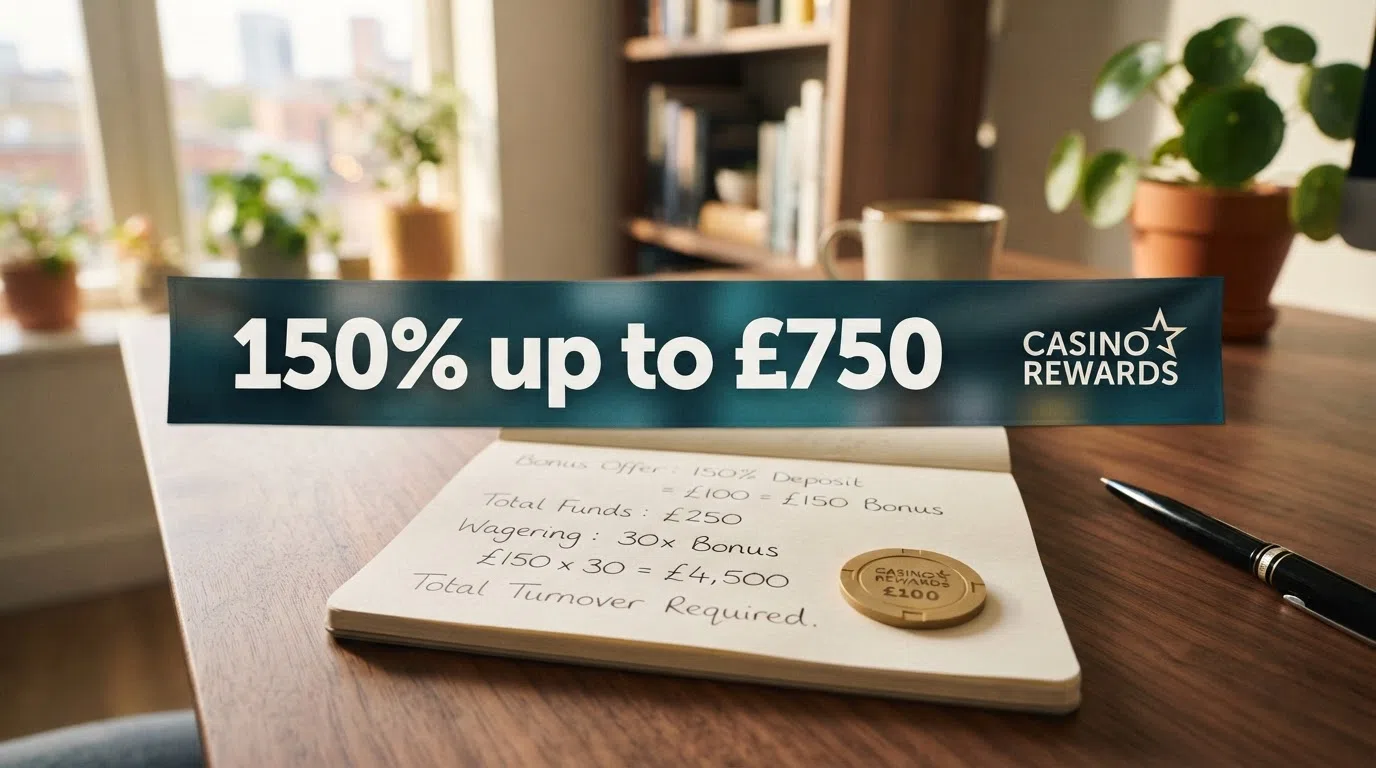
A deposit match works like this: the operator adds bonus funds equal to a percentage of the player’s deposit, and the combined amount must be wagered a stated number of times before withdrawal. The wagering multiplier applies to deposit and bonus combined at most of the offshore brands ranked here, which doubles the turnover the player has to put through. A 150% match at 30× on deposit+bonus on a £100 deposit means £250 in combined funds, multiplied by 30 — £7,500 of turnover before a single penny clears.
To take a concrete worked example: at MyStake, a £100 deposit at 150% gives a £150 bonus and £250 in combined funds. At 30× wagering on deposit+bonus, that is £7,500 in required turnover. At a £5 maximum bet per spin while the bonus is active, that is 1,500 spins of wagering. At five seconds per spin, that is roughly two hours and five minutes of continuous play to clear the bonus — assuming every spin is at the maximum stake and no early-cashout option is taken.
The same £100 deposit at a GB-licensed casino would carry a 10× wagering cap from 19 December 2025, meaning £2,500 of turnover on the same combined funds — a third of the offshore figure. The headline at the offshore casino looks larger. The turnover tells the rest.
Free spins — the wager-free offer and the one with a $10 cap
Wager-free free spins exist. Jackbit’s 100 spins on Hot Chilli Bells carry 1× wagering on deposit and winnings, which is functionally wager-free for the player who wants the winnings out fast. The $100 cap on free-spin winnings is what limits the upside: a 100× line hit on a 50p spin would clear at the £50 mark, not the £5,000 the maths suggests. The 1× multiplier is what makes Jackbit worth a player’s attention; the $100 ceiling is what keeps the offer honest.
BC.Game’s 400 free spins carry the opposite structure: 40× wagering on the bonus funds, plus a $10 maximum withdrawal cap per batch of free-spin winnings. A $10 cap on a single batch is the smallest ceiling in the ranked set; a player reading the small print sees it once and decides accordingly. 7Bit Casino’s 50 no-deposit free spins carry a $25 cashout cap, the second smallest in the set.
No-deposit bonuses — the free taste with the longest strings
The no-deposit offer arrives free. The wagering on its winnings is the stiffest of any offer type in the ranked set. 7Bit Casino’s 50 no-deposit free spins carry 45× wagering on the winnings and a $25 cashout cap. The bonus slot is Lucky Crown Spins. The offer requires no deposit, which means the player has zero downside on the bonus funds themselves — but the winnings off those spins, before they convert to withdrawable cash, must be wagered 45× through the games, with a hard ceiling of $25 on what actually pays out. The 45× multiplier is the highest in the ranked set, applied to the offer that requires the least from the player to claim.
Bitcoin and crypto bonuses — the bigger match, the steepest wagering
Crypto offers are where the headline number grows largest and the multiplier grows steepest with it. Donbet’s crypto track is a 170% match up to €1,000 plus 100 free spins at 30× on deposit+bonus+free-spin winnings. Vave’s crypto match is 150% up to 1.5 BTC plus 100 free spins at 50× on bonus funds and 40× on free-spin winnings. BC.Game’s crypto-native package totals up to $20,000 plus 400 free spins at 40× on deposit+bonus. Across the three, the wagering sits at 30×, 40× and 50× — none of them approaches the GB cap of 10×. The crypto offer is the cleanest illustration of why the offshore headline looks large: the multiplier is the price of the larger number, and the price is what the player pays.
Getting your money out — where the risk actually lives
Withdrawals are the moment an offshore site’s missing protections stop being abstract. The marketing language is “instant” or “under an hour”; the small print is the cashout cap, the wagering requirement, and the absence of a complaints route if the operator stalls. Both matter. The first determines how fast the money arrives. The second determines what arrives, and whether it arrives at all if the operator decides otherwise.
Payout speed — what “instant” and “under an hour” really mean
Crypto withdrawals at Stake are paid near-instantly. Crypto withdrawals at Jackbit are processed in under an hour. Cloudbet pays daily cash via its rakeback model. These claims are real for crypto — bitcoin and ethereum transfers settle on their own timeline, and the operator’s job is to release the funds from the casino balance, which most of the ranked operators do quickly. Fiat withdrawals move on the operator’s payment-provider timeline, which can stretch to days and is the slower lane by a margin.
Speed does not equal security. A near-instant crypto payout tells the reader the operator’s withdrawal queue is fast; it does not tell the reader what happens if the operator refuses to pay.
Withdrawals — caps, wagering and the £ you never see
A cap on free-spin winnings is a withdrawal term wearing a bonus label. BC.Game’s $10 cap per batch of free-spin winnings is the smallest in the ranked set; Jackbit’s $100 cap is the second smallest; 7Bit’s $25 cap on no-deposit free-spin winnings is the third. Each of these caps converts a bonus that looks generous into a bonus that pays a stated ceiling, regardless of what the slot actually returns. The wagering requirement clears the bonus into withdrawable cash; the cap decides how much of that cleared cash the player is allowed to take out. Where a site refuses to pay — and offshore operators have no ADR, no UKGC complaints route, and no British consumer redress — the player has no domestic backstop.
Crypto casinos — the only way to deposit in bitcoin, at a cost
Bitcoin deposits are the offshore market’s pull, and they are exactly what a GB licence forbids. The reason is structural: the UKGC’s source-of-funds, anti-money-laundering and Licence Conditions and Codes of Practice requirements make direct crypto deposits effectively impossible at any operator legally serving Great Britain. No UK Gambling Commission-licensed casino accepts cryptocurrency deposits in 2026. The crypto-only operators in the ranked set exist because the GB-licensed market has been closed to them.
Bitcoin and crypto deposits — how they work offshore
Crypto deposits at offshore casinos are fast. Bitcoin Lightning at Betpanda processes near-instantly, with no KYC required on crypto withdrawals. Stake’s crypto payouts settle near-instantly. The anonymity that replaces the credit-card ban at GB-licensed sites is the same anonymity that strips the source-of-funds verification a GB-licensed operator is required to perform. The trade-off is the trade-off the offshore market is built on: speed and anonymity for the player, in exchange for the absence of the regulatory protections that would have followed the deposit at a GB-licensed site.
The best crypto offshore casinos for UK players
The crypto-first operators in the ranked set are BC.Game (150+ coins, up to $20,000 package at 40×), Vave (1.5 BTC match at 50×, 100 free spins at 40× on winnings) and Cloudbet (zero-wagering rakeback, 0.001 BTC minimum deposit). Donbet’s crypto track is a 170% match up to €1,000 plus 100 free spins at 30×. Each of these sits above the GB-licensed ceiling on wagering multipliers — 30×, 40×, 50×, all above the 10× cap that applies from 19 December 2025. The crypto offer is the offshore market’s signature product, and the multiplier is its signature price.
The slots and tables you actually play — and an RTP that can shrink
The same slot titles carry different return-to-player percentages at different operators, and the player cannot tell from the lobby which configuration is live. The reason is structural: most modern slot providers ship their games in multiple RTP versions, and the operator chooses which version to host. Pragmatic Play operates a three-tier RTP system: Gates of Olympus is available at 96.50%, 95.50% and 94.50%. The lobby shows the game; the lobby does not show the RTP version.
| Slot title | Provider | RTP | Volatility | Max win |
|---|---|---|---|---|
| Starburst | NetEnt | 96.09% (top of six certified tiers down to 90.05%) | Low | — |
| Dead or Alive 2 | NetEnt | 96.82% | High | 111,111× |
| Blood Suckers | NetEnt | 98.00% | Low | — |
| Gates of Olympus | Pragmatic Play | 96.50% (of three tiers: 96.50/95.50/94.50%) | High | 5,000× |
| Sweet Bonanza | Pragmatic Play | 96.51% | High | 21,100× |
| Big Bass Bonanza | Pragmatic Play | 96.71% | High | 2,100× |
| The Dog House Megaways | Pragmatic Play | 96.55% | High | 12,305× |
The slot RTP gap — why the same title pays less offshore
A slot’s RTP is not fixed. The provider ships a default RTP and several lower alternatives; the operator chooses which to host. Pragmatic Play’s three-tier system means a player at one casino might be playing Gates of Olympus at 96.50% while a player at another casino — on the same game, on the same day — is playing at 94.50%. The 2-percentage-point gap is the difference between a slot that returns £96.50 per £100 wagered over the long run and one that returns £94.50. The lobby will not tell the player which one is live. NetEnt’s six-tier system for Starburst — 96.09%, 95.05%, 94.05%, 93.05%, 92.05% and 90.05% — is the widest in the table, and the gap between top and bottom tier is more than 6 percentage points.
Casino table games — blackjack, roulette and the house edge
Table games carry their own house edges, set by the game rules rather than by the operator. Blackjack at favourable rules returns over 99% to the player; European roulette (single zero) returns 97.3%; American roulette (double zero) returns 94.7%. These figures are rules-driven and do not move between operators in the way slot RTPs do. What does move is the assurance that the game is operating as published: no RTS-mandated fairness standards apply offshore, which means the testing regime that backs a GB-licensed live dealer table does not back the same table at an offshore site.
Live dealer and the online play gap
Live dealer is the product. Evolution supplies live dealer tables to Stake, BC.Game, MyStake, Donbet and Goldenbet, which means the same studio, the same dealers, and the same game mechanics as a GB-licensed site. What does not follow the table is the regulatory framework: an Evolution table at a GB-licensed casino carries the protections of the LCCP and RTS, including the £5/£2 stake caps on slots (live game shows sit outside the slot regime, but the broader responsible-gambling framework still applies). An Evolution table at an offshore site carries the studio’s operational reliability and nothing else. The cards are the same. The protection regime is not.
Responsible gambling — the safeguards that stop at the GB border
GAMSTOP, deposit limits and the broader package of GB responsible-gambling tools all stop where the licence stops. Offshore sites sit on the other side of that line. The tools that work regardless of where the player deposits are the tools that do not need a licence.
GAMSTOP will not stop you here
GAMSTOP is mandatory for every GB-licensed online operator since 31 March 2020. It is licence-bound — it covers operators the Commission regulates, and it does not extend to operators it does not. The Gambling Commission’s research has shown that some targets of unlicensed operators include people who are self-excluded or have had customer relationships terminated by operators. The implication is direct: a self-excluded British player is not protected from offshore sites. GamStop only covers operators licensed by the Gambling Commission, so offshore sites — often advertising as “not on GamStop” — aren’t blocked.
What still works — helplines, limits and blocking tools
The National Gambling Helpline (0808 8020 133), run by GamCare, took over 130,000 calls and online messages in 2024–2025, made 7,100 referrals into further treatment services, delivered 8,100 regional treatment sessions, and held an average wait time of 1.3 days. The helpline is free, confidential, and does not require the caller to be playing at any particular site — licensed or unlicensed. GambleAware funds the National Gambling Support Network, which treated 11,960 clients in the same period. NHS gambling harm clinics operate in England, Scotland and Wales. Gamblers Anonymous runs peer support.
For a player who wants a technical barrier between themselves and an offshore site, device-level blocking software and bank-level gambling blocks are the only tools that operate without a licence. Gamban is the device-level option; most UK banks offer a gambling-payment block that prevents transactions to gambling merchants regardless of the operator’s licence status.
How common gambling harm actually is in Britain
The Gambling Survey for Great Britain (2025, Year 3) found 47% of adults had gambled in the past four weeks and 38% had gambled online. The 27% figure excluding National Lottery is the more useful one — over a quarter of British adults are active gamblers by the broader definition. An estimated 4.3 million adults in Great Britain are affected by a family member’s or friend’s gambling, and approximately 2 million children live in households with adults experiencing problem gambling. The 30% of adults who gamble and experience any level of problems who want treatment is up from 17% in 2020. These figures are the context in which the offshore protection gap matters. The licensed market’s safeguards are not abstractions; they exist because the underlying demand for help is large and growing.
How we checked these casinos
The ranking and the licence labels on this page are based on a specific set of inputs. The operators were checked against the UK Gambling Commission’s public register (last updated 29 July 2026, 2,663 records); none of the ten brands appears on it. Licence jurisdictions, welcome offer terms, wagering multipliers, free-spin allocations and game provider lists were taken from current operator reviews and the regulation skill, with each operator’s status as offshore — and therefore operating illegally in Great Britain — confirmed against the register check.
The ordering of the ranking reflects the size and clarity of each operator’s welcome offer relative to its wagering terms, the breadth of its game providers, and the absence of a GB licence. Operators with cleaner offers (Cloudbet’s zero-wagering rakeback, Jackbit’s wager-free spins) sit alongside operators with larger headline numbers (BC.Game’s $20,000 package, Rolletto’s £5,500 sterling package), and the reader is left to weigh which matters more. The criterion is stated qualitatively because the ranking is editorial.
Offshore play is a choice, not a protection — decide before you deposit
The page’s own figures are the conclusion. Every offshore casino on this page is operating illegally in Great Britain at the point of consumption. Every one of them is missing the protections a GB-licensed casino is required to carry: no GAMSTOP coverage, no UKGC complaints route, no ADR, no British consumer redress, no source-of-funds verification, no statutory deposit limits, no credit-card ban. The player is not prosecuted. The player is unprotected. Those are different statements, and they do not cancel each other out.
The single question to ask before depositing is whether the offer is worth the protection gap. A 30× wagering multiplier on a £1,500 sterling package at MyStake costs £45,000 in turnover to clear. A GB-licensed casino’s 10× cap on the same package would cost £15,000. The offshore offer is larger; the offshore price is three times the GB price. For a player who would play anyway, Cloudbet’s zero-wagering rakeback closes most of that gap. For a player who would not, no multiplier makes the offer worth the protection it costs.
If the question of self-exclusion is part of why this page is being read, GAMSTOP does not cover the sites below. The tools that do work are the National Gambling Helpline (0808 8020 133), bank-level gambling blocks, device-level blocking software, and the NHS gambling harm clinics. They do not depend on the licence of any casino.
Frequently asked questions
Are offshore casinos legal for UK players to use?
Yes, for the player. No, for the operator. The point-of-consumption rule under the Gambling (Licensing and Advertising) Act 2014 requires any operator serving GB customers to hold a Gambling Commission licence, and none of the ten operators on this page does. Section 33 of the Gambling Act 2005 carries up to 51 weeks’ imprisonment or an unlimited fine against operators providing facilities without the licence. No UK player has been prosecuted for using an offshore casino. The asymmetry is the whole legal picture.
What is the difference between a UKGC-licensed casino and an offshore casino?
A UKGC-licensed casino holds a Gambling Commission operating licence and is bound by the LCCP and RTS, including the £5/£2 slot stake caps, the 10× wagering cap from 19 December 2025, the credit-card ban, GAMSTOP coverage, ADR and a UKGC complaints route. An offshore casino holds a licence from another jurisdiction (typically Curaçao or Anjouan) and is bound by that jurisdiction’s rules — not by the LCCP, not by the RTS, not by the UKGC register. The protections a GB player gets at a UKGC-licensed casino do not follow the money to an offshore site.
Do offshore casinos accept UK players without a VPN?
Yes. The operators on this page all market to UK players directly, accept sterling and euro deposits, and do not require a VPN. Accessibility is not legality — the point-of-consumption rule still applies, and the operator is committing an offence by serving a GB customer. The player’s onboarding is faster because the pre-deposit identity check a GB-licensed operator must perform does not apply offshore.
Are my winnings from offshore casinos taxed in the UK?
No. Gambling winnings are not taxed on the player side in the UK; the tax was abolished in 2001 and has not been reinstated. Operators pay Remote Gaming Duty (40% from 1 April 2026) and the statutory levy (1.1% of gross gambling yield from 6 April 2025), but those are operator-side taxes, not player-side. A British player winning at an offshore casino receives the winnings without UK income tax or capital gains tax on the win itself.
Can I use GamStop to block myself from offshore casino sites?
No. GAMSTOP is licence-bound and covers only GB-licensed online operators. It does not cover offshore sites, and the Gambling Commission’s research has confirmed that some unlicensed operators specifically target self-excluded players. The tools that work regardless of the operator’s licence are device-level blocking software (Gamban) and bank-level gambling blocks, which prevent transactions to gambling merchants at the payment layer.
How fast do offshore casinos pay out compared to UK-licensed sites?
Crypto withdrawals at offshore sites are typically faster — Stake pays near-instantly, Jackbit processes in under an hour, Cloudbet pays daily. Fiat withdrawals depend on the operator’s payment-provider timeline and can take days. GB-licensed casinos are not generally slower on crypto specifically, because they do not accept crypto at all — fiat withdrawals at GB-licensed casinos run on a similar timeline to fiat withdrawals offshore. The speed advantage at offshore sites is real for crypto, and only for crypto.
What happens if an offshore casino refuses to pay my winnings?
The player has no UKGC complaints route, no ADR approved by the Commission, and no British consumer redress. The operator’s own jurisdiction (Curaçao, Anjouan) operates its own dispute-resolution process, which is accessible but is not designed for a British player and does not carry the same enforcement weight. The licensed alternative exists precisely to close this gap — a GB-licensed operator refusing to pay is answerable to the Commission, and the player has a domestic complaints route and an ADR option. The offshore protection gap is this section’s subject.
Do these sites really take British players?
Yes, and they do not require a VPN. The ten brands below all market to UK players directly, run UK-targeted welcome bonuses priced in pounds and euros, and accept deposits from British bank cards and e-wallets without asking where the player lives. Accessibility, again, is not legality. The point-of-consumption rule still applies; the operator is simply choosing to take the legal risk on its own end.
Are these sites legal for a British player to use?
Legal to use. Illegal to operate. The point-of-consumption rule under the 2014 Act places the obligation on the operator, not the customer. Section 33 of the Gambling Act 2005 carries up to 51 weeks’ imprisonment or an unlimited fine for providing gambling facilities without the required licence — and that penalty is levied against operators and the people who run them. The Commission’s enforcement record confirms the asymmetry: between April 2024 and June 2025, the Commission issued 3,140 disruption notices, referred 447,778 URLs to search engines, and achieved 287,961 URLs removed across 160 disrupted sites. None of those actions targeted individual players. Advertising unlawful gambling is a separate offence, and the Commission’s cease-and-desist notices routinely target affiliate sites and SEO intermediaries, not customers.
Is crypto play legal for UK players offshore?
The player is not prosecuted. The operator accepting crypto from a British customer is operating illegally in Great Britain at the point of consumption — the same offence as accepting a sterling deposit, plus the additional regulatory territory of handling cryptocurrency without the source-of-funds verification a GB-licensed operator must perform. The point-of-consumption rule applies to crypto in the same way it applies to fiat. A player who deposits bitcoin at BC.Game from a London IP address is doing so at an unlicensed site; the operator is the party taking the regulatory risk.
Licence – No Minimum Deposit Casinos UK
Content created by the «No Minimum Deposit Casinos UK» team