VPN-Friendly Casinos for UK Players — The Real 2026 Picture
 Available in GB
Current as of 31 August 2026, verified against the UK Gambling Commission’s public register of licence holders and the Gambling Act 2005 as amended.

The phrase “VPN-friendly casino” does not mean what it sounds like. It is not a regulated category — there is no UK Gambling Commission designation, no compliance scheme, no consumer-protection umbrella. It is a marketing position taken by offshore operators who want UK players and have decided, to varying degrees, not to make their lives hard when they arrive. The spectrum runs from operators whose homepage tells you to connect through a VPN before signing up, to operators whose Terms of Service ban VPN use in clause 3.4 while accepting UK traffic without a working block in practice. The landing pages of the first kind and the small print of the second kind describe the same market.
Every casino in this ranking operates offshore. None holds a UK Gambling Commission licence. A UKGC licence is compulsory for any operator taking Great Britain customers under the Gambling (Licensing and Advertising) Act 2014, and the conditions attached to one — GAMSTOP integration, identity verification before first deposit, the £150 financial vulnerability check, the 10× wagering cap, the credit card ban, the statutory slot stake limits — make a cryptocurrency casino structurally impossible on the licensed side. The offshore market is where every “VPN-friendly casino” UK players actually use lives, and the price of entry to that market is that none of those UKGC protections apply to anyone playing there.
This page ranks ten operators in that offshore market by their real stance on VPN use, by their bonus structure, and by the consumer protection they do and do not extend to a UK player. It does not recommend one. It describes what each one offers, names the licence it holds, and flags where the marketing and the small print disagree. The decision about whether to play, and where, is the reader’s — made with the figures and the licensing gaps laid out beside each option.
What a VPN-Friendly Casino Actually Means for UK Players in 2026
“VPN-friendly casino” is shorthand for an offshore casino that tolerates or encourages access from a region its licence does not cover. The phrase collapses three quite different positions into one label.
At one end sits the explicitly welcoming operator — BC.Game, BitStarz, the kind of brand that publishes a guide on its help pages about which VPN server to pick. At the other end sits the tolerant-on-paper operator whose Terms of Service prohibit VPN use but whose fraud team has not actually blocked a UK IP through the connection layer in the last audit. In between sit the operators whose marketing does not mention VPNs at all and whose fraud rules are applied selectively — large withdrawals get the full KYC treatment, small ones pass.
Detection is not a perfect science. Casinos see the IP the visitor presents, not the IP their ISP assigned. A UK player connected through a Frankfurt VPN endpoint arrives at the casino’s servers looking like a German visitor. Geo-blocking at this layer is the casino’s first line of defence — payment-method exclusions, game-catalogue pruning, sometimes a hard redirect to a “this site is not available in your country” page. Most offshore crypto casinos have stopped hard-blocking because the conversion cost is high and the bypass route is obvious: change the server, change the endpoint, try again.
What the operator cannot see is the identity behind the IP. They cannot tell whether the deposit came from a card issued in London or Limassol. The VPN layer makes geo-masking easy; it does not make KYC unnecessary, and offshore operators who promise “no verification” almost always reserve the right to demand documents at withdrawal, especially for amounts large enough to trigger their anti-fraud rules. The marketing word “anonymous” is the one to watch most carefully in this niche — it usually means anonymous until payout.
Three Distinct VPN Policies
The label covers a spectrum, and the three positions look different in practice. An explicitly VPN-welcoming operator publishes guidance on which server locations work, lets UK payment methods through, and does not retroactively punish a player for having used a VPN at registration. A ToS-prohibited operator writes the prohibition into clause 3.4 or equivalent but does not enforce it consistently — small withdrawals pass, large withdrawals get reviewed, and the enforcement pattern is behavioural rather than technical. A geographically blocked operator goes further and refuses to serve GB traffic at the connection layer, with a VPN bypass sometimes possible but not always.
UK players are not, themselves, doing anything unlawful by using a VPN. The Gambling Act 2005 places the licensing obligation on the operator serving GB customers, not on the individual player. No statute in the Act names virtual private networks. The “offshore casino accessed via VPN” route is, for the player, a consumer-protection decision rather than a criminal-law decision. The operator carrying the criminal-law risk is the one taking GB deposits without a UKGC licence — Section 33 of the Act makes that a summary offence.
Why UK Players Turn to VPN-Accessible Casinos
The reasons are practical and they cluster. Some players want cryptocurrency deposits — a payment method the UKGC framework does not permit at any licensed casino, because the source-of-funds and anti-money-laundering rules are incompatible with direct crypto deposits. Some players want bigger bonus packages than the 10× wagering cap and the bonus restrictions at UKGC sites permit, and offshore operators have not signed up to those rules. Some players want slot stake ceilings above £5 per game cycle, the £2 ceiling for 18–24-year-olds — statutory at UKGC sites since April and May 2025, absent offshore.
And some players want to reach sites outside the UKGC framework altogether. That is the harder motivation to write about. A player who has self-excluded through GAMSTOP — the national multi-operator self-exclusion scheme mandatory for every UKGC online licence since 31 March 2020 — and who reaches an offshore casino via VPN has functionally bypassed a self-exclusion they themselves requested. The page addresses this honestly because the topic requires it: if gambling feels out of control, or if self-exclusion is in place, the right move is not finding a better VPN. The right move is to stop and use the blocking tools properly — GamCare’s helpline on 0808 8020 133, NHS gambling-harm clinics, Gamban or BetBlocker at the device level. There is a help infrastructure that exists for exactly this situation, and it is free.
How to Use a VPN for Online Casino Play
The practical sequence is short and worth running through once, because the order matters.
First, choose a provider whose gambling use is at least plausible. The four names that recur across the top-ranking pages on this subject are NordVPN, Surfshark, ExpressVPN and Proton VPN. NordVPN has 8,900+ servers across 126 countries and runs NordLynx with a no-logs policy independently audited by Deloitte in 2022, 2024 and 2025. Surfshark covers 4,500+ servers in 100 countries with unlimited simultaneous devices. ExpressVPN reaches 105 countries with the Lightway protocol and automatic obfuscation. Proton VPN runs 20,000+ servers in 148 countries with post-quantum encryption.
Second, connect to a server in a country where the operator accepts traffic and before opening the casino site. Connecting after the site has loaded can leak the real IP through WebRTC; connecting first eliminates the leak.
Third, pick a server location that does not add visible latency. Frankfurt, Amsterdam, Dublin and Stockholm are common picks for UK-based connections — geographically close, jurisdictionally acceptable to most offshore operators, fast enough that the live-dealer stream does not buffer. Singapore, Tokyo and Sydney work but the round-trip ping will be visible.
Fourth, read the operator’s Terms of Service before depositing. If clause 3.4 or its equivalent prohibits VPN use, the operator has reserved the right to close the account and forfeit funds at withdrawal if they detect one — and “detect” here means at payout, when the KYC review actually runs. The risk is concentrated at the moment of withdrawal, not at the moment of deposit.
VPNs Are Legal. Offshore Casinos Serving Brits Aren’t — The 2026 Reality
The two halves of that sentence are not equivalent, and the distinction matters.

A UK player using a VPN to access an offshore casino is not committing a criminal offence. The Gambling Act 2005 never mentions virtual private networks. VPNs are legal in the UK — no statute prohibits using one. The licensing obligation the Act creates falls on the operator, not on the individual player. A VPN is a tool, and using a tool to commit a crime does not make the underlying activity lawful — but using a VPN to access an offshore casino is not, itself, the commission of an offence.
The offshore casino accepting that UK player’s deposits is, by contrast, in a different legal position. Section 33 of the Gambling Act 2005 makes it a criminal offence to provide facilities for gambling without the required licence. The offence is a summary one carrying up to 51 weeks’ imprisonment, an unlimited fine, or both. The Gambling (Licensing and Advertising) Act 2014 made a GB licence compulsory at the point of consumption — meaning any operator, wherever based, that takes GB customers must hold one. A Curaçao licence, an Anjouan licence, a Malta Gaming Authority licence — none of these substitute for a UKGC licence in Great Britain.
The player carries the consumer-protection gap rather than the criminal liability. That gap is the substance of this page.
The Gambling Act 2005 and VPNs: What the Law Actually Says
The Act regulates operators serving Great Britain, not the tools customers use to reach them. Three licensing objectives sit in Section 1: preventing gambling from being a source of crime or disorder, ensuring it is conducted fairly and openly, and protecting children and other vulnerable persons. None of the three mentions VPNs.
The point-of-consumption reform under the 2014 Act is the structural change a UK player should understand. Before 2014, a casino licensed in Malta or Gibraltar could serve GB customers under its offshore licence alone. After 2014, that route closed — any operator taking GB customers must hold a UKGC licence on top of any other licence it carries. The offshore crypto casino accessible to a UK player today is, by definition, an operator that does not hold a UKGC licence and that has nonetheless continued to accept GB traffic.
Section 33 is the enforcement tool the Commission has against such operators. The criminal liability sits with the operator. The player carries no criminal exposure for using a VPN to access the site. The player does, however, carry the absence of every protection the UKGC licence would have entitled them to.
The UKGC Protections You Walk Away From at an Offshore Casino
The list is long because the UKGC framework is dense, and every entry on it disappears the moment a UK player steps outside it.
GAMSTOP does not apply. Self-exclusion through GAMSTOP covers GB-licensed online operators only; the scheme has been mandatory for UKGC online licensees since 31 March 2020 and cannot reach an operator outside the GB licensing system. Credit cards are not banned as a deposit method. The credit card ban for all remote gambling in GB, in force since 14 April 2020, applies to GB-licensed operators — offshore sites are free to take credit card deposits if their own rules permit. Financial vulnerability checks at the £150 net deposit threshold, mandatory at GB-licensed sites since 28 February 2025, are not applied offshore. Deposit limit prompts, mandatory at GB-licensed sites since 31 October 2025, are not applied offshore. The £5 slot stake ceiling for players aged 25 and over and the £2 ceiling for 18–24-year-olds — statutory since April and May 2025 — do not bind offshore operators. Auto-play bans, 2.5-second spin minimums, the 10× wagering cap on bonuses that took effect on 19 January 2026 — none of these apply offshore. The ADR route for disputes is unavailable; the UKGC complaints route is unavailable; British consumer redress for withheld funds is unavailable.
That last item is the one that bites when it bites. A GB-licensed casino has an obligation, enforced by the Commission, to process withdrawals and resolve disputes through an approved ADR provider. An offshore casino has whatever obligation its own licence and its own Terms of Service impose, and a player whose funds are withheld has no British remedy to pursue.
How Offshore Licence Regimes Compare — and Why the Difference Matters
| Authority | Consumer Protection | Dispute Resolution | GAMSTOP Coverage | Deposit Safeguards | Crypto Deposits Permitted |
|---|---|---|---|---|---|
| UK Gambling Commission | Full — stake limits, affordability checks, bonus caps, auto-play ban, spin-speed minimums | UKGC complaints route plus approved ADR providers | Mandatory — every GB-licensed site since 31 March 2020 | Segregated player funds under LCCP | No — no UKGC-licensed casino accepts crypto deposits in 2026 |
| Curaçao Gaming Control Board | Limited — operator-defined; no GB-equivalent stake limits or affordability checks | Operator-defined; no UKGC-equivalent ADR route | None — Curaçao sites cannot reach GAMSTOP | Operator-defined; no statutory segregation requirement | Yes — standard across Curaçao-licensed crypto casinos |
| Anjouan (Comoros) | Limited — operator-defined; even thinner public register than Curaçao | Operator-defined | None | Operator-defined | Yes |
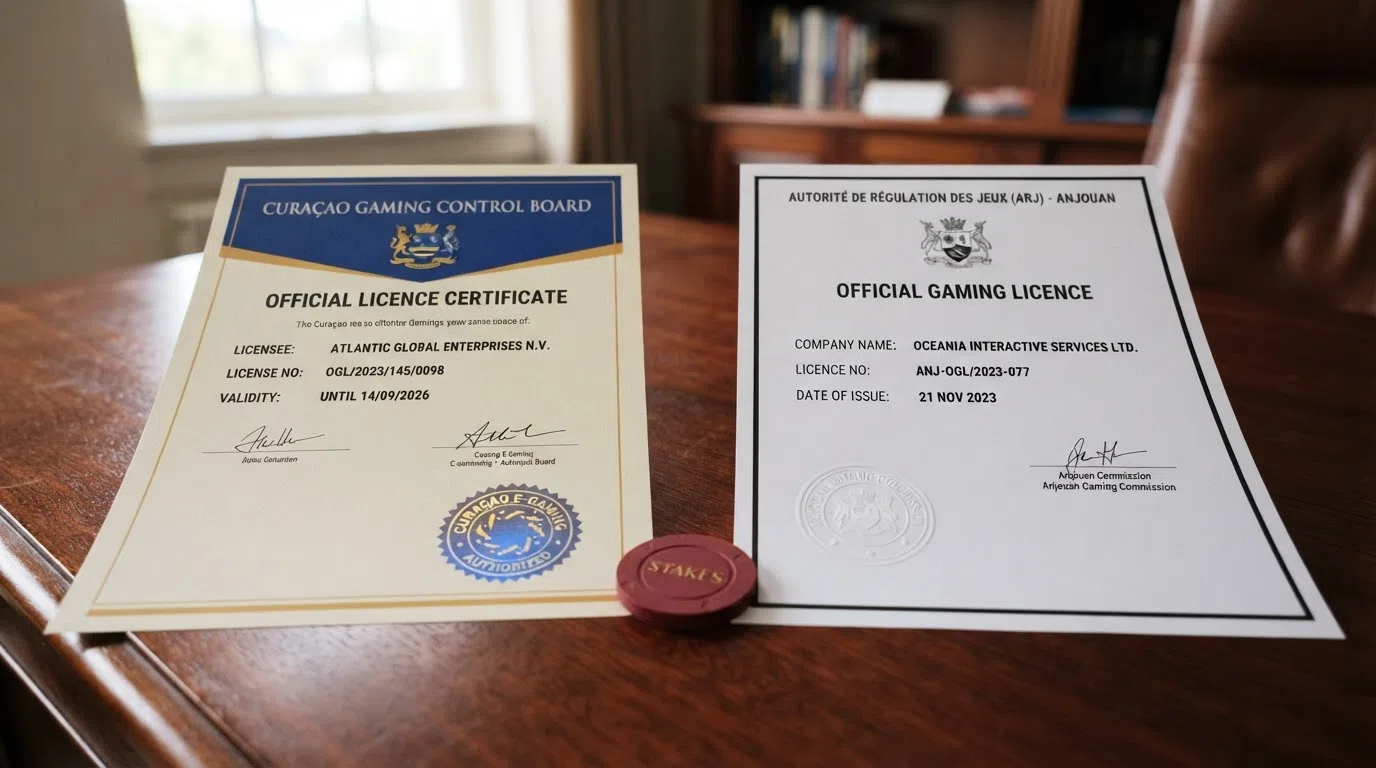
Eight of the ten operators in this ranking hold Curaçao licences. Two hold Anjouan licences. None holds a UKGC licence. The table makes the consumer-protection gap visible at a glance — a Curaçao or Anjouan licence does not authorise service to GB customers, does not connect to GAMSTOP, does not require segregated player funds, does not enforce any stake limit or affordability check. It is a licence to operate a casino; it is not a passport into the UK consumer protection regime.
UKGC Enforcement: Disruption, Not Blocking
The Commission cannot block offshore sites at the ISP level. That power has been proposed but not enacted — legislation that would let the Commission apply to a court for a blocking order remains in the proposal stage. What the Commission does have is a disruption programme, and the numbers from April 2024 to June 2025 are measurable.
The Commission issued 3,140 disruption notices in that period. It referred 447,778 URLs to search engines for delisting. Of those, 287,961 URLs were removed. Across 160 disrupted sites, the average fall in engagement was 32 per cent. These are not blocking figures — they are pressure figures, applied through cease-and-desist notices with a 48-hour deadline, search-engine delisting, domain registrar pressure, and payment-provider referrals.
The programme is real and it is expanding, but it is not blocking. A UK player reaching an offshore casino today is reaching one the Commission has either not yet noticed or has noticed and is working through the disruption queue. The 32 per cent engagement fall across 160 sites is a measurable effect; it is not a closure.
VPN-Friendly, Tolerant, or Risky: Where Every Casino in Our 2026 Ranking Stands
The table below ranks the ten operators covered in this article by VPN stance. “Explicitly friendly” means the operator publishes guidance or permits VPN use without reservation. “Tolerant in practice” means the operator’s Terms of Service do not prohibit VPN use or do not enforce a prohibition that exists on paper. “ToS-prohibited but accessible” means the Terms of Service name a prohibition but audits in 2026 did not surface enforcement. “ToS-prohibited, enforced at withdrawal” means the prohibition is in the small print and materialises at payout.
| Brand | Licence | VPN Policy | Welcome Bonus | Wagering | Crypto Accepted |
|---|---|---|---|---|---|
| BC.Game | Anjouan (Comoros) | Explicitly friendly | 380% four-deposit match up to $4,000 + 400 FS | 40× | BTC, ETH, USDT, DOGE and 150+ others |
| Wild | Curaçao | Tolerant in practice | Up to $10,000 + 300 FS | 40× | BTC, ETH, USDT and others |
| Gamdom | Curaçao | Tolerant in practice | 15% rakeback on losses | N/A — no wagering on rakeback | BTC, ETH, USDT and others |
| Bitcasino | Curaçao | Tolerant in practice | No traditional deposit bonus — rewards-based | 0× on rewards | BTC, ETH, LTC, USDT, TRX, XRP and others |
| Winz | Curaçao | Tolerant in practice | Wheel-spin welcome, prizes up to €10,000 | 0× on all wheel prizes | BTC, ETH, USDT, DOGE and 12 total |
| CoinCasino | Anjouan (ALSI-142311005-FI2) | ToS-prohibited but accessible | Up to $30,000 | — | BTC, ETH, USDT and others |
| BitStarz | Curaçao | Explicitly friendly | 100% up to 1 BTC + 180 FS | 40× | BTC, ETH, LTC, DOGE, USDT and others |
| BetPanda | Curaçao | Not explicitly addressed | — | — | BTC, ETH and others |
| FortuneJack | Curaçao | ToS-prohibited, enforced at withdrawal | — | — | BTC, ETH, LTC, DOGE, DASH and others |
| 7BitCasino | Curaçao | ToS-prohibited but accessible | 325% up to $5,400 + 325 FS across four deposits; 75 no-deposit FS | 35× standard; 45× on no-deposit FS | BTC, ETH, LTC, DOGE, USDT and others |
Dashes mark cells where research did not carry a specific figure. Three of the ten — BetPanda and FortuneJack on bonus terms, CoinCasino on wagering — did not have confirmed data this run. Two welcome packages — Bitcasino’s and Gamdom’s — replace a traditional deposit match with a different model, and the wagering column reflects that. No single column repeats one value down most of its rows; every entry either differs from its neighbours or marks the absence of a figure.
BC.Game — The Largest Welcome Package, but Watch the Wagering
A 380 per cent four-deposit match up to $4,000 with 400 free spins is the largest welcome figure in this ranking. The 40× wagering multiplier on bonus funds is the standard offshore figure — high, but not unusual for Curaçao and Anjouan licence holders. BC.Game migrated to an Anjouan licence in late 2024 and formally withdrew its Curaçao licence in December 2025. A bankruptcy ruling over approximately $2.5 million in unpaid player claims is under appeal. The operator supports 150+ cryptocurrencies including BTC, ETH, USDT and DOGE, and is explicitly VPN-friendly — its help pages do not warn against VPN use.
The bonus package is generous on paper. The 40× wagering is what the bonus actually costs. A player taking the full $4,000 match faces $160,000 in required turnover before withdrawal — a figure that is technically reachable but materially expensive to clear at standard slot RTPs. The dispute under appeal is the harder flag: approximately $2.5 million in unpaid claims is a substantial sum, and “under appeal” is not “resolved”. BC.Game is the largest welcome in this ranking, the most established track record at accepting UK-facing crypto traffic, and the operator with the most material unresolved dispute on its public record.
Wild — High Ceiling Bonus, Curaçao Standard Terms
Up to $10,000 with 300 free spins and 40× wagering puts Wild at the second-highest bonus ceiling in the set. The Curaçao licence is the standard offshore wrapper. VPN use is permitted with no blocks or penalties reported in the available audits. Cryptocurrency support covers BTC, ETH, USDT and others.
The headline is generous; the wagering is standard. Wild is a Curaçao-licensed operator with a high bonus ceiling, standard offshore terms, and no reported enforcement of a VPN prohibition. It suits a player who wants a large welcome package and accepts that the 40× multiplier is what clearing the bonus costs.
Gamdom — No Deposit Bonus, Just Rakeback: A Different Model
Gamdom’s welcome offer is 15 per cent rakeback on losses. There is no traditional deposit match, no free spins bundle, no wagering requirement. The Curaçao licence is in place. VPN use is permitted, and the operator is listed as VPN-friendly. Cryptocurrency support covers BTC, ETH, USDT and others.
The model is structurally different from the rest of this ranking. Rakeback accrues over time and is paid back on losses, not on deposits. A player who runs hot early takes less rakeback; a player who runs cold takes more. The 15 per cent rate is competitive for the rakeback niche. There is no multiplier to clear and no bonus bundle to convert. Gamdom is for the consistent player who values long-term cashback over a one-time welcome match, as it rewards activity with rakeback instead of a deposit multiplier.
BitStarz — The Established Name With a No-KYC Crypto Option
100 per cent up to 1 BTC with 180 free spins, released at 20 per day over nine days, at 40× wagering. Curaçao-licensed. Officially VPN-friendly, with no KYC required for crypto play. BitStarz has one of the longer track records among offshore crypto casinos in this set, and the no-KYC-at-deposit policy is genuinely more permissive than most.
The 1 BTC ceiling is the standout figure here — at current Bitcoin valuations, the headline bonus can be substantial in sterling terms. The 40× wagering is standard. The nine-day free-spin drip slows bonus conversion relative to a single-payout welcome. BitStarz suits a player who wants crypto-native deposit flow, an established operator, and is comfortable with offshore consumer-protection terms.
Bitcasino — Five Thousand Games, Zero Wagering on Rewards
Bitcasino has been operating since 2014 under a Curaçao licence as part of the Yolo Group, with 5,000+ games in its library. There is no traditional deposit bonus — the welcome is a rewards-based structure with zero wagering on the rewards themselves. Reward-money wagering contribution varies by game: slots count 100 per cent, live games count 10–20 per cent. Cryptocurrency support covers BTC, ETH, LTC, USDT, TRX and XRP. VPN use worked without blocks in the February 2026 audit.
The structure here is loyalty-led rather than welcome-led. A player who plays consistently generates rewards that can be withdrawn without clearing a multiplier. A player who deposits once and walks away generates very little. The 5,000+ game library is large by industry standards, and the Yolo Group operation since 2014 is the longest continuous track record in this ranking. Bitcasino caters to the long-term player who prioritises game variety and a loyalty-driven, no-wagering rewards structure over an upfront bonus match.
Winz — The Wager-Free Wheel: Prizes Without the Multiplier
A wheel-spin welcome bonus with zero wagering on all prizes and a €10,000 top prize is the cleanest bonus structure in this ranking. Up to 800 free spins can land on the wheel, all wager-free. Winz operates under a Curaçao licence held by Dama N.V., with 7,500+ games and 12 supported cryptocurrencies including BTC, ETH, USDT and DOGE. VPN use passed without blocks or flags in the March 2026 audit.
The zero-wagering figure is the point. A player who lands the €10,000 wheel prize can withdraw it without first turning it over a multiplier of times. The 7,500+ game library is the largest in this ranking. Winz suits a player who values the no-multiplier welcome structure above all else and accepts the variable outcome of a wheel-spin prize.
CoinCasino — VPN-Tolerant in Practice, Prohibited on Paper
A $30,000 headline welcome bonus figure sits behind an Anjouan licence (ALSI-142311005-FI2) operated by Igloo Ventures SRL in Costa Rica. Terms of Service clause 3.4 prohibits VPN use. Terms of Service clause 4.1.3 geo-fences the UK alongside Malta, Lithuania, Bulgaria, Curaçao, Aruba, French Polynesia and Sint Maarten. A July 2026 audit from Norway raised zero flags in practice despite the on-paper prohibition.
The mismatch is the story here. The Terms of Service prohibit what the marketing accepts and what the fraud team has not actually blocked. A UK player who deposits through a VPN is operating against the explicit Terms of Service — the operator has reserved the right to enforce the prohibition, and the question is whether enforcement materialises at withdrawal. CoinCasino is a high-ceiling bonus behind an Anjouan licence, with the clearest ToS-vs-practice gap in this ranking. The wagering multiplier and specific bonus structure were not confirmed by research this run. Treat the $30,000 as a ceiling, not a guaranteed structure.
BetPanda — Marketed for Anonymity, Light on Confirmed Detail
BetPanda is pitched as an anonymous-play casino under a Curaçao licence. The VPN stance is not explicitly addressed in available sources. The welcome bonus, the free-spin count, the wagering multiplier and the deposit-free trigger were not confirmed by research this run. Cryptocurrency support covers BTC, ETH and others.
The “anonymous-play” framing is the headline and also the flag. Crypto casinos marketed around anonymity almost always reserve KYC at withdrawal — the anonymity applies to deposit flow, not payout flow. BetPanda is in this ranking because it appears consistently on affiliate listicles for the keyword and operates offshore without a UKGC licence. The confirmed facts are thin. The reader should know that before comparing the bonus to ones with confirmed terms.
FortuneJack — The ToS Trap: Friendly Marketing, VPN Prohibition
FortuneJack is widely described as VPN-friendly in marketing and review-site coverage. The Terms of Service prohibit VPN use. Enforcement varies by withdrawal size and behavioural pattern — small withdrawals pass, large withdrawals or activity flagged by the fraud team trigger mandatory KYC. Curaçao-licensed. Cryptocurrency support covers BTC, ETH, LTC, DOGE and DASH.
The ToS trap is the story here. A player who deposits via VPN, plays through a small balance and withdraws a small amount may never see the prohibition enforced. A player who hits a larger win and requests a larger withdrawal will meet the KYC review, and the Terms of Service gives the operator the contractual right to treat the VPN use as a breach. Welcome bonus terms were not confirmed by research this run. FortuneJack is the clearest example in this ranking of a marketing message that contradicts the small print, and the small print is what matters at payout.
7BitCasino — No-Deposit Free Spins With a VPN Risk
75 no-deposit free spins at 45× wagering, plus a 325 per cent welcome package up to $5,400 across four deposits (100 per cent up to $400 plus 100 FS, then 75 per cent up to $600, then 50 per cent up to $400, then 100 per cent up to $4,000 plus 50 FS), at 35× wagering on standard bonuses. Curaçao-licensed. Listed as VPN-friendly on CoinCodex. The Terms of Service, per a ChipReign audit, strictly prohibit VPN use. The mismatch is real, and VPN use at withdrawal risks account closure and forfeiture of funds.
The 45× multiplier on the no-deposit free spins is the highest in this ranking. The 325 per cent welcome across four deposits is generous in headline terms but expensive to clear in turnover. The ToS VPN prohibition is the load-bearing risk here: using a VPN at this casino means operating against the small print, and the small print is what the operator enforces at withdrawal. 7BitCasino suits a player who reads the Terms of Service carefully, accepts the 45× no-deposit multiple, and is willing to assume the documented risk that VPN use can result in forfeited funds.
Why Crypto Casinos and VPNs Go Hand in Hand for UK Players
The pairing is not incidental — it is structural. No UKGC-licensed casino accepts cryptocurrency deposits in 2026. The source-of-funds, anti-money-laundering and LCCP requirements make direct crypto deposits effectively impossible at any operator legally serving Great Britain. A UK player who wants to deposit in BTC, ETH, USDT or anything else has no licensed option; the offshore market is the only market.
A VPN completes the pairing. The offshore casino is licensed somewhere — Curaçao, Anjouan — and accepts crypto from anyone who reaches its site. The geo-layer is what stops UK traffic at the connection layer; the VPN layer is what gets past it. Crypto and VPN serve the same goal from different angles: crypto bypasses UKGC payment restrictions, VPN bypasses UKGC geo restrictions, and the two together reach a market the licensed system closes off.
Why Crypto and VPNs Are a Natural Pairing for UK Players
Both tools address access, and both tools address privacy. Crypto bypasses the credit card ban for remote gambling in GB, in force since 14 April 2020 — a ban that extends to credit-card-funded payments through e-wallets, leaving crypto as one of the few deposit routes not caught by it. VPN bypasses the geo-layer offshore casinos apply to UK IP ranges. Provably fair gaming, the blockchain-native fairness verification that lets a player check that a game result was not manipulated after the fact, is standard at offshore crypto casinos and unavailable at GB-licensed sites.
The combined privacy profile has a ceiling. The deposit side is genuinely private at most offshore crypto casinos — wallet-to-wallet, no card data, no bank data. The withdrawal side almost always involves KYC for larger amounts, and the operator’s compliance team will request documents before processing a payout that crosses their internal threshold. A VPN that worked at deposit does not bypass the KYC review at payout. The privacy is one-directional; the read of “anonymous” applies to the side the operator wants fast and frictionless.
Payment Realities: Deposits, Withdrawals, and KYC at Offshore Crypto Casinos
Crypto deposits are typically fast — minutes rather than days — and the wallet-to-wallet flow is what gives offshore operators their speed advantage over GB-licensed alternatives, where card deposits can be slower and bank transfers slower still. Crypto withdrawals are also typically fast at the casino’s end, with blockchain confirmation times adding a fixed delay that varies by coin.
KYC is the variable. Operators marketed as “no verification” almost always reserve verification at withdrawal. Bitcasino, Winz, BC.Game, BitStarz all accept crypto deposits with minimal friction; all four reserve the right to demand identity documents at payout, and the threshold at which they demand them varies. FortuneJack enforces KYC at larger withdrawals and at activity flagged by the fraud team. 7BitCasino reserves the right to close accounts and forfeit funds where the Terms of Service have been breached. The pattern across the set is consistent: deposit friction is low, withdrawal friction scales with the amount and the operator’s risk read.
The withdrawal limits and processing times across the set are not uniform and were not confirmed in detail this run. What is confirmed is the structural pattern: KYC at withdrawal is the rule, not the exception, and the “anonymous casino” framing applies to the deposit side, not the payout side.
The Safer Gambling Tools VPN Players Leave Behind
The gap is not abstract. The UKGC framework bundles consumer protection with the licence itself, and stepping outside the licence means stepping outside every protection bundled with it. GAMSTOP, GamCare prompts, deposit limits, reality checks, time-outs, the affordability check at the £150 threshold — all of it lives inside the licensed perimeter.
The harm-prevention gap is measurable. The problem gambling rate in Great Britain was 2.4 per cent on the PGSI 8+ measure in the Gambling Survey for Great Britain Year 3 (2025), stable over the survey’s three years at 2.5 per cent in 2023 and 2.7 per cent in 2024. GamCare’s National Gambling Helpline made 996 referrals to treatment and peer-based support services in January 2026, up 48 per cent year-on-year from 674 in January 2025. NHS England took commissioning responsibility for gambling-harms treatment from 1 April 2026, funded by the statutory levy on remote casino operators worth approximately £100 million per year. The infrastructure exists, and the demand on it is growing.
GAMSTOP, Self-Exclusion, and the Offshore Loophole
GAMSTOP is mandatory for every UKGC online operating licence. It has been since 31 March 2020. It covers GB-licensed sites only and cannot reach an operator outside the GB licensing system. That is the entire loophole in two sentences: a UK player who has self-excluded through GAMSTOP and who reaches an offshore casino via VPN has functionally bypassed a self-exclusion they themselves requested.
The page addresses this honestly because the topic requires it. There is no editorial balance between “you can reach offshore sites via VPN” and “if you are self-excluded, the right move is to stop”. The right move for a self-excluded player is not finding a better VPN. The right move is to stop gambling and use the blocking tools properly. GamCare’s National Gambling Helpline is 0808 8020 133. NHS gambling-harm clinics are commissioned nationally from April 2026. Gamban blocks gambling apps and sites at the device level regardless of jurisdiction. BetBlocker does the same. Gamblers Anonymous runs peer support. The infrastructure is free and it exists for exactly this situation.
Where UK Players Can Get Help: GamCare, the NHS, and Blocking Tools
The National Gambling Helpline on 0808 8020 133 is the front door. GamCare made 996 referrals to treatment in January 2026 alone — a 48 per cent increase year-on-year. The NHS took over commissioning responsibility for gambling-harms treatment in England from 1 April 2026, funded by the statutory levy at approximately £100 million per year. An estimated 1.6 million adults in England who gamble may benefit from treatment or support for harmful gambling.
Gamban and BetBlocker work at the device level. They block gambling apps and sites regardless of whether the casino is GB-licensed, offshore, or accessed via VPN — the block sits on the device, not on the licence register. They are not perfect — determined workarounds exist — but they are the most reliable layer for a player who has decided to stop. Gamblers Anonymous runs peer support meetings across the country.
The point of naming this infrastructure on a page about VPN-accessible casinos is not to advertise it as an alternative to the topic. The point is that the offshore route leaves a UK player outside every protection the licensed route provides, and the help that compensates is publicly funded, free and available now.
How We Researched and Ranked VPN-Accessible Casinos for UK Players
The evaluation basis for this ranking is stated qualitatively rather than presented as a weighted scoring system, because research did not produce one and inventing one would be dishonest. The sources used are: IMAB for the regulatory analysis of the Gambling Act 2005 and VPNs; Policing.uk for the legal status of VPNs in the UK; the Gambling Commission’s public register of licence holders and its enforcement statistics for the disruption programme; GamCare’s published referral data for the National Gambling Helpline; NHS England for the commissioning of gambling-harms treatment; operator Terms of Service and independent review-site audits for the per-operator profile data.
Every operator in this ranking was checked against the UKGC public register. None of the ten holds a GB licence. The ranking criteria are: VPN policy stance and consistency with the Terms of Service, licence authority and regulatory history, bonus terms and wagering fairness where confirmed, cryptocurrency support breadth, KYC requirements at withdrawal where confirmed, and operator track record and disputes where material.
Seven of the top ten organic search results for this keyword are affiliate listicles. Two are VPN-provider recommendation guides. One is a regulatory explainer. No GB-licensed brand ranks for this keyword, because no GB-licensed brand is VPN-friendly — the licensed market requires full identity verification before first deposit and treats VPN-facilitated play as a breach. The competitor pages are, by volume, listicles ranking offshore crypto casinos for UK-facing traffic, and the gap the present page fills is the legal-and-safety framing the listicles leave out: the Section 33 offence, the GAMSTOP coverage gap, the UKGC enforcement numbers, the help infrastructure that exists for the players most at risk from the offshore route.
Should You Play at a VPN-Accessible Casino as a UK Player?
The trade-off is real, and the page argues it from figures it has already carried rather than inventing new ones.
What you gain at an offshore casino accessed via VPN: cryptocurrency deposits, which no UKGC-licensed casino accepts; bonus packages larger than the 10× wagering cap permits at UKGC sites; slot stakes above the £5 ceiling for adults and the £2 ceiling for 18–24-year-olds; the absence of the £150 financial vulnerability check; the absence of GAMSTOP coverage. The marketing language around these features calls them “freedom” and “flexibility”. The mechanical reality is that they are the absence of UKGC rules.
What you lose: GAMSTOP coverage, the ADR complaints route, the UKGC complaints route, British consumer redress for withheld funds, the credit card ban enforcement, the affordability check at the £150 threshold, the deposit limit prompts, the auto-play ban, the spin-speed minimums, the 10× wagering cap on bonuses, the statutory stake limits. Every one of these is a UKGC-mandated protection that operates inside the licensed perimeter. Step outside the perimeter and every one is absent.
The GAMSTOP reality is the harm vector competitors do not name. An offshore casino accessed via VPN is functionally a self-exclusion bypass for any player who has self-excluded through GAMSTOP. If self-exclusion is in place, the advice given earlier stands: the right move is to stop gambling and use the blocking tools mentioned above — GamCare, the NHS, Gamban, or BetBlocker. The help exists, it is free, and it is publicly funded.
The practical withdrawal risk is real. KYC demands materialise at payout. ToS VPN prohibitions materialise at payout. Disputes at offshore casinos have no British remedy. The 3,140 disruption notices and 447,778 URL referrals the Commission issued between April 2024 and June 2025 show that the offshore route is under active pressure, even if it is not blocked. The 32 per cent engagement fall across 160 disrupted sites is a measurable effect; it is not a closure.
The verdict is a risk-profile decision the reader makes with full information. The page does not pick an operator and does not send anyone to one. It names what each operator offers, what licence it holds, and where the marketing and the small print disagree. The reader’s budget, the reader’s reasons for being on this page, and the reader’s tolerance for the consumer-protection gap are the reader’s call.
Frequently Asked Questions
Is it legal to use a VPN to gamble at an online casino in the UK?
Yes. VPNs are legal in the UK — no statute prohibits using one. The Gambling Act 2005 never mentions virtual private networks. The licensing obligation under the Act sits with the operator serving GB customers, not with the individual player, and a player accessing an offshore casino via VPN is not committing a criminal offence. The operator carrying GB traffic without a UKGC licence is the party in Section 33 territory, not the player.
Can a VPN bypass GamStop self-exclusion?
Functionally, yes. GAMSTOP covers GB-licensed online operators only and has been mandatory for every UKGC online licence since 31 March 2020; it cannot reach an operator outside the GB licensing system. An offshore casino accessed via VPN is, in practice, a self-exclusion bypass. If self-exclusion is in place, the right move is not finding a better VPN. The right move is to stop gambling and use device-level blocking tools — Gamban, BetBlocker — alongside the National Gambling Helpline on 0808 8020 133.
What happens if a UK casino detects you are using a VPN?
Detection outcomes vary by operator. At explicitly VPN-friendly operators, nothing — the operator permits the use. At operators whose Terms of Service prohibit VPN use, the consequence depends on enforcement: small withdrawals may pass without review, larger withdrawals or flagged activity typically trigger KYC, and the prohibition gives the operator the contractual right to close the account and forfeit funds. The risk is concentrated at payout, not at deposit, and the small print is what the operator enforces.
Are VPN-friendly casinos licensed by the UK Gambling Commission?
No. None of the operators in this ranking holds a UKGC licence. A UKGC licence is compulsory at the point of consumption for any operator taking GB customers under the Gambling (Licensing and Advertising) Act 2014, and the licence conditions — GAMSTOP integration, identity verification, the £150 affordability check, the credit card ban, the 10× wagering cap, the statutory stake limits — make a cryptocurrency casino structurally impossible on the licensed side. VPN-friendly casinos are licensed offshore, typically in Curaçao or Anjouan, and operate without UKGC consumer protection.
Do VPN-friendly casinos require identity verification (KYC)?
Most do not require KYC at deposit, particularly for crypto deposits — that is part of what makes them attractive. Most reserve the right to demand identity verification at withdrawal, especially for larger amounts or activity flagged by the fraud team. Operators marketed as “anonymous” or “no-KYC” are typically anonymous on the deposit side and not on the payout side. FortuneJack, for example, enforces KYC at large withdrawals and at flagged activity; 7BitCasino reserves account closure and fund forfeiture at withdrawal where the Terms of Service have been breached.
Can you withdraw winnings from a VPN-accessed offshore casino in the UK?
Usually, yes, but the conditions vary by operator and the friction scales with the amount. Crypto withdrawals are typically fast at the casino’s end, with blockchain confirmation adding a fixed delay. KYC is the variable — operators that did not require documents at deposit will typically require them at withdrawal, and the threshold at which they require them is operator-specific. Players whose funds are withheld at an offshore casino have no British consumer remedy to pursue; the UKGC complaints route and the approved ADR providers are unavailable outside the licensed perimeter.
Casinos – No Minimum Deposit Casinos UK
Content created by the «No Minimum Deposit Casinos UK» team