
Pay by Mobile Casinos UK 2026 — How Phone-Bill Deposits Actually Work
 Available in GB
Depositing at an online casino by phone bill sounds like the simplest thing in the world. Tap the cashier, confirm on your phone, play. The catch is invisible until you try to withdraw — and that catch is the first thing to understand about any pay-by-mobile casino in the UK.

Carrier billing in this country is not a quirk of one or two niche operators. Most major UK casino brands either accept it through billing intermediaries like Fonix, Boku and Siru Mobile, or at minimum run alongside a regulatory framework that touches every site a GB player can reach. The Phone-paid Services Authority caps deposits at £40 a day. The Gambling Commission governs the casino itself. Welcome bonuses mostly refuse to recognise a phone-bill deposit. And winnings cannot return to the same phone bill they came in on. Every one of those facts shapes the choice ahead.
Current as of 30 August 2026 · Verified against the UK Gambling Commission’s public licence register and the Phone-paid Services Authority’s published framework.
What Pay by Mobile Actually Means at a UK Online Casino
Pay by mobile, sometimes called pay by phone or carrier billing, is a deposit method that routes money through your mobile network rather than through a card or bank account. Instead of typing a sixteen-digit card number or logging into online banking, you confirm a deposit on your phone and the cost lands on your monthly mobile bill — or gets deducted from prepaid credit if you run on a PAYG SIM.
The mechanism sits in an awkward middle ground. It is not a banking product, so it does not sit inside the Financial Conduct Authority’s perimeter. It is not a card payment, so the card networks never see it. It is regulated instead by the Phone-paid Services Authority under the Payment Services Regulations 2017, with a separate hard ceiling on what can move through it. That separation matters, because it means the deposit limit a casino tells you about and the deposit limit your phone network enforces are different layers of the same restriction.
The clearest way to think of pay by mobile is as a one-way valve. Money goes in. Money does not come back out through the same channel. Every pay-by-mobile player in the UK ends up nominating a separate withdrawal method — usually a debit card or bank transfer — before they ever cash out a win.
The deposit flow — from casino cashier to phone bill
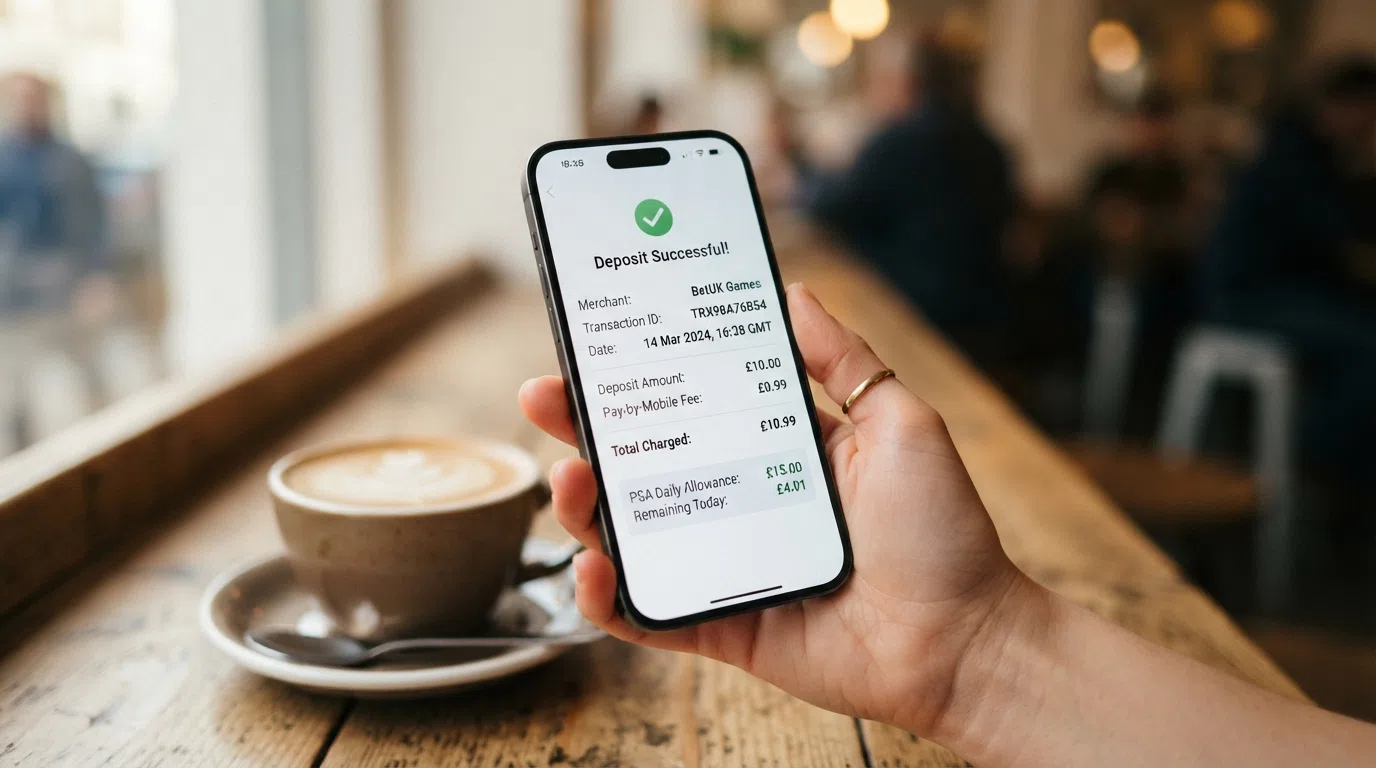
The mechanics of a phone-bill deposit are short enough to walk through in full. You open the casino cashier on your phone, select “Pay by Mobile” from the list of deposit methods, and enter an amount between £5 and £40. The casino then hands the transaction off to a billing provider — typically Fonix, Boku, Siru Mobile or PayViaPhone. That provider triggers a carrier verification prompt on your phone, either as an SMS or a one-tap confirmation.
You confirm. The funds appear in your casino balance within seconds. The cost lands on your next mobile bill, or against your prepaid credit. No card numbers. No bank login. No app beyond the casino itself. The whole thing reads as frictionless, which is exactly what the marketing wants it to read as.
What the marketing does not shout about is the £40 daily ceiling. The PSA’s per-transaction cap is the same as the per-day cap, so a pay-by-mobile player cannot “top up” by running multiple transactions back to back. Once you hit £40 for the day, the channel closes until midnight. That limit comes from outside the casino entirely — no operator can raise it, and no promotional offer can exempt you from it.
Which UK networks and billing providers power it
The four big UK networks — EE, O2, Vodafone and Three — all support carrier billing through their postpaid contracts and through prepaid credit. The mobile virtual network operators that ride on those networks — Sky Mobile, Tesco Mobile, Virgin Mobile and giffgaff — inherit billing from their host network. A Tesco Mobile SIM routes through O2’s billing infrastructure; a giffgaff SIM sits on O2’s; a Sky Mobile SIM routes through O2’s. None of those MVNOs builds its own billing layer.
Sitting between the casino and the network are the billing intermediaries. Fonix is the dominant player in the UK casino market — most of the pay-by-mobile casino sites a British player encounters run on Fonix rails. Boku operates a parallel global network with UK coverage. Siru Mobile runs a separate UK-only product with its own additional spending limit layered on top of the PSA cap. PayViaPhone is a smaller provider that several mid-tier operators use. The four providers offer overlapping functionality but are not interchangeable — fee structures, daily caps and bonus eligibility all vary by provider, and the casino decides which one to integrate.
The Mechanics of Depositing by Phone Bill — Limits, Fees and the Withdrawal Gap
Three numbers define what pay by mobile actually does to a player’s bankroll: the PSA’s £40 daily ceiling, the variable fees some operators layer on top, and the unbreakable rule that withdrawals cannot come back through the same channel. A player who knows only the deposit cap knows half the picture.
| Limit type | Amount | Set by | Applies to |
|---|---|---|---|
| Per-transaction | £5–£40 | Casino operator | Single deposit at one casino |
| Daily | £40 | Phone-paid Services Authority | Total across all pay-by-mobile deposits that day |
| Calendar monthly | £240 | Phone-paid Services Authority | Total across all pay-by-mobile deposits in the month |
| Siru Mobile 30-day | £500 | Siru Mobile | Additional layer for Siru-routed deposits |
| Per-spin stake (25+) | £5 | UK Gambling Commission | Each slot game cycle |
| Per-spin stake (18–24) | £2 | UK Gambling Commission | Each slot game cycle |
The table compresses what is actually a stack. The casino’s own minimum and maximum are at the bottom. The PSA’s daily and monthly caps sit on top. A separate provider limit — Siru Mobile’s £500 over any 30-day window — sits above even the PSA’s monthly cap for that provider’s users. And above all of it, the Gambling Commission’s stake caps limit how much of a single deposit can actually be staked: at the maximum £5 spin, the full £40 daily deposit buys at most eight spins before the player is out of money for the day.
That stack is why a £10 free spin offer triggered by a phone-bill deposit is a real, qualifying transaction for the welcome bonus on some sites, but the bonus winnings themselves cannot be withdrawn back to the phone bill. The phone-bill deposit opens the door. The withdrawal leaves through a different door.
Deposit limits and minimums — how much you can actually move
The most common pay-by-mobile deposit in a UK casino sits at £10. That figure is also the trigger threshold for almost every welcome bonus in the featured set — bet365’s headline, Sky Vegas’s 200 deposit-triggered spins, MrQ’s 100 Big Bass Splash spins, Paddy Power’s 200 deposit-triggered spins, William Hill’s 200 Big Bass Splash spins, 888 Casino’s deposit match. Every one of them sets £10 as the qualifying deposit.
Below £10, operators run their own minimums. Most pay-by-mobile-enabled casinos in the UK set £5 as the floor. Above £10, the practical ceiling is £30 or £40 — a few operators cap at £30 to keep well inside the PSA limit, but most match the regulator’s figure and stop there. Above £40, no transaction can go through regardless of operator policy.
Siru Mobile’s separate £500 over 30 days is the only limit in the stack that exceeds the PSA’s monthly cap. A player using Siru-routed deposits can move more money in a month than the PSA permits through Fonix or Boku, because Siru’s own internal ceiling sits higher. The £500 figure includes deposits across every casino the player funds through Siru, not per site.
Fees — when your £10 deposit costs £12.50
The fee structure is where pay by mobile stops being frictionless and starts costing real money. Fonix charges 25% on deposits at some operators — a £10 deposit becomes £12.50 charged to your phone bill. PayViaPhone charges 15% at some of the operators it serves. Other operators absorb the fee entirely, and a player sees no surcharge on the confirmation screen.
The asymmetry is the trap. Two pay-by-mobile casinos can sit side by side on a comparison page, both accepting the same deposit method, both running welcome bonuses in the same range, and one quietly takes £2.50 off every £10 you put in. The casino’s headline bonus still applies to the £10 that lands in your balance; the fee is on top, charged through the phone bill rather than deducted at the cashier.
The practical rule is short: before confirming any phone-bill deposit, check whether the casino passes on the provider’s fee. If it does, factor the surcharge into what the bonus is actually worth. A £10 deposit with a 25% fee puts £10 in the casino balance but charges £12.50 against the phone bill — and the £2.50 is unrecoverable.
The withdrawal problem — why your winnings cannot go back to your phone
This is the part of pay by mobile that surprises new players most. A phone bill is not a bank account. It cannot receive external funds. The Phone-paid Services Authority’s framework treats carrier billing as a collection mechanism — the network bills the customer, the customer pays the network — and there is no reverse channel in that model.
Every pay-by-mobile player therefore has to set up a separate withdrawal method before they can cash out. The standard options are a debit card, a bank transfer via the Faster Payments network, or an e-wallet like PayPal, Skrill or Neteller. Most UK casinos require the withdrawal method to be one the player has previously deposited from, which means the typical sequence is: deposit £10 by phone bill to claim a welcome bonus, deposit a small amount by debit card to “register” the withdrawal method, then withdraw to that debit card once wagering requirements are met.
That extra step is where the friction lives. A pay-by-mobile-first player who tries to withdraw without a debit card on file will be told to add one. The casino is not being obstructive — there is simply no other route for the funds to take.
KYC and identity checks — what pay by mobile does and does not change
A common misconception is that phone-bill depositing skips Know Your Customer verification. It does not. Since 7 May 2019, every UKGC-licensed remote operator has been required to verify a player’s name, address and date of birth before the first deposit or any gambling activity. Carrier billing adds a layer of its own — the phone network confirms the SIM is active and the bill is payable — but that confirmation is about the payment instrument, not about the player’s identity.
Strong Customer Authentication adds another layer for any regulated payment flow, requiring two of three factors (something you know, something you have, something you are) for transaction confirmation. Pay-by-mobile flows typically satisfy SCA through the phone’s own authentication — the SIM in your hand plus the confirmation prompt on screen.
What pay by mobile does not do is speed up KYC. The age and identity verification still has to happen before a first deposit clears, and that verification runs against the operator’s own checks rather than against the phone network. Players who skip the casino’s registration form will not get past the deposit step, regardless of how clean their phone billing is.
Top Casino Sites for Pay-by-Mobile Players in 2026 — Ranked and Compared
The featured set below is built from UKGC-licensed operators whose bonus terms are publicly documented and whose active licence status was verified against the Gambling Commission’s public register at the time of writing. The hard constraint behind the ranking: bonus value, measured by free-spin count, wagering multiplier, cashout terms and validity window. Pay-by-mobile acceptance is flagged separately, because most UK operators either do not confirm it in their public terms or exclude phone-bill deposits from bonus eligibility outright.
The table covers the ten operators in rank order. “Pay-by-mobile” is shown as “Not confirmed” where research did not surface a public confirmation, and “Confirmed (Fonix)” or “Not accepted” where the operator’s own terms are explicit.
| Operator | UKGC licence status | Welcome bonus | Free spins | Wagering multiplier | Bonus validity |
|---|---|---|---|---|---|
| bet365 | Active (38721) | Up to 500 free spins | 500 | 0× | £10 lifetime deposits |
| Sky Vegas | Active | 50 no-deposit + 200 on £10 deposit | 250 | 0× | 7-day FS expiry, 30-day deposit window |
| Paddy Power | Active | 60 no-deposit + 200 on £10 deposit | 260 | 0× | 7-day FS expiry |
| Betfair | Active | 50 no-deposit + 100 on £10 deposit | 150 | 0× | — |
| William Hill | Active (39225) | 200 free spins on Big Bass Splash | 200 | 10× | 72 hours from credit |
| 888 Casino | Active | 100% match up to £100 + 100 free spins | 100 (separate) | 10× | 90 days |
| MrQ | Active | 100 free spins on Big Bass Splash | 100 | 0× | 48 hours from deposit |
| Duelz | Active | 140 bonus spins | 140 | — | — |
| Virgin Games | Active | 100 free spins on Big Bass Splash | 100 | 0× | 30 days |
| Gala Bingo | Active (Entain) | — | — | — | — |
Two findings sit behind the table. First, six of the ten operators sit at 0× wagering on free-spin winnings — a structural shift from the pre-2025 UK market, when 35× and 40× requirements were standard. Second, only MrQ and Duelz are confirmed in research as accepting pay-by-mobile deposits with Fonix and including those deposits in bonus eligibility. Virgin Games is the inverse: it explicitly does not accept phone-bill deposits, listing Visa Debit, Mastercard Debit, Apple Pay and Google Pay as its full payment-method list.
The bonus-eligibility caveat runs through the entire table, and it matters more than the headline free-spin count. Most UK operators require a debit card deposit to activate a welcome offer; the phone-bill deposit that follows is fine for funding gameplay, but the bonus itself attaches to the card deposit. A player reading a “500 free spins” headline at bet365 should not assume those spins will unlock through a £10 phone-bill top-up — the £10 minimum lifetime deposits threshold is what counts, and the qualifying deposit can come from any accepted method.
bet365
bet365 runs the most generous headline in the featured set: up to 500 free spins with no wagering on winnings, triggered once a player has deposited at least £10 in lifetime deposits. The 0× wagering multiplier sits below the UKGC’s 10× ceiling under LCCP Social Responsibility Code 5.1.1 — bet365 is not at the regulatory maximum, it is well beneath it, which means winnings from those spins are withdrawable as cash without any turnover requirement.
UKGC account number 38721, registered to Hillside (UK Gaming) ENC, is active on the public register. The free-spin offer carries no stated maximum cashout cap in the terms surfaced by research. Pay-by-mobile acceptance should be checked directly on Bet365 before any player assumes phone-bill deposits qualify. The bet365 welcome offer is deposit-triggered rather than genuinely deposit-free; a player must clear the £10 lifetime deposits threshold to unlock the spins.
For a reader who wants the largest free-spin allocation in the UK market at zero wagering and does not need pay by mobile as the qualifying deposit, bet365 is the headline. For a pay-by-mobile-first player, the £10 lifetime deposits threshold can be cleared with a single debit card deposit before switching to phone-bill for ongoing play.
Sky Vegas
Sky Vegas splits its welcome offer into two halves: 50 genuinely deposit-free free spins awarded on registration, plus 200 additional free spins once a player has deposited and staked £10. Both halves run at 0× wagering, so winnings from either batch are cash, not bonus funds. The 50 no-deposit spins need no financial commitment at all — just an account, an age and identity check, and a Sky Vegas login.
The bonus mechanics carry two time constraints. The 50 no-deposit spins expire 7 days after credit. The 200 deposit-triggered spins carry the same 7-day expiry, and the £10 deposit-and-stake requirement has to be cleared within 30 days of registration. Miss either window and the relevant spins are gone.
The Flutter Entertainment licence behind Sky Vegas is active on the UKGC public register. Pay-by-mobile acceptance is not confirmed in research; Sky Vegas’s terms specify debit card or Apple Pay as the qualifying deposit for the 200-spin tranche. A pay-by-mobile player can register, claim the 50 no-deposit spins, and then make a single qualifying debit card deposit of £10 to unlock the 200-spin batch before continuing to fund gameplay by phone bill.
Paddy Power
Paddy Power’s headline count of 260 free spins is the largest in the featured set. The structure mirrors Sky Vegas: 60 no-deposit spins on registration, plus 200 deposit-triggered spins on a £10 deposit and wager. The wagering multiplier is 0× on both halves. The deposit-triggered spins are valued at 10p each, which fixes the headline value at £20 if all 200 are used.
The 7-day expiry on free spins runs from credit. E-wallets are not the qualifying deposit method for this offer — Flutter’s terms specify debit card, Pay by Bank or Apple Pay. Pay-by-mobile acceptance is not confirmed. A pay-by-mobile-first player follows the same path as at Sky Vegas: claim the no-deposit spins, qualify with a debit card deposit, then switch payment method.
Paddy Power sits in the Flutter Entertainment stable alongside Sky Vegas and Betfair, so the structural similarity between the three welcome offers is no accident — they are variations on a single Flutter template with different headline counts. The £20 face value of the deposit-triggered spins, against the £10 qualifying stake, is the cleanest free-spin offer in the set on a per-spin basis.
Betfair
Betfair’s welcome offer is the smallest in the Flutter trio: 50 no-deposit spins on registration plus 100 deposit-triggered spins after a £10 deposit and wager. Both halves at 0× wagering. The deposit-triggered spins are valued at £0.10 each.
The qualifying payment methods exclude e-wallets — PayPal, Neteller and Skrill deposits do not trigger the bonus. Debit card deposits qualify. Pay-by-mobile acceptance is not confirmed in research. Bonus validity window for the deposit-triggered spins is not specified in the terms surfaced this run, which is the cleanest gap in the Flutter set: Sky Vegas and Paddy Power state 7 days, Betfair does not state one.
For a reader comparing the three Flutter brands, the ranking is straightforward: Paddy Power offers the most spins and the highest per-spin face value, Sky Vegas offers a mid-sized allocation with the clearest terms, and Betfair offers the smallest allocation with a payment-method exclusion list that matters if the reader normally uses an e-wallet.
William Hill
William Hill is the outlier in the featured set on the wagering axis. Its 200 free spins on Big Bass Splash run at 10× wagering — the regulatory ceiling imposed under LCCP Social Responsibility Code 5.1.1 in December 2026 — and carry a £30 maximum redeemable winnings cap. Spins expire within 72 hours of credit. Each spin is valued at 10p, fixing the headline face value at £20.
The 10× wagering on winnings is a real cost. A player who runs the full £30 maximum cashout through 10× turnover before withdrawing is staking £300 in the casino at the wagering-contributing games. The 72-hour expiry on the spins is tight — a player who deposits and stakes the qualifying £10 has three days to use all 200 spins before they lapse.
UKGC account number 39225, registered to William Hill Online, is active on the public register. The eligibility of pay-by-mobile deposits is not explicitly confirmed for William Hill. Big Bass Splash’s theoretical RTP sits at 96.71%, which is what a player is wagering against once the bonus is active.
For a reader who values wager-free winnings over headline spin count, William Hill is the wrong offer. For a reader who wants the maximum cashout cap stated up front and is comfortable working through a 10× turnover on a known slot, the terms are legible.
888 Casino
888 Casino is the only cash-match bonus in the featured set. The welcome offer is a 100% deposit match up to £100, requiring a £10 minimum deposit and running at 10× wagering on the bonus funds within 90 days. Winnings from the bonus are capped at £100. A separate 100 free spins offer runs on selected Pragmatic Play slots at £0.10 per spin, with winnings from those spins capped at £300.
The 90-day validity window is the longest in the featured set. A player who cannot clear the 10× wagering requirement on bonus funds within three months forfeits the bonus and any associated winnings. The £100 maximum cashout on the matched bonus is a hard ceiling — even if the bonus funds produce a win above £100, only £100 can be withdrawn.
The expected cost of the bonus, taking a representative slot at 96.21% RTP, highlights the impact of wagering requirements on bonus value. The headline cost is the wagering requirement times the house edge across £1,000 of qualifying turnover, with the £100 cashout cap layered on top as the binding constraint for any large win.
888casino is operated by evoke plc (formerly 888 Holdings), with an active UKGC licence. Pay-by-mobile acceptance is not confirmed in research. The Pragmatic Play slots in the free-spin tranche were not specified by name in the terms surfaced.
MrQ
MrQ is one of only two operators in the featured set confirmed to accept pay by mobile via Fonix. The welcome offer is 100 free spins on Big Bass Splash at 10p per spin, triggered by a £10 deposit. Wagering is 0×, with winnings credited as real money balance and no stated cashout cap. Spins must be used within 48 hours of the qualifying deposit.
The 48-hour expiry is the tightest in the featured set — half the 72-hour window at William Hill and a fraction of the 90 days at 888 Casino. The trade-off is the absence of any wagering multiplier: a player who wins £50 on Big Bass Splash at MrQ can withdraw £50 directly to a debit card without working through any turnover. Big Bass Splash’s theoretical RTP sits at 96.71%.
For a pay-by-mobile player, MrQ is the cleanest fit in the featured set: confirmed Fonix integration, bonus eligibility that includes phone-bill deposits, zero wagering on winnings, and no cashout cap stated. The 48-hour expiry is the only friction point, and it is the cost of an otherwise frictionless bonus.
Duelz
Duelz is the second confirmed Fonix-accepting operator in the featured set. The welcome offer is 140 bonus spins, triggered by deposit. The wagering multiplier, bonus validity window, maximum cashout cap, spin value and bonus slot title were not surfaced in research this run — those terms are verifiable on Duelz’s website.
The gap in Duelz’s published terms is real, and it is the reason this entry sits below MrQ in the ranking. A welcome offer with an unstated wagering multiplier could be anywhere from 0× to 10×. An unstated validity window could be 24 hours or 90 days. A pay-by-mobile player choosing between Fonix-accepting casinos needs to check the current terms on Duelz’s own site before depositing.
Duelz’s UKGC licence is active. Research confirms Fonix integration is available. For a pay-by-mobile player willing to verify terms at the source, Duelz is in the running. For a player who wants the bonus terms on the comparison page, MrQ is the cleaner read.
Virgin Games
Virgin Games is the inversion of the rest of the featured set. Its welcome offer is competitive — 100 free spins on Big Bass Splash at 10p per spin, 0× wagering, 30-day completion window — but pay-by-mobile deposits are explicitly not accepted. Virgin Games lists Visa Debit, Mastercard Debit, Apple Pay and Google Pay as its full payment-method inventory, and the operator’s own terms do not extend to phone-bill deposits.
For a pay-by-mobile player, Virgin Games is a dead end. The welcome offer looks attractive on a comparison page; the payment-method list disqualifies it on the actual cashier screen. The mismatch is worth flagging because Virgin Games appears on generic “best UK casino bonuses” lists and would mislead a pay-by-mobile reader who skimmed the headline without checking payment methods.
UKGC licence is active, registered to Gamesys (now part of Bally’s). Big Bass Splash RTP at 96.71%. For a debit-card-or-wallet player, Virgin Games is a real option. For a phone-bill-first player, the search continues.
Gala Bingo
Gala Bingo closes the featured set as the operator whose terms were least surfaced in research this run. The UKGC licence is active, registered to the Entain group. Pay-by-mobile acceptance is not confirmed. The welcome bonus specifics — free-spin count, wagering multiplier, validity window, cashout cap, bonus slot title, spin value, and whether the offer is deposit-free or deposit-triggered — were not surfaced in the searches conducted.
Gala Bingo is in the table on licence status and group affiliation, not on bonus competitiveness. The absence of surfaced terms is itself the finding: a comparison page that ranks Gala Bingo above an operator with confirmed terms is ranking an absence of data against a presence of data. Entain’s track record across other brands in the stable would suggest competitive welcome offers, but the specifics are not in this page’s research.
Pay-by-Mobile Casino Bonuses — What You Can Actually Claim
The single most important thing to know about pay-by-mobile casino bonuses in the UK is that the welcome offer and the phone-bill deposit are usually different transactions. Most UKGC-licensed operators exclude pay-by-mobile deposits from welcome bonus eligibility. The qualifying deposit — the £10 that unlocks the 200 free spins, or the £10 that triggers the 100% match — has to come from a debit card, Apple Pay or another card-route method. The phone-bill deposit that follows is fine for funding ongoing play, but it is not what activates the offer.
The exceptions sit at MrQ and Duelz, the two Fonix-accepting operators in the featured set whose bonus terms include phone-bill deposits in the eligibility list. A pay-by-mobile-first player who wants the welcome bonus activated through a single £10 phone-bill deposit is, in practice, choosing between those two brands and accepting that the rest of the featured set requires a debit card deposit first.
The UKGC’s 10× wagering cap, in force since 19 December 2025 under LCCP Social Responsibility Code 5.1.1, has restructured what bonus value means in the UK market. The pre-regulation norm of 35× and 40× wagering — which made most welcome bonuses effectively unplayable on a small deposit — has been replaced by a hard ceiling that makes bonus turnover a real, achievable target for a player with a £100 bankroll. Six of the ten operators in the featured set now sit at 0×, which is a structural shift the marketing pages have not yet caught up with.
No-deposit free spins — the offers that do not need a card
Three operators in the featured set offer free spins with no deposit required: Sky Vegas (50 no-deposit spins), Paddy Power (60 no-deposit spins) and Betfair (50 no-deposit spins). All three sit at 0× wagering, so winnings from the no-deposit spins are real cash withdrawable to a debit card or bank transfer without further turnover.
The mechanics are consistent across the three. Registration, age and identity verification, and the spins are credited. No payment method is required to claim. The spins expire 7 days from credit at Sky Vegas and Paddy Power; the Betfair expiry was not stated in the terms surfaced. Spin values were not stated for Sky Vegas; £0.10 each at Paddy Power and Betfair.
For a pay-by-mobile player, the no-deposit spins are the cleanest entry point in the entire UK bonus market — zero financial commitment, zero payment-method friction, and winnings withdrawable through whatever method the player nominates after the spins are used.
Deposit-triggered bonuses and the 10× wagering cap
The 10× wagering cap is the single biggest regulatory change to UK casino bonuses in years. Before December 2025, a typical UK welcome bonus carried a 35× or 40× wagering requirement on bonus funds or free-spin winnings — a £10 bonus triggering £350 of required turnover before any win became withdrawable. The new ceiling at 10× cuts that figure to £100 of turnover, which is achievable inside a single session on most slot titles.
Two operators in the featured set sit at the 10× ceiling: William Hill on free-spin winnings (with a £30 maximum cashout cap) and 888 Casino on bonus funds (with a 90-day validity window). The other eight operators either sit at 0× (bet365, Sky Vegas, Paddy Power, Betfair, MrQ, Virgin Games) or have wagering terms not surfaced (Duelz, Gala Bingo). A player comparing the featured set on wagering terms alone finds zero-wagering offers dominating, with the 10× ceiling reserved for the cash-match bonus at 888 Casino and the capped free-spin offer at William Hill.
The 10× cap is paired with a ban on mixed-product promotional offers. Operators can no longer cross-sell between bingo, lottery, casino and betting — a “bet £10 on football, get free spins” structure is no longer compliant. Each product type carries its own bonus mechanics, and a welcome offer at a casino site cannot be conditional on activity at a sportsbook or bingo product.
No-wagering offers — what “winnings paid as cash” actually means
The “no wagering” label on a UK casino bonus in 2026 means exactly what it says: winnings from free spins are credited to the real-money balance and are withdrawable without further turnover. There is no lock-up period, no bonus-funds-versus-cash-funds distinction, and no multiplier applied to the win before withdrawal.
The cleanest illustration is MrQ’s 100 free spins on Big Bass Splash. A player who deposits £10 and wins £40 on those spins sees £40 land in the real-money balance and can withdraw £40 to a debit card immediately. There is no maximum cashout cap stated, so the only ceiling on what a single spin can produce is the slot’s own maximum win — for Big Bass Splash, that ceiling sits at 5,000× the stake, or £5,000 on a £1 spin.
The same structure applies at Sky Vegas, Paddy Power, Betfair and Virgin Games, where the free-spin winnings are 0× wagering with no stated cashout cap on the no-deposit and deposit-triggered spins. bet365’s up-to-500 free-spin offer runs on the same terms. The no-wagering model is now the dominant structure for free-spin welcome offers in the UK market, and the marketing pages built around 35× and 40× requirements are increasingly out of date.
Pay-by-Mobile Slots — Stakes, RTP and the Games Worth Playing
The slot catalogue at a pay-by-mobile casino is not different from the slot catalogue at a debit-card casino on the same site. What is different is the bankroll mechanics: a player funding with a £40 daily cap plays a fundamentally different game from a player depositing £200 by card, and the statutory stake caps shape what the £40 can actually do.
The £5 per-spin cap for players aged 25 and over, in force since 9 April 2025 under SI 2025/215, and the £2 per-spin cap for players aged 18 to 24, in force since 21 May 2025, are the binding constraints. A 25+ player funding a £40 daily deposit and staking the maximum £5 per spin gets at most eight spins before the daily ceiling is hit. A 24-year-old player at the £2 cap gets twenty spins from the same deposit. Either figure is a small number of game cycles, and the choice of slot — what RTP tier it runs at, what volatility class it sits in — is the variable that determines how much of a session the £40 actually buys.
UK casinos may deploy lower RTP tiers of the same slot title than the theoretical maximum. Book of Dead, for example, has a theoretical RTP of 96.21% but is documented as running at 94.25%, 91.25%, 87.25% or 84.18% at various UK-licensed operators. The difference between the top tier and the bottom tier is twelve percentage points of house edge, which is the difference between a slot that returns £96.21 per £100 staked over the long run and one that returns £84.18. Checking the RTP tier displayed in any given casino’s game info panel is the only practical safeguard.
Slot titles with confirmed RTP — what the numbers say
Two slot titles carry research-backed RTP figures that matter for pay-by-mobile players. Book of Dead (Play’n GO) sits at a theoretical RTP of 96.21% with high volatility and a maximum win of 5,000× the stake. Starburst (NetEnt) sits at 96.09% with low volatility and an approximate 500× maximum win. The two titles represent the two ends of the volatility spectrum: Book of Dead produces infrequent large wins on a small bankroll, Starburst produces frequent small wins that extend a session.
Book of Dead is the more important title to read carefully. UK casinos may deploy it at any of the documented RTP tiers from 84.18% to 96.21%. A player funding with a £40 phone-bill deposit and staking £1 per spin on a 96.21% tier plays a different game from one staking the same amount on an 84.18% tier — the long-run return difference across 40 spins is meaningful at any stake level. The high-volatility class adds a second variable: a 40-spin session on Book of Dead may produce nothing close to the theoretical return, because high-volatility slots pay out in concentrated bursts rather than across the full spin count.
Starburst’s low-volatility profile is the closer fit for a pay-by-mobile bankroll. Frequent small wins extend the session across more spins, which is the practical goal when the daily ceiling is £40. The 500× maximum win caps upside but does not change the long-run return calculation.
The £5 and £2 stake caps — what they mean for pay-by-mobile players
The interaction between the PSA’s £40 daily deposit cap and the UKGC’s stake caps creates a double spending brake that no other deposit method in the UK replicates. A debit-card player can deposit £500 and stake £5 per spin for 100 game cycles; a phone-bill player can deposit £40 and stake £5 per spin for 8 cycles. The phone-bill player runs out of money eight times faster at the maximum stake.
The effect on bonus play is sharper. A free-spin welcome offer of 100 spins at 10p each (a £10 face value) costs the casino almost nothing in stake — the casino funds the spins — but the winnings are subject to wagering. A 10× wagering requirement on those winnings means £100 of qualifying turnover at the contributing slots, and at a £5 maximum stake that is 20 spins of funded wagering, all of which falls inside the £40 daily deposit cap if the player is funding the wagering from their own deposits. A pay-by-mobile player working through a 10× turnover at a £40 daily cap is crossing the daily ceiling several times over the course of clearing the wagering requirement.
For players aged 18 to 24, the £2 stake cap halves the ceiling again — eight spins at the £5 cap becomes sixteen spins at the £2 cap from the same £40 deposit, but the rate of return per spin is the same, so the session lengthens without changing the long-run economics. The lower cap is a structural protection for the age band the data shows is most likely to experience gambling harm.
Is Pay by Mobile Legal and Safe? GB Licensing, the PSA and Your Rights
Two regulators protect a pay-by-mobile player in Great Britain, and they protect different things. The UK Gambling Commission governs the casino — its games, its bonus terms, its identity checks, its self-exclusion scheme, its treatment of customer funds. The Phone-paid Services Authority governs the payment — the deposit caps, the fee disclosures, the merchant registration, the consumer complaints route for billing disputes. The two frameworks sit on top of each other, and a player using pay by mobile at a UKGC-licensed casino is covered by both.
The statutory basis is the Gambling Act 2005, extended to remote operators by the Gambling (Licensing and Advertising) Act 2014 which made a GB licence compulsory at point of consumption. The PSA’s framework sits under the Payment Services Regulations 2017, which cap carrier-billing transactions at the figures in the limits table above. Neither regulator has any jurisdiction over an offshore casino licensed in Curaçao, Malta or Gibraltar — those sites are not GB-legal, and a player at one of them loses every protection described in this section.
What a GB licence delivers — dispute resolution, fund protection and fair-play rules
A UKGC-licensed casino must provide access to an independent Alternative Dispute Resolution provider for any complaint that cannot be resolved with the operator directly. Most UK-licensed casinos route through IBAS (Independent Betting Adjudication Service), and ADR decisions are binding on the operator. The route from complaint to ADR runs through the operator’s own complaints process first, then through the UKGC’s complaints team if the player remains dissatisfied with the ADR outcome.
Customer funds at UKGC-licensed casinos must be segregated from operational accounts. The degree of segregation varies — some operators hold customer funds in trust, others in a separate bank account — but the requirement is statutory. A player whose casino goes insolvent has a claim on the segregated fund pool ahead of unsecured creditors.
The game-design rules in force since 31 October 2021 shape what every slot at a UK-licensed casino actually does. Auto-play is banned — a player has to press the spin button each time. Spin speed carries a 2.5-second minimum. Features that speed up play are banned. Losses disguised as wins — slot animations that celebrate a losing spin as if it were a win — are banned. Reverse withdrawals are permanently banned; once a withdrawal request is confirmed, it cannot be cancelled. Session loss, win and time displays are required, so a player always sees how the session is going.
The credit card ban since 14 April 2020 under LCCP licence condition 6.1.2 closes a separate route. No UKGC-licensed casino accepts credit cards, and the ban extends to credit-card-funded e-wallet deposits. A player who tries to deposit via PayPal funded by a credit card will have the deposit refused at the source.
GamStop, self-exclusion and what happens when you step outside it
GamStop is the national multi-operator online self-exclusion scheme, mandatory for every UKGC online operating licence since 31 March 2020. A player registering with GamStop is excluded from every UKGC-licensed online gambling site for a chosen period — six months, one year, five years, or five years with auto-renewal — and the exclusion cannot be cancelled early.
The scheme covers every GB-licensed online casino, including every operator in the featured set above. A player who has registered with GamStop cannot deposit, wager or open an account at any of those operators until the exclusion period expires. The exclusion runs across product types — casino, betting, bingo, lottery — so a GamStop registration blocks access to the entire UKGC-licensed online gambling market.
The protection does not extend offshore. A non-GamStop casino operating under a Curaçao, Malta or Gibraltar licence is not GB-legal at point of consumption, and a player at one of those sites loses GamStop coverage, the UKGC complaints route, ADR access and British consumer protection. The UKGC’s enforcement model does not rely on ISP blocking — it uses a disruption model. Between April 2024 and June 2025 the Commission issued 3,140 disruption notices and referred 447,778 URLs to search engines, with 287,961 URLs ultimately removed. The model targets operators and intermediaries rather than individual players; no penalty applies to a player who merely gambles at an unlicensed site, but the casino itself faces criminal prosecution under section 33 of the Gambling Act 2005.
Financial vulnerability checks — what the UKGC now requires and what is coming
The UKGC’s light-touch financial vulnerability check, mandatory since 28 February 2025 under LCCP Social Responsibility Code 3.4.4, runs at a £150 net deposits threshold across a rolling 30-day period. The check uses publicly available data only — County Court Judgments, bankruptcy orders, Individual Voluntary Arrangements, Debt Relief Orders. A player whose name appears against any of those markers is flagged for an affordability conversation before further deposits.
The check is the first of two layers. The second layer — financial risk assessments, sometimes called affordability checks — has been announced but not commenced. The UKGC Board confirmed on 7 July 2026 that staged rollout will proceed, with Stage 1 thresholds at £5,000 net deposits in 24 hours for players 25 and over, and £2,500 for under-25s. Final thresholds will drop to £1,000 and £3,000 for 25+, and £750 and £2,000 for under-25s. No start date is confirmed, and any player-facing claim that the checks “have started” should be treated as inaccurate.
For pay-by-mobile players, the interaction with these checks is shaped by the PSA’s £40 daily and £240 monthly caps. A player funding entirely through phone-bill deposits cannot reach the £150 light-touch threshold inside a single day and cannot exceed the £240 monthly cap from carrier billing alone, so the trigger for a vulnerability check at a pay-by-mobile-only operator would require deposits from other payment methods in the same rolling window. A pay-by-mobile player who also deposits by debit card or e-wallet is treated under the combined total.
Pay-by-Mobile Casino Apps vs Mobile Browser — Does It Matter?
The carrier billing flow is identical whether the player deposits through a mobile browser or inside a native casino app. The phone network handles the verification, the billing provider confirms the transaction, and the casino balance updates regardless of which surface the player initiated the deposit from. There is no app-specific pay-by-mobile flow at any UK-licensed operator.
What a dedicated casino app adds is everything around the payment step. Push notifications for bonus drops and session reminders. Biometric login — fingerprint or face ID — replacing typed passwords. Faster game loading on repeat sessions, because the assets are cached locally. For a player who deposits once a week and plays once a month, the differences are marginal. For a player who deposits daily and plays every evening, the friction savings add up.
None of the operators in the featured set require a native app to use pay by mobile. Browser-based play is universal across UKGC-licensed casinos, and the pay-by-mobile deposit flow works on a mobile browser identically to the in-app flow. The choice between app and browser is a UX preference, not a payment-method constraint.
Depositing by phone bill inside a casino app
The deposit flow inside a native casino app follows the same five steps as a browser deposit: open the cashier, select pay by mobile, enter an amount, confirm via the carrier verification prompt, and watch the funds land in the app balance. The fingerprint or face ID authentication on the app replaces the password step that a browser session would require, which shortens the time-to-confirm by a few seconds but does not change the mechanics of the carrier billing flow itself.
The payment step itself shows no meaningful speed differential between app and browser. Carrier verification is triggered by the billing provider and confirmed by the phone network regardless of which surface initiated the request. What differs is the surrounding UX — app notifications when a bonus is available, biometric login at session start, cached game assets for faster spin loads — and those differences matter more for a daily player than for a weekly one.
New Pay-by-Mobile Casino Sites Launched in 2026
The newest UKGC-licensed operators tend to integrate Fonix from launch rather than adding it as a later payment method. A site launched in 2026 with pay by mobile as a listed deposit option has typically built the carrier billing flow into its cashier from day one, rather than retrofitting it after launch. This matters because the bonus eligibility terms at those sites are written with Fonix in mind — the qualifying deposit methods list often includes phone-bill deposits from the start, unlike legacy operators whose terms were drafted before pay by mobile was a category.
Newer sites also tend to run more aggressive welcome offers to build a player base. The bet365, Sky Vegas, Paddy Power, Betfair and William Hill offers in the featured set are the products of mature brands with established player bases; the welcome terms reflect that maturity. A recently licensed operator competing for the same player has reason to push the free-spin count higher, the wagering multiplier lower, or the validity window longer. The trade-off is brand recognition and regulatory track record — a site licensed last month has not yet accumulated the compliance history of a site licensed a decade ago.
The practical signal is the UKGC public register. A new licence grant in the past 12 months is verifiable on gamblingcommission.gov.uk, and the date of the grant is a rough proxy for how recent the welcome offer terms are. Operators with grants dated within the last year are most likely to have pay-by-mobile integrated from launch with current bonus terms.
Responsible Gambling — The Tools Every Pay-by-Mobile Player Should Set
Every UKGC-licensed operator has been required since 31 October 2025 to prompt a customer to set a financial deposit limit before their first deposit. The prompt is mandatory and cannot be skipped — a player who tries to deposit without setting a limit is shown the deposit-limit screen first. The limit the player sets is their own; the operator cannot set it for them, and the limit can be tightened immediately or loosened after a 24-hour cooling-off period.
The safer-gambling toolkit beyond deposit limits includes session time reminders, reality checks at configurable intervals, time-outs (24 hours to six weeks), and full self-exclusion through GamStop. Each tool is set inside the operator’s responsible gambling section and takes effect immediately for tightening actions. Loosening a deposit limit or removing a session reminder carries a cooling-off period to prevent impulsive reversal during a session.
The help infrastructure outside the operator is well-developed. GamCare runs the National Gambling Helpline at 0808 8020 133 — free, 24 hours a day, every day. NHS gambling harm clinics operate in England, Scotland and Wales, with the Northern Gambling Clinic and the National Problem Gambling Clinic as the two flagship services. GambleAware funds treatment and prevention research. Gamblers Anonymous runs peer-support meetings across the country. GamStop’s self-exclusion register is free, covers every UKGC-licensed site and cannot be cancelled once the exclusion period is set.
The prevalence data behind these services is sharp. 0.4% of GB adults meet the PGSI 8+ threshold for problem gambling; 1.6% score PGSI 3+ for at least moderate risk. Men are more likely than women to score PGSI 3+ (2.2% versus 1.0%), and the highest prevalence sits in the 25–34 age band at 3.5%. NHS gambling referrals in England totalled 4,355 in 2024/25, up 91% from 2,284 the year before. The National Gambling Helpline made 996 referrals to treatment in January 2026 alone, up 48% from the same month the year before, with 81.5% of contacts in 2026 disclosing online gambling as their primary form.
Why pay-by-mobile’s low deposit ceiling is a built-in safer-play feature
The PSA’s £40 daily cap is the closest thing the UK gambling market has to a universal spending brake. A debit-card player can deposit £500 in a single session; a phone-bill player cannot deposit more than £40 in a day across every site using that method. The cap is not a customer-set limit — it is a regulatory ceiling that applies regardless of what the player chooses, and no operator can override it.
The mechanism creates an involuntary cooling-off period. A player who exhausts the daily cap cannot deposit again until midnight, even if they want to. A player who runs through the £240 monthly cap cannot deposit at all through phone-bill for the rest of the calendar month. The cap also interacts with the UKGC’s vulnerability check at £150 net deposits — a pay-by-mobile-only player does not reach the £150 threshold inside a single 30-day window, because the monthly cap sits above the threshold only briefly and the daily cap resets each day.
The framing matters. The £40 daily cap is a side-effect of carrier-billing regulation designed to protect consumers from accidental premium-rate charges, not a gambling-harm tool deliberately designed to limit deposits. But the side-effect is real, and a pay-by-mobile-first player is structurally less exposed to a rapid-deposit session than a debit-card-first player. The cap is not a substitute for self-set deposit limits or GamStop registration, but it is a backstop that runs without the player having to ask for it.
How We Chose and Ranked These Pay-by-Mobile Casinos
Every featured operator was verified against the UK Gambling Commission’s public register at gamblingcommission.gov.uk before inclusion. The register lists 2,663 active licence records and updates daily; an operator whose status shows as active was eligible for the ranking. Operators whose licence status could not be verified, whose bonus terms were not publicly documented, or whose pay-by-mobile acceptance could not be confirmed were excluded from the featured set.
The ranking criteria applied, in order of weight: wagering multiplier (0× ranked highest, then 10×, then unconfirmed), free-spin count within the same wagering band, bonus validity window (longer ranked higher where the wagering band matched), and maximum cashout cap (uncapped ranked highest, then highest stated cap). Pay-by-mobile acceptance was treated as a flag rather than a primary ranking criterion, because research only confirmed Fonix integration at two operators and explicit non-acceptance at one; the remaining seven featured operators have unconfirmed pay-by-mobile status and were ranked on bonus terms alone.
The bonus terms for each operator were checked against the operator’s own published promotional pages where available, against major affiliate reviews (bookies.com, OLBG, Bojoko, The Independent, Racing Post, CasinoHawks), and against CasinoBuddies where applicable. The NHS Adult Psychiatric Morbidity Survey 2023–24 was the source for problem gambling prevalence figures. GamCare’s published monthly referral data was the source for helpline figures. UK legislation (the Gambling Act 2005, the Gambling (Licensing and Advertising) Act 2014, the Payment Services Regulations 2017, SI 2025/215) was the source for regulatory claims. Competitor pages were consulted to identify the gaps this page addresses — most notably the absence of any competitor linking pay-by-mobile’s deposit model to responsible gambling outcomes.
Operators dropped from consideration were Ladbrokes, Coral, Betfred and BoyleSports. The first three are Entain brands with substantial UK market share but no specific pay-by-mobile or bonus terms surfaced in research this run; BoyleSports sits outside the top 10 on market share and surfaced no differentiating data. None of the four was excluded on quality grounds — they are real UKGC-licensed operators — but the absence of surfaced bonus data or pay-by-mobile confirmation made them un-rankable against the featured set on the criteria above.
Frequently Asked Questions
Which costs more — paying by phone bill or by debit card at an online casino?
Phone-bill deposits often carry additional fees from billing providers like Fonix or PayViaPhone, which can reach 25%. A £10 deposit might incur a £2.50 surcharge, whereas debit card deposits are almost always fee-free. Always check the cashier screen for surcharges before confirming your payment to avoid unexpected costs.
Why do most casinos refuse welcome bonuses on phone-bill deposits?
Many UK casinos require a debit card deposit to verify your identity and payment method for security and regulatory compliance. Since phone-bill deposits cannot be used for withdrawals, operators often restrict welcome bonus eligibility to deposits made via debit card, bank transfer, or standard e-wallets to prevent bonus abuse.
How long does a pay-by-mobile deposit take to appear in my casino account?
Pay-by-mobile deposits are typically processed instantly. Once you receive the SMS verification or confirm the transaction through your billing provider’s prompt, the funds usually appear in your casino balance within seconds. If you do not see the credit immediately, refresh the page or contact the operator’s support team.
Can a phone-bill deposit trigger a GamStop exclusion or an affordability check?
Yes, any deposit at a UKGC-licensed casino is tracked. While phone-bill deposits have a £40 daily cap that keeps them below some high-tier vulnerability check thresholds, they still count toward your total net deposits. If your combined deposits across all payment methods trigger a check, your phone-bill activity will be included.
What is the difference between Boku, Fonix and Siru Mobile?
Fonix and Boku are global billing intermediaries that operate similarly across most UK casinos. Siru Mobile is a separate product that often imposes its own additional 30-day spending limit of £500, distinct from the PSA’s £240 monthly cap. Each provider has different integration requirements and fee structures determined by the casino.
Can I use pay by mobile on a prepaid SIM card?
Yes, pay by mobile works with prepaid credit on all major UK mobile networks, including EE, O2, Vodafone, and Three. When you confirm a deposit, the amount is simply deducted from your existing prepaid balance instead of being added to a monthly contract bill. Ensure you have sufficient credit available before depositing.
The decision framework drawn from every section above runs in five steps, in order. The order matters because each step constrains the next.
First, verify the casino holds an active UKGC licence on the public register at gamblingcommission.gov.uk before registering. An operator with an active licence is covered by every protection described in the legality section above; an operator without one is not GB-legal, and the rest of the checklist does not apply.
Second, compare bonus terms qualitatively. The headline free-spin count is the surface; the wagering multiplier, cashout cap and validity window are the substance. A 200-spin offer at 10× wagering with a £30 cashout cap is a different product from a 200-spin offer at 0× with no stated cap, and the second is worth more per spin even if the headline count matches.
Third, set a deposit limit at the prompt before the first phone-bill deposit. The prompt is mandatory at every UKGC-licensed operator since 31 October 2025. The PSA cap of £40 a day is a ceiling, not a target — a player-set limit can sit well below it, and tightening the limit takes effect immediately.
Fourth, confirm the mobile network supports carrier billing (EE, O2, Vodafone, Three and their MVNOs all do) and check whether the casino passes on the billing provider’s fee before confirming a deposit. A Fonix-routed deposit at a fee-charging operator adds 25% on top of the deposit amount; the same Fonix-routed deposit at a fee-absorbing operator does not. The two are not interchangeable.
Fifth, register with GamStop if self-exclusion is a tool the reader needs. The registration is free, covers every UKGC-licensed online gambling site, and cannot be cancelled early once the exclusion period is set. For readers whose gambling is causing harm, the GamStop registration is the single highest-leverage step in the checklist. For readers whose gambling is recreational, the registration is unnecessary — but the deposit limits set at step three remain the active control.
The wider frame sits behind these five steps. Pay by mobile is one deposit method among several at a UK online casino. Its structural advantage is the £40 daily cap, which functions as a built-in spending brake no other method replicates. Its structural disadvantage is the one-way flow — winnings cannot return to the phone bill — and the bonus-exclusion problem, where most operators require a card deposit to activate the welcome offer. The right operator for a pay-by-mobile player is the one whose bonus terms include phone-bill deposits, whose fee structure does not surcharge the carrier billing, and whose withdrawal method a player can nominate without friction. The featured set narrows that search, but the final choice rests with what the casino’s own cashier shows on the day.
Payments – No Minimum Deposit Casinos UK
Content created by the «No Minimum Deposit Casinos UK» team