
Reload Bonus Casinos in the UK: What You Keep After the Wagering
 Available in GB
The number on the offer page is rarely the number in your account. A reload bonus advertises a percentage match — fifty percent here, one hundred percent there — but what the player walks away with depends on the wagering multiple, the eligible games, the expiry window, and a statutory stake cap that most readers do not know exists. The UK reload market in 2026 sits inside the tightest bonus framework of any major English-speaking jurisdiction, and that framework has been rewritten twice in eighteen months. This page works through what a reload bonus actually costs, which UKGC-licensed casinos run the strongest reload programmes, and where the regulatory ceiling leaves the reader.

Current as of 29 August 2026. Licence claims verified against the UK Gambling Commission public register.
What a Casino Reload Bonus Actually Costs You — Beyond the Headline Match
A reload bonus is a deposit match aimed at existing customers rather than new sign-ups, usually offered on a recurring basis — every Monday, every Friday, or after a lapse in activity. The structural purpose is retention, not acquisition. A welcome offer pulls a player through the door once; a reload keeps them depositing after the welcome has been spent. That difference in purpose is why the percentages run lower and the caps run smaller — the operator is paying for a player it already has, not bidding against competitors for one it does not.
The headline match understates the real cost because the cost is the wagering, not the bonus. Before 19 January 2026, a UK reload bonus commonly carried a 30× to 60× wagering multiple on the bonus funds. A £25 bonus at 35× meant £875 of qualifying turnover before withdrawal. At 60× it meant £1,500. The player’s expected loss on that turnover — the actual mathematical cost of clearing the bonus — was a function of the game’s return-to-player rate, but the time cost alone ran into hours of play under the UK’s 2.5-second spin minimum. The post-2026 market looks very different, and the rest of this page works through how.
What a Reload Bonus Is — and Who It Is For
A reload bonus serves the regular depositor. Someone who funds their account once a year is not the audience; a player who deposits every Friday evening and plays through the weekend is. The term “reload” itself names the action: putting more money in. Operators price reloads for that rhythm, and the most successful UK reload programmes — Casumo’s daily Umorewards, Ladbrokes’ Instant Spins wheel, bet365’s Free Spins Reel — are designed around the assumption that the player will be back.
The bonus is always a deposit match: the operator adds a percentage of what the player deposits in bonus funds. Match percentages on UK reloads run from 25% to 100% of the qualifying deposit, with caps that sit below welcome-offer caps. A 50% reload on a £50 deposit adds £25 in bonus funds; a 100% reload on the same £50 adds £50. The cap — the maximum bonus the operator will credit regardless of deposit size — is the second number to look at after the percentage, because a 100% match “up to £25” is worth less to a £200 depositor than a 50% match “up to £100” is.
The contrast with a no-deposit bonus is structural. A no-deposit offer credits bonus funds or spins without requiring a deposit, which means the operator takes the entire risk and the player can withdraw without funding the account. A reload requires a deposit first, which means the player has skin in the game before the bonus activates. No-deposit bonuses test the casino; reload bonuses reward continued play. The two are not interchangeable, and the wagering attached to each reflects the difference.
Reload Bonus vs Welcome Bonus — Why the Difference Matters
Welcome offers and reload bonuses are both deposit matches, but the difference is in the numbers. Welcome offers compete for new sign-ups, so the match percentages run higher and the caps run larger: Casumo’s welcome is 50% up to £100, with 10× wagering, a £20 minimum qualifying deposit, a £5 maximum bet while the bonus is active, and a seven-day expiry. Reload offers at the same operator run lower — daily Umorewards at 50% to 100% match but on smaller qualifying deposits, with the same 10× wagering ceiling. The pattern repeats across the licensed market: the welcome is the headline number, the reload is what the player lives on.
The wagering is where the gap used to hurt. Pre-2026, a welcome bonus at 35× wagering on a £100 bonus asked for £3,500 of turnover. A reload at 60× on a £25 bonus asked for £1,500. The 10× cap that took effect on 19 January 2026 flattens this disparity by capping the multiplier on bonus funds at 10× regardless of whether the offer is welcome or reload. A 10× cap on a £25 bonus asks for £250 of turnover. A 10× cap on a £100 bonus asks for £1,000. The cap is applied to the bonus value alone, not to the deposit plus the bonus combined — that distinction matters, because Grosvenor’s welcome runs 10× on deposit plus bonus, which is the stricter reading.
The frequency is the third axis. A welcome bonus runs once per player per casino. A reload bonus is recurring — weekly, fortnightly, monthly, or triggered by a lapse in activity. For a player who deposits regularly, the reload programme determines what they actually receive over a year, and a daily zero-wagering reload at one operator can outvalue a monthly 100% match at 10× at another. The welcome is the bait; the reload is the meal.
How a Reload Bonus Works — From Deposit to Withdrawal
- Opt in or enter the code. Some UK reloads are automatic; others require a checkbox in the cashier or a promo code entered at deposit. The opt-in matters because claiming a bonus you did not intend to claim locks you into the wagering terms — a player who hits “spin” on bonus funds before deciding to opt in cannot later withdraw the deposit as cash. The opt-in is the moment the offer becomes binding.
- Make the qualifying deposit. The minimum qualifying deposit is typically £10 or £20; the bonus is calculated on whatever the player deposits up to the cap. A 50% reload up to £100 on a £40 deposit credits £20 in bonus funds; the same offer on a £250 deposit still credits £100 because the cap binds first.
- Bonus funds are credited. Some operators credit the bonus instantly; others credit it after the deposit is played through once. The “play through once” rule is designed to stop players depositing, withdrawing the deposit via a different method, and pocketing the bonus — but it delays access to the bonus funds by a session.
- Meet the wagering requirement. The wagering multiple is applied to the bonus value, not the deposit. At 10× on a £25 bonus, the player must place £250 of qualifying bets before the bonus and any winnings become withdrawable. Bets that count toward wagering are usually weighted: slots at 100%, table games at 10%–20%, live casino sometimes at 0%. The weighting is what makes slots the default clearing game.
- Withdraw or forfeit. Once wagering is complete, the bonus and any winnings move to the cash balance and can be withdrawn. Time out on the bonus before wagering is complete and the bonus — and any winnings tied to it — is forfeited. Most UK reloads give seven days from credit to clear the wagering, which is the period in which most forfeitures happen.
The Reload Bonus Landscape the 10× Cap Reshaped
Reload Bonus Wagering Types
| Reload Type | Typical Wagering | Clearing Mechanics |
|---|---|---|
| Match Bonus | 10× (Bonus) | Turnover on bonus funds |
| Free Spins | 0× (Wager-free) | Winnings as cash |
| Cashback | Variable | % of net losses |
Comparison of Clearing Mechanics
| Reload Type | Typical Wagering | Clearing Mechanics |
|---|---|---|
| Match Bonus | 10× (Bonus) | Turnover on bonus funds |
| Free Spins | 0× (Wager-free) | Winnings as cash |
| Cashback | Variable | % of net losses |
Summary of Wagering and Clearing Rules
The 19 January 2026 changes to the LCCP did two things at once. They capped bonus wagering requirements at 10× the bonus value, replacing a market where 30× to 60× had been standard. And they banned mixed-product promotions — any offer that required a customer to participate in more than one product type. The first change rewrote the value equation on every reload. The second removed a category of cross-sell that operators had been using to sweeten sports margins with casino free spins. Together, the two rules compressed the reload market into three structural forms: deposit-match bonuses, free-spin reloads, and cashback — each with its own economics, and each competing on what the 10× cap left them with.
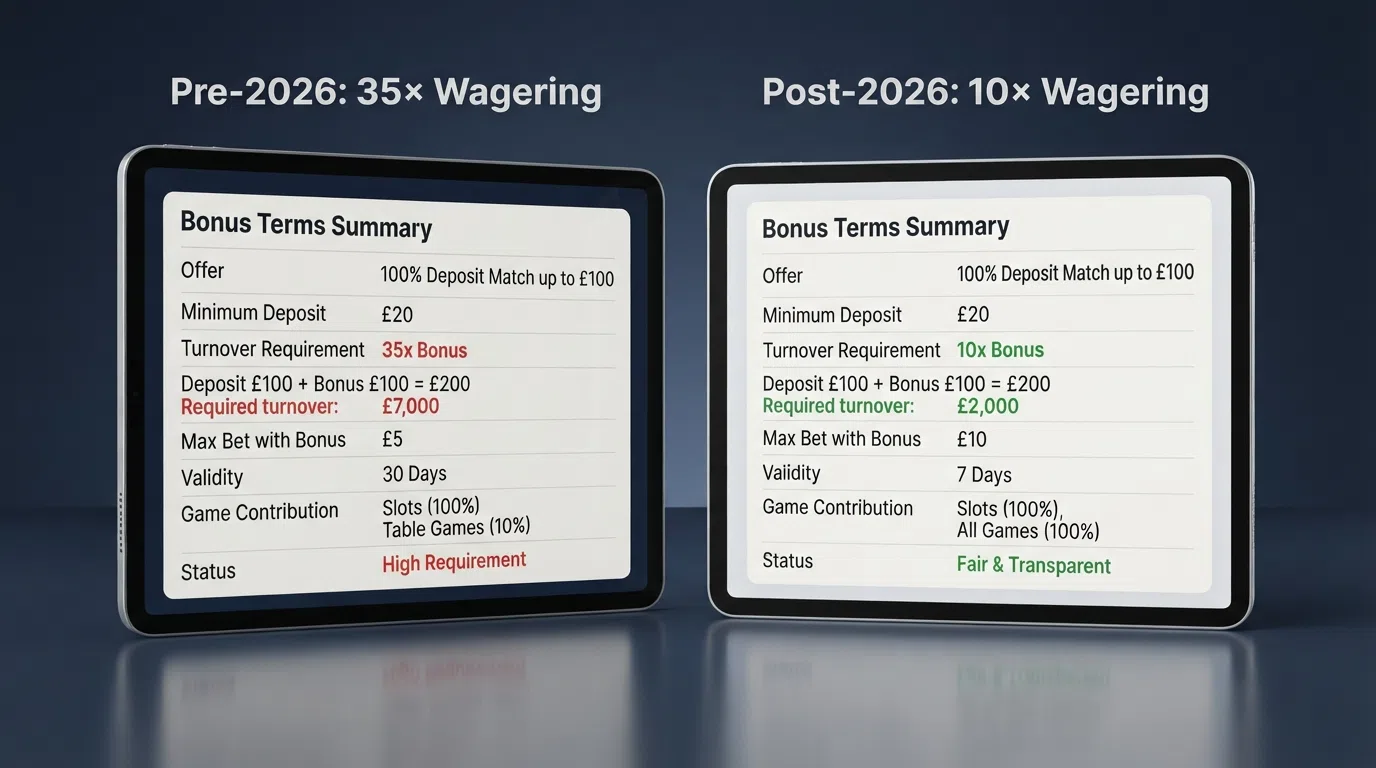
A worked example makes the change concrete. Take a 50% reload on a £50 deposit, which credits £25 in bonus funds. Under the 10× cap, the wagering requirement is £250 of qualifying turnover (bonus × 10). At the statutory maximum stake of £5 per spin for players aged 25 and over, that turnover is 50 spins. At the 2.5-second minimum interval per game cycle, 50 spins take 125 seconds — just over two minutes. At a typical 96% RTP, the expected loss on £250 of turnover is £10 (turnover × 1 − RTP). The same £25 bonus at the pre-cap 35× norm would have required £875 of turnover — 175 spins at £5, or roughly seven and a half minutes at the spin floor — and an expected loss of £35. The cap did not just reduce the multiplier; it cut the time cost and the expected loss by a factor that makes the offer genuinely playable rather than a millstone.
The figures above assume only the bonus amount is wagered and the player sticks to the £5 maximum stake. They are a statistical estimate, not a guaranteed outcome for any individual session. The math varies by game and player stake.
Match Bonuses, Free Spins and Cashback — the Three Reload Forms
- Deposit-match reloads. Match percentages on UK reloads run from 25% to 100% of the qualifying deposit, with caps that typically sit below welcome-offer caps. A 50% reload on a £50 deposit adds £25 in bonus funds, which at 10× wagering asks for £250 of turnover. The form is the traditional one and the one the 10× cap benefits most, because the old 30×–60× multipliers on a £25 bonus produced turnover figures that no casual player would clear.
- Free-spin reloads. Some operators run recurring free-spin offers instead of, or alongside, deposit matches. Spins are credited at a fixed value per spin (10p is standard across the featured set; Pub Casino runs 20p) and the winnings are either bonus funds subject to wagering or cash. MrQ credits free-spin winnings as cash with no playthrough. Sky Vegas extends its wager-free model to ongoing free-spin promotions. Coral’s 100 welcome spins at 10p are wager-free, with winnings paid as cash, and the 48-hour expiry is the catch. Wager-free spins sidestep the 10× cap because there is no wagering to cap.
- Cashback reloads. Cashback returns a percentage of net losses over a defined period (daily, weekly) as either bonus funds or cash. The cashback form is rarer than match or spins in the featured set, and where it appears — Pub Casino runs weekly cashback — it is positioned as a complement to a spin or match programme rather than the headline offer. Cashback caps at lower percentages than match reloads (typically 5%–20% of net losses) and the time window matters more than the percentage.
The form that costs the least to clear, in expected terms, is the wager-free free spin. A 10p spin with a 96% RTP returns 9.6p on average; the player gets that 9.6p as cash. A 50% match at 10× on a £25 bonus asks for £250 of turnover and returns roughly £240 in expected value, costing the player £10 in expected loss. The wager-free spin is the cleaner offer because the cost is the spin itself, not the wagering cycle around it.
Weekly, Daily and Seasonal — When Reload Bonuses Land
Frequency is the reload bonus’s hidden value lever. Two reloads at the same match percentage and the same wagering multiple can deliver very different annual value depending on how often they fire. A weekly 50% reload on a £50 deposit at 10× wagering credits £25 in bonus funds every seven days, which is £1,300 in bonus funds and £13,000 of required turnover over a year. A monthly 100% reload on a £100 deposit at 10× credits £100 in bonus funds twelve times a year, which is £1,200 in bonus funds and £12,000 of required turnover. The numbers are close, but the weekly one returns the bonus fifty-two times against the monthly one’s twelve — and the player can stop taking the weekly offer on a quiet week without forfeiting anything that was not yet claimed.
The dominant UK rhythm is the weekly reload, anchored on a Friday or weekend deposit. Ladbrokes’ Instant Spins wheel fires daily; Casumo’s Umorewards is daily and personalised; bet365’s Free Spins Reel is a daily spin that can credit 5, 10, 20, or 50 free spins; Coral’s Rewards Grabber runs daily and free. Pub Casino structures its reload value around weekly challenges plus cashback rather than a daily spin. Paddy Power and Sky Vegas lean seasonal — high-impact promotional reloads tied to events rather than a fixed weekly cadence. William Hill runs a daily opt-in of 15 free spins on a £30 minimum wager, which is the strictest daily model in the set because the player must wager to unlock the offer.
For a regular depositor, the cadence is what compounds the value. A daily free offer that pays £0.50 in expected value is worth £182 a year if claimed every day, and worth nothing if claimed once. The audit of a reload programme is therefore not just the headline match — it is whether the player will actually be there to claim it. The strongest UK reload programmes are the ones the player does not have to think about.
Wagering, Deposit Thresholds and the Fine Print That Decides Value
Four terms decide what a UK reload bonus is worth. The first is the wagering requirement: a 10× cap applies to bonus funds since 19 January 2026, which means a £25 bonus asks for £250 of turnover. The second is the minimum qualifying deposit, which sits in a £10–£20 band across the featured set — below £10 the offer excludes most casual depositors; above £20 it prices out the lower-stake player. The third is the maximum bet while the bonus is active: Casumo’s £5 cap is the most common reading and matches the statutory stake ceiling for players aged 25 and over. A player who bets above the maximum-bet rule, even once, voids the bonus and any winnings — the rule is enforced automatically and is the single commonest reason a UK bonus is forfeited. The fourth is the expiry window: seven days from credit is the standard, with Coral and Pub Casino running 48-hour spin expiries that compress the clearing time considerably.
Game weighting sits underneath all four. Slots typically contribute 100% of each bet toward the wagering requirement; table games contribute 10%–20%; live casino sometimes contributes 0% — meaning a £10 bet on roulette while a bonus is active counts as £1 or £2 toward the £250 turnover target, not £10. The weighting is what makes slots the default clearing game and why reload programmes that are spin-based — Coral, Sky Vegas, Ladbrokes, bet365, Paddy Power, Pub Casino — clear faster in real time than match-based programmes on the same wagering multiple.
bet365 runs a 30-day claim window with a 20-day spin drip — meaning the player has 30 days to opt in and then 20 days to use the spins. The drip is generous on the time axis but restricts the player to a fixed cadence rather than letting them use the spins at their own pace. Pub Casino’s 48-hour expiry is the opposite: claim the spins and use them in two days or lose them. Coral’s 48-hour expiry is the same. The two structures are responses to the same problem — that free spins without an expiry accumulate on the account and depress the operator’s liability — but they treat the player very differently.
Wager-Free Reloads and the Post-2026 Market
A wager-free reload credits winnings as cash, with no playthrough requirement. MrQ has run a no-wagering model across its reload promotions since long before the 10× cap took effect; its free-spin winnings are paid as withdrawable cash. Sky Vegas extends the same model to its ongoing free-spin promotions, with seven-day spin expiry and winnings as cash. Coral’s deposit-triggered offers run 100 wager-free spins at 10p per spin, winnings as cash, with a 48-hour expiry. bet365’s Free Spins Reel credits 5 to 50 free spins daily, all with zero wagering. Ladbrokes’ Instant Spins wheel is 0× wagering. Paddy Power runs 0× wager-free spins. Pub Casino runs 0× to 1× wagering, with the 1× variant applying to the deposit side rather than the spin winnings.
The 10× cap did not create the wager-free reload, but it made wager-free the next battlefield. Once the regulator set the ceiling on how punishing a bonus could be, operators competed on what sat underneath the ceiling — and the cleanest offer to a player is the one with no wagering at all. The catch is in the fine print. Wager-free spins often run at 10p per spin (the standard across the featured set, except Pub Casino at 20p), expire within 48 hours to seven days, and may be restricted to a single game title. The headline reads “100 free spins, no wagering”; the receipt reads “100 spins at 10p on one game, use within 48 hours, e-wallet deposits excluded”. The exclusions are not a trap, but they narrow the offer.
For a player depositing regularly, the wager-free reload is the higher-value choice. The expected loss on a 10p wager-free spin at 96% RTP is 0.4p per spin. The expected loss on a 10× match bonus at the same RTP, on a £25 bonus, is £10 across £250 of turnover. The wager-free model charges the player the cost of the spin; the match model charges the player the cost of the spin plus a chunk of expected value lost to the wagering cycle. Over a year of regular play, the gap is the difference between an offer that costs the player the house edge on a small stake and an offer that costs the player a percentage of the bonus.
Reload Bonus Codes — What They Unlock and Where to Find Them
A reload bonus code is a short alphanumeric token — sometimes a word, sometimes a string — that the player enters at the cashier to unlock a promotional offer. The code system is older than the auto-credited model: in the pre-smartphone era, codes were printed on promotional leaflets, emailed to subscribers, and pasted from affiliate pages. The UK market is moving away from them, but they have not disappeared. 10bet runs promo-code-triggered reload match bonuses (25% up to £100 is one example), and Ladbrokes maintains an ongoing promo-code layer alongside its auto-credited daily offers.
Where the codes appear matters as much as the codes themselves. The four distribution channels are email (the operator’s own mailing list), SMS (for opted-in players), the operator’s promotions page (where the code is published alongside the terms), and affiliate pages (where a third party promotes the code as part of a commercial arrangement). The first three reach the player directly; the fourth reaches whoever is reading the affiliate page. A code that is published on an affiliate page but not emailed to the player is a distribution gap — the player has to know to look for it.
The 19 January 2026 mixed-product ban does not change how codes are issued, but it changes what they can unlock. A code cannot now gate an offer that requires the player to bet on football and then claim casino free spins, because that offer is mixed-product and banned. The code is casino-only or sportsbook-only. The structural shift is small in code-handling terms and large in product-design terms, because cross-selling from sports to casino was a common use of the code mechanism.
The Best Reload Bonus Casinos in the UK for 2026
| Operator | UKGC Licence | Reload Wagering | Reload Frequency |
|---|---|---|---|
| Casumo | Active (account 61549) | 10× on bonus funds | Daily Umorewards, seasonal wheel spins |
| Sky Vegas | Active (Flutter) | 0× (wager-free) | Frequent free-spin promotions |
| Ladbrokes | Active (Entain) | 0× on free spins | Daily Instant Spins wheel, daily Coins |
| William Hill | Active (evoke) | 10× on daily spin winnings | Daily opt-in 15 free spins on £30 wager |
| Coral | Active (account 39396) | 0× (wager-free) | Daily Rewards Grabber, daily Coins |
| bet365 | Active (Hillside ENC) | 0× on free spins | Daily Free Spins Reel, 5–50 spins |
| Paddy Power | Active (Flutter) | 0× (wager-free) | Seasonal promotional reloads |
| Grosvenor | Active (Rank) | 10× on deposit + bonus | Daily bonus spins |
| 10bet | Active | 8×–10× on bonus | Weekly/daily promo-code reloads |
| Pub Casino | Active | 0×–1× (winnings as cash) | Weekly challenges and cashback |
The table above summarises the four columns that decide real player value: the licence status (verified against the UKGC public register), the wagering requirement on the reload (the post-2026 ceiling is 10×, and the wager-free operators have removed the multiplier entirely), and the frequency (which is where compounding annual value lives). The operators below the table take each row in turn.
Casumo — Umorewards and the 10× Model
Casumo’s reload programme runs through Umorewards, a daily personalised offer engine that tailors match percentages to the individual player — typically 50% to 100% on a £15 to £20 minimum deposit, with 10× wagering on the bonus funds. The personalisation is the differentiator: a player depositing on a Tuesday sees a different offer from one depositing on a Saturday, and the offer shifts in response to recent play. Seasonal wheel-spin promotions run alongside — a March Madness Wheel on a £15 deposit is the kind of structure that shows up in the research — and the welcome offer (50% up to £100, 10× wagering, £20 minimum deposit, £5 maximum bet while the bonus is active, seven-day expiry) sets the same terms that the reload programme runs at. UKGC account 61549, held by Recro Limited, is active on the public register. Casumo suits the regular depositor who likes the casino to adjust the offer to the day rather than serve a fixed weekly headline. The terms are at the post-2026 ceiling rather than below it, so the value is in the frequency and the personalisation, not in a softer wagering multiple.
Sky Vegas — the Wager-Free Standard
Sky Vegas runs a wager-free model that runs from welcome through to ongoing free-spin promotions for existing players. The welcome is 50 no-deposit free spins plus 200 free spins on a £10 deposit and stake, all wager-free, winnings paid as cash. The reload programme extends the same logic: ongoing free-spin promotions for existing players with no playthrough on the winnings, credited as withdrawable cash. The seven-day free-spin expiry is the constraint. Sky Vegas is part of Flutter Entertainment alongside Paddy Power, and the licence is held under Sky Betting & Gaming, active on the UKGC register. The wager-free standard is the strongest reload proposition in the set for a player who values cash over bonus funds — there is no wagering to clear, so the expected loss is the cost of the spins themselves rather than the cost of the spins plus a percentage of the bonus lost to the wagering cycle. A player who would rather not track a turnover target gets the cleanest offer here.
Ladbrokes — Daily Free Play Without the Wagering
Ladbrokes runs two daily programmes that credit value without requiring a deposit and without wagering on the winnings. The Instant Spins wheel is a daily free spin on a prize wheel; the result is free spins at 10p per spin, winnings as cash, zero playthrough. Coins is a daily free-prize drop, no deposit required, redeemable in the cashier. The welcome offer is Bet £10 Get 100 Free Spins with 0× wagering on the spins. Ladbrokes sits under Entain plc alongside Coral, and the UKGC licence is active. The reload ecosystem is built on frequency rather than match percentage: a daily small-value free play compounds over a year of regular claiming in a way a monthly 100% match does not. The catch is the spin value — 10p per spin is the standard, and the prizes on the Instant Spins wheel are small. For a player who claims daily, the annual value is meaningful; for a player who deposits once a month, the welcome offer is the only part of the programme that matters.
William Hill — Daily Opt-In Spins and Gold Star Loyalty
William Hill’s reload structure is the strictest daily model in the set. Each day, the player can opt in to 15 free spins, but the opt-in requires a £30 minimum wager on the same day to unlock the offer. The 15 spins carry 10× wagering on the winnings, and the offer is time-restricted and game-restricted (specific slots, specific window). The welcome offer is a 100% match up to £300. William Hill sits under evoke plc (formerly 888 Holdings), and the UKGC licence is active. Gold Star Reward is the loyalty layer that runs alongside — a points-based programme for ongoing value on top of the daily offer. The daily opt-in suits a player who is wagering £30 a day anyway and treats the 15 free spins as a small kicker; for a player wagering less, the £30 floor rules the offer out most days.
Coral — Rewards Grabber and Wager-Free Daily Value
Coral runs two no-deposit daily programmes and a wager-free deposit offer. Rewards Grabber is a daily free game, no deposit required, that credits free prizes to the account. Coins is a daily free-prize drop, no deposit required, redeemable in the cashier. The deposit-triggered welcome is 100 free spins on a £10 deposit and play, each spin valued at 10p, winnings as cash, zero wagering, with a 48-hour expiry on the spins. E-wallet deposits (Neteller, PayPal, Paysafe, Skrill) do not qualify for the welcome, which is a meaningful restriction for players funding through e-wallets. UKGC account 39396 is held under Entain plc and is active on the public register. Coral suits a player who values daily free play without funding the account every day — the no-deposit programmes run without a qualifying transaction, so the player can claim them on a quiet week and let the wager-free deposit offer sit until the next funded session. The 48-hour spin expiry is the constraint to plan around.
bet365 — the Free Spins Reel and Zero-Wagering Consistency
bet365’s Free Spins Reel is a daily spin that credits 5, 10, 20, or 50 free spins, all with zero wagering, winnings as cash. The welcome offer is Bet £10 Get 200 Free Spins — up to 500 free spins via the Free Spins Reel — with a 30-day claim window and a 20-day spin drip that paces the release of the spins. The reload value runs across both sports and casino; the Free Spins Reel itself is casino-only. The licence is held under Hillside (UK Gaming) ENC, active on the UKGC register. The 20-day spin drip is the structural feature: the player claims 200–500 free spins over the first 30 days, then settles into a daily Reel spin. The cadence is the strongest in the set for a player who values consistency — the offer is the same every day, the wagering is zero, and the drip front-loads the welcome. The constraint is the drip itself, which restricts the player’s control over when the spins are used.
Paddy Power — High-Impact Seasonal Reloads
Paddy Power’s welcome is 60 no-deposit free spins plus 200 free spins on a £10 stake, totalling 260 spins, all zero wagering, winnings as cash, with a seven-day expiry after claiming and a 10p per-spin value. The reload programme is built around seasonal promotional events rather than a fixed weekly or daily cadence — the operator concentrates value into event windows (a major sporting weekend, a holiday, a product launch) rather than spreading it across the year. Paddy Power is part of Flutter Entertainment alongside Sky Vegas, and the UKGC licence is active. The seasonal structure suits a player who pays attention to the promotions page and times deposits to the event windows; for a player who deposits on a fixed schedule regardless of what is running, the cadence looks sparse compared to the daily Reel or the daily Rewards Grabber. The wagering is the cleanest in the set at 0×, and the spin count at welcome is the largest in the set at 260.
Grosvenor Casino — Daily Spins with a £2,000 Cap
Grosvenor’s welcome offer is a 100% match up to £20, with a £20 minimum deposit, so a qualifying deposit plays with £40 (the £20 deposit plus the £20 bonus). The wagering is 10× on deposit plus bonus, which is the stricter reading of the 10× cap — a £40 starting balance at 10× means £400 of turnover, against £200 of turnover at 10× on bonus funds only. The reload programme runs daily bonus spins for existing players, with 10× wagering on the eligible games. The headline constraint is a £2,000 maximum withdrawal from the welcome offer, which caps the upside on a bonus that already runs at a smaller match and a stricter wagering base. The UKGC licence is held under the Rank Group and is active. Grosvenor suits a player who values the land-based brand and the daily spin cadence over a softer wagering multiple; the £2,000 cap means a large win on the welcome offer is forfeited above the ceiling, which is a structural disadvantage against the wager-free operators where winnings are paid as cash with no ceiling.
10bet — Weekly Promo-Code Reloads at 8–10×
10bet’s reload programme is promo-code-gated. The operator publishes codes on its promotions page and through affiliate channels; the player enters the code at the cashier to unlock a match bonus. The post-cap offer sits at 8× to 10× wagering, and the match percentages run around 25% on caps that extend to £100. The welcome offer was a £10 free-spins package after the 10× cap, an adjustment from a previous £50 bonus at 30× wagering. The UKGC licence is active. 10bet is the operator in the featured set that sits closest to the pre-cap structure: a code-gated match bonus at a multi-digit cap, running on a weekly or daily rhythm. The player who likes the code mechanic — and who follows the promotions page closely — gets a programme that resembles the pre-2026 market more closely than the other nine operators. The wagering at the upper end of the cap means a £25 bonus asks for £250 of turnover, which is the post-2026 ceiling rather than below it.
Pub Casino — Weekly Challenges, Cashback and Sub-£1 Spins
Pub Casino runs the strongest spin-value-per-stake in the set. The welcome is 50 bonus spins on a £10 deposit, with each spin valued at £0.20 — twice the 10p standard — and wagering at 0× to 1×, winnings paid as cash. The spins expire within 48 hours, and Skrill deposits are excluded. The reload programme runs weekly challenges plus cashback, plus weekly special offers, with the same low-friction wagering model. Payouts on PayPal are sub-six hours, which is the fastest in the set. The UKGC licence is active. Pub Casino suits a player who values speed of withdrawal and the per-spin value over the absolute number of spins — 50 spins at 20p is £10 of qualifying play, against 100 spins at 10p elsewhere for the same £10. The constraint is the 48-hour spin expiry, which is the shortest in the set and requires the player to use the spins on the same day they are credited to avoid forfeiture.
Why Slot Reload Bonuses Are Worth Less Than They Look
Slot reloads carry the same headline match as general casino reloads, but the clearing mathematics run differently because the UK imposes two structural constraints on online slots. The first is a statutory maximum stake per game cycle — £5 for players aged 25 and over, £2 for players aged 18 to 24, in force from April and May 2025 respectively under SI 2025/215. The second is a package of game-design rules: auto-play is banned, the minimum interval between game cycles is 2.5 seconds, losses disguised as wins are banned, and reverse withdrawals are banned. The stake cap limits how fast turnover accumulates. The spin-speed floor limits how many cycles fit in a session. Together, they turn slot bonus clearing into a manual, time-bound exercise rather than the auto-play grind that was possible before October 2021.
A worked illustration: a £25 reload bonus at 10× wagering asks for £250 of qualifying turnover. At the £5 maximum stake for a player aged 25 or over, that is 50 qualifying spins. At the 2.5-second minimum interval, 50 spins take 125 seconds — just over two minutes of pure spin time, before accounting for the time to navigate between spins, confirm bets, and avoid the max-bet rule by accident. The pre-statutory-cap player, had one existed in 2026, would have been able to run the same turnover in a fraction of the time on a single game with auto-play engaged. The slot reload bonus is therefore worth less in time terms to the player who wants to clear it quickly and worth the same in monetary terms to the player who was going to play slots anyway.
The RTP interaction matters. A 96% RTP slot returns £240 of the £250 turnover in expected value, costing the player £10 in expected loss. A 94% RTP slot costs £15. A 98% RTP slot costs £5. The spread of RTPs across the slot catalogue is wider than most players realise, and the choice of which slot to clear the bonus on shifts the expected cost by a factor of three. The featured operators all carry slots from NetEnt, Playtech, IGT, Pragmatic Play, Red Tiger, Microgaming, Big Time Gaming, Play’n GO, and Evolution, but the per-title RTP is not carried in the research. The general advice is to clear a slot bonus on a high-RTP title (96% and above) and to check the game’s information panel before committing the turnover.
Which UK Casinos Offer Slot-Specific Reload Bonuses
Six of the ten operators in the featured set run spin-based reload programmes: Coral, Sky Vegas, Ladbrokes, bet365, Paddy Power, and Pub Casino. Their reload value is delivered as free spins rather than as bonus funds, which means the wagering is either zero (wager-free) or applied to spin winnings rather than to a deposit match. The four operators running match-based reloads — Casumo, William Hill, Grosvenor, and 10bet — clear through slot play at 10× wagering on bonus funds, with game weighting that typically counts slots at 100% and table games at 10%–20%.
The choice between a spin-based and a match-based reload is a choice between two different value equations. A spin-based wager-free reload returns the cost of the spin to the player as cash; a match-based 10× reload returns the cost of the spin minus a percentage lost to the wagering cycle. For a player who plays slots anyway, the match-based reload at 10× is competitive because the wagering cycle runs on play the player was going to do. For a player who would rather withdraw the bonus and walk away, the spin-based wager-free reload is the cleaner offer because there is no wagering to wait out.
Slots are the default clearing game across the featured set because the game weighting makes any other category inefficient. A £250 turnover target on slots at 100% weighting is £250 of slot bets. The same target on table games at 10% weighting is £2,500 of table-game bets — ten times the play for the same clearing result. The featured operators do not exclude slots from their reload offers; they make slots the obvious choice through the weighting structure.
How Slot RTP and the Statutory Stake Cap Change What a Reload Delivers
The £5/£2 stake cap is the binding constraint on how fast a slot bonus clears. At £5 per spin, a 10× bonus on £25 asks for 50 spins. At £2 per spin — the cap for players aged 18 to 24 — the same bonus asks for 125 spins, and the time cost at the 2.5-second minimum rises from just over two minutes to roughly five and a half minutes of pure spin time. The differential is small in absolute terms but meaningful for the younger cohort, who play under the stricter cap and who are also the cohort the regulator is most concerned about protecting. The cap is not designed to make bonus clearing impossible; it is designed to slow the rate at which a player can cycle through qualifying turnover, which is the same logic as the spin-speed floor and the auto-play ban.
The interaction with RTP is the second-order effect. A 96% RTP slot cleared at the 10× wagering multiplier returns the player roughly £240 on a £250 turnover; the expected loss is £10. The same slot cleared at a 35× wagering multiplier (the pre-2026 norm) returns £833 on £875 of turnover, with an expected loss of £42. The 10× cap reduced the expected loss on clearing a £25 bonus from £42 to £10 — a 76% reduction. The slot RTP sets the percentage; the wagering multiple sets the absolute turnover; the stake cap sets the rate; the spin-speed floor sets the time cost. The four parameters together decide what a slot reload bonus is worth.
Where to Find the Best Slot Reload Bonuses
The highest-value slot reloads in the UK are the wager-free spin programmes. Sky Vegas, bet365, Coral, Ladbrokes, Paddy Power, and Pub Casino all run zero-wagering on spin winnings, which means the cost of the reload to the player is the cost of the spins at the house edge — a 10p spin at 96% RTP costs 0.4p in expected loss, against the £10 expected loss on a £25 10× match bonus. The six operators differ on spin value (Pub Casino’s 20p is the highest in the set), on the eligible games (some restrict to a single title, some offer a choice), on the expiry window (Coral and Pub Casino at 48 hours; Sky Vegas and Paddy Power at seven days; bet365 on a 20-day drip), and on the qualifying payment methods (Coral excludes e-wallets; Pub Casino excludes Skrill).
For a player who deposits regularly and clears the bonus on slots, the 10× wagering slot reloads at Casumo, William Hill, Grosvenor, and 10bet are competitive with the wager-free offers once the player accounts for the play they would have done anyway. A £25 bonus at 10× on a £5 spin at 96% RTP costs the player £10 in expected loss, which the player was going to lose on the same slot play without the bonus — so the bonus effectively rebates the expected loss on the qualifying turnover rather than acting as a free lunch. The honest framing is that a 10× slot bonus offsets the player’s expected loss on the qualifying turnover; a wager-free spin bonus returns the player’s expected loss on the spins themselves with no further commitment.
Who Regulates Your Reload Bonus — and What the UK’s Rules Actually Protect
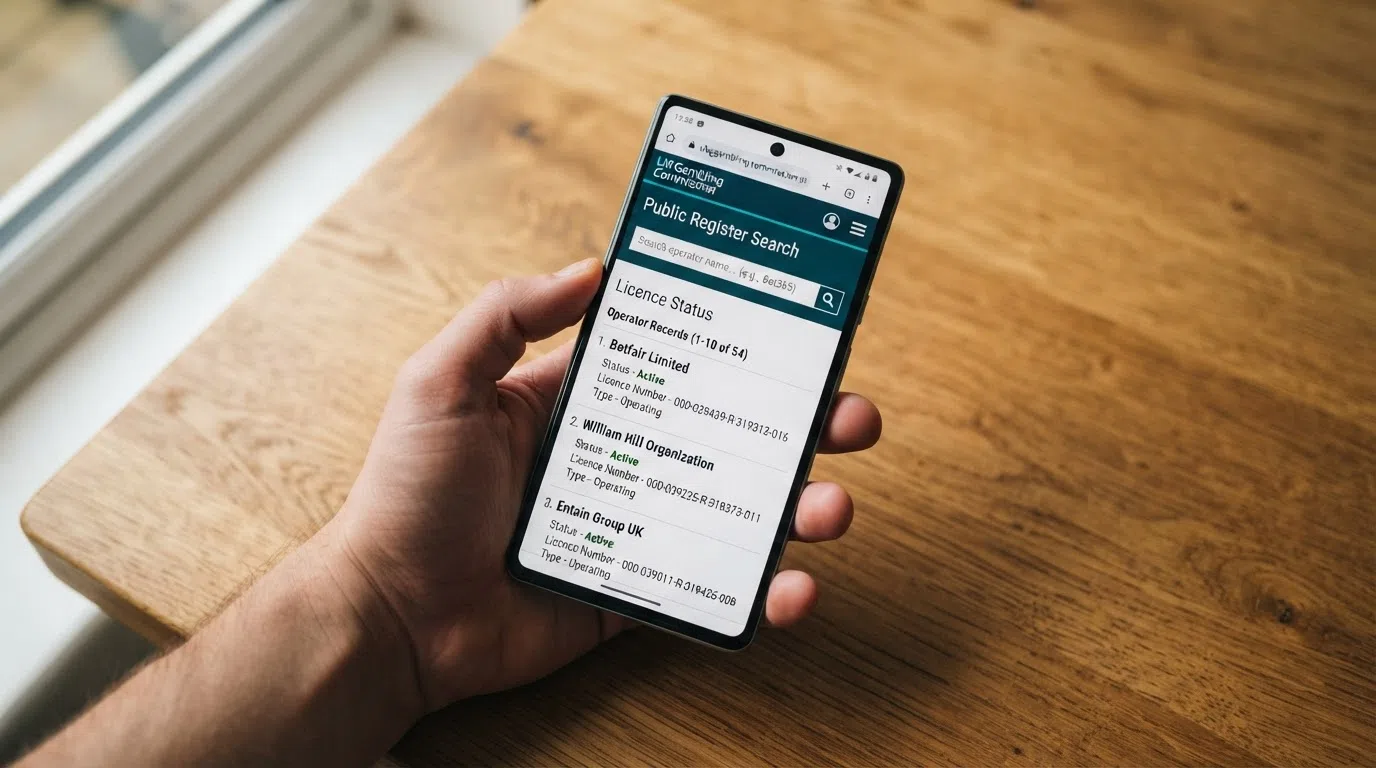
The UK reload bonus market is the most tightly regulated in any major English-speaking jurisdiction. The regulator is the Gambling Commission, an executive non-departmental public body sponsored by the Department for Culture, Media and Sport. The legal framework is the Gambling Act 2005, extended to remote operators serving GB customers by the Gambling (Licensing and Advertising) Act 2014 — the point-of-consumption reform that requires any operator serving a GB customer to hold a GB operating licence regardless of where the operator is incorporated. Every reload bonus on this page sits behind a Gambling Commission operating licence, and the public register lets the player check the licence in under a minute.
The three licensing objectives in section 1 of the Gambling Act 2005 are: preventing gambling from being a source of crime or disorder; ensuring gambling is conducted fairly and openly; and protecting children and vulnerable persons from harm. The reload bonus rules that took effect on 19 January 2026 — the 10× wagering cap and the mixed-product ban — were issued under the social responsibility code, and the Commission’s own statement on the changes is worth quoting in full: “Capping the wagering requirement to ten decreases the likelihood of harm, reduces complexity, and improves transparency while maintaining consumer choice.” That sentence sets the regulatory logic: the cap is a harm-reduction measure and a transparency measure, and the Commission is preserving the player’s right to claim a bonus while reducing the chance that the bonus causes harm.
The framework applies to Great Britain — England, Scotland, and Wales. Northern Ireland runs on separate, older legislation and is not covered by the Gambling Commission. A “GB-licensed” operator is the correct phrase, not “UK-licensed” — the difference is the regulator, and the regulator is the one the player can complain to.
The UK Gambling Commission — the Licence Behind Every Legal Offer
The Gambling Commission’s public register contains 2,663 records and can be searched by business name, trading name, domain name, or account number. Every operator featured on this page holds an active GB operating licence, verifiable by entering the operator’s name or domain in the register’s search field. The two licence numbers cited in the operator write-ups — Casumo at account 61549 and Coral at account 39396 — are taken from the public register. The other eight operators hold active licences confirmed on the public register.
A GB licence is the only substitute for a GB licence. A Curaçao, Malta, or Gibraltar authorisation is not a substitute and does not authorise an operator to advertise to or accept deposits from GB customers. Section 33 of the Gambling Act 2005 makes it a criminal offence to provide facilities for gambling without a licence — up to 51 weeks’ imprisonment, an unlimited fine, or both. The Commission’s enforcement powers are disruption-oriented: cease-and-desist notices, search-engine delisting, domain suspension, payment-provider referrals. The Commission does not currently hold statutory DNS or ISP blocking powers, although legislation has been proposed. The point is that an unlicensed operator faces real consequences, and the player’s protection — GAMSTOP coverage, ADR routes, the Commission’s complaints process — extends only to GB-licensed sites.
The 10× Wagering Cap and the Mixed-Product Ban — How They Reshaped Reload Design
The 19 January 2026 changes are the most significant rewrite of the UK bonus framework since the 2014 point-of-consumption reform, and the two rules work in tandem. The first — LCCP Social Responsibility Code 5.1.1 — caps bonus wagering requirements at 10× the bonus value, applying to bonus funds only, not to deposit plus bonus combined. A 10× cap on a £25 bonus asks for £250 of qualifying turnover; the same £25 bonus at 30× asked for £750, and at 60× asked for £1,500. The cap compresses the time and money cost of clearing a bonus to a level that a regular player can clear within a week, rather than the weeks or months the pre-cap market demanded.
The second rule — same date, same code provision — bans mixed-product promotions. An offer may not require a customer to participate in more than one product type. The “bet £10 on football, get 50 free spins” cross-sell that operators had been using to bridge sportsbook and casino is now unlawful. The rule closes a category of promotion that mixed gambling verticals in a way the regulator judged harmful, and it forces operators to design reload bonuses within a single product — casino-only or sportsbook-only. The rule does not affect a casino-only reload; it affects the cross-sell mechanics that some operators had been layering on top of them.
The downstream effect is that the wagering is no longer the differentiator it was. Every UK-licensed operator now runs at or below 10× on bonus funds, and several of the featured operators run at 0× through wager-free spin mechanics. The competitive field shifted from “who has the softest wagering” to “who has the cleanest wager-free offer, the highest spin value, or the most frequent cadence”. The reload bonus is now a product design competition rather than a wagering competition, and the player benefits from the cleaner offers that competition produces.
Advertising Standards, Opt-In Rules and What Operators Must Disclose
Gambling advertising in the UK runs through the CAP Code (non-broadcast) and the BCAP Code (broadcast), both enforced by the Advertising Standards Authority. From 1 October 2022, the test for whether a gambling ad is permissible tightened from “particular appeal” to under-18s to “strong appeal” — a stricter standard that has closed a category of creative that appealed to younger audiences without overtly targeting them. No one who is, or appears to be, under 25 may be shown gambling in a gambling ad. The 25-year rule is a hard line, and the ASA has been willing to enforce it.
From 1 May 2025, remote operators must present marketing choices by product and by channel as unticked opt-ins — the box must be empty by default, and the player must take a positive action to receive marketing in any combination. The rule applies to email, SMS, push notifications, and on-site messaging, and it is enforced under SR Code 5.1.12. The reload bonus is not directly affected by the opt-in rule, but the marketing that promotes a reload bonus is — a player who has not opted in to casino marketing should not be receiving promotional emails about a Friday reload. The opt-in architecture is the structural reason a player sometimes sees a reload offer on the operator’s promotions page without receiving an email about it: the email requires consent, the page does not.
The Safety Net Around Every UK Reload Bonus
Every UKGC-licensed reload bonus sits inside a mandatory safer-gambling framework, and the framework is what the player falls back on if the bonus stops being fun. The Gambling Commission’s prevalence data, the help infrastructure, and the operator-side tools together form the safety net. The scale of the safety net is the answer to the question of why the bonus rules are as tight as they are: the rules are written against a background of measurable harm, and the safety net is the regulator’s response to that background.
The data is sobering. The Gambling Survey for Great Britain Wave 4, covering September 2025 to January 2026, found that 47% of adults had gambled in the past four weeks — 27% excluding those who had only bought a lottery ticket — and 38% had gambled online. The survey covered a nationally representative sample of 5,210 adults. The PGSI Year 2 figures, drawn from past-12-month gamblers, put 2.7% in the problem-gambling category (PGSI 8+) and 3.1% in the moderate-risk category (PGSI 3–7), with a further 8.8% in the low-risk category (PGSI 1–2). 3.4% of those who had gambled in the past 12 months had sought support for their own gambling. The treatment outcome data is the most encouraging: among those in treatment, the problem-gambling rate fell from 87% at initial assessment to 27% at final assessment.
Deposit Limits, Reality Checks and the Controls You Set
The UK framework makes the player the primary limit-setter. Operators are required to prompt a customer to set a financial limit before their first deposit — a rule in force from 31 October 2025 — and to action any decrease to that limit immediately. Increases can be subject to a cooling-off period. The limit is the player’s number, not the operator’s, and the operator is required to make it easy to set, review, and change.
From 30 June 2026 — extended to 30 September 2026 — operators must offer a gross deposit limit and give it at least equal prominence to other financial limits. Only the gross-deposit form may be called a “deposit limit”. The rule closes a category of marketing that highlighted net-deposit limits (which exclude winnings withdrawn and re-deposited) and gave the impression of a stricter cap than the operator was actually enforcing. The gross-deposit form is the honest form, and the prominence rule means the honest form cannot be hidden behind a softer option.
From 28 February 2025, a light-touch financial vulnerability check applies to customers reaching a net deposit threshold of £150 in a rolling 30-day period, under LCCP SR Code 3.4.4. The check uses publicly available data only — county court judgments, bankruptcy orders, individual voluntary arrangements, debt relief orders — and is the regulator’s response to the affordability question. The check is light-touch by design: it does not ask the customer to provide payslips or bank statements, and it does not block play on its own. The Stage 1 affordability thresholds — £5,000 net deposits in 24 hours for players aged 25 and over, £2,500 for under-25s — were confirmed by the UKGC Board on 7 July 2026, with a staged rollout that does not yet have a confirmed start date.
GAMSTOP, GamCare and Where to Go When Gambling Stops Being Fun
GAMSTOP is the national multi-operator self-exclusion scheme. A player registers once and is excluded from every GB-licensed online gambling site for the chosen period: six months, one year, five years, or five years with auto-renewal. Registration cannot be cancelled early — the minimum period runs to its end. GAMSTOP has been mandatory for every GB-licensed online operating licence since 31 March 2020, which means a player who has self-excluded cannot open a new account at any UK-licensed casino for the duration of the exclusion. The scheme covers GB-licensed online sites only; it does not reach unlicensed operators, which is one reason the licensed market is the safer market to be in.
GamCare runs the National Gambling Helpline, available 24 hours a day, free, on 0808 80 20 133. In 2026, 82% of helpline contacts who disclosed a form of gambling cited struggles with online gambling — the highest rate since 2021. In January 2026, 996 referrals were made to treatment and peer-based support, up 48% year-on-year from 674 in January 2025. The referrals figure is the one to watch: it tracks the number of people being connected to treatment, not just the number of calls. GambleAware funds prevention and research and publishes annual treatment data. NHS gambling harm clinics operate in England, Scotland, and Wales. Gamblers Anonymous runs peer support groups across the country.
How Many Players Actually Need These Tools — and Why It Matters
The numbers above are not a scare story — they are the regulator’s evidence base. 47% of adults gambling in the past four weeks is the participation base. 2.7% scoring 8+ on PGSI is the problem-gambling rate. 996 referrals in a single month is the treatment pipeline. 82% of helpline contacts citing online gambling is the channel concentration. The National Gambling Support Network reports over 52,000 calls per year to the helpline. Each of these numbers is a different cut at the same population, and they exist because the regulator collects them, the operators fund the research through the statutory levy (1.1% of gross gambling yield, split 50% treatment, 30% prevention, 20% research, in force from 6 April 2025), and the framework is built to act on what the data shows.
The treatment outcome is the headline that earns its place at the bottom of this section. Among those in treatment, the problem-gambling rate fell from 87% at initial assessment to 27% at final assessment. The safety net works for the people who use it. The reload bonus rules, the deposit limits, the GAMSTOP exclusions, the helpline — they are written for the population the data describes, and the data shows the safety net reaching the people it is aimed at.
How We Evaluated and Ranked the UK’s Reload Bonus Casinos
The ranking on this page is built from four criteria, in this order: reload wagering requirement, reload frequency and consistency, structural offer type (wager-free versus 10×), and programme depth. The criteria are not weighted with a formula, because the inputs do not carry a weighting the plan asked for and inventing one would be exactly the kind of figure this page does not produce. The order is a judgement: a wager-free daily offer outranks a 10× monthly offer, a 10× daily offer outranks a wager-free monthly offer, and the criteria apply in that sequence rather than averaged.
Every operator was verified against the UKGC public register before being included. The two licence numbers in the operator write-ups — Casumo at account 61549 and Coral at account 39396 — are taken from the register, and the other eight operators are confirmed as active on the public register. The 2,663-record register is the source of every licence claim on this page.
The ranking does not measure what it does not claim to measure. Game library size, payment-method breadth, customer support response time, mobile app polish, live-dealer table depth — these are not reload-bonus criteria, and operators that score well on them but run weaker reload programmes are not in the featured set. The featured ten were chosen for their reload programmes, and the criteria above are the only ones the ranking is built on.
Your Deposit, Your Decision — What the UK Reload Bonus Market Actually Delivers
The decision the page is built around is whether to choose a wager-free reload or a 10× match reload, and the answer depends on how the player actually plays. Six operators in the featured set run zero-wagering on reload spins — Sky Vegas, Ladbrokes, Coral, bet365, Paddy Power, and Pub Casino. For a player who deposits weekly and withdraws quickly, the wager-free offer is the higher-value choice because there is no turnover cycle to clear before the winnings are withdrawable. The cost is the cost of the spin; the winnings are cash. The trade-off is in the spin value (10p is standard; Pub Casino runs 20p), the eligible games (some operators restrict to a single title), and the expiry window (Coral and Pub Casino at 48 hours; Sky Vegas and Paddy Power at seven days).
For a player who was going to play the slots anyway, a 10× match reload is competitive because the wagering cycle runs on play the player would have done without the bonus. The expected loss on clearing a £25 bonus at 10× on a 96% RTP slot is £10 — a figure the player would have lost on the same slot play without the bonus, so the bonus is a reduction in expected loss rather than a free lunch. The honest framing is that a 10× match bonus offsets the player’s expected loss on the qualifying turnover; a wager-free spin bonus returns the player’s expected loss on the spins themselves with no further commitment. The two offers are priced differently and the choice between them is a choice about whether the player prefers certainty (wager-free) or upside (match bonus with a higher ceiling).
The frequency versus match-percentage trade-off is the second decision. A daily small-value wager-free offer at one operator is worth more over a year than a monthly 100% match at 10× at another, because the daily offer compounds fifty-two times against the monthly offer’s twelve. Ladbrokes’ daily Instant Spins wheel, bet365’s daily Free Spins Reel, and Casumo’s daily Umorewards are the cadence winners. Paddy Power and Sky Vegas lean seasonal — high value in event windows, sparse in between — and that structure suits a player who times deposits to the events rather than depositing on a fixed schedule.
The stake cap is the constraint on slot bonus clearing. A player aged 25 or over betting at the £5 maximum clears a £25 reload at 10× in 50 qualifying spins — just over two minutes of pure spin time at the 2.5-second minimum. A player aged 18 to 24 betting at the £2 maximum clears the same bonus in 125 spins — five and a half minutes. The time cost is modest, but the existence of the cap is the structural reason a slot reload is a slower clear than a general casino reload, and a player who values speed of withdrawal over the absolute value of the bonus should weight the wager-free offers more heavily.
Every offer on this page sits inside the UK’s regulatory framework. The licence is verifiable. The deposit limit is set by the player, not the operator. The wagering is capped. The exclusion scheme is free, mandatory for every GB-licensed site, and cannot be reversed early. The helpline is free, 24 hours a day, on 0808 80 20 133. The data on who uses the helpline and what the treatment outcome looks like is published. The market is the most tightly regulated in the English-speaking world, and the reason it is regulated this tightly is that the regulator has measured the harm and acted on the measurement. A reader who is choosing between two reload bonuses is choosing inside a market that is built to be safer than the alternatives, and the safety net is the last thing to read on this page because it is the last thing anyone should need.
Frequently Asked Questions
Can I use a reload bonus on live casino or table games?
Most UK reload bonuses restrict play to slots, or count table games and live casino at a reduced percentage (often 10%–20%) toward the wagering requirement. The 10× cap on bonus funds applies to the qualifying turnover regardless of which game is played, but the time cost of clearing £250 of wagering on a 10%-weighted table game is ten times the cost of clearing it on a 100%-weighted slot. Read the game-weighting section of the bonus terms before depositing — live casino and table games are usually the slowest path to a cleared bonus.
Do reload bonuses have a maximum cashout limit?
Some do. Grosvenor’s welcome offer caps withdrawals at £2,000 from the bonus, and several other operators impose caps on specific reload promotions. The wager-free operators — Sky Vegas, bet365, Coral, Ladbrokes, Paddy Power, Pub Casino — pay free-spin winnings as cash with no cap. A max-cashout clause is in the bonus terms, and the player’s job is to check it before claiming, because the cap converts what looked like an unlimited offer into a bounded one.
What is the minimum spend to activate a reload bonus?
The minimum qualifying deposit is typically £10 or £20 in the UK licensed market. Some operators run sub-£10 offers, but £10 is the standard floor. The reload is calculated as a percentage of whatever the player deposits up to the cap, so a £10 deposit on a 50% reload credits £5 in bonus funds, and a £100 deposit on the same offer credits £50 (or the cap, whichever is lower). William Hill’s daily opt-in spins require a £30 minimum wager to unlock the 15 free spins, which is the strictest daily threshold in the featured set.
Are there wager-free reload bonuses available in the UK?
Yes. Six operators in the featured set run zero-wagering on reload free spins: Sky Vegas, Ladbrokes, Coral, bet365, Paddy Power, and Pub Casino. The wagering is replaced by cash treatment — winnings are paid as withdrawable cash with no playthrough requirement. The trade-offs are in the spin value (10p is standard; Pub Casino runs 20p), the eligible games (often a single title), the expiry window (48 hours to seven days), and the qualifying payment methods (Coral excludes e-wallets; Pub Casino excludes Skrill). The headline reads cleaner than the receipt, and the receipt is what the player should read.
What are the wagering requirements for reload bonuses in the UK?
The maximum is 10× the bonus value, in force from 19 January 2026 under LCCP Social Responsibility Code 5.1.1. The cap replaced a market where 30× to 60× wagering was standard. A £25 reload bonus at 10× asks for £250 of qualifying turnover. Several operators — the wager-free six — run at 0× on free-spin winnings, sidestepping the cap because there is no wagering to cap. The cap applies to bonus funds only, not to deposit plus bonus combined, except where an operator voluntarily applies the stricter reading — Grosvenor’s 10× on deposit plus bonus is the example. The cap is a regulatory ceiling, and operators can run below it but not above it.
Crypto Reload Bonuses — Do They Exist in the UK Market?
Crypto reload bonuses — Bitcoin deposit matches, Ethereum free-spin packages, and the broader “crypto casino” promotional category — are essentially absent from the UK-licensed market. A UKGC-licensed operator cannot offer a crypto-specific reload bonus for three converging reasons. First, crypto deposits are subject to the same KYC and anti-money-laundering controls as any other payment method, and the source-of-funds requirements on a crypto deposit are heavier than on a bank transfer, not lighter. Second, since 14 April 2020, credit cards have been banned for all remote gambling deposits at GB-licensed operators, and the ban extends to credit-card-funded payments routed through e-wallets — Skrill, Neteller, and PayPal all fall under the rule when funded by credit. A crypto reload bonus promoted to a UK audience would have to navigate that payment restriction on the deposit side, which compresses the eligible payment methods to debit cards, bank transfers, and a narrow set of properly funded e-wallets.
Third, a GB licence is compulsory at the point of consumption since 2014. A Curaçao or Malta licence is not a substitute. A crypto casino that serves UK customers without a GB licence is operating unlawfully, and the player’s protection — GAMSTOP coverage, an approved ADR route, the Gambling Commission’s complaints process — does not extend. The crypto reload bonus exists in international casino content because the international market is largely offshore; the UK reader searching for one is searching for something the licensed market does not provide, and the right answer is to look at the wager-free free-spin reloads that the licensed market does provide.
Promotions – No Minimum Deposit Casinos UK
Content created by the «No Minimum Deposit Casinos UK» team