Non-UK Licensed Casinos: Honest Terms, Real Risks
 Available in GB
Data current as of 28 August 2026, checked against the Gambling Commission’s public register and the regulator portals in Curaçao, Malta and Anjouan.

What a casino licence is — and what it does not protect
A casino licence looks like an authority figure and reads like one. A gold seal, a regulator’s name, a footer with a registration number. A British player glancing at a site footer sees “Curacao” or “Anjouan” or “MGA” and knows, at a general level, that one is the EU one and the others are somewhere looser. That is the entire mental model most readers carry into this market, and it is the model the next several sections dismantle.
The starting point is the British one, because what a UK player compares “offshore” against is GB regulation. Since the Gambling (Licensing and Advertising) Act 2014, providing facilities for gambling to customers in Great Britain requires a Gambling Commission licence regardless of where the operator is incorporated. A Curaçao, Maltese or Anjouan licence does not substitute. That is the rule this page rests on, and it is the rule every featured operator in this ranking is technically breaking by accepting GB customers.
What a licence certifies, in plain terms
A licence is a contract between an operator and a regulator. The regulator grants permission to take bets, accept deposits and run a casino product, in exchange for the operator meeting a published set of rules. Those rules typically cover who can be served (age verification, self-exclusion lists), how money is held (segregated player funds, anti-money-laundering checks), how games are tested (RNG certification) and what happens when a player complains (an approved alternative dispute resolution provider).
It is not a guarantee that the operator will pay out. It is not a certification of game fairness in any user-facing sense. It is not, in the offshore cases the rest of this page covers, much use to a British player if the operator does not pay: the regulator is usually in another jurisdiction, the courts sit elsewhere, and there is no formal British route for complaint.
What the certificate says, when it is genuine, is the operator’s name, the licence number and often a status — active, suspended or revoked. With Curaçao, that detail is now interactive: since the National Ordinance on Games of Chance took effect the seal embedded in operator sites links back to a Curaçao Gaming Authority Certificate of Operation page at cert.cga.cw, showing the operator name, licence status and the domains the licence covers. With Malta, the MGA’s public register at mga.org.mt is searchable by name, status, URL or gaming service.
Licensed vs unlicensed: the line that matters
The line between licensed and unlicensed is, in the British frame, a line of enforcement — not a line of safety. Operating without the required GB licence is a criminal offence under section 33 of the Gambling Act 2005. It is a summary offence carrying up to 51 weeks’ imprisonment, a fine at level 5 on the standard scale (in practice, unlimited), or both. That is the worst-case sanction for an operator.
For a UK player the equation is different. There is no established criminal penalty for an individual who gambles at an unlicensed site. What they lose is not liberty — it is protection. No GAMSTOP coverage at that site, no UKGC complaints route, no approved ADR, no realistic British redress if funds are withheld. The Commission’s enforcement toolkit against operators is disruption rather than blocking. The Commission has flagged a proposed statutory power to require ISP-level blocking of unlicensed sites, and that change is currently prospective, not enacted.
That distinction is the spine of this page. The rest of it is detail about what the protection actually contains, and what gets left behind when a UK player steps outside it.
How new licensed casinos get found and checked
A licence you can verify on the regulator’s own register is a licence you can rely on. A new entry in the Curaçao or MGA register is published on the regulator’s portal before the operator goes live, with the registered name and any associated domains. The “is this casino licensed?” question is therefore a check, not a faith.
For Curaçao, the seal at cert.cga.cw displayed in an operator footer should link to a Certificate of Operation page that lists the licence holder, the licence status (active, suspended or similar) and the domains the licence authorises. For Malta, the MGA’s register allows searches by operator name, status, URL or the type of gaming service authorised. Both regulators publish the data publicly; both rely on the operator to display the seal correctly. The cases where the seal is missing, broken or fails to resolve are the cases to walk away from.
The 2026 reality of playing outside the UKGC
“Legal to play, unprotected in practice” is the precise framing, and getting it precise matters. The rest of this page turns on that distinction.
What a non-UK licence casino is, and why UK players look for one
A non-UK licence casino, for the purposes of this page, is an online casino that takes bets from UK customers without holding a UKGC licence. Most of the operators in the rankings below are licensed in Curaçao, with one or two holding Anjouan or dual Curaçao and Anjouan licences. None operates under British supervision; none is bound by British stake caps, credit card bans or the 10× wagering ceiling that took effect on 19 December 2025.
Why UK players look for them is part economics, part product. Remote Gaming Duty rose from 21% to 40% from 1 April 2026 — a structural shift announced at the Autumn Budget 2025 and enacted in Finance Act 2026, section 86 — that gives operators a strong financial motive to base themselves elsewhere and leaves UK-licensed brands with less margin to absorb promotion costs. The result is a £5/£2 stake cap, a credit card ban that reaches credit-card-funded e-wallets, wagering caps of 10× and a 1.1% statutory levy on top, all in a single product line.
The offshore alternative, for a player who can find one and verify the licence, offers higher bonuses, higher wagering multiples, higher slots stakes, crypto deposit rails, no GAMSTOP coverage and no time-out verification on the British register. That is the trade. The next several sections go through it piece by piece.
The UKGC regime: what a GB licence demands in 2026
The British regime, in 2026, looks like this for online casino play.
Stake caps on online slots run age-banded: £5 per game cycle for players aged 25 and over (in force from 9 April 2025), £2 per game cycle for players aged 18 to 24 (in force from 21 May 2025). The cap applies to remote casino slots only, imposed under SI 2025/215. There is no statutory stake cap on other online products.
The credit card ban has been in place since 14 April 2020 — licence condition 6.1.2 of the LCCP prohibits GB licensees from accepting payment for gambling by credit card, with the rule extended to credit-card-funded payments routed through e-wallets. The offshore casinos covered in this ranking do not honour that rule; the choice not to use a credit card or credit-card-funded wallet is the player’s.
Wagering requirements at GB-licensed casinos are capped at 10× from 19 December 2025, with mixed-product promotional offers (the “bet on football, get free spins” construction) banned outright. The featured offshore offers in this ranking sit at 30×, 35× and 40× multiples — that is the contrast that makes the 10× figure worth quoting.
Deposit limits and affordability: from 31 October 2025 GB operators must prompt a customer to set a financial limit before first deposit; from 30 September 2026 a standardised gross deposit limit must be offered under RTS 12. A light-touch financial vulnerability check applies at £150 net deposit in rolling 30 days, with more substantial risk assessments at higher thresholds.
The statutory levy has applied from 6 April 2025 at 1.1% of gross gambling yield for remote casino licences, with proceeds split 50% to treatment, 30% to prevention and 20% to research. Players pay no tax on gambling winnings in the UK.
GAMSTOP remains mandatory for every GB online gambling licence. Players can exclude for six months, a year, five years, or five years with auto-renewal. The exclusion cannot be lifted early.
Game design rules are also in force from 31 October 2021: auto-play banned, spin speed at least 2.5 seconds, loss-disguised-as-wins banned, reverse withdrawals banned, on-screen session loss and time displays required.
That is the regime the featured operators all sidestep, and the reason — given a generous read of their motives — some UK players end up there. GOV.UK’s own material puts it plainly: online casino games and slots are associated with some of the highest levels of gambling harm, and that part of the sector has grown.
How the UKGC enforces against offshore operators
The Commission’s enforcement is measured, public and aggressive at scale.
Between April 2024 and June 2025 the Gambling Commission issued 3,140 disruption notices against illegal operators, referred 447,778 URLs to search engines, secured 287,961 URLs removed and measured an average 32% fall in GB user engagement across the 160 disrupted sites it tracked. In the year from October 2024 to September 2025 the Commission logged 208,088 enforcement actions on illegal online gambling, with search-engine URL referrals the single largest category of action.
The point of the figures is the mechanism, not the count. Disruption notices go to payment providers, domain registrars and search engines; search engines take URLs down; URLs that come back trigger fresh referrals; traffic to the affected sites then falls by roughly a third within three months. The Commission also conducts test purchases, issues cease-and-desist notices and runs a public register of personal licence holders operating in the GB market regardless of where the operator is seated.
The Commission’s published material is explicit about ISP-level blocking: it does not have that statutory power at present, and the change sits in the legislative pipeline as a proposal, not a current rule. That distinction matters, because it is the difference between “blocked” and “delisted” — between pages that fail to resolve and pages that resolve but appear lower in search rankings than they otherwise would have.
The offshore jurisdictions: Curaçao, Malta, Anjouan and Kahnawake
Four jurisdictions issue most of the licences a UK player meets offshore. They are not equivalent, and the differences are not cosmetic.
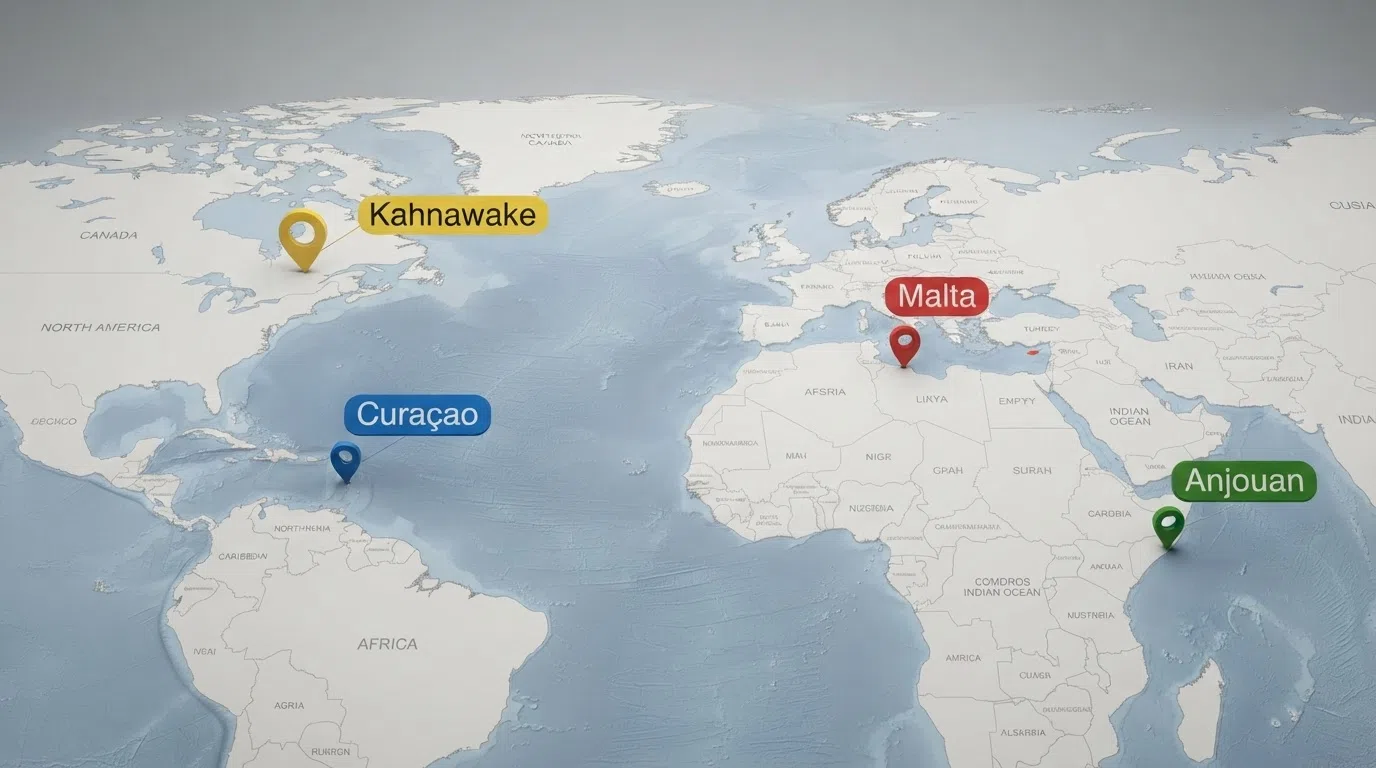
Curaçao is the volume jurisdiction of the offshore market. Application costs typically run $50,000 to $200,000 a year, with 0% gaming tax post-LOK reform. The licence is functional: the regulator validates the operator, registers the domains authorised under the licence and runs a public portal at portal.cga.cw with a dynamic seal at cert.cga.cw. The standard is not Maltese, and Curaçao’s own regulator has been candid that the regime is built to be commercially accessible rather than consumer-leading. The implication is that a Curaçao licence is enough to take bets in most markets; it is not enough, on its own, to assure a UK player they will be paid.
Malta is the EU’s gold standard for gambling licensing: best banking access, broadest market acceptance and a cost base to match. MGA applications run $25,000 to $50,000 a year with a 5% gaming tax on top. Operators choose the MGA when they want EU-compatible banking and a regulator with international credibility. The catch is fewer operators carry MGA licences because of the cost — fewer than the Curaçao market and a smaller set for the player to choose from.
Anjouan is a more recent jurisdiction for online casino licensing, with operators paying roughly €18,000 to €30,000 all-in and a 0% GGR tax. The standard is not yet established, and integrity concerns have surfaced in public. A 10 December 2025 communique from the Comorian Ministry of Finance referred the Anjouan Offshore Finance Authority to prosecutors for illegal offshore banking activity and escalated the matter to international financial authorities. Several operators in this ranking hold Anjouan licences alongside Curaçao, and that dual structure is itself worth reading carefully.
Kahnawake sits in the regulator landscape with a longer history; it is one of the older North American jurisdictions and continues to license operators, though it occupies a smaller share of the offshore market than the three above. The operator coverage available to this page does not include per-brand Kahnawake specifics, so this ranking treats Kahnawake as a presence in the wider offshore market rather than as a quantified jurisdiction for any featured brand.
Read the jurisdictional differences as cost of admission, not as a consumer protection ranking. Two operators on the same Curaçao licence can be set up to radically different standards; the licence is one signal among several, and the only one the page can verify mechanically is the register entry itself.
UKGC vs offshore: what you keep and what you give up
What a GB licence keeps in place is the regime above: stake caps, wagering caps, the credit card ban, deposit prompts, financial vulnerability checks, levy-funded treatment, GAMSTOP integration, ADR for disputes. Offshore, none of those apply. What survives the boundary is the help infrastructure — GamCare, the NHS clinics and the National Gambling Helpline still run regardless of which licence the casino holds.
What you give up is more than the badge. The disputes risk is real. If a Curaçao-licensed operator refuses to pay, the realistic complaint routes are the Curaçao Gaming Authority itself and any alternative dispute resolution provider the operator has registered with — neither of which carries the British courts’ small-claims practicality or the Commission’s backing. Operators in this ranking run wagering multiples that dwarf the British 10× ceiling, and free-spin cashout caps that bound a win to £100 in the worst cases; those terms are perfectly legal under Curaçao or Anjouan law, and they apply to UK players visiting the sites.
None of those figures invalidate offshore play. They make the cost of it visible. Read them and choose accordingly.
Licence types and requirements: from operator to dealer
A gambling licence is several different permissions, not one stamp. The Commission grants operating licences to businesses, personal licences to named individuals (key personnel, money-laundering reporting officers, directors) and software permits to game suppliers running on a remote platform. Each carries its own application, fees and ongoing conditions.
At operator level, the picture varies by jurisdiction. The MGA is the most expensive to enter and the most expensive to maintain; Curaçao is the volume play with the broadest operator base; Anjouan is cheaper still but facing unresolved integrity questions; Kahnawake continues to license but with a smaller market footprint. What an operator pays to enter each jurisdiction gives a rough sense of what an operator can plausibly invest in compliance — but it does not, by itself, certify any single brand.
Ranked: 10 offshore-licensed casinos and what their bonuses actually cost
The ten featured operators below all serve UK customers without holding a UKGC licence. None is GAMSTOP-integrated. They are presented as they are: offshore, licensed in Curaçao (one dual-licensed with Anjouan), with the standard caveat that the marketing claims have not been verified end-to-end against the CGA register for every entry. Read the wagering, the cashout ceilings and the licence status before you consider the headline numbers.
The ten featured casinos, compared on real terms
| Operator | Licence jurisdiction | Welcome bonus | Wagering | Free spins |
|---|---|---|---|---|
| MyStake | Curaçao GCB | 150% up to £750 (1st deposit); 300% up to £1,500 across three deposits | 30× deposit+bonus combined | 30 (no-deposit) |
| Goldenbet | Curaçao GCB | 300% up to £1,500 across three deposits | 35× on bonus funds | 100 |
| Donbet | Curaçao | 150% up to €750 | 30× deposit+bonus+FS combined | 50 |
| Freshbet | Curaçao | 150% up to £1,500 (1st); 300% up to £3,000 across three deposits | 30× on bonus amount | 200 across three deposits |
| Jackbit | Curaçao | 100 wager-free spins on Hot Chilli Bells | Wager-free on FS; 1× deposit+winnings | 100 (Hot Chilli Bells) |
| BC.Game | Curaçao | 120% up to $1,000 (1st); up to $4,000 across four deposits | 40× deposit+bonus combined | 400 across four deposits |
| Stake | Curaçao | No welcome match — lifetime 3.5% rakeback, $100K daily race, $75K weekly raffle | N/A (rakeback, no wagering) | None |
| Cloudbet | Curaçao and Anjouan | Up to $2,500 in rakeback + cash drops over 30 days | Zero wagering — rewards are real cash | None |
| Velobet | Curaçao | Casino: 150% up to £500 + 70 FS (under £500) or 100% up to £1,000 + 70 FS (£500+). Crypto: 160% up to €1,000 | 30× bonus (casino); 35× bonus (crypto) | 70 |
| BassWin | Curaçao (unverified) | 100% up to £1,000 + 100 FS (1st); 150% up to £1,000 + 125 FS (2nd); 200% up to £1,000 + 150 FS (3rd) | Not specified | 375 across three deposits (Fire Joker, Gemhalla, Wild Cash x9990) |

Welcome offers compared: wagering and cashout caps
| Operator | Wagering multiple | Max cashout |
|---|---|---|
| MyStake | 30× deposit+bonus combined | — |
| Goldenbet | 35× on bonus funds | £100 max withdrawal on FS winnings |
| Donbet | 30× deposit+bonus+FS combined | 5× bonus amount, up to €3,750 |
| Freshbet | 30× on bonus amount | — |
| Jackbit | Wager-free on FS; 1× deposit+winnings | — |
| BC.Game | 40× deposit+bonus combined | $10 max withdrawal per FS batch |
| Stake | N/A | — |
| Cloudbet | Zero wagering | $2,500 total cap over 30 days |
| Velobet | 30× casino; 35× crypto | £100 max cashout on FS winnings |
| BassWin | Not specified | — |
What the table tells you, before you read any operator write-up, is that the wagering column is where the offer stops looking generous. The 30× multiples dominate, with 35× and 40× for the more aggressive packages. Against the UKGC’s 10× ceiling, that is a real difference in how long the bonus takes to clear and how much the player has to risk to do it.
What separates a top-tier offshore operator
Three things, ranked by what changes a player’s actual outcome rather than the marketing click-through.
Wagering is the first. A 30× multiple on deposit and bonus combined means a real-terms effort over a real number of hours; a 40× multiple does the same at a steeper cost. Jackbit’s wager-free free spins and Cloudbet’s zero-wagering rakeback are a different model — rewards arrive as cash the player can withdraw, with only a 1× turnover condition on the deposit itself.
The cashout ceiling on free-spin winnings is the second. £100 caps at Goldenbet and Velobet, and $10 per free-spin batch at BC.Game, all bound what an apparently generous spin offer can actually pay. Not the worst terms in this market; not the best either. They are the visible sign that the “free spins” headline is not a flat win-the-spins value.
The verifiable licence is the third. Curaçao’s seal at cert.cga.cw is interactive, and a seal that resolves to a named, active licence with matching domains is a meaningful step up from a seal that doesn’t. For BassWin, that verification was not carried out independently this run; the licensee status of Curaçao is claimed rather than confirmed here.
MyStake — 150% up to £750, cleared through a 30× multiple
MyStake’s welcome package advertises 150% up to £750 on the first deposit, with the matched package running to 300% up to £1,500 across three deposits. To claim the maximum first-deposit bonus a player would deposit £500; the wagering then runs at 30× on deposit and bonus combined.
Run through the figure: a £500 deposit generating a £750 bonus brings the deposit-plus-bonus total to £1,250. Required turnover at the stated multiplier is thirty times that — £37,500 — across the 30-day validity window. With a £5 maximum bet during wagering that amounts to 7,500 individual game cycles. At five seconds per cycle the play runs to roughly 42 minutes of continuous play, on the assumption that only the bonus amount is being turned into withdrawable funds and the bonus itself is the prize at the end of it. That is the time cost of clearing the offer. The bonus amount is the headline; the 42 minutes is what the headline costs.
Min deposit: £20. Max bet during wagering: £5. Bonus validity: 30 days. Licensed by Curaçao GCB.
The cleanest 30× in the ranking for a player willing to deposit enough to clear it. Less sensible for a player who won’t see the wagering through.
Goldenbet — 300% up to £1,500 across three deposits
Goldenbet runs the largest match percentage in the featured set — 300% up to £1,500 across three deposits, plus 100 free spins to round out the package. The wagering sits at 35× on bonus funds and 10× on free-spin winnings, with a £100 maximum withdrawal on FS winnings. Min deposit: £20.
The 35× multiple is where the offer does most of its work on the player. Across three deposits the matched total is bigger than at most competitors, but the wagering is steeper too, and the £100 FS ceiling caps the most visible short-term upside. A reader attracted to the headline figure should check whether the wagering terms settle into something they can clear inside the validity window — at high RTPs and a sensible bet, 35× on bonus funds is several thousand slots cycles per stage, and that compounds across the three-stage structure.
Licensed by Curaçao GCB.
For a player who’ll work through three deposits and accept the FS cap, this is the largest match in the ranking. For everyone else, the multiple does the work that the headline doesn’t.
Donbet — a 5× cashout ceiling that caps the win
Donbet’s headline is 150% up to €750 plus 50 free spins. The 30× wagering applies to deposit, bonus and free-spin winnings combined. Min deposit: €20. Max bet: €5. Bonus validity: 30 days. What makes this offer distinct in the featured set is the cashout ceiling: max withdrawal capped at 5× the bonus amount, up to €3,750.
The cap is the offer, in operational terms. A player running the wagering to completion and converting the bonus to withdrawable funds can still take out only up to €3,750 — five times the bonus face value. Anything above that is forfeited under the bonus terms. Read the ceiling before the percentage; the 150% match is generous in advertising only up to the cashout line.
Licensed by Curaçao.
The cashout ceiling is the deciding feature. A capped win is a different offer from an uncapped one, and the percentage alone doesn’t show that.
Freshbet — a three-stage package totalling 300%
Freshbet runs a three-deposit ladder: 150% up to £1,500 + 100 free spins on the first, 100% up to £1,000 + 50 free spins on the second, 50% up to £500 + 50 free spins on the third. The matched total across the three is up to £3,000 + 200 free spins. Wagering: 30× on the bonus amount. Min deposit: £20 per stage.
The wagering structure is simpler than Donbet’s: 30× on the bonus only, not on deposit and bonus together, and not on free-spin winnings rolled in. That is a saving of a few thousand cycles per stage at the headline figures, though the per-stage rollover across three deposits still requires thousands of game cycles in total. The British slot stake ceiling does not apply, so the practical max bet is whatever the bonus terms permit.
Licensed by Curaçao.
The ladder structure rewards patient depositing. For a player comfortable spreading three deposits across three weeks, this is a workable mid-tier choice.
Jackbit — wager-free spins on a 97% RTP slot
Jackbit is the one offer in the featured set without wagering on the free spins. The welcome consists of 100 wager-free spins on Hot Chilli Bells, with a £50 minimum deposit and a 1× turnover requirement on deposit and any winnings before withdrawal.
Hot Chilli Bells is the right slot for the offer’s positioning. The title runs at 97% RTP — high for an online slot, with medium-low volatility and a 5,000× maximum win. BGaming released it in January 2025, and the RTP figure published by the supplier sits in the upper band of current releases. The combination of high RTP and low volatility matters here because the only turnover requirement is 1× on deposit and winnings: at 97% RTP and modest variance, players see a relatively steady stream of returns rather than the long dry patches more typical of medium-volatility slots.
The trade-off is the bonus value. Without a matched-deposit bonus, the headline figure is the value of the spins, not a percentage match. For a player who prizes cashout potential over bonus size, that is the right offer.
Licensed by Curaçao.
The cleanest entry in the ranking for a player who prizes cashability above matched-percentage value. For a player chasing the biggest matched-deposit headline, this isn’t it.
BC.Game — four deposits, 40× combined wagering
BC.Game runs the deepest package in this ranking: 120% up to $1,000 plus 100 free spins on the first deposit, followed by 100% up to $1,000, 80% up to $1,000, and 80% up to $1,000 on the second, third and fourth deposits respectively, each with an additional 100 free spins. The matched total runs up to $4,000 plus 400 free spins across four deposits. Wagering: 40× on deposit and bonus combined. Bonus validity: 30 days. Max withdrawal per FS batch: $10.
The 40× multiple is the steepest in this ranking and turns the offer into a long-haul clearance rather than a short-term bonus. A player depositing the full $1,000 to claim the $1,000 match on the first deposit has $2,000 in deposit-plus-bonus, multiplied by 40, giving required turnover of $80,000 on the first stage alone — and that compounds across four stages. The $10 maximum withdrawal per FS batch caps the spin-side value further.
BC.Game is also one of the brands that advertises no-KYC at sign-up, with the right to request full verification at withdrawal. Read the small print before depositing.
Licensed by Curaçao.
The deepest match and the steepest wagering multiplier in this ranking. Volume players only.
Stake — no welcome match, lifetime rakeback instead
Stake is the set’s outlier on bonuses. There is no first-deposit match. The replacement structure is a lifetime rakeback at 3.5% of the theoretical house edge, plus a daily $100,000 wager race and a weekly $75,000 raffle. The model returns a percentage of what the player has wagered rather than offering a one-off match on top of it.
For a high-volume player, that can work out ahead of a typical 30× bonus; for a low-volume player, it underperforms a matched offer within the first few deposits. The race and raffle are leaderboard-style prize pools with turnover-weighted entry rather than bonus-related play, and they sit on top of the rakeback without replacing it. There is no wagering requirement on any of these rewards; they pay out in cash.
Licensed by Curaçao.
For high-volume crypto play, rakeback outperforms a one-off matched bonus over time. For low-volume play this is the offer to skip — and that’s the honest frame.
Cloudbet — rakeback with zero wagering attached
Cloudbet carries dual Curaçao and Anjouan licences and runs a welcome package of up to $2,500 in rakeback and cash drops over 30 days, paid as real cash with no wagering requirement. The only turnover condition is 1× on the deposit itself.
The structure rewards by percentage of activity rather than by matched deposit, with the cash drop element delivering prizes across the 30-day window. There are no free spins attached; the only valuable reward is the cashback-style return, which is the polar opposite of a matched bonus in player outcomes. For a player who values cashability above all else, this is the cleanest offer in the ranking.
Licensed by Curaçao and Anjouan.
For a player who prizes cashability above matched value, the cleanest entry in this ranking. The dual licence is the only one of its kind here, with an Anjouan integrity caveat that comes with any Anjouan-licensed operator.
Velobet — two tracks and a £100 free-spin ceiling
Velobet runs three tracks under one licence. Under the casino track, deposits under £500 get 150% up to £500 plus 70 free spins; deposits of £500 or more get 100% up to £1,000 plus 70 free spins. The crypto track runs 160% up to €1,000 at 35× wagering. Casino wagering: 30× on the bonus. Free-spin wagering: 35×, with a £100 max cashout.
The crypto track at 35× on the bonus amount is the steeper path; the casino track at 30× is closer to the rest of the set. The £100 free-spin ceiling matches Goldenbet’s cap and is the boundary between marketing value and cashable value on the spin component. Min deposit sits at the standard £20 mark, and Velobet’s presentation of three different offers is itself a small marketing tell — three packages is one more than the player needs to compare line by line.
Licensed by Curaçao.
The three tracks give a player the choice to optimise. The £100 free-spin cap is the consistent feature across all of them.
BassWin — 375 spins over three deposits, licence unverified
BassWin runs the largest free-spins total in this ranking — 100 free spins on Fire Joker with the first deposit (100% up to £1,000), 125 free spins on Gemhalla with the second (150% up to £1,000) and 150 free spins on Wild Cash x9990 with the third (200% up to £1,000), totalling 375 free spins across three deposits.
The catch is verification state. The brand claims a Curaçao licence; this run did not independently verify that claim against the CGA public register. The 375 free spins figure is the offer; the licence question is what the offer is built on. A player drawn to the headline should resolve the licence first.
The named slots carry RTPs that vary across releases. Fire Joker and similar classics sit lower than the 97% Hot Chilli Bells figure, so the spin-side value of the package is not as straightforward as the spin count suggests.
Licensed by Curaçao (unverified this run).
A big spin count with an unverified licence. The headline reads well; the verification reads less well. Read the verification before you read the headline.
Crypto and no-KYC play: anonymity at a price
Crypto deposit rails are the second-largest reason a UK player ends up offshore, after the bonus value itself. Two of the featured operators — Stake and Cloudbet — make crypto the centre of their model rather than a deposit option. Both are Curaçao-licensed; Cloudbet carries a parallel Anjouan licence.
What a licensed crypto casino is
A licensed crypto casino is still a licensed casino — the coin is the deposit rail, not the regulatory framework. The licence still comes from Curaçao, the MGA, Anjouan or another offshore jurisdiction, and the operator’s duties to that regulator don’t change because the deposit is in BTC rather than GBP. The difference is operational: crypto deposits typically settle faster, can avoid the conventional banking system entirely, and give operators access to deposits from players whose card-issuer blocks gambling transactions outright.
In the featured set, Stake is the largest fully-crypto casino; Cloudbet runs both fiat and crypto rails under its Curaçao and Anjouan structure. The crypto bonus structure differs from the standard matched-deposit model: Stake’s 3.5% lifetime rakeback is calculated on the theoretical house edge of every wager, and Cloudbet’s zero-wager rakeback is a similar mechanic with no rollover.
Bitcoin and altcoin casinos: what the research found
Bitcoin dominates the crypto side of this ranking by operator coverage. Stake and Cloudbet both process BTC deposits and withdrawals; BC.Game accepts a wider altcoin range across its 70-plus provider platform. Litecoin appears as a supported coin at most crypto-first operators, but no per-operator bonus terms for Litecoin specifically were available to research; treat that as a deposit rail, not as a separate offer structure.
The crypto bonus track is typically lower-percentage than the headline casino track but with a higher ceiling — Velobet’s crypto track at 160% up to €1,000 is the cleanest example in this ranking. The implicit reason is that crypto deposits cost the operator less to process, so the bonus is set higher to share some of that saving back. Crypto wagering sits in the same 30× to 35× range as the standard casino track.
No-KYC casinos and the withdrawal-time KYC catch
No-KYC is a marketing promise, not a steady state. Several brands in this ranking — BC.Game and Jackbit in the featured set — accept sign-up with an email and deposit anonymously, and they advertise that feature. The catch is at withdrawal.
Most no-KYC operators reserve the right to request full KYC at the point of withdrawal. The trigger varies: large withdrawal amounts, unusual patterns, source-of-funds questions, or simply a regulator-mandated check at the point of payout. The rule of thumb is straightforward — if a player wants to withdraw without ever sending documents, no operator in the offshore market is structurally committed to that. The decision changes at the moment a withdrawal is initiated.
Some operators also tolerate or actively encourage VPN access, which can breach their own terms depending on jurisdiction and player location. A player using a VPN to access a service not licensed for their country is gambling on the operator’s enforcement of their own rules.
Choosing a safe licensed crypto casino
The verification steps look the same as for any other offshore brand: check the seal at cert.cga.cw for Curaçao or the MGA register for Malta. Add one more layer for crypto-specific risk — custody and coin volatility. Custody: how is the operator storing customer deposits, and are segregated funds visible? Volatility: a £500 deposit on Monday in BTC is not necessarily £500 on Friday, which means the bonus value and the wagering arithmetic can drift between deposit and clearance.
The bonus terms at crypto-first operators do not change with the coin; the underlying volatility does. Treat the deposit amount as a value at the time of the wagering, not at the time of the deposit.
How to verify a licence and spot a red flag before you deposit
A licence you can verify on the regulator’s own register is a licence you can trust. A licence that won’t resolve against its own register is a licence to walk away from. The verification is mechanical, not a matter of trust.
Verifying a casino’s licence against the official register
The Curaçao seal at cert.cga.cw resolves to a Certificate of Operation page that lists the licence holder, the licence status (active, suspended or revoked) and the authorised domains. If the seal in the operator’s footer does not resolve, does not display a status, or shows a status other than active, that is the verification failure. Some operators also display a registered name and licence number in the footer, which can be cross-checked against the CGA’s public management portal at portal.cga.cw.
For Malta, the MGA’s public register at mga.org.mt is searchable by name, status, URL or service. A brand that claims an MGA licence but does not appear on the register, or appears with a status other than active, is not in good standing. The MGA’s record carries the date the licence was issued and any conditions or sanctions.
Choosing a safe and reputable operator
Safety, in this market, is the licence plus the register plus the published terms. Check the regulator’s record, the terms’ enforceability and the operator’s payment terms in tandem. A licence without a register entry is a marketing claim. A register entry without published terms is incomplete. A licence with published terms but an unregulated banking arrangement is a different risk entirely.
At a higher tier, look at the corporate group, the personal licence holders, the providers the operator runs, and the length of time the operator has held the licence. Curaçao’s regime has changed over time, and licences issued after the LOK reform sit under a different regime than pre-reform Curaçao licences. An operator licensed in 2025 looks different on the register than one licensed before the reform.
Red flags and warning signs
The two loudest red flags are an unverifiable licence and a missing regulator entry. If the seal doesn’t resolve, if the licence number doesn’t appear in the regulator’s database, if the operator’s name on the seal does not match the operator’s marketing name, the licence is the verification failure.
Next-tier flags: payment delays that are not explained by verification requests, ambiguous terms on bonus and withdrawal, no published ADR provider, no clear company address, and any feature that suggests the operator is concealing ownership structure. The December 2025 Anjouan integrity communique, with its referral of the AOFA to prosecutors, is itself a flag against any operator relying solely on an Anjouan licence — Curaçao as a parallel licence is the safer combination.
A separate flag in this ranking: BassWin’s licence was claimed but not independently verified this run. That note appears in the comparison table and in the write-up; it is a research state, and a player considering BassWin should verify independently before depositing.
The protections you leave behind — and the help that still works
The UK licence regime wraps a set of player protections around each session. Offshore, those protections mostly stop at the border. What survives the border is the help infrastructure.
The player-protection rules a GB licence enforces
A GB licence enforces seven interlocking protections. GAMSTOP coverage, so a player who has self-excluded cannot open a new account at any GB-licensed operator. Credit card prohibition, extended to credit-card-funded e-wallets since 14 April 2020. Stake caps on online slots, age-banded at £5 (25+) or £2 (18 to 24) per game cycle. Auto-play ban and minimum 2.5-second spin speed. Mandatory deposit prompts from 31 October 2025, with a standardised gross deposit limit from 30 September 2026. A light-touch financial vulnerability check at £150 net deposit in rolling 30 days. A 1.1% statutory levy on gross gambling yield, with proceeds funding treatment, prevention and research.
GAMSTOP itself carried over 562,000 active exclusions at the end of 2025, with 58,675 new registrations in the second half — a 40% rise in under-25 registrations over the same period. The scheme covers every GB online licence. It does not, by design, cover offshore sites.
The deposit-limit regime is the recent shift. From 31 October 2025 GB operators must prompt a customer to set a financial limit before first deposit, and decreases apply immediately. From 30 September 2026 a standardised gross deposit limit must be offered across the remote casino sector under RTS 12, with the actual level to be set in formal consultation. The mechanism is “the prompt compels the offer”; the level is the player’s.
Responsible gaming at non-UK casinos: what’s actually there
GAMSTOP does not cover non-UKGC sites. A self-excluded UK player cannot open at a Curaçao-licensed casino under that exclusion. No UKGC complaints route exists. No Commission-approved ADR provider exists for these sites. No British consumer redress is available if funds are withheld.
What tools do exist on the featured sites are operator-set: deposit limits, time-outs, account-level self-exclusion. None of these binds the operator to the same standards as a GB licence, and none provides the regulator-backed recovery routes that GAMSTOP, the Commission’s ADR acceptance and the ombudsman-style frameworks do. The Commission’s offshore enforcement targets operators, not individual complaints.
A player considering offshore play who is weighing their safety net should think of it as a personal responsibility list rather than a regulator-backed list: set your own deposit and time limits, monitor your own play against an external record, and use the help resources below if the check no longer adds up. GAMSTOP is mandatory for every GB online licence; offshore, that obligation does not exist.
GamCare, the NHS and other help that survives the border
The help infrastructure is British and operates regardless of where the gambling itself happens. The National Gambling Helpline (0808 8020 133, free, confidential, 24/7, with live chat available) takes referrals at all hours. GamCare, which runs the helpline, reported 996 referrals to treatment and peer support in January 2026 — a 48% increase on the 674 in the same month of the previous year.
The NHS runs gambling harm clinics in England, Scotland and Wales. GambleAware funds prevention and treatment, including the National Gambling Support Network — that network saw 11,960 clients treated in the year April 2024 to March 2025, an 11% rise on the previous year. Gamblers Anonymous runs peer support. Together they cover the player who has slipped across the line, the player who is weighing whether to play offshore, and the player already in trouble.
Prevalence figures sit behind all of this. About 0.5% of adults in England are problem gamblers (PGSI 8+), with 3.8% at elevated risk and an estimated 7% of the British population negatively affected by someone else’s gambling. The NHS Adult Psychiatric Morbidity Survey 2023/24 put the problem gambling figure at 0.4% of adults (PGSI 8+), with 1.6% at moderate risk or above (PGSI 3+). These are the numbers the help infrastructure is calibrated to. A player reading this page should know what they look like before they need them.
How we chose and ranked the featured operators
The featured ten are the operators whose terms are researchable, whose licences are verifiable against at least one public register and whose UK-availability is direct rather than claimed. The comparator is the affiliate lists that dominate the top of search results for this query — pages that list 8 to 15 brands each with three to five bullet fields.
The ranking rests on three checks. First, licence verification — the Curaçao Gaming Authority’s public portal at portal.cga.cw and the dynamic seal at cert.cga.cw, plus the MGA’s public register at mga.org.mt. Second, terms reading — wagering multiples, free-spin caps, validity windows, minimum deposits, maximum-bet caps and the cashout ceilings that turn a marketing figure into an operator-side number. Third, payment terms — deposit rails, withdrawal caps, timeframes and verification requirements at withdrawal.
What the ranking does not use is operator reputation surveys, game provider depth or subjective player experience — there is no audited basis for those and this page does not claim one. The featured set is the set this ranking is built on, not the entire offshore market.
BassWin’s Curaçao licence is the one entry whose verification was not completed this run. That note appears beside its name in the comparison table and in its write-up; it is a research state, not a brand property.
When an offshore casino is not worth the protection you lose
Scepticism, not a recommendation, is the right frame for the end of this page.
The wagering alone tells the story. The UKGC’s 10× cap, in force from 19 December 2025, fixes a ceiling on how much of a bonus a player must turn over to clear it. The featured offshore offers in this ranking sit at 30×, 35× and 40× multiples, on deposit and bonus combined. Run the arithmetic: a 150% matched bonus of £750 with 30× wagering on the deposit-plus-bonus total needs £37,500 of turnover, 7,500 game cycles at a £5 bet and roughly 42 minutes of continuous play. That is the time cost of clearing the offer — separate from any consideration of how much the bonus is actually worth, net of the house edge, after that period.
The stake cap is the other ceiling. A player used to £5 spins on a UK-licensed site is constrained offshore only by the operator’s bonus terms — typically a £5 cap during wagering, often higher outside bonus play. That is flexibility, and it comes with longer sessions.
Then there is GAMSTOP. The exclusion that takes hold at one GB-licensed site takes hold across the lot. At an offshore site, it takes hold at that site only. For a self-excluded player, that is precisely the gap the offshore market is built to provide — and precisely the gap a regulator, by design, cannot close. The British regime cannot reach it; the player’s own commitments have to.
The arithmetic doesn’t argue for one operator or another, because the arithmetic is independent of operator choice. What it argues is for clarity on what is being given up. Read the wagering column, the cashout column and the licence column together. Treat the absence of any of them — the “not specified” entries in the comparison table — as a reason to ask before depositing. A bonus that doesn’t say what it costs is a bonus that should not be claimed.
For a high-volume crypto player who values cashability over bonus size, Cloudbet or Stake delivers a different offer than a matched-deposit casino — without a matched-deposit bonus, and without the wagering that comes with one. For a low-deposit slot player testing a new site, Jackbit’s wager-free spins on a 97% RTP game are the cleanest entry in this ranking. For a player who has self-excluded at home, no offshore site should be the answer; the answer is the help infrastructure, which works regardless of where the gambling happens.
None of the figures above declares a winner. The decision is the player’s, and the decision should turn on the figures the page has laid out: the 10× ceiling that bound wagering in Britain, the £5/£2 stake cap that bound slots, the 562,000 active GAMSTOP exclusions that bind exclusion and the 40% Remote Gaming Duty that drives operators toward this market in the first place.
Frequently asked questions
Is it legal for UK players to gamble at a casino without a UKGC licence?
Accessing an offshore casino is not a criminal offence for the player. The point-of-consumption duty makes a GB Gambling Commission licence compulsory for any operator serving GB customers, and operating without one is a section 33 Gambling Act offence — but the sanction falls on the operator, not on individual gamblers. The player gives up protection, not liberty.
Can I use GamStop self-exclusion at non-UK licensed casinos?
No. GAMSTOP integrates with every GB online gambling licence; offshore operators are not in the scheme, and the Commission has no jurisdiction to extend it to them. A self-excluded player can still open accounts at Curaçao-licensed sites. GamCare and the National Gambling Helpline apply regardless of where you play.
Are crypto casinos without UK licences safe to play at?
Licensed crypto casinos are licensed casinos — the coin changes the rail, not the regulatory framework. The same Curaçao and Anjouan rules apply whether the deposit is in BTC or in pounds. The catch is KYC: no-KYC brands typically reserve the right to request full verification at withdrawal, and that right is usually exercised when it counts.
Do non-UK licensed casinos accept credit card deposits?
Often yes, because the credit card ban is GB-bound. The LCCP condition 6.1.2 stops GB licensees from accepting credit card payments — including credit-card-funded e-wallets — but offshore operators are not subject to it. The choice not to use one is the player’s, not the regulator’s.
What happens if a non-UK casino refuses to pay my winnings?
The routes narrow. There is no UKGC complaints mechanism for non-UKGC sites and no approved British alternative dispute resolution provider. The complaint goes to the regulator that issued the licence — typically the Curaçao Gaming Authority or the MGA — and to any ADR provider the operator has registered. Enforceability depends on the jurisdiction.
Licence – No Minimum Deposit Casinos UK
Content created by the «No Minimum Deposit Casinos UK» team