
No account casinos in the UK — what the marketing hides and what you can actually get
 Available in GB
The phrase “no account casino UK” promises a friction-free product: deposit, play, withdraw, no forms, no documents, no waiting. It is one of the most searched terms in British online gambling, and one of the most misleading. Under the Gambling Commission’s Licence Conditions and Codes of Practice, a licensed operator must verify your name, address and date of birth before you are permitted to place a single spin — not at withdrawal, not after a deposit, but before gambling begins. That requirement has been in force since 7 May 2019, and it does not bend for marketing copy. A true “no account” casino cannot legally operate under a GB licence. What you can get is a fast-registration UK casino, and the ten on this page are the closest the law comes to delivering on the original promise — minutes, not seconds, and always with identity confirmed first.

Data current as of 28 August 2026 and cross-checked against the Gambling Commission’s public register of licence holders.
True “no account” casinos do not exist in the UK — here is what you actually get
The search term persists because the experience it describes is genuinely desirable. Nobody opens a casino account for the pleasure of uploading a passport scan. The phrase has weight because it names a real frustration: slow forms, repeated document requests, payout holds attached to compliance checks. The UK gambling market does not have a product that removes those steps. What it has, and what this page is about, is a tier of UKGC-licensed casinos that have streamlined the legal version of sign-up to its shortest possible form.
What a “no account casino” actually promises — and why the name misleads UK players
The pitch is simple. You land on a casino site, type a deposit amount, authorise the payment through your bank, and you are playing. No username, no password, no address fields. The site provisions an account invisibly, links it to your verified bank identity, and the entire process is over before the page has finished loading. Trustly’s Pay N Play technology, which powers most of the offshore casinos that use this marketing, resolves the flow in under sixty seconds. The bank authentication returns your identity and your deposit at the same time, and the casino is built to accept that as a complete sign-up.
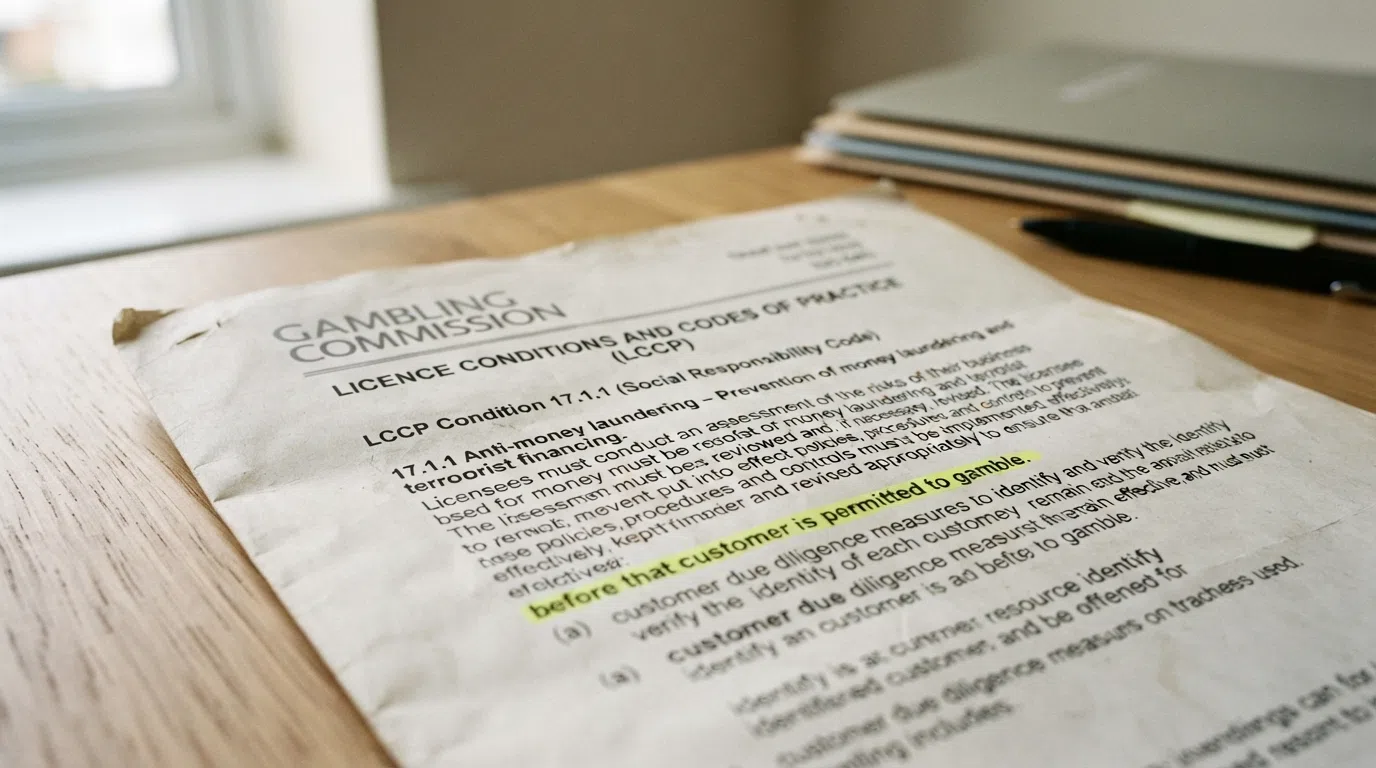
The problem is not that the technology is fictional. It works, and it works well in the markets it was designed for. The problem is that the model assumes a payment rail and a digital identity system that Britain does not have for gambling purposes. The UK Gambling Commission does not treat a bank login as proof of identity in the way the Swedish Spelinspektionen does. Under LCCP Condition 17.1.1, licensees must “obtain and verify information in order to establish the identity of a customer before that customer is permitted to gamble.” That is the exact wording, and it has been the rule since 7 May 2019. The operator must independently confirm who you are, using documents or a verified database, before you touch a game. A bank authentication step is a payment convenience, not a substitute for that check. The “no account” promise, in a UK context, is a marketing claim attached to a product the law does not allow.
How Pay N Play works — the Nordic model Britain cannot copy
The Pay N Play flow is a single uninterrupted sequence. The player clicks deposit, is redirected to their bank, enters their bank credentials or opens their banking app, and approves the transaction. Trustly, the dominant provider, then returns three things to the casino: confirmation that the payment cleared, the verified identity attached to the bank account, and a token that authorises the casino to provision an account on the player’s behalf. From the player’s point of view, the entire process — landing on the site, depositing, identifying yourself, and being ready to play — takes less than a minute. Globally, Trustly has passed 120 million users on this model.
That sequence depends on a digital identity infrastructure Britain has not built for gambling. In Sweden, the bank login is backed by BankID, a government-issued digital identity that carries the legal weight of a verified person. A casino that accepts a BankID-authenticated deposit is accepting a government-verified identity, and the Swedish regulator accepts it as satisfying KYC. The UK has open banking, which moves money between accounts securely, but it does not have a gambling-grade digital identity layer that the Gambling Commission treats as equivalent to the operator running its own checks. So when a Pay N Play casino markets itself to British players, it is either licensed somewhere that does not require the same checks (Curaçao, Malta, Anjouan), or it is licensed in the UK and quietly running a verification step the marketing prefers not to mention. Either way, the “no account” experience as delivered in the Nordics is not legally reproducible in Britain.
What UK-licensed casinos actually give you: verification-first, not account-free
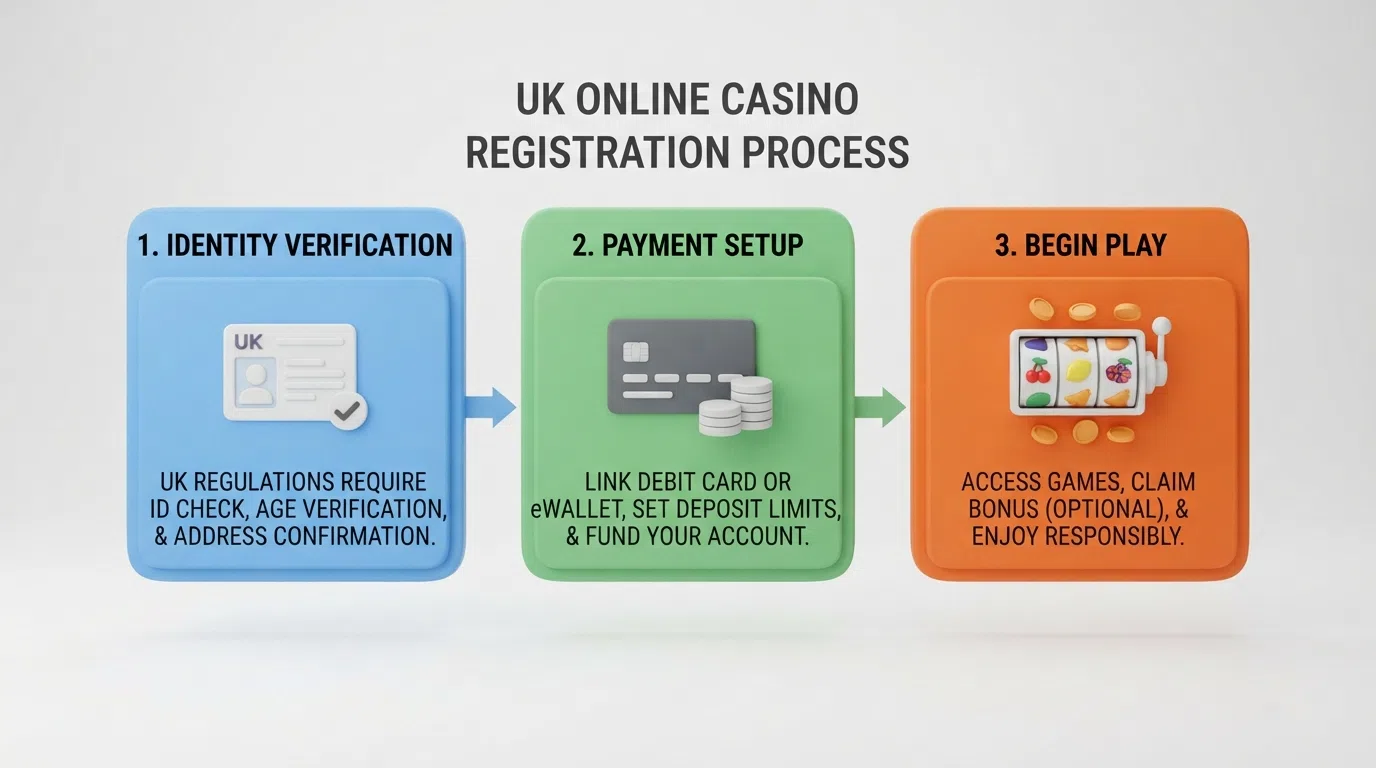
The real registration flow at a modern UKGC-licensed casino is faster than the “no account” label suggests, and the gap is the only one that matters. You fill in a short form — name, email, date of birth, address — and the operator runs the details against a verification database. If the match is clean, you are approved within minutes, sometimes seconds. You deposit and you are playing. The whole sequence, from the landing page to the first spin, is typically under five minutes at the fastest operators, and it is occasionally faster than that. This is not a Pay N Play sixty-second experience. It is also not the multi-day document-upload grind that older UK casinos used to run. It is the legal middle ground, and it is what every operator on this page delivers.
The trade-off, and the reason the UK approach is not just bureaucratic inertia, is the protection layer that comes with the licence. GAMSTOP, the national self-exclusion register, has been a mandatory condition of every Gambling Commission online operating licence since 31 March 2020. One registration blocks every GB-licensed site for the period chosen, and the periods run from six months to five years, with an option to renew automatically. Age-banded stake limits — £5 per game cycle for players aged 25 and over, £2 for those aged 18 to 24 — apply to every licensed slots product. None of that exists at an offshore “no account” casino, and the absence is not a minor caveat. It is the difference between gambling inside a regulated framework and gambling outside it.
Real-money play, mobile access and the games waiting after verification
Once verification is complete, the experience at a UKGC-licensed casino is full-featured. Slots catalogues run into the thousands — bet365 lists 1,800+ across its Vegas, Casino and Games lobbies, and the Flutter and Entain brands sit in the same range. Live dealer tables, RNG table games, jackpots, scratchcards and game-show formats are all standard. Demo mode is available across every featured operator, so a player can try a game before staking real money, and the catalogue can be browsed without depositing at all. Mobile access is via browser rather than a dedicated app in most cases, and the responsive sites are built to the same standard as a native download.
The post-verification experience is not a stripped-down version of a casino. It is the same product an account-holder at a traditional UK casino gets, reached through a faster door. The auto-play ban, the 2.5-second minimum spin speed, the ban on losses disguised as wins — all of those rules apply from the first spin, and a player experiences the regulated product immediately. Demo mode lets a player feel those rules: a single spin takes its time, the winnings and losses are displayed transparently, and the session clock ticks in the corner. That is what “account-free” actually means under British law, and it is a more constrained product than the marketing of an offshore casino suggests.
10 UKGC-licensed casinos built for speed: register and play in minutes
The ten operators below all hold an active UKGC Casino Remote licence. They are not ranked by a scored index — there is no single number that captures the difference between a 500-free-spin welcome at bet365 and a £30-capped offer at William Hill. They are ordered by topical relevance: the brands most strongly associated with fast, streamlined UK sign-up appear first, and the cluster tightens around the same Entain and Flutter platforms as the list progresses. The comparison table summarises the field; the profiles that follow give each brand a verdict.
| Operator | UKGC licence | Welcome bonus | Free spins | Wagering | Demo mode |
|---|---|---|---|---|---|
| bet365 | Active | Up to 500 free spins | 500 | 0× | Yes |
| Sky Vegas | Active | 250 free spins | 250 (50 no-deposit) | 0× | Yes |
| William Hill | Active | 200 free spins | 200 | 0× (£30 cap) | Yes |
| Ladbrokes | Active | 100 free spins | 100 | 0× | Yes |
| Coral | Active | 100 free spins | 100 | 0× | Yes |
| Paddy Power | Active | 260 free spins | 260 (60 no-deposit) | 0× | Yes |
| Betfair | Active | 150 free spins | 150 (50 no-deposit) | 0× | Yes |
| 888 Casino | Active (since 2014) | 100% match up to £100 | — | Subject to 10× cap | Yes |
| Gala Casino | Active | 100 free spins | 100 | 0× | Yes |
| Virgin Games | Active | 100 free spins | 100 (Game of Thrones) | 0× | Yes |
Offshore “no account” casinos versus UKGC-licensed operators: the split that defines this page
The UK online gambling market runs on two parallel tracks, and a player choosing between them is choosing between two different products with two different risk profiles. The first track is the licensed market: operators holding an active UKGC Casino Remote licence, subject to the LCCP, the RTS and the Gambling Commission’s enforcement. The second track is the offshore market: operators licensed in Curaçao, Malta, Anjouan or other jurisdictions, marketing aggressively to British players, and offering “no account” play because their home regulator does not require what the UKGC requires. A Curaçao-licensed site can let a player deposit and play in seconds because nobody is asking for verified identity. That is the whole selling point. It is also the whole risk.
A licensed site gives a player GAMSTOP, the £5/£2 stake caps, the 10× wagering ceiling, the ban on reverse withdrawals, the ban on losses disguised as wins, the 2.5-second spin speed floor, an alternative dispute resolution route, and segregated customer funds. An unlicensed site gives a player none of these. Operating without a GB licence while serving British customers is a criminal offence under section 33 of the Gambling Act 2005, and the Commission treats it as one: between April 2024 and June 2025, it issued 3,140 disruption notices, referred 447,778 URLs to search engines for delisting, and saw 287,961 of those URLs removed. Enforcement is disruption-based rather than ISP-blocking — the sites remain reachable, but they are pushed down search results, have their payment routes choked off, and lose access to UK-facing affiliates. The unlicensed alternative is not just a faster sign-up. It is an unprotected one.
bet365
bet365’s UKGC licence is held under Hillside (UK Gaming) ENC, account number 38721, currently active. The welcome offer is up to 500 free spins, released in 10 daily reveals of between 5 and 50 spins on selected Fishin’ Frenzy and King Kong Splash titles. The value per spin is £0.10, and the winnings carry zero wagering requirements. The minimum deposit to qualify is £10 (a lifetime minimum — existing customers who have never deposited also qualify). The catalogue is the largest on this page: 1,800+ slots across three lobbies, plus a full live casino, table games and jackpots. Demo mode is available throughout, and the mobile site is among the most responsive in the UK market. The 30-day window to claim from registration and 7-day window per daily batch are worth noting in the small print, but they are generous by the standards of the field. For players prioritising catalogue scale and high-volume free spins, bet365 remains the industry’s most comprehensive choice.
Sky Vegas
Sky Vegas operates under Sky Betting & Gaming, a Flutter Entertainment subsidiary, with an active UKGC Casino Remote licence. The welcome is split into two tiers: 50 free spins credited without a deposit, plus 200 more triggered by depositing and spending £10 on slots within 30 days of registration. All 250 spins are wager-free, and there is no stated cap on winnings. The 50 no-deposit spins are a genuine no-deposit offer — they are credited on registration, not after a first transaction, and any winnings are paid as cash. The Sky brand operates multiple casino lobbies, so the game range is wide, and demo mode is available on the same games. The deposit-and-spend trigger is the standard pattern across the Entain and Flutter brands on this page, and Sky’s offer is the strongest of the no-deposit alternatives for a player who wants to try the casino before committing a penny.
William Hill
William Hill’s licence is held under evoke plc, with an active UKGC Casino Remote licence. The welcome is 200 free spins on Big Bass Splash at £0.10 per spin, triggered by depositing £10 and staking it on slots within 7 days. The winnings are wager-free — but they are capped at £30, which is the small print that matters. The cap is the price of the headline number, and a player who works out the maths finds that 200 spins at £0.10 with a £30 ceiling is a fixed-odds proposition: you are playing for the chance to win up to £30, not the chance to win whatever a high-variance slot will pay. The 72-hour bonus validity is tight, so the spins need to be used promptly. The brand’s reputation for security makes this a safe entry, though the £30 cap on winnings will disappoint players chasing high-variance volatility.
Ladbrokes
Ladbrokes holds an active UKGC Casino Remote licence under Entain. The welcome is 100 free spins on selected games at £0.10 per spin, triggered by depositing and spending £10 on slots. The spins are wager-free, with no stated cap on winnings, and the 48-hour acceptance window followed by a 7-day validity is the standard Entain format. Ladbrokes runs a large catalogue through the group platform — Blueprint, Pragmatic Play, Red Tiger, Playtech, IGT and NetEnt are all represented. Demo mode is available across the slots. The offer is not the largest on this page, but it is straightforward: deposit, spend, take the spins, keep what you win. This is a reliable, no-nonsense bonus that suits players who prefer familiar Entain lobby mechanics over chasing novelty-weighted offers.
Coral
Coral is the third Entain brand on this page, and its welcome mirrors Ladbrokes almost exactly: bet £10 on slots, receive 100 free spins on selected games at £0.10 each, wager-free with no stated cap. The 48-hour acceptance and 7-day validity are the same, the wagering is zero, the demo mode coverage is the same. The differentiator is brand familiarity and product layout rather than bonus terms, and a player choosing between Coral and Ladbrokes is choosing on the strength of the lobby design and the loyalty programme rather than the welcome. For a player who has shopped at a Coral bookmaker on the high street and wants the casino version, the offer is the natural place to start. The bonus itself is unspectacular by comparison with bet365 or Paddy Power, but it is a clean, wager-free, low-friction entry.
Paddy Power
Paddy Power holds an active UKGC Casino Remote licence as part of Flutter Entertainment. The welcome is the largest combined free-spin count on this page: 260 spins in total, split into 60 no-deposit spins credited on registration and 200 more on a £10 deposit. The winnings are paid as cash with zero wagering, and the 7-day validity applies to the deposit-triggered batch. Eligible games vary by promotion period, which is a minor unknown the small print covers. The Flutter group catalogue is large, demo mode is universal, and the brand voice is the most distinctive in the UK market — the same irreverence that runs through Paddy Power’s sportsbook shows up in the casino promotional emails. This offer delivers arguably the best value on the list, making it the primary choice for bonus-focused players.
Betfair
Betfair’s UKGC Casino Remote licence is held under Flutter Entertainment, the same group as Sky Vegas and Paddy Power. The welcome is 150 free spins: 50 no-deposit on Jackpot King games, plus 100 on a £10 deposit on Crabbin’ For Cash Extra Big Catch. Wagering is zero, validity is 7 days, and the no-deposit tier is the same acquisition tool used by Sky Vegas and Paddy Power. The Jackpot King selection on the no-deposit spins is a meaningful differentiator: those games are part of Blueprint’s progressive network, and the no-deposit tier gives a player a chance at a pooled prize without staking anything. The Jackpot King titles do not all run in demo mode at every UK operator, so the no-deposit offer is the cheapest way to feel the network. The dual-tier no-deposit and deposit offer provides a balanced test of both the lobby and the Jackpot King network.
888 Casino
888 Casino is the only operator on this page offering a traditional matched-deposit welcome. The licence is account 39028, held under 888 UK Limited (evoke plc), and it has been active since 1 November 2014. The welcome is a 100% match up to £100, with wagering subject to the 10× cap that took effect on 19 January 2026. The standard welcome does not include free spins, which is the structural difference from every other brand on this page. 888’s catalogue is extensive — multiple 888-branded lobbies, the full range of major providers, and a long-established live casino. The offer suits a player who prefers a larger matched deposit to a free-spin bundle, and the 10× cap means the wagering is the lowest it has ever been in the UK market. The comparison the page is making is with the old 40×–60× era: a £100 bonus once meant £4,000–£6,000 of required turnover. Under the cap, it means £1,000. For a player who wants a bonus with substance rather than spin count, 888 is the one to look at.
Gala Casino
Gala holds an active UKGC Casino Remote licence under Entain, the same group as Ladbrokes and Coral. The welcome is 100 free spins at £0.10 each on selected games, triggered by depositing and spending £10 on slots. Wagering is zero, no cap is stated, and the 7-day window from registration to claim is the operative deadline. The Gala catalogue runs the same Entain group content as the sibling brands. For a player coming from Gala’s bingo roots, the casino offer is a natural extension; for a new player, the welcome is interchangeable with Coral and Ladbrokes on the bonus terms and differentiated only by the lobby. Demo mode is available across the slots. The 7-day claim window is the cleanest of the Entain formats — no separate acceptance step.
Virgin Games
Virgin Games operates under Gamesys, part of Bally’s Corporation, with an active UKGC Casino Remote licence. The welcome is 100 free spins on the Game of Thrones slot, at £0.10 per spin (1p coin size across 10 lines), wager-free. The trigger is playing £10 on slots, and the qualifying window is 30 days from registration — the longest on this page, and the one that suits a player who wants to settle in before completing the requirement. Gamesys in-house titles sit alongside NetEnt, IGT, Blueprint, Pragmatic Play and Red Tiger. Demo mode is available across the catalogue. The 30-day window is the practical edge: most operators on this page give a player 7 days to complete the qualifying spend, and Virgin’s 30 days is generous by comparison. For a player who wants breathing room between sign-up and bonus, Virgin Games is the most accommodating.
What matters more than registration speed: how to choose a UK casino you can trust
Speed is the headline metric, and the operators above have all been selected because they are at the fast end of what UK law allows. But the sign-up form is the smallest part of the experience that matters. A casino that takes five minutes to verify you and then delays your withdrawal for a week is not faster than one that takes ten minutes and pays out the same day. The decision factors that genuinely shape a player’s experience run in a different order: licence status first, then game range and bonus fairness, then payment speed, then everything else.
The GB licence test: the one check that rules out every unsafe site
The Gambling Commission publishes a public register of licence holders at gamblingcommission.gov.uk, and it is the only authoritative source for whether a casino is licensed to serve British customers. The register entry carries the licence type, the account number, the trading name, and the current status. A player who wants to verify an operator before depositing enters the brand name, checks that the entry is active, and confirms the licence type is Casino Remote. Five minutes of work, and it rules out every offshore site that markets “no verification” as a feature.
The reason this check sits at the top of the hierarchy is that a GB licence is what unlocks everything else. GAMSTOP access, the ADR route, the segregated customer funds, the stake limits, the 10× wagering cap, the spin speed rules — all of these are conditions of the licence, and an unlicensed site is not bound by any of them. A Curaçao logo presented as equivalent to a UKGC logo is not equivalent: the regulatory architecture is different, the enforcement is different, and the player protection is different. The public register is the filter that determines whether the rest of this page applies.
Reading a casino bonus beyond the headline number
The bonus terms that determine whether an offer is worth claiming are wagering, validity and cashout cap. The UK market has moved decisively on the first of these: the 10× wagering cap that took effect on 19 January 2026 means a £100 bonus carries £1,000 of required turnover at the outside, and most offers on this page are wager-free for free-spin winnings, which removes the question entirely. Before the cap, the standard wagering was 40×–60×, which meant a £100 bonus was £4,000–£6,000 of required play, and the maths made most welcome offers effectively un-clearable for the median player.
Validity is the second lever. William Hill’s 200 spins are credited with 72 hours of validity — a tight window that requires the player to log in and use them quickly, or lose them. Most Entain and Flutter offers give 7 days, and Virgin Games stretches to 30 days for the qualifying spend. The shorter the window, the more the offer favours a player who is already in the habit of logging in. Cashout cap is the third lever, and the William Hill example is the cleanest illustration: the spins are wager-free, but winnings are capped at £30. A player who values the absence of wagering more than the absence of a cap will take the deal; a player who values a high-ceiling free-spin session will not. The mixed-product ban, in force from 19 January 2026, has removed the cross-sell trap — no more “bet £10 on football, get free spins” — and that simplifies the comparison across operators.
Demo mode: try every game for free before you deposit a penny
Every operator on this page offers demo mode across its slot catalogue, and the coverage is a UKGC expectation as much as a commercial choice. The browser-based demo lets a player test game feel, check the displayed RTP, observe volatility behaviour across a few hundred spins, and see how the slot performs on mobile — all without registering a payment method. The experience is not a watered-down preview. The auto-play ban, the 2.5-second spin speed floor, the transparent display of total losses and wins, and the session clock are all present in demo, and a player who tries a slot in demo at a UK-licensed casino is seeing the same product they would see with real money.
The practical use of demo mode is as a shortlisting tool. A player who is comparing five different high-volatility slots can test each in a 200-spin demo session, note which ones hit bonus rounds within the sample, and decide which one to fund with a deposit-triggered free-spin offer. The same player can also use demo to test a casino’s mobile site — how it handles portrait mode, how the game loads, whether the lobby is usable on a small screen. Demo is the only part of the “no account” experience the UK market actually offers, and it is more thorough than the marketing suggests.
Why UK welcome bonuses in 2026 are worth more than they look
The UK bonus market in 2026 is a different market from the one that existed three years ago. Three changes have done the work: the 10× wagering cap, the mixed-product ban, and the rise of wager-free free spins as the dominant welcome offer. The combination has made UK bonuses genuinely fairer — not perfect, not free of marketing inflation, but measurably more transparent. The arithmetic that follows shows how much the 10× cap changes the value of a traditional matched-deposit offer, using the 888 Casino welcome as the worked example.
The 888 Casino welcome is a 100% matched deposit up to £100, with wagering subject to the 10× cap. At the maximum, that means £100 of bonus funds with a turnover requirement of £1,000 (£100 × 10). At a stake of £0.10 per spin, that is 10,000 spins. At a 5-second standard spin interval, that is 50,000 seconds, or roughly 13.9 hours of continuous play. For a player who treats the bonus as something to clear methodically, the work involved is real but bounded. Under the pre-2026 norm of 40×–60× wagering, the same £100 bonus would have required £4,000–£6,000 of turnover — 40,000 to 60,000 spins, or 55.6 to 83.3 hours of play. The 10× cap has compressed a full day of grinding into a single long session, and the cap is the reason more operators have moved to wager-free free spins rather than matched-deposit bonuses at all.
The wager-free free-spin wave: what 0× wagering actually means for your winnings
When a casino says “wager-free,” every pound won from a free spin is withdrawable cash. No playthrough obligation, no locked bonus balance, no game restrictions after the win. The contrast with the old model is sharp: under a 40× wagering requirement, a £10 win from a free spin had to be staked £400 more before it could be withdrawn, and the expected loss on that £400 of additional play was a multiple of the original win. Wager-free removes that loop entirely. Nine of the ten operators on this page offer wager-free free-spin winnings, and only 888 Casino — with its matched-deposit structure — is bound by the 10× cap in the way the older generation of bonuses was bound.
The wager-free trend is a competitive response to the cap. With wagering capped at 10× across the industry, the differentiator between operators can no longer be who offers the lowest multiple (everyone is at 10× or below). The new differentiator is whether wagering applies at all, and the operators that have dropped the requirement are signalling that they are willing to compete on bonus fairness rather than bonus size. The signal is genuine, and the small print at each operator confirms it: no playthrough on free-spin winnings, no game restrictions, no max-bet rule during bonus play. For a player comparing offers, the wagering line is now a binary check — zero or non-zero — and the non-zero offers are increasingly rare.
No-deposit free spins: the closest thing to risk-free play at a UK-licensed casino
Three operators on this page offer no-deposit free spins: Sky Vegas (50), Paddy Power (60) and Betfair (50). The spins are credited on registration, before any deposit, and any winnings are paid as cash. The terms vary: Sky Vegas gives 7 days to use the deposit-triggered batch but the no-deposit spins are credited immediately; Paddy Power runs a 7-day validity on the full set; Betfair applies the same 7-day window. None of the three impose a wagering requirement, and none of the three state a cap on winnings from the no-deposit batch in the research.
The important caveat is that “no-deposit” does not mean “no verification.” LCCP Condition 17.1.1 applies to free-to-play games as well as real-money play, and a player at any of the three operators will complete identity verification before the no-deposit spins are usable. Age verification has to be completed before the player can access the games at all. What “no-deposit” actually delivers is a chance to play real-money slots with the operator’s money, on a verified player account, without staking any of your own. The wins are real and withdrawable, subject to the standard payment-method minimums. The acquisition logic for the operator is the same as it has always been — a no-deposit offer is a sample, not a gift — and the player value is the chance to test a casino’s games and payout flow before committing.
Deposit-match bonuses: the 888 Casino case and why most operators dropped them
888 Casino is the lone deposit-match offer on this page, and the structural reason most operators have moved away from matched-deposit bonuses is the 10× cap. Under the old 40×–60× regime, a £100 matched deposit was a multi-day grinding project with a high expected loss. Under the 10× cap, it is a single long session — 10,000 spins at £0.10, roughly 14 hours of play. The liability for the operator is lower, the expected loss for the player is lower, and the marketing case for “£100 bonus” is still strong. The arithmetic now favours the player in a way it did not before, but most operators have nonetheless chosen to replace matched-deposit offers with free-spin bundles, where the liability is fixed and the marketing is simpler.
The trade-off for the player is between bonus size and bonus simplicity. A £100 matched deposit at 888 means £100 of bonus funds, with the wagering obligation attached, but the bonus is usable across the full slot catalogue. A free-spin bundle at Paddy Power means 260 spins at a fixed value, wager-free, but the player cannot choose the stake or the game freely. For a player who wants to spread play across a session and across multiple games, the matched-deposit structure is more flexible. For a player who wants the cleanest possible bonus with no strings, the free-spin bundle is the better fit. The UK market in 2026 offers both, and the page is honest about the fact that the choice is a real one.
Payments at UK casinos: the methods that move money fastest after verification
Once identity is verified, deposits at a UKGC-licensed casino are near-instant across the major payment methods. The bottleneck is not the deposit; it is the withdrawal, and the payment method you pick shapes how long the withdrawal takes.
| Payment Method | Typical Speed | Key Feature | |
|---|---|---|---|
| Trustly | Under 6 seconds | Open banking instant transfer | |
| Debit Card | 1–3 business days | Universal acceptance | |
| E-wallets | 24–48 hours | Standard digital wallet | |
| Paysafecard | N/A (voucher) | Privacy-focused deposit | Credit cards have been banned for all remote gambling in Great Britain since 14 April 2020, and the ban extends to credit-card-funded e-wallet payments. The practical payment set is debit card, bank transfer, open banking rails (Trustly), e-wallets (PayPal, Skrill, Neteller — where accepted), and prepaid vouchers (Paysafecard). Each has a different withdrawal profile. |
Trustly and open banking: fast payments, not fast identity checks
Trustly moves money between bank accounts in under six seconds, both for deposits and for withdrawals, and that speed is the reason the brand is so closely associated with the “no account” pitch. A Trustly deposit at a UK casino is the same as a Trustly deposit in Sweden: the player logs into their bank, authorises the transaction, and the funds arrive. The difference is what Trustly’s flow does and does not verify. The flow confirms the bank account is real and the payment cleared, and it returns a token that links the casino session to the bank account. In Sweden, that token carries a BankID-verified identity, and the regulator accepts it. In the UK, it does not. The UKGC’s verification requirement is independent of the payment method, and a Trustly deposit at a UK casino is a payment event, not an identity event. The operator still has to run its own checks.
The practical experience is that Trustly is the fastest withdrawal method at UK casinos that offer it, and the player who has verified their identity through the standard sign-up flow can deposit via Trustly, play, and withdraw back to the same bank account in seconds once the withdrawal is approved. The “Pay N Play” branding is a misnomer in the UK context — what the player gets is fast payments on a verified account, not fast sign-up. For a player who values withdrawal speed above all else, Trustly is the method to choose, and the fact that the sign-up still requires verification is a separate issue that the page has already covered.
Paysafecard and cryptocurrency: alternative payment methods and their limits at UK-licensed casinos
Paysafecard adds a layer of privacy that debit cards and bank transfers do not: the voucher is prepaid, purchased in a shop or online, and redeemed by entering a 16-digit code. No bank account is linked at the point of payment. The privacy is real, but it is partial — the casino still verifies identity before the first deposit, and the Paysafecard route does not change the verification step. Withdrawal timing is the trade-off: Paysafecard withdrawals take up to 24 hours to credit, compared to Trustly’s under-six-second bank-to-bank flow. For deposits, the voucher is fast; for withdrawals, the player has to nominate a bank account or an alternative method, and the Paysafecard voucher cannot receive funds back.
Cryptocurrency is offered at a small number of UKGC-licensed casinos, but adoption is limited and the verification mandate applies unchanged. The pitch of anonymous crypto payment is undermined by the requirement to verify identity before gambling, and the operator offering both crypto deposits and full KYC is resolving an internal contradiction — the payment is pseudonymous, the player is not. For a player considering a UK-licensed casino, the choice of payment method comes down to withdrawal speed, fee structure, and personal preference. Trustly is the fastest, debit card is the most universal, and Paysafecard is the most private at the point of deposit. None of them shortens the ID check.
New UK casino launches in 2026 — and why the no-account model still will not arrive
The UK has seen a steady stream of new casino launches in 2026, and the pattern is consistent: faster onboarding, modern UI, fresh game catalogues, and welcome offers built around free spins. None of the new entrants have been able to offer a true “no account” experience, because the regulatory floor has not moved. The Gambling Commission’s LCCP Condition 17.1.1 is unchanged, and the 2025/2026 reform wave — age-banded stake limits, the deposit-limit prompt, the 10× wagering cap, the mixed-product ban, the gross-deposit-limit definition — has added obligations rather than removed them. A new casino launching in 2026 is, by definition, launching into a more regulated market than the one its predecessor entered a year earlier.
What to expect when you join a casino that launched in 2026
A new UKGC-licensed casino launching in 2026 competes on registration speed within the fixed regulatory frame. The onboarding technology is modern: open banking integration, document upload via mobile camera, automated database verification, real-time age checks. The flow is shorter than it was in 2020, often completing in under five minutes for a clean match. What has not changed is the sequence of mandatory steps: identity verification (name, address, DOB), age check, deposit-limit prompt. The deposit-limit prompt, mandatory from 31 October 2025, is the new step that did not exist in the 2024 onboarding flows, and a player joining a brand-new casino will see it on their first deposit screen. The prompt offers the chance to set a daily, weekly or monthly deposit limit, and the limit is the player’s choice — the operator’s obligation is to ask.
A new entrant in 2026 is also building for the gross-deposit-limit mandate that takes effect on 30 September 2026. From that date, the only thing that can be called a “deposit limit” is a gross deposit limit (money paid in, not recycled winnings), and operators have to redesign their limit screens accordingly. The financial vulnerability check at £150 net deposits in a rolling 30-day period — in force since 28 February 2025 — is another fixed step in the new-casino experience. A player who deposits more than £150 in 30 days will trigger a light-touch check using publicly available data. None of these steps takes long, but they are the regulatory frame, and a new casino cannot opt out of any of them.
The regulatory direction: why Britain is moving toward more checks, not fewer
Every reform since 2019 has tightened identity and affordability rules. The 7 May 2019 verification mandate was the first big move. The 2025 wave added the age-banded stake limits (9 April for 25+, 21 May for 18–24), the financial vulnerability check (28 February), the direct marketing opt-in per product and channel (1 May), and the deposit-limit prompt (31 October). The 2026 wave is heavier still: the 10× wagering cap and mixed-product ban (19 January), Remote Gaming Duty rising from 21% to 40% (1 April), and the gross-deposit-limit definition (30 September). The statutory levy, raised from 6 April 2025, is funding the treatment and research infrastructure that justifies the tightening.
The announced but not-yet-commenced measure is the financial risk assessment. The Commission has set thresholds — £5,000 in 24 hours for players aged 25+ and £2,500 for under-25s at stage 1, with final thresholds of £1,000–£3,000 (25+) and £750–£2,000 (under 25) — but the start date is unconfirmed. When it lands, it will add a deeper affordability check at the higher end of player spending, on top of the existing £150 vulnerability check. The offshore enforcement record reinforces the direction: 3,140 disruption notices, 447,778 URLs referred, 287,961 removed in the 15 months to June 2025. The Commission is using its existing powers to the limit, and proposed legislation would give it statutory ISP blocking on top. The regulatory direction is not ambiguous. It points toward more compliance, not less, and a UK Pay N Play carve-out is structurally unlikely under any plausible policy trajectory.
Why Pay N Play can never be legal under UK gambling law
The legal architecture that blocks Pay N Play in the UK is short, and a single sentence in the LCCP is the load-bearing wall. LCCP Condition 17.1.1 reads: “Licensees must obtain and verify information in order to establish the identity of a customer before that customer is permitted to gamble.” The phrase “before that customer is permitted to gamble” is the operative clause. It does not say “before withdrawal.” It does not say “within 72 hours of registration.” It says before, and the in-force date is 7 May 2019. Pay N Play, by design, lets the player gamble before any operator-led identity check, on the basis of a bank authentication. The two are not compatible under a GB licence. There is no carve-out, no threshold, no opt-in for “low-risk” deposits. The rule is the rule.
The Gambling Act 2005 and the point-of-consumption reform: how Britain claimed jurisdiction
The Gambling Act 2005 is the statutory foundation for the Gambling Commission’s powers, and it sets three licensing objectives: preventing gambling from being a source of crime or disorder, ensuring gambling is conducted in a fair and open way, and protecting children and other vulnerable persons from being harmed or exploited. Every LCCP condition and RTS requirement that follows is built on those three objectives. The 2005 Act covered Great Britain (England, Scotland and Wales) but not Northern Ireland, which runs on separate, older law.
The point-of-consumption reform came in 2014, with the Gambling (Licensing and Advertising) Act. Before 2014, a remote operator licensed in a white-listed jurisdiction (Gibraltar, the Isle of Man, Alderney) could serve British customers without a GB licence. The 2014 Act ended that regime: any operator targeting GB customers now needs a UKGC licence, regardless of where the operator is incorporated. A Curaçao licence is not a substitute. A Malta licence is not a substitute. A Gibraltar licence is not a substitute. The Gambling Commission has jurisdiction at the point of consumption, and operating without a GB licence while serving British customers is a criminal offence under section 33 of the 2005 Act — up to 51 weeks’ imprisonment, an unlimited fine, or both. The reform is the reason the British market looks the way it does, and the reason “no account” casinos are not on the register.
Identity verification, age checks and the death of anonymous play
The pre-2019 regime allowed a 72-hour window between registration and identity verification. That window was abolished because the harm during the grace period was concentrated — problem gamblers who deposited and played in the 72 hours before being asked for documents, and underage players who registered with false details and played before the check caught up. The 7 May 2019 rule closed the window. Since then, a player at a GB-licensed casino has had name, address and date of birth verified before the first spin. The verification has to be independent — not self-declared — and it has to cover all three data points.
Age verification is the other half of the same architecture. The operator must confirm a player is 18 or older before they can deposit, play, or access free-to-play games on the site. The rule is not a soft expectation; it is a hard condition of the licence. The auto-play ban, the spin speed rules, the ban on losses disguised as wins — all of the product-safety rules in the RTS are predicated on the verified-player relationship, and the verified-player relationship is the thing that makes the no-account model impossible. An operator cannot build a product for anonymous players and a separate product for verified players. The verified-player relationship is the product.
Sweden versus Britain: two regulatory philosophies and why Pay N Play only works under one
Sweden built a system in which the player’s bank ID is the casino ID. BankID is a government-issued digital identity that carries legal weight, and the Swedish Spelinspektionen accepts a BankID-authenticated deposit as a complete KYC event. Trustly’s Pay N Play model is a commercial layer on top of that government infrastructure — the casino does not need to verify the player because the bank has already done it, with the regulator’s blessing. The model works because the underlying identity layer is government-grade.
Britain has open banking, which moves money securely between bank and casino, but it does not have a gambling-grade digital identity layer. The UKGC’s requirement is for the operator to verify independently — not to accept a payment-rail authentication as proof of identity. The gap is not technical. A British bank could in principle return a verified identity with each open banking transaction, but no UK legislation has required it to, and the Gambling Commission has not accepted a payment-rail identity as satisfying LCCP 17.1.1. The financial risk assessment trajectory points the other way — toward more operator-led checks at higher deposit thresholds, not fewer — and a British player at a Swedish-licensed Pay N Play casino is on a site that either blocks GB IPs or operates without a GB licence. The risks of the latter are the ones the offshore enforcement record is built to deter.
Safer gambling at speed: the tools every UK-licensed casino must give you
The speed of a UKGC-licensed sign-up does not come at the cost of player protection. The UK’s safer-gambling infrastructure is the most comprehensive of any regulated online market, and it is built into every casino on this page. The tools are not optional add-ons; they are conditions of the licence. GAMSTOP participation has been mandatory since 31 March 2020. Deposit limits must be offered before the first deposit from 31 October 2025. Reality checks and session tracking are mandatory during slots play. The prevalence data that explains the architecture is stark: 2.7% of GB adults scored 8+ on the Problem Gambling Severity Index in 2024, and 82% of National Gambling Helpline contacts in 2026 cited online gambling as the source of harm — the highest rate since 2021.
GAMSTOP, deposit limits and reality checks: the tools you control
GAMSTOP is the nuclear option. One registration, free, at gamstop.co.uk, blocks the player from every GB-licensed online gambling site for the period they choose. The periods are six months, one year, five years, or five years with automatic renewal at the end. The registration cannot be cancelled early, and the cooling-off design is deliberate: a player in the middle of a harmful pattern cannot undo the block on a whim. For a player who recognises the early signs of harmful gambling, GAMSTOP is the single most effective step available.
Deposit limits are the everyday tool. From 31 October 2025, every licensed operator must offer the player the chance to set a deposit limit before the first deposit. The limit is the player’s choice, and the operator cannot bypass it. From 30 September 2026, under RTS 12, only a gross deposit limit may be called a “deposit limit” — that is, a limit based on money paid into the account, not on net deposits after recycled winnings. The wording matters because a net deposit limit can rise even as a player is losing, and the gross deposit definition closes that loophole. Reality checks are the in-session tool: pop-up alerts at intervals during slots play, displaying time played and net position. Time-outs are the short-term cooling-off: 24 hours, 7 days, or any period the operator offers. None of these tools requires the player to leave the site, and the casino is required to make them visible.
Where to get help: the UK’s gambling-support infrastructure in 2026
The National Gambling Helpline (0808 8020 133), operated by GamCare, is available 24 hours a day, 365 days a year. The line is confidential, the advice is free, and the web chat is available at gamcare.org.uk. In January 2026 alone, the Helpline made 996 referrals to treatment and peer-based support services — up from 674 in January 2025, a 48% year-on-year increase. The growth is a measure of both the underlying harm and the improving accessibility of the support network.
From 1 April 2026, NHS England took commissioning responsibility for the treatment of gambling-related harms, funded by the statutory levy. The levy raised just under £120 million in its first year, with 50% going to NHS England and equivalent bodies for treatment, 30% to prevention, and 20% to research. The National Gambling Support Network, commissioned by GambleAware, treated 11,960 clients in 2024/25 — an 11% increase year-on-year. Specialist services fill the gaps the NHS does not cover: Gamblers Anonymous for peer support, Gambling with Lives (07774 617771) for people bereaved by gambling-related suicide, Betknowmore UK for community support, and the NICE guideline NG248 for clinical identification and management. The infrastructure is funded, the pathways are open, and a player who recognises harm has somewhere to go at any hour of any day.
How we selected and ranked the casinos on this page
The selection universe is the Gambling Commission’s public register of Casino Remote licence holders. The non-negotiable filter is an active UKGC Casino Remote licence — the same filter a player should apply themselves before signing up. Every operator on this page passed it, and every operator is verified against the public register as of the data current date above. Offshore-licensed operators — Curaçao, Malta, Anjouan, Gibraltar — are excluded by design, because the page is about the UK-licensed market and the protections that come with it.
Within the licensed set, the ranking is qualitative. The dimensions are registration speed and ease (how short the verified sign-up flow is in practice), bonus fairness measured against the 10× wagering cap (whether wagering applies, whether winnings are capped, how long the validity window is), game range and provider diversity (how wide the catalogue is, which studios are represented), availability of demo mode (whether the games can be tested without depositing), and withdrawal speed by payment method (how fast the operator pays out once verification is complete). No single dimension is decisive. The ranking reflects an editorial judgement about which operators are most strongly associated with fast, streamlined UK sign-up, and the table that opens the operator section is a summary of the key terms rather than a scored index.
The exclusion rule is explicit: no Curaçao, Maltese or other offshore-licensed operators appear on this page. The reason is the legal and protective framework. A GB licence is compulsory at point of consumption, and the protections that come with it — GAMSTOP, ADR, segregated funds, stake limits, wagering caps, the spin speed rules, the age-verification mandate — are not available at unlicensed sites. A player who values the “no account” promise above the protective framework will not find what they are looking for on this page, and that is a deliberate editorial choice. The page is for the player who wants the fastest lawful route from landing page to first spin, and the route runs through the UKGC.
What UK players should actually do about “no account” casinos
The honest answer is that “no account casino UK” is a search term, not a product. The law treats identity verification as a precondition for gambling, and the regulator has been tightening every adjacent rule since 2019. A player who lands on this page looking for true no-account play has reached the end of that road. What they can do instead is use the ten operators above to reach the lawful version of the experience — a few minutes of sign-up, a clean welcome offer, a full game catalogue, and the protective framework the offshore sites cannot match.
The decision framework is straightforward. Verify the operator against the UKGC public register before depositing. Compare welcome offers on wagering and validity rather than headline spin count. Use demo mode to test the games and the mobile site before committing a deposit. Set a deposit limit at registration — the operator is required to offer one, and taking the offer is the easiest safer-gambling step available. Choose a payment method that suits the withdrawal speed you want, with Trustly the fastest and Paysafecard the most private at deposit. None of these steps takes long, and the combined cost is the few minutes of identity verification that the UK requires. In return, the player gets a legal, recoverable, harm-protected gambling experience, with GAMSTOP available if it is ever needed and an ADR route if a dispute arises. The extra minutes are the price of the framework, and in 2026 that trade is the right one to make.
Frequently asked questions about no account casinos in the UK
Can I play at an online casino in the UK without creating an account?
No licensed UK casino lets you play without identity verification. LCCP Condition 17.1.1 requires the operator to confirm your name, address and date of birth before you are permitted to gamble, and the check has been mandatory since 7 May 2019. The fastest UKGC-licensed casinos complete verification in minutes rather than hours, but the step itself cannot be skipped under a GB licence. Any site offering true no-account play to UK residents is operating outside the British regulatory framework and does not provide the protections that come with a Gambling Commission licence.
What payment methods can I use at UK online casinos without uploading documents?
The payment method does not change the identity check. The UKGC requires verification before the first deposit regardless of how the deposit is funded, and the same rule applies to debit cards, bank transfers, open banking rails like Trustly, e-wallets and Paysafecard vouchers. Credit cards have been banned for all remote gambling since 14 April 2020, including credit-card-funded e-wallet payments. Trustly is the fastest withdrawal method at UK casinos that offer it, with payouts back to the player’s bank account in under six seconds, but the sign-up still requires the operator to run its own KYC checks.
How does the UK Gambling Commission’s identity verification requirement compare to other countries?
The UK requires operator-led verification before gambling, and the requirement is among the strictest in Europe. Sweden accepts BankID, a government-issued digital identity returned through the bank login, and that architecture enables Pay N Play. The UK has open banking but no equivalent gambling-grade digital identity, so the operator must verify independently. Several other European regulators sit between the two models, with varying degrees of payment-rail acceptance. The UK’s combination of pre-gambling verification, age-banded stake limits, the 10× wagering cap, and mandatory GAMSTOP participation makes it one of the most prescriptive regulatory environments for online gambling anywhere.
What is the difference between a no-account casino and a no-deposit bonus casino?
A no-account casino, in its Nordic sense, lets a player deposit and play via bank authentication without registering a traditional account. It does not legally exist under a GB licence. A no-deposit bonus casino is a standard licensed casino that credits free spins or bonus funds on registration, without requiring an initial deposit. Three operators on this page — Sky Vegas (50 spins), Paddy Power (60 spins) and Betfair (50 spins) — offer no-deposit free spins as part of their welcome. The no-deposit offer is the closest a UK player gets to risk-free play, but it still requires identity verification before the spins are usable.
Do I need to verify my identity to withdraw from a UK online casino?
Yes, and you need to verify before you deposit, not just before you withdraw. LCCP Condition 17.1.1 requires the operator to confirm name, address and date of birth before the player is permitted to gamble, with their own money or with bonus funds. The verification is a precondition for play, not a step on the withdrawal path, and a player who tries to withdraw without having completed verification will be asked to do so at the withdrawal stage as well. The fastest operators complete verification at the sign-up stage, which means the withdrawal process runs without a separate document check.
What are the safest alternatives to no-account casinos for UK players?
The safest alternative is a UKGC-licensed casino with a fast, streamlined sign-up. The ten operators on this page all hold active Casino Remote licences, all complete verification quickly, and all offer the safer-gambling tools the UK framework requires — GAMSTOP access, deposit limits, reality checks, ADR. A player who wants the closest experience to no-account play should look at the no-deposit free-spin offers at Sky Vegas, Paddy Power and Betfair, which credit spins on registration and let the player try the casino with the operator’s money before any deposit. The next step is a deposit-triggered free-spin welcome, where the £10 qualifying spend is the trade for a larger spin bundle.
Account – No Minimum Deposit Casinos UK
Content created by the «No Minimum Deposit Casinos UK» team