
The Newest UK Casinos Worth Your First Deposit-Free Spin
 Available in GB
Every casino on this page sits on the UK Gambling Commission’s public register. The bonuses were verified against operator sites, Oddschecker, Betbond, Livescore and Casino Buddies. Data current as of 28 August 2026 and cross-checked against the UK Gambling Commission’s public licence register.

A “new” UK casino is, in practice, a casino that has launched since the post-2026 reform cycle, built its welcome offer around the 10× wagering cap, and decided to compete on terms rather than spin count alone. That last point is the one the marketing pages tend to bury, so it is worth saying plainly: the most generous-looking no-deposit bonus is rarely the most generous by what actually lands in a withdrawable balance.
This ranking looks at ten UKGC-licensed operators, what their no-deposit offers actually require, and what a reader keeps after the wagering, the cashout cap, and the spin value have done their work. Where a brand has no standing no-deposit offer, that is stated rather than dressed up.
How “new” works in the UK market in 2026
A British-facing casino can be brand-new by launch date, or new-to-the-UK, or new-to-its-current-licence. The label is elastic. What the term genuinely means under British law is narrower: any operator taking real-money bets from players in Great Britain must hold a UK Gambling Commission licence at the point of consumption, in force since the Gambling (Licensing and Advertising) Act 2014. A Curaçao or Malta registration is not a substitute, and an offshore launch does not become a UK launch by serving British players. The GB licence is the gate, and it is the one the regulator enforces.
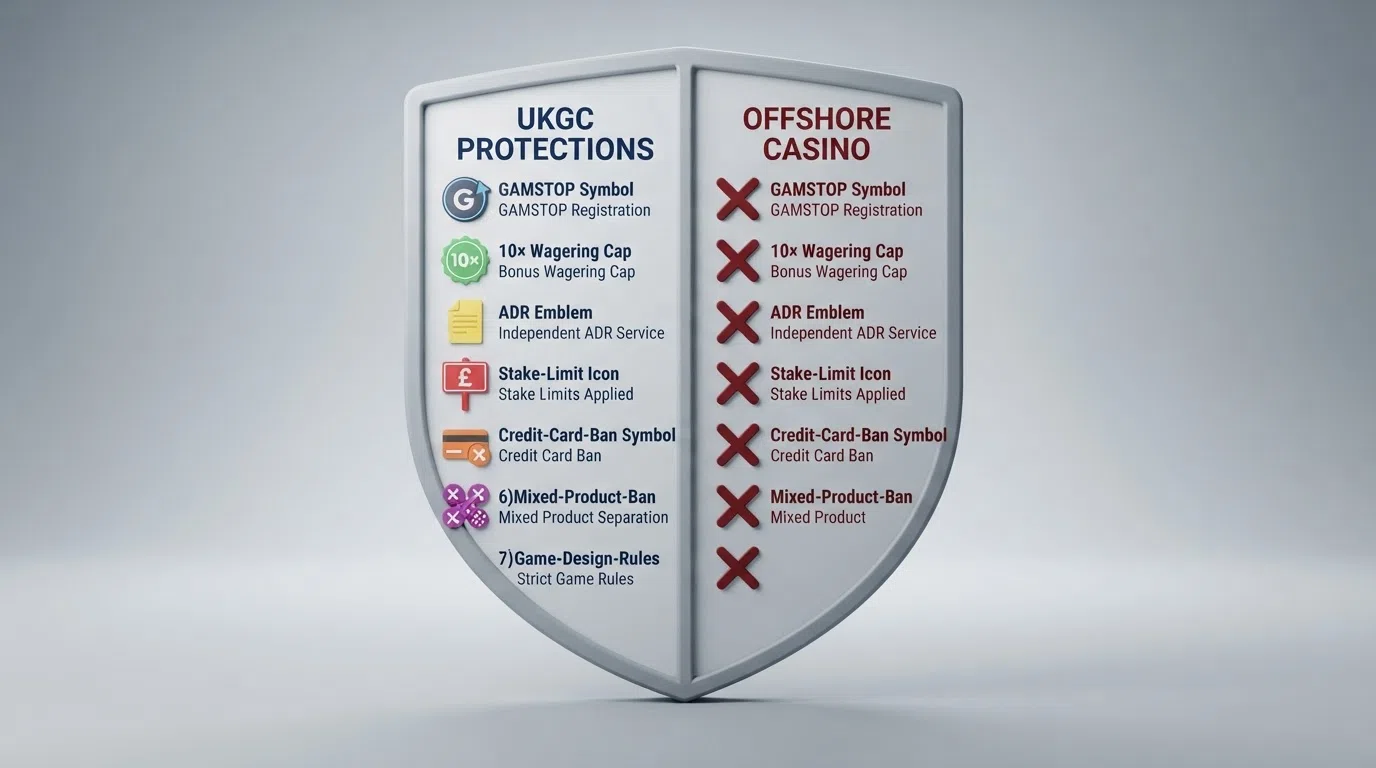
Three things have shaped the shape of a “new” UK casino’s bonus in 2026.
First, the wagering cap. Since 19 January 2026, LCCP Social Responsibility Code 5.1.1 has capped wagering requirements at ten times the bonus amount. Pre-reform offers regularly demanded 35× to 65× the bonus. A £5 bonus under the old rules could have required £325 in turnover; under the current rules, it cannot exceed £50. The Commission’s own rationale: capping wagering to 10× “decreases the likelihood of harm, reduces complexity, and improves transparency.” For a reader comparing welcome offers, the practical effect is that older reviews and older bonus rankings are obsolete on this one point.
Second, the mixed-product promotion ban. From the same January 2026 date, an offer may not condition a bonus on the customer playing a different product type, so a casino cannot ask you to bet on football in order to unlock free spins. The bonus and the wagering must sit inside one product. For casino-focused readers, that removes a common trick; for sportsbook readers, it is the reason some “free spins if you bet £10 on the match” promos have vanished.
Third, the typical offer size has shrunk to match the new ceiling. The no-deposit bonus band running across the UK licensed market now sits at 10 to 50 free spins or £3 to £10 in bonus cash, with wagering at the 10× cap where it applies at all. Anything materially larger, say a “200 free spins, no deposit” banner from a UK-facing page, is either a deposit-gated offer, a multi-stage welcome package, or a brand operating outside the UKGC net.
The launch-date recency matters less than it sounds. A casino that opened its virtual doors in March 2026 under the new rules will write a tighter offer than one that launched in 2024 and has legacy T&Cs still working through the catalogue. Recency is a useful proxy, not a guarantee. What guarantees value is reading the terms of the specific offer sitting in front of you.
Why a casino’s launch date changes the bonus you actually get
Newer UK casinos do not just inherit the reformed market; they are designed for it. A casino that built its bonus engine in 2025 or 2026 starts from the 10× cap, the mixed-product ban, and the post-reform compliance template. A casino that launched before 2026 has older bonus frameworks, grandfathered offer variants, and promos that may technically comply but were written for a different regulatory ceiling. The two products read differently even when the headline looks the same.
That is why a 50-free-spin offer with 0× wagering from a 2026 launch is a cleaner experience than the same headline from a 2018 launch that has been retrofitted to fit the new rules. The newer product does not have legacy bonus structures hanging off it.
For a bonus hunter, the practical move is to read the bonus page, not the homepage. Launch date is the first filter; the wagering terms and the cashout cap are the second.
UK-licensed new casinos vs international launches
A casino launching “new” in the UK means UKGC-licensed. Everything else is offshore, and the difference is enforcement, not geography.
The Commission does not have statutory ISP or DNS blocking powers. Its enforcement runs on disruption: cease-and-desist notices with a 48-hour deadline, search-engine URL referrals, payment-provider pressure, and registrar-level takedowns. Between April 2024 and June 2025, the regulator referred 447,778 URLs to search engines and saw 287,961 removed, and issued 208,088 enforcement actions against illegal online gambling in the year to September 2025. Disruption is not a wall; it is a sieve. The licensed market is the one that holds.
Three licensing objectives sit behind the licence. Under section 1 of the Gambling Act 2005, the Commission must aim to prevent crime, ensure fairness, and protect children and vulnerable persons. Those three lines are the reason a UKGC casino cannot offer anonymous play, must cap spin stakes, must integrate GAMSTOP, and must publish dispute-resolution routes. They are the reason the offshore alternative is genuinely cheaper on bonuses and genuinely weaker on protection.
Playing for real money at a casino that opened its doors this year
A real-money deposit at a brand-new UK casino is backed by the same protections as a deposit at a decade-old one. The licence applies to the operator, not the launch date. What recency changes is the offer shape, not the legal standing.
The trade-off is real and worth naming. A fresh welcome offer, especially a wager-free no-deposit bundle, is the casino’s strongest marketing asset. A shorter operating track record means fewer player reviews, fewer resolved complaints on public forums, and a thinner record of how the operator handles withdrawal disputes. The UKGC public register confirms the licence is active; it does not tell you how last Tuesday’s withdrawal request went. For a reader, that means a small first deposit, a no-deposit test of the withdrawal process, and a willingness to walk away from a casino that delays or stalls.
Prevalence data sharpens the point. In 2024, 2.7% of adults in Great Britain scored 8+ on the Problem Gambling Severity Index, the segment the regulator calls “problem gamblers.” A further 2.3% sat in the “moderate risk” band, taking the combined at-risk-or-higher group to 5%, a figure that has been statistically stable since 2012. That is roughly one in twenty adults. The new-casino segment is not a higher-risk slice by design, but it is the slice where marketing intensity is greatest, and that combination is why the deposit-limit mandate exists.
PayPal, debit card or bank transfer: how new UK casinos handle your money
Payment method availability at a new casino is a quiet signal. PayPal, for instance, runs its own merchant-vetting programme; a casino that clears PayPal acceptance has already met a second compliance bar beyond the UKGC one. Apple Pay availability tells a similar story. The credit-card ban, in force across all remote gambling since 14 April 2020, means debit cards, bank transfers, PayPal, Apple Pay and Paysafecard are the standard routes, with credit-card-funded e-wallets also prohibited.
What you will not find at a UKGC-licensed site is a confirmed cryptocurrency deposit route. The Commission has no published policy on crypto deposits at this stage, and no major UKGC-licensed new casino in the featured set accepts Bitcoin or Ethereum. Where crypto is offered to British players, the operator sits outside the GB licence, and the protections that go with it. That mismatch is the subject of a later section.
For a reader, the practical test is straightforward. If a brand markets hard on crypto, anonymous play, and credit-card deposits, it is not offering a no-deposit bonus at a UKGC-licensed new casino; it is offering a different product entirely.
Top 10 newest UK casinos ranked by their no-deposit offers
The table below compares the ten UKGC-licensed operators reviewed on this page. Spin counts and wagering figures are taken from operator sites and the aggregator pages listed earlier; cashout caps are stated where the operator states them and left blank where the operator does not. Three of the ten (PlayOJO, Foxy Games, 32Red) do not currently offer a genuine no-deposit bonus, and that absence is shown rather than papered over.
| Casino | UKGC licence | No-deposit free spins | Wagering on no-deposit | Slot count |
|---|---|---|---|---|
| Sky Vegas | 39439 | 50–70 | 0× | 700+ |
| MrQ | 51250 | 10 | 0× | 900+ |
| Betfair Casino | 39439 | 50 | 0× | 400+ |
| Paddy Power Games | 39411 | 60 | 0× | 1,000+ |
| 21 Casino | 52894 | 50–70 | 10× | 2,000+ |
| Virgin Games | 38905 | 30 | 0× | 500+ |
| Spin Genie | 39326 | 10 | 10× | 1,500+ |
| PlayOJO | 39326 | — | — | 3,000+ |
| Foxy Games | 39451 | — | — | 800+ |
| 32Red | 39430 | — | — | 500+ |
The post-reform pattern is visible at a glance. Six of the ten offer no-deposit free spins with zero wagering, where the spin winnings land directly in the real-money balance and can be withdrawn subject only to the operator’s stated cashout policy. Two of the ten (21 Casino and Spin Genie) carry the maximum-permitted 10× wagering on their no-deposit spins, with 21 Casino additionally capping cashout at £50. Three (PlayOJO, Foxy Games, 32Red) do not offer a no-deposit bonus at the time of research; each routes its welcome value through a deposit-gated package instead.
The largest spin count on a no-deposit basis is Paddy Power’s 60. The largest library sits at PlayOJO, which has no no-deposit offer. No single operator wins on every column, which is why the table is the table rather than a single recommendation.
Sky Vegas
Sky Vegas pairs the largest no-deposit free-spin bundle in the featured set with the cleanest possible terms. The current welcome offer is 50 to 70 free spins on registration, no deposit required, zero wagering, and no stated cashout cap, valued at £0.10 per spin. An additional 200 spins unlock on a £10 deposit and spend. The slot catalogue runs past 700 titles from NetEnt, Pragmatic Play, Playtech, Blueprint, IGT, Red Tiger and Evolution for live dealer.
The Flutter group runs Sky Vegas under Bonne Terre Limited, with UKGC licence 39439 confirmed active on the public register. The dedicated iOS app holds a 4.2-star rating from roughly 4,000 reviews, and the Android build is available. Sky Vegas stands as the benchmark for a no-wagering model with a large spin count and a robust Flutter-backed library.
MrQ
MrQ keeps its offer the way its founders named it: ten spins, no wagering, no cashout cap, no tricks. The 10 no-deposit free spins land on Big Bass Q the Splash at £0.10 per spin, with winnings going straight to the real-money balance. A £10 deposit unlocks 50 additional spins; the same deposit on a first-purchase basis unlocks 100 more on Big Bass Splash.
The slot library runs past 900 games from NetEnt, Pragmatic Play, Blueprint, Red Tiger, Hacksaw Gaming and Thunderkick. Lindar Media Limited holds UKGC licence 51250. The site is browser-optimised rather than wrapped in a native app, and on a modern phone browser the experience matches most native builds.
For a reader who values clarity over volume, MrQ is the cleanest no-deposit offer in the set. The 10-spin count is small, but every one of them lands as real money.
Betfair Casino
Betfair routes its 50 no-deposit free spins through Playtech’s Jackpot King network, a different prize pool from the standalone slots used elsewhere on this page. Eligible titles include Crabbin’ For Cash Extra Big Catch, Eye of Horus Jackpot King, and Fishin’ Frenzy Jackpot King. Wagering is zero, the cashout cap is not stated, and a £10 deposit unlocks 100 additional spins.
The slot library is smaller, around 400 titles, but the Jackpot King integration gives Betfair a distinctive angle for readers who want progressive potential on a no-deposit spin. Flutter Entertainment holds UKGC licence 39439 for the brand. The iOS app ranks in the App Store Casino category, and a daily free-to-play game (Prize Pinball) sits alongside the real-money lobby.
The Jackpot King network integration makes Betfair a compelling option for those seeking progressive jackpot opportunities.
Paddy Power Games
Paddy Power Games leads the featured set on raw no-deposit spin count. The current welcome offer is 60 free spins on registration at £0.10 per spin, zero wagering, no stated cashout cap, valid across 12 eligible slots plus Paddy’s Mansion Heist (the player picks the game). A £10 deposit adds 200 more spins.
PPB Entertainment Limited holds UKGC licence 39411. The slot library runs past 1,000 titles from Playtech, NetEnt, Pragmatic Play, Blueprint, Red Tiger and Evolution. The iOS app sits at #17 in the App Store Casino category per Oddschecker, and the Android build is available. As of March 2026, Casino Buddies identified this 60-spin bundle as the highest genuine no-deposit free-spins offer in the UK licensed market, with Sky Vegas’s 50 spins as the next-largest confirmed genuine offer. With the highest no-deposit spin count currently available at a UKGC-licensed casino, Paddy Power Games is the premier choice.
21 Casino
21 Casino’s no-deposit offer is the one on this page that shows what a UK bonus used to look like, only legal. The 50 to 70 free spins on Book of Dead at £0.10 per spin carry the full UK maximum 10× wagering on free-spin winnings and a £50 maximum cashout cap. The total stake value across 50 spins is £5, which means a reader has to turn over £50 in winnings before any of it becomes withdrawable, and then the casino keeps the first £50 above the cap.
White Hat Gaming Limited holds UKGC licence 52894. The slot library is the largest in the set that runs on a no-deposit offer, at 2,000+ titles from NetEnt, Play’n GO, Microgaming, Pragmatic Play, Evolution and Red Tiger. The site is browser-optimised, and Book of Dead is the title research consistently points to when the bonus is wager-bound rather than wager-free. 21 Casino is a solid option for those who want a vast slot library and are comfortable meeting the 10× wagering requirement.
Virgin Games
Virgin Games wraps a smaller no-deposit offer in the most polished mobile experience of the featured set. The current welcome bundle is 30 free spins no deposit, zero wagering, no stated cashout cap, with a £0.01 coin size across 10 lines (a £0.10 effective stake). A £10 deposit and wager adds 70 more spins. The iOS app holds a 4.6-star rating from over 29,000 reviews, the highest in the set by a clear margin, with a dedicated Android build alongside it.
Gamesys Operations Limited holds UKGC licence 38905 under the Bally’s Corporation umbrella. The slot library is around 500 titles, smaller than several peers, but Game of Thrones and other branded exclusives make the catalogue feel curated rather than padded. Virgin Games is highly recommended for mobile players who want a polished, frictionless experience.
Spin Genie
Spin Genie grants only 10 no-deposit free spins, with 10× wagering on the winnings and a cashout cap that is not explicitly stated. The welcome deposit bonus sits alongside it. Skill On Net holds UKGC licence 39326 across Spin Genie, PlayOJO, and other brands in the group. The slot library is one of the largest in the set, at 1,500+ titles from NetEnt, Microgaming, Pragmatic Play, Play’n GO, Evolution and Red Tiger.
The iOS app sits at a 3.8-star rating from roughly 24 reviews; the Android build is rated 4.3 out of 5 from around 370 ratings, the better-reviewed of the two. Spin Genie’s large catalogue makes it a reliable choice within the Skill On Net network for those who prioritize volume.
PlayOJO
PlayOJO skips the no-deposit route entirely. The current welcome offer is 50 free spins on Big Bass Bonanza, triggered by a £10 deposit, with zero wagering and no cashout cap. That makes it a deposit-gated offer, not a no-deposit one, and it sits on this list because the page is about newest UK casinos and PlayOJO is one of them, not because it satisfies the head term.
PlayOJO lacks a no-deposit bonus, requiring a £10 deposit to unlock its 50 free spins on Big Bass Bonanza. Its extensive library and zero-wagering policy make it a strong candidate for those willing to deposit initially.
Foxy Games
Foxy Games cycles its welcome promotion rather than running a standing no-deposit offer. Current variants include free spins or bonus credit on a £10 deposit and spend, with 10× wagering applying where a no-deposit promotion is active. The current cycle does not include a no-deposit offer, and that is stated rather than hidden.
Foxy Games manages its welcome promotion through revolving offers rather than a standing no-deposit bonus. Players should check current cycles, as deposit-matched promos are the standard at the time of research.
32Red
32Red’s welcome offer is the largest spin bundle in the set, and it is deposit-gated. Play £30 and wager to unlock 320 free spins on Big Bass Splash at £0.10 per spin, with 10× wagering on winnings. 32Red Limited holds UKGC licence 39430 under the Kindred Group. The slot library is around 500 titles from Microgaming, NetEnt, Evolution, Pragmatic Play, IGT and Red Tiger, with a heavy weighting toward Microgaming exclusives.
The iOS app sits at #19 in the App Store Casino category per oddschecker, and the Android build is available. There is no current no-deposit bonus. For a reader who already plans to deposit £30 and wants 320 free spins as the welcome, 32Red is the value play. For a reader who needs the no-deposit trigger, 32Red is in the same category as PlayOJO and Foxy Games: not in the running on the head term.
Why your no-deposit bonus is smaller than it looks
The headline spin count hides three reductions: the stake per spin, the wagering multiplier, and the cashout cap. A 50-free-spin offer at £0.10 per spin is worth £5 of total play before the casino has even looked at you. Add a 10× wagering requirement and a £50 cashout cap, and a £100 win from those spins becomes a £50 withdrawal at best.
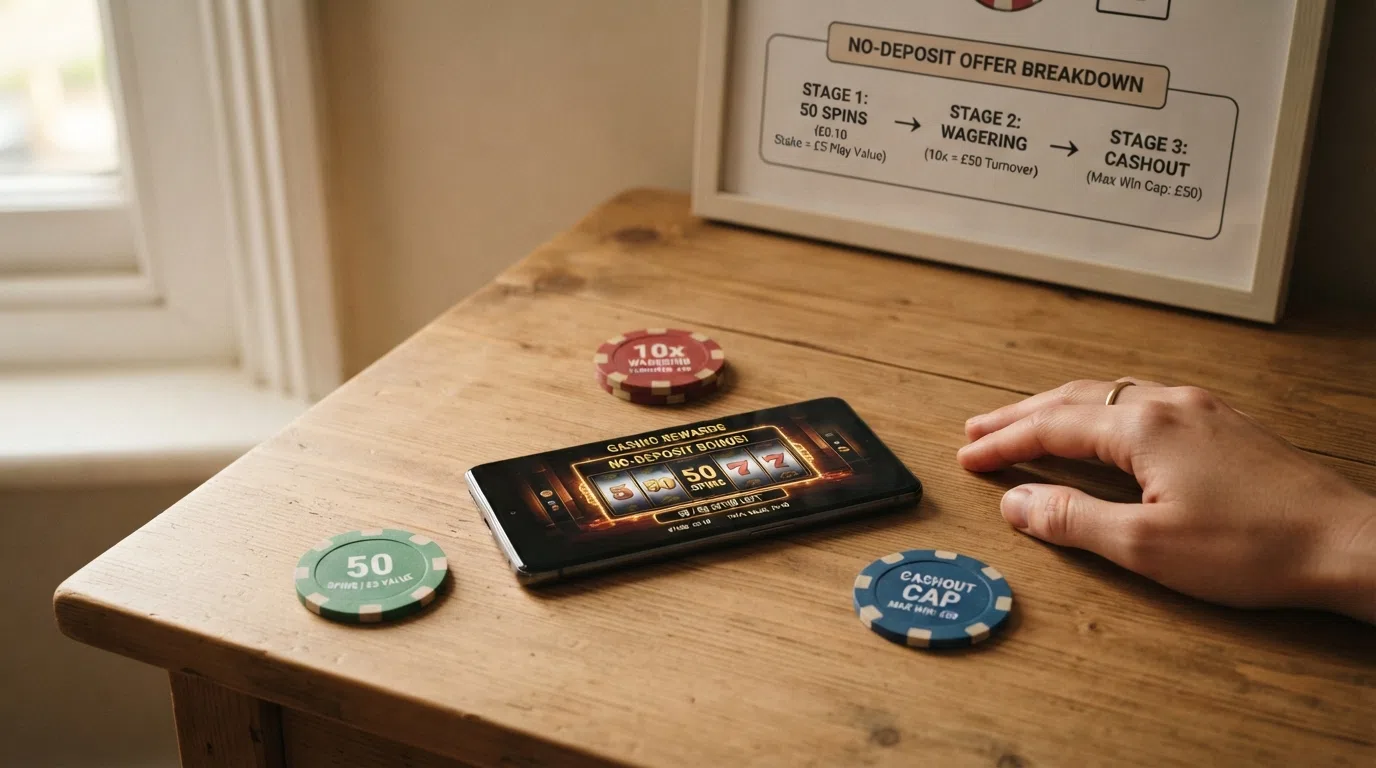
The post-reform UK market has narrowed the band where this matters. Under the 10× cap, no UKGC-licensed casino can demand more than ten times the bonus value in turnover, and a £5 no-deposit bonus caps turnover at £50. That is a 70% to 85% reduction from the pre-reform market, where 35× to 65× was common. A reader who learned the bonus game in 2018 would recognise a different industry. The direction of travel is favourable; the absolute value of a no-deposit bonus is still modest.
The single sharpest piece of consumer protection the regulator added in this reform is the simplicity. The Commission’s stated rationale: capping wagering to 10× “decreases the likelihood of harm, reduces complexity, and improves transparency.” Translation: a reader can read a bonus page and know what the bonus will cost. The “you can win £1,000 from a no-deposit bonus but the casino may only let you keep £100” problem is still there, but it is the cap doing the cutting, not a hidden wagering multiple. Both are still real. The cap is just more visible.
No-deposit bonus codes vs automatic no-deposit offers
The distinction is mechanical. An automatic offer credits your account on registration or first login; a code-based offer requires you to enter a string at the cashier or sign-up page. Both end in the same result if completed; a missed code means no bonus at all.
Most new UK casinos credit their no-deposit welcome offer automatically, so specific bonus codes are rarely required. The general shape of the UK licensed market is that codes have receded. Most UKGC-licensed new casinos credit their no-deposit welcome offer automatically, in part because the mixed-product ban and the simpler-term reform make a promotional code unnecessary as a marketing lever, and in part because affiliate partnerships have standardised on auto-credited offers with an attribution cookie rather than a code.
While specific bonus codes were once standard, today’s automatic credits are the industry preference. Readers should still verify the bonus terms upon registration, as some offers may require manual input.
Free spins vs bonus cash
The two formats end up in similar places, but they start differently. Free spins lock you to one slot (or a small eligible set) at a fixed stake. Bonus cash lets you pick the slot, set the stake, and play anything in the eligible-games list. The wagering and the cashout cap apply identically to both.
In the post-reform UK market, the no-deposit offer is overwhelmingly free spins, because a 10–50-spin bundle is the cheapest promotional product for the operator to issue, and the £3–£10 bonus-cash alternative is harder to make work under the 10× cap. A £5 cash bonus with 10× wagering means the operator has to absorb £50 of theoretical turnover, which is a meaningfully different risk profile from 50 free spins at £0.10 with the same play-through.
For a reader, the question is which format converts to withdrawable cash more often. The honest answer is that both face the same cap. The format that maximises take-home is the one with zero wagering and no cashout cap, which is the free-spin model used by the featured wager-free operators.
The 10× wagering cap
The 10× cap is the single largest change to UK casino bonuses in a decade, and the change that makes this ranking possible. Before 19 January 2026, a no-deposit bonus could demand 35× to 65× the bonus in turnover, which meant a £5 bonus required up to £325 in play before any winnings were real money. After the cap, a £5 bonus requires £50. That is the difference between an offer a player can read in five seconds and an offer that needs a calculator.
The cap also interacts with the mixed-product ban. Pre-reform, a casino could offer free spins conditioned on a sports bet, which let the operator shift the theoretical cost of the bonus onto a different product line. Post-reform, the bonus and the wagering must sit inside one product. A reader no longer has to evaluate the bonus in two markets at once.
Two further notes on the cap. First, “anything over 10× is either offshore or about to be fined,” as one industry observer put it. That is the practical test: a UK-facing offer demanding 30× wagering is not a UKGC offer. Second, the cap does not raise the floor. A casino can still offer a 0× wagering bonus, and several of the featured operators do. The cap is a ceiling, not a target.
The expected cost of clearing the 10× requirement on a 21 Casino no-deposit offer (50 free spins on Book of Dead at £0.10) is a worked example. The bonus stake value is £5, so the required turnover under the 10× cap is £50. Book of Dead runs at 96.21% RTP, so the expected house edge across £50 of wagering is £50 multiplied by 3.79%, which is £1.90. The player is, on average, paying £1.90 to convert the bonus into a real-money balance, and then the £50 cashout cap means any winnings above £50 are forfeited at withdrawal. That expected cost is the cost of clearing the bonus, not the cost of a single spin session.
Cashout caps
The cashout cap is the fine print that defines the real ceiling. The typical UK no-deposit cap runs from £20 to £200, with £50 to £100 as the most common bracket. The 21 Casino offer is the only one in the featured set that states a cap, at £50; the featured wager-free offers do not state a cap, which means the standard account withdrawal terms apply.
The interaction with wagering is worth flagging. A 10× wagering requirement does not lift a cashout cap; the cap is a separate ceiling on what the casino will pay regardless of how much you win during the wagering period. A player who turns a £5 no-deposit bonus into £1,000 of winnings under a 10× requirement will, at 21 Casino, withdraw £50 of that. The remaining £950 is forfeited on withdrawal. The quote that captures it: “you can win £1,000 from a no-deposit bonus but the casino may only let you keep £100.” That is the cashout cap doing its work.
For a reader, the takeaway is to check the cap before the spin count. A 70-spin offer with a £50 cap and 10× wagering is materially less generous than a 30-spin offer with no cap and no wagering, even though the headline looks larger.
Welcome bonuses, reload offers and loyalty perks
A no-deposit bonus is the door-opener; the deposit-match welcome, the reload, and the loyalty scheme are the rooms behind it. The same 10× cap that governs no-deposit offers governs every other bonus type at a UKGC-licensed casino, so the same arithmetic applies. A 100%-match welcome bonus with 10× wagering on the bonus amount is the post-reform norm, and reload offers follow the same template.
The mixed-product ban matters here as well. A reader will not see a casino offering a casino bonus conditioned on placing a sports bet, or vice versa. The product is the product, and the bonus sits inside it.
The standout deposit-gated offers in the featured set are PlayOJO’s 50 wager-free spins on Big Bass Bonanza for a £10 deposit, and 32Red’s 320 free spins on Big Bass Splash for a £30 deposit and wager. Both are competitive with the no-deposit offers on a per-spin basis once the deposit is factored in, and both are subject to the same responsible-gambling controls as any other UKGC bonus. For a reader who plans to deposit anyway, the deposit-gated welcome can deliver more spin value than the no-deposit bundle; for a reader who wants to test the casino first, no-deposit is still the cheaper trial.
The slots and games your free spins actually unlock
Most no-deposit free spins are locked to one title, or a small eligible set. The game you get matters as much as the spin count, because the RTP, the volatility, and the maximum win all shape what a reader actually keeps after wagering and the cashout cap have done their work.
Three titles dominate the UK no-deposit free-spin landscape: Big Bass Bonanza, Book of Dead, and Starburst. A fourth, Big Bass Splash, appears in the deposit-gated offers from MrQ, Betfair (where the Jackpot King variant applies) and 32Red. The reason these four recur is a combination of brand recognition, RTP band, and Pragmatic Play’s and Play’n GO’s commercial reach. They are the slots the aggregators and the operators both know will land.
The slots that dominate UK no-deposit free spins
| Slot title | Provider | RTP | Volatility | Max win |
|---|---|---|---|---|
| Starburst | NetEnt | 96.09% | Low | 500× |
| Book of Dead | Play’n GO | 96.21% | High | 5,000× |
| Big Bass Bonanza | Pragmatic Play | 96.71% | High | 2,100× |
| Big Bass Splash | Pragmatic Play | 96.71% | High | 2,100× |
Big Bass Bonanza is the highest-RTP title in this group, at 96.71% with high volatility and a 2,100× max win. Book of Dead is the volatility play, at 96.21% RTP and a 5,000× max win, which is why it is the title that recurs on wager-bound offers (the operator prefers a higher-volatility title when the player is paying for the privilege of converting the bonus). Starburst is the steady-eddy: 96.09% RTP, low volatility, a 500× max win, and the kind of gameplay that turns over quickly. Big Bass Splash sits alongside Big Bass Bonanza in the RTP band, with the same 96.71% headline, though some operators run lower-RTP variants of the game; the figure on the page is the standard configuration.
High-volatility slots like Book of Dead offer larger potential wins but increase the likelihood of exhausting your bonus before meeting wagering requirements, unlike low-volatility titles such as Starburst. Choosing the right slot is key to your strategy.
Slot jackpots at new casinos
A no-deposit spin can trigger a progressive jackpot, in the sense that the spin is real-money play on a real-money title. Whether it does, and what the payout looks like, is governed by the progressive network’s contribution rules and the game’s base mechanics, neither of which research establishes at the per-title level for this page.
Betfair’s Jackpot King integration is the featured no-deposit example, with 50 spins on Crabbin’ For Cash Extra Big Catch, Eye of Horus Jackpot King, and Fishin’ Frenzy Jackpot King. The Jackpot King network links these titles to a shared progressive pool; the contribution from each spin is small, the odds of hitting the top tier are long, and the cap on a no-deposit bonus will almost always bite before the prize is paid. The honest framing is that a no-deposit spin on a progressive is a way to play the game, not a way to win the jackpot.
Table games and live dealer
No-deposit free spins are slot-locked. Bonus cash, where it is offered, is the route to table games and live dealer. The featured set is overwhelmingly free-spins-led, so table-game access through a no-deposit bonus is thin on this page.
The live-dealer studios powering the featured operators are well known: Evolution is the dominant name across the set, with Playtech also a presence at Sky Vegas, Paddy Power and Foxy Games. The studio matters less than the licence: any live-dealer game at a UKGC-licensed casino is subject to the same fairness testing and the same stake-cap rules as the slot catalogue, with the 10× wagering cap applying to any bonus used on those titles.
The studios behind the reels
The provider roster at a new UK casino signals its commercial standing. NetEnt, Pragmatic Play, Play’n GO, Microgaming, Playtech, Blueprint and Evolution are the seven names that recur across the featured set, and a casino that runs all seven has cleared a baseline of provider-vetting and integration work. Smaller studios (Hacksaw Gaming, Thunderkick, Big Time Gaming) appear at MrQ, PlayOJO and a handful of others, and they tend to be the marker of a casino that is investing in catalogue breadth rather than minimum-viable compliance.
A reader does not need to memorise the studio list. The signal is simple: a casino with eight or more named providers and a catalogue past 500 titles is in a different operating tier from a casino with three providers and 200 titles. The featured set sits in the first tier.
Mobile play at new UK casinos
Most new UK casinos launch browser-first, with a dedicated app as a secondary product rather than the primary surface. The mobile experience on a modern phone browser is, in practice, indistinguishable from a native app for slot play. Where the native app earns its keep is push notifications, biometric login, and the small bits of UI polish that come from a build designed for the screen rather than retrofitted.
Browser-optimised casinos vs native apps
A browser-optimised casino loads the full slot catalogue directly, with no curated subset. A native app often curates for performance, especially on older devices, and that curation can mean the app carries 600 titles while the browser version carries 1,500. MrQ and 21 Casino both run browser-optimised, and both carry their full libraries that way; the absence of a native app is a feature, not a gap, for a reader who plays on a phone and does not want to manage an install.
The app’s real advantage is push notifications, which a browser cannot send without permission, and biometric login. For a player who values being told about a reload offer the moment it drops, the app wins. For a player who wants the full catalogue in one place, the browser wins.
Game selection on a five-inch screen
Slots are mobile-native. A 6×4 reel layout on a five-inch screen is readable, the spin button is reachable, and the bet-adjust controls are touch-sized. Live-dealer tables on the same screen are a different experience: the stream is readable but the betting-grid layout compresses, the chat overlay takes screen real estate, and the multi-camera angles lose some of their impact. The slot catalogue is the better mobile product; the live-dealer catalogue is the better desktop product.
The age-banded stake cap shapes every spin, including mobile play. The statutory maximum online slot stake is £5 per game cycle for players aged 25 and over (in force 9 April 2025) and £2 for players aged 18 to 24 (in force 21 May 2025), imposed by SI 2025/215. Two adults at the same casino can face different maximum bets on the same slot. The cap is per spin, not per session or per day, which means the boundary is checked on every bet rather than at session start.
Crypto casinos and British players
A UKGC-licensed casino does not currently offer a confirmed cryptocurrency deposit route. The Commission has no published policy on crypto deposits at UK-licensed operators, and none of the major new casinos in the featured set accepts Bitcoin or Ethereum. Every crypto casino targeting British players is operating outside the UKGC net, and the protections that go with it.
Offshore crypto casinos
Offshore crypto casinos offer a different product, by design. Anonymous accounts, no KYC, credit-card deposits, crypto payments, bonus-buy slots: each of these is restricted or banned at a UKGC-licensed site. The credit-card ban has been in force since 14 April 2020, identity verification is required before first deposit or gambling, and the game-design rules (no auto-play, no fast spin, no losses disguised as wins) all sit on the UK side of the line. The trade the offshore site is offering is your consumer protection, in exchange for those features and a higher headline bonus.
The enforcement picture matters. The UKGC’s actions on illegal online gambling ran to 208,088 in the year to September 2025; 447,778 URLs were referred to search engines between April 2024 and June 2025, and 287,961 were removed. The disruption is real, but the underlying point is that the licence is the gate, not the search engine.
No-KYC casinos
A casino that does not verify your identity also does not protect your funds, your dispute route, or your self-exclusion. Identity verification is the entry point for the entire UKGC protection framework: it links the player to the GAMSTOP register, enables the financial vulnerability check at £150 net deposit in a rolling 30-day window, and opens the route to an Alternative Dispute Resolution (ADR) provider if a withdrawal dispute escalates. Removing identity verification removes all of that, and the offshore no-KYC product is precisely the bundle.
A player who uses an unlicensed site commits no established criminal offence under English law, but loses every GB consumer protection in the bargain. That is the cost, and it is the cost the no-KYC marketing page does not put in the headline.
Licensed vs offshore
A UKGC licence is not a rubber stamp. It is a set of enforceable rights that the offshore sites do not give you: stake caps, wagering caps, game-design rules, deposit limits, ADR, GAMSTOP, segregated player funds. The “licensed vs offshore” comparison is the comparison of those rights against their absence, and the score is not close.
GAMSTOP and self-exclusion
GAMSTOP is the national multi-operator self-exclusion scheme for Great Britain, mandatory for every UKGC online licensee since 31 March 2020. A player who registers excludes themselves from every GB-licensed online gambling site for six months, one year, five years, or five years with auto-renewal. The exclusion cannot be cancelled early. It is the most effective single tool a player who has decided to stop has, and it is the tool that offshore sites have no obligation to honour.
The off-shore alternative is the “non-GAMSTOP casino.” These sites operate under Curaçao, Costa Rica, or Anjouan licences, and they actively market to UK players. The marketing targets a specific audience: players who are already self-excluded and looking for a way around their own decision. The page does not promote that alternative, and it does not need to. The point is that a player on GAMSTOP who plays at a non-GAMSTOP casino has not beaten the system; they have routed around a protection that was designed for them, and the casino knows it.
Non-GAMSTOP casinos accepting UK players
The non-GAMSTOP landscape is named in research: Emperia Casino (Curaçao, launched 2026), Winorio Casino (Costa Rica, launched March 2025), MadCasino (launched March 2025), Zizobet (Curaçao, launched 2024), and Slotzania (Anjouan, launched 2026). These sites advertise credit-card deposits, crypto payments, and bonus-buy slots, all of which are restricted or banned at UKGC-licensed operators. They are not a loophole. They are a regulatory gap, and the UKGC’s enforcement against them runs on disruption: cease-and-desist notices, search-engine referrals, registrar pressure. The Commission does not currently hold statutory ISP or DNS blocking powers, although proposed legislation would allow court-ordered blocking once enacted.
A reader who is registered with GAMSTOP and searching for a non-GAMSTOP alternative is, definitionally, in the audience those sites are designed to catch. The support services in the next section are the route that serves that reader better than any casino link.
The real risk of playing at an unregulated casino
A player who uses an unlicensed site is not committing a criminal offence. The risk is practical, not legal. The losses are: no UKGC complaints route, no ADR, no GAMSTOP protection if the urge returns, no segregation of player funds, no enforceable stake cap, and no recourse if the casino simply declines to pay a winning withdrawal. The casino is offshore, the licence is offshore, and the dispute-resolution forum is whatever the operator chooses to put on its own site.
The way to verify a UKGC licence is the public register at gamblingcommission.gov.uk. Every licence on this page was verified against that register; the licence numbers in the operator write-ups are the ones to check. A casino that does not publish a UKGC licence number, or that lists a non-GB licence, is not a UKGC-licensed casino.
Playing safely
The responsible-gambling tools at UKGC-licensed casinos are not optional. They are licence conditions, and they are the practical expression of the “protect children and vulnerable persons” objective in section 1 of the Gambling Act 2005.
The 2024 prevalence figures put the scale of the underlying problem in plain numbers. 2.7% of adults in Great Britain scored 8+ on the Problem Gambling Severity Index in 2024, the segment the regulator classifies as “problem gamblers.” A further 2.3% sit in the moderate-risk band, taking the combined at-risk-or-higher group to 5%, a figure that has been statistically stable since 2012. Men (7%) are more than twice as likely as women (3%) to score at the at-risk-or-higher threshold. The harm is concentrated, and the tools exist for that concentration.
Deposit limits, reality checks and time-outs
The deposit-limit mandate is the most consequential single addition to the UK responsible-gambling framework in this cycle. From 31 October 2025, every UKGC-licensed operator must prompt a customer to set a financial limit before their first deposit. From 30 September 2026, the operator must offer a “gross deposit limit” (based solely on money paid in) and only that form may be called a “deposit limit.” The point is to push the limit-setting decision to the moment a player is about to fund an account, when the decision is most likely to be thoughtful, rather than after a loss chase.
The complementary tools are the reality check, the time-out, and the financial vulnerability check. Reality checks are mandatory session-time and spend pop-ups, on by default during slots play; time-outs are short-term exclusions from 24 hours to six weeks; the financial vulnerability check is a light-touch public-data review triggered at £150 net deposit in a rolling 30-day window (in force from 28 February 2025), using CCJ and insolvency data only. The game-design rules that frame every spin — no auto-play, no spin faster than 2.5 seconds, no features that speed up play, no losses disguised as wins, no reverse withdrawals — are the floor beneath the tools.
For a reader, the single most effective step is to set the deposit limit before claiming any bonus. The regulator has now made that step compulsory; the rest is discipline.
Where to get help
The UK runs one of the world’s most comprehensive gambling-harm support systems, and the entry points are public, free, and confidential.
GamCare runs the National Gambling Helpline on 0808 8020 133, available 24/7 with a live-chat option. The service covers England, Scotland and Wales and provides counselling, information, and onward referral.
GambleAware funds the research, prevention, and treatment infrastructure, including the National Gambling Treatment Service. In 2024/25, the service treated 11,960 clients, an 11% increase on the prior year; 93% of clients who completed treatment saw improvement in their presentation.
NHS specialist gambling harm clinics operate in England, Scotland and Wales, providing clinical assessment and psychological therapy for moderate-to-severe gambling harm. Referral routes are via GP or directly via the clinic.
Gamblers Anonymous runs peer-support meetings across Great Britain, modelled on the 12-step programme and free to attend.
GAMSTOP is the self-exclusion register itself, and the route to it is at gamstop.co.uk. The statutory levy that funds much of this infrastructure took effect on 6 April 2025, set at 1.1% of gross gambling yield for remote casino operators, split 50% to treatment, 30% to prevention, and 20% to research. The system is paid for by the industry, and the services are free at the point of use.
How we selected and ranked these operators
Every operator in the featured set was checked against the UK Gambling Commission’s public register for active licence status before inclusion, and the licence numbers in the operator write-ups are the register references to verify. Bonus terms were verified against the operator’s own bonus page and at least one of the following independent aggregators: Oddschecker, Betbond, Livescore, Casinos and Casinomeister. Where the operator’s page and the aggregator disagreed, the operator’s page took precedence and the discrepancy is noted where it matters.
The ranking criteria are five. No-deposit bonus accessibility (is the offer genuinely deposit-free, or is a minimum deposit hidden in the small print?). Wagering burden (0× preferred, 10× acceptable, anything over the legal cap disqualifying). Cashout freedom (no cap preferred, a stated cap ranked by its level, an unstated cap assumed at the operator’s standard account terms). Game eligibility breadth (which slots the spins are locked to, and whether the casino carries a meaningful library beyond the bonus game). And the operational track record (the licence’s age, the casino’s public complaint history, and the quality of the responsible-gambling tooling).
The featured set is ten operators. The UK licensed market runs to far more than ten, and the comparison is not exhaustive; it is a curated cross-section designed to show the spread of the post-reform offer landscape, from the wager-free benchmark (Paddy Power, Sky Vegas, MrQ) through the wager-bound middle (21 Casino, Spin Genie) to the deposit-gated alternatives (PlayOJO, 32Red) and the rotating offer (Foxy Games).
The data current as of 28 August 2026 reflects the offers on each operator’s UK-facing page at the time of research. Bonus terms change. The licence register is the verification that does not.
What to do with a no-deposit bonus at a brand-new UK casino
A no-deposit bonus is free money with strings, and the strings are the part that matters.
The offers worth claiming are the wager-free ones from our featured list. The winnings are real money on spin completion, the cashout cap is either generous or unstated, and the only decision the player has to make is which slot to play. The offers to evaluate carefully are the wager-bound ones: 21 Casino’s 50 to 70 spins on Book of Dead at 10× wagering with a £50 cap, and Spin Genie’s 10 spins at 10× wagering. The expected cost of clearing 21 Casino’s offer on Book of Dead is £1.90, calculated as £50 of required turnover multiplied by the 3.79% house edge on a 96.21% RTP game, before the £50 cashout cap bites on the withdrawal. That is the realistic ceiling of what the offer costs, and it is the number to weigh against the cap.
The offers to skip, on the head term, are the deposit-gated ones: PlayOJO, Foxy Games (in its current cycle), 32Red. They are not worse offers; they are different offers, and they sit on a different decision. A reader who came to this page for a no-deposit bonus will not find one at those three, and the honest framing is that they are not the answer to the question being asked.
The real value of a no-deposit bonus is not the take-home cash. The expected value is in the low single-digit pounds for the typical UKGC offer. The real value is the test: a free run at the casino’s withdrawal process, the game library, the mobile experience, and the customer-support response time, before any money is on the line. A reader who treats the no-deposit bonus as a free trial rather than a profit engine will make better use of it than one who treats it as a winning tip.
The single most important rule is the one the regulator has now made compulsory. Set the deposit limit before claiming any bonus. The limit-setting prompt is now a licence condition for every UKGC-licensed operator, in force from 31 October 2025, and the gross-deposit-limit definition follows on 30 September 2026. The casino will ask; the right answer is to set a number, not to skip the screen.
The UK regulatory framework does the rest, provided the reader stays inside it. The 10× wagering cap, the 5×/2× age-banded stake cap, the credit-card ban, the mixed-product ban, the game-design rules, the GAMSTOP register, the deposit-limit prompt, the ADR route: each of these is an enforceable right at a UKGC-licensed casino and an absence at an offshore one. The bonus is the door. The licence is the building. Stay inside the building.
Frequently asked questions
Can I really win real money from a no-deposit bonus at a new UK casino?
Yes, at the featured wager-free offers, the winnings from no-deposit free spins land in the real-money balance and can be withdrawn subject to the operator’s standard account terms. At wager-bound offers like 21 Casino’s, winnings are real money after the 10× wagering requirement is cleared, and the £50 cashout cap applies.
What is the maximum I can withdraw from a no-deposit bonus?
It depends on the operator. The wager-free offers in the featured set do not state a no-deposit-specific cashout cap, which means the standard account withdrawal terms apply. 21 Casino’s no-deposit offer carries an explicit £50 maximum cashout. The typical UK no-deposit cap sits between £20 and £200, with £50 to £100 the most common bracket across the licensed market.
How long do no-deposit free spins last before they expire?
The featured operators’ bonus terms specify an expiry window, typically 24 hours to 7 days from credit, with the wagering completion window running parallel. Check the specific terms on the bonus page when you claim, as the exact figure varies by operator and by promotion.
Do I need to verify my identity before claiming a no-deposit bonus?
Identity verification is required before first deposit or first gambling at any UKGC-licensed casino, but the no-deposit free spins themselves are often credited on registration, before verification is complete. The verification step is required before a withdrawal can be processed, so the bonus can be claimed and played before the ID check, but the winnings cannot be withdrawn until the check has cleared.
Are there no-deposit bonuses with no wagering requirements?
Yes. Half of the featured operators offer no-wagering no-deposit free spins. The wagering-free model is the post-reform benchmark, and the offers on this page that carry wagering (21 Casino at 10×, Spin Genie at 10×) are the minority pattern in the curated set.
What happens if I am registered with GAMSTOP — can I still claim a new-casino bonus?
No. GAMSTOP covers every UKGC-licensed online operator, and registration excludes you from claiming a bonus or opening an account at any of them for the duration of the exclusion. The exclusion cannot be cancelled early. Non-GAMSTOP casinos exist and actively market to self-excluded players, but they operate outside the UKGC net, with no consumer protections, no ADR route, and no recourse if a dispute arises.
Which slot titles get the most no-deposit free spins at new UK casinos?
Big Bass Bonanza, Book of Dead, and Starburst are the three titles that recur most frequently across UK no-deposit free-spin offers, with Big Bass Splash appearing in deposit-gated alternatives. Big Bass Bonanza has the highest RTP in the group at 96.71%, Book of Dead is the high-volatility option at 96.21% RTP and a 5,000× max win, and Starburst is the low-volatility steady option at 96.09% RTP.
Bonuses – No Minimum Deposit Casinos UK
Content created by the «No Minimum Deposit Casinos UK» team