
How UK Casino Players Actually Move Money — And Which Methods Are Worth Using
 Available in GB
A payment method at a UK casino is not a clerical detail. It decides how fast you can sit down to play, how quickly you can take your money out, whether your welcome offer still applies, and which personal data the operator ever holds. The marketing copy tends to call every accepted route a “fast and secure option” and leave the differences for the cashier page to bury. This guide is built on the other side of that — on what each method actually does once you are past the deposit screen and waiting on a withdrawal.
The ranking below draws on operator payment pages, the Gambling Commission’s published register of gambling businesses (last updated 29 July 2026), and the Commission’s own market and withdrawal data. The slot of money wagered online in Great Britain keeps growing: the latest figures put total online gross gambling yield at £1.55 billion for January to March 2026, with online slots up 12% on the previous year. That scale is exactly why the payment layer has become a regulated product in its own right, and not a line item in the terms and conditions.
*Last updated: 17 August 2026. Licence claims were checked against the UK Gambling Commission’s public register of gambling businesses.*
How UK Casino Payments Work — and Which Methods Actually Deliver
The phrase “payment method” hides five very different beasts. A Visa debit card, a PayPal account, a Trustly bank link, a Paysafecard voucher and a Boku phone-bill charge are not variations on the same idea. They sit on different rails, cost different amounts to run, fall under different consumer-protection regimes, and answer different questions when a withdrawal comes back the wrong way. The five families below are how the UK market actually splits, and how the rest of this page organises them.
Debit cards are the universal baseline. Every UK-licensed operator takes them, the cashout route already exists in the operator’s records, and the bank-level fraud and chargeback protections apply. E-wallets — PayPal, Skrill, Neteller and a handful of smaller names — are typically the fastest way to receive a withdrawal, but they sit between the bank and the casino in a way that operators do not always reward with bonus eligibility. Bank transfer covers everything from a one-off Faster Payments deposit to a recurring direct-debit-style arrangement. Prepaid vouchers and pay-by-mobile routes are deposit-only: they exist to fund a session, not to receive a cashout, and that single fact rules them out of half the decisions a player has to make.
Knowing the family is the first step. Knowing which operator in the featured set skips which family, and which methods trigger a bonus exclusion, is what the rest of this page is for.
What Actually Counts as a Casino Payment Method
A debit card is a payment instrument issued by a bank and tied to a current account. The casino receives the deposit through Visa or Mastercard rails, and any refund or withdrawal has to be sent back to the same card. That last point matters: a withdrawal cannot be redirected to a different card, and the issuing bank is the ultimate authority on a chargeback.
An e-wallet is a custodial account run by a third party — PayPal, Skrill, Neteller, MuchBetter, MiFinity, ecoPayz, AstroPay. Money moves from bank to wallet to casino, and the casino’s cashier never sees the player’s bank details. Withdrawals credit the wallet almost as soon as the operator releases them, which is why e-wallets are the speed leader in this market.
Bank transfer is the direct route: a Faster Payments instruction or, increasingly, a Trustly / Open Banking handshake that authenticates the payer through their banking app and settles directly between accounts. There is no card network, no e-wallet, and no shared credential. That is the part Open Banking’s proponents find most compelling.
A prepaid voucher, in this market almost always a Paysafecard, is a 16-digit PIN bought at a retail outlet or online. The PIN is entered at the cashier, the deposit lands instantly, and the player’s bank and card never touch the casino’s system. It is, by design, deposit-only — a withdrawal cannot be returned to a PIN that has no account behind it.
Pay-by-mobile, with Boku as the dominant UK brand, charges a deposit to the player’s phone bill or deducts it from prepaid credit. It is a small-deposit tool, not a withdrawal method, and the casino cannot route any cashout back through it. A separate debit card, bank account or e-wallet has to be registered before any withdrawal at all.
The Payment Methods UK Players Reach for Most
Debit cards are where almost every player starts, because almost every operator demands it. The point is not that debit is exciting — it is that nothing else is universal. Where operators skip an e-wallet or decline a particular voucher, debit cards are still there.
E-wallets dominate the speed conversation. PayPal in particular is the method players ask about most, and not because the deposit is special — the deposit is instant, like every other modern route — but because the withdrawal can land within hours rather than days. The Commission’s own data on the largest operators shows that, on the operator side, around 99% of withdrawal requests are approved, processed and fulfilled within 24 to 48 hours of being made. The variable that decides whether the money arrives the same day or three days later is the payment method’s own settlement infrastructure, not the casino.
Open Banking is the route gaining the most ground in 2026. Trustly, branded at some operators as “Pay by Bank”, lets a player authenticate through their banking app and move money directly, with no card and no e-wallet. The convenience is the omission: no card number is typed, no wallet account is funded, and no password leaves the banking app.
How Money Moves — From Deposit Click to Cashout
A deposit at a licensed UK casino is the simpler half of the journey. The player chooses a method, the cashier routes the payment, and the money lands in the casino balance within seconds for cards, e-wallets, Open Banking and most prepaid or phone-bill routes. Every online casino payment now has to clear strong customer authentication under PSD2 — a one-time code, a banking-app approval, or a biometric step. The friction is mild, and it is the same friction the player sees on every online checkout in the country.
Identity verification is the first gate that introduces delay. Since 7 May 2019, a remote UK licensee has had to verify the customer’s name, address and date of birth before the first deposit or the first bet. Most operators run this check in real time against commercial and public data sources, but a manual review still happens in a minority of cases, and it can hold the first deposit by hours or days.
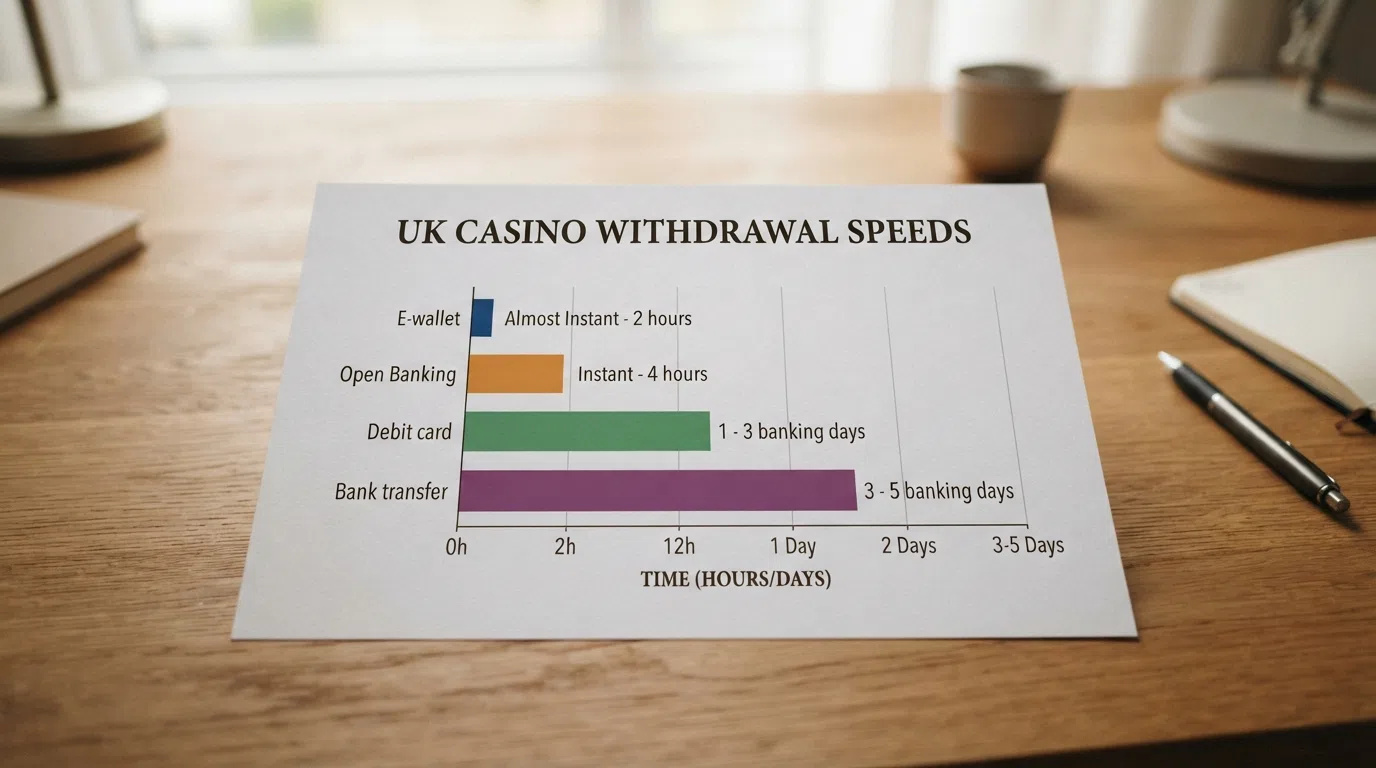
The withdrawal request is where the payment method starts to matter. The casino’s payments team has to approve the request, often through a separate fraud-and-risk review, and that approval step is what the Commission’s 24 to 48 hour data covers. From there the money is handed to the payment method’s own rails. An e-wallet credit can be near-instant. A debit card refund takes one to three working days once the card network and issuing bank process it. A bank transfer via Faster Payments can land the same day at operators that release funds in time; a regular BACS transfer can take up to five working days.
Two rules shape the player’s position on this side of the journey. First, a licensed UK operator must allow the player to withdraw their deposit balance at any time — even while a bonus is pending or active. The right is not contingent on completing a wagering requirement. Second, any charge the operator levies on a withdrawal must not exceed the direct cost of processing it. In practice, no major licensed UK casino charges a withdrawal fee at all, but the rule exists precisely so that a fee cannot quietly eat into a withdrawal.
A third change is on the way. From 30 June 2026, only a limit based on the total amount a customer pays into their account over a set period may be described as a “deposit limit”. The wording matters because it stops operators from rebranding a net-deposit threshold, a loss cap or a wagering ceiling as a “deposit limit” — and from giving those other caps more prominence than the actual deposit cap itself.
Alternative Payment Routes — Open Banking, Revolut and What They Change
Open Banking is the route that quietly restructures the choice. Trustly acts as the bridge: the player picks their bank, authenticates through their banking app, and the payment settles between accounts without a card number, e-wallet login or voucher PIN ever crossing the casino’s system. Among the featured operators, bet365, William Hill, Gala Bingo, PlayOJO and Videoslots all accept Trustly or Open Banking, and Betfred counts an Open Banking deposit toward the qualifying action for its welcome offer. The route is treated in depth under the Trustly section below.
Revolut sits in a different category. It is a digital-first current account — a UK banking licence of its own, an app, a card — and the casino simply sees it as a bank account on the other end of a transfer. Ladbrokes and Coral both accept Revolut, and the deposit and withdrawal behave like any standard bank transfer from there. The point of using Revolut is rarely the casino side of the transaction at all; it is the budgeting, currency conversion and instant notifications that come with the account.
The UK Casinos That Get Payments Right — Our 2026 Ranking
Ten GB-licensed operators make up the featured set. They were checked against the UK Gambling Commission’s public register, and the table below lays out the payment-method coverage, licence status and welcome-offer shape for each. The ranking weights three things: how many recognised UK payment routes the cashier accepts without friction, how the operator’s published withdrawal timelines read against the Commission’s 99%-within-24-to-48-hours benchmark, and whether the welcome offer is accessible by a method a player is likely to choose anyway.
| Operator | UKGC Licence | Debit Card | PayPal | Welcome Offer |
|---|---|---|---|---|
| bet365 Games | GB-licensed (UKGC register) | Yes | Yes (debit safer for bonus) | Up to 500 free spins, 0x wagering |
| William Hill Vegas | GB-licensed (UKGC register) | Yes | Yes | 200 free spins on Big Bass Splash, 10x wagering |
| Sky Vegas | GB-licensed (Flutter group) | Yes | No | 200 free spins, 0x wagering |
| Ladbrokes | GB-licensed (Entain, UKGC register) | Yes | Yes (excluded from welcome) | 100 free spins + 300 LadBucks, 0x wagering |
| Coral | GB-licensed (Entain group) | Yes | Yes (min £10) | — |
| Betfair | GB-licensed (Flutter group) | Yes | Yes (e-wallet min £30) | Up to 150 free spins (no-deposit + deposit elements) |
| Betfred | GB-licensed (UKGC register) | Yes | Yes | Up to 200 free spins, £10 qualifying stake |
| Gala Bingo | GB-licensed (Entain group) | Yes | Yes | 100 free spins, 0x wagering |
| PlayOJO | GB-licensed (UKGC register) | Yes | Yes | — |
| Videoslots | GB-licensed (UKGC register) | Yes | Yes | — |
A few patterns fall out of that table. The first is that debit cards are a constant: every operator in the featured set takes them, and no operator restricts them from the welcome offer. The second is that PayPal is nearly universal — present at nine of ten — but three of those nine either exclude it from the welcome offer or warn that another method is safer for the bonus. The third is that the welcome-offer column is not equally populated: three operators (Coral, PlayOJO, Videoslots) did not surface their current offer in the sources reviewed this run, and the ranking reflects their payment-method coverage instead.
The write-ups below put meat on each row. The shape of the offer matters, but the gap between what the cashier accepts and what the promotion counts is the bit that decides whether a player actually gets to use the bonus.
bet365 Games — Zero-Wagering Free Spins and the Widest Payment Net
The welcome offer at bet365 Games is up to 500 free spins, credited in tranches of 5, 10, 20 or 50 per day over ten days, with zero wagering on whatever the spins produce. Each set of spins is valid for seven days from credit, and the whole package has to be claimed within 30 days of registration. The eligible titles include Book of Horus, Curse of the Bayou, Magic Forge and Wrath of the Deep, drawn from Pragmatic Play and Red Tiger among other suppliers.
The payment-method roster is the widest in the featured set. Visa debit and Mastercard debit are there, alongside Apple Pay, Google Pay, Trustly / Pay by Bank, Paysafecard, bank transfer and PayPal. The note that sits beside that last method is the one to read: certain promotion sources warn that PayPal deposits can be riskier for bonus eligibility, and that a debit card is the safer route for the welcome offer. The cashier accepts PayPal happily for general use, but the question of which deposit counts toward the 500 free spins is the one the small print decides.
William Hill Vegas — Big Bass Splash Spins with Wagering to Clear
William Hill Vegas offers 200 free spins on Big Bass Splash at 10p per spin, and the trade-off for the named slot is that free-spin winnings carry a 10x wagering multiplier. The qualifying stake has to be made within seven days of opt-in, and the free spins themselves expire 72 hours from issue. The window is short and the multiplier is the cost of the headline — a 10x playthrough on a typical Big Bass Splash return can mean several hundred pounds of staking before the bonus money is actually withdrawable.
The payment-method list is broad: Visa, Mastercard, Maestro and Electron debit cards, PayPal, Apple Pay, Paysafecard, Trustly and Fast Bank Transfer. Some deposit types are reported as ineligible for the offer in operator materials, and the safest bet for the welcome package is a debit card or Apple Pay. The range of accepted methods is wider than the range of methods that count toward the bonus, and the gap is the thing to read twice before funding.
Sky Vegas — No-Wagering Spins, but No PayPal, Skrill or Neteller
Sky Vegas runs 200 free spins with zero wagering, which is the simpler end of the bonus spectrum. The payment-method list is the interesting part. Sky Vegas takes Visa debit, Mastercard debit, Maestro, Electron, Apple Pay, Google Pay and instant bank transfer — and that is the whole list. There is no PayPal, no Skrill and no Neteller.
For a player who prefers to keep casino money in an e-wallet, Sky Vegas is a non-starter. For everyone else, the offer is one of the cleaner zero-wagering packages in the featured set, and the deposit-and-withdrawal route through debit card or Apple Pay is short. The payment-method roster is the trade the player is making for the simplicity of the bonus.
Ladbrokes — Free Spins Without Wagering, but PayPal Misses the Bonus
Ladbrokes runs 100 free spins plus 300 LadBucks on deposit and spend, with zero wagering on the free-spin winnings. The acceptance window is the tight bit: 48 hours to accept the offer after registering, then seven days from acceptance to use it. LadBucks are a site-credit balance usable on selected games and the rules around them carry their own terms.
The payment-method coverage is broad. Visa, Mastercard, Apple Pay, Google Pay, PayPal, instant bank transfer, Paysafecard and Revolut all make the cashier. PayPal carries a £10 minimum deposit and — the part that catches out unwary players — is excluded from the welcome offer. The pattern is consistent with the wider Entain group: a deposit that works for general use is not always a deposit that triggers the bonus. Debit card or Apple Pay is the path of least friction.
Coral — Broad Payment Coverage Under a GB Licence, with Thin Bonus Detail
Coral is a GB-licensed Entain brand with wide payment-method coverage: Visa, Mastercard, Apple Pay, Google Pay, PayPal, Revolut, Paysafecard and instant bank transfer are all in the cashier. PayPal carries a £10 minimum deposit.
Coral’s current promotion page details the active bonus terms, which should be verified before funding. A player weighing Coral against the rest of the featured set should check Coral’s own promotion page for the active offer before funding, because the welcome package is the variable that decides whether the rest of the picture (a strong payment-method range, an Entain-group licence, broad cashier coverage) is competitive at this moment.
Betfair — Free Spins with a No-Deposit Entry Point
Betfair’s headline is up to 150 free spins, with both a no-deposit element and a deposit-triggered element surfaced in the available sources. The headline offer includes both a no-deposit and a deposit-triggered element; players should consult the current promotion page for the full terms before committing.
The payment-method list runs to debit cards, PayPal, Skrill, MuchBetter, Neteller and instant bank transfer — a wider e-wallet range than most of the featured set. The e-wallet minimum deposit is reported at £30, which sits above the £5 or £10 minimum that usually applies to debit cards. The no-deposit element is the unusual feature: a player can register, claim the no-deposit spins, and only deposit if they want to convert the bonus into a cash balance.
Betfred — 200 Spins, but Only Three Payment Routes Qualify for the Offer
Betfred offers up to 200 free spins when staking £10, with a 30-day window to complete the qualifying stake. The accepted payment methods are Visa, Mastercard, PayPal, Apple Pay and bank transfer — five routes at the cashier.
The narrower list is the one the bonus actually counts: only debit card, Apple Pay and Open Banking were reported as qualifying for the welcome offer. A PayPal deposit and a standard bank transfer land in the account and work for general play, but the £10 qualifying stake has to be made through one of the three routes the promotion recognises. The gap between “what the cashier takes” and “what the bonus counts” is the bit to read first at Betfred.
Gala Bingo — Zero-Wagering Spins in the Entain Network
Gala Bingo’s offer is 100 free spins after depositing and spending £10 on slots, with zero wagering on the free-spin winnings. The spins are valid for seven days and have to be claimed within seven days of registration. The bonus is part of the Entain group, which is also where the relevant bonus-exclusion pattern lives.
The payment-method list includes Visa, Mastercard, PayPal, Trustly, Skrill, Neteller and others. Skrill and Neteller are typically excluded from Entain-group welcome bonuses — a player funding through those e-wallets will see the deposit land but the welcome spins will not unlock. Debit card, PayPal (depending on the current offer) and Trustly are the safer routes for the welcome package.
PlayOJO — Same-Day PayPal Cashouts with No Minimum
PlayOJO’s standout payment feature is the stated PayPal withdrawal time of within 24 hours, with no minimum cashout threshold. Apple Pay, Pay by Mobile, debit cards and Trustly round out the cashier. The Pay-by-Mobile option is the notable inclusion: it gives a player a way to fund a session through a phone bill and still receive the cashout through PayPal.
PlayOJO’s current promotion page details the active bonus terms, which should be verified before funding. The payment-method coverage and the PayPal withdrawal speed are the part of the offer that holds up without the bonus.
Videoslots — Open-Banking Deposits and a £10k Daily Ceiling
Videoslots accepts Trustly / Open Banking, PayPal, Paysafecard, Visa and Mastercard debit, and Faster Payments bank transfer. Paysafecard is deposit-only here as elsewhere, and the standard deposit limits surfaced are a £10 minimum and a £10,000 daily ceiling — the daily cap is the higher one in the featured set, and it is the option for a player who wants to fund a larger balance in one go.
Videoslots’ current promotion page details the active bonus terms, which should be verified before funding. The cashier is the part of Videoslots that holds up regardless. The combination of Trustly, Faster Payments and PayPal covers the three main withdrawal-speed profiles a UK player tends to want.
Frequently Asked Questions
What payment methods can I use at UK online casinos?
Most UK-licensed casinos support debit cards, e-wallets like PayPal, and Open Banking routes like Trustly. Some also accept prepaid vouchers or pay-by-mobile services. The best approach is to check the cashier at the operator site, as availability can vary by brand and promotion.
Which payment methods are fastest for withdrawals at UK casinos?
E-wallets such as PayPal, Skrill, and Neteller typically provide the fastest withdrawal times, often processing funds within 24 hours of approval. While the operator’s processing time is similar across most methods, the e-wallet rails are generally quicker than bank transfers or debit card refunds once the payment is released.
Can I use a credit card to deposit at a UK online casino?
No. Since 14 April 2020, GB-licensed operators are prohibited from accepting payments via credit card. This ban includes credit-card-funded e-wallet deposits or any other payment routed through a money service business. Debit cards and direct bank transfers are the standard compliant alternatives used throughout the market.
Do UK casinos allow PayPal deposits for welcome bonuses?
It depends on the operator. While many UK casinos accept PayPal for general deposits, some exclude PayPal from welcome offers. Always check the bonus terms and conditions before depositing, as casinos may specify that a debit card is required to trigger the bonus eligibility.
Is Trustly safe to use for casino deposits in the UK?
Yes. Trustly operates as an Open Banking solution that allows you to authenticate payments directly through your own banking app. Because no card numbers or banking credentials are shared with the casino, it is considered a secure method that simplifies the deposit process and often supports fast withdrawals.
Can I withdraw to Paysafecard or Boku / pay by mobile at UK casinos?
No. Paysafecard and pay-by-mobile services like Boku are deposit-only tools. They exist to fund sessions without using a bank or card directly. If you deposit using these methods, the operator will require you to register a separate withdrawal route, such as a debit card or bank account, for cashouts.
A player waiting on a cashout is usually told the operator is “processing” the withdrawal, and the impression is that the casino is the slow part. The Commission’s own data does not support that. Around 99% of withdrawal requests at the largest gambling companies are approved, processed and fulfilled within 24 to 48 hours of being made, as the Gambling Commission’s 2026 data shows. The extra two or three days that make a cashout feel slow come from the payment method’s own settlement rails after the operator has already done its job.
| Payment Method | Deposit Speed | Withdrawal Speed | Fees | Bonus Eligibility |
|---|---|---|---|---|
| Visa / Mastercard debit | Instant | 1–3 working days after approval | None at UK-licensed operators | Universal — never restricted |
| PayPal | Instant | Within 24 hours, often same day | None at UK-licensed operators | Often restricted from welcome offers |
| Skrill / Neteller | Instant | Within 24 hours, often same day | Operator fees uncommon; wallet fees possible | Frequently excluded from welcome offers |
| Trustly / Open Banking | Instant (via bank app) | Same day to 24 hours after approval | None at UK-licensed operators | Generally accepted |
| Bank transfer (Faster Payments) | Same day to next day | Same day to 24 hours | None | Generally accepted |
| Apple Pay / Google Pay | Instant (tokenised debit) | Same as underlying card | None | Treated as the underlying card |
| Paysafecard | Instant | Deposit only — no withdrawal route | None | N/A for withdrawals |
| Pay by Mobile (Boku) | Instant (on phone bill) | Deposit only — no withdrawal route | Carrier fee possible | Often excluded; small-deposit tool |
The table is not a list of the methods a cashier accepts in the abstract. It is a description of what happens to a withdrawal once the operator has already approved it. The 24-to-48-hour operator window is roughly the same across the table; the variability sits in the column to the right of it.
How Fast Your Money Moves — Real Withdrawal Timelines by Method
E-wallet cashouts are the fastest route a UK player has. PayPal, Skrill, Neteller and the smaller wallets receive the funds from the operator within hours of approval, and the wallet balance updates almost immediately. The result is that a withdrawal requested in the morning is often spendable, withdrawable back to a bank account, or transferable elsewhere by the same evening. PlayOJO’s published PayPal withdrawal window is within 24 hours, and bet365’s cashier supports a similar PayPal timeline.
Debit card withdrawals are the universal baseline and the universal slow route. The operator approves the request within the 24-to-48-hour window, and then the card network and the issuing bank take over. A Visa or Mastercard debit refund typically lands in one to three working days after the operator releases it, and the timing is set by the bank, not the casino. There is no way to make a debit card refund arrive faster by choosing a different operator.
Bank transfer sits between the two on speed but closer to the e-wallet end when Faster Payments is in play. A withdrawal released by the operator in the morning can be in the player’s current account by the afternoon, provided the receiving bank and the operator’s sending bank both support Faster Payments. A regular BACS transfer, where it is still used, runs to one to three working days on top of the operator’s approval time, and the total cashout timeline can stretch towards a working week.
The pattern that emerges is that the operator’s job is fast and consistent, and the payment method is the variable. A same-day cashout is the domain of e-wallets, while debit cards offer the familiarity of a refund to the issuing institution. Bank transfers offer a middle ground, with speed contingent on whether both institutions support Faster Payments.
The Safest Ways to Move Casino Money in the UK
Every payment method at a UKGC-licensed casino is regulated. The Gambling Commission licence conditions, the Payment Services Regulations and PSD2 strong customer authentication apply to the cashier regardless of which button the player presses. That is the floor — every route below it sits on the same legal footing.
Above the floor, the methods differ in the kind of protection they offer. A debit card carries bank-level fraud protection and a chargeback route through the card network. If a deposit is disputed, the issuing bank is the player’s first port of call. An e-wallet separates the casino from the player’s bank account entirely — the casino never sees a card number, and the wallet acts as a buffer. Most major e-wallets add two-factor authentication, device binding and biometric login on top. Open Banking does not share the player’s banking credentials with the casino at all; the authentication happens inside the player’s own banking app, and the payment settles through a regulated API.
Prepaid vouchers are the privacy-first end of the spectrum. A Paysafecard deposit costs the player only the value of the PIN, so the financial exposure is hard-capped at the voucher amount. A pay-by-mobile deposit is similarly small by design. The protection these routes offer is not consumer-dispute protection — it is the simple fact that the casino only ever sees what was on the voucher or the phone bill.
E-Wallets — The Withdrawal Speed Leaders
PayPal, Skrill and Neteller are the e-wallets that appear most often in the UK cashier, and they are the methods that deliver the fastest cashouts. The mechanic is straightforward: the operator releases the withdrawal to the wallet provider, the wallet provider credits the player’s account, and the player can then transfer the balance to a bank account or spend it elsewhere. The bottleneck is the operator’s release step, not the wallet.
The trade-off is bonus eligibility. A Skrill or Neteller deposit will frequently unlock the account and let a player play, but it will not trigger the welcome offer at many operators. The pattern is most consistent inside the Entain group, where Skrill and Neteller are typically excluded from welcome bonuses, but it shows up across the wider market. PayPal sits in a slightly different place: the bonus exclusion is more operator-by-operator, and some brands (Sky Vegas, for example) do not accept PayPal at all. The list of e-wallets that turn up in the UK cashier also includes MuchBetter, MiFinity, ecoPayz and AstroPay, each with their own fee structure and regional footprint. Betfair is the operator in the featured set that takes the widest e-wallet range.
Debit Cards and Bank Transfer — Slower but Universal
Every operator in the featured set accepts Visa and Mastercard debit cards, and that universality is the reason debit cards remain the default. The deposit is instant, the cashier is familiar, and the welcome offer is rarely restricted. The cost is the cashout timeline: one to three working days after the operator approves the withdrawal, with the actual pace set by the issuing bank.
Faster Payments is the bank-transfer method that closes most of the speed gap. A withdrawal released by the operator in the morning can arrive the same afternoon, and a deposit made through a Faster Payments instruction is typically credited within minutes. The catch is that the operator has to support it on the sending side and the player’s bank has to credit it promptly on the receiving side, and the combination does not hold at every cashier.
Credit cards are out. Since 14 April 2020, GB licensees have not been allowed to accept payment for gambling by credit card, and the ban extends to credit-card funds routed through a money service business. There is no licensed UK casino where a credit card deposit will go through, and there is no licensed UK casino that will treat a credit-card-funded e-wallet deposit as anything other than a blocked payment.
Which Casino Payment Method Should You Pick? Every UK Option Compared
The method-by-method breakdown below walks through every payment route open to UK players in 2026, in the form a player is likely to use it. The deposit speed, the withdrawal behaviour, the typical limits, and the bonus-eligibility picture are the four things that decide which method to use, and each method is described with those four in mind.
Two rules apply across every method. No UK-licensed casino charges a deposit fee, and any withdrawal charge the operator does levy must not exceed the direct cost of processing the payment. In practice, the major operators charge nothing for deposits or withdrawals, and the rule is the backstop that keeps it that way.
Visa and Mastercard Debit — The Default Route for Every UK Player
Debit cards are the baseline. Every featured operator accepts them, the cashier is identical to every other online checkout the player uses, and the welcome offer is almost never restricted. The deposit is instant, gated only by PSD2 strong customer authentication, and the funds are available in the casino balance within seconds.
The withdrawal timeline is the cost. A Visa or Mastercard debit refund takes one to three working days after the operator releases the funds, and the timing is set by the card network and the issuing bank. There is no way to make a debit card cashout arrive faster by switching operator, and there is no realistic way for a player to influence the issuing bank’s processing window. The operators in the featured set that explicitly recommend a debit card for bonus eligibility — bet365, William Hill Vegas and Betfred among them — do so because the welcome offer is almost always accessible through debit and almost never restricted to it.
PayPal at UK Casinos — Fast, Familiar, but Sometimes Bonus-Blocked
PayPal is the e-wallet that UK players know best, and it is the one they ask about most. The deposit is instant. The withdrawal can be within 24 hours at operators that release funds promptly — PlayOJO’s published window is within 24 hours, and bet365’s cashier supports a similar PayPal timeline. The familiarity is real: the wallet is the same one the player uses on the high street and online, and the security features (two-factor authentication, device binding) carry over.
The bonus-eligibility picture is the friction. PayPal deposits are excluded from the welcome offer at Ladbrokes, and the pattern repeats at other Entain-group brands. Some operators carry a £10 minimum on PayPal deposits (Ladbrokes, Coral), and Betfair’s broader e-wallet minimum is £30. The operators in the featured set that accept PayPal are bet365, William Hill, Ladbrokes, Coral, Betfair, Betfred, Gala Bingo, PlayOJO and Videoslots. The one that does not is Sky Vegas. While PayPal is often the fastest route for cashouts, check the specific promotion terms before making the first deposit to ensure the welcome bonus remains accessible.
Skrill and Neteller — Speed at a Cost, and Often Excluded from Welcome Offers
Skrill and Neteller offer the same near-instant withdrawal experience as PayPal, and the same separation from the player’s bank account. Among the featured operators, Betfair and Gala Bingo take both, and Sky Vegas explicitly does not. The mechanic is identical to PayPal: the operator releases the funds to the wallet, the wallet credits the player, and the player can transfer the balance onward.
The bonus-exclusion picture is sharper than for PayPal. Skrill and Neteller are the two methods most consistently excluded from UK welcome offers, and the pattern is strong enough that a player should assume the exclusion is in force unless the operator’s promotion page says otherwise. The e-wallet minimum deposit at Betfair is £30, which is higher than the £5 or £10 minimums common to debit cards. The result is a method that wins on speed and loses on bonus access, and that trade-off is the consistent shape of Skrill and Neteller at UK casinos.
Trustly and Open Banking — The Direct Bank Route That Skips the Middleman
Trustly, branded at some operators as “Pay by Bank”, is the Open Banking route that moves money directly between the player’s bank account and the casino. The mechanic is what makes it different: the player picks their bank, authenticates inside the banking app, and the payment settles through a regulated API. No card number is typed. No e-wallet is funded. No password leaves the bank.
The featured operators that take Trustly or Open Banking are bet365, William Hill, Gala Bingo, PlayOJO, Videoslots and Betfred (where an Open Banking deposit counts toward the qualifying action for the welcome offer). The security advantage is the main pitch: no card details or wallet credentials are shared with the casino, and the authentication is the same one the player uses for any other banking app session. The withdrawal speed depends on the operator, but the route is typically faster than debit card once the operator has approved the request, and Faster Payments is often the settlement rail.
Apple Pay, Google Pay and Revolut — The Digital-First Payment Layer
Apple Pay and Google Pay are not separate payment methods in the strict sense. They are tokenised fronts for a debit card: the casino sees a card transaction, and the player’s actual card number never leaves the device. The deposit speed and the withdrawal route are the card’s, and the bonus-eligibility treatment is whatever the underlying card would receive. Among the featured operators, Apple Pay is accepted at bet365, William Hill, Sky Vegas, Ladbrokes, Coral, Betfred and PlayOJO. Google Pay is accepted at bet365, Sky Vegas, Ladbrokes and Coral.
Revolut is a different thing. It is a digital-first current account, with its own UK banking licence, an app and a card, and the casino simply sees it as a bank account on the other end of a transfer. The deposit and withdrawal behave like a standard bank transfer. Ladbrokes and Coral are the operators in the featured set that accept Revolut, and the appeal for a player is the budgeting, currency-conversion and instant-notification features of the Revolut app, not anything specific to the casino’s cashier.
Paysafecard — Deposit-Only Privacy with a PIN
A Paysafecard is a 16-digit PIN bought at a retail outlet or online, and the PIN is entered at the casino cashier. The deposit lands instantly, no personal financial data reaches the operator, and the player’s bank and card never touch the casino’s system. The privacy is the appeal, and the small denominations (£10, £25, £50, £100 and upwards) make the method a natural budgeting tool.
The hard limit is that Paysafecard is deposit-only. A withdrawal cannot be returned to a PIN that has no account behind it, and the player has to register a separate withdrawal method — typically a debit card or a bank account — before requesting a cashout. The featured operators that accept Paysafecard are bet365, William Hill, Ladbrokes, Coral and Videoslots.
The Smaller E-Wallets — MuchBetter, MiFinity, ecoPayz and AstroPay
Beyond PayPal, Skrill and Neteller, the UK cashier sometimes turns up MuchBetter, MiFinity, ecoPayz and AstroPay. MuchBetter is the one that appears most often in the featured set: Betfair accepts it, with a minimum deposit in line with the other e-wallets there. The others are narrower in their UK footprint, and a player who already holds an account with one of them will find the cashier availability on a per-operator basis.
The smaller e-wallets tend to operate their own apps with their own fee structures, and currency-conversion charges can apply for non-GBP balances. The simplest rule is to check the operator’s cashier for current acceptance, because the presence of any of these wallets at a UK casino is narrower than the presence of PayPal or Skrill.
Pay by Mobile at UK Casinos — Convenient, but Strictly Deposit-Only
Pay-by-mobile is the route for a player who wants to fund a session with the smallest possible friction. The deposit is added to the monthly phone bill or deducted from prepaid credit, the amount is small, and the casino never holds a card number. The constraint is that the route is deposit-only, and the player has to register a separate withdrawal method before any cashout at all.
How Pay-by-Mobile Casino Deposits Work
The deposit flow is short. The player selects pay-by-mobile at the cashier, chooses an amount, confirms by SMS, and the charge lands on the next phone bill (post-paid) or is deducted from prepaid credit. The deposit is instant, and the carrier — not the casino — sets the per-transaction and daily limits. The typical UK ceiling is around £30 per transaction, which is the small-deposit ceiling the route is built around.
The appeal is convenience. There is no card number, no e-wallet account, and no separate app. The cost of that convenience is that the method is not designed for high-value play, and the welcome-bonus eligibility at most operators does not extend to pay-by-mobile deposits.
Boku — The Brand Behind UK Phone-Bill Casino Payments
Boku is the carrier-billing platform that connects the casino to the mobile network. The casino integrates with Boku, Boku handles the SMS verification and the carrier billing, and the player sees the charge on their phone bill. The transaction cap is set by the network rather than the casino, and the typical Boku deposit at a UK casino runs from £5 to £30 per transaction.
Boku is deposit-only by design. The player has to register a separate withdrawal method at the casino before requesting a cashout, and the carrier billing relationship does not extend to incoming payments. A player who likes the deposit convenience can still use Boku to fund the account and a debit card, bank transfer or e-wallet to take the winnings out.
The Hard Limits of Pay-by-Mobile — No Withdrawals, Small Deposits
The pay-by-mobile route cannot do three things, and the limits shape the role it plays. It cannot return a withdrawal — a casino has no path to credit a phone bill. It cannot support large deposits — the per-transaction and daily caps are set by the network and are typically low. And it cannot guarantee welcome-bonus eligibility at most operators, because the small amounts and the chargeback risk are reasons to exclude the route from the most generous offers.
The method is best understood as a top-up tool, not a cashier replacement. A player who deposits £20 by Boku to test a casino and then registers a debit card for the welcome offer is using the method the way it is designed to be used. The comparison with Paysafecard is instructive: both are deposit-only, both keep bank details off the casino’s system, and both require a separate withdrawal route. The difference is the rail — a PIN bought at a shop versus a charge on a phone bill.
The UK Rules That Decide What You Can (and Cannot) Do with Casino Money
UK gambling regulation is among the strictest in the world, and the payment layer is where most of that strictness lands. Every payment at a licensed casino runs through a framework of bans, caps and mandatory protections, and the table below lays them out in one view.
| Rule | What It Limits | Threshold or Cap | In Force Since |
|---|---|---|---|
| Credit-card gambling ban | All credit-card deposits, including via e-wallets / MSBs | No credit-card deposits permitted | 14 April 2020 |
| Online slots stake cap (25+) | Maximum stake per game cycle for adults | £5 per spin | 9 April 2025 |
| Online slots stake cap (18–24) | Maximum stake per game cycle for younger adults | £2 per spin | 21 May 2025 |
| Mandatory deposit-limit prompt | Operators must offer a financial limit before first deposit | Must be offered and easy to change | 31 October 2025 |
| Light-touch affordability check | Triggered at a net deposit threshold (rolling 30 days) | £150 net deposits | 28 February 2025 |
| “Deposit limit” definition (RTS 12B) | Only gross-deposit limits may be called “deposit limits” | Equal prominence to other financial limits | 30 June 2026 |
| Wagering-requirement cap | Maximum wagering on promotional offers | 10x | 19 December 2025 |
| PSD2 strong customer authentication | All online casino payments must pass two-factor verification | Required on every payment | In force |
| Reverse-withdrawal ban | Player cannot undo a withdrawal request and return funds to the casino | Reverse withdrawals prohibited | 31 October 2021 |
| Statutory levy | Operator contribution to research, prevention and treatment | Collected by the UKGC | 6 April 2025 |
| GAMSTOP self-exclusion | National multi-operator self-exclusion | Mandatory for all GB licensees | 31 March 2020 |
The rules are not a list of inconveniences. They are the architecture of consumer protection in a licensed market, and the player who knows them is the player who notices when an operator falls short.
The UKGC Licence — What It Means for Your Casino Payments
The Gambling Commission regulates every GB-facing casino under the Gambling Act 2005, with the point-of-consumption extension brought in by the Gambling (Licensing and Advertising) Act 2014. The licence is a legal requirement, not a marketing badge: providing facilities for gambling in Great Britain without the required licence is a criminal offence under section 33 of the Gambling Act 2005. Operating without one is not a regulatory grey area; it is the criminal end of the market.
The licence conditions that shape payments are the ones a player actually feels. Identity verification is mandatory before the first deposit, and has been since 7 May 2019 — the casino has to confirm the customer’s name, address and date of birth before any money moves. The right to withdraw a deposit balance at any time, including while a bonus is pending or active, is enshrined in the Commission’s withdrawal guidance. The reverse-withdrawal ban, in force since 31 October 2021, closes the loophole where a player could cancel a cashout and return the funds to the casino balance. The cap on withdrawal charges, set at no more than the direct cost of processing the payment, prevents operators from quietly levying a percentage on the way out.
The Credit Card Ban — Why You Have Not Been Able to Use One Since April 2020
Since 14 April 2020, GB licensees have not been allowed to accept payment for gambling by credit card. The legal basis is LCCP licence condition 6.1.2, and the ban reaches further than a straight credit-card deposit. A credit-card-funded e-wallet top-up, or a credit-card-funded payment routed through a money service business, is also caught, because the spirit of the rule is that no gambling deposit can ultimately trace back to a credit facility. The UK is one of the few jurisdictions with a comprehensive credit-card prohibition, and the practical effect is that no payment method on a licensed UK cashier will accept a credit card at any layer.
Debit cards are unaffected. The ban is on credit, and the regulatory concern is that credit removes the friction that budgeting is meant to provide. A debit card deposit draws on money the player already has, which is exactly the boundary the regulation draws.
Deposit Limits, Affordability Checks and SCA — The Rules That Protect Your Money
The deposit-limit framework has three layers. The first is the mandatory offer: since 31 October 2025, every UK operator has to prompt a customer to set a financial limit before the first deposit, make the limit easy to review and change, and action any decrease immediately. The second is the “deposit limit” definition, taking effect on 30 June 2026, which restricts the term to a limit based on the total amount a customer pays into the account over a set period and requires that limit to be given at least equal prominence to any other financial limit. The third is the affordability check, which runs in the background at the operator level rather than at the cashier.
The light-touch affordability check is the first of the two financial-vulnerability checks. Triggered at £150 net deposits in a rolling 30-day period from 28 February 2025, it uses publicly available data only and is meant to catch the customers in clear financial difficulty without creating friction for everyone else. The staged rollout of the more thorough financial risk assessments is still being finalised; announced Stage 1 thresholds are £5,000 net deposits in a rolling 24 hours (25 and over) and £2,500 (under 25), with final-stage figures announced at lower levels, and the start date is not yet confirmed as commenced.
PSD2 strong customer authentication is the rule that produces the one-time code or banking-app approval on every online casino payment. It applies regardless of the payment method, and it is the same friction a player sees on every online checkout in the country. The two-factor step is not optional, and the friction is the protection.
The statutory slots stake caps are the most direct payment-adjacent rule. From 9 April 2025, the maximum stake per game cycle on online slots is £5 for players aged 25 and over; from 21 May 2025, the limit is £2 for players aged 18 to 24. The cap is on the stake, not on the deposit, and it is the most visible sign of a regime that prices the bet rather than the session.
Staying in Control — The Safer-Gambling Tools Every UK Player Should Set
The UK regulatory framework is built around the assumption that every player needs concrete tools, not abstract advice. The data on why the tools matter is sobering. An estimated 0.5% of the adult English population experience problem gambling, 3.8% are at elevated risk, and 7% of the British population are negatively affected by someone else’s gambling. GambleAware’s own research found that 13.1% of adults were classified as experiencing any level of gambling problems (PGSI 1+), equivalent to around 6.8 million GB adults. These are not edge cases, and the safer-gambling infrastructure exists because the prevalence is not zero.
Deposit Limits — Why the Mandatory Prompt Is Worth Taking Seriously
The deposit limit is the single most direct payment control a player can set, and the UK operator has to offer one before the first deposit. The mechanic is straightforward: a cap on the total amount paid into the account over a chosen period — daily, weekly or monthly — and a hard stop once the cap is reached. A decrease in the limit takes effect immediately, which means a player can tighten a limit mid-session if the day takes a wrong turn. From 30 June 2026, the gross-deposit limit must be offered with at least equal prominence to any other financial limit the operator surfaces.
The limit is a budgeting tool, not a punishment. A player who sets a £200 weekly limit and stops when it is reached is not under-regulating themselves; they are using the one payment control that maps directly onto the actual flow of money.
GAMSTOP, Self-Exclusion and Time-Outs — Your Emergency Brakes
GAMSTOP is the national multi-operator self-exclusion scheme for Great Britain. A single registration blocks every GB-licensed online gambling operator, for a period the player chooses — six months, one year, five years, or five years with auto-renewal. The exclusion cannot be cancelled early, and GAMSTOP has been a mandatory licence condition since 31 March 2020. The scope is the point: a player who has decided to step away does not have to register with each operator in turn.
Time-outs and reality checks are the lighter-touch tools available inside individual operator accounts. A time-out is a short self-exclusion — 24 hours, 48 hours, a week — that pauses play without committing to a GAMSTOP registration. A reality check is a pop-up reminder of how long the session has lasted and how much has been staked or won. Neither is a substitute for GAMSTOP when a player is in serious difficulty, but both are part of the same architecture of small interventions before larger ones are needed.
Where to Get Help — GamCare, BeGambleAware and NHS Support Routes
Free, confidential help is available 24/7 in the UK, and the routes are several. The National Gambling Helpline on 0808 8020 133 is run by GamCare and is free from any UK phone. Callers and online chat users can speak one-to-one with an adviser for confidential advice, information and support, as GambleAware advises in its 2026 guidance. GamCare’s published referral numbers show the demand: 996 referrals to treatment and peer-based support services in January 2026, up from 674 in January 2025 — a 48% year-on-year rise that tells its own story about how the support infrastructure is being used.
BeGambleAware provides information and routes into support, and the NHS gambling-harm clinics offer specialist treatment for the most severe cases. The statutory levy that took effect on 6 April 2025 now funds the research, prevention and treatment pipeline through the Gambling Commission, replacing the previous system of voluntary operator contributions. The infrastructure is funded, the routes are public, and the cost of using any of them is zero.
How We Selected and Ranked the Casinos on This Page
The ranking was built on four data sources. The first was the UK Gambling Commission’s public register of gambling businesses, last updated 29 July 2026, used to confirm the GB-licence status of each featured operator. The second was each operator’s own published payment-method pages and bonus terms, used to map the cashier to the welcome offer. The third was a set of authoritative UK-facing casino review sources, used to cross-check payment-method availability and bonus terms against what the operator says. The fourth was the Gambling Commission’s published withdrawal and market data, used as the speed benchmark for the operator-side approval window. Data provided to the Commission by some of the largest gambling companies shows that those firms approve, process and fulfil around 99 percent of customer withdrawal requests within 24 to 48 hours of the request being made, as the Commission reported in 2026.
The ranking criteria were four. Payment-method breadth: how many recognised UK payment routes the cashier accepts without friction, including e-wallets, Open Banking and the digital-first layer. Withdrawal speed: the published and reported timelines against the Commission’s 24-to-48-hour benchmark, weighted by whether the operator accepts the methods that deliver the fastest cashouts. Bonus accessibility by payment method: whether the welcome offer is reachable through the methods a player is most likely to use, or whether the bonus and the cashier are pointing at different routes. GB-licence standing: confirmation against the UKGC public register.
The limitation is that only publicly available data was used, and bonus terms change. The welcome-offer specifics for Coral, PlayOJO and Videoslots were not surfaced in the sources reviewed this run, and the reader should verify current terms on the operator’s own promotion page before funding any of the three. The ranking reflects payment-method coverage and licence standing for those three in the absence of confirmed bonus detail, and a current offer may shift the picture.
What UK Players Should Actually Do About Casino Payments in 2026
The choice between payment methods is rarely about safety — every method at a licensed UK casino is regulated, and the differences in protection are differences of kind, not of category. The choice is about priorities.
A player who wants the fastest cashout picks PayPal, Skrill or Neteller, accepts that the welcome offer may not be available through the chosen wallet, and registers a debit card as the fallback. The PlayOJO-style promise of PayPal withdrawals within 24 hours, with no minimum cashout, is the best-case scenario, and the e-wallet minimum deposits (£30 at Betfair, for example) are the cost of admission.
A player who wants a welcome offer and a refund to the same instrument picks a debit card. The deposit is instant, the bonus is almost never restricted, and the cashout takes one to three working days after approval. The wait is the trade, and the trade is straightforward.
A player who wants neither the wallet layer nor the card-number layer picks Trustly or Open Banking. The authentication happens inside the banking app, the casino never sees a card number, and the cashout is typically faster than debit card once the operator has released the funds. Videoslots’ combination of Trustly, Faster Payments and PayPal is the most flexible version of this profile in the featured set.
A player who wants to keep bank and card details off the casino’s system entirely picks Paysafecard or pay-by-mobile, with the understanding that both are deposit-only and a separate withdrawal route is required. The exposure is hard-capped at the voucher or the phone-bill amount, and the convenience is genuine.
The single most important payment decision on this page is not the method. It is the deposit limit. From 31 October 2025, every UK operator has to prompt a player to set one before the first deposit, and a player who treats the prompt as a real budgeting tool — rather than a checkbox on the way to a bonus — is the player who is using the UK framework the way it is meant to be used. The cashier choices matter, the bonus choices matter, and the licence register is the floor. The deposit limit is the move that decides whether the rest of the framework is doing its job.
Payments – No Minimum Deposit Casinos UK
Content created by the «No Minimum Deposit Casinos UK» team