
Best new UK casino sites in 2026 — what "new" actually buys you
 Available in GB
Data current as of 17 August 2026 and verified against the Gambling Commission’s public register of licence holders. Every operator on this list is listed there; every figure comes from that register, from operator terms and conditions, or from the regulations cited in the text.

A new UK casino site can mean three different things, and only one of them is genuinely “new” in the way a player usually means. A freshly licensed brand has just received its Gambling Commission account number and has no track record with British players. A newly launched casino is an existing licence holder opening another skin — same group, fresh marketing, often the same platform underneath. A rebranded casino is an old name with a new coat of paint, occasionally a new bonus, and a launch date that means very little.
That matters because the search query “best new online casino sites UK” promises a reader a shortlist of the best casinos that have recently appeared. What it actually delivers depends on which kind of new the list is built from. The page below ranks ten UKGC-licensed operators on the criteria a player actually feels — bonus value, withdrawal speed, game quality — and grounds every claim in the Gambling Commission’s own register rather than a competitor’s affiliate summary.
What “new” actually means at a UK online casino in 2026
The word “new” on a British casino landing page has been stretched to cover almost anything, and a player who takes it at face value is comparing unlike things.
Freshly licensed, newly launched, or just rebranded — three kinds of “new”
A freshly licensed casino is the rarest kind of new. The Gambling Commission issued several new remote operating licences in late 2025 and early 2026: West Gaming (account 100116, active from late November 2025), Aion Gaming (100746, active from March 2026) and LNW Gaming UK (66104, active from March 2026). These are businesses the Commission’s register did not list twelve months earlier, with no UK player history, no complaint record, and no settled track record on payout speed. They carry the most uncertainty, the freshest marketing budgets, and often the most generous welcome offers on the page.
A newly launched casino is a new brand on an existing licence. BetPro IQ took the wrapper of account 100293 in June 2026; Playzee appeared in January 2026 on the White Hat Gaming platform; Betsuna relaunched in May 2026 via ProgressPlay. Each is “new” in the sense that a player has not seen the name before, but the platform, the game aggregation, the payment rails and the compliance team are those of an established operator. The launch date tells you the marketing team started spending, not how safe or how solid the operation underneath actually is.
A rebranded casino is the most common form of “new” in this market, and the one with the least informational content. An existing licence holder closes a tired brand, opens a fresh one, runs a launch promotion, and the page-one result for “new casino UK” gains another entry that has been operating in some form for years.
The three kinds carry different player risk, and a ranking that does not distinguish between them is comparing a brand-new business with a relaunched skin and calling them peers. The list on this page uses the Commission’s own register to verify that every operator named is licensed; the recency of the licence is a separate question the table and the write-ups answer individually.
Best, top, or newest — why the ranking word changes the list
“Best” weighs rating criteria: game quality, payout speed, complaint record, bonus terms. “Top” combines popularity with review scores, which folds in traffic and brand recognition that have nothing to do with how a casino treats the player sitting at it. “Newest” prioritises recency over every other factor and is the easiest list to fake — a rebrand from last week is “newer” than a licence granted last year.
A page that ranks “best new” has to balance all three, and the trade-off is real. A freshly licensed casino with a 96% payout rate and a £500 welcome bonus can rank above a decade-old operator with a slightly smaller offer, and the case for it is that the player gets the bonus while the operator is still buying market share. The case against it is that the complaint record is thin because the casino is thin. Neither answer is right for every reader, which is why the page makes the trade-off visible rather than hiding it behind a single composite score.
The clearest example of how regulation changes the ranking is the age-banded slot stake limit. Since 9 April 2025 a player aged 25 or over can stake up to £5 per game cycle on an online slot; since 21 May 2025 a player aged 18 to 24 can stake only £2. The “best” casino for a 23-year-old is not the same as the “best” for a 30-year-old on the same slot, because the maximum bet they can place is different. A list that ignores this ranks the same offer for two readers who can use it at different sizes.
Independent casinos — when the new site is not part of a household-name network
A genuinely independent new casino is one that holds its own UKGC licence and has built its own platform, rather than taking the licence wrapper from a white-label operator like ProgressPlay, White Hat Gaming, Jumpman or Aspire Global. 36Vegas is the clearest example from the 2026 launch cohort — a brand-new UKGC licence with no shared platform underneath.
The trade-off is the trade-off of independence in most markets. An independent casino controls its own bonus engine, its own withdrawal queue and its own game aggregation, which means a bespoke offer and a game library a white-label cannot match. It also means a thinner game selection, fewer payment methods, and the operational risk that comes with a small team. Betsuna on ProgressPlay and Playzee on White Hat Gaming will look familiar to anyone who has played at another casino on the same platform — the bonus structure, the withdrawal window, even the eligible games are often drawn from the same template. 36Vegas, by contrast, can choose to be different, and that difference is the whole reason an independent licence exists.
The practical test is straightforward. If a casino’s small print names a platform you have seen before, the welcome offer is unlikely to be a one-off. If the platform name is absent and the licence number leads to a brand-new Commission record, the casino is its own operation and the bonus is its own choice.
The top new UK casino sites in 2026 compared side by side
The table below ranks ten UKGC-licensed operators on the criteria that actually decide whether a welcome offer is worth claiming. A column appears only where at least half the operators carry a confirmed figure, so the table does not pretend to know what it does not.
| Operator | UKGC licence | Free spins (total) | Wagering on winnings | Minimum qualifying action |
|---|---|---|---|---|
| Sky Vegas | Active (Flutter Entertainment) | 270 (70 no-deposit + 200 on £10) | 0× | None for 70; £10 stake for 200 |
| bet365 Casino | Active (Hillside, 55149) | Up to 500 | 0× | £10 lifetime deposit |
| MrQ | Active (Lindar Media, 60629) | 100 | 0× | £10 deposit |
| Betfred | Active (Petfre Gibraltar) | Up to 200 | 0× | £10 stake (debit card) |
| Coral | Active (LC International, Entain) | 100 | — | £10 deposit and bet |
| Pub Casino | Active (2023 launch) | 50 | 0× | £10 bet |
| LeoVegas | Active (LeoVegas Gaming plc) | 50 | 0× | £10 deposit and play |
| PlayOJO | Active (SkillOnNet) | — | 0× | — |
| Lottoland | Active | 100 | 0× | £20 bet |
| QuinnCasino | Active (QuinnBet) | 50 | — | £10 bet |
The empty cells are honest gaps. Coral and QuinnCasino do not state their wagering multiplier in the standard terms, and PlayOJO’s specific spin count is not carried in the verified snippets. A table that filled those cells with guesses would tell the reader a comfortable lie; the gaps are the point of using a registered regulator as the verification source rather than an affiliate summary.
The single figure that matters most is the one in the wagering column. Seven of the ten operators show 0×, which is the result of two years of regulatory pressure culminating in the 10× cap that came into force in December 2025. Before that ceiling, wagering requirements of 35× to 50× were routine. The table above would have looked very different two years ago, and the change is the single most important fact for any reader who last compared welcome offers before 2024.
A UKGC licence is your safety net — and what you lose when a new casino skips it
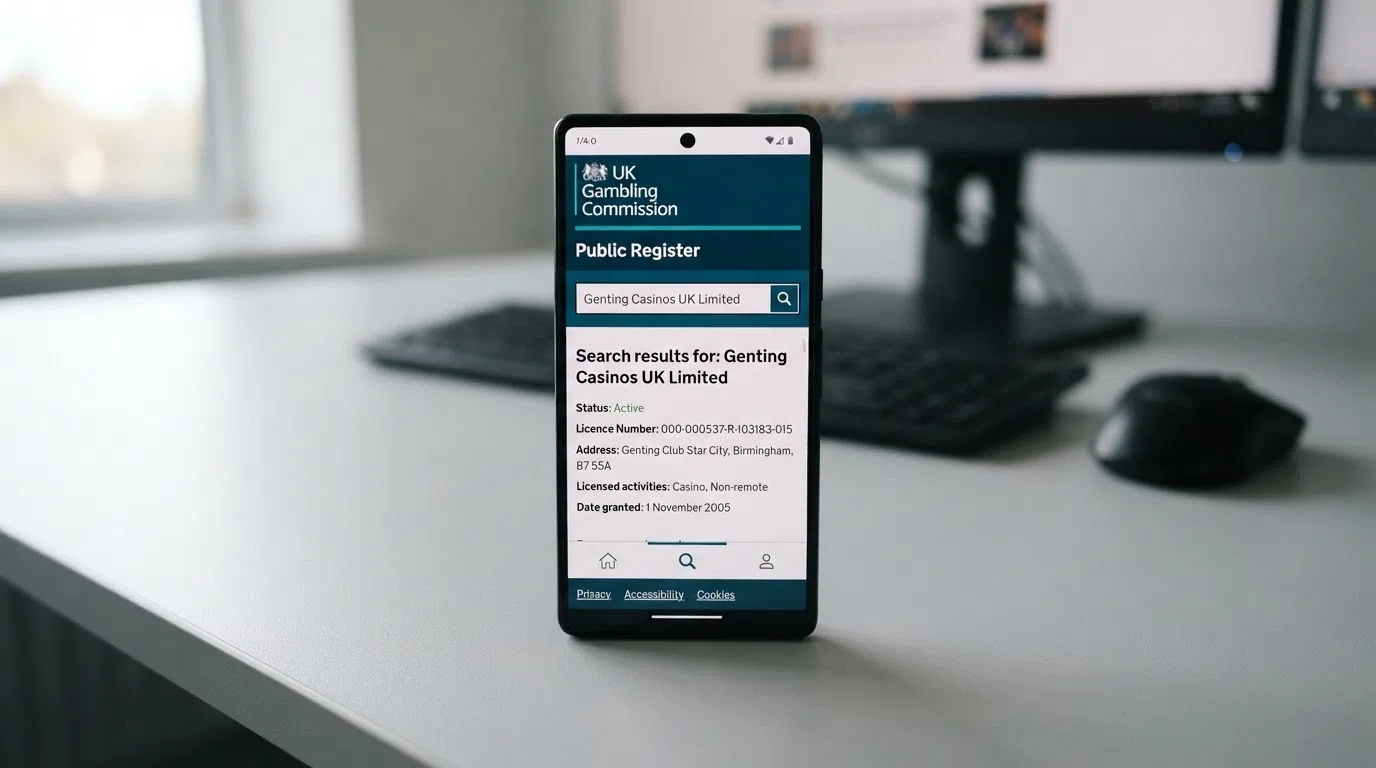
A Gambling Commission licence is the single check that matters, and it is also the one that takes the least time. The Commission’s public register lists every active licensee — 2,665 businesses at the count of 29 July 2026 — searchable by name and account number. If a brand is not on the register, it is not legally offering remote gambling to British players, and the section 33 offence under the Gambling Act 2005 carries up to 51 weeks’ imprisonment and an unlimited fine for the operator. The reader is not at risk of prosecution, but is at risk of every other thing the licence is designed to prevent.
| Protection | What it guarantees | In force since |
|---|---|---|
| Pre-deposit ID verification | Name, address and date of birth confirmed before first deposit | 7 May 2019 |
| GAMSTOP self-exclusion | Block on access to all GB-licensed sites for six months to five years | 31 March 2020 |
| Credit card ban | No credit-card gambling, including credit-card-funded e-wallets | 14 April 2020 |
| Auto-play and spin-speed ban | Auto-play removed; 2.5-second minimum per game cycle | 31 October 2021 |
| Financial vulnerability checks | Mandatory check at £150 net deposit in 30 days | 28 February 2025 |
| Direct-marketing opt-in | Unticked, per-product, per-channel consent | 1 May 2025 |
| Statutory stake cap (25+) | £5 maximum per game cycle | 9 April 2025 |
| Statutory stake cap (18–24) | £2 maximum per game cycle | 21 May 2025 |
| Statutory levy | 1.1% of gross gambling yield funds treatment, prevention, research | 6 April 2025 |
| Wagering cap and mixed-product ban | 10× maximum on casino bonuses; no bundling sports with slots | 19 December 2025 |
| Financial limit prompt | Operator must prompt a customer to set a limit before first deposit | 31 October 2025 |
| Gross deposit limit (RTS 12) | Limit based on money paid in, separate from net-deposit checks | 30 September 2026 |
| Remote Gaming Duty rise | Operator tax on online casino profits rises from 21% to 40% | 1 April 2026 |
The table is a list of reasons, and the reason they are reasons is that each one represents a player protection that disappears the moment the operator steps outside the GB-licensed market. A Curaçao-licensed casino does not run GAMSTOP, does not run the financial vulnerability check, does not cap the stake, and does not offer the 24-hour National Gambling Helpline as a route to British treatment services.
The 30-second UKGC licence check that tells you everything
The Commission’s public register is the single most useful page on the regulator’s website. A search by trading name returns the licence number, the licence type, the date it was granted, the current status, and the full corporate trail. The check takes under a minute, and the answer is binary: a brand is on the register, or it is not.
Three licence types appear in the register. An operating licence is what a casino needs to take bets from British customers; a personal management licence is held by the people who run the operation and is what the Commission checks for competence; a premises licence covers physical casinos, which is not the subject of this page. A brand showing the Gambling Commission’s logo without an operating licence number is showing a picture, not a credential.
There is a related distinction worth keeping clean. “GB-licensed” means the Commission has issued an operating licence under the Gambling Act 2005 as amended by the 2014 Act, which extended the point-of-consumption rule so that any operator serving British customers, wherever based, must hold a GB licence. A Malta Gaming Authority or Curaçao licence is not a substitute. An MGA-licensed brand is regulated for the Maltese market, not the British one, and the protections a British player expects at a Commission-licensed site are not guaranteed by the Maltese regime. The register tells the player which regime the brand is operating under; the logo on the homepage rarely does.
GamStop — what self-exclusion actually covers at a new UK casino
GAMSTOP is the national multi-operator self-exclusion scheme, and every GB-licensed online casino must participate in it. A single registration with GAMSTOP blocks the player from opening new accounts or logging into existing ones at every participating operator, for the period the player chooses: six months, one year, five years, or five years with auto-renewal.
The scheme cannot be cancelled early, and the exclusion does not expire silently — a registration that runs its term continues to protect the player for up to seven years unless the player contacts GAMSTOP to lift it. The point of those features is that a self-exclusion made in a difficult moment cannot be undone in another difficult moment two weeks later.
GAMSTOP is also strictly online and strictly licence-bound. A site operating without a GB licence is outside the scheme by definition, which is why GAMSTOP coverage is the cleanest single test of whether a casino is on the British licensed market or pretending to be.
Non-GamStop casinos — what they are, why they exist, and what you lose
A non-GamStop casino is a site that operates without a GB licence and therefore does not participate in the scheme. These sites typically hold Curaçao or Costa Rica licences, accept British customers, and actively target UK players in spite of the 2014 Act making unlicensed remote provision a criminal offence under section 33 of the Gambling Act 2005.
The reason a player might end up at one is the marketing. The reasons not to stay at one are the protections that disappear. No GAMSTOP coverage means a self-exclusion made at a GB-licensed site does not stop the player opening an account next door. No UKGC complaints process means an unresolved dispute has no Commission-mediated route. No alternative dispute resolution (ADR) provider means no independent referee on a withdrawal or a bonus refusal. No British consumer law means the Financial Ombudsman and the small-claims route are not available. The player is gambling under the rules of whatever jurisdiction the offshore operator has chosen, and the rules of Curaçao are not the rules of Britain.
The Commission’s enforcement is real but does not currently extend to ISP-level blocking. Between April 2024 and June 2025 the Commission issued 3,140 disruption notices and referred 447,778 URLs to search engines, with a 32% average fall in engagement across 160 disrupted sites. The Commission does not hold statutory powers to require UK ISPs to block unlicensed domains; the legislation to give it those powers has been proposed but not enacted. The practical effect is that non-GamStop casinos remain reachable from a British internet connection, and the choice to use one remains the player’s.
Why your free spins at a new UK casino are worth more in 2026 than two years ago
Three regulatory changes since 2025 have reshaped the value of a free-spin welcome offer, and the change is large enough that a player who compared bonuses two years ago and has not looked since is working from a wrong picture.
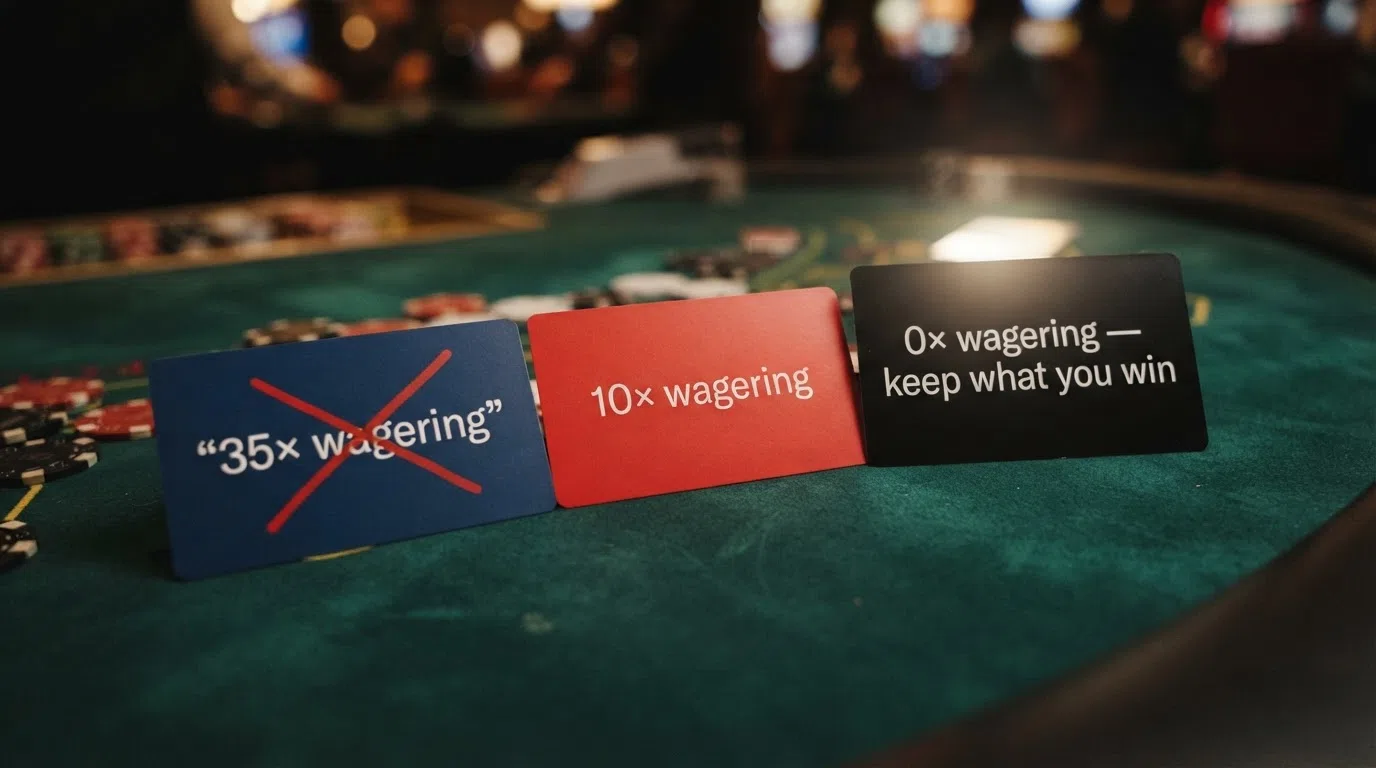
The 10× wagering cap, in force from 19 December 2025, ends an era when a casino could demand thirty-five or fifty times the bonus amount in play before allowing a withdrawal. The cap is per bonus, not per spin, and it applies to every casino bonus on a GB-licensed site. The welcome offers in the table above all carry 0× wagering, which sits comfortably under the ceiling; a reader who sees a 10× or 20× offer elsewhere is looking at a casino that is operating right at the new legal maximum, and the contrast with 0× is what the cap was designed to make visible.
The mixed-product ban, in force from the same date, stops operators from bundling a sports bet with a free-spin offer. The old “bet £10 on the football, get 50 free spins” structure is now illegal, because it forces a player who came for the casino into a product they did not choose. The effect on the welcome offers above is that every spin package stands on its own, and a player can claim a casino bonus without being routed through a sportsbook they did not want.
The direct-marketing opt-in rule, in force from 1 May 2025, requires every operator to present marketing choices as unticked boxes, one per product and one per channel. A player who registers at a new UK casino and does not tick the “free spins by SMS” box cannot receive free-spin promotions by SMS, and the operator is barred from assuming consent. The rule is the reason the welcome offer at a new UK casino is more often delivered in the product itself rather than chased through a marketing funnel.
These three changes are why seven of the ten operators in the table above carry 0× wagering. The cap makes high wagering unattractive, the mixed-product ban removes a way to launder an unattractive bonus through a sports bet, and the opt-in rule makes a hidden term harder to slip past a player. None of this makes a free spin a free lunch — the house still has an edge — but the gap between the marketing headline and the player-keepable value is narrower than it was.
No-deposit free spins — play a new casino without funding your account
A genuinely deposit-free spin requires zero payment to claim: no deposit, no stake, no minimum lifetime top-up. Sky Vegas is the only operator in the featured set that offers one, and the offer is specific — 70 spins at £0.10 each on the first eligible game loaded, with no wagering and winnings withdrawable. The 7-day validity is the catch, and it is a fair one: the spins do not sit in the account waiting for the player to remember them.
Most claims of “no deposit” elsewhere in the market are not what they say. Bet365’s up-to-500-spin offer requires a £10 lifetime deposit before any of the spins can be claimed, and MrQ’s 100 spins need a fresh £10 deposit on first sign-in. Both are excellent offers, and both are deposit-gated, and a reader who treats them as no-deposit offers is reading the wrong column of the table.
The small print on a no-deposit offer carries the same items as any other welcome bonus, but the limits are usually tighter. Game eligibility is narrower, the spin value is often at the bottom of the operator’s range, and the win cap, where one exists, sits well below the no-cap standard of the deposit bonuses in the table. Reading the small print is not optional; it is the only place the offer’s actual cost shows up.
Welcome packages — how first-deposit free-spin bundles work under the new rules
A first-deposit free-spin bundle at a new UK casino in 2026 follows a tight template. Deposit £10 to £20, receive between 50 and 500 free spins on one or more named slots, with a spin value between £0.05 and £0.20 and a validity window of 48 hours to 7 days. The figures in the table above come from operator terms rather than affiliate summaries, and the values reflect what the operator actually credits, not what the headline image shows.
Bet365’s bundle is the largest in the featured set: up to 500 spins on four of the operator’s own Originals — Book of Horus, Curse of the Bayou, Magic Forge and Wrath of the Deep — dripped out at 5 to 50 per day over ten days, with 0× wagering and 7-day validity from crediting. The spins must be claimed within 30 days of registration, which is a long window by industry standards. The 0× wagering means every pound the spins produce lands in the withdrawable balance, and the player is not playing a second game to unlock their own winnings.
MrQ’s standard 100 spins on Big Bass Splash are the cleanest small offer in the set: £10 deposit, £0.10 per spin, 0× wagering, 8 minutes to use them. The talkSPORT-exclusive variant extends to 300 spins on Fishin’ BIGGER Pots of Gold across four days, which is the longest-running welcome offer on the page and one of the more generous spin counts at any new UK casino.
Betfred’s bundle offers a choice that few operators match: 50 spins at £0.20, 100 at £0.10, or 200 at £0.05. The total face value of the spins is roughly the same across the three options; what changes is the size of each win and the volatility of the game the spins are played on. A player who wants a chance at a larger single hit takes the 50-spin package; a player who wants more time on the reels takes the 200-spin package. Coral’s 100 spins on a £10 stake are the simplest version of the same template.
The general shape across the set is consistent because the rules around it are consistent. The 10× wagering cap and the mixed-product ban push operators toward clean spin bundles with no hidden play-through, and the direct-marketing opt-in rule means the offer is presented at the point of registration rather than chased by email afterwards.
No-wagering free spins — keep every pound you win
A no-wagering spin credits winnings directly to the withdrawable balance, and the player does not need to play any further amount to unlock them. Seven of the ten operators in the table carry confirmed 0× wagering on their free-spin offers, which is a structural change from the market of two years ago when a 35× to 50× wagering requirement was the industry norm.
The 10× statutory cap makes even a rare wagering-attached bonus far lighter than the historical norm. A reader who sees a 10× offer on a casino not in the featured set should treat it as the upper end of what the new rules allow, and a reader who sees a higher number should treat it as a sign that the casino is not GB-licensed.
The catch on a no-wagering spin is never the wagering. It is the spin value, the game eligibility and the validity window. A £0.05 spin on a high-volatility slot plays very differently from a £0.20 spin on the same game, and a 48-hour validity window punishes a player who deposits on a Friday and does not return to the site until Monday. Reading the small print on those three numbers is the difference between a welcome offer and a welcome loss.
Bonus codes and new-customer exclusives — when you need a code and when you do not
Most new UK casinos auto-apply the welcome offer on a qualifying deposit, and a code is the exception rather than the rule. Where a code is required, it is usually tied to an exclusive route — a partner site, a price-comparison portal, a media promotion — and the exclusive is a one-shot deal that cannot be reactivated across accounts.
The direct-marketing opt-in rule changed how casinos can promote these exclusives. Before 1 May 2025, an operator could email a one-off exclusive code to a player who had ticked a “send me offers” box at sign-up; after that date, the box must be unticked, per product and per channel, and a player who did not tick “casino offers by email” cannot receive a casino-exclusive code by email. The same exclusive is still available through a partner site, but the operator’s own email list no longer carries it as a default.
The code itself is not the offer. A reader who treats a code as the only path to a welcome bonus is reading the marketing funnel rather than the casino’s terms page, and the welcome offer at the casino’s own registration flow is usually the better of the two.
The games that make or break a new UK casino — slots, live tables, and the studios behind them
A new UK casino that opens with a thin game library does not stay new for long, and a welcome bonus cannot rescue a casino where the player has nothing they want to play. The game library is the reason a player returns after the welcome spins are spent, and the studios listed at the bottom of a casino’s homepage are the quickest way to read whether the library is serious.
The studios that matter — Pragmatic Play, NetEnt, Microgaming and the rest
Pragmatic Play is the most common name in the bonus-eligible slot list at every new UK casino in the featured set. Big Bass Splash, the slot MrQ and LeoVegas use for their standard welcome spins, is a Pragmatic Play title at 96.71% RTP with medium-high volatility and a 2,100× maximum win. Fishin’ BIGGER Pots of Gold, the talkSPORT-exclusive MrQ variant, is the same studio. The Big Bass series is the closest thing the current market has to a default bonus slot, and a casino without at least one Pragmatic Play title on its roster is unusual.
NetEnt and Microgaming remain the quality floor. A new casino without either is a red flag, because both have been around long enough that their absence is a choice rather than an accident. NetEnt supplies the Starburst, Gonzo’s Quest and Twin Spin lineage; Microgaming supplies the Mega Moolah jackpot network and a deep back catalogue of older titles that experienced players look for. Bet365, MrQ, Betfred, Coral, Pub Casino, LeoVegas and PlayOJO all carry at least one of the two; most carry both.
Hacksaw Gaming and Push Gaming represent the higher-volatility modern slot style. Hacksaw’s scratch-card origins give the studio a distinctive feel in the bonus-buy and high-volatility space; Push Gaming’s Jammin’ Jars and Wild Swarm have been the standard-setters for cluster-pays and high-variance play. MrQ’s inclusion of both is part of the reason it ranks well with players who want a less conventional slot library.
Playtech and IGT supply the older-network brands. Betfred’s roster leans heavily on Playtech and IGT — Age of the Gods God of Storms 2 and Better Wilds, the two bonus-eligible slots in Betfred’s welcome offer, are Playtech titles. Coral’s provider list runs through Playtech, NetEnt, Microgaming, IGT, Evolution and Pragmatic Play, which is the broadest cross-section of the older studios in the featured set.
Live casino at a new site — real dealers, real tables, real money
Evolution Gaming and Pragmatic Play Live supply the majority of live-dealer content at UK-facing new casinos, and the two studios are close to complementary rather than substitutable. Evolution’s lightning roulette, crazy time and the blackjack party-game formats are the high-production end of the market; Pragmatic Play Live’s Mega Wheel and roulette variants are the value end. A live casino that carries both is a serious operation; a live casino that carries one is competent; a live casino that carries neither is a slot-only white-label launch with a thin live tab.
The new casino’s live-dealer offering is a signal of investment. A live lobby with twenty-plus tables running around the clock implies a dedicated studio connection, a payments team that has integrated with Evolution’s cashiering, and a customer-service operation that can field table-specific disputes. A live lobby with three tables in low resolution is a slot site with a checkbox.
The statutory slot stake cap does not apply to live casino. The £5/£2 maximum per game cycle covers online slots only, and a live-dealer blackjack or roulette table is set by the operator within its UKGC risk framework. A player who has hit the £5 slot ceiling is not at the £5 ceiling at the live blackjack table, which is why the live section is the part of the new casino that scales with the player’s bankroll rather than against it. The mobile experience at a modern live casino is now indistinguishable from desktop: same dealers, same camera angles, same betting interface, all on a phone.
White-label platforms — what Jumpman, ProgressPlay, and White Hat Gaming mean for the player
A white-label platform provides the licence wrapper, the game aggregation, the payment processing and the bonus engine. The casino brand supplies the marketing, the front-end design and the customer-service tone. ProgressPlay (Betsuna), White Hat Gaming (Playzee, account 52894), Jumpman and Aspire Global are the four most visible white-label platforms behind the 2026 launch cohort.
The trade-off for the player is consistency versus distinctiveness. Casinos on the same platform often share identical bonus structures, the same withdrawal timeframes, the same eligible-games list, and sometimes the same customer-service scripts. A reader who has played at one White Hat Gaming casino and is considering a second is, in practice, considering a rebrand of a product they have already used. The welcome offer is the part that usually differs; the underlying experience is the part that usually does not.
An independent licence like 36Vegas means the operator built its own stack. That is rarer, riskier, and potentially more distinctive. A platform-built casino is a known quantity, with the same known limitations; an independent casino is an unknown quantity, with the same unknown opportunities.
Fast cashouts are not a perk at a new UK casino — they are the baseline
Withdrawal speed is the test a welcome offer cannot pass on the player’s behalf, and it is the test that separates the operators that care about the second-day experience from the ones that care only about the first. PayPal, debit cards, Apple Pay and Trustly each handle a different part of the timeline, and the payment method chosen at deposit is almost always the one the player must withdraw to.
PayPal at new UK casinos — instant deposits and the fastest withdrawals on this list
PayPal is the benchmark payment method at the new UK casino end of the market, and the gap between PayPal and debit cards is wide enough to be the deciding factor for a player who values cashout speed. MrQ’s recorded PayPal withdrawal time is two hours on average and as fast as four minutes in the best-recorded test; PlayOJO states withdrawals within 24 hours via PayPal with no minimum cashout; Mr Vegas sits at five to fifteen minutes. The fastest PayPal withdrawals on this list run in minutes, not days.
PayPal deposits are instant at the casino end, and PayPal offers a layer of buyer protection that keeps gambling transactions off the player’s bank statement. The credit-card ban that came into force in April 2020 extends to credit-card-funded e-wallet deposits, which means a PayPal account that has been topped up by credit card cannot be used to fund a casino. A debit card or a bank transfer into PayPal is the path that works.
Pay-by-phone, Trustly, and Apple Pay — the other ways to fund a new casino account
Pay-by-phone via Boku allows a deposit to be charged to the player’s mobile bill, with a typical daily cap around £30. The cap makes it a small-stakes method — useful for a £10 welcome offer, less useful for a player who plans to deposit more. The catch is that pay-by-phone does not support withdrawals, so a player who deposits by phone will withdraw by some other method, and that method must already be set up on the account.
Trustly enables Pay N Play at no-registration casinos and processes both deposits and withdrawals within 24 hours, often faster. The model is uncommon in the UK-licensed market because the Gambling Commission’s identity-verification rules require the operator to verify the player before first deposit regardless of the payment provider, which removes the no-registration advantage Pay N Play offers in other markets. Trustly is most useful at casinos that have already integrated it as a payment rail, which is a smaller list than PayPal or debit cards.
Apple Pay is growing at UKGC casinos as a fast card-based deposit method that does not share the card number with the operator. The tokenised card detail is the security feature that distinguishes it from entering a debit card number into the cashier. Apple Pay withdrawals are supported at a smaller subset of operators, and where they are not, a player who deposits with Apple Pay will withdraw to a linked debit card or PayPal account.
Debit cards remain the fallback. Most welcome offers require a debit card deposit as the qualifying action, which is the operator’s way of ensuring a real payment instrument is on file before the bonus is credited. A player who plans to deposit by phone or by Apple Pay and then withdraw by the same method should read the small print on the welcome offer first; if the offer requires a debit card deposit, the deposit must be on a debit card.
Your phone is the lobby now — how new UK casinos build for mobile first
A new UK casino that does not work on a phone is obsolete before launch, and the mobile experience at every operator in the featured set is built to the standard a player expects from any modern app. The full game library is available on mobile, with slots and live-dealer tables ported to touch-screen play; native apps are optional and increasingly rare at new brands, because the browser-based experience is now good enough that the cost of an app build no longer pays back.
The difference between a competent mobile casino and a great one shows up in three places. Load speed, which is the time between tapping the URL and seeing the lobby populated with games. Game search, which is the speed of finding a specific title across a library of two thousand. Deposit flow, which is the number of taps and screens between the cashier and a confirmed deposit. A player who tests all three in the first five minutes of a new casino has a better read on the operator than any welcome offer provides.
Apple and Google restrict gambling apps from unlicensed operators, which is why a GB-licensed casino’s app passes the storefront review process and an offshore casino’s app does not. The result is that the App Store and Google Play are reliable filters for licensed status: an app from a casino on either storefront has cleared a review that includes the operator’s licensing position.
The auto-play ban and the 2.5-second minimum spin speed apply across every platform, mobile included, and a player who taps the spin button twice in quick succession on a phone gets the second tap ignored. The rule is the same as on desktop, and the rhythm of play is the same too. Mobile-specific bonuses are uncommon; most welcome offers are cross-platform by design, and the same 0× wagering on a free spin applies whether the player is on the bus or at a desk.
Crypto at a new UK casino — what the law allows and what it does not
The blunt reality for a UK player searching for a new crypto casino is that no crypto casino is currently confirmed as GB-licensed. Bitcoin, Ethereum and Litecoin casinos operate offshore under Curaçao or Costa Rica registrations, and the identity-verification rule that has applied to every GB-licensed operator since May 2019 makes anonymous crypto play incompatible with the licensed market. A player who wants to deposit at a British-licensed casino has to verify first, which removes the anonymity that the crypto route is supposed to provide.
The Commission’s register does not list a confirmed crypto-friendly remote casino, and no specific UKGC rule permits or prohibits crypto deposits at GB-licensed sites. The practical answer is that a player who wants both crypto and a UKGC licence does not currently have a single product to choose, and a player who wants crypto without a UKGC licence has accepted the section 33 risk and the loss of every protection that goes with it: no GAMSTOP, no Commission complaints process, no ADR, no British consumer-law recourse if funds are withheld.
Apple and Google block unlicensed gambling apps, so crypto casinos distribute through browser-based progressive web apps. The PWA loads in the browser, saves to the home screen, and behaves like an app without going through the storefront review. The convenience is real; the regulatory position is the same as it would be at any other offshore site.
Try before you buy — demo play at every new UK casino
Every UKGC-licensed casino offers demo-mode slots, with virtual credits and no real-money commitment. Demo play requires no deposit and at most sites no registration — the game loads in the browser, plays with a pretend balance, and lets the player assess the game’s volatility, the bonus frequency, and the feel of the mechanics before any money is on the line. The mode provides a risk-free way to test the game engine itself, though it is not a guarantee of future real-money performance.
The switch from demo to real-money play adds the statutory protections the player does not see in demo mode. The auto-play ban, the 2.5-second minimum spin speed, the losses-disguised-as-wins ban, the mandatory stake cap — all of these apply in real-money mode and none of them apply in demo. The slot itself plays the same way, because the RNG is the same RNG; what changes is the environment around the spin. A player who tests a game in demo and then plays it for real is not getting a different game, but is getting a different set of rules around the game.
The £5/£2 stake cap does not apply in demo mode. A player can test a game at any stake the demo allows, which is useful for getting a feel for the volatility of a bonus-buy feature at higher stakes than the real-money ceiling would permit.
Popular free-slot titles worth trying before you deposit
Big Bass Splash is the most common bonus-eligible slot across the featured set. MrQ, LeoVegas and most of the other bonus-slot-friendly operators use it for their standard welcome offers, and the 96.71% RTP with medium-high volatility and a 2,100× maximum win is a reasonable summary of what a typical Pragmatic Play bonus slot looks like in 2026. A player who likes the feel of Big Bass Splash in demo will probably like the feel of the welcome offer at any of the operators that runs it.
bet365’s Originals — Book of Horus, Curse of the Bayou, Magic Forge and Wrath of the Deep — are exclusive to bet365 and unavailable elsewhere. They are not in the libraries of the white-label platforms or the independent operators, and a player who has settled on one of those four titles is settling on bet365 as the casino. The four cover a spread of mechanics — Book of Horus is the expanding-symbols format, Curse of the Bayou is a cluster-pays game, Magic Forge is a tumble-reels game, Wrath of the Deep is a hold-and-spin format. A player who tries all four in demo before claiming the bet365 welcome offer has a better read on the bundle than the marketing page provides.
Age of the Gods God of Storms 2 (Playtech) and Better Wilds are the Betfred bonus-slot choices. The Age of the Gods series is the older-network jackpot lineage, and God of Storms 2 carries the same mythology-themed mechanics as its predecessors. Better Wilds is a simpler Playtech slot with a wild-reels feature and a lower-volatility feel.
Fishin’ Frenzy and Eye of Horus appear in the Sky Vegas eligible-games list. Both are older Blueprint and Reel Time Gaming titles with the fishing-theme mechanics that have become a sub-genre of their own, and both are useful demo-spin tests for a player who plans to claim the Sky Vegas no-deposit 70 spins before deciding whether to deposit for the additional 200.
How to read a new casino shortlist without getting burned
The four questions below are the ones that determine whether a shortlist is worth trusting, and each one has a specific place to find the answer.
The licence question is answered definitively by the Commission’s public register. A brand is either on it or it is not, and a 30-second search settles the matter. Six of the ten page-one search results for this keyword are affiliate listicles, which is why the verification has to be done against the regulator rather than against another review.
The bonus question is answered by reading past the headline spin count to the wagering, the validity window and the qualifying action. A 500-spin offer with 50× wagering and a 24-hour validity is worth less than a 100-spin offer with 0× wagering and a 7-day window, and the table above is built so the reader can see the difference without having to click through.
The independence question is answered by reading the operator’s terms for the platform name. A casino on ProgressPlay, White Hat Gaming, Jumpman or Aspire Global is a skin on a known platform; a casino with no platform named in the terms is either independent or running on its own custom stack, and the difference shows up in the game library and the bonus terms.
The game question is answered by looking at the provider list at the bottom of the casino’s homepage. A player who wants Pragmatic Play and Evolution should not sign up at a casino without either. A player who wants NetEnt and Microgaming should not sign up at a casino without both. The provider list is a one-minute check that prevents the most common cause of player disappointment — a welcome bonus on a casino with the wrong game library.
Responsible gambling at new UK casinos — the tools are built in, not bolted on
Every new UKGC-licensed casino must offer a full suite of safer-gambling controls from day one, and the controls are not optional. From 31 October 2025, the operator must prompt every customer to set a financial limit before the first deposit; from 30 September 2026, a gross deposit limit based solely on money paid in must be offered under RTS 12, separate from the net-deposit financial vulnerability check that has been in force since February 2025. The deposit-limit prompt is a pop-up, not a checkbox, and a player who closes the pop-up without setting a limit is still required to engage with it on the next visit.
The scale of gambling harm in Britain is large enough to make the controls worth using. The latest annual treatment survey puts 13.1% of adults who gamble — about 6.8 million people — in the PGSI 1+ category, which means any level of problem gambling. In the second quarter of 2026, 81.5% of National Gambling Helpline contacts cited online gambling as the form they were worried about, a five-year high. The licensed market is the safer side of that figure, and the tools below are the licensed market’s answer.
Deposit limits, reality checks, and time-outs — the tools every new casino must provide
Deposit limits can be set daily, weekly or monthly, and the rules around them are designed to make tightening easier than loosening. A limit reduction takes effect immediately. A limit increase or removal carries a cooling-off delay — typically 24 hours to 7 days — during which the change is pending and can be reversed by the player. The asymmetry is the point: a player who decides to spend less should not have to wait; a player who decides to spend more should have time to think about it.
Reality checks are pop-up reminders at a chosen interval, usually 30, 60 or 90 minutes, showing the time played and the net position. The pop-up pauses the session and gives the player a chance to log out, set a limit, or continue. A player who has set reality checks at 30-minute intervals has a built-in decision point every half hour, which is the most useful moment the safer-gambling suite offers.
Time-outs lock the account for a set period from 24 hours to six weeks and cannot be reversed. GAMSTOP is the longer-period version of the same idea, with exclusion periods from six months to five years and a five-year auto-renewing option. Both are licence-bound, which is the reason a self-exclusion at a GB-licensed casino does not extend to a non-GamStop site and the reason an operator that steps outside the GB-licensed market removes the tool the player was relying on.
The gross deposit limit from September 2026 is based on money paid in, which is a different figure from net deposits (money in minus money out). The two limits sit alongside each other rather than overlapping: a gross-deposit limit caps how much can come in, a net-deposit financial vulnerability check at £150 in 30 days triggers an affordability conversation. Both are mandatory, both apply at every GB-licensed casino, and the difference between them is one of the more useful things a player can know about the controls.
Where to get help — GamCare, BeGambleAware, and the NHS clinics
The National Gambling Helpline on 0808 8020 133 is free, confidential, and available 24 hours a day, every day of the year. It is run by GamCare, and the most recent annual figures carry over 52,000 calls in a year and 11,960 clients treated through the National Gambling Support Network — an 11% year-on-year increase. The treatment figure is the one that tells the story: more people are asking for help, and the licensed market’s funding model is one of the reasons more help is available.
NHS gambling harm clinics operate in England, Scotland and Wales, with referral through a GP or self-referral. The clinics are the most medicalised end of the treatment pathway, and a player whose gambling has reached the stage of NHS referral has usually exhausted the lower-intensity options.
The statutory gambling levy, in force from 6 April 2025, charges operators 1.1% of gross gambling yield, split 50% to treatment, 30% to prevention and 20% to research. Remote casino and remote bingo licences pay into the same pot. The Government’s own description of the levy as a “generational change” is the right framing: the funding is no longer voluntary, no longer dependent on the operators’ goodwill, and no longer vulnerable to the year-to-year variation that left the support network under-resourced in the past.
A player who wants treatment, support or advice is not alone. The latest survey figure is that almost 1 in 3 adults who gamble and are experiencing any level of problems want treatment, support or advice — almost double the 17% in 2020. The licensed market is the place where that treatment is funded by the operators, and the helpline is the front door.
How we selected and ranked the new UK casinos on this page
Every operator on this list was checked against the Gambling Commission’s public register of licence holders — a brand is either on the register or it is excluded. Bonus terms were sourced from operator T&Cs and verified through independent review sites that test with real deposits, not from affiliate summaries. The comparison table ranks by bonus value and player terms — free-spin count, wagering requirement, and qualifying action — not by commercial arrangements. Where a value is not confirmed, the cell is empty rather than guessed, and the empty cells are the honest gaps in the data.
The regulatory facts are drawn from the Gambling Act 2005, the Licence Conditions and Codes of Practice, the Remote Technical Standards, and the HM Treasury publications cited in the text, rather than from competitor pages. Six of the ten page-one results for this keyword are affiliate listicles, and the methodology on this page is built from primary regulatory sources and operator terms instead.
The research was conducted in 2026 and reflects the Commission’s register as updated 29 July 2026, with 2,665 active businesses. New 2026 licence grants and new 2026 launches are individually named in the relevant sections, and the recency of the licence is treated as a separate question from the licence itself.
Your move — what to actually do with this list
The single most important check is the Commission’s register — the 30-second search that answers the safety question definitively. A reader who has not done that check has not started.
The second filter is the bonus that matches how the player actually plays. A no-deposit offer at Sky Vegas is the right fit for a player who wants to test the casino before committing. A large spin bundle at bet365 is the right fit for a player who plans to deposit, play through the welcome offer, and move on. A choice-of-package offer at Betfred is the right fit for a player who wants to decide between more spins or larger spins. No single offer is the right fit for every reader, and the table is built so the fit is visible without a click-through.
The third filter is withdrawal speed. PayPal delivers the fastest cashouts on this list, with MrQ’s four-minute best and PlayOJO’s 24-hour promise setting the standard. A player who values the speed will deposit by PayPal at the casino that supports it; a player who is happy to wait a day or two can use a debit card and skip the PayPal fees.
The fourth filter is the game library. A player who wants Big Bass Splash picks MrQ or LeoVegas. A player who wants bet365 Originals picks bet365. A player who wants Playtech and IGT picks Betfred or Coral. The provider list at the bottom of each casino’s homepage is the fastest way to check.
No single operator wins on every axis. The right choice depends on which axis matters most, and the value of the page is in making the trade-off visible rather than in declaring a winner.
Frequently asked questions about new UK casino sites
How do I check a new casino’s UKGC licence myself?
Search the Gambling Commission’s public register by trading name. The register is on the Commission’s website and lists every active licensee with its account number, licence type, status and the date the licence was granted. A 30-second search returns a binary answer — a brand is either listed as an active operating licence holder, or it is not licensed to take bets from British customers. A brand displaying the Commission’s logo without an account number is showing a picture rather than a credential, and a licence from Malta or Curaçao is not a substitute for a GB operating licence under the Gambling Act 2005 as amended by the 2014 Act. The register is updated regularly; the count of active businesses on 29 July 2026 was 2,665.
What is the maximum I can stake per spin at a new UK online casino?
The maximum is age-banded. For players aged 25 and over, the statutory cap is £5 per game cycle on online slots, in force since 9 April 2025 under SI 2025/215. For players aged 18 to 24, the cap is £2 per game cycle, in force since 21 May 2025. The cap covers online slots only and cannot be defeated by splitting a spin across multiple stakes. Two adults at the same casino can face different maximum bets on the same slot. Live casino, sports betting and bingo are not subject to the same cap; the limit on a live-dealer table is set by the operator within its UKGC risk framework.
Can I try a new casino’s games without depositing any money?
Yes. Every UKGC-licensed casino offers demo-mode slots with virtual credits and no real-money commitment. Demo play requires no deposit and at most sites no registration; the game loads in the browser and plays with a pretend balance. The mechanics are identical to real-money play, but the statutory protections — the auto-play ban, the 2.5-second minimum spin speed, the losses-disguised-as-wins ban, the £5/£2 stake cap — apply in real-money mode only. A player who tests a game in demo before deciding to deposit has the best available read on the game’s volatility and bonus frequency without any money on the line.
Do all new UK casino sites participate in GamStop?
Every casino that holds a GB operating licence must participate in GAMSTOP, and GAMSTOP has been mandatory for all GB-licensed online operators since 31 March 2020. A single registration with GAMSTOP blocks the player from opening new accounts or logging into existing ones at every participating operator for six months, one year, five years, or five years with auto-renewal. The scheme cannot be cancelled early and does not expire silently. A site operating without a GB licence — typically Curaçao- or Costa Rica-licensed — is outside the scheme by definition, and the term “non-GamStop casino” describes exactly that gap.
How fast can I get my money out of a new UK casino?
The speed depends on the payment method. PayPal is the fastest at the featured operators: MrQ’s average is around two hours, with the fastest recorded withdrawal at four minutes; PlayOJO states within 24 hours; Mr Vegas runs five to fifteen minutes. Debit card withdrawals take one to five business days at most operators because the timeline is set by the banking rail, not by casino policy. Apple Pay and Trustly withdrawals sit between the two, with Trustly typically processing within 24 hours. The mandatory pre-deposit identity verification since May 2019 removes the post-win document check that used to delay first withdrawals at new casinos.
Are my casino winnings taxed in the UK?
No. Player-side betting duty was abolished in 2001, and gambling winnings for a UK-resident player at a GB-licensed casino are not subject to income tax or capital gains tax. The operator pays Remote Gaming Duty, which rose from 21% to 40% from 1 April 2026 under the Autumn Budget 2025, and a separate statutory levy of 1.1% of gross gambling yield funds treatment, prevention and research from 6 April 2025. Neither of those operator-side charges is the player’s liability, and a winning withdrawal from a GB-licensed casino lands in the player’s account without a tax deduction at source.
Casinos – No Minimum Deposit Casinos UK
Content created by the «No Minimum Deposit Casinos UK» team