
The Best 3-Reel Slots at UK-Licensed Casinos in 2026
 Available in GB
The three-reel slot is the oldest game in the casino, and the most misunderstood. In a market that now ships video slots with 1,000+ paylines, cascading wins and bonus rounds built like video games, a 3×3 grid spinning fruit and bar symbols looks like a relic. It is not. UK players staked £773 million on online slots in the quarter to March 2026 across 25.1 billion spins and 4.8 million average monthly active accounts, and a meaningful share of that action still lands on the simpler grid. The reason is not nostalgia. It is math, payout tables that fit on one screen, and a session rhythm that resembles a pub fruit machine more closely than a modern video slot.
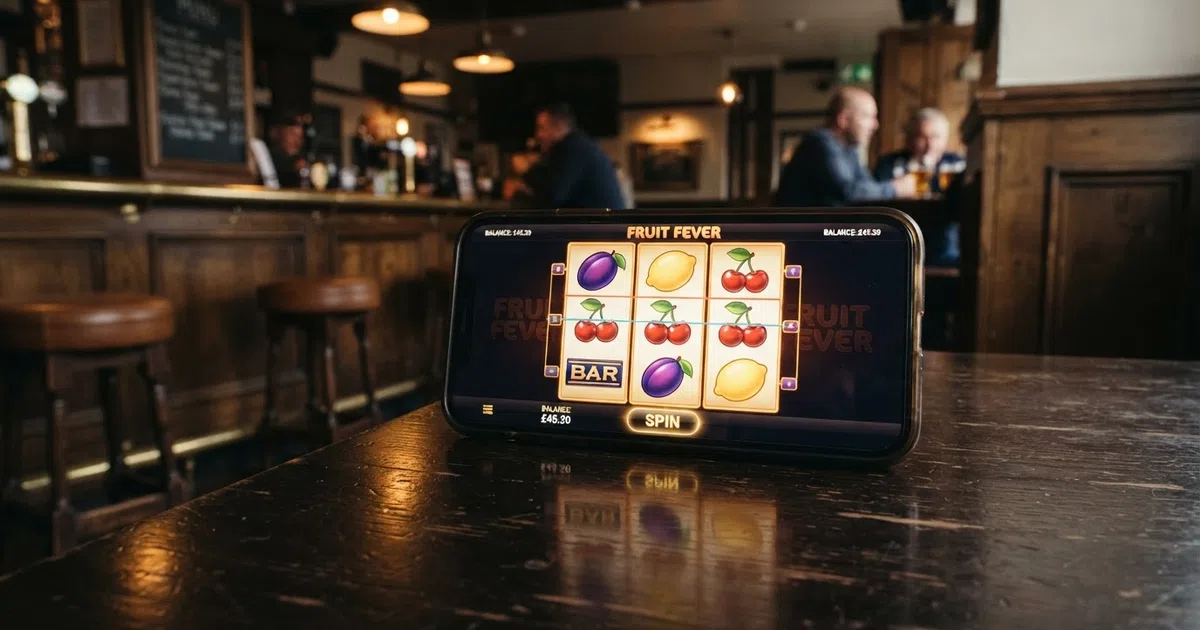
This page ranks the strongest 3-reel slot titles available to UK players, lists ten GB-licensed casinos that carry the genre, walks through the mechanics that separate a 94% slot from a 99% one, and lays out the rules that govern every spin you make at a British-licensed site. The aim is to give a player who already knows the genre a sharper shortlist, and a player who is curious about it a reason to try one.
Verified against UK Gambling Commission public register, checked as of 17 August 2026.
What a 3-reel slot actually is — and why UK players still choose them in 2026
A 3-reel slot is a casino game built on three spinning reels, each carrying a column of symbols, with winning combinations paid across one or more paylines that cross those reels. The format descends from the mechanical one-armed bandits that filled British seaside arcades and pub corners through the mid-twentieth century, then moved through electromechanical stepper cabinets in the 1970s and 1980s before becoming the first generation of online slots in the late 1990s. The classic template, IGT’s Double Diamond, runs a single horizontal payline across the centre of three reels and pays on three-of-a-kind symbol matches. Everything more elaborate in the genre is a variation on that grid.
The UK market never stopped carrying the format. Studios still release new 3-reel titles every year — Pragmatic Play launched Big Bass Bonanza 3 Reeler in December 2024, and Realistic Games’ Pentagram 5000 has built a following around a 97.45% RTP and a free-spins bonus round that delivers wins up to 5,000× the stake. The genre survives because it offers a session rhythm closer to a pub fruit machine: one click per spin, no cascading reels, no mini-games interrupting the cadence. The UK Gambling Commission’s 2021 game-design rules reinforced that rhythm by banning auto-play, setting a 2.5-second minimum spin speed and outlawing features that disguise losses as wins.
For a UK player choosing what to play in 2026, the practical appeal of a 3-reel slot is straightforward. The paytables are short enough to read on one screen. The hit frequencies are typically lower than a 5-reel, 20-payline video slot, but the per-line wins are larger and the variance is easier to feel. A 3-reel slot does not offer the “thousand ways to win” math of a modern Megaways title, and it does not pretend to.
The anatomy of a 3-reel slot
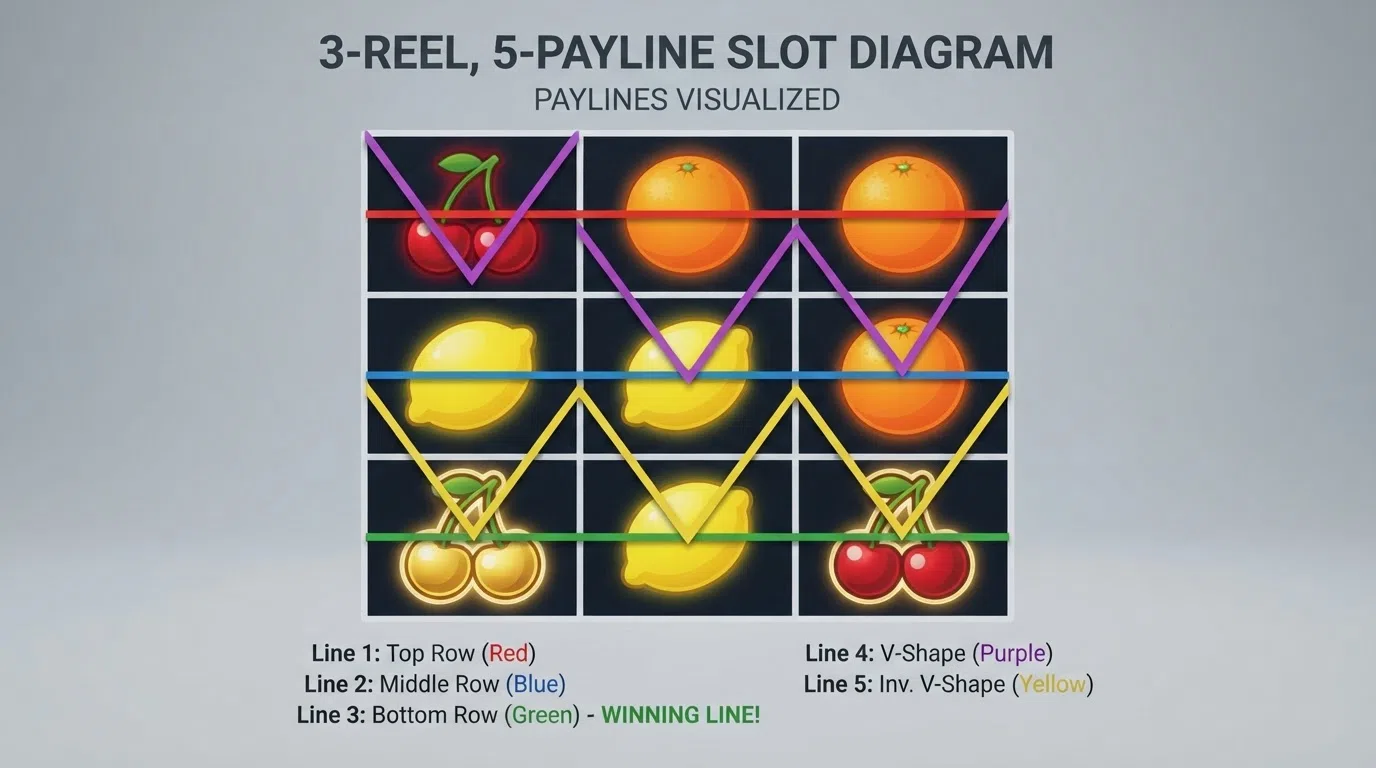
A 3-reel slot is built from a small number of moving parts. The grid is three reels wide and one or three rows tall, with symbols stopping in the visible window to form combinations across the paylines. The default layout is a single horizontal payline across the centre, and that is still the purest form of the genre — IGT’s Double Diamond carries one payline, with three matching symbols paying the line’s prize. Modern 3-reel titles tend to expand the grid to three rows and run five fixed paylines, as on NetEnt’s Jackpot 6000, Play’n GO’s Fire Joker and Games Global’s Break da Bank. A few, like Realistic Games’ 777 Golden Hit, keep the five-payline, three-row shape with bets from 1p to £20 per spin.
The symbol set is the part that gives the format its character. Fruits — cherries, lemons, plums, oranges, watermelons — sit at the low end of the paytable, with bar symbols (single, double, triple) and the lucky 7 at the high end. A joker or wild symbol appears in some titles, substituting for other symbols to complete a line. The paytable, usually accessible from a button on the game screen, is the only map a player has: it shows what each three-of-a-kind symbol combination pays, whether wilds substitute, what the maximum win is, and what the theoretical return to player is for the game. A 3-reel slot that hides its RTP is a 3-reel slot a UK player should not be playing.
The jump from one payline to five is the single biggest design decision in the genre. On a single-line slot, every spin is one decision: does the centre line hit? On a 5-payline slot, each spin evaluates five potential lines at once, and the bet per spin is multiplied by the number of active lines. That changes the hit frequency dramatically — a player will see more “wins” on a 5-line game, but each win is smaller relative to the total stake, and the total bet per spin is higher. The mathematics of the two formats are very different even when the headline RTP looks similar.
Classic, retro and fruit-machine variants — the three families of 3-reel slot
Not every 3-reel slot plays the same way, and the genre divides into three families a UK player should be able to tell apart.
The classic slot is the purest form: three reels, a single payline, fruits, bars and sevens on the paytable, no bonus features beyond the base game. IGT’s Double Diamond is the reference. These games have the simplest math, the cleanest visual presentation and the longest dry spells. They reward patience more than engagement.
The retro or vintage slot borrows the classic layout but layers in modern features — respins, multiplier wilds, occasional free-spin rounds. Play’n GO’s Fire Joker, with its 3×3 grid, 5 paylines and a re-spin-of-fire feature that gives a near-miss a second chance, is the clearest example. The retro variant usually sits at a lower volatility than the classic single-line game, because more paylines means more frequent but smaller wins.
The fruit-machine variant is the British pub descendant. The pub fruit machine was an electromechanical cabinet with a hold-and-nudge feature, a gamble button and, in some regions, a cash collector. The online version of the genre keeps the visual DNA — fruit symbols, BARs, a red-and-gold colour scheme — and sometimes keeps the gamble feature. The most influential sub-genre, though, is the Supermeter mode that NetEnt built into Mega Joker and Jackpot 6000. In Supermeter, a player who has won a base-game payout can bank it or carry it forward into a higher-stakes bonus round with a substantially higher theoretical return. Mega Joker’s Supermeter mode runs at a 99% theoretical RTP, against a base-game return of 76.9%. Jackpot 6000’s Supermeter mode runs at 98.86%. These two titles are outliers in the genre, and the Supermeter mechanic is the reason the genre still has a high-RTP reputation.
The best 3-reel slots to play online in 2026
The table below ranks the strongest 3-reel titles with verified RTP, volatility and max-win data, sorted by UK-available RTP. The UK-deployed figure for Mega Joker is used in place of the theoretical ceiling because most UK operators run the lower RTP setting; the theoretical figure is named in the prose where it matters.
| Title | Provider | RTP | Volatility | Max Win |
|---|---|---|---|---|
| Jackpot 6000 | NetEnt | 98.86% | High | 6,000× |
| Pentagram 5000 | Realistic Games | 97.45% | — | 5,000× |
| Money Maker | BGaming | 97.03% | Low | — |
| Big Bass Bonanza 3 Reeler | Pragmatic Play | 96.5% | High | — |
| Fire Joker | Play’n GO | 96.15% | Medium-low | 800× |
| Double Diamond | IGT | 95.44% | High | 1,000× |
| Break da Bank | Games Global | 95.43% | High | — |
| Mega Joker (UK-deployed) | NetEnt | 94.05% | — | — |
Mega Joker’s reputation in the slot community rests on its theoretical 99% RTP in Supermeter mode, but UK players should plan around 94.05% — the rate at which most UK casinos deploy the game. That gap is the single most important thing to know about the title. Jackpot 6000, by contrast, holds its 98.86% figure consistently in the UK because the Supermeter mode is the central mechanic rather than a side bet. Pentagram 5000 sits at 97.45% and pairs that with a free-spins bonus triggered by three PENTAGRAM symbols, which is rare for the genre. Money Maker from BGaming runs a single-payline stepper format with low volatility and a 97.03% RTP — a rare combination in any slot, and a useful counterpoint to the high-variance titles above it. The volatility column is the one to read alongside the RTP number: a 98.86% high-volatility slot and a 97.03% low-volatility slot feel completely different across a 100-spin session, even though the gap in expected return is only 1.83 points.
Playing 3-reel slots for real money in the UK
Real-money play on a 3-reel slot at a UK-licensed casino looks different from free-play in three ways, and the difference matters. The stake limit kicks in: £5 per game cycle for those 25 and over; £2 for 18–24-year-olds. A game cycle is the period from the moment a spin is initiated to the moment all money staked has been lost or all winnings delivered — so the cap applies to the total staked within one round, not per line. A 5-payline 3-reel slot at £1 per line is therefore at the £5 ceiling for an over-25 player, and at the £2 ceiling (40p per line) for an 18–24-year-old. The age-banded structure is the most distinctive feature of the British regulatory model: two adults at the same casino can face different maximum bets on the same slot.
The second difference is operator identity. A GB licence from the UK Gambling Commission is a non-negotiable condition for any operator taking UK players, enforced since the point-of-consumption reform in 2014. Operating without one is a criminal offence under section 33 of the Gambling Act 2005 — up to 51 weeks’ imprisonment, an unlimited fine, or both. Every operator on this page is verified against the UKGC public register. An offshore brand may have a higher headline bonus or a looser welcome package, but it does not give a UK player the consumer protections the GB framework provides: a regulator to complain to, ADR access, GAMSTOP self-exclusion, and the deposit-limit and reality-check infrastructure that the LCCP mandates.
The third difference is the operator-side tax. Remote Gaming Duty rose from 21% to 40% on 1 April 2026. That is operator cost, not player cost — UK gambling winnings remain untaxed at the point of receipt — but it shapes the offer mix a casino can run. Higher operator tax means tighter margins, and a tighter margin shows up in the size and structure of welcome offers rather than in the RTP of the games, which are certified independently of the operator.
The UK casinos with the strongest 3-reel slot collections in 2026
The ten operators below are all GB-licensed and verified against the UK Gambling Commission’s public register. The table ranks them by slot-library depth and welcome-offer terms for classic-slot players; individual write-ups follow with the provider mix, demo-mode availability and the bonus mechanics that matter for a 3-reel session. Free-spin counts and wagering multipliers are stated as published; spin value is 10p unless otherwise noted.

| Operator | Slots | Welcome Free Spins | Wagering | Bonus Validity |
|---|---|---|---|---|
| bet365 | 600+ | Up to 500 | 0× | 7 days per daily allocation |
| Sky Vegas | 500+ | 50 no-deposit + 200 | 0× | 7 days |
| William Hill | 500+ | 200 | 10× | 72 hours |
| Ladbrokes | 500+ | 100 | 10× | 30 days |
| Paddy Power | 500+ | 60 no-deposit + 100 | 0× | 7 days |
| 32Red | 500+ | Up to 320 | 0× | 30 days |
| BetVictor | 500+ | 50 + £30 bonus | 10× | 30 days |
| Coral | 400+ | 100 | 10× | 30 days |
| Betfred | 400+ | 200 | 0× | 7 days |
| Betfair | 400+ | 50 no-deposit + 100 | 0× | 7 days |
The first column to read is the wagering multiplier. The 10× ceiling on William Hill, Ladbrokes, Coral and BetVictor is the LCCP cap — the legal maximum a UK-licensed casino can ask a player to wager a bonus, in force since 19 December 2025. The 0× operators — bet365, Sky Vegas, Paddy Power, 32Red, Betfred and Betfair — pay free-spin winnings as cash with no playthrough. That distinction matters more than the spin count: a 100-spin offer at 10× wagering on a 3-reel slot at 96% RTP can be cleared, but a 200-spin offer at 0× wagering keeps everything it wins. The bet365 daily reveal — 5, 10, 20, 50 free spins per day for ten days — is a particular shape, useful for a player who logs in daily and less useful for one who does not.
How we picked the operators that made this list
The entry ticket is the UKGC public register. Every operator below is on it, with an active remote operating licence. Slot-library size matters, but not the way most rankings treat it: a 500-slot lobby with ten 3-reel classics is not the same as a 200-slot lobby with thirty, because the depth of the classic-slot catalogue is what a 3-reel player actually navigates to. The provider mix is the proxy for that depth — NetEnt, Play’n GO, IGT, Games Global, BGaming, Realistic Games and Pragmatic Play are the studios with the strongest 3-reel catalogues, and every operator below carries at least five of them. Demo mode is a non-negotiable: every featured operator lets a player load a 3-reel title in free-play before staking real money. Welcome-offer structure is the final filter, ranked on free-spin count, wagering multiplier and whether the offer has a no-deposit entry point.
The 10× wagering cap, in force since 19 December 2025, is the regulatory floor under every offer here. No UK-licensed casino can ask a player to wager a bonus more than ten times. That ceiling is why the four operators above sit at exactly 10× — they are at the legal maximum, not at a marketing choice.
Sky Vegas
Sky Vegas is the Flutter Entertainment casino that hands out the most free spins on registration in the UK: 50 free spins the moment an account is opened, no deposit required, no wagering on what they win. Stake and wager £10 on slots and a further 200 free spins follow, also wager-free. The lobby runs 500+ slots from leading developers including NetEnt and Play’n GO. The 50 no-deposit spins carry a 7-day validity and a 10p spin value.
For a player who values the no-deposit entry point above everything else, Sky Vegas is the operator that offers the most of it in absolute terms. The wagering structure does the rest of the work: 0× on every free-spin bundle means winnings go straight to the cash balance. The 7-day validity is the catch — a player who opens the account and does not return loses the offer.
bet365
bet365 runs the largest slot library on this list at 600+ titles, and its welcome offer is the highest free-spin count available from any GB-licensed casino: up to 500 free spins, paid as cash with no wagering on winnings. The shape of the offer is unusual: spins are revealed daily in tranches of 5, 10, 20 and 50 over ten days, and each tranche has a 7-day validity from the day it lands. The whole offer must be claimed within 30 days of registration. The £10 minimum deposit is standard. The lobby runs 600+ titles, including NetEnt, Play’n GO, and Pragmatic Play classics. Demo mode is available on most titles.
For a player who logs in daily and wants the deepest spin pot in the UK market, bet365 is the operator. The daily-reveal shape is the trade-off: a player who misses a day forfeits that day’s tranche. The 0× wagering makes the per-spin value higher than the headline count suggests, because nothing has to be cleared afterwards.
William Hill
William Hill has held a GB remote operating licence since 1 January 2009 (UKGC account 39225), making it the longest-established high-street name on this list. The welcome offer is 200 free spins on Big Bass Splash after a £10 deposit and £10 stake, with a 10× wagering multiplier on free-spin winnings and a 72-hour validity. Free-spin winnings are capped at £30. The lobby runs 500+ slots from developers such as NetEnt and IGT.
For a player who values brand tenure and is comfortable with the 10× wagering cap, William Hill is the most established option on this list. The 72-hour validity is the shortest on the page and the £30 winnings cap is the rule most often missed at the claim stage. The 10× multiplier is the UKGC legal maximum, not a William Hill choice.
Ladbrokes
Ladbrokes is the Entain-owned high-street name with 500+ slots from NetEnt, Play’n GO, Games Global, IGT, Blueprint, Red Tiger, Novomatic and Inspired Gaming. The welcome offer is 100 free spins on selected games at 10p each after depositing and spending £10 on slots, with 10× wagering on bonus funds — the regulatory ceiling — and a 30-day bonus window. Free spins are valid for 7 days, with 48 hours to accept the offer once credited.
For a player who wants a wide provider mix and is comfortable with the 10× ceiling, Ladbrokes is the most balanced Entain option. Players who do not accept the offer within two days of credit forfeit the bonus.
Paddy Power
Paddy Power is the Flutter casino that pairs the largest no-deposit bundle on this list with a deep deposit-step add-on: 60 free spins on registration (50 on selected slots, 10 on Paddy’s Mansion Heist), no deposit required, no wagering on winnings. Stake and wager £10 on slots and a further 100 free spins follow, also wager-free. Total 160 free spins, 0× wagering, 7-day validity, 10p spin value. The lobby runs 500+ slots from major studios such as NetEnt and Play’n GO.
For a player who wants the deepest no-deposit spin pot from a single Flutter brand, Paddy Power is the top choice. The structure mirrors Sky Vegas’s, with a higher no-deposit count and the same 0× wagering policy.
Coral
Coral is the Entain sibling to Ladbrokes with 400+ slots from major developers. The welcome offer is 100 free spins on selected qualifying slots at 10p per spin after a £10 bet, with 10× wagering on free-spin winnings — the UKGC ceiling — and a 30-day bonus window. Demo mode is available across the lobby including classic 3-reel titles.
For a player who prefers the Coral brand over Ladbrokes but wants the same Entain welcome structure, this offer is effectively identical. The 30-day validity is generous compared to other high-street brands.
Betfred
Betfred is the Petfre (Gibraltar) Limited casino with 400+ slots from major industry studios. The welcome offer is 200 free spins for staking £10 or more on slots, with no wagering requirement on winnings — every win lands as cash. The offer must be accepted within 48 hours, and the spins are valid for 7 days. The £10 minimum deposit is debit-card only.
Betfred is a solid wager-free option for players who prefer brands with a long UK high-street history. Players must accept the offer within two days, and must use a debit card to deposit.
Betfair
Betfair is the Flutter casino with a Jackpot King focus and 400+ slots from major industry developers. The welcome offer is 50 free spins on registration with no deposit required, and a further 100 free spins for depositing and wagering £10 on Jackpot King games — total 150, 0× wagering, 7-day validity, 10p spin value. E-wallet deposits are excluded from the deposit-step offer.
Betfair is the ideal option for players who want a no-deposit entry point and are happy to play Jackpot King titles. The e-wallet exclusion is the most common reason players miss out on the deposit-step offer.
32Red
32Red is the Kindred Group casino with the deepest free-spin pot on this list: opt in and stake £30 on slots to unlock 320 free spins on Big Bass Splash (or stake £10 for 250 spins under the variant offer), with 0× wagering on free-spin winnings. The offer must be claimed within 48 hours, and the spins are valid for 30 days. The £10 minimum deposit is debit card or instant bank transfer only — e-wallets are excluded. The lobby runs 500+ slots from major providers like NetEnt and Games Global.
32Red offers the largest wager-free spin pot on the market for players with a higher bankroll. Ensure the offer is claimed within two days of registration, using a debit card or bank transfer.
BetVictor
BetVictor is the only operator on this list offering a cash bonus alongside its free spins: deposit and wager £10 or more and the casino credits £30 in bonus funds (10× wagering, £300 maximum withdrawal from the bonus) plus 50 free spins on Fishin’ Frenzy at 10p each. The bonus expires after 30 days. The lobby runs 500+ slots from providers including NetEnt, IGT, and Novomatic.
For a player who prefers a cash bonus to a free-spin-heavy welcome, BetVictor is the only option on this list. The £300 max-withdrawal cap on bonus funds is the most common surprise at the withdrawal stage, and the 10× wagering is the UKGC legal maximum.
Play 3-reel slots for free: no download, no registration, no deposit required
Every operator on this list offers demo mode on most of its 3-reel titles. That is the single most useful feature for a player new to the genre, and it is the feature the rest of this section is built around. Demo mode runs the same RNG, the same RTP, the same paytable and the same features as real-money play. The difference is the balance: the casino credits a player with virtual credits, the spins cost nothing, and the winnings do not pay out. The game engine does not know which mode it is in.
That last point is the reason demo mode is more than a free-trial gimmick. The game-design rules the UK Gambling Commission introduced in October 2021 — auto-play banned, 2.5-second minimum spin speed, losses-disguised-as-wins banned, reverse withdrawals banned — apply identically in demo and real-money mode. A player who tries a 3-reel slot in demo at one of the ten operators above is testing the exact game a real-money session will run.
No-download instant play is the standard at every UK-licensed casino on this list. There is no.exe to install, no plugin to add, no app required for the demo. A player loads the slot in a browser, the game opens, and the virtual credits are waiting. Most operators on this list do not even require an account to load a demo; the exceptions ask for a login first and credit the demo balance to the registered account. Either way, the path from landing page to spinning reels is a single click.
How demo mode works at UK-licensed casinos
Loading a 3-reel slot in demo mode at a UK-licensed casino credits the account with a virtual balance (usually 5,000 or 10,000 demo units) and the game runs on the same RNG as the real-money version. The UKGC game-design rules introduced on 31 October 2021 apply identically to both modes: a player must click for every spin, a minimum of 2.5 seconds elapses between initiating a spin and the next being available, and the game cannot disguise a losing outcome as a winning one through celebratory sounds or animations on a net loss. The demo experience is therefore not a sanitised version of the real game — it is the same game with a different balance.
Most of the operators on this list let a player load a demo without an account. A small number require a login first, but the login itself does not require a deposit. The practical difference matters for a player who wants to compare two slots back to back at the same operator: the no-login path is faster, and the login path is the one a player will need anyway before switching to real-money play.
Free spins and no-deposit offers on classic 3-reel slots
The operators that hand out free spins on registration with no deposit are Sky Vegas (50), Paddy Power (60) and Betfair (50). The other no-deposit entry point is the no-wagering structure on the deposit-step offer: Sky Vegas, bet365, Paddy Power, Betfred, Betfair and 32Red all pay free-spin winnings as cash with zero playthrough, so what a player wins is what a player keeps.
The 10× wagering operators — William Hill, Ladbrokes, Coral and BetVictor — sit at the UKGC legal maximum. A 10× multiplier on a 100-spin offer at 10p per spin means a maximum theoretical playthrough of £100 on free-spin winnings, which a player clears by running the winnings through any slot at the same wagering contribution rate. The trade-off is the £30 winnings cap on William Hill and the £300 max withdrawal on BetVictor’s cash bonus, both of which the wager-free operators do not impose.
One catch is worth checking before a player claims any free-spin bundle: not every offer works on every slot. The big-spin titles like Big Bass Splash and Fishin’ Frenzy are common selections, but a 3-reel classic like Jackpot 6000 or Mega Joker is less often eligible. A player who wants a specific game should confirm its eligibility on the terms page before claiming.
Free play vs real-money play — what changes when you switch
The game engine is identical between demo and real-money mode, and the RTP, volatility and hit frequency do not shift. What changes is everything around the game. The stake limits become real: £5 per game cycle for over-25s, £2 for 18–24-year-olds, both figures imposed by SI 2025/215. The time limit becomes the player’s own: the operator’s responsible-gambling infrastructure (deposit limits, reality checks, session P&L displays) becomes active. And the emotional calculus of a losing streak becomes incomparable to anything a demo balance produces. A player who can comfortably spin 200 rounds in demo without flinching is not the same player who can comfortably spin 200 rounds with £5 on the line.
The point of demo play is therefore not to experience the slot — it is to test volatility, payline behaviour and bonus frequency cheaply, so that the real-money session is a decision rather than a discovery.
Inside the 3-reel engine: the RTP, paylines and features that decide what you win
A 3-reel slot looks simpler than a 5-reel video slot because it is, but the mathematics are not simple by default. The genre spans a 94.05% to 98.86% RTP range among the UK-deployed titles on this page, and that 4.81-point spread is the difference between a player losing £4.81 and £1.14 from every £100 staked over a long session. Volatility, the dial that controls how often the game pays and how large the wins are, ranges from low (Money Maker, 97.03%) to high (Jackpot 6000, Double Diamond, Break da Bank) across the same set of titles. The two dials together define the experience of playing a given 3-reel slot, and the best-paying ones cluster in the 97–99% range for a reason.
The cost of a 100-spin session is the most concrete way to feel the difference. A session of 100 spins at the UK 25+ stake cap of £5 is £500 staked. On a 94.05% RTP slot like Mega Joker as deployed in UK casinos, the expected loss is £500 × (1 − 0.9405) = £29.75. On a 97.45% RTP slot like Pentagram 5000, the expected loss is £500 × (1 − 0.9745) = £12.75. On a 98.86% RTP slot like Jackpot 6000, the expected loss is £500 × (1 − 0.9886) = £5.70. The arithmetic uses the Mega Joker UK-deployed RTP as the conservative case and the prescribed 100-spin session length; the same 100 spins at the 18–24 stake cap of £2 would produce £200 staked, with expected losses of £11.90, £5.10 and £2.28 respectively. The expected loss is a statistical average, not a guarantee for any single session.
The headline is that the gap between a 94% slot and a 99% slot at the same stake is roughly £24 over 100 spins. That is the entire edge the format offers a player who picks deliberately. Over a 1,000-spin session, the gap is £240 — about the price of a month’s groceries, or the cost of a pub fruit machine habit translated into the online format.
Paylines on a 3-reel slot — single-line vs multi-line
The single-payline 3-reel slot is the original format: one horizontal line across the centre of three reels, one winning combination per spin, three matching symbols paying the line’s prize. IGT’s Double Diamond is the reference, and it runs at 95.44% RTP with high volatility and a 1,000× max win on that single line. The format feels slow because it is: a single payline means the hit rate per spin is roughly 5–10%, against 20–30% on a typical 5-reel, 20-payline video slot.
The 5-payline 3-reel slot multiplies the hit rate by roughly 2–3×, but multiplies the per-spin stake by 5× as well. NetEnt’s Jackpot 6000, Play’n GO’s Fire Joker, Games Global’s Break da Bank and Realistic Games’ 777 Golden Hit all run on the 5-payline, 3-row grid. A player covering all five lines at 10p each is staking 50p per spin; at the UK 25+ stake cap, that means 50p per line is the maximum each line can carry. A 5-payline 3-reel slot at the same RTP as a single-payline slot feels less volatile because wins land more often, but the per-spin cost is higher and the per-line wins are smaller.
The volatility difference between the two formats is real and material. A single-line 3-reel slot at 95% RTP and a 5-line 3-reel slot at the same 95% RTP do not play the same way. The single-line version has longer dry spells and larger per-win payouts. The 5-line version has shorter dry spells and smaller per-win payouts. A player who wants the high-variance, big-win experience picks the single-line format; a player who wants a longer session for the same bankroll picks the 5-line format.
Special features — wilds, multipliers, free spins and the Supermeter mode
Wild symbols on a 3-reel slot substitute for other symbols to complete a winning line, and they matter more on a 3-reel grid than on a 5-reel grid because there are fewer stopping positions. A wild on the centre reel of a 3×3 grid can complete a line that would otherwise miss; the same wild on a 5×3 grid is one of fifteen visible symbols. Multiplier wilds extend the substitution by adding a 2×, 3× or higher multiplier to the line’s payout, which is the most valuable kind of feature on a single-payline slot because the entire win flows through the multiplied line.
Play’n GO’s Fire Joker uses a re-spin mechanic as its signature feature: when two of the three reels land matching symbols, the third reel re-spins for free, giving a near-miss a second chance. The maximum win on the title is 800× the bet, which is modest by 5-reel video-slot standards but competitive for a 3-reel format.
The Supermeter mode is the most distinctive feature in the genre, and it is unique to NetEnt’s Mega Joker and Jackpot 6000. In Supermeter, a player who has won a base-game payout can carry it forward into a higher-stakes bonus round with a substantially higher theoretical return. Mega Joker’s Supermeter mode runs at 99% theoretical RTP, against a base-game return of 76.9%. Jackpot 6000’s Supermeter mode runs at 98.86%. The two titles are outliers in the genre because of this mechanic: most 3-reel slots do not offer a bonus round that can flip the math from 76% to 99%.
Free-spin bonus rounds on 3-reel slots are rare, and Realistic Games’ Pentagram 5000 is the strongest example. Three PENTAGRAM bonus symbols trigger a free-spins round with wins up to 5,000× the stake, on a 3-reel title with a 97.45% RTP. The mechanic is unusual for the format and is part of why the title sits near the top of the RTP table above.
RTP and volatility — why two 3-reel slots with the same layout can play completely differently
RTP, or Return to Player, is a long-run theoretical average. A 97% RTP does not mean a player gets £97 back from every £100 staked in a single session — it means the game returns 97% of all money wagered across the entire population of spins, over an indefinitely long period. In a 100-spin session, the realised return can be anywhere from 0% to 400% or more, with most of the probability mass clustered around the headline figure. The RTP is the right number to compare two games; it is the wrong number to predict the next session.
Volatility is the dial that controls how that probability mass is distributed. A low-volatility 3-reel slot (Money Maker at 97.03% RTP) pays small wins often. A high-volatility 3-reel slot (Jackpot 6000 at 98.86% RTP, or Double Diamond at 95.44%) pays rarely but larger. The two feel completely different in a 100-spin session even at similar headline RTPs: the low-volatility game produces a steady drip of small wins, the high-volatility game produces long dry spells punctuated by a few larger payouts. A player with a small bankroll and a short session is usually better served by a low-volatility title. A player with a longer session and a higher tolerance for variance is usually better served by a high-volatility title.
The UK-deployed RTP for Mega Joker is the most important caveat in the genre. The title’s theoretical ceiling is 99% in Supermeter mode, but most UK casinos in 2026 run the game at 94.05%. A player who sees “99% RTP” advertised for Mega Joker is looking at a theoretical figure that is not the figure they will be playing at. The 94.05% UK-deployed rate is the number to plan around, and the title therefore belongs near the bottom of an RTP-ranked table rather than the top.
How to play 3-reel slots — and whether they actually beat 5-reel video slots
A 3-reel slot round works in four steps. The player sets the stake, within the UK £5 or £2 cap depending on age band. The player chooses the active paylines where the slot allows — single-line slots have none to choose, 5-line slots require all five to be active. The player presses spin, the RNG locks a result within 2.5 seconds at minimum (the UKGC game-speed rule), and the reels stop to display it. The game reads the active paylines, identifies any winning combinations per the paytable, and credits the winnings to the balance. The whole cycle is a single click on a single button, which is the format’s core appeal and the reason it survives.
The strategy question is the one every player eventually asks, and the honest answer is that no system beats a game driven by an RNG. Any system promising to beat a slot is lying. What a player does control is three decisions: which slot to play, what stake to set, and when to stop. The first decision is the one the RTP and volatility numbers inform — a 97% low-volatility slot and a 99% high-volatility slot are different products for different sessions. The second decision is bounded by the UK stake cap and the player’s bankroll. The third decision is the only one the player has full control over, and it is the one that matters most.
How a 3-reel slot round works, step by step
Step one is setting the stake. The UK cap is £5 per game cycle for players aged 25 and over, £2 for players aged 18 to 24. A game cycle is the period from the moment a spin is initiated to the moment all money staked has been resolved. The cap applies to the total staked within one round, not per line. 5-payline slots at £1 per line exceed the £5 cap for over-25s.
Step two is payline selection. Single-line 3-reel slots like Double Diamond have only the centre line; there is nothing to choose. 5-payline 3-reel slots like Jackpot 6000 and Fire Joker require all five lines to be active to qualify for the line-based bonus features (the Supermeter mode, the re-spin of fire). The payline count is set by the game, not by the player.
Step three is the spin. The player clicks the spin button. The RNG locks a result within 2.5 seconds at minimum (the UKGC spin-speed rule, in force since 31 October 2021), and the reels stop to display it. Auto-play is banned, so a player who wants 100 spins clicks 100 times.
Step four is reading the outcome. The paytable, accessible from a button on the game screen, tells the player what each symbol combination pays. The game adds the winning combination to the balance and the round ends. The next round is a separate click away.
Strategy and tips for 3-reel slots — what you can and cannot control
The one thing a player cannot influence is the RNG. Every spin is independent. Every “system” promising to beat a slot is selling false confidence, and the slot-review ecosystem is not short of them.
Decision one is which 3-reel slot to pick. The RTP and volatility numbers are the selection levers: a 98.86% high-volatility slot for a long session with a big bankroll, a 97.03% low-volatility slot for a short session with a small bankroll. The provider matters too — NetEnt, Play’n GO, IGT, Games Global, BGaming and Realistic Games are the studios with the deepest 3-reel catalogues.
Decision two is the stake. The UK cap is the ceiling, but a stake is also a divisor: a 100-spin session at £1 per spin on a 97% RTP slot costs £3 in expected loss; the same 100 spins at £5 cost £15. The stake decision is where the UK 25+/18–24 age band matters most, because a younger player has half the stake ceiling by definition.
Decision three is when to stop. The slot does not know when a player has had enough. The operator’s responsible-gambling tools (deposit limits, reality checks, session P&L displays) are the only objective stopping aids the session provides, and the player’s own pre-set win goals and loss floors are the only subjective ones. The third decision is the one that turns a 100-spin session into a budgeted entertainment expense rather than an open-ended commitment.
UK gambling law and your 3-reel slot session: what the rules actually change
The UK has the tightest online slot regime in Europe, and the rules in force during 2026 touch every spin a player makes at a GB-licensed casino. The framework starts with the Gambling Act 2005, which established the Gambling Commission as the single statutory regulator for Great Britain, and the Gambling (Licensing and Advertising) Act 2014, which extended the regime to all remote operators serving GB customers — the point-of-consumption reform that made a GB licence compulsory for any operator taking UK players, wherever its servers sit. The three licensing objectives in section 1 of the 2005 Act — preventing gambling from being a source of crime, ensuring it is conducted fairly and openly, and protecting children and vulnerable persons — shape every other rule on this page.
The headline reform is the age-banded stake cap. From 9 April 2025, online slots are capped at £5 per game cycle for players aged 25 and over; from 21 May 2025, the cap drops to £2 for players aged 18 to 24 (SI 2025/215). This two-tier structure is unique to the British market. A £5 stake on a 3-reel spin at the over-25 ceiling is the maximum a UK player can place in one cycle.
The game-design rules in force since 31 October 2021 have reshaped what a UK slot looks like on screen. Auto-play is banned, meaning a player clicks for every spin. The minimum spin speed is 2.5 seconds per game cycle. Features that speed up play are banned, as is any audio or visual treatment that disguises a losing outcome as a winning one — the “losses disguised as wins” prohibition. Reverse withdrawals were banned at the same time. The session P&L and elapsed-time display is mandatory throughout play, so a player always sees the net position and the session duration without leaving the game screen.
The bonus and payment rules in force during 2026 are the third pillar of the framework. Wagering requirements on bonuses are capped at 10× under LCCP Social Responsibility Code 5.1.1, in force since 19 December 2025. Mixed-product promotions — the “bet on the football, get free slot spins” shape that dominated UK casino marketing a decade ago — are banned. Credit cards have been prohibited as a funding method for all remote gambling since 14 April 2020 under LCCP 6.1.2, including credit-card-funded e-wallet deposits. The credit-card ban is the rule most often missed at the deposit stage, and every operator on this list enforces it.
The UK Gambling Commission and why a GB licence matters
The Gambling Commission is the single statutory regulator for Great Britain, an executive non-departmental public body sponsored by the Department for Culture, Media and Sport. It licenses operators, personnel and software, and it publishes a public register of licence holders that contained 2,663 records as of January 2026. The Commission’s three licensing objectives — preventing gambling from being a source of crime, ensuring it is conducted fairly and openly, and protecting children and other vulnerable persons — are the framework against which every operator’s licence is assessed.
The point-of-consumption reform of 2014, enacted through the Gambling (Licensing and Advertising) Act, made a GB licence compulsory for any operator taking GB customers, wherever its servers are based. An operator licensed in Malta, Gibraltar or Curaçao but serving UK players without a GB licence is operating illegally in the UK market. Section 33 of the Gambling Act 2005 makes it a criminal offence — up to 51 weeks’ imprisonment, an unlimited fine, or both.
The Commission’s enforcement is not a paper tiger. Between April 2024 and June 2025, it issued 3,140 disruption notices to unlicensed operators, referred 447,778 URLs to search engines for delisting, and saw 287,961 of those URLs removed. The Commission’s preferred tactic is disruption rather than ISP blocking: cease-and-desist notices, search-engine referrals and payment-provider referrals. The headline number is that 64% of the URLs referred to search engines were ultimately removed, which is the closest the regulator comes to a removal rate.
For a UK player, what a GB licence guarantees is the consumer-protection infrastructure the LCCP mandates: ADR access for disputes, GAMSTOP self-exclusion, deposit-limit prompts, reality checks and the game-design rules described above. An offshore brand may offer a larger bonus or a looser welcome package, but it does not give a player any of that.
Stake limits, spin-speed rules and the end of auto-play
The age-banded stake cap is the most distinctive feature of the British model: £5 per game cycle for players aged 25 and over, and £2 for those aged 18 to 24, as imposed by SI 2025/215. A game cycle is the period from initiation until all money staked has been lost or all winnings delivered, so the cap applies to the total staked within a round. Five-payline slots at £1 per line exceed the £5 cap for over-25s. Two adults at the same casino can therefore face different maximum bets on the same slot, and age-verification compliance is the responsibility of the operator.
The 2021 game-design rules reshaped the on-screen experience of every UK slot. The 2.5-second minimum spin speed means a player who clicks spin cannot initiate the next round for at least 2.5 seconds, which is closer to a pub fruit machine’s rhythm than to the rapid-fire play of an unregulated offshore site. The auto-play ban means a player clicks for every spin — there is no “set 100 autospins” button on any UK-licensed slot. Features that disguise losses as wins (celebratory sounds or animations on a net-losing spin) are banned, and features that speed up play (a “quick spin” or “turbo” button) are banned too. Reverse withdrawals — the ability to cancel a withdrawal request and return the funds to the playing balance — were banned at the same time.
The combined effect is a session that looks and feels like a UK-regulated product, because it is one. A player who has used an offshore site will notice the click-per-spin rhythm immediately, and those accustomed to UK-licensed sites will find this standard experience.
Bonus rules — the 10× wagering cap, the mixed-product ban and the credit-card prohibition
The 10× wagering cap, in force under LCCP Social Responsibility Code 5.1.1 since 19 December 2025, is the legal maximum a UK-licensed casino can ask a player to wager a bonus. William Hill, Ladbrokes, Coral and BetVictor all sit at exactly 10× in the operator table above, which is the ceiling, not a marketing choice. The mixed-product ban, also in force from 19 December 2025, prohibits cross-vertical promotions: no “bet on the football, get free slot spins” shape, and no casino bonus that requires a player to wager on sports or bingo to clear it. Every welcome offer on this page stands on its own as a casino-only product.
The credit-card prohibition has been in force since 14 April 2020 under LCCP 6.1.2, and it covers all remote gambling — slots, casino, sports, bingo. Credit-card-funded e-wallet deposits are included, so a player who loads a Skrill or PayPal balance from a credit card cannot route the funds into a UK casino account. Every operator on this list enforces the rule at the deposit stage, and the failure mode is a declined transaction rather than a confiscated balance.
A related rule that matters for a player’s session-economy: from 31 October 2025, every UK-licensed operator must prompt a player to set a financial deposit limit before the first deposit, with decreases taking effect immediately. The deposit-limit prompt is a one-time requirement at registration, not a recurring one, and a player who chooses not to set a limit can proceed. From 30 September 2026, RTS 12 standardises the “gross deposit limit” framework across all GB licensees.
GAMSTOP and self-exclusion — how to lock yourself out of every UK casino at once
GAMSTOP is the national multi-operator online self-exclusion scheme, mandatory for every GB online operating licence since 31 March 2020. A single registration at gammstop.co.uk excludes a player from every GB-licensed online gambling site for the chosen exclusion period. There are four periods: six months, one year, five years, or five years with auto-renewal. None can be cancelled early — once a player opts in, the exclusion runs to the end of the period selected.
GAMSTOP covers all GB-licensed online gambling, slots and casino included. It does not cover land-based premises (bookmakers, casinos, arcades) and it does not cover unlicensed offshore sites. The offshore gap is the practical limit of the scheme: a player who has registered with GAMSTOP and wants to continue gambling can still access offshore brands that do not participate. The point of GAMSTOP is to remove the friction-free option, not to make gambling impossible.
Registration is free and takes a few minutes. The exclusion is irreversible for the chosen period. A player who has signed up to GAMSTOP and is looking for help beyond the scheme’s scope is referred to the support services described in the section that follows.
Responsible gambling: the tools you have, the numbers behind them and where to get help
The responsible-gambling infrastructure in the UK is built in three layers: the tools every operator must give a player, the prevalence data the regulator and the treatment sector publish about how many people are affected, and the support services that catch the players who need help beyond what the operator’s tools can provide. Each layer matters, and the three together are the reason the British model is the most heavily regulated in Europe.
The operator-side tools are mandatory under the LCCP. From 31 October 2025, every UK-licensed casino must prompt a player to set a financial deposit limit before the first deposit; decreases take effect immediately, increases can carry a delay. Reality checks — pop-ups at a set interval showing how long a player has been playing and what they have won or lost — are mandatory throughout every session. Time-outs (a short cooling-off period of 24 hours to six weeks) and the session P&L / time display are also required. GAMSTOP registration is mandatory for every GB online operating licence.
The prevalence data explain why the regulatory machinery exists. The Gambling Survey for Great Britain (Year 3, 2025) found 2.7% of adults scored 8+ on the Problem Gambling Severity Index, which is the clinical threshold for problem gambling. The wider harm picture is larger: GambleAware’s 2024 Treatment and Support Survey found 13.1% of GB adults — approximately 6.8 million people — at PGSI 1+, meaning any level of gambling problem. The National Gambling Treatment Service reported 11,960 clients treated in 2024/25, an 11% increase on the prior year, with 93% of those completing treatment seeing improvement and one quarter reporting that problem gambling had started by age 18. GamCare’s helpline data for 2026 shows 81.5% of contacts now cite online gambling, a five-year high. The trend is toward more online contacts and more younger players in the treatment population.
The support ecosystem is funded by a statutory levy on operators, not by the player. From 6 April 2025, the gambling levy replaced voluntary operator contributions at 1.1% of gross gambling yield for remote casino licences, split 50% treatment, 30% prevention, 20% research. GamCare runs the National Gambling Helpline (0808 8020 133) and provides free counselling and 24/7 support. GambleAware funds the National Gambling Support Network and commissions the research and prevalence data cited on this page. The NHS runs gambling harm clinics in England, Scotland and Wales, accessible through a GP referral or self-referral. Gamblers Anonymous runs peer-support groups across the UK. GAMSTOP, described in the previous section, is the self-exclusion scheme that locks a player out of every GB-licensed online site at once.
The combined picture is of a market that takes the harm data seriously, builds operator-side tools to limit the damage, and funds a treatment and prevention sector that catches the players the tools do not reach. None of it is a substitute for the player’s own decisions about stake, time and session length, but the infrastructure is there for the player who wants it.
The tools every UK-licensed casino must give you
The operator-side toolkit is standardised under the LCCP, and every UK-licensed casino on this list deploys all of it. The deposit-limit prompt, mandatory from 31 October 2025, asks a player to set a financial limit before the first deposit. A decrease in the limit takes effect immediately; an increase can carry a cooling-off delay. RTS 12, effective from 30 September 2026, standardises the “gross deposit limit” — based solely on money paid in over a set period — across the GB market.
The reality-check pop-up shows how long a player has been playing and what they have won or lost at a set interval, configurable by the player but with a default that cannot be disabled entirely. The session P&L and time display is visible on every slot screen throughout play. Time-outs (24 hours to six weeks) are available through the responsible-gambling section of every account. GAMSTOP registration is the multi-operator self-exclusion layer above all of this, with four exclusion periods and no early cancellation.
The toolkit does not run a session for the player. It puts objective stopping aids on screen and forces the player to engage with them. A player who treats the toolkit as the baseline and adds their own session rules (a win goal, a loss floor, a time limit) is using the system as intended. Those who dismiss pop-ups or ignore limits are assuming the responsibility for the session outcome themselves.
How many UK players are affected — the prevalence data
The prevalence data is the reason the regulatory machinery exists, and the figures have moved in the wrong direction in recent years. The Gambling Survey for Great Britain (Year 3, 2025) found 47% of adults had gambled in the past four weeks (27% excluding National Lottery only), 38% had gambled online, and 2.7% of adults scored 8+ on the PGSI. The 2.7% figure is the clinical threshold for problem gambling, and it is the headline number for the regulator.
The wider harm picture is larger and growing. GambleAware’s 2024 survey found 13.1% of GB adults — approximately 6.8 million people — at PGSI 1+, meaning any level of gambling problem. The National Gambling Treatment Service treated 11,960 clients in 2024/25, an 11% increase on the prior year, with 93% of those completing treatment seeing improvement. One quarter of those in treatment reported that their problem gambling had started by age 18, which is the data point that justifies the 18–24 age-banded stake cap in SI 2025/215.
The online shift is the most important trend in the data. GamCare’s helpline contacts citing online gambling reached 81.5% in 2026, a five-year high. The proportion was 79.5% in 2025. The implication is that the players the helpline is reaching are increasingly online players, which is the population the GB licensing framework was designed to regulate. The framework is reaching the right people; the volume of people who need it is growing.
Where to get help — GamCare, GambleAware, the NHS and GAMSTOP
GamCare runs the National Gambling Helpline on 0808 8020 133, free, confidential, available 24/7. The organisation also provides free counselling and structured support programmes across England, Scotland and Wales. GamCare is the first port of call for a player who is concerned about their own gambling or someone else’s.
GambleAware funds the National Gambling Support Network, which delivers treatment and recovery services across Great Britain. The organisation also commissions the research and prevalence data cited on this page, which is the evidence base the regulator and the treatment sector work from.
The NHS runs specialist gambling harm clinics in England, Scotland and Wales, offering in-person and remote treatment. A player can self-refer through the NHS website, or be referred by a GP. The clinics are part of the wider NHS mental-health provision and are free at the point of use.
Gamblers Anonymous runs peer-support groups across the UK, following the same model as Alcoholics Anonymous. The groups are free, confidential and run by people in recovery from gambling harm. A player who responds better to peer support than to clinical treatment often finds the GA model a better fit.
GAMSTOP is the self-exclusion scheme that locks a player out of every GB-licensed online gambling site at once. Registration is free at gammstop.co.uk and takes a few minutes. The four exclusion periods — six months, one year, five years, or five years with auto-renewal — cannot be cancelled early. GAMSTOP is the right tool for a player who has decided they need a hard stop, and the right first step before any of the other services above.
How we chose and ranked the operators on this page
The operator set on this list is ten GB-licensed casino brands, all verified against the UK Gambling Commission’s public register, which contained 2,663 records as of January 2026. Each operator was checked for an active remote operating licence before being added to the list, and the licence status is noted in the per-operator write-ups above.
The ranking criteria are slot-library depth, provider mix weighted toward studios with a classic-slot track record (NetEnt, Play’n GO, IGT, BGaming, Games Global, Realistic Games and Pragmatic Play), welcome-offer terms assessed on free-spin count, wagering multiplier and the presence of a no-deposit entry point, and demo-mode availability across the lobby. The 10× wagering cap, in force since 19 December 2025, is the regulatory floor under every offer; the four operators that sit at 10× are at the legal maximum, not a marketing choice.
The slot-title data — RTP, volatility, max win and provider for the nine ranked titles in the table above — was confirmed against operator game pages, RTPTrack, Slotslord.com, GreatSlots, SlotRanker, Slingo.com, FruitySlots and Slottomat. The Mega Joker UK-deployed RTP of 94.05% is the figure most UK operators run the game at in 2026 and is the rate a player should plan around, not the 99% Supermeter theoretical figure.
The regulatory framework — every legal and responsible-gambling fact on this page — was sourced from the UK Gambling Commission website, the Gambling Act 2005, the Gambling (Licensing and Advertising) Act 2014, SI 2025/215, the LCCP conditions and codes of practice, the Gambling Survey for Great Britain (Year 3, 2025), the GambleAware annual surveys and the National Gambling Treatment Service statistics. Prevalence figures are taken from the named surveys; treatment figures from NGTS 2024/25; helpline figures from GamCare’s 2026 dataset.
No operator paid for inclusion on this list. The ranking is editorial.
Your 3-reel slot session in 2026 — what to play, where to play and what it costs
There is no single best 3-reel slot. There is a slot that fits a particular session, a particular bankroll and a particular tolerance for variance, and the decision a player faces is which of the nine titles above matches the session they are planning. The framework is straightforward.
On the title decision, the volatility and session length matter more than the RTP number. A high-volatility 98.86% slot like Jackpot 6000 will feel completely different from a low-volatility 97.03% slot like Money Maker across a 100-spin session, even though the gap in expected return is only 1.83 points. A player with a small bankroll and a short session is usually better served by a low-volatility title. A player with a longer session and a higher tolerance for variance is usually better served by a high-volatility title. The high-RTP mid-volatility choices (Pentagram 5000 at 97.45%, Big Bass Bonanza 3 Reeler at 96.5%, Fire Joker at 96.15%) sit in between and are the most forgiving for mixed sessions.
On the operator decision, the wagering structure matters more than the free-spin count. The six wager-free casinos on this list — Sky Vegas, bet365, Paddy Power, Betfred, Betfair and 32Red — pay free-spin winnings as cash with no playthrough, so what a player wins is what they keep. The four at the 10× cap — William Hill, Ladbrokes, Coral and BetVictor — sit at the legal maximum, which is the UKGC ceiling and not a marketing choice. A player who values certainty of payout prefers the wager-free operators. A player who values a larger cash bonus (BetVictor’s £30 in funds) prefers the 10× operators.
On the cost decision, the stake cap and the RTP together define the expected loss of a session. A 100-spin session at the UK 25+ cap of £5 on a 94.05% RTP slot costs roughly £30 in expected loss. The same 100 spins at the 18–24 cap of £2 on a 97% RTP slot cost about £6. The arithmetic is the same shape as the one in the calculation block above, with the 100-spin session at the 2.5-second spin speed equalling roughly 4 minutes of continuous play. The expected loss is a statistical average over many spins, not a guaranteed outcome for any single session — but over a long run, it is the figure a player’s bankroll is up against.
The one thing to do before depositing at any of the operators above is to play the demo first. Every operator on this list offers demo mode on most 3-reel titles, and the demo runs on the same RNG, the same RTP and the same paytable as the real-money game. A player who tries Jackpot 6000 and Money Maker in demo back to back will learn more about which one fits them in five minutes than from any RTP table. The numbers on this page tell a player what the genre looks like on paper. The demo tells them whether they enjoy the ride.
Frequently asked questions about 3-reel slots in the UK
How much can I legally bet per spin on a UK online slot machine?
The UK Gambling Commission mandates a £5 stake limit for players 25 and over, and a £2 limit for those aged 18 to 24, as enforced from April and May 2025 respectively. A game cycle is the period from when a spin begins to when all money staked has been resolved. The cap applies to the total staked in one round, not per payline, so a 5-payline 3-reel slot at £1 per line is at the £5 ceiling for an over-25 player and at the £2 ceiling for an 18–24-year-old.
Can I use a casino welcome bonus on 3-reel slot machines?
It depends on the operator. Most welcome bonuses on UK-licensed casinos are restricted to selected games, and 3-reel classics are not always on the eligible list. The big-spin titles like Big Bass Splash and Fishin’ Frenzy are common selections, but Jackpot 6000, Fire Joker or Mega Joker are less often eligible. The terms of the specific offer apply, and a player should confirm the 3-reel title they want to play is on the eligible list before claiming the bonus.
How do I know a 3-reel slot machine is fair and not rigged?
Every slot at a UK-licensed casino is independently tested and certified by an accredited testing house before deployment, and the RTP is published in the game’s help or paytable section. The UK Gambling Commission licenses the software as well as the operator, and the LCCP requires operators to display the RTP and the game rules. A 3-reel slot that does not publish its RTP is a 3-reel slot a UK player should not be playing, and the regulator takes action against operators that fail to display it.
How does a British pub fruit machine differ from the 3-reel slots you play online?
A pub fruit machine is an electromechanical or video cabinet with a hold-and-nudge feature, a gamble button and, in some regions, a cash collector, and it pays out in cash at the machine rather than into an online balance. Online 3-reel slots keep the visual DNA of the pub fruit machine — fruit symbols, BARs, a red-and-gold colour scheme — and sometimes the gamble feature, but they run on a certified RNG rather than mechanical reels. The UKGC’s 2.5-second minimum spin speed and the auto-play ban have brought the online format closer to the pub fruit machine’s click-per-spin rhythm.
Can I still play 3-reel slots if I have signed up to GAMSTOP?
No. GAMSTOP registration excludes a player from every GB-licensed online gambling site, including all GB-licensed casinos and every 3-reel slot they carry. The exclusion covers all four GAMSTOP periods (six months, one year, five years, and five years with auto-renewal) and cannot be cancelled early. GAMSTOP does not cover land-based premises or unlicensed offshore sites, so the scheme removes the friction-free option rather than making gambling impossible.
What makes a 3-reel slot high volatility and should I avoid those games?
A high-volatility 3-reel slot has longer dry spells between wins and larger payouts when wins land, because the math is set up to concentrate returns into a small number of bigger events. Jackpot 6000 at 98.86% RTP and Double Diamond at 95.44% RTP are both high-volatility 3-reel titles. High-volatility slots are not for everyone — a player with a small bankroll and a short session will feel the dry spells more acutely than a player with a longer session — but they are not a game to avoid on principle. They are a different product for a different kind of session, and the right choice depends on the bankroll, the time available and the player’s tolerance for variance.
3-reel vs 5-reel slots — which format gives you a better shot?
The headline RTP comparison does not favour either format. The 3-reel titles on this page span 94.05% to 98.86%, and the 5-reel video-slot range across the same providers runs roughly 94% to 97%. The 3-reel format has a higher ceiling (the Supermeter mode on Mega Joker and Jackpot 6000 pushes above 98%) and a lower floor (some 3-reel titles sit below 95%), so the format is more dispersed but neither dominates on RTP alone.
Volatility does favour the 5-reel format for short sessions, because more paylines means more frequent but smaller wins. A 5-reel, 20-payline video slot lands a win on roughly 20–30% of spins; a single-payline 3-reel slot like Double Diamond lands on 5–10%. That is the real experiential difference, and the one a player feels in a 100-spin session more acutely than the RTP gap. A 3-reel slot will produce more dry spells and bigger per-spin payouts; a 5-reel slot will produce more small wins and a smoother session.
The player-experience verdict is that 3-reel slots reward patience with a cleaner, less cluttered rhythm. There are no cascading reels, no Megaways, no pick-me bonus rounds interrupting the cadence. The session is a click, a 2.5-second wait, a payline read, and a repeat. 5-reel slots reward the appetite for features, animations and bonus rounds, and the variance-management tools those features provide. Neither format is better. They are different products for different sessions, and a player who tries both will develop a preference that the RTP numbers do not capture.
Slots – No Minimum Deposit Casinos UK
Content created by the «No Minimum Deposit Casinos UK» team