Anonymous crypto casinos from a UK seat: the offshore list, the bonus math, the protection gap
 Available in GB
*Verified against the UK Gambling Commission’s public register and operator terms on 17 August 2026.*
“Anonymous” and “UK-licensed” cannot both be true. Since 7 May 2019, a UKGC remote licensee must verify a customer’s name, address and date of birth before they can deposit or gamble — with their own money or a free bet. Every anonymous crypto casino a UK player can actually use sits outside that licence, on a server the Commission does not oversee, governed by a regime the British player-protection system does not recognise. This page works through who those operators are, what their bonuses cost after the wagering arithmetic, where the speed advantage is real, and what the player trades away when they step over the line.
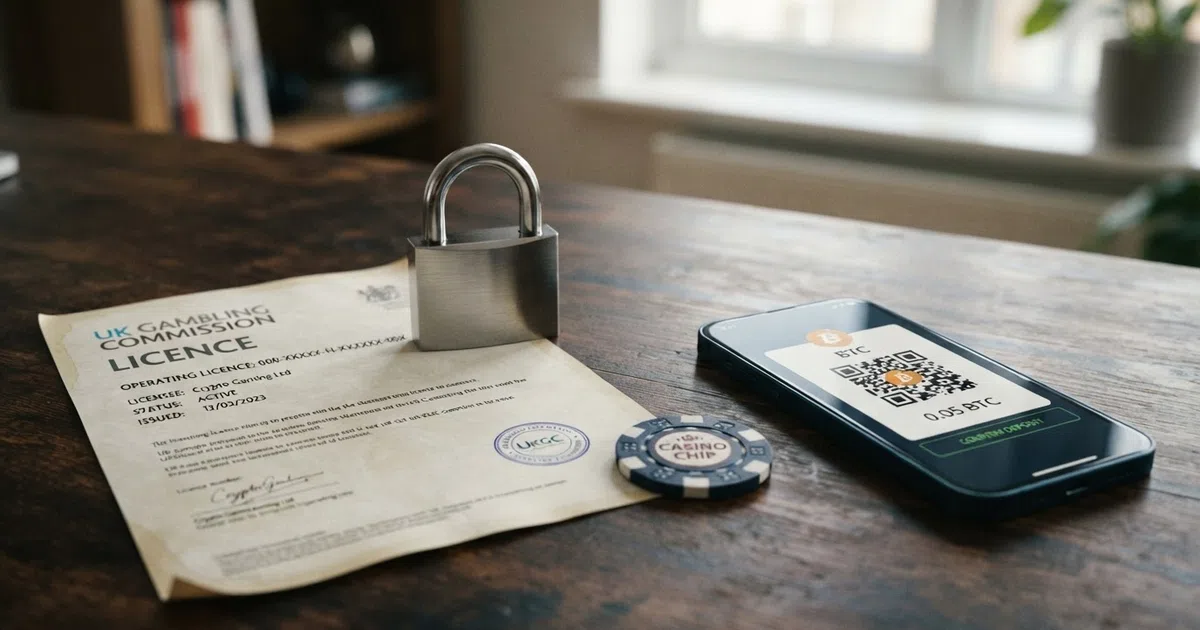
No-KYC gambling from Britain: what the privacy-first casino model delivers and what it costs
The phrase does a lot of work. “Anonymous” in this market almost never means “never any checks.” Industry reporting puts it plainly: no-KYC tends to mean light-KYC or threshold-KYC, where you can deposit, play and make small withdrawals without uploading documents, but verification can still be triggered later. The trigger varies by brand — a fraud or AML flag at one operator, a withdrawal above a set ceiling at another, a routine risk-based check at a third — and the only honest way to read the label is as a description of what happens at the point of signup, not as a permanent state.
That distinction matters more in the UK than in almost any other market, because the UK is the one country in search results where the contrast is total. A UKGC licensee has to verify identity before the first deposit. An anonymous crypto casino has no such obligation under its own jurisdiction, and many deliberately keep the on-ramp as frictionless as an email address. The product on offer is therefore not a softer version of the same thing — it is a different shape entirely. Crypto flows in wallet-to-wallet, the operator never sees a card number, and the only KYC pressure that exists is the pressure the operator chooses to apply to itself.
A consequence follows that most listicles do not state. The search results for this keyword are dominated by affiliate pages that describe these casinos as if “anonymous” were an attribute a UK player could select on a UK-licensed site. It cannot. No GB-licensed operator offers anonymous play; none can. Every result in the search is therefore an offshore brand with no entry on the UKGC public register of 2,661 licensed businesses, and the ranking is hiding the most important line in the comparison.
Crypto-only vs crypto-accepting: the distinction that defines the anonymity level
A Bitcoin deposit button does not make a casino anonymous. Two shapes sit under that label, and they are not equivalent. A crypto-only casino never touches fiat at all — no GBP, no EUR, no card rails — and therefore has no payment-processor trail and no KYC trigger from card networks or banks. A crypto-accepting casino also takes Visa, Apple Pay, bank transfer or e-wallet, which means the same operator is processing personal data through a fiat channel and is more likely, in practice, to be pulled into AML obligations that demand documents.
The wallet-to-wallet flow is what does the privacy work. The player connects a self-custody wallet, the casino credits the deposit, the player plays, and on withdrawal the casino sends crypto back to a wallet the player controls. No payment processor sits in the middle, no merchant of record sees the transaction, and the on-chain record is pseudonymous — addresses, not names. On-ramp and off-ramp models — where a third party converts fiat to crypto before it reaches the casino, or vice versa — reintroduce the identity layer at the edge. Most featured operators in this market are crypto-only, and that is the architecture that makes the no-KYC stance meaningful rather than cosmetic.
The UK anonymous-casino landscape in 2026: why the search volume exists
The volume exists because the regulated alternative does not serve the use case. A player who wants crypto funding, fast withdrawals, and minimal onboarding friction has no fully licensed route into the UK market today, and the regulator is openly working out whether to build one. The UKGC’s Sue Young, speaking at the 2026 KPMG Gibraltar eSummit, described the Commission’s discussions with the Industry Forum and the FCA on a potential path for crypto assets to be used as a consumer payment option for licensed gambling, and called the work “early days.” The CEO, Andrew Rhodes, has been blunter about the politics of it: the question of whether to allow crypto into the licensed frame is a government-level decision, because “once you open that door, you cannot close it.”
That is the gap the search fills. Players searching for an anonymous crypto casino from a UK IP are not confused about the geography — they know the licensed market does not offer the product, and they are looking for the offshore alternative. The problem is that almost every result they find is a listicle that ranks operators without explaining that the ranking is happening entirely outside the regulatory framework the searcher’s own government built. The ranking is real, the bonuses are real, the payout speeds are real, and the absence of every protection a UK player has been taught to expect is also real.
The 10 no-KYC gambling operators UK search results surface — ranked by what each one provides
Every operator below operates outside the GB licensing system. None appears on the UKGC’s public register of 2,661 licensed businesses. A UK player using any of them is gambling with a brand that has no obligation under the Gambling Act 2005, no route into the Commission’s complaints process, and no recognition of any British self-exclusion or protection measure. That is the standing position before the comparison begins.
| Operator | Licence / Jurisdiction | Welcome Bonus | Free Spins | Wagering | Payout Speed |
|---|---|---|---|---|---|
| Jackbit / Jack.com | Curaçao (historical); rebrand entity unconfirmed | 100 wager-free spins on Hot Chilli Bells ($50 min deposit) | 100 | 10x on spin winnings | Under 10 min |
| BC.Game | Curaçao | Up to $20,000 across 4 deposits (180%–360% matches) | 400 ($10 per batch) | 40–45x on deposit+bonus | Under 3 min (USDT TRC-20) |
| CoinCasino | Costa Rica (data-processing only) | 200% up to $30,000 | 50 Super Spins | 60x in 10% instalments | ~14 min BTC/ETH |
| Cryptorino | Costa Rica (data-processing only) | 100% up to 1 BTC | — | 66x | ~20 min |
| Flush | Curaçao | Daily free spins (terms not confirmed) | Daily | — | Under 1 hr (BTC) |
| Bombastic | Not confirmed this run | 100% up to 1 BTC | 250 (50/day for 5 days) | 40x | Sub-2 min USDT |
| TrustDice | Curaçao | 500% up to 1 BTC across 3 deposits | 100 | 35–40x | — |
| mBit Casino | Curaçao | First/second deposit bonus: 40x wagering, 1-day expiry | — | 40x | — |
| Bitcasino.io | Curaçao (since 2014) | None offered | None offered | 0x on all rewards | — |
| Dexsport.io | Not confirmed this run | — | — | — | — |
Where a cell is empty, research did not confirm the figure this run. Empty cells are not the same as a bad result; they are the audit telling you what this page does not know.
Jackbit / Jack.com
Jackbit is the rebranded identity of a Curaçao-licensed operation that changed its public name to Jack.com across 2025 and 2026; whether the new entity inherits the old one’s licence and payout record is not confirmed this run. The welcome offer is unusual for the set: 100 wager-free spins on Hot Chilli Bells on a first deposit of at least $50, with a 10x wagering requirement applied only to the spin winnings, not the deposit itself, and a $100 maximum cashout cap on those winnings. The deposit is yours to withdraw after a 1x playthrough; the spin profits are where the operator’s edge lives. Withdrawals clear in under ten minutes for most methods, against weekly and monthly limits of €7,500 and €15,000.
The verdict depends on what a player values. The wagering is the lowest in the featured set outside Bitcasino.io, the speed is genuinely fast, and the $100 cap on free-spin winnings is small enough to be honest about — a player who treats the offer as a free chance at a $100 win, not as a route to a four-figure payout, has read the terms correctly. The rebrand is the part the audit cannot clear: a player depositing at Jack.com today is taking the new entity’s word for the old entity’s reputation.
BC.Game
BC.Game is the largest catalogue in the set, with 8,000+ games from 100+ providers and 150+ cryptocurrencies accepted, including USDT on the TRC-20 rail that independent April 2026 testing clocked at under three minutes per withdrawal with no platform fee. The welcome package stretches across four deposits — 180%, 240%, 300%, 360% escalating matches up to $20,000 in total — plus 400 free spins paid out in $10-per-batch caps. Wagering is 40–45x on deposit+bonus, with a 30-day validity window that is the longest in the featured set and gives the player more room to clear than the seven-day windows elsewhere. Verification is risk-based and attached to withdrawals rather than deposits, and 150+ coins means the player can move money through the operator without touching a fiat on-ramp at all.
The arithmetic on a $100 first-deposit claim is what a reader needs to see. At a 120% match and 40x wagering on deposit+bonus, the player has $220 in playable funds and faces an $8,800 turnover requirement to unlock the bonus portion for withdrawal. The expected-loss calculation further down this page works that number through; the headline is that a bonus of $120 in name, on a $100 deposit, carries a turnover obligation that runs into four figures. The scale and the speed are real. The cost of the bonus is also real, and BC.Game makes the player work harder for it than almost any peer.
CoinCasino
CoinCasino is the Telegram-native entry in the set, registered in Costa Rica under Deep Sea Tech Ventures with a data-processing licence only — there is no gambling-specific permit behind the brand. The welcome offer is the largest headline figure in the set: 200% up to $30,000 plus 50 Super Spins, with 60x wagering released in 10% instalments. The instalment structure is the interesting part: every 6x of the deposit the player wagers unlocks another 10% of the bonus, so a player who stops at 6x deposit turnover has 10% of the bonus to play with and 90% forfeit pending. The 14-day validity is tight, and the bonus is gone if the player does not move through the instalments in time. Payouts are fast — over 95% of crypto withdrawals processed within 60 minutes by March 2026, with Bitcoin and Ethereum averaging 14 minutes — and the instant payout system launched in February 2025.
The structure is clever and the speed is the strongest in the table, but the licence is the weakest. A data-processing registration in Costa Rica is not a gambling permit; it does not require the operator to segregate player funds, maintain a complaints process, or submit to a gambling-specific audit. A player who values speed and a large headline number gets both here, and they get them on a brand that has fewer regulatory obligations than almost any peer in the table.
Cryptorino
Cryptorino’s welcome is a 100% match up to 1 BTC with a 66x wagering requirement — the highest multiplier in the featured set — and a 7-day clearance window that is the tightest window alongside that high a burden. The maths on a small deposit: a €100 deposit becomes a €100 bonus at 66x, which is €6,600 of turnover to clear in seven days, against a €12 max-bet-per-spin rule that means a player can run the wagering in roughly 550 maximum-sized spins. The operator’s published withdrawal limits are €5,000 per 24 hours, €15,000 per week, and €45,000 per month; the bonus is non-withdrawable before those limits apply, but they bite the moment a player wants their winnings out. Cryptorino also publishes no responsible gambling information at all — no self-exclusion route, no deposit-limit tools, no reality-check pop-ups — which is a red flag the audit should not paper over.
For a player who treats a bonus as a price worth paying for entertainment, 66x is the worst deal in the table. For a player who reads the page and concludes that the bonus is the wrong thing to take, Cryptorino’s no-wagering-zero-bonus path is not on offer — the operator does not run that alternative, and the welcome package is the only headline. The redemption point is narrow: a player who can clear €6,600 of turnover in seven days without breaching the €12 max-bet rule and without bumping into the daily withdrawal ceiling has beaten a structure that is built to make that hard.
Bombastic
Bombastic takes the email-only baseline to its endpoint: no phone, no address, no documents required for standard activity, and registration that asks for what an email provider already knows. The welcome offer is 100% up to 1 BTC plus 250 free spins paid at 50 per day over five days, with 40x wagering and a 5 USDT maximum bet per spin during bonus play. USDT withdrawals clear in under two minutes in test runs, and the operator charges zero platform fees. The licence is not confirmed this run, which leaves the brand’s standing harder to verify than BC.Game’s or Bitcasino.io’s.
The 5 USDT max-bet rule is the clause to watch. A player who runs a single spin above that ceiling during wagering voids the bonus and any winnings tied to it — that is the standard offshore pattern, and Bombastic sets the cap low enough that it takes an inattentive player to trip it. The free-spin drip is the other tell: 50 spins a day for five days keeps the player logging in, which keeps them depositing, which is the point of the structure. The anonymity is the strongest in the set; the verification of the brand’s standing is the weakest.
TrustDice
TrustDice runs the highest headline match in the table — 500% up to 1 BTC across three deposits, plus 100 free spins, with 35–40x wagering in a 7-day window. The arithmetic on the headline: a 500% match on a $1,000 first deposit is a $5,000 bonus with 35x wagering on deposit+bonus, or $210,000 of turnover to clear in seven days. The free spins are a smaller part of the value; the headline percentage is the marketing engine. The 7-day window is tight for a bonus that large, and the wagering terms are designed to be the part most players do not finish.
TrustDice also runs the closest thing to a no-deposit bonus in the featured set, and it is not a welcome bonus in the traditional sense. The crypto faucet pays 67 Satoshis every six hours to any registered account, which is a few pence in fiat terms per claim and functions as an engagement mechanic, not as a route to a meaningful withdrawal. KYC is triggerable on large or flagged withdrawals despite the no-KYC bonus play, which is the threshold-KYC pattern in action. TrustDice is a brand for a player who values a large headline number and is willing to be the one in a hundred who clears the wagering.
Flush
Flush is the operator in the set that emphasises ongoing rewards over a one-off welcome figure. Daily free spins, a Curaçao licence, a privacy-first stance, crypto-only, and BTC withdrawals that clear in under an hour in testing. The welcome bonus details — the match percentage, the wagering, the validity window, the maximum cashout — are not confirmed this run, and the audit is honest about that: a comparison cell that says “not confirmed” is doing the job a guessed figure would corrupt. What is confirmed is the architecture: a Curaçao-licensed crypto-only operator whose product is a daily cadence of small rewards rather than a single large bonus to be cleared.
The honest read is that Flush suits a player who has decided that bonuses are a poor deal and wants an operator whose incentive structure agrees. Without the bonus terms in hand, the calculation is incomplete, and any reader who wants the comparison should treat the Flush row of the table as a placeholder rather than a verdict.
Bitcasino.io
Bitcasino.io is the outlier in two directions. It is the longest-running brand in the set — operating since 2014 under a Curaçao licence — and it does not offer a deposit or welcome bonus at all. There is no match percentage, no free-spin bundle, no wagering multiple to clear, because there is no bonus to take. All rewards, when they come, are paid without wagering requirements — 0x — meaning what the player earns is theirs to withdraw immediately. A WagerX audit deposited 0.7 ETH and withdrew 0.08 ETH without triggering KYC, which is one of the few independent deposit-and-withdraw tests in the set.
The contrast with the rest of the table is the point. Every other operator in the ranking is selling a bonus that costs the player turnover to unlock. Bitcasino.io sells the casino and lets the player keep what they win. For a player who has read the expected-loss calculation further down the page and concluded that bonuses are a tax in different clothing, Bitcasino.io is the only brand in the featured set whose incentive structure agrees.
mBit Casino
mBit is the legacy brand in the set, long-established on a Curaçao licence, and the one whose terms do the most to test the player’s patience. First and second deposit bonuses carry a 40x wagering requirement with a 1-day expiry if wagering is not completed. One day. The shortest window in the table by a factor of seven. The maths on a $200 deposit at 40x on deposit+bonus is $16,000 of turnover in 24 hours, which is roughly 1,500 spins at the maximum-bet ceiling — feasible at speed, but only for a player who treats the bonus as a full session’s commitment the moment they accept it.
mBit is the brand a player picks when they know exactly how much of their bankroll they want to commit to a bonus in a single sitting, and they want the rest of their money out of the offer before the clock runs. For anyone else, the 1-day expiry is the kind of term that voids a win by accident rather than design.
Dexsport.io
Dexsport is the operator in the set for which research confirmed almost nothing. It was reviewed for anonymity by Crypto Daily, and that is the extent of what the page can state with confidence. The licence is not confirmed, the game providers are not confirmed, the welcome bonus is not confirmed, the wagering is not confirmed, the payout speed is not confirmed. The honest read of the operator row in the table is that the comparison is honest about its gaps rather than filling them with plausible guesses.
For a reader, Dexsport is a brand to approach with the diligence the page argues for in its evaluation section: independent testers’ deposit-and-withdraw runs, community feedback over time, and a refusal to deposit on the strength of an affiliate listing alone. The audit cannot tell a reader Dexsport is unsafe; it can tell a reader the page does not have the data to tell them it is safe.
No UKGC licence means no UK protection — the legal reality no competitor page explains
Operating without a GB licence is a criminal offence under section 33 of the Gambling Act 2005, carrying up to 51 weeks’ imprisonment, an unlimited fine, or both. That sanction is directed at the operator, the advertiser and the intermediary — not at the player. No penalty has been traced this run that applies to a UK resident merely for gambling on an unlicensed site. What the player loses by stepping outside the licensed market is not the risk of prosecution; it is the entire scaffolding of protection the licence requires.
The KYC obligation is the spine. Since 7 May 2019, a UKGC-licensed remote operator must verify a customer’s name, address and date of birth before the customer can deposit or gamble. The licensed environment runs on the principle that the operator knows who is on the other end of every session, every deposit, and every withdrawal. The anonymous-crypto model is built on the opposite principle. The two are not different points on a spectrum; they are different products, and the licensed one is the only one that gives the player the protections the regulator requires an operator to provide.
The regulator is not standing still. The UKGC’s enforcement arm published figures for April 2024 to June 2025: 3,140 disruption notices, 447,778 URLs referred to search engines, 287,961 URLs removed, and an average 32% fall in engagement across 160 disrupted sites. The Crime and Policing Bill received Royal Assent, granting the Commission new powers to go after the IP addresses and domain names of illegal sites, although secondary legislation has not yet brought those powers into force. The Commission’s criminal caseload rose 300% year-on-year, driven largely by illegal gambling investigations. The direction of travel is toward more disruption, not less.
What “no KYC” actually means at an anonymous crypto casino — and what it does not
The industry quote is worth keeping in view: no-KYC almost never means never any checks; it means light-KYC or threshold-KYC, where the player can deposit, play and make small withdrawals without uploading documents, but verification can still be triggered later. The trigger points vary by operator, and the variation is what a careful player should map before depositing. At Jackbit, verification is reserved for fraud or AML flags. At BC.Game, verification is risk-based and typically attached to withdrawals rather than deposits. At Bombastic, the baseline is email-only and documents are not required for standard activity. At Cryptorino, the operator publishes no responsible gambling information at all, which is a different problem — the absence of a stated verification policy is not the same as a light one.
The practical distinction is between no-verification and without-verification. The first describes a permanent state the operator has committed to; the second describes a temporary condition that can change at any withdrawal. Anonymous crypto casinos are mostly the second kind, and the page is more useful for saying so than for pretending otherwise.
The UKGC’s KYC obligation: why anonymous play is structurally impossible at any licensed GB site
The architecture is the point. A UKGC licensee runs identity checks before deposit, runs affordability monitoring at a £150 net-deposit threshold in a rolling 30-day period, runs financial vulnerability checks against publicly available data, and runs a mandatory GAMSTOP cross-check at signup. The 7 May 2019 rule makes that first check a precondition for play, not a step that happens later. An anonymous crypto casino runs none of this. The structural impossibility is not a regulatory oversight; it is the definition of the product on each side of the line.
The contradiction at the heart of the keyword is that “anonymous” and “UK-licensed” cannot coexist under current law, and the regulator is not pretending otherwise. The UKGC’s Industry Warning Notice stated that licensed casino games supplied by licensed operators were appearing on unlicensed websites available to GB consumers illegally, and the Commission said it may conduct test purchasing to evidence potential breaches. The licensed games are reaching the unlicensed sites, which means the offshore operator is using content the regulator has approved, and the player on the unlicensed site is playing it without the protection the regulator tied to that approval.
Inside and outside the licensed market: how anonymous casinos operate beyond UKGC reach
The licence regimes in the table split into three groups. Curaçao is the dominant jurisdiction: BC.Game, Flush, TrustDice, mBit, Bitcasino.io, and historically Jackbit all hold Curaçao sub-licences, which require a local master-licence holder and an online gaming permit but do not require the operator to meet UK-equivalent player-protection standards. Costa Rica is the second group: CoinCasino and Cryptorino are registered as data-processing operations under Deep Sea Tech Ventures and Star Bright Media S.R.L. respectively, with a data-processing licence only and no gambling-specific permit. The third group is the operators whose licence is not confirmed this run: Bombastic and Dexsport.io.
What none of these licences provides is the British player’s protection layer. No GAMSTOP recognition, no UKGC ADR route, no British consumer law protection if funds are withheld, no recourse to the Commission if a complaint goes nowhere. A player who understands the difference between “Curaçao-licensed” and “UK-licensed” and chooses the former anyway has made an informed trade; a player who believes the two are equivalent has not.
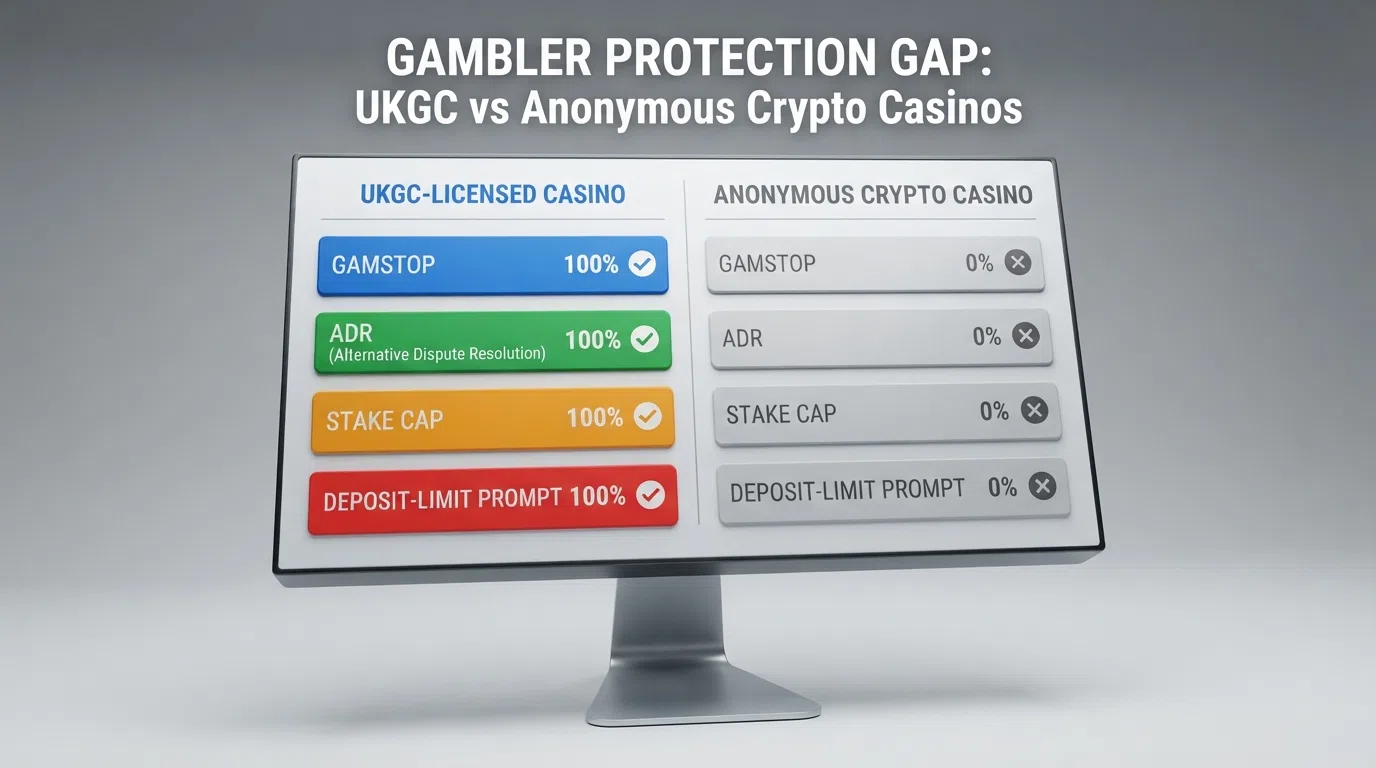
What a UK player loses: the full protection gap in a side-by-side comparison
| Protection | UKGC-Licensed Casino | Anonymous Crypto Casino |
|---|---|---|
| Identity verification before deposit | Mandatory since 7 May 2019 | Not applied at signup |
| GAMSTOP self-exclusion | Mandatory since 31 March 2020 | Not recognised |
| Approved ADR provider for disputes | Required | Not available |
| Statutory online slots stake cap | £5 (25+) / £2 (18–24) since 2025 | No cap |
| Wagering requirement cap on bonuses | 10x since 19 December 2025 | None — offers run 0x to 66x |
| Mandatory deposit-limit prompt | Required since 31 October 2025 | Not offered |
| Financial vulnerability check at £150 net deposit | Mandatory | Not applied |
| Credit-card ban for remote gambling | Since 14 April 2020 | Not applicable (crypto rail) |
| UKGC complaints and enforcement route | Available | Not available |
| Player fund segregation in GB | Required | Not required |
| Responsible gambling information | Required | Inconsistent — Cryptorino publishes none |
Every row in that table is a protection a UK player leaves behind when they deposit at an offshore crypto casino. The bonus cap is the row the wagering arithmetic hits hardest: 10x is the ceiling the UK regulator set, and every operator in the featured set except Bitcasino.io exceeds it. The deposit-limit prompt is the row a player most underestimates in advance — a UK-licensed site will not let a first-time customer deposit without offering a financial limit; an offshore site will let the same customer deposit as much as they wire in, and the only limit is the one the customer sets on themselves.
Why your anonymous casino bonus in 2026 costs more than it looks
The welcome offers across the featured set span 100% to 500% matches, 0x to 66x wagering, and $100 to $30,000 caps. The headline figure is what the marketing sells; the turnover requirement is what the player actually pays. The UKGC’s 10x wagering cap — in force at GB-licensed operators since 19 December 2025 — is the benchmark the offshore set is built to exceed, and exceed it does. The expected-loss calculation further down this section works the real cost on a representative example. The work it does is show what a bonus actually costs the player after the wagering has been cleared, which is the figure no welcome page prints.
The mixed-product ban in force at UKGC licensees since the same date is the other piece of context. A GB-licensed operator cannot condition a bonus on the customer playing slots, then live casino, then sportsbook in sequence. An offshore operator can, and several of the featured welcome packages structure wagering contributions that way. A player who values simplicity gets a UK bonus; a player who values headline size gets an offshore one, and the difference is the protection and the cost.
Welcome bonuses side by side: what each operator actually puts on the table
The comparison table in the ranking section already renders the headline figures: bonus type, free-spin count, wagering multiplier and tested payout speed. The cell that does the most work is the wagering column, because that is the column that turns a $1,000 bonus into either a ten-turn playthrough at a UK-licensed site or a forty-to-sixty-six-turn playthrough at an offshore one. Where research did not confirm a value — Flush’s terms, Dexsport’s bonus, Bombastic’s validity window — the cell is empty rather than filled. The empty cell is the audit doing the job a guessed figure would corrupt.
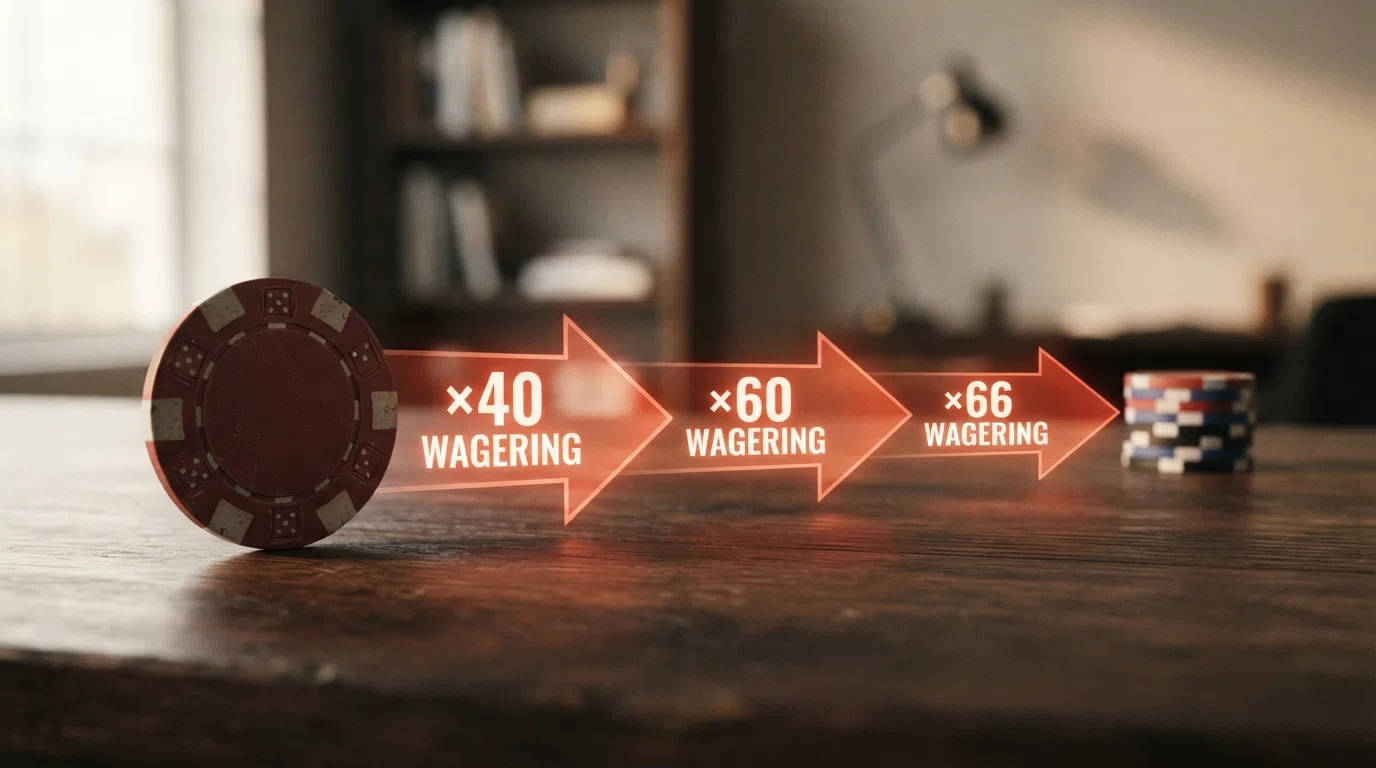
Wagering requirements: 40x, 60x, 66x — and why the UK’s 10x cap rewrites the value proposition
A wagering requirement is the multiple of the bonus (or deposit+bonus) the player must bet before the bonus converts to withdrawable cash. The range across the featured set is wide: 0x at Bitcasino.io, where there is no bonus at all; 10x at Jackbit on free-spin winnings only; 35–40x at TrustDice; 40x at BC.Game, Bombastic and mBit; 60x at CoinCasino, released in instalments; 66x at Cryptorino. The arithmetic on the worst case in the table is what makes the cost real.
Take BC.Game’s first-deposit match: 180% up to $1,000 with 40x wagering on deposit+bonus. A player who deposits $100 receives $180 in bonus money, has $280 in playable funds, and must turn over $11,200 — the deposit and bonus combined, multiplied by 40 — before the bonus portion becomes withdrawable. The expected loss on that turnover, at a representative slot RTP of 96%, is $11,200 multiplied by 4% (the house edge), or $448. The expected value of the bonus to the player is the bonus amount ($180) minus the expected loss ($448), which is -$268. The bonus is not free money. The bonus is, on average, a $268 cost for a $180 headline gain.
The UK’s 10x cap is the contrast. The same $100 deposit at a UK-licensed site, hypothetically matched 100% with 10x wagering, would have $200 in playable funds, a $2,000 turnover requirement, and an expected loss of $80 at 96% RTP. The expected value of the bonus to the player is $100 minus $80, which is +$20. The UK bonus is, on average, a $20 gain. The offshore bonus at 40x is, on average, a $268 loss. The gap is the wagering cap.
Free spins, no-deposit offers and the faucet that is not a bonus
No featured operator offers a traditional no-deposit welcome bonus. The closest equivalent is TrustDice’s crypto faucet, which pays 67 Satoshis every six hours to any registered account — a few pence in fiat terms, not a route to a meaningful withdrawal, and not a bonus in the conventional sense. The faucet is an engagement mechanic that keeps a player logging in; the welcome bonus at TrustDice is the conventional deposit-match structure with 35–40x wagering behind it. Treating the faucet as a no-deposit bonus is a misread of what it actually is.
Jackbit’s 100 wager-free spins are the closest the featured set comes to a no-strings offer, and even those require a $50 minimum deposit to trigger, with a $100 maximum cashout on the spin winnings. The wagering is 10x on the winnings, not the deposit, which is the lightest burden in the table. The free-spin terms that vary across the set: BC.Game’s 400 spins are paid in $10-per-batch caps with a $10 maximum withdrawal per batch; Bombastic’s 250 spins are paid at 50 per day for five days; CoinCasino’s 50 Super Spins carry a separate 35x wagering on winnings. The batch caps and daily drip structures are the same pattern in different costumes: they keep the player returning, which is the operator’s goal and the player’s small-print cost.
Bonus validity, max bets and cashout caps: the small print that can void a win
| Operator | Wagering Multiplier | Validity Window | Max Cashout Cap |
|---|---|---|---|
| Jackbit | 10x (spin winnings only) | 7 days | $100 on FS winnings |
| BC.Game | 40–45x (deposit+bonus) | 30 days | $10 per FS batch |
| CoinCasino | 60x (in 10% instalments) | 14 days | — |
| Cryptorino | 66x | 7 days | — |
| Bombastic | 40x | — | — |
| TrustDice | 35–40x | 7 days | — |
| mBit Casino | 40x | 1 day | — |
| Bitcasino.io | 0x | N/A | N/A |
The 1-day window at mBit is the standout. The 5 USDT max-bet rule at Bombastic and the €12 max-bet rule at Cryptorino are the small-print clauses that void bonuses by accident. A player who spins once at $13 during wagering at Cryptorino loses the bonus and any winnings tied to it. The rule exists at every featured operator; the thresholds are the part that vary, and the threshold is what the player has to read before they accept the offer.
The prescribed bonus-cost calculation: how long to clear BC.Game’s 40x on a $100 deposit
The formula is: required turnover = bonus × wagering factor; spins = turnover ÷ stake per spin; play time (hours) = spins × 5-second interval ÷ 3600. Plugging in BC.Game’s first-deposit welcome of 180% up to $1,000 at 40x wagering on deposit+bonus, a $100 deposit, a $1 stake per spin and a 5-second spin interval: the player receives $180 in bonus money, has $280 in playable funds, and must turn over $11,200 to clear. At $1 per spin, that is 11,200 spins. At 5 seconds per spin, that is 1,000 seconds, or roughly 17 minutes of continuous play.
For contrast, the same $100 deposit at a UK-licensed site with the GB-licensed maximum 10x wagering on bonus only — the $180 bonus at 10x — would require $1,800 of turnover, or 1,800 spins at $1, or 4,000 seconds, or 1 hour 7 minutes. The offshore bonus at 40x on deposit+bonus takes more than six times as long to clear as the UK bonus at 10x on bonus only, on the same deposit, against the same games. The time cost is the wagering multiple in hours, and the wagering multiple is the bonus’s real price.
These are statistical estimates — averages over many spins under the stated assumptions, not a guarantee for any single player. The calculation promises no win, no payout and no return. It tells the player how long the bonus will take to clear if the player plays through to the end, which is the input the welcome page does not provide.
Crypto payouts clear in minutes — but speed is not the whole withdrawal story
The figures from independent testing are unambiguous. BC.Game clears USDT on the TRC-20 rail in under three minutes. Jackbit clears most withdrawals in under ten minutes. CoinCasino’s Bitcoin and Ethereum withdrawals averaged 14 minutes across March 2026, with over 95% of crypto withdrawals processed within 60 minutes. Cryptorino’s test withdrawal landed in 20 minutes. Flush’s BTC withdrawals clear in under an hour. Bombastic’s USDT withdrawals clear in under two minutes with zero platform fees. These are not marketing claims; they are observed times from deposit-and-withdraw tests by named independent reviewers.
The counterweight is the withdrawal limits. Jackbit caps at €7,500 per week and €15,000 per month. Cryptorino caps at €5,000 per 24 hours, €15,000 per week and €45,000 per month. BC.Game charges no platform fee but the network fee is the network’s, and on a congested day the time and the cost both rise. The speed is real, and the limits are real, and the player who wants both will end up at a different operator from the player who wants only one.
Crypto vs traditional payout speed: why the gap exists and how wide it really is
Crypto withdrawals settle on-chain. The operator initiates the transaction, signs it with the casino’s wallet, and broadcasts it to the network. The network confirms it in seconds on TRC-20, in tens of minutes on Bitcoin mainnet, and instantly on the Lightning Network. There is no payment processor in the middle, no bank intermediary, no manual review delay, no opening-hours constraint. UKGC-licensed sites process withdrawals through payment gateways and bank rails, where one to three business days is standard and where weekends and bank holidays stretch the timeline.
The Lightning Network and TRC-20 are the acceleration layers that cut the confirmation time from thirty to sixty minutes to seconds, and they explain why BC.Game’s TRC-20 USDT is faster than its BTC: the network design is the speed. The caveat is that speed depends on network congestion, on the operator’s internal processing queue, and on the player not triggering a verification review. A withdrawal that lands in under three minutes on a Tuesday afternoon can land in under ten on a Sunday night during a market move, and the player who has not set the expectation to the operator’s slowest case will be the one complaining in the chat.
No app needed: how anonymous crypto casinos work on a UK mobile screen
None of the ten featured operators requires a dedicated app. All are accessible through a mobile browser, and the responsive design at most of them is the product rather than a fallback. The practical consequence is that there is no app-store gatekeeping in the player’s flow: no Apple or Google KYC overlay, no geo-restriction enforcement through store policy, and no app permission footprint on the player’s device. The browser is the front door, and the browser does not ask for a reason.
That absence cuts both ways. The player does not get the curated experience of a native app, but the player also does not get the curated surveillance of one. An app store can require an operator to add identity verification before listing, can refuse to list a brand in a specific country, and can demand permissions the player may not want to grant. A mobile browser does none of this, and the operator’s site is what the player sees, no more and no less.
The mobile crypto casino experience: what changes on a smaller screen
Game-provider mobile optimisation is the technical layer that makes the experience work. Pragmatic Play, Hacksaw Gaming and Evolution titles — used by Jackbit and BC.Game — are mobile-optimised as standard, and the touch interface on a phone screen is the design target rather than an afterthought. The wallet connection on mobile runs through QR codes or mobile-wallet deep links, which is a friction point the desktop flow does not have. A player depositing from a phone is scanning a code or approving a wallet connection; a player depositing from a desktop is copying an address or connecting a browser extension. The flow is the same underneath; the entry point is what differs.
The honest read is that the mobile experience at the featured operators is good enough to be the default for most players, and is not so good that a player who values a larger screen should feel they are missing out. Per-operator mobile testing data is not confirmed this run; the page covers the architecture rather than the brand-level difference.
What you can actually play: slots, live dealer and provably fair games at anonymous casinos
The game counts at the featured operators are aggregator-scale. BC.Game lists 8,000+ games from 100+ providers. Cryptorino lists 6,000+ from 70+ providers. CoinCasino lists 4,000+ from around 60 studios. Jackbit’s catalogue runs into the thousands with Pragmatic Play, Hacksaw Gaming and Evolution among the providers named in the public terms. These are not proprietary games; they are third-party titles aggregated into one platform, and a player who has played a Pragmatic Play slot at one offshore casino has played the same game at another.
The anonymity promise changes what fairness verification looks like, because the regulator is not in the loop. A UKGC-licensed slot is audited by an approved testing house before it goes live, and the return-to-player is published and enforced. An offshore slot may be the same game running on the same RNG, but the audit trail is the operator’s claim rather than the regulator’s check. Provably fair is the concept the offshore market has built to fill that gap, and the page works through what it is and what it is not.
Provably fair vs traditional RNG: the verification difference that matters when there is no regulator
Provably fair is a cryptographic verification system. The operator commits to a server seed before the round starts, the player provides a client seed, and the result of the round is generated from a hash of both. After the round, the player can verify the hash against the server seed and confirm the outcome was not changed after the fact. The verification is mathematical, not reputational, and the player can run it themselves with a hash checker. Most games at the featured operators are standard provider titles — Pragmatic Play slots, Evolution live-dealer tables, Hacksaw Gaming crash games — and most of those are not provably fair in the strict cryptographic sense. The original in-house titles, where the operator runs the game’s logic, are the ones where provably fair is more likely to be available.
The limitation is the one the concept does not advertise. Provably fair verifies the individual game round. It does not verify the operator’s solvency, the operator’s willingness to pay out, the operator’s enforcement of the bonus terms, or the operator’s behaviour when a player requests a large withdrawal. A provably fair game at an operator that refuses to pay is a provably fair game the player never sees the winnings from. The verification is real and useful, and it is not a substitute for a licence.
How to evaluate no-KYC gambling sites when the usual safety signals are absent
The UKGC public register is the single verification source for GB-licensed operators: 2,661 licensed businesses, downloadable as a full list, searchable by name. None of the featured operators in this ranking appears on it, which is the first signal the page can offer. The second signal is the one a player builds themselves in the absence of a register entry: licence or permit transparency, independent testing, community reputation over time, and bonus-term clarity.
Licence transparency is the cheapest signal to read. An operator that names its jurisdiction on its homepage, links to the regulator’s register, and publishes its company registration is more verifiable than one that buries the licence in a footer or names only a generic “Curaçao” without the licence number. Independent testing is the next signal: a third-party tester who deposited real funds and withdrew them, and published the times, the limits, and the verification triggers, is more useful than a marketing claim. Community reputation over time is the signal a new operator cannot fake: a brand operating since 2014 with no major payout scandal (Bitcasino.io) carries weight a 2026 newcomer does not, and the absence of a track record is itself information. Bonus-term clarity is the last: an operator that publishes its wagering multiplier, its validity window, and its max-bet rule prominently is doing the player a service an operator that buries them in a 30-page terms document is not.
What independent reviews and community feedback actually cover — and what they miss
The search results for this keyword are almost entirely commercial affiliate content. Every ranking page has a financial incentive to list operators, and the operator at position one is often the operator with the highest commission rate rather than the one with the best payout record. The independent testers named in research — WagerScope, WagerX, NoKYC Vault, Bitranked, Crypto Daily — provide deposit-and-withdraw data that is more objective than a surface-level description, and a tester who names the time, the coin, the amount, and the verification trigger is doing the job an affiliate listicle does not.
Community forums and player reports fill the gap the testers cannot. A tester runs one deposit and one withdrawal. A community runs hundreds, and the pattern that emerges from hundreds is closer to the truth than the pattern that emerges from one. A player report on a delayed withdrawal, a voided bonus, a refused KYC at the threshold — these are the data points an operator’s marketing page will not publish, and they are the data points a careful player reads before depositing. The advice is qualitative and not invented: cross-reference at least two independent sources, prefer testers with a track record over testers with a single post, and treat the absence of complaints as less informative than the presence of resolved ones.
New for 2026: the latest anonymous crypto casino launches — and what “new” actually means for trust
The rebrands and launches that qualify as new in 2026 are limited. Jackbit’s rebrand to Jack.com ran across 2025 and 2026. CoinCasino’s instant payout system launched in February 2025. Beyond those two data points, the broader pattern is that genuinely new anonymous crypto casinos launch frequently and few survive long enough to build a verifiable payout record. The trade-off is the one every new casino asks the player to make: a fresh welcome bonus is often the most competitive offer the operator will ever run, because the operator has no reputation to trade on and needs the deposit flow to build one. The same absence of track record means there is no data on whether the operator pays.
The newness is the marketing and the risk at the same time. A player who deposits at a 2026 launch has no community data to lean on, no long-term payout record to read, and no test-results-from-independent-reviewers to quote. A player who deposits at a 2014 launch (Bitcasino.io) has all three. The price of the headline bonus at the new casino is the absence of the track record at the old one, and the player has to choose which trade they would rather make.
2026 newcomers and rebrands: the operator changes that reset the due-diligence clock
A rebrand is not a new casino. Jackbit’s move to Jack.com is the same operation under a different name, and the question of whether the new entity inherits the old one’s licence, the old one’s payout record, and the old one’s player balances is not confirmed this run. The practical question for a player depositing at Jack.com today is whether the operator’s payout data from six months ago still applies to the site they are visiting. The honest answer is that the page cannot confirm it does.
A relaunch is a different shape. An operator that closed and reopened under a new domain carries no inherited reputation, even if the team is the same. A genuine new launch — a new domain, no prior track record, a first welcome bonus the operator is using to seed deposits — is the third shape, and the one a player should approach with the most caution. CoinCasino’s Costa Rica registration as a data-processing operation, with no gambling-specific permit, is the example to keep in view. The page has described what the licence is and what it is not; the player has to decide whether the description is enough.
The responsible gambling tools that do not exist offshore — and the ones a UK player can still use
What does not exist at any featured operator is a meaningful list. No GAMSTOP self-exclusion recognition. No mandatory deposit-limit prompt before first deposit. No financial vulnerability check at £150 net deposit. No £5/£2 online slots stake cap. No 10x wagering cap. No automatic reality-check pop-up after one hour of play. No approved ADR provider for dispute resolution. No British consumer-law route if funds are withheld. The player trades all of this for the speed and the anonymity, and the trade is the part the page exists to make legible.
What the UK player can still access is independent of any casino’s licence status. GamCare’s National Gambling Helpline is free and confidential. The NHS runs gambling harm clinics in England, Scotland and Wales. GambleAware funds the National Gambling Support Network, which treated 11,960 clients in 2024/25 with a 93% improvement rate among those completing treatment. Gamblers Anonymous runs peer-led support groups across the UK. The player can set a personal deposit limit at the wallet level by moving only what they intend to play with into a separate wallet, and they can decide in advance what a winning session looks like before they sit down. The tools that do not exist on the casino side can be built on the player side, and the building is the player’s responsibility.
The prevalence data is what gives the section its weight. 0.4% of adults in England experienced problem gambling (PGSI 8+), and 1.6% experienced at least moderate risk gambling (PGSI 3+), according to the NHS Adult Psychiatric Morbidity Survey 2023–24. GamCare’s National Gambling Helpline made 996 referrals to treatment in January 2026, a 48% year-on-year increase. The numbers are not abstract; they describe the population a UK player is part of when they sit down at any of the operators in this ranking.
The help that is still there: GamCare, NHS clinics and the resources a UK player can use regardless of where they play
GamCare’s National Gambling Helpline is the first call. Freephone, live chat, 24 hours. The 996 referrals in January 2026 were a 48% increase on January 2025, which is the helpline’s signal that demand is rising faster than the supply of funded treatment can keep up. The National Gambling Support Network treated 11,960 clients across Great Britain from April 2024 to March 2025, an 11% increase on the previous year, and 93% of those completing treatment saw improvement. The NHS gambling harm clinics in England, Scotland and Wales are free at the point of use and operate on a clinical model. Gamblers Anonymous runs peer-led meetings across the UK and is the option for a player who wants the recovery conversation to come from people who have lived it. None of these services checks which casino a player uses. All of them are reachable from a UK phone, regardless of where the player has deposited.
Frequently asked questions about anonymous crypto casinos
Do I really need to provide no identity documents at a no-KYC crypto casino?
“No-KYC” in this market rarely means zero checks. It usually means “light-KYC” or “threshold-KYC,” allowing you to deposit and play without immediate document uploads. However, operators often trigger verification based on risk, withdrawal amounts, or AML flags. You should always be prepared to provide ID if the operator asks for it.
How fast are withdrawals at anonymous crypto casinos compared to UK-licensed sites?
Crypto withdrawals are significantly faster, often settling in minutes because they operate on blockchain rails without bank intermediaries. UK-licensed casinos use traditional payment systems that typically take one to three business days. While crypto speed depends on network congestion, it is structurally faster than regulated fiat payment methods.
Can I claim a no-deposit bonus at an anonymous crypto casino without verification?
Most featured anonymous operators do not offer traditional no-deposit welcome bonuses. Any no-deposit offer, if available, often functions as an engagement tool rather than a withdrawal-ready bonus. Even when no initial document upload is required, operators may still trigger KYC before allowing you to withdraw any winnings from that bonus.
Can a UK player who has registered with GAMSTOP still access and play at anonymous crypto casinos?
Yes, but with no protection. Anonymous crypto casinos operate entirely outside the UKGC licensing framework and do not participate in the GAMSTOP self-exclusion scheme. Registering with GAMSTOP is mandatory for licensed UK sites, but it does not prevent you from accessing or depositing at an unlicensed offshore casino.
What happens if an anonymous crypto casino refuses to pay my winnings — do I have any recourse as a UK player?
You have no formal recourse. Because these operators are unlicensed in Great Britain, you cannot use the UKGC’s complaints process, and they do not use approved UK ADR providers. If a dispute arises or funds are withheld, you are governed solely by the offshore jurisdiction’s laws and the casino’s terms.
Are anonymous crypto casinos safe, or am I risking my money by playing at unlicensed sites?
Playing at unlicensed sites carries significant risks, including the absence of consumer protections like stake caps, wagering limits, and fund segregation. While the speed of crypto is real, the regulatory gap means you lack the legal guarantees and dispute resolution paths that protect you when gambling at a licensed UK site.
The ten operators in this ranking were identified from the UK-facing “anonymous crypto casino” search results and cross-referenced against the UKGC public register. None of the ten appears on the register, which is the single verification source for GB-licensed businesses and which contains 2,661 licensed operators as a downloadable list. The brands that surface for a UK searcher are the brands the page works through, because the searcher is who the page is for.
Each operator’s licence or permit status was sourced from its own website and cross-referenced where possible against independent affiliate testers. Where a licence is not confirmed, the page says so. Bonus terms were sourced from operator sites and verified against named independent testers — WagerScope, WagerX, Bitranked, NoKYC Vault, Crypto Daily — who have run real deposit-and-withdraw tests and published the results. The ranking criteria were qualitative: licence or permit transparency; KYC stance and the practical anonymity level; bonus value net of wagering burden; payout speed and withdrawal-limit fairness; game selection breadth and provider quality; track-record length and community reputation. No numerical scores or percentage weightings are applied, because the research does not carry the data to weight them, and a weighted score built on incomplete data is less honest than a ranked list with honest gaps.
The ranking is not exhaustive. It covers the operators that dominate the UK-facing search results at the time of research. Other offshore brands exist that did not surface, and a player who finds one through a different search should apply the same criteria this page applies to the ten in the table.
What the numbers actually say: your move as a UK player in 2026
The protection gap is documented and real. No UKGC-licensed operator can offer anonymous play, because the 7 May 2019 KYC rule makes anonymous play structurally impossible at any licensed site. Every anonymous crypto casino a UK player can use sits outside the regulatory framework, and every protection that framework provides is absent. The list of what is absent is the list in the protection table above, and the list is long.
The crypto payout speed is the one unambiguous advantage. Minutes versus days, on a settlement system that does not run on bank hours, and at limits that vary by operator but that no UKGC-licensed casino can match for the same stake sizes. The speed is structural, not promotional; it is a feature of blockchain settlement, and it would persist even if every marketing claim on the offshore sites were a lie.
The bonus headline figures are not free money. A 40x wagering requirement on deposit+bonus turns a $180 bonus on a $100 deposit into an $11,200 turnover obligation and, at 96% RTP, a $448 expected loss against a $180 headline gain. The expected-value calculation runs negative on most welcome offers in the featured set; the only operator in the table whose incentive structure agrees with the player is Bitcasino.io, with 0x wagering on a model that does not offer a welcome bonus at all. The player who has decided the bonus is the wrong thing to take has a single option in the featured set; the player who has decided to take the bonus has nine, and the wagering terms are what separate them.
The UKGC is actively exploring a path for crypto as a consumer payment option at licensed operators. The Commission is in discussions with the Industry Forum and the FCA, the work is described as “early days,” and the CEO has framed the policy choice as one that, once made, cannot be unmade. The landscape can change. The page is a snapshot of what it looks like in 2026, and the snapshot will need a refresh when the Commission’s position lands.
The reader’s decision turns on a single trade-off. The combination of crypto payout speed and on-ramp anonymity is real, and the loss of every UK regulatory safeguard is also real. The page has given the reader the figures — wagering multiples, expected losses, withdrawal limits, prevalence data, regulatory gaps — to make the trade-off for themselves. The page does not recommend an operator, does not recommend against the category, and does not pretend the choice is costless. The choice is the reader’s, and the data is the data.
Account – No Minimum Deposit Casinos UK
Content created by the «No Minimum Deposit Casinos UK» team